


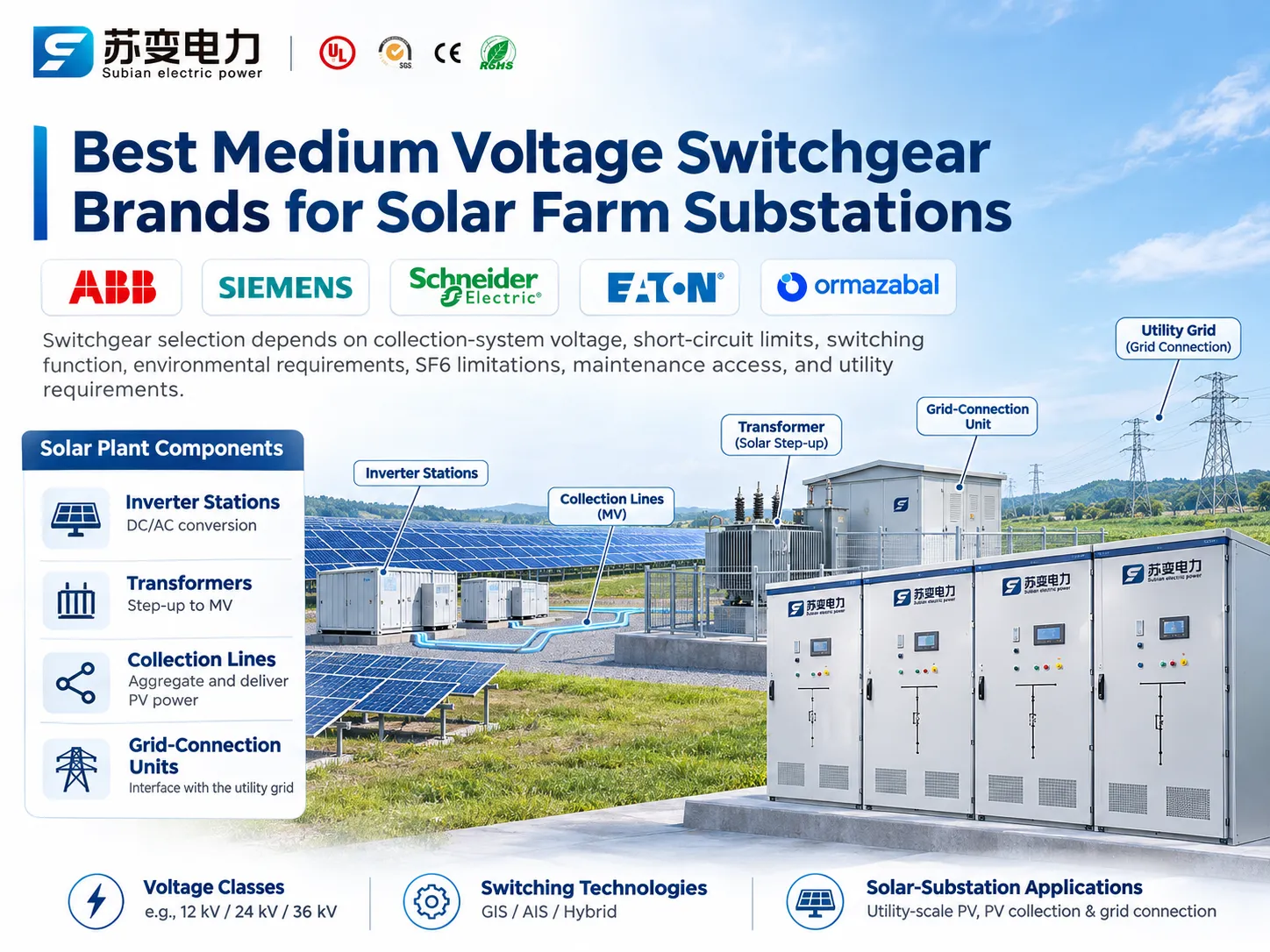
The process of selecting medium voltage switchgear for solar plants is different from that used in traditional power networks. In a solar plant the components of the facility include inverter stations, transformers, collection lines and grid-connection units. All equipment will serve different functions even if its technical parameters are the same.
Actually, the search for medium voltage switchgear brands that suit solar substations is more of an engineering task rather than relying on brand names. There are companies that manufacture well-known brands such as ABB, Siemens, Schneider Electric, Eaton, Ormazabal, but the products offered by companies are of different voltage classes, switching technologies and specific applications. One should not equate a 24kV compact unit with a 36kV metal-clad unit.
To summarize, ABB UniGear, Siemens NXAIR and 8DJH, Schneider Electric AirSeT, Eaton Xiria and Ormazabal switching devices are useful points to consider when looking for solar farm switchgear. The choice must be made based on voltage of the collection system, future short-circuit limit, switching functionalities, environmental requirements, SF6 limitations, maintenance access and the utility requirements. The need to conduct brand-wise models comparison rather than rely on brand names is highlighted.
The purpose of this guide is to provide resources for different solar power implementation stakeholders, including solar developers, Engineering/Procurement/Construction contractors and engineering advisors. The information contained in this guide is based on both publicly available information provided by manufacturers together with renewable energy project experience during the project development. The company Subian Electric is not affiliated with any of the products considered and the product names are used for technical reference only.
Why Do Solar Farm Substations Need Medium Voltage Switchgear?
In general, a utility-scale solar plant is formed by a number of electrical blocks placed sequentially one after the other. Solar PV panels produce DC which is forwarded to an inverter to transform the generated DC into controlled AC for transportation to a low-voltage bus or directly to a medium-voltage outlet, as per the design of the inverter. The direct-transfer transformer is used in raising the voltage for the medium-voltage collection lines, which transport the power to the collector structure of the solar plant or to the connection substation of the electric grid.
The hierarchy can vary according to an existing electricity plant and utility. A good sequence of the path of electricity in a solar power system is:
PV arrays → inverters → transferring transformers → MV switchgear + collection lines → collector/substation → interface point.
Apart from the existing auxiliary function, the switchgear also serves a number of functions while being used on the path. It allows for isolating the transformer station for the purpose of maintenance, connects/disconnects a feeder, helps in clearing electrical faults thanks to available circuit breakers, offers earthing, and delivers the needed measurements and signals for the protection and automation systems. One should note that the switchgear itself doesn’t generate reactive power thus the protective features need adequate control and development of the inverter together with reliability of the protection system.
Inverter station equipment vs collector-substation equipment
There are many inverters, one of which has its own transformer. A compact module may have a transformer protection. More than one feeder comes to the bus strip of the collector substation, and this means the requirement for draw-outs in circuit breakers. The difference is significant because the RMUs are a type of MV switchgear and not a separate type of equipment. It’s possible that at one point of plant equipment should have a compact RMU along with MV equipment. For a deeper explanation of the electrical ratings of compact ring units, see our Ring Main Unit Specifications guide.
Five Medium Voltage Switchgear Brands Worth Comparing for Solar Farms
The five manufacturers listed below are representative manufacturers with reference products or solar project records. They are not ranked according to reliability, sales, price, or market share. The product limitations mentioned here refer to certain published product families only, not to every variation listed in their catalog; make sure you always request a fresh configuration-specific data sheet.
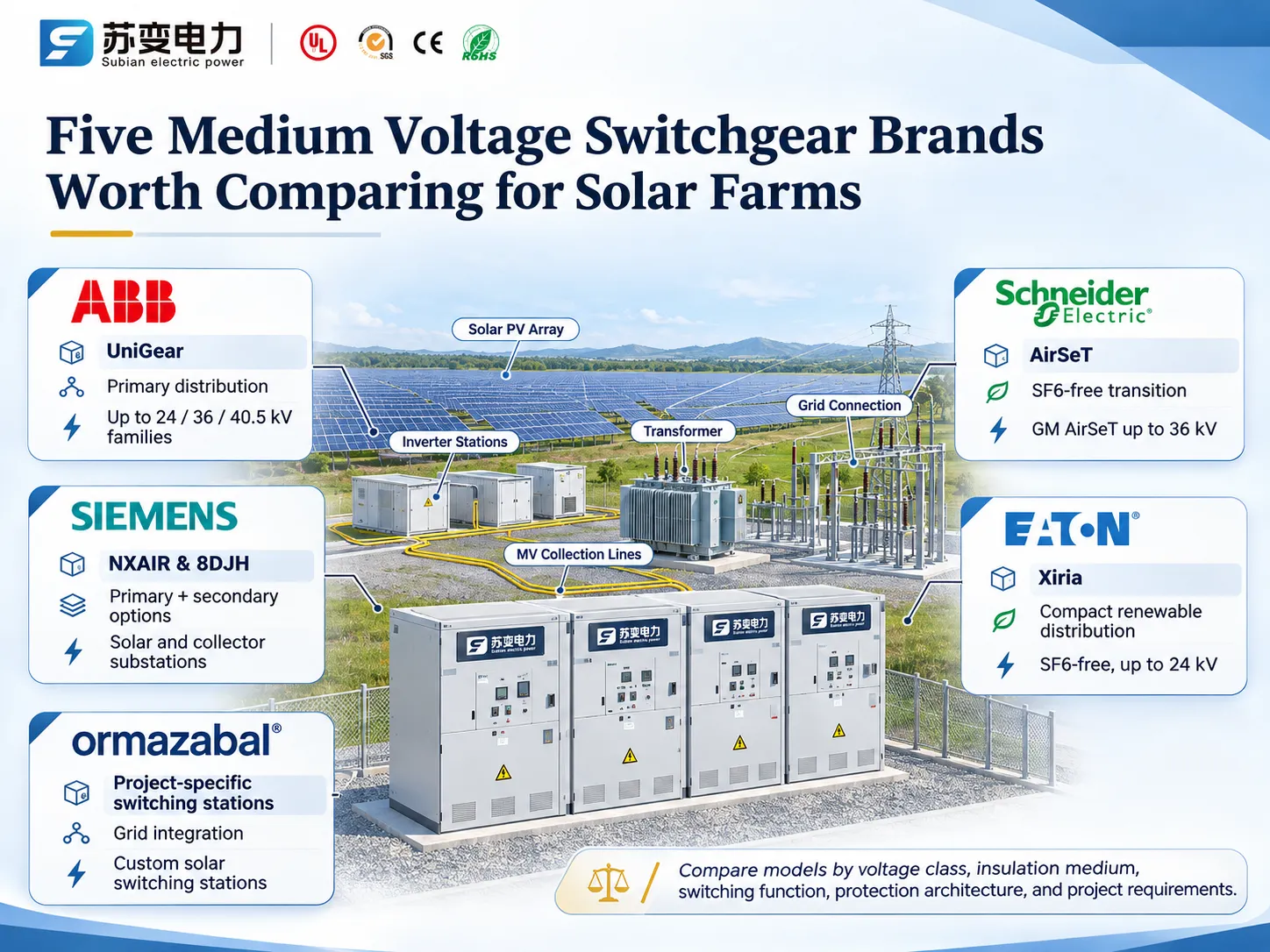
ABB: UniGear for primary distribution and solar collector substations
ABB’s UniGear product line is of special importance in cases a solar EPC needs metal-clad primary distribution equipment with specific feeder functions and protection architecture. In the ABB comparison of the UniGear lines, UniGear ZS1 has a capacity of up to 24 kV, ZS2 up to 36 kV, and ZS3.2 up to 40.5 kV; however, these product families represent different classes of equipment rather than a single cabinet that operates at all the above voltage levels. See the ABB UniGear portfolio.
ABB also brings an unusually useful real-world example of solar applications. In the Cirata floating solar project in Indonesia, ABB exhibits that it supplied 17 UniGear ZS1 medium voltage panels equipped with Relion protection relays including REF615 feeder protection. The project makes it clear why it is important to ensure feeder protection, fault clearing, remote operation, and possibility to expand the network at the utility scale PV installation in question. It does not mean that this ZS1 configuration can be used in the 33 or 35 kV collection network; rather, it means that the voltage class of the equipment needs to be verified. Source: ABB Cirata project announcement.
Schneider Electric: AirSeT and the SF6-free transition
The Schneider Electric portfolioThe AirSeT product range includes GM AirSeT primary switchgear (up to 36 kV) and RM AirSeT secondary preference switchgear (up to 24 kV) with other families of air-insulated products. AirSeT is positioned as a fluorinated gas-free alternative for the selected applications. The switching technology and voltage level depend on what AirSeT model is selected. Source: Schneider Electric MV portfolio.
In Europe, for some solar installations, the insulation and switching medium has become a procurement question, not just a sustainability issue. But a 24 kV RM AirSeT product cannot be assumed to be applicable in the feeder of 33/35 kV voltage class. The actual voltage class of equipment and functional units available should not be compared on the basis of environmental mission only.
Siemens: NXAIR primary switchgear and 8DJH secondary distribution
Siemens provides the primary air-insulated switchgear and secondary distribution equipment in a compact design. The NXAIR H series features the rated voltages up to 36 kV with maximum short-circuit ratings depending on configuration (up to 31.5 kA). The fact that the device is air-insulated and has the vacuum breaker with various digital devices makes this equipment interesting as a subject for research in the area of collector stations. Source: Siemens NXAIR.
The 8DJH 36 series represents the compact three-phase installation for the gas-insulated switchgear with the clear indication by Siemens that this equipment can be used in wind and solar projects. The insulation technology should not be confused with SF6-free NXAIR air-insulated technology. In the purchase specifications, the generation of the equipment, insulation medium, voltage class, and switching units must be specified. Source: Siemens 8DJH 36.
Eaton: Xiria for compact renewable-energy distribution
Eaton clearly states that its SF6-free Xiria switchgear can be used in solar plants and wind farms. Thus, the published series has a maximum voltage of 24 kV, and the corresponding figures for the operation current are equal to 630 A, which means that the malfunction breaker is employed in this equipment. Source: Eaton Xiria technical information.
This clearly shows how critical the voltage filter is. Equipment suitable for 20 and 22 kV can hardly be used in features of 33 and 34.5 kV – the voltage matters here much, and another product from Eaton must be chosen for this application.
Ormazabal: project-specific switching stations and grid integration
Ormazabal’s public case study on a German RWE photovoltaic project describes customized medium-voltage switching stations used to gather PV feeder circuits and connect them to the common grid interface. In the documented example, a cgm.800 switchgear arrangement with five cubicles operated at 25 kV and included the project’s distribution and metering functions. Source: Ormazabal / RWE solar switching-station case.
The case is helpful because it shows how the complete delivered station—building, metering, protection, cable interfaces and switchgear—can matter as much as the cubicle itself. Its 25 kV operating figure is a project fact, ليسوا a general maximum-voltage statement for every cgm.800 product.
ABB vs Siemens vs Schneider vs Eaton vs Ormazabal: A Technical Comparison
Use this table to identify suitable product families for initial investigation. It is deliberately not a price, quality or reliability ranking, and it does not imply that the different families have identical performance or certification.
| الشركة المصنعة | Representative family | Published voltage reference | Useful solar-farm evaluation point |
|---|---|---|---|
| ABB | UniGear ZS1 / ZS2 / ZS3.2 | Up to 24 / 36 / 40.5 kV, respectively | Primary switchgear, feeder protection and documented Cirata solar reference |
| شنايدر إلكتريك | GM AirSeT / RM AirSeT | Up to 36 / 24 kV, respectively | Primary vs secondary use; SF6-free equipment options |
| سيمنز | NXAIR H / 8DJH 36 | Up to 36 kV in these families | Air-insulated primary vs compact gas-insulated secondary architecture |
| إيتون | Xiria | Up to 24 kV | Compact secondary distribution; vacuum switching; solar application stated by manufacturer |
| Ormazabal | cgm.800 project station | Documented solar station operated at 25 kV | Project-specific grid connection, feeder collection and metering |
Reading the table correctly: “Up to” is a family-level catalog figure; it does not establish the current rating, circuit-breaker duty, withstand duration, IAC class or availability of the requested panel at that voltage. A fair comparison begins only after two proposals have the same project specification and test evidence.
MV Switchgear or RMU – What is Better for Inverter Station or Collector Substation?
RMUs Installed Close to Step-Up Transformers
In distributed transformer stations, the compact layout of the incoming and outgoing cables and a properly protected tee-off is important. The ring main unit will be able to fulfill this task due to its properties related to the power flow, load switching, fault clearing, and cable testing. In the case of the transformer outgoing line circuit protection, a combination of fuse and switch can be applied or the circuit breaker relay scheme. The concept of load-break switch should not be misinterpreted by suggesting that it can interrupt any fault current at a desired range like a suitable circuit breaker.
Use of Circuit-Breaker Switchgear in Collector Substations
At the collector substation, separate circuit breakers will provide higher selectivity and the possibility to remotely adjust the setting of protection as well as the maintenance of equipment in comparison with RMU located in small transformer stations. Moreover, bus sectionalization, voltage transformers, metering, disturbance records, IEC 61850 and other communication interfaces would be necessary for engineers, not to mention enough spaces for future circuits.
It is wrong to pick any of the solutions based on MW alone. A small facility connected to a constrained grid may require sophisticated protection system, while a big facility can build several standard transformer stations and apply a simpler collection scheme. The choice that should be made should be made on the basis of the approved single-line diagram and the results of the protection study.
Selecting 11, 22, 33, and 35 kV Switchgear for Solar Farms
The nominal system voltage does not mean rated voltage of switchgear
An 11 kV distribution system has a nominal rating, but switchgear has a rated voltage of 12 kV class. A 20 kV or 22 kV distribution system typically corresponds to 24 kV class. At 33, 34.5, or 35 kV, the utility’s highest design voltage and insulation level have to be confirmed along with the class of the switchgear, which could be 36, 38, or 40.5 kV class. These classes cannot be interchanged automatically. A project involving 34.5 kV in North America can refer to practices defined by ANSI/IEEE standards rather than IEC.
Rated current and short-circuit requirements
Current ratings of busbar and feeder must cover maximum case of exportations, which can include possible upratings and BESS charging and discharging currents as well . For example, for a three-phase feeder working at 20 MW and 33 kV with a power factor of 0.98, the current is about 357 A (I = P / (√3 × V × PF)). This is only a reference value of operating current; it does not provide enough information for selecting a panel with a 400 A or 630 A rating.
Engineers must also take short-time withstand current and its duration, peak withstand current, breaking and making performance of the switch made by the selected circuit breaker, cable thermal performance and limits of service conditions into account. The rating of a certain switch by the manufacturer as 25 kA does not mean that the whole switchgear is able to interrupt 25 kA.
Internal arc, continuity of services and environmental conditions
Solar substations can be hot, dirty, humid, with conditions dangerous for the equipment, and thus the proper protection, anti-corrosion measures, and means of cooling should be chosen. For metal-enclosed switchgear, the manufacturer should define the classification with respect to internal arc and accessibility, as well as classes of continuation of service and separation of internal components.
| Project question | What the EPC must verify | Common mistake |
|---|---|---|
| 11 kV collection system | 12 kV-class equipment, insulation, fault level and frequency | Assuming all 12 kV panels have the same switching duties |
| 22 kV collection system | 24 kV-class equipment and complete functional-unit arrangement | Confusing an RMU tee-off rating with busbar current |
| 33–35 kV collection system | Highest voltage for equipment, LIWV/BIL, breaker ratings and utility specification | Assuming a 24 kV RMU can serve a 35 kV plant |
| Solar + BESS hybrid plant | Two-way power flow, charging duty, protection and control interfaces | Specifying from PV-only daytime export figures |
Solar Farm Defense Systems: In What Ways Are Inverters Different When It Comes to Feeders?
The fault contribution of solar inverters is typically influenced by the power electronics and may differ considerably from the operation of a synchronous generator or a strong utility supply. This has an impact on sensitivity of detection and coordination during protection, in particular in case of faults on collection feeders and at the connection point.
Overload and earth-fault protection
Standard overhead MV collectors are checked for conditions with overcurrent (ANSI 50/51) or the presence of earth-faults (e.g. 50N/51N or other systems working with earth fault detection). If more than one power movement is possible, then directional protection (67/67A) is used to increase sensitivity. Therefore, this leads to the necessity of taking into account voltage transformer ratios, grounding, connecting and working current of some power electronic devices during the whole protection elaboration process.
Transformer differential, breaker failure and sequential emergencies
The job may include transformer differential protection (87T), breaker-failure protection (50BF), voltage and frequency devices, synchronism check supervision (25) in critical feeder circuits. The above mentioned devices should be coordinated with the site controller and local utility protection. A solar collector power switchboard does not work as a complete system for compliance with grid code requirements.
Monitoring and commissioning
Include relay settings, fault export, IEC 61850 or Modbus implementation if necessary, breaker operation counters, alarm outputs, cable test devices, and SCADA points. FAT and commissioning should prove behavior during primary and secondary injection, tripping paths, breaker interlocks and communication process. The design should also account for safe isolation and grounding schedule before going to transformer and cable compartments.
For cases involving deliberate islanding, battery grid-forming controls and complex reconnection sequences, see our separate Microgrid Switchgear: Multi-Source Switching and Protection article. That is a different search and engineering problem from ordinary solar collection feeder protection.
SF6-Free Solar Switchgear and European Regulations in 2026
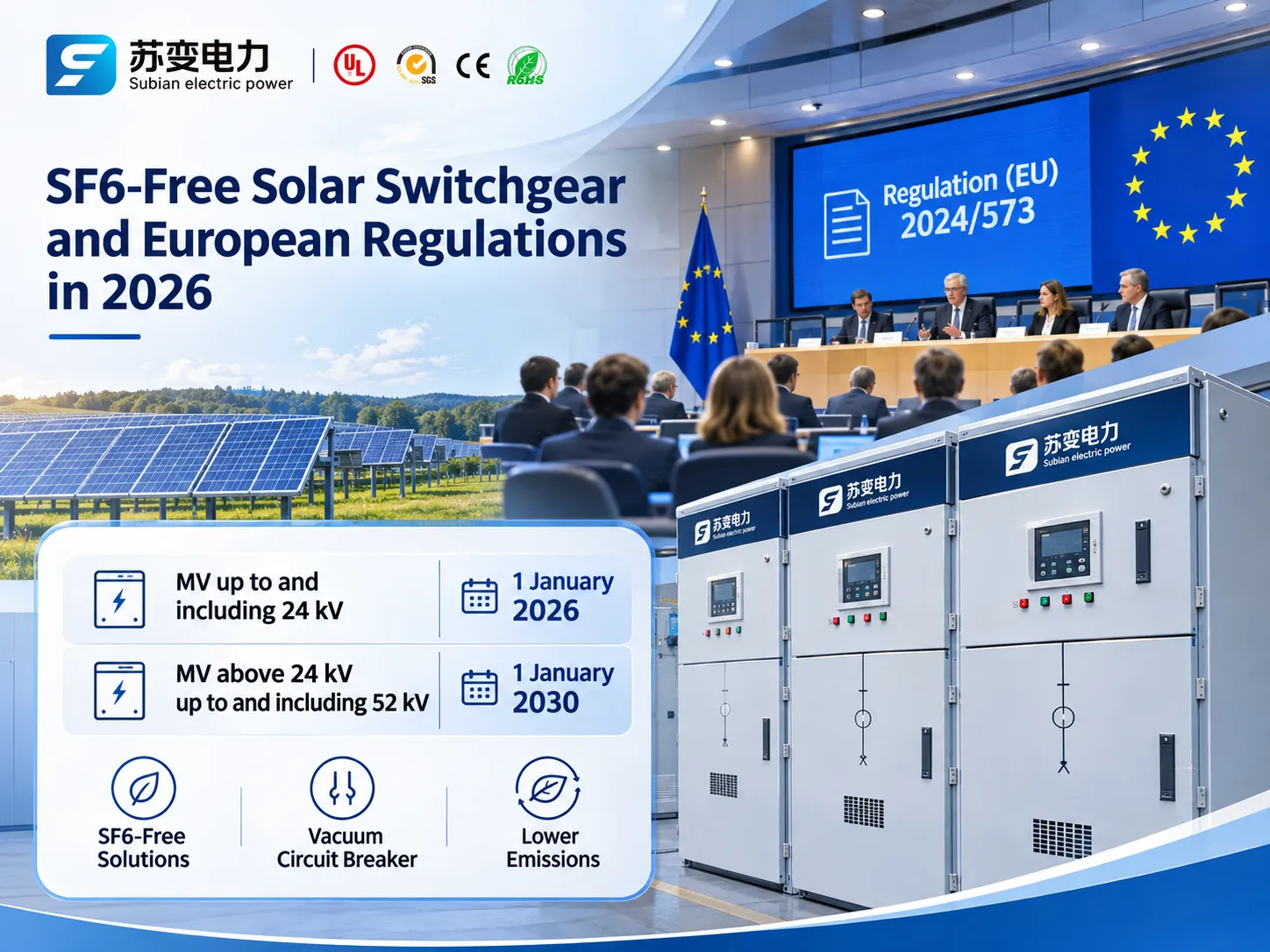
For solar developments in European Union member states, the insulation or interruption medium can influence which new switchgear may legally be put into operation. Regulation (EU) 2024/573, Article 13(9), establishes phased restrictions for certain electrical switchgear that uses or depends upon fluorinated greenhouse gases in the insulating or breaking medium.
| Switchgear voltage range | General start date under Article 13(9) | Practical project implication |
|---|---|---|
| MV up to and including 24 kV | 1 January 2026 | Check F-gas restrictions for new equipment put into operation |
| MV above 24 kV up to and including 52 kV | 1 January 2030 | Plan 33/35 kV equipment procurement around the later stage |
An essential stipulation includes that the regulations incorporate specific exclusions, exemptions, and transitional clauses. It does not just call for the disuse of SF6 electric equipment by the year 2026. Developers of the project must refer to the current legislation, date of commissioning envisaged, and interpretation of the competent body. See also sf6-free-switchgear-manufacturers.
There exist the “vacuum circuit breaker” and “ynatural gas insulated switch.” Nevertheless, the terms are not interchangeable. A circuit breaker can interrupt with vacuum while the insulating casing may not be vacuum as well. Therefore, it is crucial to get information about the insulation medium, interruption medium, requirements and specification of gas emission.
IEC Standards EPC Contractors Should Verify
For IEC-based solar farms, switchgear and substation compliance are not the same thing. The individual switching devices, metal-enclosed assembly and complete prefabricated substation may fall under different parts of the standards family.
| مرجع | Main subject | لماذا هو مهم |
|---|---|---|
| IEC 62271-200 | AC metal-enclosed switchgear, rated above 1 kV through 52 kV | Assembly ratings, construction, service continuity and internal arc provisions |
| IEC 62271-202 | AC prefabricated substations | Assessment of the complete enclosure and integrated substation within the standard’s scope |
| IEC 62271-100 | AC circuit breakers | Breaking/making and related circuit-breaker requirements |
| IEC 62271-102 | Disconnectors and earthing switches | Isolation and safe earthing functions |
| IEC 62271-103 / -105 | Switches / switch-fuse combinations | Check the precise device used for transformer protection |
| IEC 61850 / IEC 61869 | Power-utility communication / instrument transformers | Relevant for automation and protection instrument interfaces when specified |
The applicable editions, national adoptions and site-specific requirements must be specified in the tender. As one example, the IEC lists a consolidated IEC 62271-200:2021 + AMD1:2024 edition. A type test on a standalone MV panel does not replace the test evidence required for a complete packaged photovoltaic substation under the applicable IEC 62271-202 requirements.
Which Types of Switchgear Are Suitable for Various Solar Projects?
There is no specific megawatt level to ascertain whether any system is obliged to buy RMU, metal clad switchgear or collector substation. There are several issues to consider such as number of inverter-transformer blocks, voltage of the power network, cable topology, protection selectivity and rules from the grid operator regarding the connection.
Distributed solar projects
A project which is connected at the medium voltage can be realized with only one transformer and a few feeder ways. Even this case demands revenue metering and utility isolation which can be more stringent than the installed megawatts. The first thing is to define the connection point and the boundary of the utility proprietary rights.
Utility scale systems
A typical solar farm may imply several transformer blocks and multiple collection circuits. It is possible to connect several feeders to the collector bus and apply circuit breakers and relays in order to make sure that a circuit fault happens to the dedicated circuit only. The distance of cables matter, as well as the grounding and charging currents.
Solar with storage systems
The battery storage utilization brings a lot of changes in terms of operation and faulting processes. The same MV feeder has to export energy during the day, charge from the grid in the daytime and export energy during the night. Therefore, the controller must carries out the same activities as in the case of a traditional system, which means testing of the right equipment and processes.
What Determines the Cost of Medium Voltage Switchgear for a Solar Farm?
It is uncommon for manufacturers to announce a price which can be applied universally, since a project RFQ indicates much more than its brand name. A three-way secondary RMU and a collector-substation line-up with a number of draw-out feeder circuit breakers are different systems, even if both are termed solar farm switchgear. Nevertheless, they have different bills of materials, factory testing plans and site engineering requirements.
Cost drivers needing line items in RFQ include:
Electrical parameters: voltage, busbar current, short circuit breaking ability, insulation level and frequency.
Functional configuration: the number of inputs, feeders, bus couplers, switch-fuse ways and backup panels.
Protection: types of relays, CT/VT accuracy ratings, arc detection, and breaker failure logic and multiplexing.
Insulation technology: AIS, GIS, solid insulation, gas-free insulation and lifetime maintenance.
Location: indoor/outdoor enclosure, seismic and corrosion protection, temperature range and type of access.
Project execution: type testing, FAT, connection of cables, commissioning and training.
The final installed and maintained cost should be calculated instead of the factory price alone.
Solar Farm MV Switchgear RFQ Checklist
Before asking manufacturers for quotations, an EPC team should prepare a basic engineering package: a single-line diagram with the point of interconnection, the maximum export/import load cases, a fault-level study and an agreed protection philosophy. Without these documents, suppliers may quote different functional scopes that are difficult to compare.
| RFQ field | Information to provide |
|---|---|
| Site and grid | Country, utility, frequency, nominal voltage and highest system voltage |
| Plant operating cases | PV export, BESS charge/discharge where applicable, planned expansion |
| المخطط الأحادي | Incomers, outgoing feeders, bus sections, transformer connections and ownership boundary |
| Current and fault study | Continuous feeder current, prospective fault current, duration and protection coordination |
| Insulation and switching | AIS/GIS, SF6-free requirements, breaker vs switch-fuse, interlocking and earthing |
| Protection and SCADA | Required relay functions, CT/VT ratios, communication interfaces and remote operation |
| Safety and environment | IAC class, LSC/partition requirements where relevant, IP, ambient temperature and pollution |
| Factory deliverables | Drawings, type-test evidence, routine tests, FAT procedures, spare parts and manuals |
A useful tender asks each supplier to complete the same compliance matrix and identify deviations. That makes proposals from international brands and independent manufacturers auditable without pretending they are identical solutions.
Photovoltaic Substations and Medium-Voltage Equipment from Subian Electric
Subian Electric manufactures transformers, packaged substations and selected medium-voltage switchgear for power-distribution and renewable-energy projects. For solar developers, the most directly relevant listed product is its YBM-35/0.8 photovoltaic step-up substation, a packaged transformer-and-switching concept intended for photovoltaic power collection.
Subian also lists معدات المفاتيح المعدنية القابلة للسحب KYN28A-12 أكبر 12 kV, 50 Hz applications. That published panel is not a 33/35 kV switchgear model; it should not be offered as one without a different, verified design. The company’s RMU technical guide provides additional background on compact secondary-distribution equipment.
For a project enquiry, ask the engineering team to confirm the available voltage class, frequency, transformer capacity, protection arrangement, insulation medium, short-circuit ratings, factory testing and applicable local approvals. Technical descriptions on product pages are starting points, not replacements for an approved project datasheet and signed manufacturer offer.
For project-specific discussions, اتصل بشركة Subian Electric with your single-line diagram, site location, desired MV voltage and required equipment scope.
الأسئلة المتكررة
What are the best medium voltage switchgear brands for solar farm substations?
ABB, Siemens, Schneider Electric, Eaton and Ormazabal are pertinent companies to investigate because they provide relevant information about switchgear product families or provide reference data for solar applications. No universal ranking system exists, because the right model is determined by the specific project voltage, fault level, switching function, study of protection system, environmental conditions and acceptance by utility.
What type of switchgear is normally used in a solar power plant?
Depending on the single-line diagram of the plant and the type of feeder protection, solar plants can opt for compact ring main units or switch-fuse units at individual inverter-transformer stations along with mv switchgear based on circuit breaker mechanism at collector substations.
Is an RMU suitable for a utility-scale solar farm?
Yes, for suitable secondary-distribution points and when its ratings and protection functions satisfy the design. A main collector substation may need a different primary-distribution line-up with dedicated feeder breakers and relays.
What rated voltage should a 33 kV solar farm use?
For systems at 33 kV, it is routine to source equipment that is rated at a voltage greater than that of the normal system and is likely to be 36 kV, 40.5 kV or any other voltage level consistent with the highest voltage supply available from the utility, along with the impulse withstand rating, insulation coordination and local specifications for the voltage used for the operation of the equipment.
Are air-insulated and gas-insulated switchgear interchangeable?
It is not only through description that one can tell the difference. Both types may perform the same work, but there are differences in the sizes of enclosures, isolation technologies, types of switch-gear, types of gas used, maintenance access and test ratings. Look at the certified configuration versus the complete specification of the project.
Is SF6-free medium-voltage switchgear mandatory for European solar projects?
The regulation number 2024/573 brings some limitations regarding the utilization of some of the equipment that relies on F-gas, starting from 2026 for medium voltage equipment between 1 to 24 kV, and starting from 2030 for equipment above 24 kV. There will be some exceptions and transitional regulations. Further information is given in the Article 13, including local regulations for particular projects.
What IEC standards should be requested in a solar switchgear RFQ?
IEC 62271-200 is key to the metal clad switchgear assembly. Other related parts include IEC 62271-100 for circuit breakers, -102 for isolators and earthing switches, and -103/-105 for applicable switches and switch fuses. A complete pre-manufactured station may also need assessment to IEC 62271-202.
Can conventional overcurrent relays protect inverter-based solar collection feeders?
The inverters can be included in the scheme, however, the design should not rely on the utility-like fault current coming from each inverter. The relay settings and other functions rely on many factors such as inverter response, the fault study data, type of earthing, site conditions and the connection rules with the utility company.
How should EPC contractors compare solar switchgear quotations?
Issue all vendors with the same technical details and schedule for compliance. Compare voltage and fault ratings and the functionality of each unit, the type of relay scheme, test method, type of gas used, lead-time commitments, other site services, and any deviations. The price of the panel cannot be used as a sole measure of value when there is no protection or control and no FAT scope defined.
المراجع
- ABB — UniGear switchgear portfolio and product-family ratings.
- ABB — Cirata floating solar plant, UniGear ZS1 and Relion case study.
- Schneider Electric — Medium-voltage switchgear and AirSeT product portfolio.
- Siemens — NXAIR air-insulated primary switchgear.
- Siemens — 8DJH 36 gas-insulated secondary switchgear.
- Eaton — Xiria SF6-free medium-voltage switchgear.
- Ormazabal — RWE solar-project switching-station case.
- European Union — Regulation (EU) 2024/573, Article 13.
- ESB Networks — Practical guidance on the EU F-gas switchgear phase-in.
- IEC — IEC 62271-200:2021 + AMD1:2024.
- IEC — IEC 62271-202:2022.
الخاتمة
There is no single answer to the question of the best medium voltage switchgear brands for solar farm substations. ABB, Siemens, Schneider Electric, Eaton and Ormazabal provide credible reference architectures, but the right equipment depends on the part of the solar farm it serves. Start with the collection voltage, the single-line diagram and the fault study; then compare the exact rated and tested functional units, protection, environmental requirements and utility approval.
For 33/35 kV photovoltaic sites, do not confuse a compact 24 kV secondary RMU with a collector-station design. For European sites, review the relevant SF6-related commissioning dates and exceptions. For international tenders, make every supplier complete the same compliance matrix. If a packaged photovoltaic step-up solution is needed, Subian’s photovoltaic substation range is a relevant starting point for a project-specific technical discussion.