


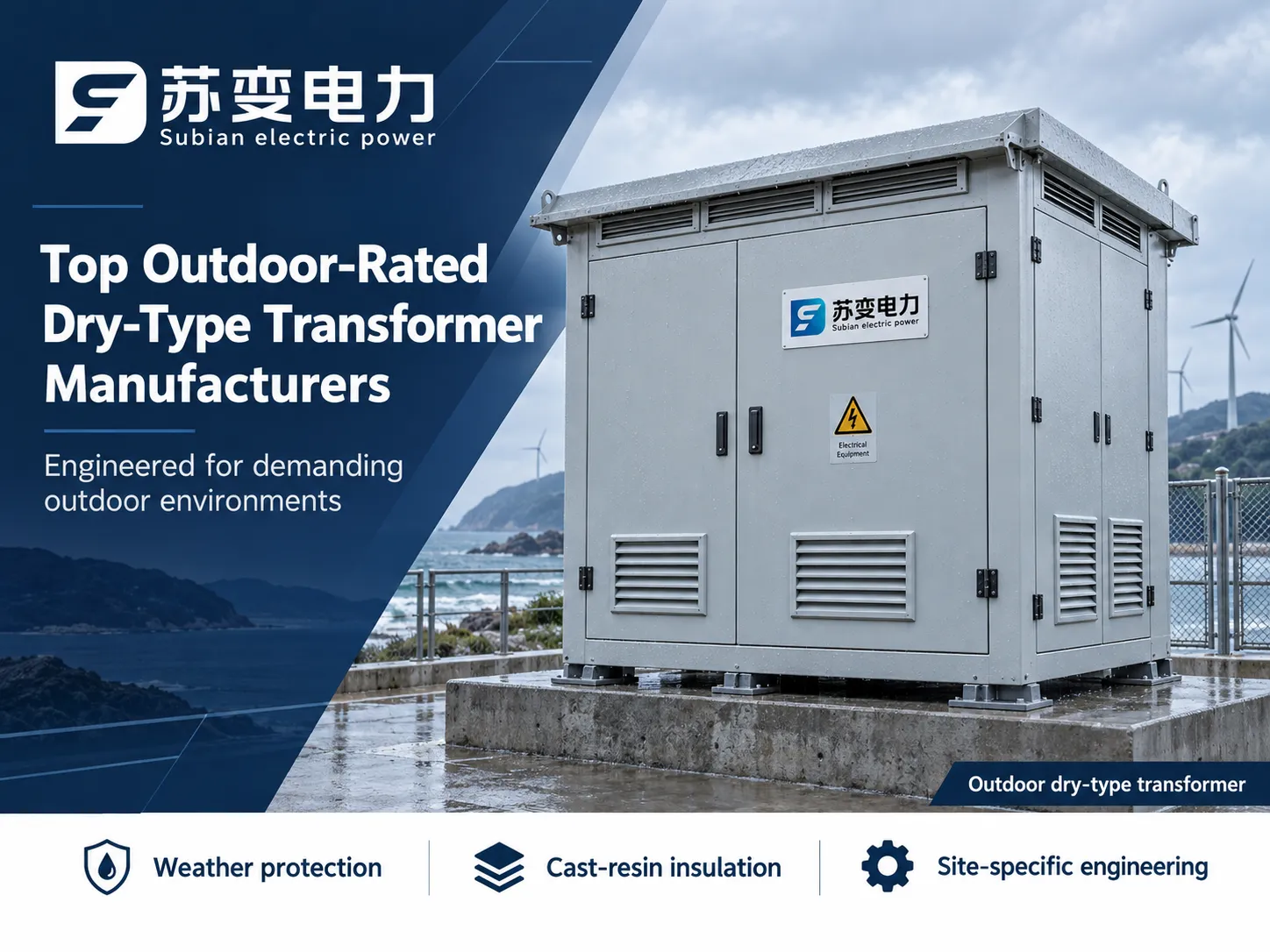
In the case of a meteorological exposed scene, specifications are strict. The transformer has to be able to stand the test of salt air climates, winds, rain, and dust storms. It has to function during harsh winters and hot summer afternoons. It shouldn’t require any oil pit construction and therefore eliminate the owner’s need for expensive maintenance. Only one option meets these requirements – an exposed outdoor dry-type transformer usually made of insulated cast resin and enclosed in a weatherproof casing. The hard part is not likely to be the transformer itself, but that it might be really hard to find a company capable of making a unit that would suit the place.
This paper explains what the best manufacturers of outdoor dry-type transformers make them to stand out among others. Those points are the factors the professionals should have in mind when evaluating such companies and their offers. The paper will not list companies’ names but will be focused on the documentation and engineering behind every transformer built for an outdoor use.
What “Outdoor-Rated” Really Means for a Dry-Type Transformer
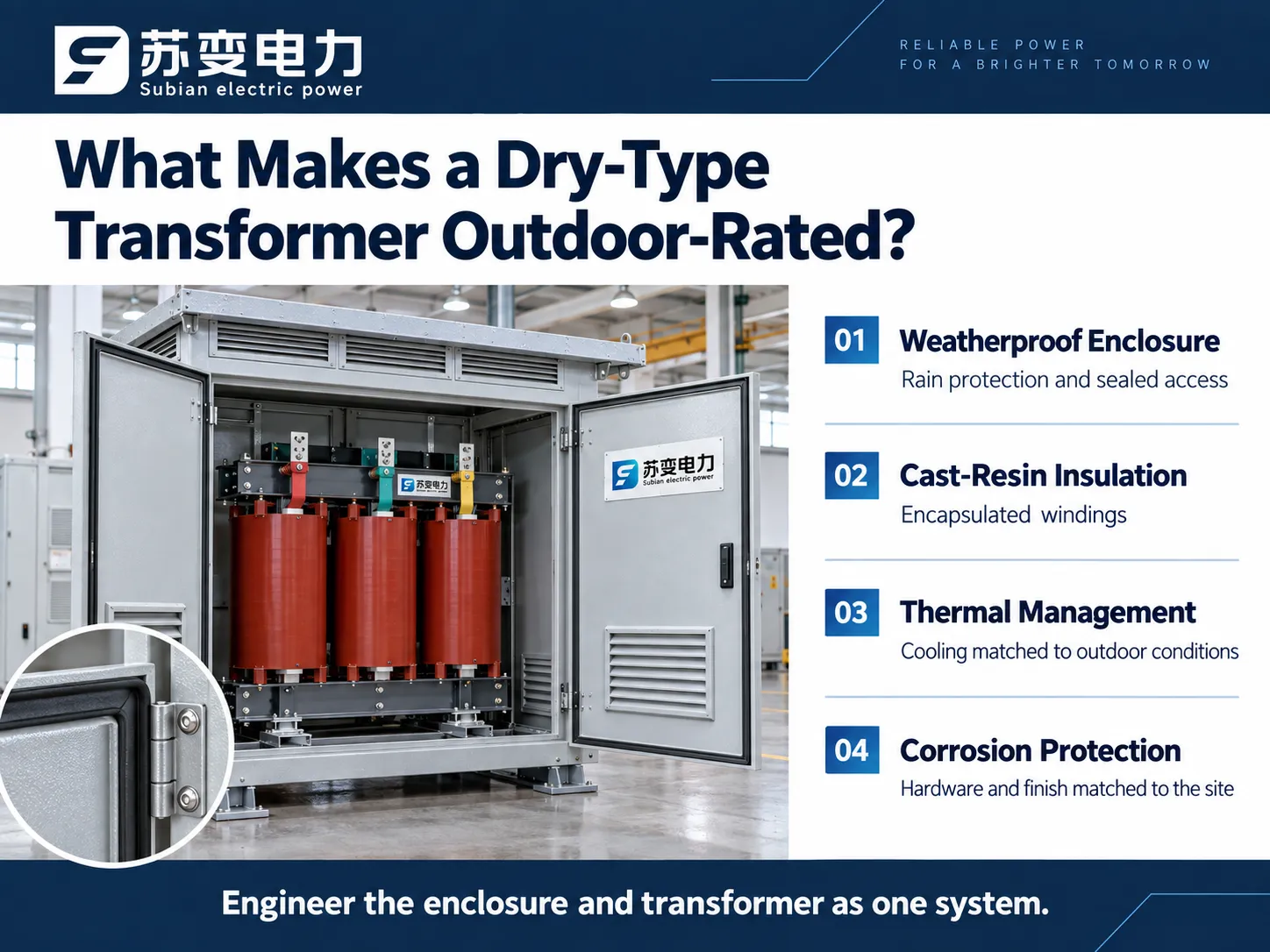
Standard indoor dry-type transformer is intended for clean and secure electrical rooms. On the other hand, an outdoor dry-type transformer must withstand humidity, dust, UV radiation, and temperature drops while it does not have the oil reservoir as the liquid-filled type has. Following are four design features that turn a simple dry-type transformer into a complete outdoor machine.
Enclosure rating: The least-efficient type of enclosure for outdoor use is NEMA 3R or IP54 enclosure which provides the rain and snow protection but is nevertheless ventilated. Popular coastal areas and sites require NEMA 4X or stainless-steel enclosure to avoid corrosion problems due to salt.
Insulation system: A cast-resin dry-type transformer totally fills its windings with epoxy, so that moisture cannot get to the cables. Cast-resin device is the best way out for outdoor dry-type transformers, while devices with vacuum pressure-wound coils must have additional protection.
Temperature class: Class F and class H insulation systems permit to work in the environments with high temperature and solar heating while rising temperature must be considered.
Corrosion protection: The fittings, seals, and coatings of the enclosure must be suitable for the location: it may be stainless steel for saline spray, epoxy coated steel for acid rains, and tight connections for ammonia in agriculture.
Once four design features are properly combined, a المحول من النوع الجاف can be positioned outside without any additional shelter. When these features are treated as addition to a standard system, even a highly desirable core-and-coil transformer will fail within a short time after installation.
What Separates the Top Outdoor-Rated Dry-Type Transformer Manufacturers
Any manufacturing site can wind coils and encapsulate them in resin. What distinguishes dry-type transformer manufacturers is whether the final product can be tested for outdoor durability throughout its entire lifespan. These qualifications define a supplier worth partnering with compared to suppliers of low quality and represent parameters that have to be used for assessing any offer.
Proven Weatherproof Enclosure Engineering
Most outdoor failures have their roots in the enclosure, so it follows that the leading manufacturers of transformers concentrate their resources in that area. With the leading manufacturers, the enclosure and transformer are designed as one unit, ensuring that the weatherproofing is done properly and that the airflow is tailored specifically to outdoor use rather than designed for use in a cool indoor environment with its drip shields, condensation controls, and corrosion-resistant hardware. What appears to be an outdoor dry-type transformer may, in fact, just be some kind of enclosure surrounding an indoor design, regardless of what is stated on the nameplate attached to the unit.
Cast-Resin Winding Technology
Epoxy encapsulation is responsible for outdoor efficiency. In the right casting process, moisture entering the winding will be prevented, as well as partial discharge effects and mechanical impact by thermal cycling and short-circuit forces. The leading lines of dry-type transformers use epoxy resin which goes through vacuum casting and regulated curing processes in the absence of air voids, which is where partial discharge and insulation breakdown starts.
Verified Test Documentation
A credible manufacturer is one that can back up its claims altogether. Any supplier should make available the results of routine testing, partial-discharge measurement or the type-test certificates of the transformer, which prove material traceability. A supplier that is reluctant to provide this information should not be shortlisted. Documentation is not just scrap paper; it is the only evidence the buyer has in ensuring they get the transformer performing as declared.
Low-Loss Core Options
A transformer located outside usually runs continuously and consumes no-load losses all day long throughout its life. Manufacturers providing amorphous alloy dry-type transformer solutions give users the ability to reduce those standing losses significantly, which plays a major role in future operating expenses of a piece of equipment that remains always activated. This is one of the best examples of how a manufacturer may better the economics of an outdoor system.
Standards Compliance and Engineering Support
The design shall comply with the internationally acknowledged standards for dry-type transformers, mainly IEC 60076-11 and IEEE C57.12.01, along with the requirements of the local utility. Availability of a responsible engineering team and the time of delivery are equally as important. This is due to the fact that an outdoor substation located in a secluded location cannot wait for weeks before getting the necessary assistance.
It is important to mention the role of all of this in relation to the fact that outdoors failures are often misinterpreted.
Subian Power: A Manufacturer Built for Outdoor Dry-Type Service
Jiangsu Subian Power Equipment Co., Ltd. is a well-known Chinese producer specializing in the construction of transformers of electrical voltage equal to or lower than 110kV, prefabricated substations, solar PV substations, and switchgear (low and high voltage). The company commenced operation in 2019 in Xuzhou, Jiangsu, in a facility with a total area of 30000 sq. m. with a registered capital of 102 million yuan and approximately 350 employees. The equipment produced by the company operates in modern power grid systems, construction projects, and various power stations and terminals (the company uses its transformers in different environments where outdoor dry-type transformers can be applied).
Subian builds its dry-type transformers on iron-resin technology (epoxy technique) and proposes different configurations of the manufactured equipment allowing an outdoor use.
- ، تجفيف 10 kV SCBH-series amorphous alloy dry-type transformer uses a high-quality amorphous alloy core to deliver ultra-low no-load and load losses, and is designed for use in demanding environments. For an outdoor unit that stays energized continuously, this هو مثال مباشر، يستخدم نواة سبائك غير متبلورة عالية الجودة directly attacks the standing losses that dominate lifetime cost.
- ، تجفيف 20-35 kV SCB-series epoxy resin dry-type transformer is a fire-safe, high-efficiency epoxy resin dry-type transformer built for critical infrastructure such as urban grids, high-rise buildings, tunnels, airports, railway stations, ports, and underground stations.
- ، تجفيف 6-10 kV SCB-series cast dry-type distribution transformer covers the medium-voltage distribution range with thin-walled cast-resin construction and reliable, low-loss performance.
Since Subian creates its transformers, prefabricated substations and switchgear, it offers the market a comprehensive outdoor package rather than just a bare core-and-coil. In cases of buyers requiring specific ingress rating, stainless-steel enclosure from water and water-related issues for coastal area, forced-air cooling and temperature rise, the engineers assist in writing these specifications. Subian has dry-type designs according to international standards for dry-type transformers, and on demand it provides an opportunity to get the routine-test data, including partial-discharge measurement plus type-test certificates. Its OEM and ODM programs permit the development work and panels assembling to get the enclosure, cooling and insulation class compatible with the unique outdoor environment, only one supplier and one engineering interface are involved in the work. You can review the full Subian dry-type transformer range to compare capacities and voltage classes.
Outdoor Dry-Type or Oil-Immersed? Choosing the Right Outdoor Transformer
When shopping around for an outdoor dry-type transformer, a buyer usually considers the related liquid-filled type as well, with the distinction being that both fulfill a different purpose. By understanding this, the buyer will be able to make the right choice instead of going for what he/she is used to.
In the case of dry-type transformers, they are largely preferable when fire safety, environment cleanliness, and trouble-free operation become vital. Owing to their absence of oil, nothing will be spilled in the environment, thus it does not require any containment pond or analyses of dissolved gases, which forms the basis of the growing presence of cast-resin units at such places as airports, tunnels, renewable energy facilities, rooftops, and so on where oil presence would be unacceptable. The fact that the material is self-extinguishing is one of its key advantages and limits the maintenance process to fairly simple cleaning, checking, and thermal analysis.
Compared to this, oil-filled transformers are still champions in terms of capacity and price at the largest voltage levels and capacities as the oil itself functions as an excellent heat-transfer medium. Thus, in the case of a large high-capacity outdoor substation where they can deal with fire and containment safely, an oil-filled transformer will turn to be economically more viable. That is why the presence of a company that can produce both options becomes beneficial because it would suggest the most appropriate solution for the particular site instead of pushing for the best-selling one. Subian Power is one such manufacturer working in this field and offers both cast-resin dry-type and oil-immersed transformers at the voltage level of 110kV and less.
Where Outdoor-Rated Dry-Type Transformers Are Used
The usage of outdoor-rated dry-type transformers prospects in the fire safety and low-maintenance fields that have weather resistivity at the same time is on the rise. The applications that involve outdoor dry-type transformers are:
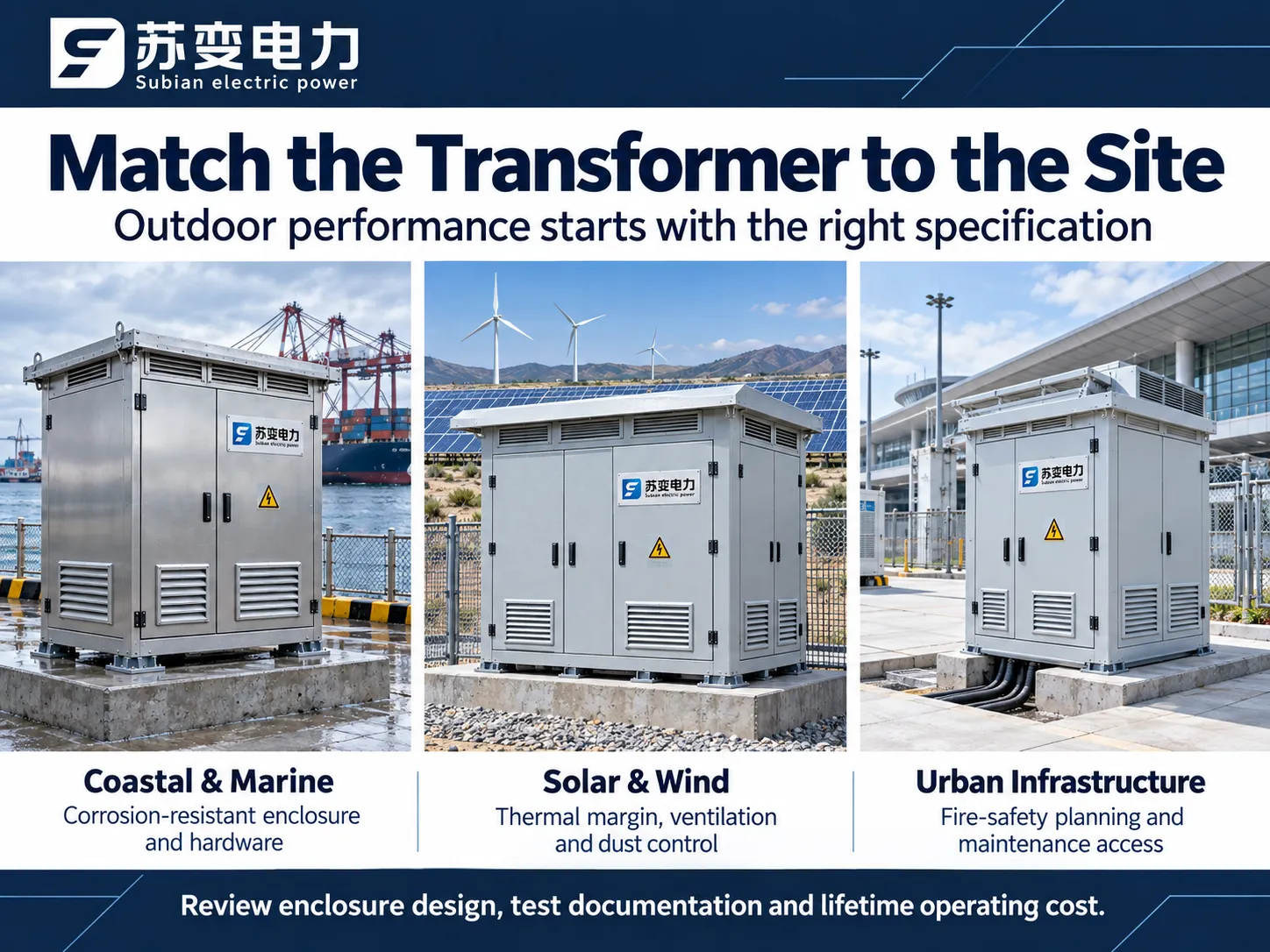
Renewable energy. Solar farms and wind energy facilities need transformers that work 24 hours in extreme temperatures and withstand dust and coastal environment conditions; here is where a low-loss cast resin dry-type transformer shines.
Utility and distribution substations. A compact المحول من النوع الجاف eliminates the need for oil containment and gas testing, thus making the permitting and maintenance processes much easier.
Coastal, marine, and offshore installations. A power generator operating on the coast should be of stainless steel so saltwater wouldn’t cause corrosion.
Industrial and infrastructural sites. Ports, tunnels, and railroads use fire safety technology in harsh outdoor conditions.
How to Evaluate an Outdoor Dry-Type Transformer Supplier
When choosing outdoor-rated dry-type transformer manufacturers, it is important to consider how the supplier’s engineering matches the environment of the installation site. A simple checklist can make the evaluation of the manufacturer of dry-type outdoor transformers easier.
Fit for the Environment. Sites by the oceans require the use of corrosion-resistant cabinets and hardware, desert sites require that the transformers can withstand high temperatures, and cold areas may need heaters to protect the equipment from condensation.
Quality Certification. The company must design and manufacture transformers according to the IEC 60076-11 and IEEE C57.12.01 standards and provide the necessary type-test documentation confirming that the equipment meets these standards.
Documentation. The manufacturer must provide all the results of the routine tests, data on partial discharges, and ensure the traceability of the materials that were used. If the manufacturer refuses to do so, it is better not to choose its services.
Service and Delivery Times. The potential manufacturer of transformers must give the precise data on the terms of production and be ready to provide assistance in case the transformers fail.
Total Cost of Ownership. The analysis of the total cost of ownership should include consideration of the cost of ownership and durability of the housing along with maintenance of the equipment across several decades. In many cases, an amorphous core or better housing pays off.
الأسئلة المتكررة
What makes a dry-type transformer outdoor-rated?
An outdoor dry-type transformer is equipped with a weather-proof casing that at least meets the standards NEMA 3R or IP54, corrosion-resistant equipment, and an insulating system that will effectively combat moisture, dust, and ultraviolet rays. The indoor counterpart, on the other hand, simply depends on a ventilated box and offers no protective features; hence, it would break down in no time if exposed to rain or snow.
Can an epoxy cast-resin dry-type transformer be installed outdoors without a shelter?
Yes. Cast resin dry type transformers equipped with an adequate external housing designed for outdoor use and boasting a rating of NEMA 3R, IP54, or a higher level of protection can be installed directly outside and do not require any additional type of weatherproofing. The encapsulation of the windings in epoxy makes them moisture resistant and the construction of cast resin transformers the best choice for outdoor applications.
Are outdoor dry-type transformers suitable for coastal and desert sites?
Yes, as long as they are specified correctly. For installations done in coastal areas, stainless steel or NEMA 4X enclosures and hardware that is ‘sealed’ are to be used to resist salt corrosion, while in desert areas installations require higher temperature class and additional allowance for solar loading. One competent manufacturer integrates these environmental requirements in the unit, not just as mandatory provisions or add-ons.
Why choose an amorphous alloy dry-type transformer for outdoor use?
The fact that an outdoor unit tends to be always on means it incurs no-load losses hour after hour. The dry-type transformer using amorphous alloys with a low loss core eliminates such losses occurring on a permanent basis and results in lower running costs as well as heat released over the many years of continuous operation of an outdoor installation.
How long does an outdoor dry-type transformer last, and what maintenance does it need?
An appropriately sized outdoor dry-type transformer will ideally last for 25 to 35 years, although many last even longer. Routine maintenance is minimal compared to oil-filled types. The steps involved include cleaning the ventilation openings, checking the gaskets and hardware for corrosion, making sure that the cooling fans work, checking the winding insulation and doing a thermal scan of the connectivity on a regular basis. There is no gas to analyze and no oil to sample.
Does Subian Power supply outdoor-rated dry-type transformers?
Subian manufactures cast-resin dry-type transformers, including SCB epoxy resin and SCBH amorphous alloy series, that can be configured for outdoor installation with weatherproof enclosures, corrosion protection, and the appropriate temperature class. The engineering team works directly with buyers to match the enclosure, cooling, and insulation to the specific outdoor environment.
المراجع
- NFPA — كود الكهرباء الوطني، متطلبات تأريض الخدمة والتوصيل
- وزارة الطاقة الأمريكية — جودة الطاقة وموثوقية نظام التوزيع
- EPRI — أوضاع فشل المحولات الكهربائية وتقييم الحالة
- IEEE — معايير جودة الطاقة وأدلة تحميل المحولات
- UL Solutions — أجهزة الحماية من زيادة التيار (UL 1449)
الخاتمة
، تجفيف top outdoor-rated dry-type transformer manufacturers all share one ability: they can encapsulate a winding, enclose it in a weather-resistant housing, and prove the combination will survive rain, salt, dust, and temperature extremes for decades. What separates them is the depth of their type-test library, the responsiveness of their engineering team, and the honesty of their factory test data. Subian Power builds outdoor-capable cast-resin and amorphous alloy dry-type transformers with the enclosure options, corrosion protection, and documentation that turn a demanding specification into a reliable, long-term installation. To size a unit or request certified test data for an outdoor project, contact the Subian Power engineering team for a tailored quotation.