


Ein Transformatorausfall folgt typischerweise einem Muster. In den meisten Fällen gibt es Monate von Warnsignalen vor dem Transformatorausfall. Zum Beispiel gibt es einige Symptome, darunter niedrigere Ölstände, höhere Wicklungstemperaturen und Rissbildung an den Isolatoren des Transformators. Um mit diesen Signalen umzugehen und die Probleme zu beheben, solange sie kostengünstig sind, existiert eine Transformator-Checkliste. Die Transformator-Checkliste ist jedoch keine universell anwendbare Checkliste; es gibt verschiedene Arten von Checklisten, die in unterschiedlichen Transformatorprüfungen verwendet werden. Jeder dieser Tests hat seinen eigenen Grund, durchgeführt zu werden; zum Beispiel bestätigt die Endinspektion des Herstellers, dass der Transformator den Spezifikationen entspricht; die Empfangsinspektion stellt sicher, dass der Käufer das Recht auf Garantie hat, und die Checkliste für die vorbeugende Wartung bestätigt, dass ein gesunder Transformator gesund bleibt.
Die primäre Transformator-Checkliste umfasst: (1) Die Hersteller-/Fabrik-Checkliste wird verwendet, um die Entwurfsüberprüfung zu beschreiben, die Wicklungswiderstand, Übersetzungsverhältnis, Isolierungen, Leerlauf-/Lastverluste, Temperaturanstieg und die vor dem Versand des Transformators durchgeführten Dielektriktests umfasst. (2) Die Empfangs-Checkliste wird verwendet, um zu überprüfen, ob es Schäden am Transformator gibt, die Typenschildüberprüfung, die Überprüfung des Ölstands (im Falle von Öleinheiten), den Zustand der Isolatoren und des Tanks, den Feuchtigkeits- und Lagerschutz sowie die relevanten Dokumente während der Abnahme zu überprüfen. (3) Die Checkliste nach Reparatur/Inbetriebnahme enthält die notwendigen Prüfungen und Tests, die durchgeführt werden müssen, wie Isolationswiderstand, Verhältnis, Polarität/Phasierung, Öltests, Trocknungsüberprüfung, Erdungskontinuitätsprüfungen und Einstellungen der Schutzeinrichtungen. (4) Die Checkliste für die vorbeugende Wartung präsentiert verschiedene Schritte, die unternommen werden müssen, um die Funktionsprüfung von Transformatoren sicherzustellen, wie visuelle Inspektionen, Ölstände, Temperaturmessungen, Leckprüfungen und Überprüfungen der Bedingungen von Überspannungsableitern und Isolatoren.
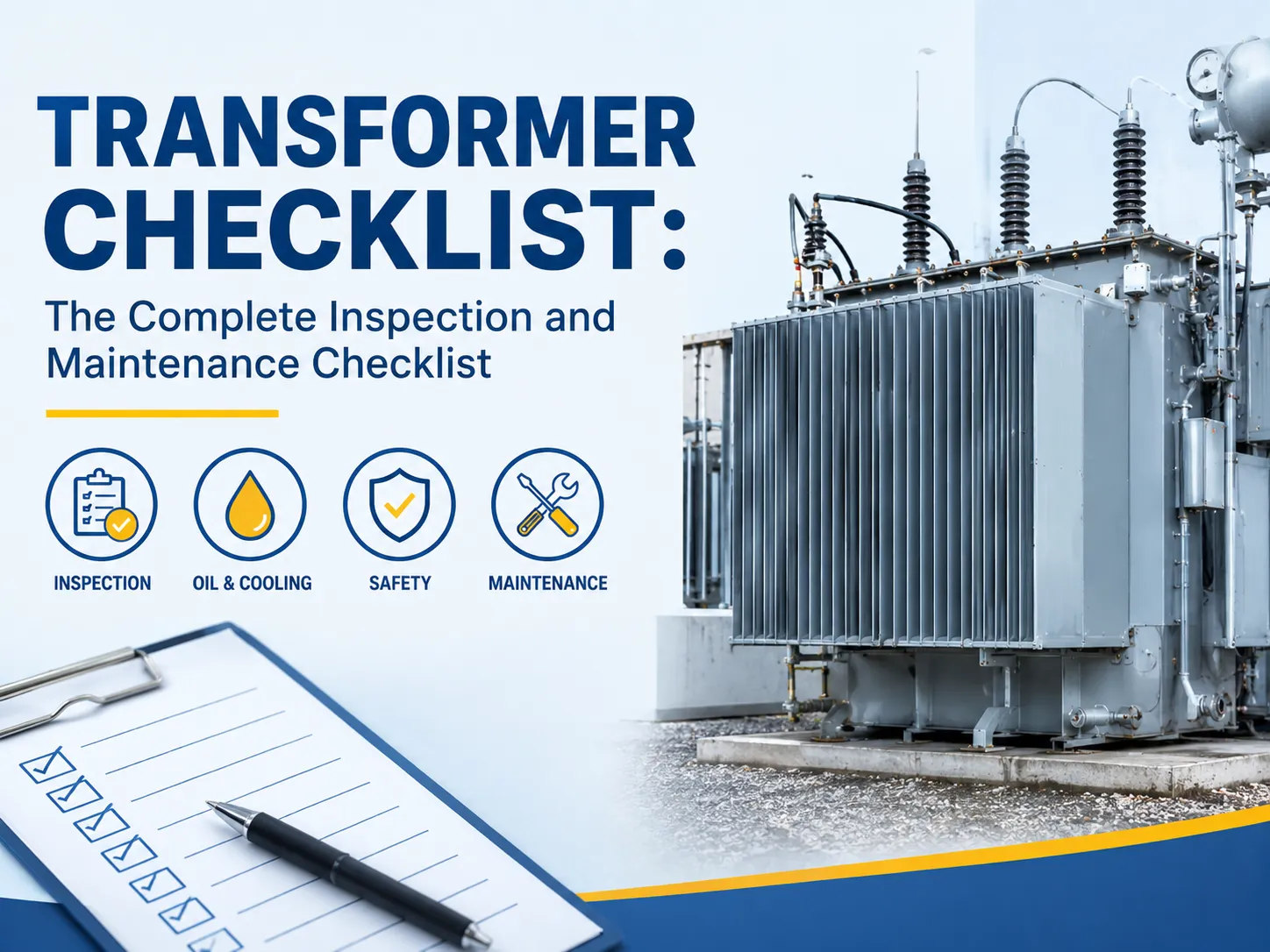
Die Master-Transformator-Checkliste
Eliminieren Sie die Phasen, und dennoch umfasst jede Checkliste für einen Transformator die gleichen sechs Bereiche. Wenden Sie die relevanten Checklistenpunkte aus jedem Bereich für jede der verschiedenen Phasen an.
- Dokumentation: Stellen Sie alle korrekten Elemente bereit, einschließlich der Typenschilddaten (angegeben in kVA und Spannungsbewertung, Vektorgruppe und Impedanzbewertungen), Prüfberichte, Verdrahtungsdiagramme, Garantiedokumente und Betriebsanleitungen für den Transformator.
- Physikalischer Zustand: Überprüfen Sie den Zustand des Tanks/Gehäuses und der Isolatoren sowie den Zustand der Kühler. Überprüfen Sie den Zustand aller an dem Transformator installierten Hebelöcher. Überprüfen Sie auch die Erdungsverbindungen und stellen Sie sicher, dass keine Lecks oder Schäden vorliegen.
- Elektrische Integrität: Überprüfen Sie das Gleichgewicht des Wicklungswiderstands, das Übersetzungsverhältnis, den Isolationswiderstand und testen Sie die Polarität/Phasierung mit einem Multimeter.
- Öl-/Isolationssystem (ölgefüllte Einheiten): Überprüfen Sie, ob der Ölstand, die Ölqualität (dielektrische Festigkeit, Feuchtigkeit, Säuregehalt), Wasser und gelöste Gase für den Betrieb des Transformators zufriedenstellend sind.
- Schutz und Hilfseinrichtungen: Stellen Sie sicher, dass die Sicherungen/Leistungsschalter, Relais, Temperatur- und Druckgeräte, Überspannungsableiter sowie Kühlventilatoren/Thermometer ordnungsgemäß für den Transformator funktionieren.
- Betriebszustand: Vergleichen Sie die Last mit der Nennleistung (die 80-Prozent-Regel) des Transformators.
Hersteller-/Fabrikinspektionscheckliste
Die Fabrikcheckliste stellt fest, dass der Transformator den Spezifikationen entspricht und die geltenden Normen (IEC 60076, IEEE C57, ANSI oder nationale Normen) einhält. Für Käufer sind die bedeutendsten Punkte diejenigen, die Sie im Prüfbericht für Routineprüfungen und im Abnahmeprüfbericht finden:
- Routineprüfungen (Routine für alle Einheiten): Wicklungswiderstandstests, Überprüfung des Wicklungsverhältnisses, Isolationswiderstandstests und die Prüfung der dielektrischen Festigkeit (Anwendungs-Spannung), Leerlauf- und Verluststrom, Lastverlust- und Impedanzmessung sowie Polaritäts-/Vektorüberprüfung.
- Typprüfungen (Designprüfungen an einer Muster-Einheit): Temperaturanstiegstests bei voller Last, Blitzimpulsprüfungen, Kurzschlussfestigkeitsprüfungen und Akustikmessungen.
- Visuelle und dimensionale Prüfung: Drucktests des Tanks und Lecktests (für Öleinheiten), Lackierung/Fertigstellung, Überprüfung des Typenschilds und Einhaltung der Montage-/Dimensionierungsanforderungen.
Wenn Sie den neuen Transformator in Empfang nehmen, verwenden Sie den Prüfbericht für Routineprüfungen als Ihr Hauptbeweis dafür, dass die Einheit einwandfrei ist; bewahren Sie ihn in der Akte des Transformators auf und vergleichen Sie ihn mit Ihren eigenen Messungen, die Sie beim Empfang der Kurbelwelle vorgenommen haben.
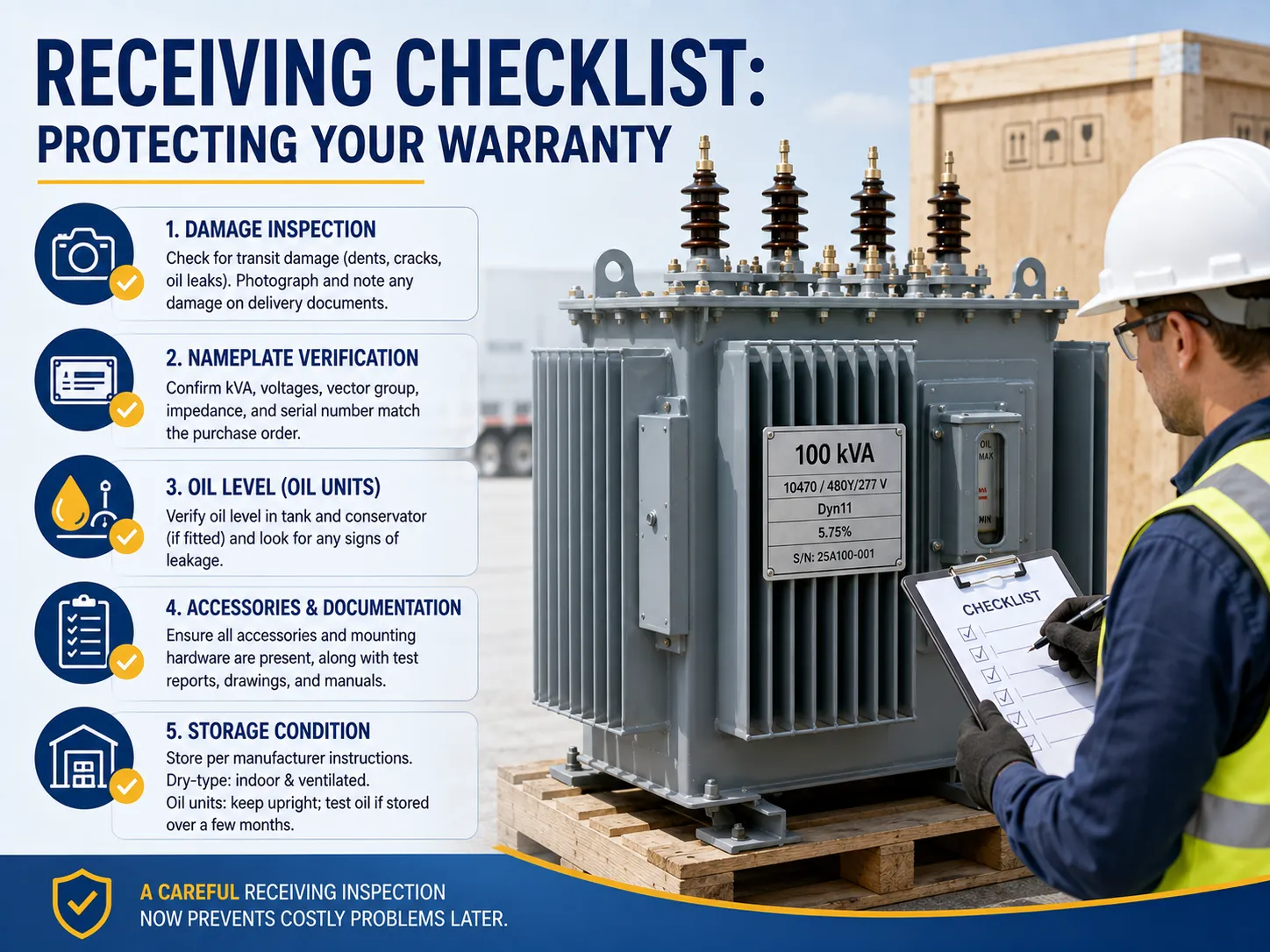
Empfangscheckliste: Ihren Garantieanspruch schützen
Die Empfangsinspektion erfolgt bei der Lieferung und dient dazu, Ihre Rechte und Interessen gegenüber dem Spediteur und dem Hersteller zu schützen. Es ist wichtig, die Empfangsinspektion durchzuführen, bevor Sie den Lieferschein unterschreiben:
- Schadensinspektion: Überprüfen Sie die Kiste und die Einheit auf Transportschäden (Dellen, beschädigte Isolatoren usw.), machen Sie Fotos von allen Schäden, die Sie finden, und dokumentieren Sie diese auf dem Lieferschein. Sie benötigen dies, damit Ihre Reklamation von der Speditionsfirma akzeptiert wird.
- Überprüfung des Typenschilds: Bestätigen Sie, dass die kVA, Spannungen, der Vektorgruppe, der Impedanz und die Seriennummer auf dem Typenschild mit dem übereinstimmen, was auf der Bestellung steht. Ein falsches Spannungsgerät jetzt zu erkennen, könnte später kostspielige Fehler vermeiden.
- Ölstand (im Falle von Öleinheiten): Stellen Sie sicher, dass der Ölstand im Tank und im Ausdehnungsgefäß (falls zutreffend) korrekt ist, und überprüfen Sie auf Leckagen, die während des Transports verursacht wurden.
- Zubehör und Dokumentation. Überprüfen Sie, ob sämtliches bestelltes Zubehör (Ventilatoren, Messgeräte, Montagematerial, Ersatzdichtungen usw.) enthalten ist, sowie die Prüfberichte, Zeichnungen und Handbücher, die die Einheit begleiten sollten.
- Lagerung: Wenn das Gerät nicht sofort installiert wird, stellen Sie sicher, dass es gemäß den Anweisungen des Herstellers gelagert wird. Trockenbaugeräte erfordern eine Lagerung in Innenräumen mit Belüftung, während Öleinheiten aufrecht gelagert werden müssen und ihr Öl überprüft werden sollte, wenn sie längere Zeit gelagert werden.
Eine saubere Empfangscheckliste könnte den Unterschied zwischen einem Garantieanspruch und einer kostspieligen Reparatur ausmachen. Die gleiche Disziplin gilt, wenn der Transformator an einem Projektstandort ankommt — siehe unsere Produktseiten für Verteilungstransformatoren für das typische Lieferdokumentationsset.
Nach-Reparatur- und Inbetriebnahme-Checkliste
Nach Reparaturen oder Wicklungen oder wann immer das Gerät zum ersten Mal unter Spannung gesetzt wird, garantiert die spezifische Checkliste, dass die Ausrüstung sicher ist, da die elektrischen Schaltungen korrekt abgeschlossen wurden:
- Isolationswiderstand (Megger): Primär und Erde, Sekundär und Erde, Primär und Sekundär – und vergleichen Sie mit den erforderlichen Werten; Wenn die Werte niedrig sind, bedeutet dies möglicherweise, dass Feuchtigkeit oder zerstörerische Reparaturen erforderlich sind, bevor das Gerät unter Spannung gesetzt wird.
- Widerstand: Überprüfen Sie alle Phasen und Werte; die Balancen zwischen den drei Phasen sollten relativ nahe bei 2% der vorgesehenen Werte liegen.
- Übersetzungsverhältnis (TRR): Schließlich muss jedes Wickelabgriffverhältnis mit einem Validierungsnameplate überprüft werden, und die Position der Anzeige für die Versorgungsspannung sollte genau übereinstimmen.
- Polarität/Phasierung: Stellen Sie immer sicher, dass sowohl die Vektorgroup als auch die Phasenreihen identisch mit dem System sind.
- Ölsystem (in Betrieb): Ölstände und die Durchschlagfestigkeit sowie Feuchtigkeits- und DGA-Baseline-Messungen vor dem Inbetriebnehmen jedes Dienstsystems.
- Erdung und Schutzmaßnahmen: Der Neutralanschluss muss korrekt sein, während elektrische Sicherungen/Schalter ebenfalls perfekt sein sollten.
- Inbetriebnahmeprüfung (Zeitmessung): Überprüfen Sie zuerst die Spannung an beiden Enden und kehren Sie die Phase um, erden Sie elektrisch und belasten Sie es, wenn Sie fertig sind.
Das vollständige Testset mit Passkriterien ist in unserem Transformator-Testleitfaden; führen Sie es vollständig nach jeder Wicklung durch, da ein repariertes Gerät das zusätzliche Risiko von Arbeitsfehlern birgt.
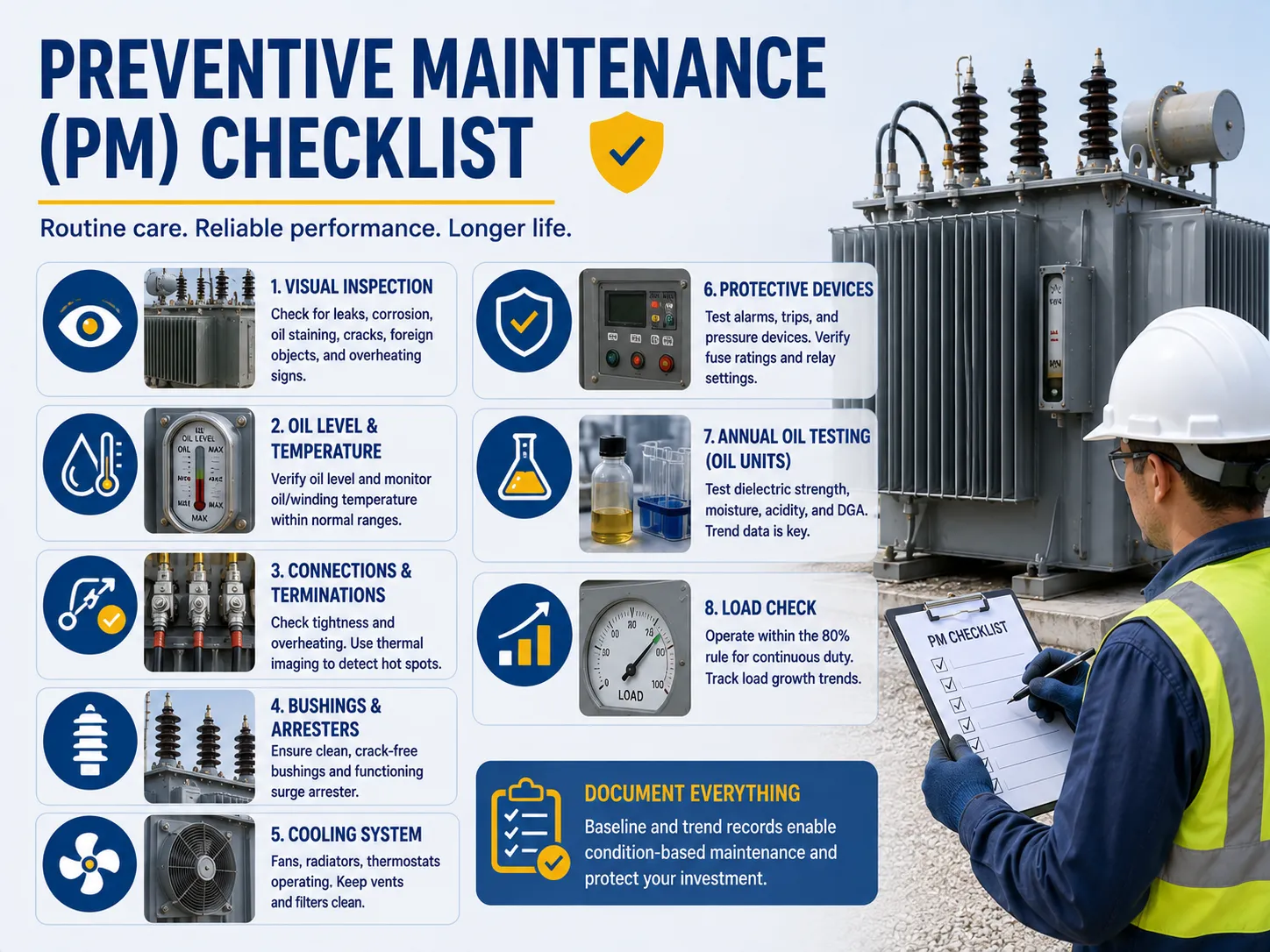
Präventive Wartungs-Checkliste
Ein konsistenter präventiver Wartungszyklus — vierteljährlich oder jährlich je nach Wichtigkeit durchgeführt — hält den Transformator in der gewünschten Funktionsweise. Die folgenden Verfahren sind:
- Sichtprüfungen: auf Lecks, Rost, Verfärbungen, Risse an Isolatoren, Objekte im Inneren oder auf dem Transformator und Anzeichen von Überhitzung (Verfärbung).
- Ölstände und Temperaturen (laut Ölanzeigen im Konservator und den Temperaturmessungen des Öls und des Transformators); stellen Sie sicher, dass es keine Aufwärtstrends gibt, da diese sofort behandelt werden sollten.
- Anschlüsse und Enden: Verwenden Sie Wärmebildkameras, um Kabel- und Sammelschienenanschlüsse auf Überhitzung zu überprüfen.
- Isolatoren und Überspannungsableiter: ungeräucherte Isolatoren und ein funktionierender Überspannungsableiter ohne durchgebrannten Indikator.
- Kühleinheiten: funktionierende Lüfter, Kühler und Thermostate, wobei sichergestellt wird, dass die Luftfilter und Lüftungsöffnungen sauber sind (insbesondere bei Trockenbaugeräten, die immer Staub als Hauptursache für den Ausfall von Kühlsystemen haben).
- Sicherheitsvorrichtungen: Überprüfen Sie Alarme und Auslösesysteme sowie Druckschalter usw.
- Führen Sie regelmäßige Ölanalysen durch, um die dielektrische Festigkeit, die Säure (nach der Karl-Fischer-Methode) usw. zu testen.
- Überprüfen Sie die Last gemäß der zuvor festgelegten 80%-Regel; wenn Sie einen Wachstumstrend feststellen, wissen Sie, dass es Zeit für ein Upgrade ist.
Die Dokumentation der systematischen Wartung und der Basisdaten ist für die zustandsbasierte Wartung erforderlich – Aufzeichnungen von Ereignissen sind Ihr wertvollstes Gut. Unsere Transformatorwartungsdienste Seite zeigt, wie ein professioneller PM-Zyklus strukturiert ist, und der Artikel über die Grundlagen der Ölprüfung behandelt die ölspezifischen Punkte ausführlich.
Typunterschiede: Ölgetauchte vs Trockenbau-Checklisten
Die Master-Checkliste unterteilt sich nach Kühltyp an drei praktischen Stellen:
| Checklistenbereich | Ölgetaucht | Trockentyp |
|---|---|---|
| Isolationssystem | Ölstand, dielektrische Festigkeit des Öls, Feuchtigkeit, DGA, Ölacidität | Zustand der Wicklungsisolierung, Feuchtigkeit (durch Eindringen oder Kondensation), Lack-/Harzintegrität |
| Kühlung | Ölstand, Kühler, Kühlventilatoren, Öltemperatur | Luftöffnungen/Filter sauber, Wicklungstemperaturanzeigen, Staubentfernung (der dominante Ausfallfaktor bei Trockenbau) |
| Leckage/Umwelt | Ölleckagen, Auffangvorrichtung (Tropfschale), Ausdehnungsgefäß | Gehäuse (IP-Bewertung), Kondensationskontrolle, Innenbelüftung |
Die elektrischen Tests (Isolationswiderstand, Wicklungswiderstand, TTR, Phasierung) sind für beide gleich — siehe die Spezifikationen auf unserem Trockenbau-Transformator Seiten für die typenspezifischen Daten — und die ölspezifische Suite ersetzt einfach den Fokus auf Feuchtigkeit und Belüftung des Trockenbau-Transformators. Unabhängig vom Typ bleiben die Checklistenpunkte den gleichen sechs Master-Domänen zuordenbar.
Die Tests hinter den Checklistenpunkten
Einige der Checklistenpunkte, die für die Transformatorprüfung verwendet werden, dienen in bestimmten Fällen als Tests selbst, und es ist wichtig, genau zu identifizieren, was jeder Test tatsächlich erkennt, um die Integrität der Checkliste aufrechtzuerhalten:
- Isolationswiderstandstest: erkennt Feuchtigkeit, Verunreinigungen und Verschlechterung der Isolierung; für diesen speziellen Test ist der Trend bedeutender als jeder einzelne Wert.
- Wicklungswiderstandstest: erkennt lose Verbindungen sowie gebrochene Wicklungen; das Kriterium für Bestehen/Nichtbestehen wird erreicht, indem ein Gleichgewicht über die Phasen sichergestellt wird.
- Übersetzungsverhältnis-Test: stellt sicher, dass die Wicklungswindungen mit dem Typenschild übereinstimmen; ein Wicklungsfehler oder eine kurzgeschlossene Wicklung wird sofort sichtbar.
- Gelöste Gasanalyse (DGA): ist im Wesentlichen ein Bluttest für das Öl; die Muster von Wasserstoff, Ethylen und Acetylen geben Hinweise auf Teilentladungen, die Überhitzung verursachen können; es ist eine Methode zur Identifizierung von Problemen, bevor sie auftreten (d.h. IEEE C57.104, IEC 6059).
- Öltests: bestimmen, ob die Isolierflüssigkeit weiterhin Isolierung bieten kann; niedrige Durchschlagspannung oder hohe Feuchtigkeitswerte bedeuten, dass die Flüssigkeit behandelt oder ersetzt werden muss.
- Temperaturanstiegstest: bestimmt, ob das Gerät die Nennlast bewältigen kann und weiterhin betrieben werden kann, ohne dass die Isolierungstemperaturen die Entwurfsgrenzen überschreiten.
Für Einzelheiten zum Prüfverfahren und vollständige Bestehen/Nichtbestehen-Tabellen zu jedem der oben genannten Tests konsultieren Sie das Transformatorprüfhandbuch; das Handbuch dient als Tabelle für alle Listenpunkte in diesem Artikel, da es jede der Verfahren im Detail zusammen mit ihren Akzeptanzgrenzen beschreibt.
Häufig gestellte Fragen
Was ist die 80%-Regel für Transformatoren?
Gemäß der 80%-Regel darf ein Transformator nicht mehr als 80% seiner nominalen kVA-Bewertung kontinuierlich belastet werden, um zukünftige Laststeigerungen, die im Laufe der Zeit auftreten können, hohe Umgebungstemperaturen und temporäre Spitzen zu berücksichtigen. In einigen Vorschriften stellt dies die maximale Grenze dar, die die Dimensionierung von Transformatoren regelt (NEC 450.3 für Überstromschutz). Daher wird ein 100 kVA Transformator so dimensioniert, dass er etwa 80 kVA der normalen Betriebsbelastung aufnehmen kann. Die Logik eines solchen einflussreichen und planenden Faktors liegt zwischen Nutzung (Effizienz) und Alterung — wenn der Transformator über längere Zeiträume nahe dem Nennwert betrieben wird, beschleunigt dies den Alterungsprozess der Isolierung und verringert somit seine Betriebsdauer.
Was ist eine PM-Checkliste?
Die PM (präventive Wartung) Checkliste stellt eine Liste moderner präventiver Wartungspraktiken dar, die regelmäßig, normalerweise vierteljährlich oder jährlich für Transformatoren durchgeführt werden, und bezieht sich auf tägliche Inspektionen, Ölstände mit Temperaturüberwachung in aquatischen Einheiten, das Lockern oder Festziehen von Verbindungen, die Analyse des Zustand der Durchführungen, die Überwachung des Betriebs des Kühlsystems und die Sicherheitsüberprüfung des Geräts. Ziel dieser PM-Praxis ist es, Fehler zu verfolgen, bevor die Maßnahmen zu spät werden, sodass kleinere Unannehmlichkeiten zu einem sehr niedrigen Preis behoben werden können.
Welche Wartungsaufgaben sollten in einer Transformator-Wartungscheckliste enthalten sein?
Die Hauptaufgaben zur Überwachung und Wartung von Transformatoren sind wie folgt: Sichtinspektion auf Leckagen, Bestätigung der Ölstände und -temperaturen (in aquatischen Systemen), Überprüfung der festen Verbindungen; Überwachung der Verbindungen und der Temperatur des Isoliermediums sowie Überprüfung der Sicherheitsmechanismen. Bei einigen Arten von Geräten muss die dielektrische Festigkeit des Öls berücksichtigt werden, die Analyse des Feuchtigkeitsgehalts des dielektrischen Öls und die Analyse gelöster Gase in ölgetauchten Systemen.
Welche Tests sind für Transformatoren erforderlich?
Gemäß IEC 60076 umfassen die verallgemeinerten regelmäßigen Tests für Transformatoren Wicklungswiderstände, Prüfungen des Wicklungsverhältnisses (TTR), Überprüfung des Isolationswiderstands, die dielektrische Durchschlagprüfung (einschließlich angelegter Spannung) und Verlustmessungen oder Betriebswerte.
Referenzen
- IEC 60076 — Leistungstransformatoren (Routine- und Typentests)
- IEEE C57 — Transformatorstandards (C57.104 DGA, C57.12-Serie)
- NFPA 70 — National Electrical Code (Artikel 450 Transformatoren)
- ASTM — Prüfmethoden für Isolieröl (D877, D1816, D1533)
- US DOE — Richtlinien zur Effizienz und Wartung von Transformatoren
Fazit
Die Transformatoren-Checkliste kann als die günstigste Versicherung für ein elektrisches Werk angesehen werden, wenn sie zur richtigen Zeit und für die richtige Checkliste angewendet wird. Der Prüfbericht der Fabrik zeigt das ordnungsgemäße Vorgehen, gefolgt von der Empfangsinspektion, die die Garantie schützt, und die Inbetriebnahme verifiziert, dass der Transformator funktioniert; Der PM-Zyklus, visuelle und Öltests, DGA und Verbindungsthermografie-Tests garantieren, dass der Transformator während seiner Nutzungsdauer weiterhin voll funktionsfähig bleibt. Der Unterschied zwischen dem ölgetauchten und dem trockenen Transformator betrifft nur Öl und Belüftung, daher gibt es keine wesentlichen Unterschiede in irgendeinem Bereich der Dokumentation, des physischen Zustands, der elektrischen Integrität, des Isolationssystems, des Schutzes und der Betriebsleistung.