


Wenn Sie heutzutage eine Produktionsstätte betreten, wären Sie überrascht von der Anzahl der Arbeitsplätze, die Transformatoren nutzen. Die 20 kV Einspeisungsleitung geht direkt in einen 2.000 kVA Transformator; im Kontrollraum gibt es einen 500 kVA Transformator, der Strom für die Steuer- und Relais-Schutzgeräte bereitstellt; auf der Werkstattfläche befinden sich die sogenannten Isolationstransformatoren, die zwischen Antrieben und Wägegeräten platziert sind; im ersten Stock können Sie einen 160 kVA Transformator sehen, der sicherstellt, dass die Brand- und Gebäudeleitsysteme korrekt funktionieren; und im Labor ist ein dreiphasiger Isolationstransformator dafür verantwortlich, dass alle Testgeräte ordnungsgemäß arbeiten. Somit werden in dieser einen Einrichtung gleichzeitig viele Transformatoren verwendet, obwohl die meisten Wartungspersonal sie als “eine Sache” betrachten.
Die industrielle Automatisierungstechnik umfasst die Verwendung mehrerer Formen von Transformatoren in Parallelbetrieb – hauptsächlich Transformatorarten von Transformatoren, die die Stromversorgung bereitstellen, Verteilungstransformatoren sowie Transformatoren, die auch zur Isolation von Antriebs- und Wärmeverarbeitungsprozessen verwendet werden, Sicherheitstransformatoren, die häufig in der Beleuchtung angewendet werden usw. Preislich können wir bei 1.200 für einen kleinen Steuertransformator beginnen, wobei die Kosten bis zu 80.000 für die 10–60 MVA Einspeiseeinheit steigen können. Jedes Produkt benötigt bestimmte Überlegungen hinsichtlich der Eigenschaften wie Erdung, harmonische Bewertung sowie Schutzmaßnahmen, daher macht die sorgfältige Auswahl des richtigen Produkts für jeden speziellen Fall eine der kosteneffektivsten ingenieurtechnischen Entscheidungen möglich.
Zuordnung der Transformatorenrollen in einer Automatisierungsanlage
Es ist nützlich, das Stromlayout einer regulären automatisierten Anlage zu skizzieren, bevor man fortfährt. Die Anordnung der Struktur reicht von der Einspeisung des Versorgungsnetzes bis zur kleinsten Prozesslast.
| Stromschicht | Typischer Transformator | Nennleistung | Primäre Rolle |
|---|---|---|---|
| Einspeisung / Netzanschluss | Hauptleistungstransformator (ölgetaucht oder trocken) | 1–60 MVA | Herabsetzung von 20–110 kV auf die Verteilungsspannung der Anlage |
| Verteilung innerhalb der Anlage | Verteilungstransformator | 500–2.500 kVA | Versorgt Schaltanlagen und MCCs mit 0,4–0,69 kV |
| Antriebs- und Maschinenversorgung | Isolation / Antriebstransformator | 50–2.000 kVA | Versorgt VFDs, Umrichter und Motorsteuerzentren |
| Instrumentierung & Steuerung | Steuertransformator, geschirmte Wicklung | 10–160 kVA | Saubere, isolierte Versorgung für PLCs, Instrumente und Schaltschränke |
| Nebendienstleistungen | Sicherheits- / Beleuchtungstransformator | 10–100 kVA | Beleuchtung, HVAC, Brandschutzsysteme auf einer geschützten Versorgung |
| Besondere Prozesse | Gleichrichter, Ofen oder Phasenverschiebungstransformator | 500 kVA–50 MVA | Elektrolyse-, Heiz- und Umrichterlasten |
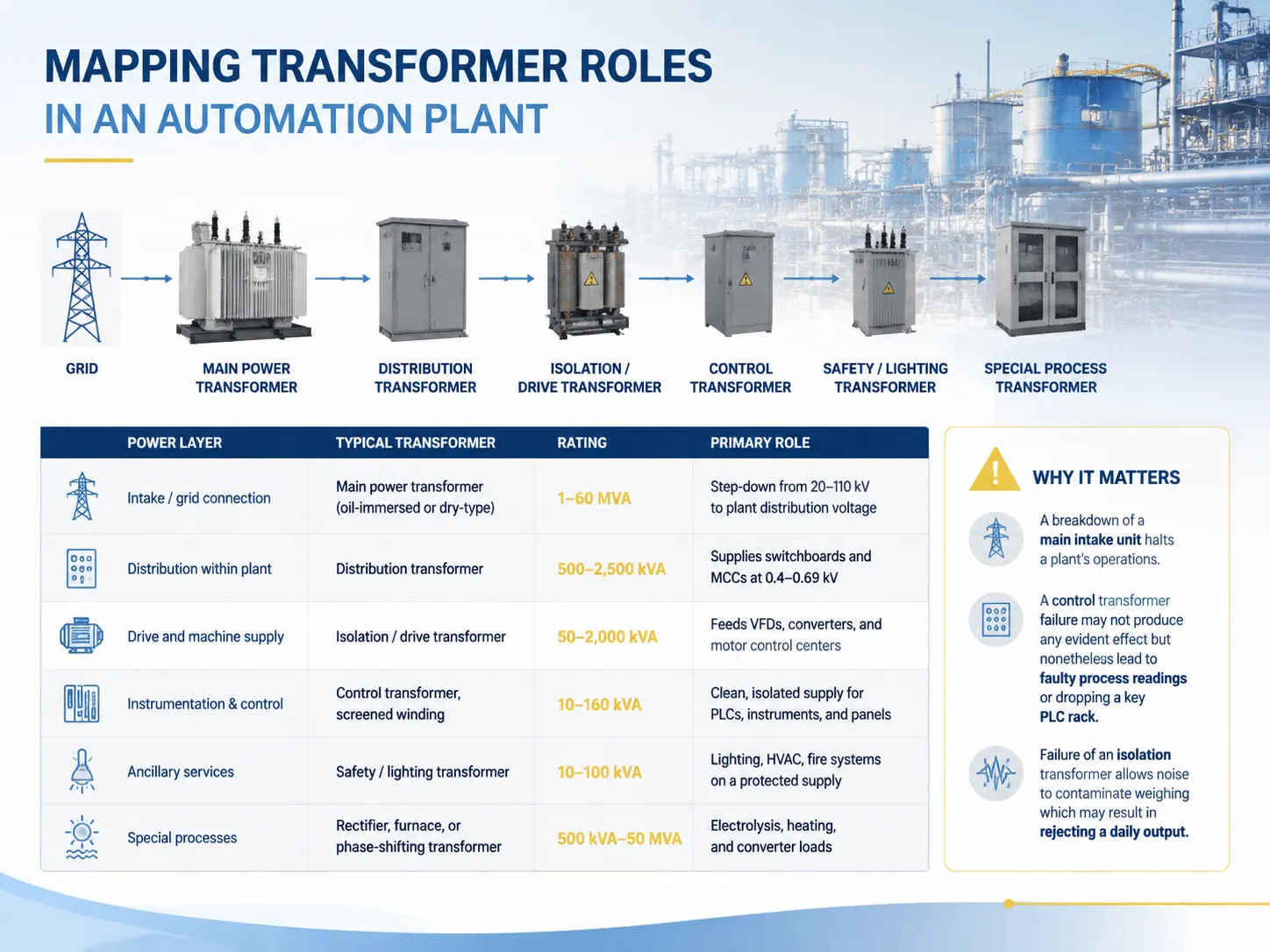
Warum ist die Zuordnung wichtig? Dies liegt an der Auswirkung, die jede Schicht bei Ausfällen hat. Ein Ausfall einer Haupt-Einspeiseeinheit stoppt den Betrieb einer Anlage; ein Ausfall des Steuertransformators hat möglicherweise keine offensichtlichen Auswirkungen, kann jedoch dennoch zu fehlerhaften Prozessmessungen oder dem Ausfall eines wichtigen PLC-Racks führen; während der Ausfall eines Isolationstransformators dazu führt, dass Störungen die Wägung kontaminieren, was zu einer Ablehnung der täglichen Produktion führen kann.
Haupt-Einspeisetransformatoren
Der Haupttransformator verbindet die Anlage mit dem Stromnetz und passt in der Regel die Spannungspegel von 20–110 kV auf 6-11 kV oder 0,4–0,69 kV an. Die Kernanforderungen, die das Design von Automatisierungsanlagen bestimmen, umfassen Folgendes:
- Impedanz: 6-10% ist der Durchschnittswert für Eingangstransformatoren, die das Niveau des Kurzschlussstroms begrenzen und die Spezifikationen der nachgeschalteten Geräte einhalten müssen.
- OLTC: Der Lastwechsel ist in Einheiten über 10 MVA unerlässlich; bei geringerer Leistung wird er dennoch empfohlen.
- Überwachung: Es gibt auch eine zunehmende Nachfrage nach der Überwachung von DGA- und Temperaturwerten aufgrund der Bedeutung der Einheit.
Was die spezifischen Kosten von Transformatoren betrifft, so wird das Modell 5-MVA, 35/10-kV einen Preis zwischen $60.000-$120.000 haben; die Kosten für das Modell 20 MVA, 110/10 kV variieren zwischen $180.000-$400.000. Bei der Einführung eines solchen Transformators ist es notwendig, zunächst vor Ort Tests gemäß dem Standard IEEE C57.12.90 durchzuführen.
Steuer- und Hilfstransformatoren
Transformatoren in Steuer- und Umspannwerken sind die unsichtbare Kraft hinter der Automatisierung in der Industrie. Sie versorgen PLC-Racks, DCS-Schränke, die Installation von Instrumenten und Magnetventilen sowie den Betrieb elektrischer Netzwerke mit Strom. Ihre grundlegenden Anforderungen sind das einfache und kontinuierliche Design der Steuereinheit.
- Geschirmte oder elektrostatikgeschützte Wicklung: minimiert die Kopplung von Common-Mode-Rauschen zu Steuerelektronik;
- Regelung: normalerweise für 3 – 5% Spannungsregelung bei 100% Last ausgelegt, sodass die Stromversorger für PLC eine zuverlässige Spannung am Eingang haben;
- Gehäuse: IP54 – IP65, häufig an Wänden montiert oder in separaten Fächern untergebracht.
Steuertransformatoren folgen dem IEC 61558 Standard für die Sicherheit von Leistungstransformatoren, Stromversorgungsgeräten und Reaktoren, anstatt umfangreiche Tests basierend auf dem IEC 60076 Standard durchzuführen. Diese Geräte werden im Bereich von 10-160 kVA produziert und bieten den niedrigeren Preis von $1200 für eine 15 kVA Transformator-Einheit bis zu $8000 – $12000 für einen Transformator in Schaltschrankqualität mit 160 kVA Kapazität.
Isolationstransformatoren für Antriebe und Instrumente
Isolationstransformatoren werden in zwei einzigartigen Funktionen eingesetzt, die oft verwechselt werden können. Die erste ist die Antriebsisolierung, sodass der Transformator zwischen der Stromversorgung und dem Frequenzumrichter (VFD) oder Konverter installiert wird. Die zweite ist die Instrumentierungsisolierung, was bedeutet, dass der Transformator die Messschaltungen vor Erdschleifen und Rauschstörungen schützt.
| Typ | Anwendung | Schlüsselanforderung | Typische Nennleistung |
|---|---|---|---|
| Antriebsisolierungstransformator | Zwischen Stromversorgung und VFD-Eingang | Handhabung von Harmonischen, hohen Einschaltströmen, Lastschaltungen ohne Last | 100–2.000 kVA |
| Instrumentierungsisolierungstransformator | Versorgt PLC-, Wäge-, Analyse-Schaltungen | Geschirmte Wicklung, niedrige Kapazität, enge Regelung | 1–50 kVA |
| K-factor rated transformer | Drive-heavy loads | K-4 to K-20 rating for harmonic current | 150–1.500 kVA |
One of the common problems in the field of instrumentation is that those isolation transformers with a rating of less than 5 kVA are given specifications that are the same as those of motor transformers, thus exposing the delicate circuits to the common mode interference. The solution to the issue consists in requesting a screened winding that has a capacitance of less than 0.001 µF between the primary and secondary, a solution that increases the price of the unit by 10–20% but eliminates most of the issues associated with ground loop-related instruments.
Special-Purpose Transformers in Process Lines
Certain automation applications call for transformation units beyond the conventional distribution. The most typical ones in today’s facilities include:
- Rectifier transformers for electroplating, anodizing and forming batteries, supplying power to thyristor or diode rectifiers, withstanding high harmonic distortions; they range from 0.5 MVA to 10 MVA and cost $18000 to $120000.
- Furnace transformers for induction heating or resistance heating processes, capable of delivering high current at low voltage; a *2 MVA* furnace transformer is priced at $40000 to $90000.
- Phase-shifting transformers meant for considerable multi-pulse converters (12/24-pulse rectifiers), due to cancellation of 5th and 7th harmonics, costing $30000 to $150000.
- Servo transformers and motion isolation transformers used in vast packaging and robotic installations which are usually small-sized (5-50 kVA) but have strict transient immunity criteria.
Each type has its own standard regulating testing procedures for transformers; usually rectifier transformers must meet the requirements of IEC 61378-1 whereas furnace transformers usually called to meet company’s certification scheme based on IEC 60076. The main request for the automation engineer is that the transformer supplier must be introduced early, as such items are long-lead (10-24 weeks) and almost impossible to substitute with standard equipment during commissioning phase.
Comparison of Transformer Applications
The table included below explains how the same plant uses the full basal transformer characteristics for different functions in the complete production process.
| Charakteristik | Intake | Verteilung | Drive Isolation | Control / Instrument |
|---|---|---|---|---|
| Typische Nennleistung | 1–60 MVA | 500–2.500 kVA | 100–2.000 kVA | 1–160 kVA |
| Primärspannung | 20–110 kV | 10–35 kV | 0,4–0,69 kV | 4 kV |
| Impedanz | 6–10% | 4–6% | 4–8% | 2–5% |
| Harmonic handling | Begrenzt | Begrenzt | High (K-factor) | N/A (screened) |
| Key standard | IEC 60076 | IEC 60076 | IEC 60076 + IEEE 519 | IEC 61558 |
| Failure impact | Plant stop | Area outage | Line stoppage | Control degradation |
| Typical price (USD) | $60,000–$400,000 | $9,000–$38,000 | $4.000–$22.000 | $1,200–$12,000 |
By looking at the table, we can see the design logic. Impedance and protection redundancy are higher for layers associated with critical processes; sensitive layers get screening and better controlling; whereas layers that process significant amount of harmonics utilize K-factor and special designs as well. It should be emphasized that there is no ideal “standard transformer” that can be used for every case.
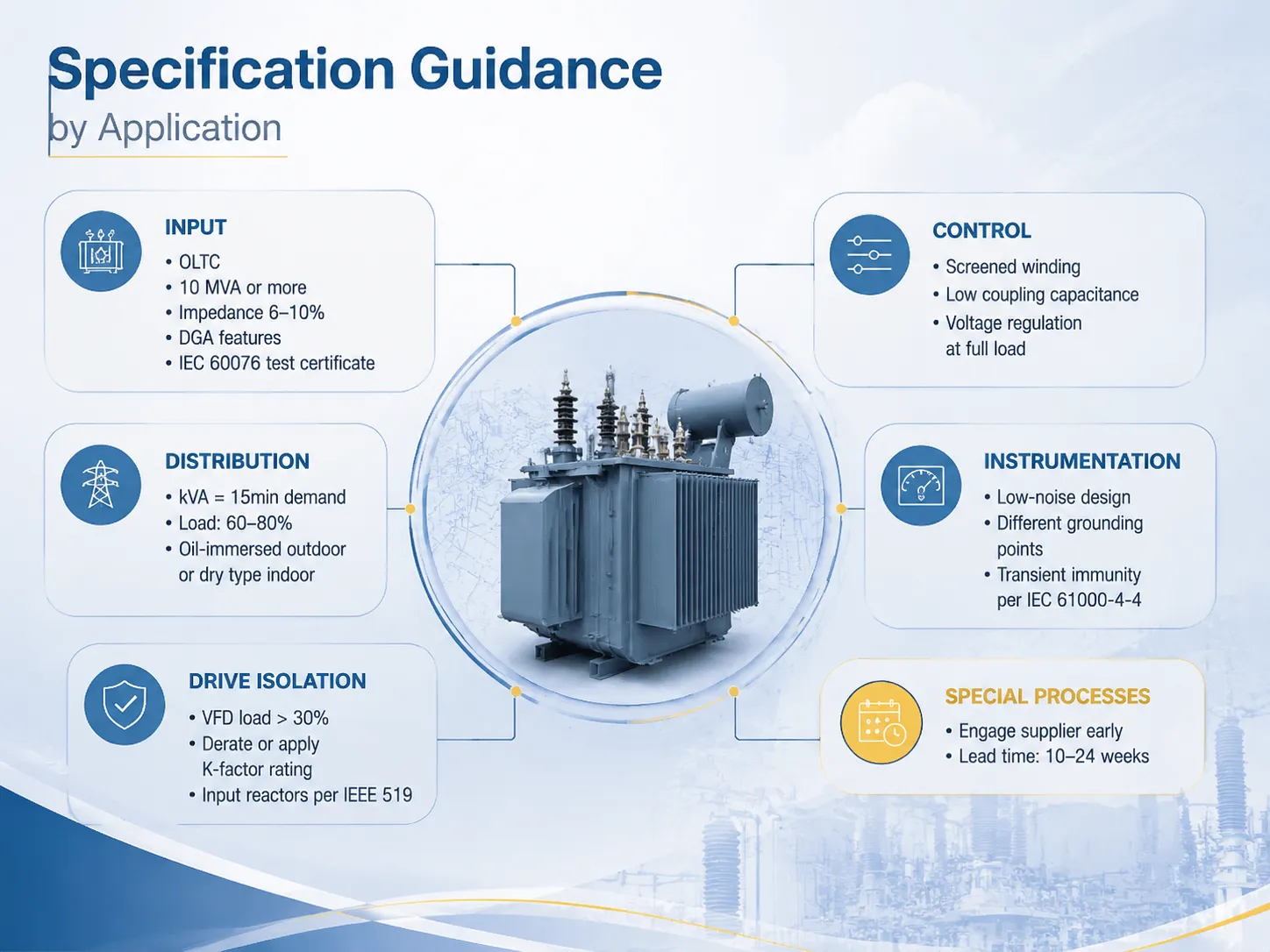
Specification Guidance by Application
- Input: Indicate the OLTC, 10 MVA or more, with an impedance ranging from 6-10%, as well as verifying that the DGA features and the IEC 60076 test certificate are available.
- Distribution: Ensure that the kVA matches the 15min demand at an electrical load of 60-80% while the equipment type being either an oil-immersed outdoor transformer or a dry type indoor transformer.
- Drive isolation: Derate or apply K-factor rating for a case where the load of VFD exceeds 30% and additionally provide input reactors following that of IEEE 519.
- Control: Use a screened winding of low coupling capacitance and validate that the voltage regulation occurs during the full load.
- Instrumentation: Require a low-noise design, different grounding points, as well as transient immunity in accordance with IEC 61000-4-4.
- Special processes: Work with any supplier early in the design stage and ensure any lead time of 10-24 weeks.
Price Ranges by Application
| Anwendung | Nennleistung | Typischer Preis (USD) | Vorlaufzeit |
|---|---|---|---|
| Sicherheits- / Beleuchtungstransformator | 10–100 kVA | $900–$4,500 | 2–6 weeks |
| Control transformer (screened) | 15–160 kVA | $1,200–$12,000 | 4–10 weeks |
| Antriebsisolierungstransformator | 200–2,000 kVA | $4.000–$22.000 | 6–14 weeks |
| Verteilungstransformator | 500–2.500 kVA | $9,000–$38,000 | 8–16 weeks |
| Rectifier transformer | 500 kVA–10 MVA | $18,000–$120,000 | 12–24 weeks |
| Main intake transformer | 5–60 MVA | $60,000–$400,000 | 16–40 weeks |
Prices depend on specifications, brands, and other details hence the aforementioned values are estimates for making a plan for IEC 60076-compliant transformers. Custom transformers must be protected under the contract rules so it is common to include a liquidated damage clause for delayed deliveries.
Top-Marken & Preisvergleich
In general, when deciding on the suppliers for industrial automation products, the buyers use two criteria for evaluating suppliers of transformers: product engineering and cost. The prices featured in the table refer to a typical transformer – 1,000 kVA, 10/0.4 kV distribution transformer although the prices of unique transformers run much higher.
| Marke | Land | Automation-Relevant Strengths | Indikativer Preis (USD) |
|---|---|---|---|
| Siemens | Deutschland | Deep PLC/SCADA integration, digital twin services | Der dritte wichtige Vorschlag ist die Verwendung von Paralleltransformatoren im Falle einer breiten l… |
| ABB | Schweiz | Drive-to-transformer packages, broad LV/MV portfolio | $14.000–$26.000 |
| Schneider Electric | Optimierungsmaßnahmen in der Praxis | EcoStruxure control integration, dry-type strength | $13,000–$25,000 |
| Hitachi Energie | Japan/Schweiz | Power transformer heritage, rectifier transformer expertise | $15,000–$30,000 |
| Eaton | USA | Control and isolation transformer depth for machinery OEMs | $12.000–$24.000 |
| Jiangsu Subian Electric Power | China | IEC 60076 compliance, full range of oil/dry/rectifier types, OEM | $9.000–$18.000 |
International producers of transformers achieve their profits by integrating their own devices. Their transformers do interact with their own motor drives, switch gears and control systems, thus saving a lot of automation projects time. Jiangsu Subian Electric Power, on the other hand, is an IEC 60076 compliant manufacturer which offers all kinds of control transformers as well as large rectifier systems at 45-60% of the prices established by European or US manufacturers. Being a provider of automation tools and machinery making companies, Jiangsu Subian Electric Power has something to offer to those companies, including custom winded transformers with custom impedance and kVA capacity.
Häufig gestellte Fragen
How many transformers does a typical automated plant actually use?
Mid-sized plants often operate 5-10 transformers including one or two incoming transformers, two to four distribution transformers, as well as control, isolation and safety transformers ranging from 10 kVA and up to 2,000 kVA in ratings. Large processing plants even go up to 20-40 transformers depending on the complexity of the processing line. However, it may be the first step in any optimization program to keep track of all transformers in operation.
What is the difference between an isolation transformer and a control transformer?
An isolation transformer serves to isolate circuits to avoid the possibility of ground loops and common noise throughout the circuit and can be utilized for both drives and equipment. A control transformer is a kind of an isolation transformer for control circuits which is designed to serve in control circuits, internally equipped with shielding, with an average regulation of not more than 3-5% and the correspondent IEC 61558 standards. All control transformers isolate, however isolation does not mean suitability for control applications.
How much does a small control transformer cost?
One can buy a 15 kVA screened control transformer for around $1,200 to $2,500; a 160 kVA workstation type will take $8,000 to $12,000. The price depends on the level of isolation, the class of regulation, the housing protection (IP54/IP65), as well as the manufacturer. While these amounts are not significant compared to the main intake unit, it is cheap protection, as for $1,500 a control transformer may save millions worth of PLC and control equipment.
Do I need a K-factor transformer for my drive loads?
When a VFD load is over roughly 30% of transformer capacity, either a K-factor unit (K-4 to K-20) or derated standard unit must be chosen. The presence of harmonics from converters leads to more heating of the windings, and use of a K-13-rated unit is costlier by 10-25% compared to standard ones but prevents failures of insulation that can be caused by overheating. Otherwise, the use of 5% impedance input reactors for each drive would allow a standard transformer to be used instead.
What is the lead time for a rectifier or furnace transformer?
Transformers, particularly rectifier and furnace types, are made to order with much longer lead times than those for standard distribution transformers. Rectifier and furnace transformers are manufactured in about 12 to 24 weeks while usual distribution transformer fabrication takes 8 to 16 weeks. Since these transformers feed processes which cannot be held off at commissioning, they need to be scheduled 6 to 9 months before the actual startup and factory test witnessing will be a contract necessity.
Referenzen
- IEC 60076-Serie — Leistungstransformatoren — the base design and testing standard for intake, distribution, and drive transformers.
- IEC 61558 — Safety of transformers, reactors and similar products — governs small control and safety transformers used in control circuits.
- IEC 61378-1 — Converter transformers — the standard for rectifier and converter duty transformers in process lines.
- IEEE 519 — Harmonic control in electric power systems — THD limits for drive-heavy plants and the basis for K-factor selection.
- IEC 60204-1 — Safety of machinery: Electrical equipment of machines — requirements for machine-level control and isolation transformer supply.
- NEMA standards for transformers — North American ratings and application guidance for industrial buyers.
- Jiangsu Subian Electric Power — official site — IEC 60076-compliant transformer manufacturer serving industrial automation projects globally.
Fazit
In industrial automation, different transformer types come into play — one could find transformers fulfilling different purposes — intake, distribution, drive isolation, control, instrumentation and special process duty, among others. The distinguishing factor between a successful plant design and simply a reactive maintenance approach towards achieving the desired operational results is former’s ability to determine which transformer is planned for which job, define operating parameters (impedance, screening efficiency, harmonic performance, and regulation) and ensure the budget is set considering that each transformer carries a different risk and comes at a different cost from $1,200–$400,000 each.
Main points to consider are the following:
- You should document all transformers in the plant before starting optimization.
- Control transformers should conform to IEC 61558 standard with screened windings; drive transformers should be able to process harmonics.
- Use K-factor transformers or input reactors when VFD loads exceed 30%.
- Be ready to order special process transformers 6–9 months before needed and go through factory testing.
Compare well-known global brands like Siemens, ABB, Schneider, and their products by IEC-certified manufacturers (Jiangsu Subian Electric Power) in terms of ecosystem integration vs. cost.For transformer supply across the full industrial range — from control units to rectifier transformers — visit www.subian-electric.com.