


Der Sicherheitsmanager der Versorgungsunternehmen untersucht derzeit die Gründe, warum drei Umspannwerke eine interne Prüfung nicht bestanden haben. Eines der Umspannwerke versäumte es, den Gas-Auslöseschaltkreis des Buchholz-Relais zu überprüfen, der mit einer Alarmleuchte verbunden war. Im zweiten Umspannwerk war die Brandwand, die zwei Transformatoren mit 10 MVA trennte, kürzer als der Ölauffangbereich, und im Falle eines Tankbruchs hätte das brennende Öl über die Wand fließen können. Im dritten Umspannwerk war das Transformatorenöl seit neun Jahren in Gebrauch, ohne einmal auf die Dielektrizität getestet zu werden, und der Wassergehalt war fast viermal so hoch wie der zulässige Grenzwert. In allen drei Fällen war der zugrunde liegende Grund, dass die Mitglieder des Projektteams die Sicherheitsstandards für ölgetauchte Transformatoren nicht anwendeten.
Der Leitfaden beschreibt die wichtigen technischen Sicherheitsstandards für ölgetauchte Transformatoren, wie internationale Standards (IEC, IEEE, NFPA), nationale Vorschriften (GB, NEC) und Betriebspraktiken, und erklärt, wie diese Standards dazu in der Lage sind, Menschen, Ausrüstung und Umwelt zu schützen. Der Leitfaden wurde für Ingenieure, Projektmanager und Einkäufer verfasst, die verstehen müssen, was mit Konformität gemeint ist, bevor sie die Spezifikationen abzeichnen.
Schnelle Antwort: Die wichtigsten Sicherheitsvorschriften für ölgetauchte Transformatoren sind die IEC 60076-Serie (Design, Prüfung, Kurzschlussverhalten), IEC 60296 und IEC 60422 (Ölqualität), IEC 60599 (DGA-Interpretation), IEEE C57.12.00 und C57.104 (nordamerikanische Analogien und Gasbewertung) sowie Brandschutz- und Elektrovorschriften – NFPA 70 (NEC), NFPA 850 (Anlagenschutz), IEC 61936 (Installation über 1 kV). Kritische Konformitätszahlen: dielektrische Festigkeit des Öls ≥ 50 kV/2,5 mm für neues Öl; Flammpunkt von Mineralöl ≥ 135°; Feuerpunkt ~160°; Temperaturerhöhung der Wicklungen ≤ 65K; Blitzschlagfestigkeit von 170 kVp für Transformatoren der Klasse 35 kV. Die Sicherheitsvorrichtungen Buchholz-Relais, Druckentlastung, Ölretention müssen gemäß IEC 60076-1 und IEC 61936 beachtet werden.
Warum Standards für ölgetauchte Transformatoren wichtig sind
Ein Tauchtransformator hat in einem einzigen Tank drei Klassen von Gefahren. Hier beziehen wir uns auf verschiedene Situationen, in denen große Mengen eines brennbaren Fluids vorhanden sind, die Energiekapazität, die ausreicht, um einen Lichtbogen zu erzeugen, und Druckgase, falls etwas schiefgeht. Wenn etwas schiefgeht, ist der Schaden nicht proportional. Ein kleiner Fehler in der Isolierung eines 30 MVA-Transformators kann zu einer Explosion des Tanks und dem Spritzen von brennendem Öl über ein großes Gebiet führen. Richtlinien existieren aufgrund der Tatsache, dass die Physik von Ausfällen gnadenlos ist und die aus unglücklichen Unfällen gewonnenen Lektionen Leben kosten und ganze Umspannwerke zerstören.
Das System der Normen funktioniert in Schichten. Das System der Entwurfsnormen stellt sicher, dass Geräte robust genug sind, um den Belastungen standzuhalten, die sie ertragen müssen. Die Prüfstandards ermöglichen es, sicherzustellen, dass die Haltbarkeit im Werk erreicht wird. Der Installationsstandard sichert die korrekte Installation der Ausrüstung. Der Betriebsstandard gewährleistet die langfristige Funktion der Maschine. Schließlich verhindern Brandschutzvorschriften erhebliche Zerstörungen, falls etwas schiefgeht. Eine konforme Installation ist eine Installation, die alle Ebenen der Normen nutzt.
IEC 60076: Das Rückgrat von Design und Prüfung
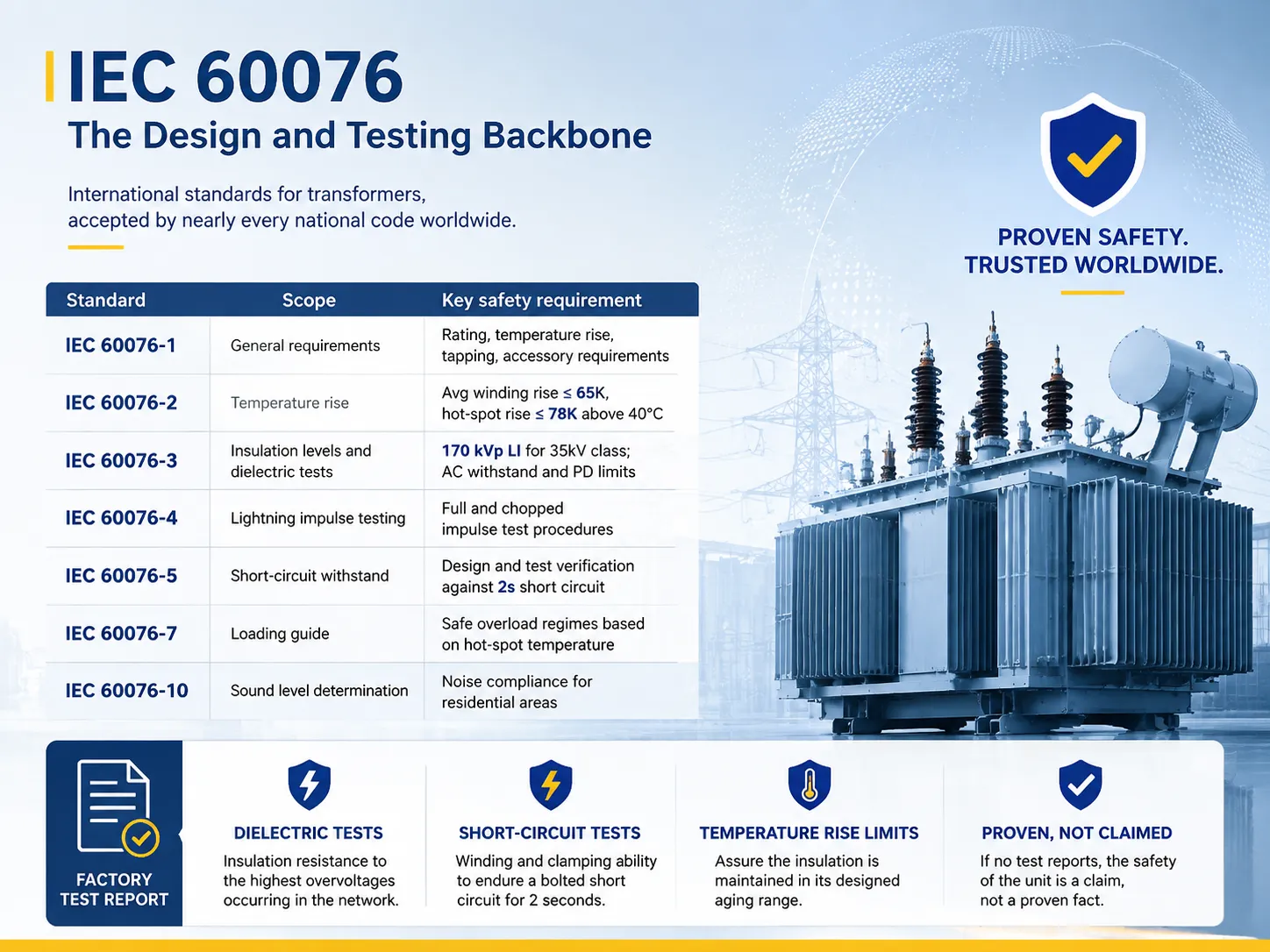
Die IEC 60076-Serie bezieht sich auf die internationalen Normen für Transformatoren und wird von nahezu jedem nationalen Regelwerk der Welt anerkannt. Die relevantesten Normen für ölgetauchte Transformatoren sind:
| Norm | Umfang | Wichtige Sicherheitsanforderung |
|---|---|---|
| IEC 60076-1 | Allgemeine Anforderungen | Nennwerte, Temperaturanstieg, Abzapfungen, Zubehöranforderungen |
| IEC 60076-2 | Temperaturanstieg | Durchschnittlicher Wicklungsanstieg ≤ 65K, Hot-Spot-Anstieg ≤ 78K über 40°C |
| IEC 60076-3 | Isolationsniveaus und dielektrische Tests | 170 kVp LI für 35kV-Klasse; AC-Beständigkeit und PD-Grenzwerte |
| IEC 60076-4 | Blitzimpulsprüfung | Voll- und gekürzte Impulsprüfverfahren |
| IEC 60076-5 | Kurzschlussfestigkeit | Entwurf und Testverifizierung gegen 2s Kurzschluss |
| IEC 60076-7 | Lastleitfaden | Sichere Überlastregime basierend auf Hot-Spot-Temperatur |
| IEC 60076-10 | Schallpegelbestimmung | Geräuschkonformität für Wohngebiete |
Jedes dieser Komponenten übersetzt sich in eine ok/nicht ok-Bewertung, die in einem Prüfbericht des Werks präsentiert wird. Die dielektrischen Tests zeigen den Isolationswiderstand gegenüber den höchsten Überspannungen im Netz. Die Kurzschlussprüfungen zeigen die Wicklungs- und Klemmfähigkeit der Einheit, um einen Kurzschluss zu überstehen. Die Temperaturanstiegsgrenzen stellen sicher, dass die Isolierung in ihrem vorgesehenen Alterungsbereich bleibt. Wenn ein Hersteller diese Berichte nicht vorlegen kann, ist die Sicherheit der Einheit nur eine Behauptung und kein bewiesener Fakt.
Ölstandards: IEC 60296, IEC 60422 und DGA
Das Isolieröl wird sowohl als Dielektrikum als auch als diagnostisches Medium charakterisiert und unterliegt zwei Normen bezüglich seiner Lebensdauer.
IEC 60296 legt die Spezifikationen für das neue Transformatorenöl fest. Die wichtigsten Werte: Durchschlagspannung ≥ 30 kV/2,5 mm vor der Behandlung und ≥ 60 kV/2,5 mm nach der Behandlung für die höchsten Klassen, Wassergehalt ≤ 30 ppm, tan Delta ≤ 0,005 bei 90 Grad Celsius und Flammpunkt ≥ 135 °C für inhibiertes Mineralöl.
IEC 60422 befasst sich mit der Überwachung im Feld. Es legt Schwellenwerte für Wassergehalt, Säuregehalt, Durchschlagspannung und tan Delta basierend auf der Spannungsgruppe fest und definiert die Intervalle für die Probenahme. Für einen Transformator der 35 kV-Klasse liegt der empfohlene Wert für die Durchschlagspannung im Betrieb normalerweise bei 50 kV/2,5 mm.
Die Analyse gelöster Gase stellt die diagnostische Ebene dar. Die IEC 60599 definiert, wie die sieben Schlüsselgase, die aufgrund verschiedener Fehler entstehen, analysiert werden: Wasserstoff, Methan, Ethan, Ethylen, Acetylen, Kohlenmonoxid und Kohlendioxid. Eine Verdopplung des Wasserstoffs bei steigendem Acetylen zeigt an, dass Lichtbogenbildung auftritt, während anhaltendes Ethylen mit hohem Wasserstoffgehalt auf thermische Fehler hinweist. Diese Interpretation von Fehlern gemäß dem Standard stellt bei weitem das wichtigste Diagnosewerkzeug dar, um ölgefüllte Geräte rechtzeitig in der gegenwärtigen Phase zu überwachen.
| Öleigenschaft | Neues Öl (IEC 60296) | Betriebsgrenze (IEC 60422) |
|---|---|---|
| Durchschlagspannung | ≥ 30 kV/2,5 mm (unbehandelt), ≥ 60 kV/2,5 mm (behandelt) | ≥ 50 kV/2,5 mm für >72,5 kV Klasse |
| Wassergehalt | ≤ 30 ppm | Steigende Tendenz untersucht > 20-30 ppm |
| Säuregehalt (Neutralisationswert) | ≤ 0,01 mg KOH/g | ≤ 0,10-0,15 mg KOH/g |
| Tan Delta bei 90°C | ≤ 0,005 | ≤ 0,05-0,10 je nach Klasse |
| Flammpunkt | ≥ 135°C | Kein signifikanter Rückgang vom Neuwert |
Diese Anforderungen sind greifbare Messungen der Sicherheitsleistung von Transformatorenöl; die Einhaltung dieser Anforderungen wird als Kriterium für Beschaffung und Nutzung angesehen, nicht nur als Absicht.
Aus betrieblicher Sicht ist es finanziell vorteilhaft. Regelmäßige Öltests eines 10 MVA-Transformators kosten $200–$600, abhängig vom verwendeten Labor für die Tests und dem Umfang der Bedürfnisse. Ein verpasster DGA-Trend, der zu einer hohen Fehlerstelle führt, verursacht Kosten von $200.000–1.000.000 für den Austausch und die Ausfallzeit der Einheit. Das Verhältnis zeigt die Rentabilität der Praxis, die 1:1.000 beträgt.
IEEE-Standards: C57.12.00 und C57.104
In Nordamerika und anderen Gebieten, in denen US-Technologie gefördert wird, erfüllt IEEE C57 dennoch die IEC 60076-Funktion anderswo.
- IEEE C57.12.00 ist der allgemeine Anforderungsstandard im Bereich der flüssigkeitsgefüllten Verteilungs- und Leistungstransformatoren, der Nennwerte, Impedanz, Temperaturanstieg, Dielektrizitätstests (Basisimpulsniveau, BIL) und Prüfpraktiken spezifiziert. Beispielsweise sollte ein Transformator der Klasse 35 kV gemäß den IEEE-Definitionen typischerweise ein BIL von 200 kV haben.
- Das Dokument IEEE C57.104 dient als Leitfaden zur Interpretation der DGA-Ergebnisse, die die Gas Konzentrationen in 4 Kategorien (normal, erhöht, hoch und sehr hoch) gruppiert haben, mit vorab festgelegten Maßnahmen und Wiederholungen für die Probenahme.
- IEEE C57.12.10 ist der Standard, der die Designs einschließlich der pad-montierten und Schachtarten behandelt.
IEC und IEEE unterscheiden sich nur in ihrer Spezifikationsstufe. Einheiten, die nach einem Standard entwickelt wurden, können die Anforderungen des anderen Standards nicht erfüllen, da sich Impulsniveaus, Impedanztoleranzen und Benennungskonventionen unterscheiden. Daher müssen Käufer, die Einheiten erwerben möchten, die anwendbaren Standards in jeder Anfrage angeben, ohne die Möglichkeit, “IEC 60076“ und „IEEE C57.12.00“ als austauschbare Begriffe zu verwenden.
Brandschutz- und Installationsvorschriften: NFPA und IEC 61936
Eine separate Ebene von Vorschriften regelt die Sicherheit von Installationen. Die meisten Käufer von Maschinen sind sich solcher Gesetze völlig unbewusst, aber sie haben längst entschieden, ob ein bestimmter Transformator an einem bestimmten Standort montiert werden kann oder nicht.
| Vorschrift | Umfang | Wichtige Anforderungen an Öltansformatoren |
|---|---|---|
| NFPA 70 (NEC) | Elektrische Installationen in den USA. | Abstände, Schächte, Trennabstände für flüssigkeitsgefüllte Transformatoren |
| NFPA 850 | Brandschutz für elektrische Kraftwerke | Trennung, Unterdrückung, Ölauffang für Transformatoren |
| IEC 61936-1 | Installation elektrischer Geräte über 1 kV | Abstände, Barrieren, Erdung und Anforderungen an die Ölauffangvorrichtungen |
| NFPA 921 / NFPA 30 | Branduntersuchung / brennbare Flüssigkeiten | Hintergrundregeln zur Brandsicherheit, die den Umgang mit Transformatorenöl betreffen |
Die Anwendung dieses Codes hat praktische Manifestationen in jeder ordnungsgemäß gebauten Umspannstation: eine Brandwand oder ein Abstand, der Transformatoren trennt (normalerweise etwa 4–8 Meter oder eine Wand, die für einen 3-Stunden-Brand zwischen den Einheiten bewertet wurde), eine Ölauffanggrube oder ein Damm, der 100% des Öls plus die Menge an Löschwasser halten kann, Abfluss von gefährdeten Zonen und minimale Abstände zwischen Durchführungen und Kabelkästen. Darüber hinaus erfordern viele Bereiche eine automatische Branddetektion oder -unterdrückung für Inneninstallationen mit einer bestimmten Bewertung (zum Beispiel erfordern Inneninstallationen mit mehr als 10 MVA oder 500 kVA in bevölkerten Gebieten normalerweise die Installation von automatischen Branddetektions- und -unterdrückungssystemen).
Anforderungen an Schutzausrüstung
Die standardmäßige Suite von Schutzeinrichtungen für öltypische Transformatoren mit Konservatoren, wie in IEC 60076-1 und den Installationsstandards angegeben, wurde definiert, und jedes Element dieser Suite hat eine Funktion sowie einen Fehlermodus erhalten, der überwacht werden muss, wie zum Beispiel:
- Buchholz (Gas) Relais: In der Lage, sowohl eine langsame Gasansammlung als Alarm als auch eine schnelle Ölüberdruckauslösung zu bieten; die Verkabelung und Prüfung des Gasauslöseschaltkreises ist ein Auditfehler, wie bereits erwähnt.
- Druckentlastungsgerät: Entlastet den Tank schnell, um einen Anstieg des Innendrucks zu verringern; es muss ausreichend für die Transformatorgröße sein und muss kontinuierlich auf eine effektive Funktion überprüft werden.
- Ölstandsanzeiger; ein Gerät, das die Ölstände unter Berücksichtigung der thermischen Ausdehnung aufrechterhält; ein niedriger Ölstand führt zur Exposition der Wicklungen gegenüber warmer Luft und verursacht Gasleckagen.
- Temperatursensoren; Alarme, die sowohl die Oberöltemperatur als auch die Temperatur der Wicklungen anzeigen (ob sie übermäßig ist), müssen die in der IEC 60076-2 Dokumentation genannten Grenzwerte einhalten.
- Silikagel-Atmer; ein Gerät, das die Entfeuchtung der Luft im Konservator ermöglicht; Pinkes Silikagel zeigt Sättigung mit Feuchtigkeit an, was eine routinemäßige visuelle Inspektionsanforderung ist.
- Ölauffangvorrichtung; eine Auffangvorrichtung mit direktem Verhältnis zum Ölvolumen wird gemäß dem Dokument IEC 61936-1 und den lokalen Vorschriften erwartet.
Keines dieser Geräte ist im Vergleich zum ursprünglichen Gerät zu teuer, aber jedes von ihnen ist ein notwendiger Bestandteil einer Sicherheitskette.
| Schutzeinrichtung | Funktion | Prüfungsfrequenz |
|---|---|---|
| Buchholz (Gas) Relais | Langsame Gaswarnung, schnelle Ölüberdruckauslösung | Jährlich, plus Test bei Inbetriebnahme |
| Druckentlastungsgerät | Schnelles Entlüften des Tanks bei internem Druck | Jährliche Überprüfung der Wiederabdichtung |
| Ölstandsanzeiger | Warnung bei niedrigem Stand vor Exposition | Vierteljährliche visuelle Inspektion |
| Öl-/Wicklungstemperaturanzeigen | Alarm und Auslösung bei thermischen Grenzwerten | Alle 2–3 Jahre kalibrieren |
| Silikagel-Atmer | Feuchtigkeitsentfernung aus der Zuluft | Visuelle Kontrolle jedes Quartal |
Ein Kurzschluss, der das Buchholzrelais korrekt auslöst, ist ein Ereignis; derselbe Fehler mit einem defekten Relais ist eine Katastrophe.
Nationale Vorschriften: GB und NEC in der Praxis
Die chinesische Praxis des Exports von Transformatoren basiert hauptsächlich auf der GB-Serie, die eng mit den IEC-Standards übereinstimmt. Was ölgetauchte Transformatoren betrifft, so gelten die in diesem Bereich angewandten GB-Standards GB 1094 (entspricht IEC 60076), GB/T 6451 (Verlustniveaus), GB 20052 (Effizienzklassen) und GB/T 50065 sowie GB 50060 (bezüglich der Erdung und Anordnung von Umspannwerken). Das Effizienzklassensystem gemäß GB 20052-2020 ermöglicht die Umsetzung der Verlustniveaus.
In Bezug auf die Vereinigten Staaten regelt der National Electrical Code (NFPA 70) Artikel 450 die Praktiken der Transformatoreninstallation hinsichtlich der Trennabstände für ölisolierte Transformatoren in Gebäuden und bestimmter Anforderungen an Räume für Transformatoren über 35 kV. Im Falle der in Innenräumen befindlichen flüssigkeitsgefüllten Transformatoren verlangt der NEC entweder das Vorhandensein eines feuerfesten Raums oder geeignete Trennmaßnahmen zusammen mit dem Brandschutzsystem.
Die praktische Botschaft für Exportkäufer lautet: Fordern Sie IEC- oder IEEE-Zertifizierungen vom Werk an, stellen Sie jedoch sicher, dass die Installation den lokalen Vorschriften entspricht.
Eine Compliance-Checkliste für Käufer und Betreiber
- Fordern Sie das vollständige Testpaket an: Standard-Testbericht gemäß IEC 60076-1, Typprüfberichte (Temperaturanstieg, Impuls, Kurzschluss) bezüglich des Designs und Öl-Zertifikat gemäß IEC 60296.
- Stellen Sie sicher, dass die Zertifizierung mehr als nur ein Logo ist: Fordern Sie die ausstellende Stelle und die Berichtnummer an; überprüfen Sie die Bewertung mit dem Typenschild.
- Überprüfen Sie die Impulsniveaus: Für die Einheit in der 35-kV-Klasse sollten Sie 170 kVp gemäß IEC oder 200 kV BIL gemäß dem IEEE-Standard erwarten; geben Sie an, welcher für Ihre Einheit zutrifft.
- Entwerfen Sie die Ölauffangvorrichtung vor der Bestellung, nicht danach: Der Auffangraum sollte in der Lage sein, das gesamte Volumen des Öls zu halten, und den Vorschriften in Ihrer Region entsprechen.
- Verdrahten und testen Sie alle Schutzvorrichtungen während der Inbetriebnahme: Buchholz-Gas- und Überspannungsabschaltung, Druckentlastung sowie beide Temperaturalarmstufen.
- Legen Sie den Prüfzeitraum fest: jährliche DGA- und dielektrische Prüfungen gemäß IEC 60422; häufiger, wenn es Änderungen in Bezug auf Schlüsselgaskonzentrationen gibt.
- Bewahren Sie die Dokumente während der gesamten Lebensdauer des Vermögenswerts auf: Prüfberichte, DGA-Historie und Lastabgriffprotokolle können als Grundlage für sichere Betriebsabläufe und Versicherungsansprüche dienen.
Wie Hersteller die Konformität nachweisen
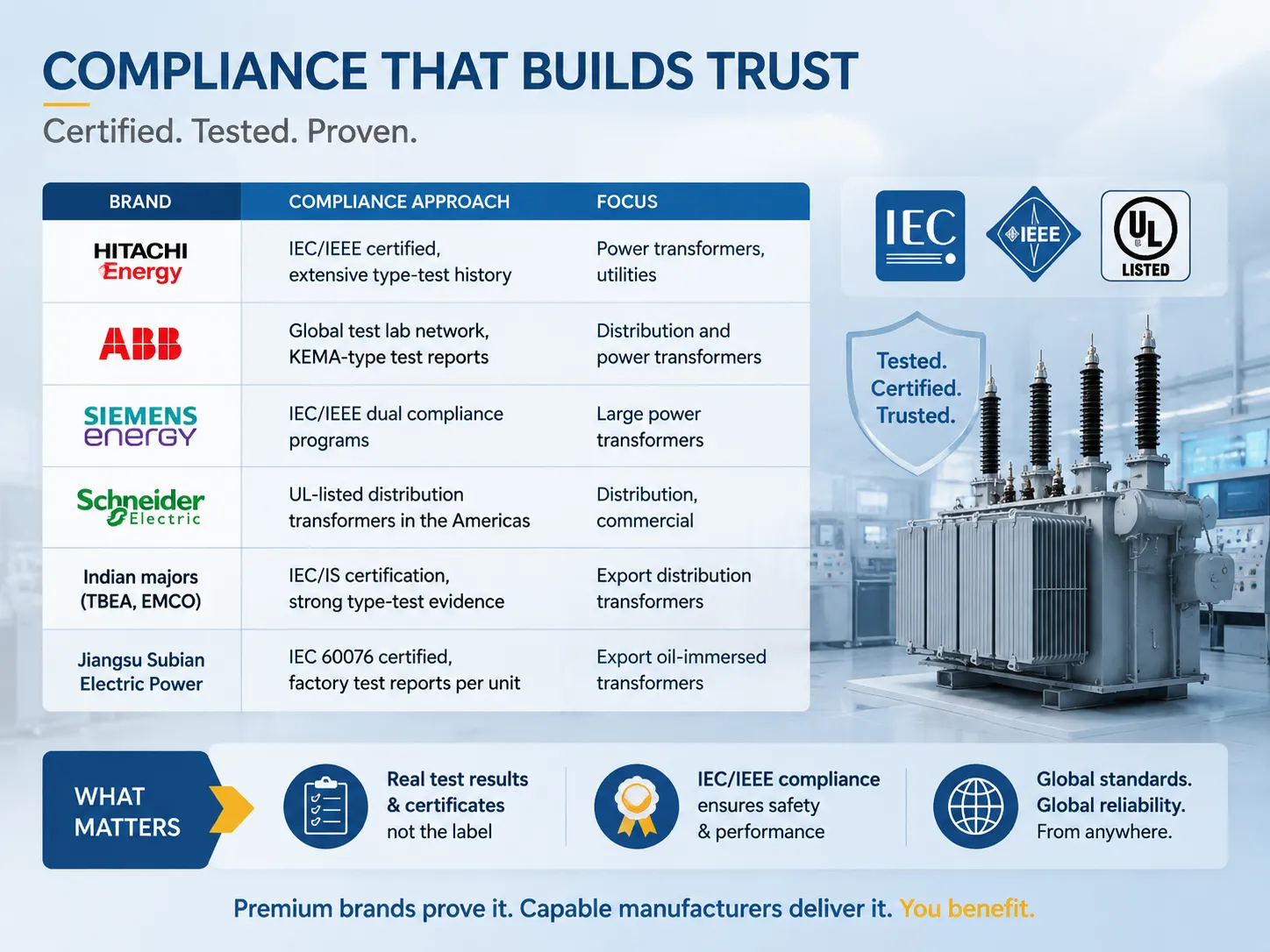
| Marke | Konformitätsansatz | Fokus |
|---|---|---|
| Hitachi Energie | IEC/IEEE-zertifiziert, umfangreiche Typprüfgeschichte | Leistungstransformatoren, Versorgungsunternehmen |
| ABB | Globales Testlabor-Netzwerk, KEMA-Typprüfberichte | Verteilungs- und Leistungstransformatoren |
| Siemens Energie | IEC/IEEE-Dual-Compliance-Programme | Große Leistungstransformatoren |
| Schneider Electric | UL-gelistete Verteilungstransformatoren in Amerika | Verteilung, kommerziell |
| Indische Großunternehmen (TBEA, EMCO) | IEC/IS-Zertifizierung, starke Typprüfnachweise | Exportverteilungstransformatoren |
| Jiangsu Subian Electric Power | IEC 60076-zertifiziert, Werkstestberichte pro Einheit | Export ölgetauchte Transformatoren |
Premium-Marken basieren einen Teil ihrer Preisstruktur auf den Nachweisen der Tests, der Breite der Dokumentation und einer nachgewiesenen globalen Sicherheitsbilanz. Die Einhaltung ist jedoch erschwinglicher geworden. Leistungsfähige chinesische und indische Werke, trotz weniger bekannter Fertigungshintergründe, erfüllen die IEC-Anforderungen mit kalibrierten Geräten und stellen Zertifikate aus. Der Käufer ist mehr an der Realität dieser Zertifikate interessiert als an anderen Details, zu denen das Produktionsland, np431p4-Testresultate usw. gehören würden.
Der Fall von Jiangsu Subian Electric Power ist ebenfalls erwähnenswert. Die Fabrik hat ölgetauchte Transformatoren gemäß dem IEC 60076-Standard entwickelt und stellt mit jeder Lieferung routinemäßige Berichte über Verhältnis, Vektorgroup, Impedanz, Leerlauf- und Lastverluste sowie die Dielektrizitätstests aus. Die Fabrik ist offen für Prüfungen durch Dritte und stellt Ölzertifikate gemäß IEC 60296 aus und dokumentiert die Sicherheitsausrüstung entsprechend. Details sind unter subian-electric.com.
Häufig gestellte Fragen
Was ist die minimale Durchschlagfestigkeit für Transformatorenöl?
Laut IEC 60296 darf die Durchschlagspannung von neuem Öl vor der Behandlung nicht weniger als 30 kV/2,5 mm und nach der Behandlung 60 kV/2,5 mm für die beste Qualität betragen. Die Durchschlagspannung für den Betrieb in der Stromversorgung bei Spannungen über 72,5 kV sollte gemäß den Anforderungen der IEC 60422 mindestens 50 kV/2,5 mm betragen, und niedrigere Grenzwerte gelten für andere Kategorien. Alles unter 30 kV/2,5 mm im Betrieb erfordert sofortige Überprüfungen.
Was ist der Unterschied zwischen IEC 60076 und IEEE C57.12.00?
Während beide Standards Definitionen von Nennwerten, Tests und Spezifikationen in Bezug auf flüssigkeitsgefüllte Transformatoren bereitstellen, unterscheiden sie sich in Impulsniveau, Impedanzwerten, Temperaturanstiegsmethoden und Testverfahren. Zum Beispiel beträgt bei IEC 35-kV-Transformatoren die Impuls-Spannung 170 kVp, während das IEEE-Pendant normalerweise 200 kV BIL verwendet. Es wird empfohlen, für jedes Projekt einen regulierenden Standard zu übernehmen.
Wie oft muss Transformatorenöl getestet werden?
Laut IEC 60422 beträgt die Probenahmefrequenz für Geräte im Normalzustand einmal im Jahr und umfasst die Analyse gelöster Gase, Durchschlagspannung, Säuregehalt, Wassergehalt und tan Delta-Tests. Die in Betrieb genommenen Geräte sollten innerhalb weniger Wochen nach ihrer Inbetriebnahme eine erste Messung der gelösten Gase haben. Im Falle eines Anstiegs der Gaskonzentration oder einer Änderung eines wichtigen Gasverhältnisses ändert sich die Probenahmefrequenz auf einmal im Monat, bis die Ergebnisse stabil sind.
Ist ein Buchholz-Relais obligatorisch?
Ölgetauchte Transformatoren mit einem Konservator, der auf etwa 1 MVA oder mehr ausgelegt ist, benötigen tatsächlich eine Art Buchholz-Relais zum Schutz gemäß dem IEC 60076-1 Standard und den Relais-Schutzstandards. Für die hermetisch abgedichteten Transformatoren oder kleinen Verteilungstransformatoren wären Gasdruckrelais oder Druckentlastungen mit Alarm Ersatz.
Fügen die Sicherheitsstandards für Transformatoren erhebliche Kosten hinzu?
Unbedeutend. Im Allgemeinen werden die Kosten für die Schutzausrüstung, Testergebnisse und Dokumentation, die für die Einhaltung von IEC/IEEE erforderlich sind, zum Gesamtpreis des Produkts hinzugefügt, was 1–3% ausmacht. Im Gegensatz dazu könnte jede Nichteinhaltung dieses Standards zu viel höheren Kosten führen, wie z.B. einem vollständig vermeidbaren Brand, abgelehnten Versicherungsansprüchen oder großen Ausfällen.
Referenzen
- IEC 60076-1: Leistungstransformatoren – Allgemeines — Der grundlegende Entwurfs- und Prüfstandard für ölgetauchte Leistungstransformatoren.
- IEC 60296: Flüssigkeiten für elektrotechnische Anwendungen – Mineralische Isolieröle — Spezifikation für die Qualität neuer Transformatorenöle.
- IEC 60422: Mineralische Isolieröle – Aufsicht und Wartungsleitfaden — Grenzwerte und Zeitpläne für die Ölprüfung im Betrieb.
- IEC 61936-1: Energieinstallationen über 1 kV a.c. — Anforderungen an Installation, Abstand und Ölauffangvorrichtungen.
- IEEE C57.12.00: Flüssigkeitsgetauchte Verteilungs- und Leistungstransformatoren — Entsprechende allgemeine Anforderungen für Nordamerika.
- IEEE C57.104: Interpretation der in ölgetauchten Transformatoren erzeugten Gase — DGA-Interpretation und Aktionslevel.
- NFPA 850: Brandschutz für elektrische Kraftwerke und Hochspannungs-Gleichstrom-Umspannwerke — Brandschutz- und Löschpraktiken für Transformatoren.
- Offizielle Website von Jiangsu Subian Electric Power — IEC 60076-zertifizierte Transformatorenprodukte und Testdokumentation.
Fazit
Die Sicherheit von ölgetauchten Transformatoren ist nicht nur ein isolierter Standard, sondern vielmehr eine Kombination mehrerer Standards, einschließlich IEC 60076, was Entwurfs- und Prüfanforderungen bedeutet, Ölstandards, IEEE C57 für Nordamerika, NFPA und IEC 61936 für Installations- und Brandschutzanforderungen. Jeder Standard hat seine eigenen Sicherheitsmessungen wie einen Anstieg von 65K, einen Impuls von 170 kVp und die Festigkeit des Öls, die bei 50 kV/2,5 mm bewertet wird.
Wichtige Punkte:
- Fragen Sie immer nach einem Testpaket, bevor Sie einen Kauf tätigen, da Typprüfberichte die Sicherheit des Designs nachweisen.
- Stellen Sie sicher, dass DGA- und Ölprüfungen als jährliche Ausgaben betrachtet werden, da sie obligatorisch und nicht zusätzlich sind.
- Stellen Sie sicher, dass jedes Gerät während der Inbetriebnahme verkabelt, getestet und protokolliert wird.
- Denken Sie daran, die Ölauffangvorrichtung gemäß den lokalen Standards zu entwerfen, bevor der Transformator versendet wird.
Unternehmen wie Jiangsu Subian Electric Power stellen ölgetauchte Transformatoren gemäß IEC 60076 mit allen Testdokumentationen zu wettbewerbsfähigen Preisen her.