


Die Technikerin führt eine morgendliche Inspektion durch, als sie sieht, dass die Farbe des Silikagels im Atmungsgerät des Transformators von Blau zu leuchtendem Pink im oberen Teil der Säule gewechselt hat, während der Ölstand im Konservator nahe dem Minimum liegt. Sie überprüft, um beide Ereignisse zu protokollieren, erinnert sich jedoch aus dem Wartungshandbuch, dass diese Beobachtungen zwei frühe Warnzeichen für ein Problem anzeigen: Feuchtigkeit und Luft, die in das geschlossene Ölsystem des Transformators eindringen. Dasselbe geschah bei einem Transformator eines anderen Unternehmens, als vor zehn Jahren die Ausrüstung ausfiel, als sie die gleichen Probleme hatte. Nach dem Unfall zeigte der Bericht zur Analyse der gelösten Gase, dass Anzeichen für steigende Wasserstoffwerte vorhanden waren, die schon lange im Zustand des Atmungsgeräts sichtbar waren. Das Problem wurde durch das Gasrelais erkannt – in diesem Fall handelt es sich um ein Buchholzrelais.
Der Artikel liefert Details darüber, wie Atmungsgeräte und Gasrelais in einem Öltransformator funktionieren, ihre Bedeutung, wie man ihre Signale interpretiert und was eine neue Einheit kostet.
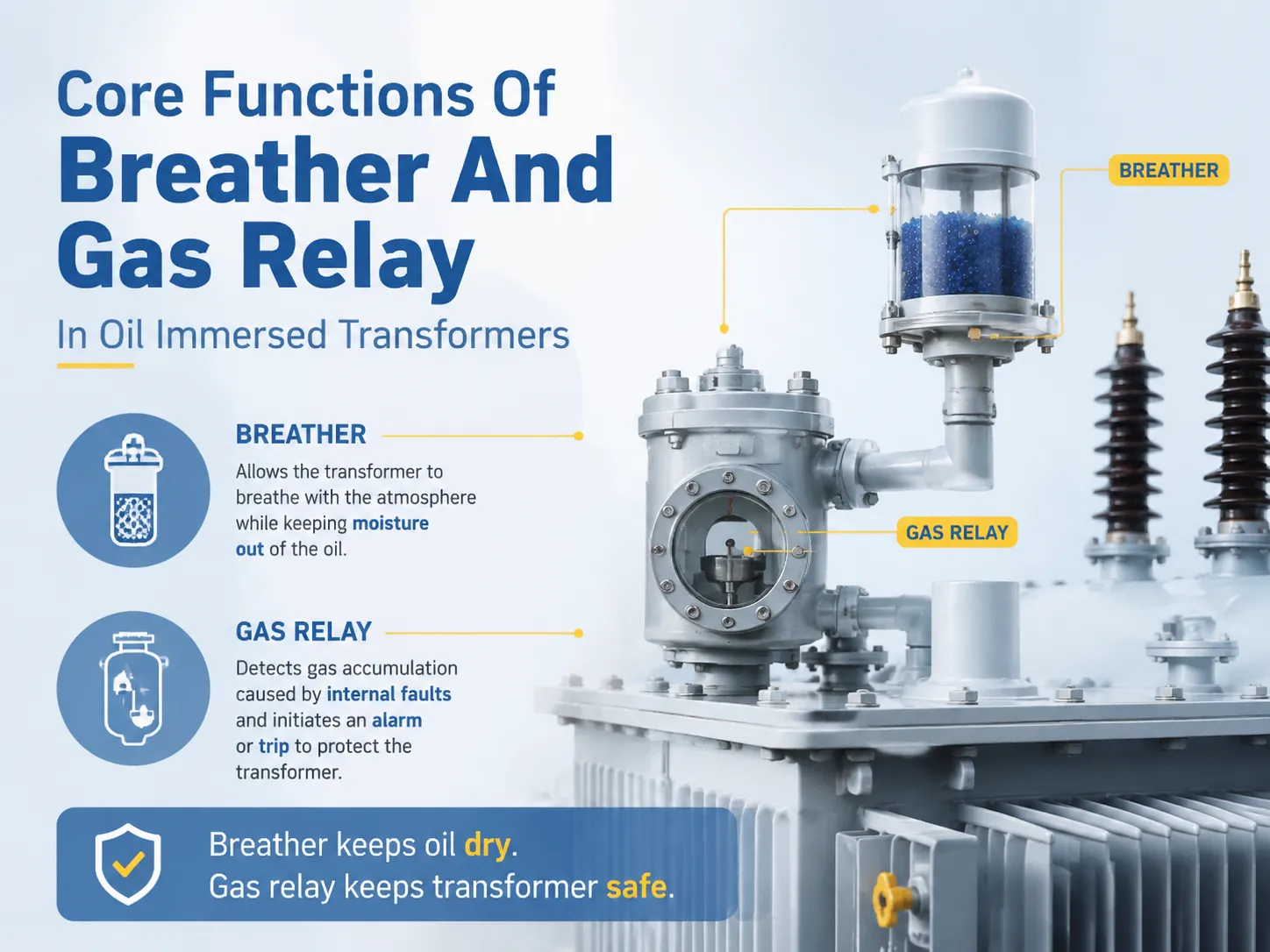
Das Atmungsgerät ist ein Teil des Ölkonservators. Es handelt sich um ein auf Silikagel basierendes Gerät, das Feuchtigkeit aus der Luft entfernt, die durch den Ölkonservator angesogen wird, während der Transformator atmet. Das Gasrelais ist ein weiteres Schutzgerät, das normalerweise zwischen dem Konservator und dem Tank installiert ist, um Gasansammlungen aufgrund von Fehlfunktionen des Transformators zu erkennen. Der Preis eines Atmungsgeräts liegt normalerweise zwischen $50 und $300, und das Gasrelais kostet in der Regel zwischen $100 und $600. Generell müssen alle Leistungstransformatoren mit einer Nennleistung über 1 MVA mit Gasrelais ausgestattet sein (IEC 60076-1 Standard). Es ist obligatorisch, dass alle Konservatorarten Atmungsgeräte verwenden. Das Silikagel im Atmungsgerät muss regelmäßig alle 3 bis 6 Monate überprüft und regeneriert werden, wenn es die Farbe ändert.
Warum ölgetauchte Transformatoren beide benötigen
Das Öl, das im ölgetauchten Transformator verwendet wird, erfüllt die doppelte Funktion der Kühlung und Isolierung. Beide Funktionen können durch die zwei Feinde gefährdet werden, gegen die Gasrelais und Atmungsgeräte schützen – Feuchtigkeit und Gas aus internen Fehlern. Ein ölgefüllter Transformator atmet, weil sich das Öl mit der Temperatur ausdehnt und zusammenzieht: Wenn die Last steigt, erwärmt sich das Öl und dehnt sich aus und drückt die Luft durch das Atmungsgerät nach außen. Wenn das Öl abkühlt, kommt die Luft zurück in den Tank. Ohne ein Trockenmittel-Atmungsgerät würde die Luft die Feuchtigkeit ins Öl bringen, da Wasser der schnellste Weg zum Isolationsausfall ist. Nur wenige hundert Teile pro Million Wasser im Transformatoröl können seine Durchschlagfestigkeit dramatisch beeinträchtigen – die Durchbruchspannung kann von über 60 kV auf unter 30 kV mit zunehmender Feuchtigkeit gesenkt werden.
Gasrelais kämpfen die andere Schlacht. Interne Fehler — kurzgeschlossene Wicklungen, Kernfehler, lose Verbindungen — erzeugen Wärme und entladen elektrische Lichtbögen, die Öl in Gase zersetzen. Die gebildeten Gase steigen an die Oberseite des Tanks und gelangen über das Rohr, das zum Gasrelais führt, zum Konservator, wodurch das Gasrelais Gas erkennen kann, lange bevor andere Schutzvorrichtungen es sehen können.
Der Breather: Funktion und Design
Ein dehydrierender Breather ist eine zylindrische Einheit, die am Lufteinlass eines Konservators installiert ist, normalerweise oben auf einem Konservatorbehälter. Der Breather verwendet das Trockenmittelmaterial, das normalerweise Silikagel ist, durch das die gesamte einströmende Luft strömt. Das Silikagel entzieht der einströmenden Luft Feuchtigkeit, bevor sie zum Öl gelangt. Eine Farbänderung des Silikagels von aktivem Status (meist blau) zu hydratisiertem Zustand (rosa, weiß oder orange, je nach Qualität) zeigt die verbleibende Kapazität des Trockenmittels zur Feuchtigkeitsaufnahme an.
Die Einheit hat typischerweise eine Öldichtung oder ein Rückschlagventil, um eine Sättigung des Trockenmittels mit Wasser durch Regenwasser zu verhindern. Das Gerät ermöglicht auch das Entweichen von Gas und lässt keine Feuchtigkeit eindringen. Moderne Breather können mit einem Anzeige-Fenster, einer abnehmbaren Patrone mit Trockenmittel zur Erneuerung und einem Heizer in kalten Umgebungen ausgestattet sein, wo Feuchtigkeit im Inneren der Einheit kondensieren kann. Ein üblicher dehydrierender Breather kann zwischen ein und drei Kilogramm Silikagel wiegen und für viele Transformatoren mit nur wenigen MVA arbeiten; ein größerer Maßstab erfordert ein größeres Gehäuse oder eine Kombination mehrerer Breather.
Das Gasrelais: Funktion und Design
Das Gasrelais — allgemein als Buchholzrelais bekannt, nach seinem Erfinder Max Buchholz (1921) — ist im Rohrleitungssystem positioniert, das den Haupttank mit dem Konservator verbindet, mit einer leichten Neigung, die zum Anstieg von Gas führt. Es umfasst zwei Schwimmerschalter und einige Typen haben eine Barriere, die Wellen unterscheidet.
- Gasansammlung: Kleine interne Fehler verursachen eine langsame Ansammlung von Gas. Infolgedessen drückt es das Öl im oberen Tankraum nach oben, was den Pegel des oberen Schwimmers senkt und den Alarmkontakt schließt. Dann kann der Techniker das Relais entlüften und Gasproben zur Untersuchung entnehmen.
- Ölanstieg: Wenn ein großer Fehler auftritt, z.B. ein Kurzschluss der Wicklung, beginnt das Öl mit hoher Geschwindigkeit vom Tank zum Konservator zu strömen. Die Trennwand wird freigegeben und lässt den unteren Schwimmer nach unten bewegen, wodurch die Auslöseschaltung geschlossen wird, die zur Trennung des Transformators führt.
Auf diese Weise wird das Buchholzrelais zum ersten und effektivsten Schutzgerät, da es das Auftreten eines Fehlers bemerkt, noch bevor der Strom hoch genug ansteigt, um den Transformator zu trennen.
Typen von Gasrelais und Breather
| Typ | Beschreibung | Typischer Preisbereich |
|---|---|---|
| Standard-Silikagel-Breather | 1-3 kg Trockenmittel-Säule, Öldichtung, Fenster | $50-$300 |
| Großkapazitäts-/Industrie-Breather | 5-15 kg Säule für Leistungstransformatoren, Heizoption | $300-$1,500 |
| Farbwechselanzeige-Breather | Blau-zu-Rosa-Silikagel, austauschbare Patrone | $80-$400 |
| Klassisches Buchholzrelais (Schwimmertyp) | Zwei Schwimmer, Gasalarm + Überstromauslösung, Glassicht | $100-$500 |
| Elektronisches / intelligentes Gasrelais | Hinzugefügte Sensoren, Fernanzeige, DGA-bereiter Anschluss | $400-$1,200 |
Im Falle eines Verteilungs- oder Industrietransformators sind das Buchholz-Schwimmerrelais und ein farbwechselndes Silikagel-Atmungsgerät die bevorzugten Werkzeuge, einfach weil sie die zuverlässigsten und kostengünstigsten sind. Die elektronischen Versionen bieten Daten zum Betrieb des Relais an abgelegenen Standorten.
Die Signale lesen: Was jedes Gerät Ihnen sagt
| Beobachtung | Wahrscheinliche Bedeutung | Maßnahme |
|---|---|---|
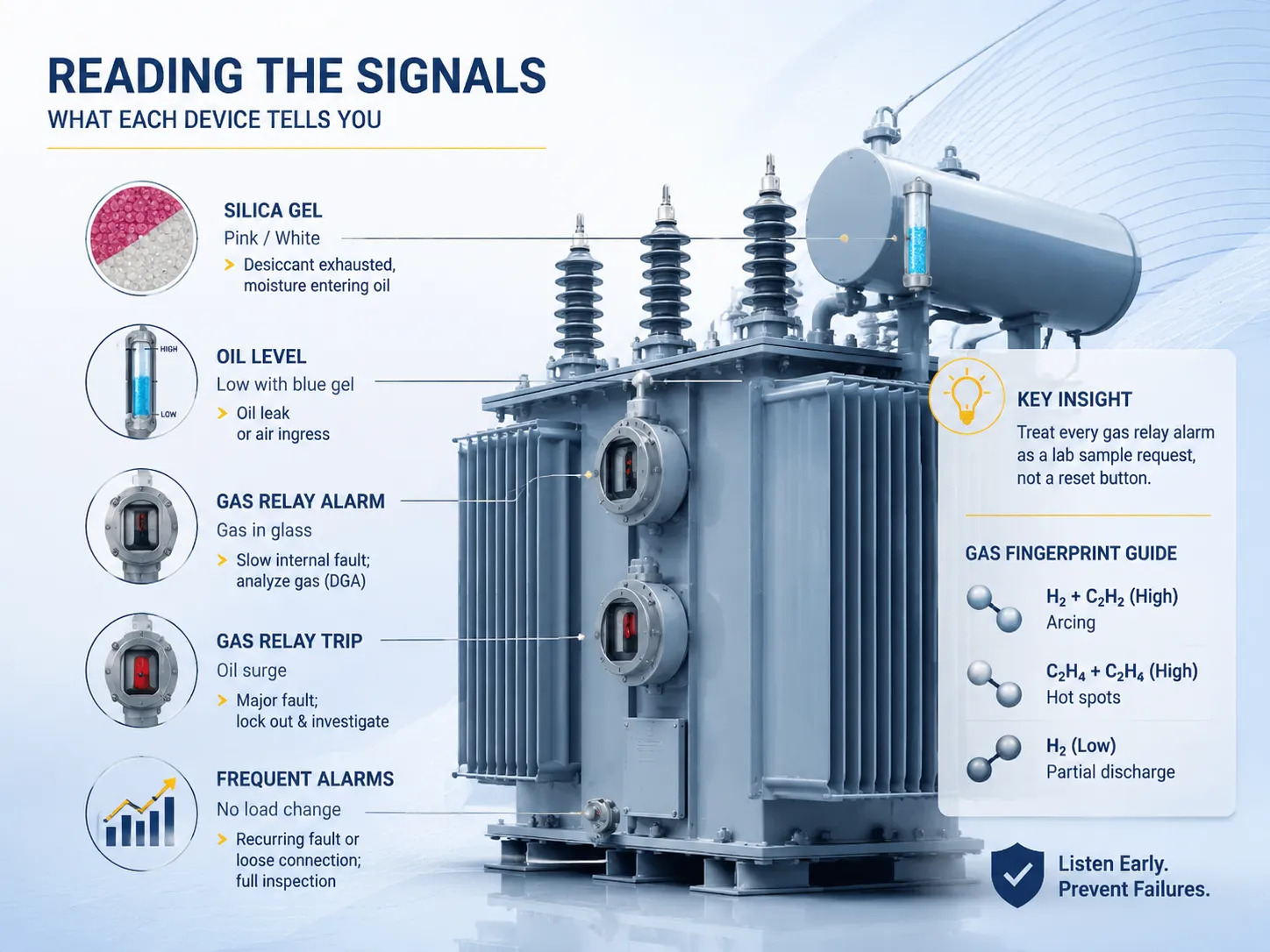
| Silikagel wurde pink / weiß | Trockenmittel erschöpft; Feuchtigkeit dringt in das Öl ein | Silikagel regenerieren oder ersetzen; Öl-Wasser-Gehalt überprüfen |
| Ölstand niedrig im Konservator mit blauem Gel | Ölleck oder Luft eindringen | Leck finden und beheben; Öl nachfüllen |
| Gasrelais-Alarm ausgelöst, Gas im Glas | Langsame interne Störung; Gaszusammensetzung identifiziert sie | Gasprobe für DGA sammeln; nicht zurücksetzen ohne Analyse |
| Gasrelais-Auslösung betätigt | Schwerwiegende Störung; Ölüberdruck | Transformator abschalten; untersuchen, bevor er wieder unter Spannung gesetzt wird |
| Häufige Gasrelais-Alarmmeldungen, keine Laständerung | Wiederkehrende interne Störung oder lose Verbindung | Vollständige interne Inspektion; Wicklungswiderstands- und Windungsverhältnis-Tests |
Die wichtigste Praxis in Bezug auf die Wartung von Transformatoren besteht darin, den Gasrelais-Alarm als Anfrage für eine Laborprobe zu betrachten, nicht nur als Rücksetzung. Das Vorhandensein von Wasserstoff (H₂) und Acetylen (C₂H₂) weist auf das Auftreten von Lichtbogen hin, das Vorhandensein von Ethylen (C₂H₄) und Ethan (C₂H₆) zeigt Hotspots an, während eine niedrige Konzentration von Wasserstoff auf Teilentladung hinweist. Jeder Fall führt zu einem anderen Bereich des Transformators.
Spezifikationen und Auswahl
| Parameter | Entlüfter | Gasrelais |
|---|---|---|
| Kapazität / Nennwert | Trockenmittelmasse: 1-15 kg pro Ölvolumen | Rohrgröße: DN50-DN100 passend zum Konservatorrohr |
| Norm | IEC 60076-1 bezogen; Herstellerspezifikation | IEC 60076-1; Relais getestet gemäß Herstellernorm |
| Materialien | Verzinkter / Edelstahlkörper, Glas- oder Polycarbonatfenster | Gusskörper mit Glas-Sichtfenstern, Messing-/Stahlfloats |
| Alarm-/Auslösekontakte | Keine (nur visuell) oder optionaler Alarm bei hoher Luftfeuchtigkeit | Zwei unabhängige Kontakte: Gasalarm, Überspannungs-Auslösung (z. B. 250 V, 2-3 A AC) |
| Montage | Konservatoroberteil, Lufteinlass | Rohr zwischen Tank und Konservator, 1-5° Neigung |
Wählen Sie die Bohrungsgröße des Rohrs unter Berücksichtigung des verwendeten Gasrelais und der Bewertung der Kontakte, entweder AC oder DC. Für Trockenmittel verwenden Sie die Menge des Trockenmittels gemäß der Ölkapazität des Transformators und der Atmungsrate, wobei als Faustregel gilt, dass für Verteilungsgeräte etwa 1 kg Silikagel für jeweils 1.000-2.000 Liter Öl verwendet wird.
Wartungsintervalle und Verfahren
Beide Geräte sind kostengünstig, einfach zu bedienen und werden häufig ignoriert, was dazu führt, dass die Geräte ihre Funktionen nicht effektiv erfüllen. Ein logischer Plan ist wie folgt:
- Atmer – alle drei bis sechs Monate die Farbe des Silikagels überprüfen. Ersetzen oder regenerieren Sie das Gel, wenn es unwirksam geworden ist. Blaues Silikagel kann durch Erhitzen im Ofen bei 105-120 °C für mehrere Stunden getrocknet werden, bis es wieder seine blaue Farbe annimmt.
- Gasrelais – einmal jährlich überprüfen, ob das Gerät funktioniert, indem das Prüfventil geöffnet wird, durch das der Alarmkontakt schließt, wenn das Gerät arbeitet.
- Gasrelais – bei jeder Öl-gelösten Gasanalyse den angesammelten Gasgehalt mit den Gasaufzeichnungen im Inneren des Transformators vergleichen.
- Atmerdichtung – einmal jährlich sicherstellen, dass die Ölstände und Rückschlagventile auf einem angemessenen Niveau sind. Eine ausgetrocknete Dichtung bedeutet potenzielle Feuchtigkeit, die über den eigenen Anschluss des Atmers eindringt.
Die Kosten für diese einfache Überwachung können einige Hundert Dollar pro Jahr betragen, während die Kosten für das Nichtüberwachen zu feuchtigkeitsbeeinflussten Wicklungen oder nicht erkannten internen Ausfällen führen können, was zu einer vollständigen Transformatorüberholung führt, die im Durchschnitt 50-80 Prozent eines neuen Transformators kostet.
Wenn das Gasrelais eine Probe erhält, zeigt die Gaskonzentration, was den Fehler verursacht hat, da dies das ist, was das Labor, das an der gelösten Gasanalyse beteiligt ist, immer zuerst überprüft.
| Gasunterschrift | Angezeigter Fehler | Empfohlener nächster Schritt |
|---|---|---|
| Hoher H₂ + C₂H₂ (Acetylen) | Lichtbogen im Wicklung oder Kern | Interne Inspektion; Wicklungswiderstands- und Windungsverhältnis-Tests |
| Hoher H₂ allein (niedrige Konzentration) | Teilentladung | Fortfahren mit DGA-Überwachung; auf lose Hardware überprüfen |
| Hoher C₂H₄ + C₂H₆ (Ethylen/Ethan) | Thermischer Hotspot (Überhitzung) | Lastprofil, Kühlung, Ölstand überprüfen; DGA in 1-3 Monaten wiederholen |
| Hoher CO + CO₂ | Papier-/Isolationsalterung oder Überhitzung | Furananalyse; verbleibende Isolationslebensdauer schätzen |
| Stickstoffdominiert ohne Fehlergase | Normale Atmung / kein interner Fehler | Fortfahren mit routinemäßiger Überwachung |
Wo sie verwendet werden
Atemgeräte und Gasrelais sind in vielen ölgefüllten Transformatoren mit Konservatoren zu finden, typischerweise ab 50 kVA und aufwärts. Die Standardkonfiguration umfasst:
- Verteilungstransformatoren (50-2.500 kVA): Standard-Atmungsventil mit einem Gasrelais, das für über 1 MVA dringend empfohlen wird.
- Leistungstransformatoren (5-100 MVA): Ein größeres Atmungsventil, Buchholz-Relais mit Alarm- und Auslösefunktion, das gemäß IEC 60076-1 obligatorisch ist.
- Generator-Hochspannungstransformatoren und Netztransformatoren: Mehrere Atmungsventile und Relais sind normalerweise mit der Möglichkeit der elektronischen Überwachung ausgestattet.
- Transformatoren mit hermetisch dichten und Ausdehnungsbehälter-Designs: Das Atmungsventil kann nur durch einen Ausdehnungsbeutel dargestellt werden; jedoch ist das Gasrelais über 1 MVA weiterhin ein Faktor.
Hermetisch dichte und luftdicht abgeschlossene Transformatoren (unter Verwendung von Stickstoff) vereinfachen die Aufgabe eines Atmungsventils; dennoch wird der Konservator mit einem Atmungsventil viele Jahre überdauern, insbesondere an Orten mit variabler Last und hohen Luftfeuchtigkeitsraten.
Marken- und Preisvergleich
| Marke | Herkunft | Produkte | Ungefährer Preisbereich |
|---|---|---|---|
| MR Reinhausen | Deutschland | Premium-Gasrelais und Zubehör | $300-$1,500 |
| ABB | Schweiz/Schweden | Relais und Atmungsventile als Transformatorenzubehör | $150-$1,000 |
| Schneider Electric | Optimierungsmaßnahmen in der Praxis | Schutz-Zubehör der Verteilungsklasse | $80-$500 |
| Comem (Italien) / Lokato | Italien / China | Spezialisten für Gasrelais und Konservatorenzubehör | $100-$600 |
| Allgemeine Zubehörlieferanten | Verschiedene | Silikagel-Entlüfter, alle Größen | $50-$1,200 |
| Jiangsu Subian Electric Power | China | Entlüfter, Buchholz-Relais, komplette Tankbaugruppen mit Zubehör | $60-$700 |
Im Zubehörsegment setzen Hersteller wie MR Reinhausen und Comem die Standards für die Qualität von Gasrelais, während Hersteller aus Europa bei Käufern von Leistungstransformatorlösungen ernsthafte Beliebtheit genießen. Der komplette Transformator — Tank, Konservator, Entlüfter und Buchholz-Relais, die als eine Baugruppe getestet werden — wird von Herstellern wie Jiangsu Subian Electric Power geliefert, die alle Arbeiten am Herstellungsstandort durchführen und Preise anbieten, die etwa 40-60% niedriger sind als die der westlichen Hersteller. Der Unterschied liegt darin, dass die Qualität des Gasrelais und des Entlüfters nicht der Bereich ist, in dem man beim Kauf eines Transformators Geld sparen sollte, sondern vielmehr der Bereich, der definiert, ob ein guter Hersteller das Zubehör als Teil des Transformator-Designs behandelt oder nicht.
So wählen Sie aus und installieren
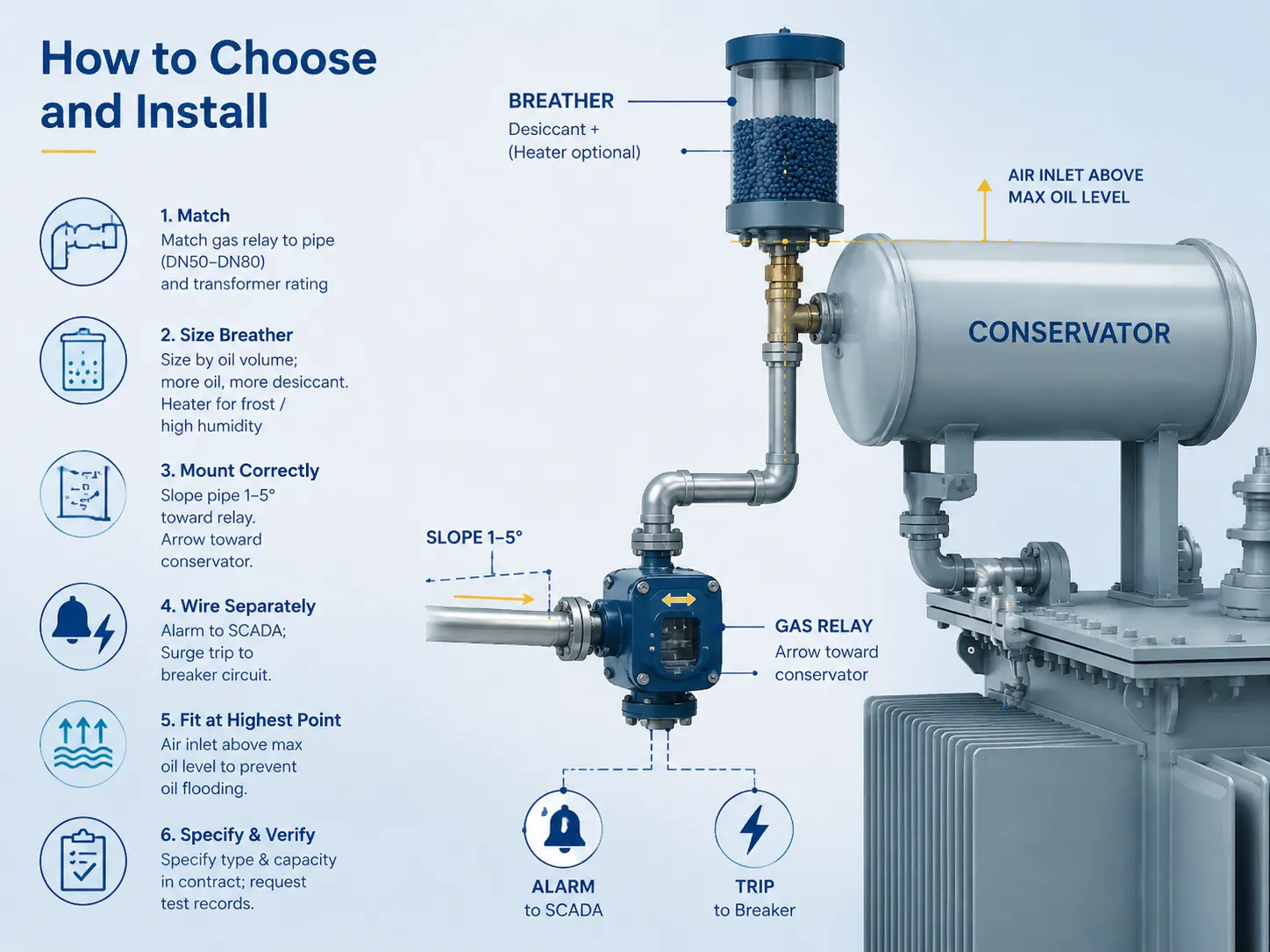
- Schließen Sie das Gasrelais an das Rohr an. Wählen Sie einen Durchmesser für den Konservatoranschluss (Nennbohrung DN50-DN80) und die Nennleistung des Transformators, um sicherzustellen, dass die Kontaktwerte für den Auslöseschaltkreis geeignet sind.
- Der Entlüfter sollte entsprechend dem Ölvolumen im Transformator ausgewählt werden. Je höher das Ölvolumen, desto höher die Atmungsrate und die Menge des Trockenmittels; stellen Sie sicher, dass Sie einen Heizkörper installiert haben, wenn Sie unter frostigen oder feuchten Bedingungen arbeiten.
- Stellen Sie sicher, dass das Relais korrekt positioniert ist. Eine Neigung von 1-5° zum Relais wird empfohlen, um sicherzustellen, dass das Gas im Relais gesammelt wird — stellen Sie sicher, dass der Pfeil auf dem Relais auf den Konservator zeigt.
- Schließen Sie die Alarm- und Auslöseschaltkreise separat an. Der Gasalarm muss an SCADA angeschlossen werden; im Gegensatz dazu muss der Überspannungs-Auslöser an den Transformator-Schutzschaltkreis angeschlossen werden.
- Platzieren Sie den Entlüfter an der höchsten Stelle des Rohrs. Die Lufteinlassöffnung muss über dem maximalen Ölstand im Konservator platziert werden, damit das Öl das Trockenmittel nicht überflutet.
- Geben Sie die Geräte im Vertrag an. Geben Sie den Typ des Relais und die Kapazität des Entlüfters in der Bestellung an und stellen Sie sicher, dass Sie deren Prüfberichte im Lieferzertifikat haben.
Häufig gestellte Fragen
Wie viel kostet ein Entlüfter und Gasrelais?
Der Preis eines standardmäßigen Silikagel-Entlüfters mit einem Gewicht von zwischen 1 kg und 3 kg variiert von 50 bis 300 Dollar; der Preis eines großen Leistungstransformator-Entlüfters liegt im Bereich von entweder $300 bis $1.500 oder darüber. Ein traditionelles Buchholz-Gasrelais kostet zwischen $100 und $500, während ein elektronisches mit Fernüberwachung zwischen $400 und $1.200 kostet. Beide Zubehörteile machen nicht mehr als drei Prozent des Preises eines kompletten Transformators aus.
Wie oft sollte ich das Silikagel im Entlüfter überprüfen oder wechseln?
Führen Sie visuelle Kontrollen der Farbe mindestens alle drei bis sechs Monate durch, häufiger in feuchten Umgebungen. Wenn das blaue Gel rosa oder weiß wird, ist es vollständig verbraucht. Regenerieren Sie es, indem Sie es auf zwischen 105 °C und 120 °C erhitzen, bis seine Farbe wieder blau wird, oder ersetzen Sie es vollständig. Wenn der gesättigte Atmer nicht ersetzt wird, dringt Feuchtigkeit in das Öl ein, was zu einem Ausfall des Isolationssystems führt.
Was erkennt das Gasrelais tatsächlich?
Dieses Gerät kann zwei Arten von Fehlern identifizieren. Zuerst ist da der Gasaufbau, der durch einen langsamen internen Fehler verursacht wird, bei dem das Gas das Öl zwingt, den Schwimmer zu verdrängen, was einen Alarmkontakt auslöst. Zweitens ist da ein plötzlicher Ölüberschuss, der durch einen schweren Fehler verursacht wird, der eine Trennwand bewegt, die den Leistungsschalter des Transformators sofort öffnet. Das gesammelte Gas kann analysiert werden, um seine Zusammensetzung (Wasserstoff, Acetylen, Ethylen) zu bestimmen, wodurch festgestellt werden kann, ob der Fehler durch Lichtbogen, heiße Stellen oder Teilentladung verursacht wurde.
Warum funktioniert mein Gasrelais-Alarm weiterhin ohne Laständerung?
Ein wiederholter Gasalarm bei normaler Last deutet im Allgemeinen darauf hin, dass ein interner Fehler vorliegt, normalerweise eine lose Verbindung, eine kurzgeschlossene Wicklung oder eine Überhitzung des Kerns. Vermeiden Sie es, den Alarm zurückzusetzen, ohne zuvor Gasproben zu entnehmen und eine Gas-in-Öl-Analyse durchzuführen. Wenn der Gasalarm häufig ausgelöst wird, deutet dies darauf hin, dass der Transformator interne Tests (Isolationswiderstand, Übersetzungsverhältnis und Wicklungswiderstandstests) benötigt.
Kann ein Transformator ohne Gasrelais betrieben werden?
Die Aussage ist technisch korrekt. Es ist jedoch eine schlechte Praxis und nicht konform, Buchholz bei Transformatoren mit einer Leistung von mehr als etwa 1 MVA zu verwenden, wo Schutz gemäß IEC 60076-1 obligatorisch ist. Das Buchholzrelais ist das einzige Gerät, das die sich entwickelnden internen Fehler erkennt, bevor ein Phasen-zu-Phasen-Kurzschluss auftritt. Ohne es kann das erste Anzeichen eines Fehlers der katastrophale Ausfall oder Brand sein. Die Kosten für das Relais liegen zwischen $100 und $600, und dieses Relais gilt als eine der günstigsten Schutzformen in Umspannwerken.
Referenzen
- IEC 60076-1 — Leistungstransformatoren, Allgemeine Anforderungen — Der Hauptstandard, der Zubehör wie Gasrelais bei ölgetauchten Transformatoren abdeckt.
- IEEE C57.106 — Leitfaden für Akzeptanz und Wartung von isolierendem Mineralöl — Feuchtigkeitsgrenzen und Ölzustandsrichtlinien, die durch die Wartung des Atmers geschützt werden.
- IEEE 62 — Leitfaden für diagnostische Feldtests elektrischer Energieanlagen — Kontext für Feldtests von Relais und Isolierung.
- MR Reinhausen — Zubehör und Gasrelais — Referenzdokumentation für hochwertige Gasrelais-Designs.
- OSHA Elektrische Sicherheitsrichtlinien — Kontext zur Arbeitssicherheit bei Arbeiten an unter Spannung stehenden Transformatorenschutzsystemen.
- Transformers Magazin — Branchenpublikation mit praktischen Artikeln zur Wartung von Atmern und Relais.
Fazit
Die ersten Komponenten auf der Liste der kostengünstigen und informativen Teile, die fast vergessen sind, aber in einem ölgefüllten Transformator dennoch sehr notwendig sind, sind das Gasrelais und der Atmungsfilter. Das erste warnt Sie vor möglichen Problemen im Inneren des Transformators und zeigt an, wenn etwas schiefgeht.
- Überprüfen Sie alle 3 bis 6 Monate die Farbe des Silikagels und regenerieren oder ersetzen Sie es, wenn es nicht funktionsfähig ist.
- Behandeln Sie keinen Alarm des Gasrelais als Löschtaste; betrachten Sie ihn als Anfrage für eine DGA-Probe.
- Überprüfen Sie das Gasrelais jährlich auf Funktion und stellen Sie sicher, dass der Auslösekreis einwandfrei funktioniert.
- Fügen Sie in den Transformatorvertrag diese beiden Komponenten ein und fordern Sie die Protokolle ihrer Tests an.