


Ein Arbeiter in einer modernen chinesischen Transformatorenfabrik, der damit beauftragt ist, Spulen für Transformatoren zu wickeln, muss den Fortschritt seiner Aufgaben nicht mehr im Auge behalten; alles, was er tun muss, ist, seine Aufmerksamkeit auf den Bildschirm zu richten, der ihm die Werte anzeigt, die zeigen, dass die Spannung in den Drähten, mit denen er arbeitet, stabil ist und innerhalb der spezifischen Grenzen (97 N ± 3%) liegt, sowie angibt, wie viele Umdrehungen er beim Wickeln dieser Spule abgeschlossen hat. Ein anderer Roboterarbeiter hat bereits die vierte Schicht des Kerns gestapelt; und laut den Informationen aus dem Managementsystem der Fabrik hat der Vorgang den Alarm bezüglich der hohen Verluste dieses Kerns ausgelöst.
Dieser Artikel beschreibt den Prozess der digitalen Transformation, den Unternehmen durchlaufen haben, was es ihnen ermöglicht hat, ihre Technologien von einer anfänglichen Phase des bloßen Sammelns von Daten bis hin zu Operationen im Smart Factory-Modus zu entwickeln.
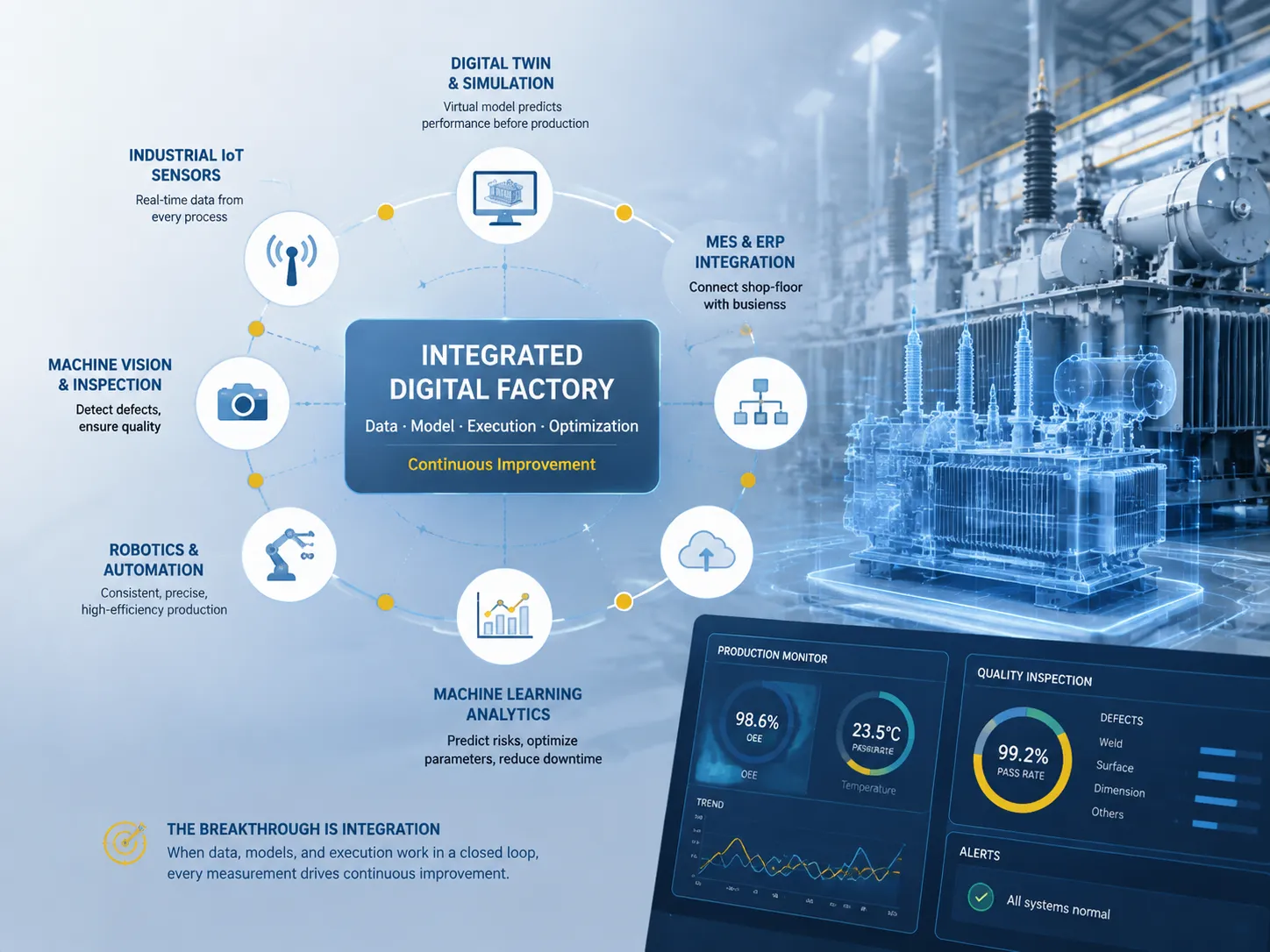
Kurz gesagt, können wir sagen, dass digitale Befähigung in der Transformatorenherstellung bedeutet, elektronische IoT-Sensoren, digitale Zwillinge, die Integration von MES/ERP, maschinelles Lernen und automatisierte Technologien in allen Phasen der Produktion zu nutzen – von der Materialannahme bis zur Endprüfung. Infolgedessen ist es möglich, die Qualität zu verbessern, die Kosten für Rücksendungen zu senken, die Durchlaufzeiten zu minimieren und eine vollständige digitale Rückverfolgbarkeit pro Einheit des produzierten Produkts zu gewährleisten. Einige der führenden Fertigungsanlagen haben Nachbearbeitungsraten von unter 1% (von 3-5% zuvor) erreicht, die Durchlaufzeiten von 3-6 Monaten für Standardtransformatoren auf 6-12 Wochen verkürzt, die Konsistenz des Leerlaufverlusts von ±10-15% auf ±3-5% verbessert und vollständige als gebaut-Daten für jedes produzierte Gerät erhalten. Die ungefähren Kosten für die Implementierung solcher Technologien liegen zwischen $200.000-800.000 und die Amortisation wird typischerweise in 2-4 Jahren beobachtet, dank verbesserter Materialnutzung und reduzierter Rücksendekosten. Kunden sollten die Hersteller nach ihren Aufzeichnungen zur digitalen Rückverfolgbarkeit und ihren Daten in der Testphase fragen, denn dort kann die digitale Befähigung verfolgt werden.
Was ist digitale Befähigung in der Transformatorenherstellung?
Digitale Befähigung ist die Nutzung digitaler Technologien als grundlegende Grundlage des Produktionsprozesses. Digitale Technologien sollten kein Zusatz mehr sein; vielmehr führt jeder Schritt eines Produktionsprozesses zu Daten, die zur Verbesserung und Verwaltung des Prozesses genutzt werden und die Herstellung von Transformatoren ermöglichen, die ihre digitale Lebensgeschichte tragen. Das Konzept wird in der Idee einer Smart Factory zusammengefasst, die Industrie 4.0 in Bezug auf teure, wertvolle und schwer herzustellende Industriegüter repräsentiert.
Drei Faktoren können diese Revolution erklären. Zunächst einmal verlangen die Kunden nach Rückverfolgbarkeit. Fabrikprüfungsprotokolle und alternative Informationsverträge sind das, was Käufer heutzutage wollen, was aufgrund der Fortschritte in der digitalen Technologie viel einfacher bereitzustellen ist. Zweitens gibt es einen starken Bedarf an Effizienz. Die Tatsache, dass das Transformatorengeschäft traditionell niedrige Gewinnmargen hat, erfordert die Beseitigung aller Material- und Arbeitsverschwendungen. Schließlich sind die Anforderungen an die Produktqualität hoch, wenn moderne Verlustgarantien und Effizienzklassen eine Qualität der Herstellung verlangen, die nicht sichergestellt werden kann.
Die digitale Reise: 4 Reifestufen
Fabriken werden nicht sofort digitalisiert; sie steigen die Reifestufen hinauf. Die erste Stufe ist die digitale Aufzeichnungsphase — wenn Papierprotokolle und Prüfblätter in die einfache Speicherung von Daten an wichtigen Stationen umgewandelt werden, beginnen die Verluste berechnet zu werden, es finden Suchen statt und die Rückverfolgbarkeit stoppt. Es ist kostengünstig — hauptsächlich werden Tabellenkalkulationen und tragbare Geräte verwendet — aber der Anfang ist gemacht. Die zweite Stufe sind verbundene Prozesse — Sensoren, die an verschiedenen Geräten angebracht sind, senden die Daten an das MES. In dieser Situation ist die Verarbeitung der Informationen mit Hilfe der Grenzen möglich — die Parameter der Prozesse werden in Echtzeit von den Menschen überwacht. Der Prozess hier beginnt sich zu verkürzen, da die Probleme innerhalb von 1 Minute erkannt werden, anstatt in der Endphase der Qualitätsprüfung. Die dritte Stufe ist die Erstellung digitaler Zwillinge und deren Verbindung zur realen Produktion. Die Produktionsdaten ermöglichen den Vergleich der Einheit mit dem Modell der Einheit. In diesem Fall ist es einfach, die Gründe für Unterschiede zu finden. Die vierte Stufe ist die Prozessoptimierung durch maschinelles Lernen und Maschinenanalyse. Momentan befinden sich nur sehr wenige Fabriken in Stufe vier, während sich die meisten ernsthaften Fabriken in den Stufen zwei und drei befinden. Das Wichtigste, was Käufer verstehen sollten, ist, dass Hersteller, die in den Stufen zwei und drei arbeiten, bereits fast allen Wert bieten, den die Kunden benötigen.
Schlüsseltechnologien und ihre Rollen
| Technologie | Was es tut | Wo es am wichtigsten ist |
|---|---|---|
| Industrielle IoT-Sensoren | Erfasst Spannung, Drehmoment, Temperatur, Vakuum, Vibration in Echtzeit | Wickeln, Trocknen, Montage, Prüfung |
| Digitaler Zwilling / Simulation | Virtuelles Modell prognostiziert Verlust, Temperatur, Belastbarkeit vor der Produktion | Design, Abweichungsanalyse |
| MES (Manufacturing Execution System) | Verfolgt jeden Arbeitsauftrag, jede Station und jede Messung während der Produktion | Fertigungssteuerung, Rückverfolgbarkeit |
| ERP-Integration | Verknüpft Aufträge, Materialien, Kosten und Lieferung mit Produktionsdaten | Planung, Beschaffung, Lieferung |
| Maschinenvision & automatisierte Inspektion | Erkennt Schweißfehler, Oberflächenschäden, dimensionale Abweichungen | Kernschneiden, Schweißen, Montage |
| Robotik / CNC-Automatisierung | Konsistentes Schneiden, Wickeln, Stapeln, Schweißen | Kern- und Wickellinien |
| Analytik des maschinellen Lernens | Prognostiziert Prozessdrift, Ausfallrisiko und optimale Parameter | Predictive Maintenance, Qualität |
| Cloud-Datenplattformen | Speichert die as-built Aufzeichnungen und ermöglicht die Fernüberwachung von Flotten | Lebenszyklusunterstützung nach der Lieferung |
Eine einzelne Lösung ist nicht der Durchbruch; vielmehr ist der Durchbruch die Kombination. Ein digitaler Zwilling ohne Produktionsdaten ist nur ein Entwurfswerkzeug, während Produktionsdaten ohne Zwilling lediglich ein Berichtswerkzeug sind. Die erfolgreichen Fabriken der Zukunft werden den Ansatz verfolgen, das Simulationswerkzeug mit der Sensorik und der Datenerfassung in einem kontinuierlichen Kreislauf zu verbinden, in dem die Messung das System kontinuierlich verbessert.
Gemessene Auswirkungen: Konventionelle vs. digitalisierte Produktion
| Maß | Konventionelle Produktion | Digitalisierte Produktion |
|---|---|---|
| Nachbearbeitungsquote | 3–5% Einheiten | < 1% Einheiten |
| Verlustkonstanz im Leerlauf (Streuung) | ±10–15% | ±3–5% |
| Durchlaufzeit, Standard 2.000 kVA Einheit | 3–6 Monate | 6–12 Wochen |
| Testdokumentation | Papier, fehleranfällig | Digital, vollständig, prüfbar |
| Geschwindigkeit der Ursachenanalyse | Tage bis Wochen | Stunden |
| Validierung von Ingenieuranpassungen | Prototyp-Hardware | Simulation zuerst |
| Materialnutzung | Manuelle Schätzung | Optimierte Schneidpläne |
| Lieferzuverlässigkeit | Variabel | Hoch, terminorientiert |
Dies sind Durchschnittswerte, die aus Fabriken stammen, in denen die Transformation ernst genommen wurde; individuelle Ergebnisse können je nach Größe und Durchführung der Transformation variieren. Das Wichtige ist der Mechanismus: Digitale Transformation geht nicht darum, einen Parameter signifikant zu verbessern – es geht darum, jeden Parameter gleichzeitig zu verbessern, da sie sich mit den Ursachen der Variation und nicht mit deren Folgen befasst.
Wo die Digitalisierung liefert: Prozess für Prozess
Folgen Sie der digitalen Fabrik Schritt für Schritt, um herauszufinden, wo der Wert fließt. Materialeingang: Wenn Stahlrollen ankommen, werden ihr Gewicht und Verlust notiert, sodass das Kernteam Material basierend auf den Eigenschaften auswählen kann – die niedrigsten Kosten sind in der Fabrik am besten.
- Kernschneiden und Stapeln: Der durch Maschinenvision festgestellte Defekt wird sofort von der CNC-Maschine abgelehnt; Roboterstapler sorgen für einen engen und konsistenten Pack, was das Problem von kurzlaminierten Stapeln beseitigt.
- Wickeln: Durch die Kontrolle der Spannung mit Servos und die Automatisierung des Einlegens von Isolierung zwischen den Schichten werden die klassischen Gründe für Defekte beseitigt; die Anzahl der Wicklungen wird mühelos gemessen.
- Trocknung und Ölanwendung: Die Kontrolle der Trocknung basiert auf der Überwachung des Endpunkts des Prozesses (die Trocknung erreicht den 0,5% Feuchtigkeitsgrad im Papier); der Zustand der Isolierung hängt davon ab.
- Endgültige Qualitätsprüfung: Die Informationen über Tests gelangen ohne Transkriptionsfehler in das digitale Protokoll, während alle notwendigen Tests für zukünftige Vergleiche gespeichert werden. Nach der Lieferung wird das erstellte digitale Protokoll die Grundlage für die Überwachung des Zustands der Einheit sein.
| Produktionsprozess | Digitale Lösung | Gemessener Nutzen |
|---|---|---|
| Materialeingang | Barcode + erfasster Verlust | Stahl nach Eigenschaften ausgewählt, Verlust verteilt |
| Kernschneiden / Stapeln | CNC-Schneider, Maschinenvision, Roboterstapler | Grat < 0,02 mm, konsistente Klemmung |
| Spulenwickeln | Servo-Spannungsregelung, automatische Wicklungszählung | Spannung ±3%, keine Zählfehler |
| Vakuumtrocknung | Feuchtigkeitsendpunktkontrolle | Papierfeuchtigkeit zuverlässig < 0,5% |
| Endprüfung | Datenfluss vom Instrument zur Datenbank | Vollständiger IEC 60076-1 Datensatz pro Einheit, keine Transkriptionsfehler |
| Nach der Lieferung | Digitale Ist-Basislinie zur Überwachung | Schnellere Abweichungserkennung, bessere Fehlanalyse |
Die Wirtschaftlichkeit: Investition, Einsparungen & Amortisation
| Artikel | Typischer Bereich | Anmerkungen |
|---|---|---|
| Stufe 1–2 Digitalisierung (Aufzeichnungen + verbundene Prozesse) | $200.000–$800.000 | MES, Sensoren, Konnektivität für eine mittelgroße Fabrik |
| Digitaler Zwilling / Simulationsplattform | $150.000–$500.000 | Software, Rechenleistung, Ingenieurausbildung |
| Automatisierung (robotergestütztes Stapeln, Sichtschweißen) | $500.000–$2.000.000 pro Linie | Kapitalintensiv; durch Volumen gerechtfertigt |
| Jährliche Betriebskosten (Lizenzen, Wartung) | $50.000–$200.000 | Cloud, Software, Unterstützung |
| Nacharbeitsersparnisse (3–5% → <1% bei $20M Ausgabe) | $400.000–$800.000/Jahr | Der Haupttreiber für die Amortisation |
| Materialnutzunggewinne | $100.000–$300.000/Jahr | Optimierte Kern- und Leiterzuschnitte |
| Typische Gesamtrendite | 2–4 Jahre | Nacharbeit + Material + Durchsatz |
Die Zahlen entwerfen ihre Pläne. Die gute Nachricht ist, dass das Geschäftsmodell nicht von Premiumpreisen abhängt, da das System finanziell tragfähig ist, einfach weil es Abfall reduziert und den Durchsatz verbessert, was der Grund ist, warum es bei Herstellern von Non-Premium-Marken an Beliebtheit gewinnt. Tatsächlich können digitalisierte Fabriken Waren von besserer Qualität und in kürzerer Zeit zu Preisen produzieren, die mit denen ihrer Wettbewerber übereinstimmen.
Häufige Fallstricke & wie man sie vermeidet
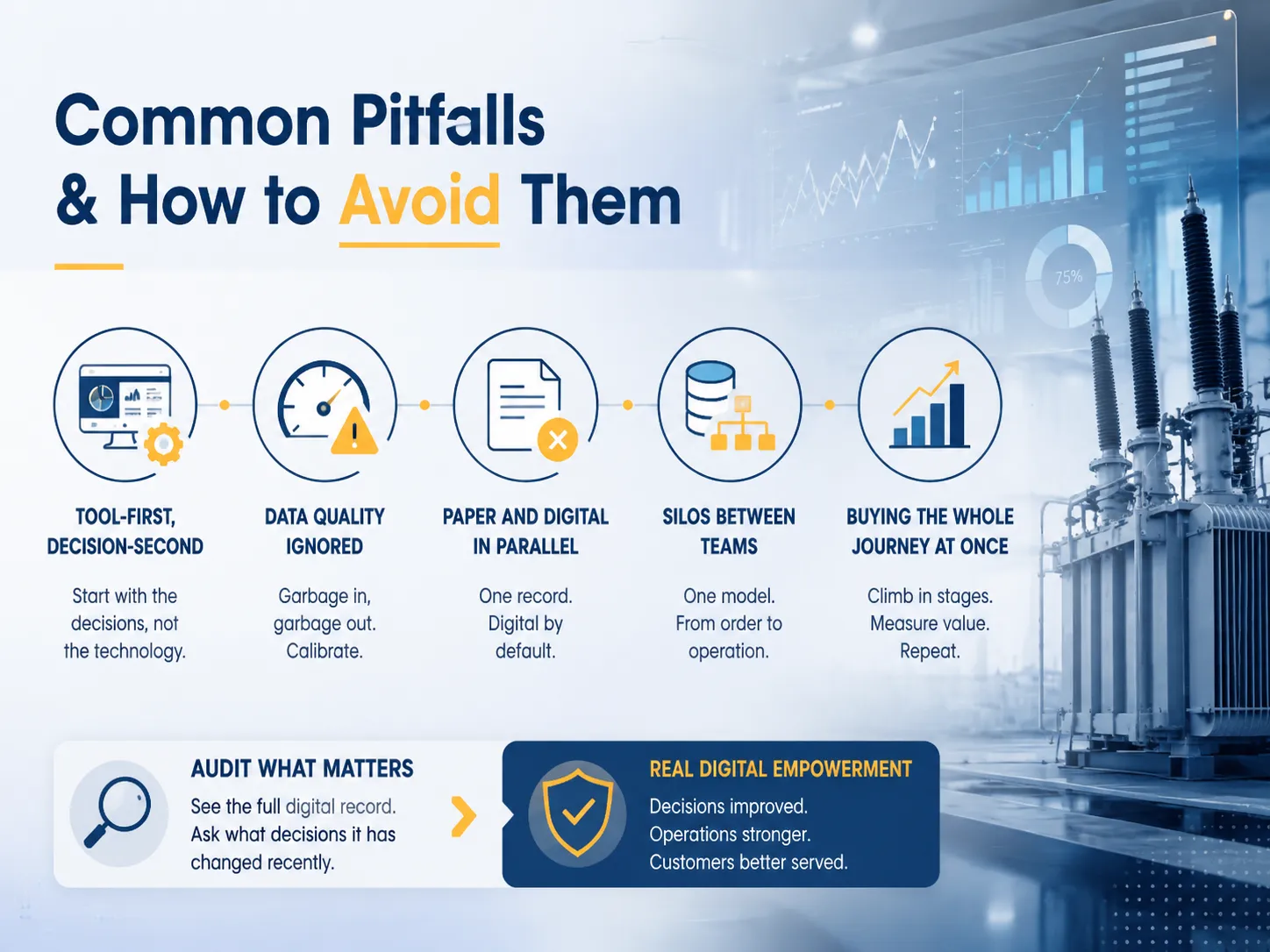
Es gibt signifikante und klare Methoden, durch die digitale Transformationsbemühungen scheitern, und das Erkennen dieser Methoden sollte sowohl den Fabriken als auch ihren Käufern helfen, Misserfolge zu vermeiden. Eine Methode: Die Fabrik installiert zuerst Sensoren und Plattformen, bevor sie Entscheidungen darüber entwickelt, welche Daten bereitgestellt werden müssen, was zu nutzlosen Dashboards führt. Lösung: Definieren Sie mindestens 3 betriebliche Fragen und gestalten Sie den Datenfluss entsprechend. Zweite Methode: Qualität der Daten wird ignoriert. Nicht kalibrierte Sensoren liefern zuverlässigen Müll; ein fehlerhafter DGA- oder Temperatursensor verdirbt die Analyse. Lösung: Kalibrierung sollte zu Beginn des Designs verwendet werden. Dritte Methode: Betreiber notieren Aufzeichnungen auf Papier “nur für den Fall”, und infolgedessen verschwindet die digitale Aufzeichnung. Lösung: Die gleiche digitale Aufzeichnung sollte jederzeit anstelle von Papier und digital parallel aufbewahrt werden. Vierte Methode: Es sollte keine Trennung zwischen Design und Produktion oder zwischen digitalem Zwilling und Serviceabteilung geben. Lösung: Das einzige, was konstruiert werden sollte, ist das einzige Datenmodell, das den Prozess vom Moment der Auftragserteilung bis zum Betrieb abdeckt. Letzte Methode: Unternehmen, die versuchen, den gesamten Prozess auf einmal zu kaufen, landen in der Megaprojektphase, während erfolgreiche Unternehmen ihre Projekte in Phasen aufbauen und die Rentabilität in jeder Phase überprüfen.
Daher sollten bei der Bewertung der digitalen Fähigkeiten des Lieferanten all diese Fallstricke überprüft werden. Bitten Sie sie, Ihnen die digitalen Aufzeichnungen für die Einheit im vergangenen halben Jahr zu zeigen und zu sagen, was sich gemäß den auf diesen Daten basierenden Entscheidungen geändert hat.
Die Lieferantenlandschaft & Preisspannen
| Lieferant | Digitale Fähigkeit | Typischer Preis (2.000 kVA Klasse) | Anmerkungen |
|---|---|---|---|
| Siemens Energie | Digitales Zwillingsökosystem, Cloud-Überwachung | $38.000–$75.000 | Führende IoT-Integration |
| Hitachi Energie | Smart-Grid-Dienste, Flottenanalytik | $35.000–$70.000 | Starke Serviceplattform |
| Schneider Electric | EcoStruxure Smart Factory-Integration | $25.000–$55.000 | Verteilungsfokus |
| TBEA / China XD | Groß angelegte digitalisierte chinesische Fabriken | $20.000–$45.000 | Skalierung und Automatisierung |
| Jiangsu Subian Electric Power | Digitale Aufzeichnungen, automatisierte Linien, IEC 60076-Tests | $15.000–$38.000 | Digitale Rückverfolgbarkeit zu wettbewerbsfähigen Preisen |
Die Kosten ändern sich je nach ihren Spezifikationen und dem Standort der Transaktion in der Welt; Sie sollten sie als mögliche Referenzen für Ihre Planungszwecke betrachten. Die führenden Unternehmen in diesem Bereich — Siemens Energy, Hitachi Energy und Schneider Electric — haben die am besten integrierten digitalen Ökosysteme entwickelt, sodass ihre Preise die höchsten sein werden. Chinesische Hersteller wie Jiangsu Subian Electric Power nutzen bereits ähnliche digitale Mittel — automatische Wicklungen, zustandsbasierte Trocknung, digitale Prüfdokumente der Einheit usw. Aber sie können Ihnen deutlich niedrigere Angebote machen — 20-40% niedriger für ähnliche IEC 60076-konforme Spezifikationen. Was ein Käufer fragen muss, wenn er nach einem Lieferanten sucht, ist nicht, ob das Unternehmen digital ist, sondern ob seine digitalen Aufzeichnungen die Qualität des betreffenden Transformators bestätigen.
Häufig gestellte Fragen
Was ändert sich tatsächlich durch digitale Befähigung für Transformatorenkäufer?
Es verändert Ihre Fähigkeit zur Überprüfung. Eine digitalisierte Fertigungsstätte bietet Ihnen die Möglichkeit, pro Einheit als gebaute Dokumente zu erhalten — die Eigenschaften der verwendeten Materialien, Trocknungsprozesse, Wicklungskonfiguration sowie die vollständigen Ergebnisse der Werksprüfungen — und ermöglicht so die Qualitätsüberprüfung durch Daten anstelle einer Bestätigung. Darüber hinaus verkürzt es die Zeitrahmen (6–12 Wochen für Standardverteilungseinheiten) und minimiert Verluste (auf ±3–5%). Wenn Sie die Lieferanten vergleichen, fordern Sie ein digitales Dokument einer kürzlich hergestellten Einheit an, zusammen mit den Testergebnissen als Nachweis der digitalen Leistungsfähigkeit.
Wie viel kostet es, eine Transformatorenfabrik zu digitalisieren?
Eine mittelgroße Fertigungseinheit, die ein Niveau der Digitalisierung der Stufen 1-2 (Einführung von E-Dokumenten, Installation von Sensoren und Nutzung eines Manufacturing Execution Systems (MES)) erreicht, hat Ausgaben in Höhe von $200,000-800,000. Die Installation von digitalen Zwillingen und Simulatoren erfordert zusätzliche $150,000-500,000, während umfangreiche Automatisierungen (Roboterpalettierung und Automatisierung von Schweißprozessen) $500,000-2,000,000 pro Produktionslinie kosten. In der Regel dauert die Amortisation der Investition 2-4 Jahre durch sinkende Prozentsätze an Nacharbeit (von 3-5% auf unter 1%), signifikante Einsparungen bei Materialien und höhere Produktivitätswerte der Abläufe.
Was ist ein digitaler Zwilling in der Transformatorenproduktion?
Digitaler Zwilling bezieht sich auf ein virtuelles Duplikat des Geräts, das seine Spezifikationen und Produktionsdaten widerspiegelt. In der Fertigung wird die Technologie angewendet, um elektrische, thermische und mechanische Leistungen vor der Herstellung zu simulieren. Nachdem das Produkt hergestellt wurde, wird der digitale Zwilling verwendet, um die in der Produktion erhaltenen Daten mit den erwarteten Werten in der Software zu vergleichen, sodass Abweichungen nahezu in Echtzeit identifiziert werden können.
Zahlen Käufer mehr für Transformatoren aus digitalisierten Fabriken?
Nicht immer. Die Digitalisierung senkt die Kosten für Fabriken aufgrund geringerer Nacharbeiten und Abfälle sowie schnellerer Bearbeitungszeiten, was höhere Investitionen ermöglicht. Aus diesem Grund ist es heutzutage üblich, dass IEC 60076-konforme Transformatoren aus digitalisierten Fabriken Preise im gleichen Bereich wie die traditionelle Produktion haben (UNGEFÄHR $150 BIS $250 PRO kVA FÜR ÖL-IMMERSE 1–10 MVA EINHEITEN) mit zusätzlichen Vorteilen wie besserer Dokumentation und konsistenteren Verlusten. Ein wichtiger Hinweis ist, dass überprüft werden muss, ob Nachweise für die Ansprüche der Fabrik vorliegen.
Wie kann ich feststellen, ob die digitalen Ansprüche eines Herstellers echt sind?
Fordern Sie drei Dinge an. Erstens, fragen Sie nach dem tatsächlichen digitalen Protokoll für eine kürzlich produzierte Einheit in Ihrer Kategorie, falls verfügbar und wenn die Zeitstempel konsistent sind. Zweitens, fragen Sie, wie die Daten die Abläufe im letzten Zeitraum von sechs Monaten beeinflusst haben (Verbesserungen bei Nacharbeiten, Änderungen der Parameter, Verbesserungen bei der Lieferung) — richtig angewandte digitale Abläufe liefern reale Beispiele. Drittens, bitten Sie um einen Fabriktest — dank digitaler Systeme werden solche Tests automatisch durchgeführt und die Daten direkt in das Protokoll der Einheit übertragen.
Referenzen
- IEC 60076-1: Leistungstransformatoren – Teil 1: Allgemeines — der Standard hinter Fabriktests und Verlustgarantien, die digitale Systeme automatisieren.
- IEC 60076-20: Leistungstransformatoren – Teil 20: Energieeffizienz — Effizienzklassen, die die Fertigungskonsistenz verlangen, die die Digitalisierung bietet.
- IEEE Gesellschaft für industrielle Elektronik — Forschung und Standards zur industriellen Digitalisierung und intelligenten Fertigung.
- Plattform Industrie 4.0 — der Referenzrahmen für die Implementierung von Smart Factories und Reifegradmodelle.
- Siemens Energie — Branchenreferenz für digitale Zwillinge und Transformatorenüberwachungssysteme.
- Hitachi Energie — Referenz für digitale Netzdienste und Analysen von Transformatorenflotten.
- Jiangsu Subian Electric Power — digitalisierter IEC 60076-konformer Transformatorenhersteller mit digitalen Testprotokollen pro Einheit.
Fazit
Digitale Befähigung ist einer der führenden innovativen Ansätze in der Transformatorenfertigung, da sie eine Lösung für das bedeutendste Problem der Branche bietet — das Problem der Variabilität. Dank verbundener Sensoren, digitaler Zwillinge, Integration mit MES und Automatisierung hat sich die Fertigung von einer auf Fähigkeiten basierenden Schätzung zu einem messbaren, steuerbaren Prozess gewandelt, der quantifizierbare Zahlen für Kunden liefert: weniger als 1% Nacharbeit, Konsistenzverluste innerhalb der Grenzen von ±3-5%, Durchlaufzeiten von 6 bis 12 Wochen und eine vollständige digitale Historie jeder produzierten Einheit. Obwohl der Weg kostspielig ist, lohnt er sich in 2-4 Jahren, indem Abfälle eliminiert und der Durchsatz erhöht werden.
- Die Digitalisierung ermöglicht die Verbesserung jedes Qualitätsindex gleichzeitig, was bedeutet, dass kein Qualitätsmaß zugunsten von Verbesserungen in anderen Indizes geopfert werden muss.
- Die Reife des gewählten Stufen 2-3 ermöglicht es, die sichtbarsten Ergebnisse für die Kunden zu erzielen.
- Kunden sollten Ansprüche bezüglich der digitalen Aufzeichnungen und Testergebnisse nach der Herstellung erheben.
- Das Geschäftsmodell basiert auf der Reduzierung der Kosten für Nacharbeiten und verwendete Materialien, um einen wettbewerbsfähigen Preis zu gewährleisten.
Jiangsu Subian Electric Power ist ein Beispiel für einen modernen digitalisierten Hersteller, der den IEC-Standards entspricht und auf Ihrer Prüfliste für die nächste Beschaffung stehen sollte.