


Un gerente de adquisiciones de servicios públicos en Perú ha sido testigo del rendimiento de dos transformadores de 10 MVA fabricados por diferentes fabricantes a lo largo de cinco años. El transformador más barato no cumplió con su garantía de pérdida de carga en 2.4% para el cuarto año de operación, ya que su bobinado se había movido bajo el efecto de tantos cortocircuitos, mientras que el transformador de referencia sigue funcionando dentro de 0.3% de su rendimiento nominal. La reparación que se realizó después de la falla costó a la empresa más que la diferencia en el costo de los dos transformadores.
Este documento expondrá en qué consiste un transformador de alta calidad, incluidos los elementos de la construcción y materiales del transformador, la disciplina de fabricación, normas y regulaciones que hacen que la calidad sea cuantificable.
Resumen: Un transformador premium es un transformador eléctrico hecho con núcleos de acero silicio orientado M4-M3, cables de cobre o aluminio, y sistemas de aislamiento (A-H) y que ha pasado diversas pruebas. La calidad significa mínima pérdida, poco ruido, pocas descargas parciales y una vida útil de 25 a 30 años.

¿Qué es un transformador de alta calidad?
Un transformador de alta gama se define como aquel que cumple o incluso supera sus especificaciones de placa de identificación en cuanto a pérdidas, atenuación, aumento de temperatura, ruido y aislamiento durante una vida útil de diseño de 25-30 años en las condiciones de servicio prescritas. La calidad no puede equipararse con la imagen de marca; es un parámetro cuantificable, a saber, pérdidas verificadas, descarga parcial inferior al umbral, emisión de sonido inferior a los niveles nominales y sin desplazamiento del bobinado.
Si bien cada transformador funciona en teoría, las marcas fallidas no cumplen con los estándares, desarrollan alta temperatura, producen zumbidos y dejan de funcionar mucho antes de la vida útil de diseño. Las investigaciones muestran que el 30-50% de las fallas de transformadores ocurren debido a fallas de aislamiento que fueron aceleradas por defectos de fabricación como contaminación por aceite, sujeción inadecuada y secado al vacío incompleto en lugar de condiciones de operación.
Cómo funcionan los transformadores—y por qué la calidad importa
El funcionamiento de cualquier transformador se basa en los principios de la inducción electromagnética. El bobinado primario utiliza corriente alterna para generar un campo magnético en el núcleo que produce voltaje en el bobinado secundario según la relación de vueltas. Las pérdidas de potencia ocurren en dos formas: pérdidas en vacío (pérdidas del núcleo) que se refieren a las pérdidas por histéresis y corrientes de Foucault que ocurren constantemente; y pérdidas de carga (pérdidas de cobre) que aumentan al cuadrado de la corriente que fluye a través del bobinado.
La calidad del núcleo juega un papel enorme en este aspecto. Utilizar material de núcleo magnético de alta calidad, incluyendo patrones láser y acero silicio orientado verticalmente, puede llevar a una supresión significativa de las pérdidas que ocurren tanto en el núcleo como en el bobinado en un 20-40%. Además, el bobinado debe hacerse de manera consistente y espaciado específicamente para proporcionar la impedancia correcta en todas las secciones del bobinado. El proceso de secado también debe ser secado al vacío para eliminar la humedad.
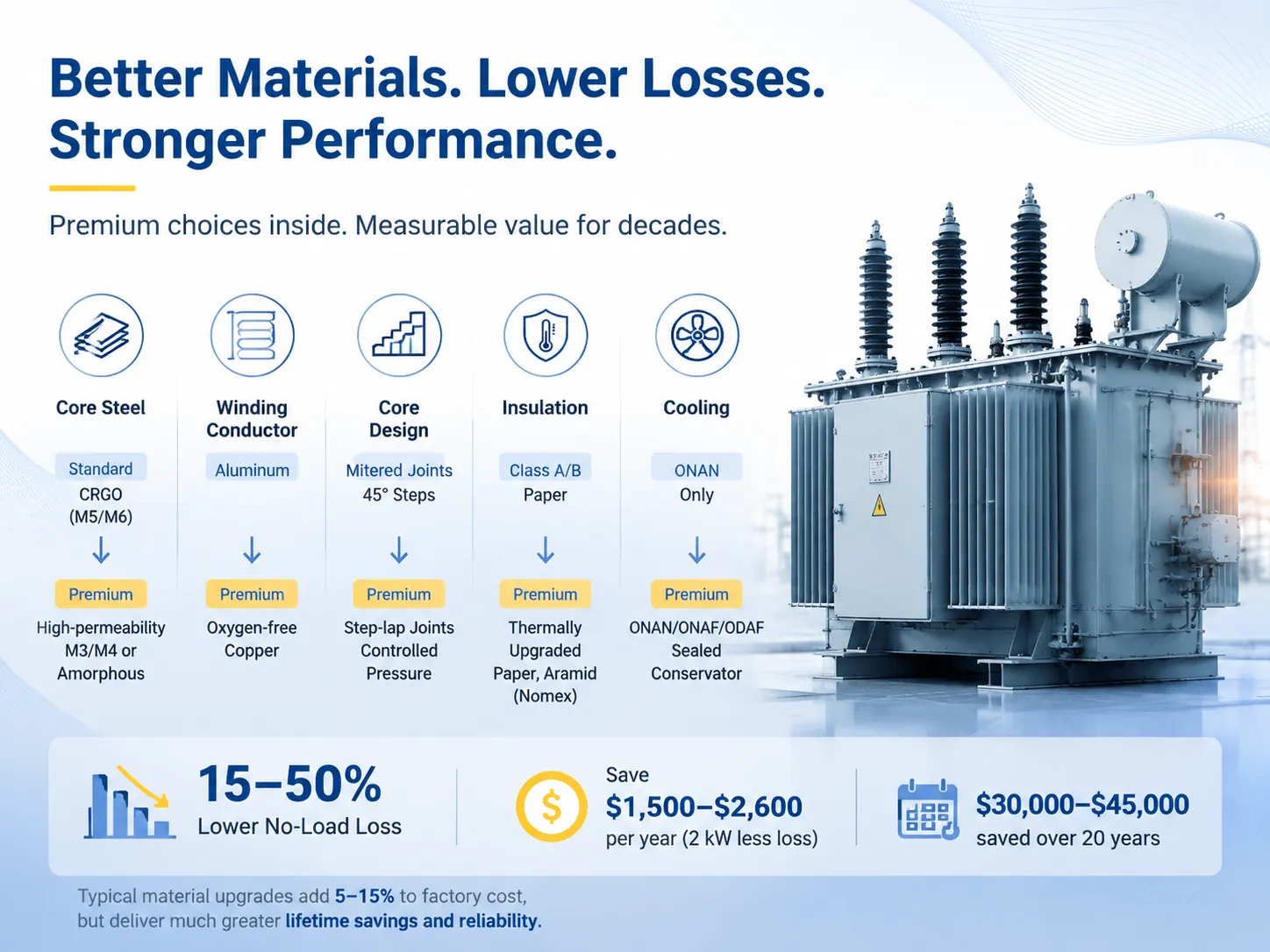
Núcleo, Bobinados y Materiales de Aislamiento
| Componente | Nivel de Entrada | Alta Calidad | Impacto de la Opción Premium |
|---|---|---|---|
| Acero del núcleo | CRGO Estándar (M5/M6) | Alta permeabilidad grabada con láser (M3/M4) o amorfa | Pérdida en vacío recortada 15–50% |
| Conductor de bobinado | Aluminio | Cobre libre de oxígeno de alta pureza | Menor resistencia, funcionamiento más fresco, mayor vida útil |
| Diseño del núcleo | Juntas en inglete, pasos de 45° | Juntas en escalón, presión de apilamiento controlada | Menor corriente de excitación, operación más silenciosa |
| Aislamiento | Papel Clase A/B | Papel térmicamente mejorado, puntos calientes de aramida (Nomex) | Clasificado para servicio continuo de 120–155°C |
| Refrigeración | Solo ONAN | Opciones ONAN/ONAF/ODAF, conservador sellado | Mayor carga cíclica y de contingencia |
Generalmente, la selección de material provoca un aumento en el costo de fábrica de 5%–15%; sin embargo, la disminución en los costos futuros es mucho mayor. Considere un transformador con una pérdida en vacío inferior en 2 kW, lo que genera ahorros de aproximadamente $1,500–$2,600 al año (el costo de la electricidad es $0.09–$0.13/kWh)—lo que equivale a ahorros de $30,000–$45,000 a lo largo de 20 años.
Los Estándares que Definen la Calidad
| Estándar | Alcance | Por qué un Comprador Debe Importarle |
|---|---|---|
| IEC 60076-1/-2/-5 | General, aumento de temperatura, resistencia a cortocircuitos | La base global para el diseño y prueba de transformadores de potencia |
| IEC 60076-10 | Niveles de sonido | Garantiza ruido, crítico para sitios urbanos y en interiores |
| IEC 60076-11 | Transformadores de tipo seco | Clasificaciones de tipo seco, pérdidas y requisitos de prueba |
| IEEE C57.12.00 | Transformadores de distribución/potencia sumergidos en líquido | Estándar de diseño y prueba de América del Norte |
| NEMA TP-1 | Eficiencia de transformadores de distribución | Niveles mínimos de eficiencia adoptados por muchas regulaciones estatales |
| DOE de EE. UU. 10 CFR 431 | Estándares mínimos de eficiencia | Límites de pérdida obligatorios para transformadores de distribución en EE. UU. |
Solicite a cada proveedor en su lista corta la confirmación de cumplimiento con los estándares, el certificado de prueba de tipo y el informe de pruebas de rutina. Cualquier proveedor que parezca reacio a proporcionar la documentación generalmente tiene algo que ocultar; un proveedor de buena reputación no esperará a que usted pregunte dos veces antes de enviarle la información.
Niveles de Calidad: Entrada, Estándar, Premium
| Parámetro | Entrada | Estándar | Premium |
|---|---|---|---|
| Acero del núcleo | M5/M6 | M4 | M3 o amorfo |
| Pérdida en vacío (1,000 kVA) | 1,700–2,200 W | 1,300–1,700 W | 800–1,200 W |
| Pérdida de carga @120°C | 10,500–13,000 W | 9,000–10,500 W | 7,500–9,000 W |
| Ruido (1,000 kVA) | 58–65 dB(A) | 52–58 dB(A) | 46–52 dB(A) |
| Vida útil de diseño | 15–20 años | 25–30 años | 30–40 años |
| Cobertura de pruebas | Solo rutina | Rutina + pruebas de tipo clave | Pruebas de tipo completo + pruebas especiales |
| Aumento de precio | Línea base | +8–15% | +15–30% |
Si bien el nivel inicial puede parecer atractivo en un proceso de licitación, las pérdidas de capital combinadas con una duración más corta suelen hacer que la opción premium sea más asequible durante un período de 25 años. Hay una regla general utilizada por varias empresas en el sector que dice que para evaluar las pérdidas, se debe considerar 1 kW de pérdida como costando alrededor de $4,000-8,000, dependiendo de la carga y evaluar cómo se habrían comparado los niveles en tal base.
Cómo se construye la calidad en la fabricación
- Producción de unión del núcleo: las placas del núcleo utilizan tanto uniones de paso como presión de apilamiento exacta que mejoran el rendimiento de la unión y eliminan las desventajas de la corriente de excitación; las pérdidas del núcleo se determinan tan pronto como se produce el núcleo y antes de la bobinado.
- Proceso de bobinado: se deben utilizar capas aislantes, espaciado consistente entre las vueltas y bobinado continuo de la bobina para minimizar conexiones débiles; se mide la resistencia y la relación de transformación de todas las bobinas.
- Secado al vacío: el núcleo se coloca en un horno de vacío y se seca a una temperatura de 100–120 °C.
- Preparación del aceite: el aceite del transformador se desgasifica, deshidrata y filtra hasta alcanzar 10 ppm de agua y 1000 ppm de gas.
- Montaje: todos los bobinados y núcleos están ajustados y no se desplazan durante el envío.
Las pruebas que demuestran la calidad
| Prueba | Propósito | Aceptación Típica |
|---|---|---|
| Relación de vueltas y grupo vectorial | Transformación de voltaje correcta | ±0.5% de la relación especificada |
| Pérdida en vacío y corriente | Calidad del núcleo | Dentro del valor garantizado según IEC 60076-1 |
| Pérdida de carga e impedancia | Calidad del bobinado, voltaje de cortocircuito | ±7.5% tolerancia de impedancia |
| Resistencia de aislamiento | Secado e integridad del aislamiento | Mínimo por clase de aislamiento, por ejemplo, >1,000 MΩ a 1 kV |
| Prueba de voltaje inducido | Aislamiento entre vueltas | 2× voltaje nominal, 60 s |
| Impulso de rayo (LI) | Resistencia a tensiones de conmutación/surge | Por nivel de aislamiento, sin ruptura |
| Descarga parcial (PD) | Defectos incipientes de aislamiento | <100 pC a 1.1× Ur para sumergidos en aceite, <10 pC resina fundida |
Especificaciones representativas
| Clasificación | Voltaje | Pérdida en Vacío | Pérdida de Carga | Impedancia |
|---|---|---|---|---|
| 630 kVA | 11/0.4 kV | 900–1,300 W | 6,000–8,500 W | 4.5–6% |
| 1,000 kVA | 11/0.4 kV | 1,300–1,800 W | 9,000–12,500 W | 6% |
| 10 MVA | 33/11 kV | 8,000–11,000 W | 55,000–75,000 W | 10–12% |
| 50 MVA | 110/33 kV | 30,000–45,000 W | 200,000–280,000 W | 12–14% |
Donde la alta calidad más vale la pena
- Empresas eléctricas y redes: los MWh pasan por múltiples transformadores antes de ser entregados a los clientes; esto hace que las tasas de eficiencia sean múltiples.
- Centros de procesamiento de datos: Operando día y noche, la eficiencia y la fiabilidad son aspectos críticos para las empresas al tomar decisiones.
- Sector de energía verde: Los dispositivos de energía eólica y solar pasan por muchos ciclos de operación y son costosos de reemplazar.
- Industria pesada: Las fundiciones de aluminio y otras fábricas operan cerca de su capacidad máxima, pero los límites térmicos y la capacidad de soporte de fallas influyen en su tiempo operativo.
- Ferrocarriles: Las condiciones climáticas requieren el uso de transformadores secos.
Principales marcas y rangos de precios
| Marca | País | 630 kVA | 10 MVA | Conocido por |
|---|---|---|---|---|
| Hitachi Energy | Suiza/Japón | $11,000–$18,000 | $140,000–$220,000 | Tecnología HVDC y EHV |
| Siemens Energy | Alemania | $10,000–$17,000 | $130,000–$210,000 | Transformadores de potencia grandes |
| ABB | Suiza | $10,000–$17,000 | $135,000–$215,000 | Red de servicio global |
| Schneider Electric | Francia | $9,500–$16,000 | $120,000–$190,000 | Línea de distribución de eco-diseño |
| Hyosung / HD Hyundai | Corea del Sur | $10,000–$16,500 | $125,000–$200,000 | Transformadores EHV para Asia |
| China XD / TBEA | China | $7,000–$12,000 | $80,000–$140,000 | Producción de alta capacidad, precios competitivos |
| Jiangsu Subian Electric Power | China | $6,000–$11,000 | $70,000–$120,000 | Probado según IEC 60076, OEM/ODM, enfoque en exportación |
Nombres importantes como Hitachi Energy, Siemens Energy y ABB son modelos a seguir importantes durante la cooperación en ingeniería y, como tienen una amplia presencia mundial, influyen en los precios que el resto de los competidores deben seguir. Sin embargo, en el caso del segmento de potencia media, es la operación real lo que importa, ya que la tecnología en sí está disponible para la mayoría de los fabricantes. Jiangsu Subian Electric Power fabrica transformadores conforme a IEC 60076 en el rango de 50 kVA-110 kV, proporciona el servicio de testigo de pruebas, permite la marca de productos OEM y ofrece precios de fábrica que son casi 30–45% por debajo de los precios europeos.
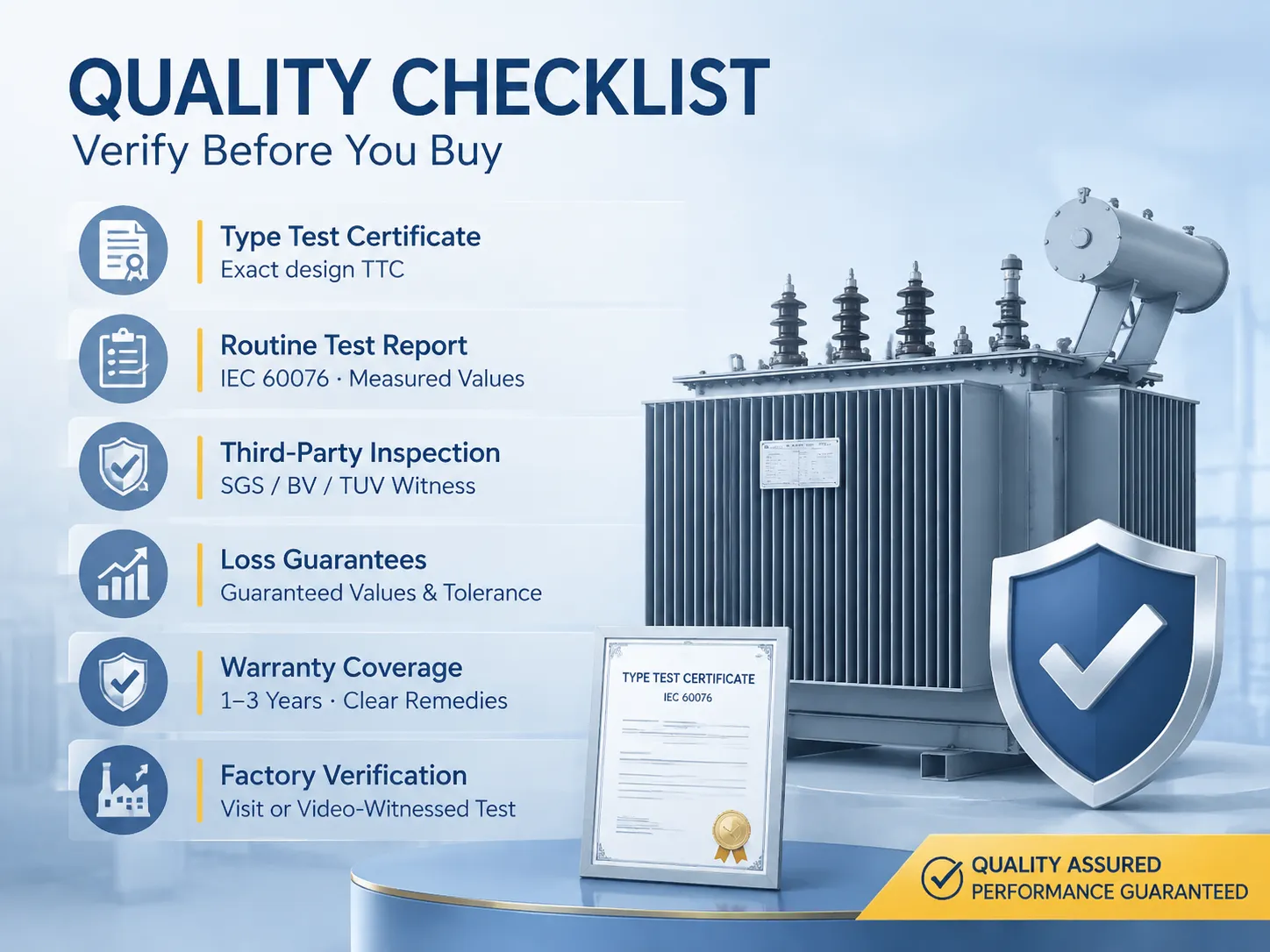
Cómo verificar la calidad antes de comprar
- Solicite el certificado de prueba de tipo (TTC) para la unidad exacta que se está cotizando en lugar de una unidad “similar”.
- Exija un informe de prueba de rutina de acuerdo con la norma IEC 60076 que muestre valores medidos, no calculados.
- Pregunte si hay alguna manera de que un inspector de terceros (como SGS, Bureau Veritas, TUV, etc.) sea testigo de las pruebas finales.
- Verifique si las pérdidas están garantizadas; asegúrese de que sean los valores garantizados con la tolerancia garantizada requerida y que se incluyan penalizaciones.
- Verifique las condiciones de garantía; los transformadores de calidad tienen un período de garantía de 1-3 años con obligaciones de remedio claras.
- Si visitar la fábrica es imposible, solicite pruebas observadas por video.
Preguntas Frecuentes
¿Qué hace que un transformador sea de “alta calidad”?
Los métricas de rendimiento aquí son el elemento de pérdidas aceptables, descarga parcial por debajo del umbral de diseño, ruido por debajo de los límites, resistencia a cortocircuitos y vida útil de 25-30 años de diseño. En cuanto a sus elementos, el transformador cuenta con acero de núcleo de alta calidad (M3 / M4 o amorfo), bobinas de cobre de alta pureza, aislamientos certificados, secado al vacío y pruebas exhaustivas.
¿Cuánto más cuesta un transformador de alta calidad?
Presupuestar un premium de entre 15% y 30% sobre los precios de nivel de entrada para equipos con la misma clasificación. Por ejemplo, un transformador de distribución de 630 kVA de calidad suficiente cuesta entre $8,000 y $15,000 en comparación con $5,500–$9,000 para equipos de nivel de entrada. Mientras tanto, un transformador premium de 10 MVA costará entre $120,000 y $220,000 en lugar de los $80,000–$140,000 que se pagaría por uno de nivel de entrada. Los precios varían significativamente según la marca, especificación y geografía, pero se logran ahorros significativos en costos de capital en un tiempo relativamente corto de 3–6 años.
¿Cuál es la causa más común de falla en transformadores?
La principal causa de fallas en componentes llenos de líquido es la ruptura del aislamiento, que representa aproximadamente el 40 al 60% de los problemas; esto es seguido por problemas de bobinado/terminales y fugas de aceite. Los fallos en el proceso de fabricación, como el secado incompleto, aceite contaminado o un apriete que no es firme, hacen que el aislamiento se deteriore rápidamente y hacen que las pruebas y la inspección sean muy importantes.
¿Una calificación de eficiencia más alta siempre significa mejor calidad?
Por sí sola, pero es la representación singular más fuerte. La eficiencia depende de la calidad del núcleo y el bobinado, que también tiene correlación con la calidad del aislamiento y la resistencia mecánica. Siempre respalde la afirmación de eficiencia con certificados de prueba porque un diseño de baja pérdida no será económicamente viable si falla la prueba de cortocircuito.
¿Cuánto tiempo dura un transformador de alta calidad?
Los transformadores de distribución fabricados según la IEC 60076 con buen mantenimiento duran más de 25–35 años; los transformadores de utilidad grandes alcanzan de 40 a 50 años con monitoreo de la condición del aislamiento y recuperación de aceite. El abuso térmico es la última palabra en la destrucción de transformadores: cada 8–10°C por encima del punto caliente nominal significa que la vida del aislamiento se reduce a la mitad.
Referencias
- IEC 60076-1: Transformadores de Potencia – Requisitos Generales — clasificaciones, tolerancias y procedimientos generales de prueba.
- IEC 60076-5: Capacidad para Resistir Cortocircuito — define los requisitos de resistencia a cortocircuitos y métodos de prueba.
- IEC 60076-11: Transformadores de tipo seco — requisitos para unidades de resina fundida y VPI.
- IEEE C57.12.00: Transformadores sumergidos en líquido — estándar de diseño y prueba de América del Norte.
- DOE de EE. UU.: Eficiencia de Transformadores de Distribución — estándares de eficiencia mínima obligatorios (10 CFR 431).
- NEMA TP-1 — el punto de referencia de eficiencia de la industria para transformadores de distribución.
- Jiangsu Subian Electric Power — fabricante de transformadores conforme a IEC 60076, desde distribución hasta clase de 110 kV, con soporte de exportación y OEM.
Conclusión
Utilizar un transformador premium no es un costo adicional; de hecho, es la forma más asequible de seguro para su sistema eléctrico. Los parámetros medibles—pérdidas, ruido, descarga parcial, resistencia a picos de corriente y su larga vida de 25 a 30 años—no solo se traducen en los costos de energía, incursiones de tiempo de inactividad y procesos de reemplazo; sino que también son útiles para calcular las pérdidas totales durante las comparaciones de diversas ofertas, incluido su precio.
- Asegúrese de que el cumplimiento de IEC 60076 (o IEEE C57.12) esté respaldado por el certificado de prueba tipo del diseño requerido.
- Considere la pérdida de $4,000–$7,000 por kW a lo largo de la vida útil del diseño de no menos de 25 años (en lugar de 15).
- Incluya el presupuesto para la inspección de terceros de la unidad fabricada correspondiente a sus especificaciones técnicas.