


Cuando un ingeniero a cargo del tratamiento de agua ubicado en Texas sugirió usar un transformador de tipo seco con una capacidad igual a 500 kVA para la nueva estación de bombeo construida, estaba haciendo lo mismo que realizan diariamente miles de ingenieros. Copió la especificación de un proyecto similar y solo cambió el kVA. Como resultado, tres proveedores de materiales le enviaron sus solicitudes de cotización, con sus ofertas variando en un 35 por ciento. Los tiempos de entrega para el equipo propuesto también diferían, siendo de ocho a veintidós semanas. Además, una vez que realizó una comparación de los detalles de las propuestas técnicas, resultó que los proveedores excedieron diferentes tipos de transformadores en sus propuestas. De hecho, debido a que el ingeniero no había especificado ni los materiales a utilizar en la producción, ni los tipos de aislamiento, ni los criterios de evaluación de aumento de temperatura o pérdidas, recibió tres transformadores que diferían radicalmente entre sí. Una lección que se puede aprender de esta situación es que el tipo de transformador debe determinarse de manera correcta y eficiente para evitar confusiones en las ofertas.
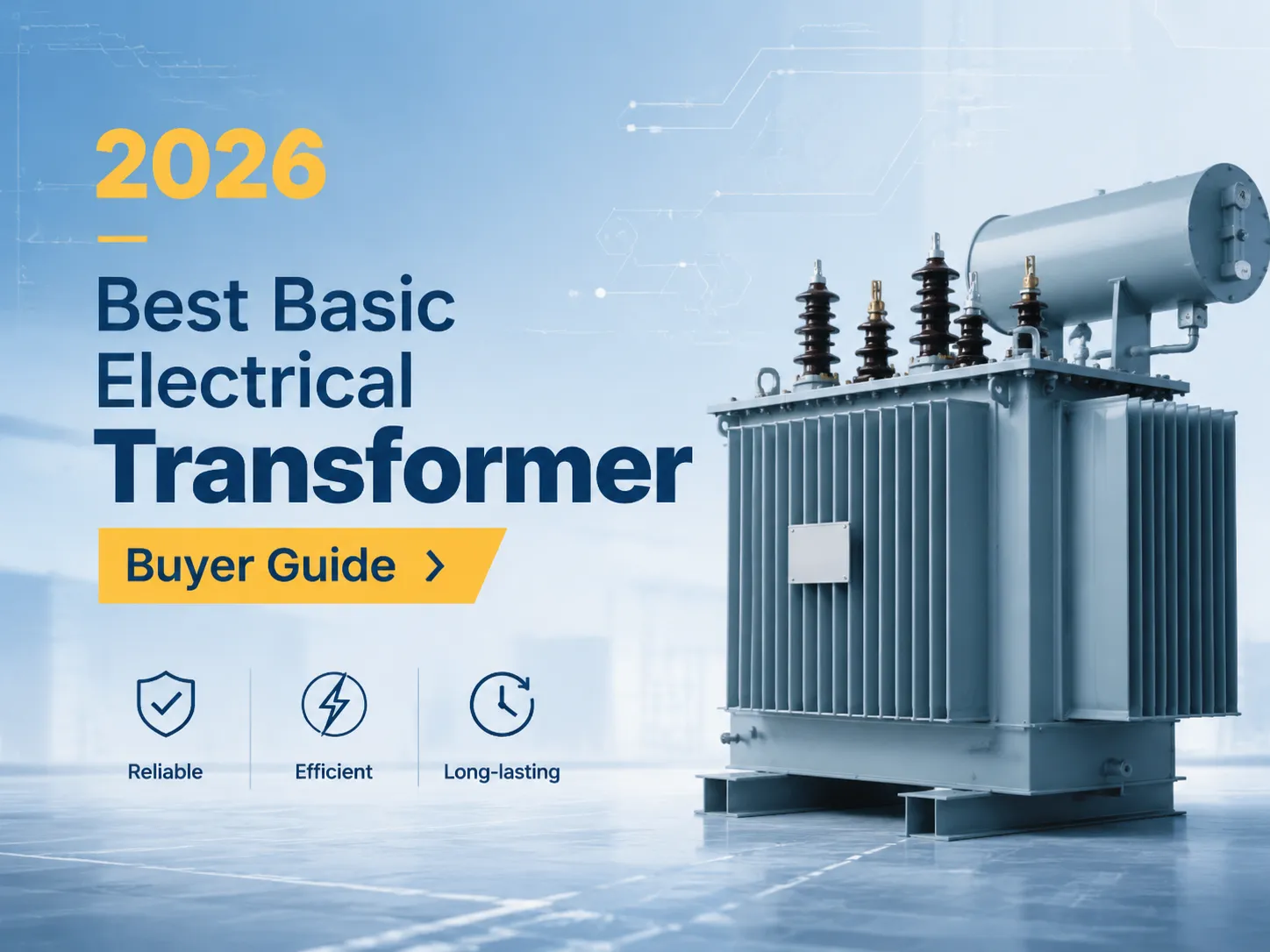
Descripción: Al elegir el transformador eléctrico adecuado, un comprador debe entender, al menos, lo siguiente: clasificación en kVA (esto se puede calcular a través del cálculo de carga basado en la carga continua, factores de demanda y consideración para el crecimiento futuro – es decir, la regla de carga continua 80% que es la práctica establecida en la industria), voltajes primario y secundario (los voltajes se miden en voltaje nominal del sistema e incluyen los tomas requeridos, así como el grupo vectorial – por ejemplo, Dyn11 para transformadores radiales), tecnología de enfriamiento y aislamiento (llenado de aceite vs. seco, donde este último puede ser de tipo VPI o bobina fundida, mientras que el primero puede ser aceite mineral vs. éster natural vs. silicona – esta elección se basa en el sitio de instalación, requisitos de seguridad contra incendios y filosofía de mantenimiento), material de bobinado (cobre vs. aluminio – el cobre es más caro, pero tiene un tamaño más pequeño y menores pérdidas, mientras que el aluminio es más barato y ligero pero necesita conductores más grandes y tiene mayores pérdidas dado el mismo kVA), evaluación de eficiencia/pérdidas (la pérdida en vacío y la pérdida de carga deben proporcionarse en vatios, mientras que el comprador debe evaluar las cotizaciones utilizando una fórmula de capitalización de pérdidas que calcula el valor presente del consumo de energía del transformador durante 25 a 35 años, ya que un precio más alto puede compensar las pérdidas a lo largo de la vida útil), normas y certificaciones aplicables (IEC 60076 o IEEE C57.12 u otra norma que debe ser especificada por el comprador en su especificación), y otros detalles (tipo de cambiador de tomas, monitor de temperatura, dispositivo de alivio de presión, clasificación de la carcasa, etc.). Una buena especificación de transformador responderá la mayoría de estas preguntas. Una oscura deja a los proveedores la responsabilidad de responder de acuerdo con sus propias preferencias de fabricación.
Cómo funciona un transformador — y por qué los conceptos básicos son importantes para el comprador
Cada transformador funciona de acuerdo con el principio de inducción electromagnética ideado por Michael Faraday en 1831. La corriente alterna que pasa a través del devanado primario del transformador crea un flujo magnético cambiante en el núcleo de acero laminado del transformador. El flujo magnético induce un voltaje en el devanado secundario, cuyo tamaño está determinado por la relación del número de vueltas en los devanados secundario y primario, respectivamente. El transformador aumenta el voltaje cuando el número de vueltas en el devanado secundario es mayor que en el devanado primario. Sin embargo, cuando el número de vueltas en el devanado secundario es menor que en el devanado primario, el transformador disminuye el voltaje. La potencia se transmite del circuito primario al circuito secundario a través del campo magnético sin ninguna conexión eléctrica directa. Este proceso de operación del transformador se llama aislamiento eléctrico por acoplamiento magnético con transformación de voltaje, incluida la relación de vueltas, y es el mismo para cualquier transformador.
La mayor implicación para el comprador de transformadores es que debe tener en cuenta la relación de vueltas que determina la relación de voltaje y, por lo tanto, indicar correctamente el voltaje primario y el voltaje secundario; el voltaje del circuito primario debe ser mayor que el del secundario; de lo contrario, puede haber efectos negativos para el equipo conectado a los circuitos secundarios. La elección del material del núcleo también es significativa, ya que el material del núcleo de acero al silicio crea pérdidas en vacío, que es la energía que el transformador consume todos los días 24/7 (al trabajar continuamente), mientras que la elección del material del devanado y la forma de los conductores determina las pérdidas de carga, que dependen de la corriente. El sistema de aislamiento impacta la temperatura del transformador y su vida útil, mientras que las características del medio para enfriar el transformador ayudan a definir ya sea el método de enfriamiento o el método de instalación, que debe tenerse en cuenta.
Los principales tipos de transformadores — y cómo elegir entre ellos
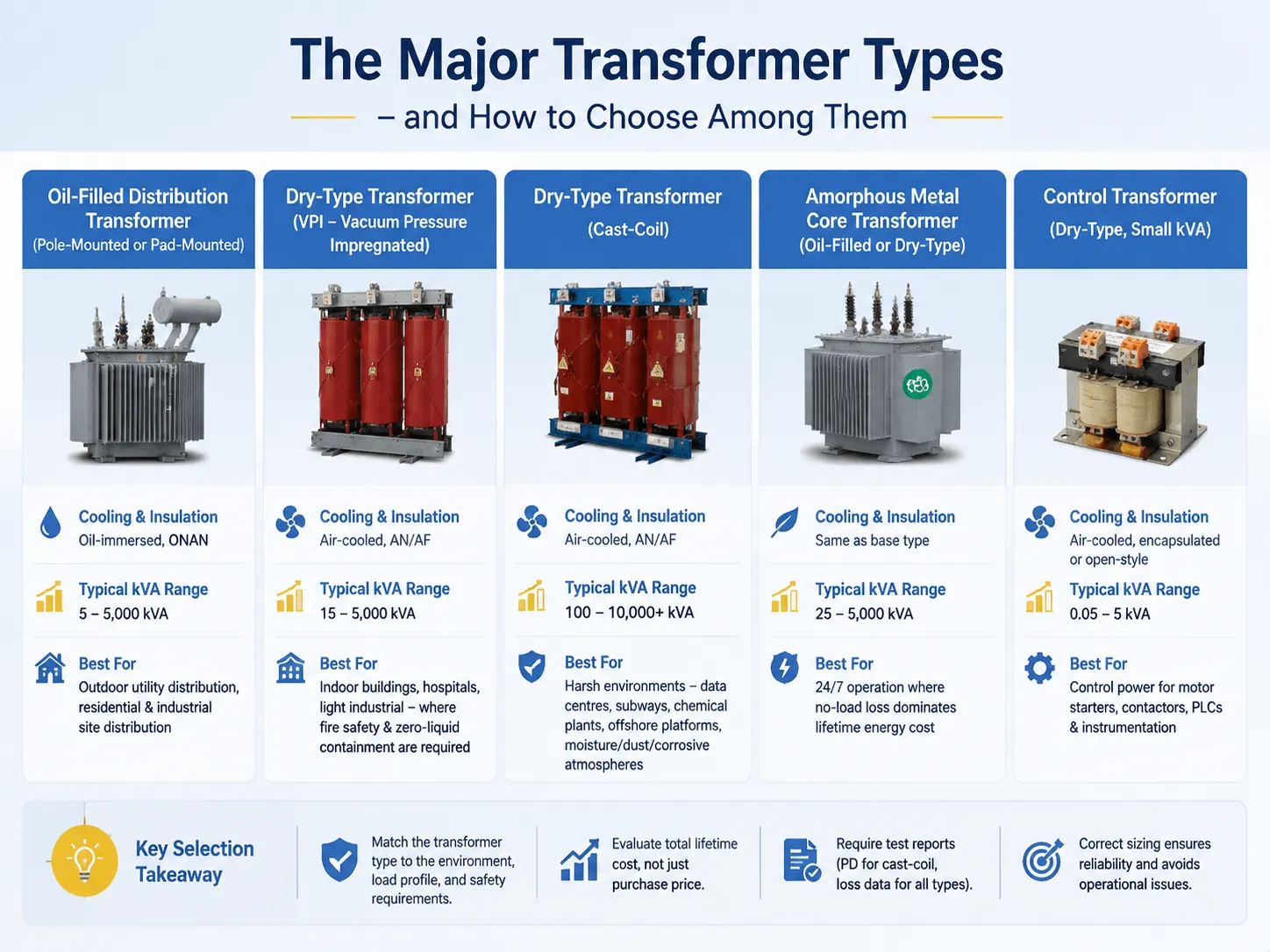
La tabla a continuación resume los tipos de transformadores más comunes en aplicaciones industriales, comerciales y de servicios públicos, sus características definitorias y los escenarios de aplicación donde cada uno es la elección correcta. Comprender estas categorías es el primer paso para redactar una especificación que atraerá las ofertas adecuadas de los proveedores correctos. Tipo de transformador.
| Enfriamiento y aislamiento | Rango típico de kVA | Criterios clave de selección | Mejor para | Transformador de distribución lleno de aceite (montado en poste o montado en base) |
|---|---|---|---|---|
| Aceite mineral, éster natural o fluido de silicona. Enfriamiento ONAN (aceite natural, aire natural). El aceite aísla y enfría. | 5 kVA – 5,000 kVA. | Distribución de servicios públicos al aire libre, subdivisiones residenciales y comerciales, distribución en sitios industriales. El precio de compra más bajo por kVA para aplicaciones al aire libre. | Distribución de servicios públicos al aire libre, subdivisiones residenciales y comerciales, distribución en sitios industriales. El precio de compra más bajo por kVA para aplicaciones al aire libre. | Tipo de fluido (aceite mineral para el costo más bajo; éster natural para seguridad contra incendios y biodegradabilidad; silicona para aplicaciones de alta temperatura). Recubrimiento del tanque y protección contra la corrosión para entornos costeros o húmedos. |
| Transformador de tipo seco (VPI — Impregnado a Presión al Vacío) | Refrigerado por aire, con los devanados impregnados con un barniz bajo vacío y presión. Refrigeración AN o AF (forzada por aire). | 15 kVA – 5,000 kVA | Instalaciones interiores en edificios comerciales, hospitales y instalaciones industriales ligeras donde se requieren seguridad contra incendios y contención de líquidos cero, y donde el costo adicional del tipo de bobina fundida no está justificado. | VPI es la tecnología de tipo seco de menor costo, pero los devanados no están completamente encapsulados y son más vulnerables a la humedad, el polvo y el ataque químico que la bobina fundida. La envoltura debe estar ventilada y mantenerse limpia. |
| Transformador de tipo seco (Bobina Fundida) | Refrigerado por aire, con los devanados de alta tensión completamente encapsulados en resina epóxica bajo vacío. Refrigeración AN o AF. | 100 kVA – 10,000+ kVA | Instalaciones interiores y exteriores en entornos severos — centros de datos, metros, plantas químicas, plataformas en alta mar y cualquier ubicación donde estén presentes humedad, polvo o atmósferas corrosivas. La bobina fundida es la tecnología de tipo seco premium, con la mejor resistencia a la degradación ambiental. | La bobina fundida cuesta más que VPI pero proporciona una vida útil más larga en entornos exigentes. El comprador debe requerir un informe de prueba de descarga parcial en cada devanado, porque PD es el principal mecanismo de falla en un transformador de bobina fundida. |
| Transformador de Núcleo de Metal Amórfico (Lleno de Aceite o de Tipo Seco) | Mismo enfriamiento y aislamiento que el tipo de transformador base, con un núcleo de metal amórfico que reemplaza el núcleo convencional de acero silicio. | 25 kVA – 5,000 kVA | Transformadores que están energizados 24 horas al día, 365 días al año, y donde la pérdida en vacío domina el costo energético a lo largo de la vida útil. Los transformadores de distribución en redes residenciales ligeramente cargadas son la aplicación clásica. | Los núcleos de metal amórfico reducen la pérdida en vacío en un 60–70% en comparación con el acero silicio convencional. La prima de precio de compra es típicamente del 15–25%. El retorno de la inversión, en un transformador que funciona continuamente, suele ser de 2 a 4 años. El comprador debe evaluar las ofertas utilizando una fórmula de capitalización de pérdidas. |
| Transformador de Control (Tipo Seco, Pequeño kVA) | Refrigerado por aire, encapsulado o de estilo abierto, típicamente monofásico. | 05 kVA – 5 kVA | Suministrando energía de control a arrancadores de motores, contactores, PLCs y instrumentación en paneles de control industrial. Reduce 480 V o 240 V a 120 V o 24 V para circuitos de control. | El transformador de control debe dimensionarse para la corriente de arranque de los contactores y los relés que alimenta. Un transformador que es demasiado pequeño experimentará una caída de voltaje cuando un contactor se active, causando que el contactor titilee o se desconecte. |
Cómo Dimensionar un Transformador: El Cálculo de Carga y la Regla del 80%
El tamaño adecuado de un transformador eléctrico depende del cálculo de la carga conectada, los factores de demanda apropiados y la selección de la clasificación estándar en kVA que garantiza la provisión de suficiente capacidad para la carga actual, así como un buen margen para el aumento futuro de la carga. El procedimiento determinante ha sido establecido en el Código Eléctrico Nacional (NEC) Artículo 220 que regula los cálculos de carga y en las normas IEEE e IEC que rigen la carga de transformadores.
El primer paso implica hacer una lista de las cargas atendidas por el transformador, incluyendo iluminación, tomacorrientes, motores, equipos HVAC y cargas de proceso. Se deben indicar los volt-amperios (VA) y el factor de potencia. Para la carga del motor, se debe utilizar la corriente de carga completa de la placa de identificación o las tablas del NEC, considerando que la corriente de arranque es esencial en caso de que el motor arranque con una carga.
En segundo lugar, se deben incluir los factores de demanda que coincidan con el tipo de instalación. El factor de demanda es necesario porque no todas las cargas operan a plena capacidad. Un alimentador con capacidad de 100 A que atiende 20 tomacorrientes de 20 A cada uno no tiene que dimensionarse para 400 A. El factor de demanda contribuirá a la reducción de la carga calculada a un valor factible.
Además, es esencial añadir cargas continuas en la proporción de 125%. La carga continua se define como aquella que trabaja durante 3 horas o más y el transformador, así como los conductores, deben dimensionarse para la carga continua en la proporción de 125%. Así, la carga de 100 A requerirá transformador y conductores dimensionados para una carga de 125 A.
Luego, se debe seleccionar la clasificación en kVA por encima de la carga calculada. Los transformadores monofásicos estándar pueden clasificarse con calificaciones de 10, 15, 25, 37.5, 50, 75, 100, 167, 250, 333 y 500 kVA, mientras que las calificaciones de transformadores trifásicos estándar son 15, 30, 45 y 75, así como 112.5, 150, 225, 300, 500, 750, 1000, 1500, 2000 y 2500 kVA, respectivamente.
Finalmente, se debe tener en cuenta la regla 80% relacionada con la carga continua. Un transformador no debe operar bajo una carga continua de más del 80% de su clasificación en kVA. Con esto en mente, se crea un margen térmico, asegurando una larga vida útil del aislamiento y permitiendo hacer frente a sobrecargas sin desconectar dispositivos de protección.
Especificando las Pérdidas: Por qué el Precio de Compra No Es el Costo
Es un error común entre las personas que compran transformadores comparar ofertas únicamente en función del precio de compra. Una vez instalado, un transformador pierde energía debido a la pérdida en vacío (pérdida del núcleo) y la pérdida de carga (pérdida en el devanado). El costo de energía durante la vida útil del transformador es mucho mayor que su costo de compra. Un transformador con un bajo precio de compra y altas pérdidas costará más operar a lo largo de su vida que un transformador con un alto precio de compra pero menores pérdidas. El método de comparación de ofertas consiste en evaluar el costo total de propiedad, que es el costo de las pérdidas expresado como valor presente del costo de capital. Para calcular el costo total de propiedad, podemos usar una fórmula simple que se puede presentar como Costo Total Evaluado = Precio de Compra + A x Pérdida en Vacío (en vatios) + B x Pérdida de Carga (en vatios), donde A y B son factores de capitalización de pérdidas particulares en dólares por vatio. Por ejemplo, los valores de A pueden variar de 5 a 10, mientras que los valores de B están en el rango de 1 a 3 dependiendo del costo de electricidad y la tasa de descuento. Por ejemplo, un transformador con una pérdida en vacío de 500 vatios y una pérdida de carga de 2000 vatios tenía un valor de A igual a $7 y un valor de B igual a $2. Así, a partir del ejemplo anterior, el costo total evaluado se calcula como Precio de Compra + $3500 + $4000 = Precio de Compra + $7500. Un transformador con un precio de compra que excede el precio del transformador mencionado anteriormente en $2000, mientras tiene pérdidas en vacío y de carga más bajas en 30%, tendrá un costo total de propiedad más bajo, lo que lo convierte en una mejor opción de compra. El comprador que aplique esta fórmula a cada oferta de transformador nunca volverá a seleccionar un transformador solo por el precio de compra. Para obtener ayuda con el cálculo específico y los factores de capitalización de pérdidas para diferentes escenarios de servicios públicos e industriales, las normas publicadas por el IEEE y la orientación de la Departamento de Energía de EE. UU. proporcionan los datos de referencia y la metodología.
La Documentación Que un Comprador Debe Requerir con Cada Transformador
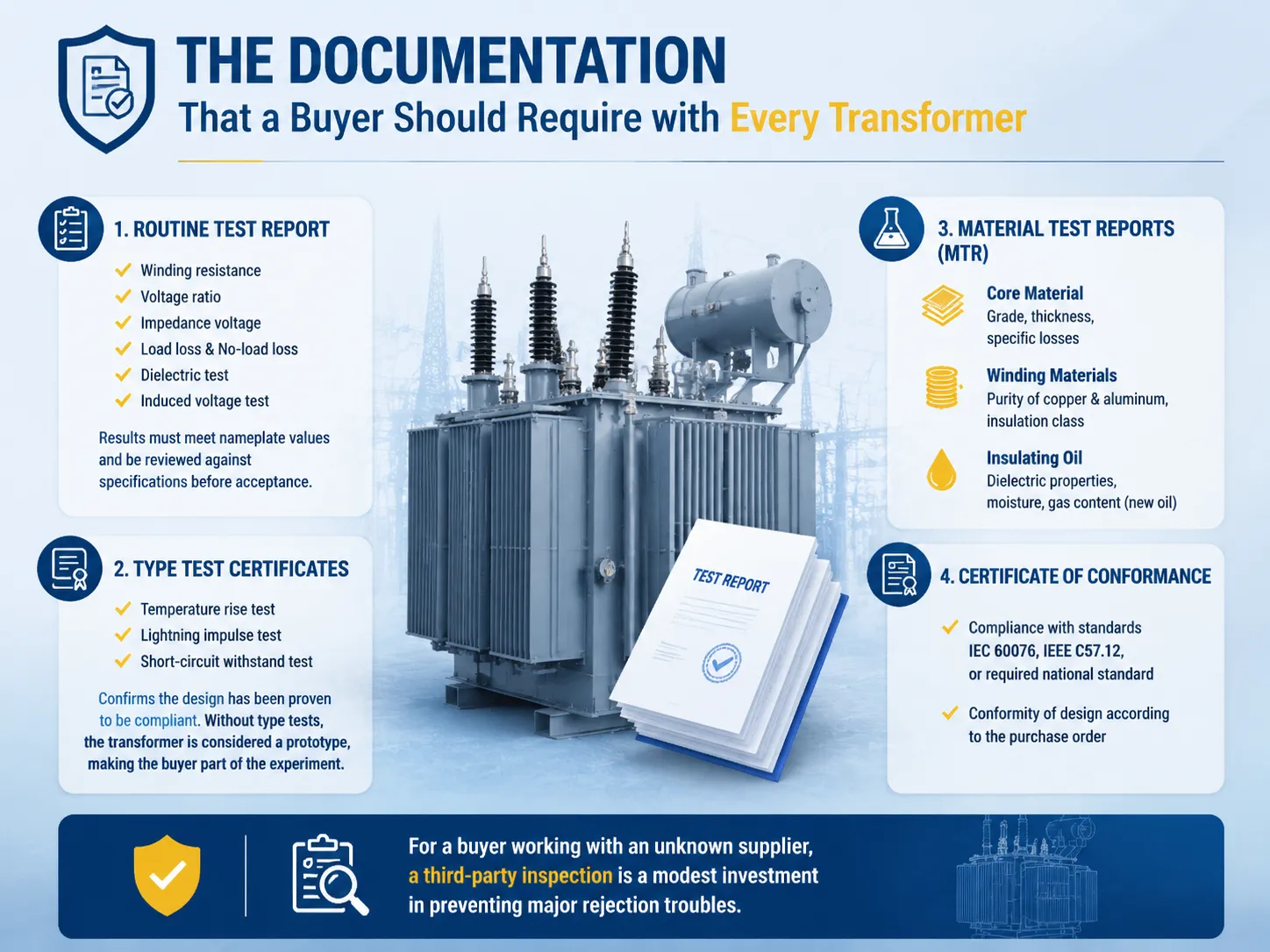
Un transformador cuyos informes de prueba y certificaciones de material no están disponibles al momento de la entrega no puede ser aceptado. Es crítico insistir en ciertos documentos como parte del contrato de compra que deben ser revisados y aprobados mucho antes de que el transformador sea enviado. El primer documento es el informe de prueba de rutina (que es una colección de pruebas realizadas por el fabricante de cada transformador antes de que salga de la fábrica: resistencia de devanado, relación de voltaje, voltaje de impedancia, pérdida de carga, pérdida en vacío, prueba dieléctrica a diferentes niveles de voltaje y prueba de voltaje inducido. Los resultados de todas las pruebas deben indicar que el transformador cumple con sus valores de placa y deben ser revisados en comparación con las especificaciones antes de aceptar el transformador). Otro tipo de documentos son los certificados de prueba de tipo (las pruebas de tipo se realizan en una muestra representativa que tiene el mismo diseño y parámetros que el transformador solicitado que incluye prueba de aumento de temperatura, prueba de impulso de rayo y prueba de resistencia a cortocircuitos; el certificado confirma que el diseño del transformador ha demostrado ser conforme. Si un transformador no ha sido sometido a pruebas de tipo se admite que es un prototipo, lo que convierte al comprador en un miembro del experimento). El siguiente tipo de documentos son los informes de prueba de material (MTR) que deben ser emitidos para el material del núcleo confirmando su grado, grosor y pérdidas específicas; para los materiales de devanado confirmando la pureza de los materiales de cobre y aluminio, y la clase de aislamiento de acuerdo con una especificación; y para el aceite de aislamiento confirmando sus propiedades dieléctricas, humedad y contenido de gas del aceite nuevo. El último tipo de documento que debe obtenerse es el certificado de conformidad (una carta que indica que el transformador cumple con las normas aceptables IEC 60076, IEEE C57.12, o la norma nacional requerida) y la conformidad del diseño de acuerdo con los requisitos técnicos de la orden de compra. Para un comprador que trabaja con un proveedor desconocido, una inspección de terceros es una inversión modesta para prevenir grandes problemas de rechazo.
Preguntas Frecuentes
¿Cuál es la especificación más importante a definir al comprar un transformador?
La especificación más importante del transformador es el conjunto completo de requisitos — el kVA, el voltaje, el tipo de refrigeración, el material de devanado, el aumento de temperatura y la eficiencia — porque estos parámetros interactúan, y definir solo uno o dos de ellos deja al fabricante hacer suposiciones sobre el resto. La segunda más importante es la evaluación de pérdidas, porque el precio de compra es una fracción del costo total de propiedad, y un transformador que se evalúa solo por precio casi seguramente será la opción más cara a lo largo de su vida útil. La tercera son los requisitos de prueba y documentación, porque un transformador que llega sin su informe de prueba de rutina y sus certificaciones de material es un desconocido, y un desconocido no puede ser confiable.
¿Cómo sé si necesito un transformador lleno de aceite o un transformador de tipo seco?
La elección entre un transformador lleno de aceite y uno de tipo seco está determinada por la ubicación de la instalación y los requisitos de seguridad contra incendios. Para una instalación al aire libre — un poste, una base, un patio de subestación — un transformador lleno de aceite es típicamente la opción más económica, y proporciona una excelente capacidad de sobrecarga y una larga vida útil. Para una instalación en interiores — un edificio, un centro de datos, un hospital — un transformador de tipo seco es requerido por la mayoría de los códigos de construcción, porque no contiene líquido inflamable y elimina la necesidad de un pozo de contención de aceite. Dentro de los transformadores de tipo seco, el tipo de bobina fundida es preferido para entornos duros, polvorientos o corrosivos; el VPI es aceptable para ubicaciones interiores limpias y secas.
¿Cuál es la diferencia entre bobinados de cobre y de aluminio en un transformador?
Los bobinados de cobre son más conductores, lo que significa que un transformador con bobinado de cobre tiene un núcleo y un conjunto de bobinas más pequeños para la misma clasificación de kVA, resultando en un transformador más compacto con menores pérdidas por carga. El cobre es más caro que el aluminio, y el precio de compra de un transformador con bobinado de cobre es más alto. Los bobinados de aluminio son más ligeros y menos costosos, pero la menor conductividad requiere una sección transversal de conductor más grande, lo que resulta en un núcleo y un conjunto de bobinas más grandes y mayores pérdidas por carga. Para un transformador que estará muy cargado, el ahorro energético a lo largo de la vida útil del cobre a menudo justifica el precio de compra más alto. Para un transformador ligeramente cargado, el aluminio puede ser la opción más económica. La decisión debe evaluarse utilizando la fórmula de capitalización de pérdidas.
¿Cuánto tiempo debería durar un transformador correctamente especificado?
Un transformador correctamente especificado, instalado en un entorno adecuado y cargado dentro de sus límites de diseño, debería durar de 25 a 35 años para una unidad de tipo seco y de 30 a 40 años para una unidad llena de aceite. El sistema de aislamiento es el componente que limita la vida útil, y se degrada con el tiempo en función de la temperatura, la humedad y el oxígeno a los que está expuesto. La regla de carga continua 80%, que mantiene la temperatura de bobinado por debajo del límite nominal del aislamiento, es la práctica más efectiva para extender la vida útil de un transformador. Un transformador que está sobrecargado, incluso de forma intermitente, tendrá una vida significativamente más corta que uno que se opera dentro de sus límites de diseño.
Referencias
- IEEE C57.12.00 — Estándar para Requisitos Generales para Transformadores de Distribución, Potencia y Regulación Sumergidos en Líquido. El estándar fundamental de IEEE para el diseño, prueba y rendimiento de transformadores llenos de aceite.
- IEEE C57.96 — Guía para la Carga de Transformadores de Distribución y Potencia de Tipo Seco. La guía de IEEE que define la relación entre la carga, la temperatura y la vida útil del aislamiento para transformadores de tipo seco, incluyendo la regla de carga 80%.
- Departamento de Energía de EE. UU. — Normas de Eficiencia Energética para Transformadores de Distribución. Los estándares regulatorios que definen los requisitos mínimos de eficiencia para transformadores de distribución vendidos en los Estados Unidos, incluyendo los niveles de eficiencia DOE 2016 que han impulsado la adopción de núcleos de metal amorfo y diseños de mayor eficiencia.
- IEC 60076 — Transformadores de Potencia. La serie de normas internacionales que define el diseño, las pruebas y los requisitos de rendimiento para transformadores de potencia y distribución, adoptada en Europa, Asia, África y Oriente Medio.
El año 2026 ofrece muchas oportunidades a los compradores de transformadores eléctricos, quienes pueden aprovechar más opciones, compartir más información y utilizar más herramientas que nunca para tomar sus decisiones. El comprador actual puede elegir entre numerosas variedades de equipos, cubriendo tipos como transformadores de poste de aceite tradicionales y transformadores de núcleo amorfo de bobina fundida, y así puede hacer una interpretación tan precisa al elegir el transformador para una aplicación determinada, lo cual no era posible hace dos décadas. Sin embargo, la amplia gama de opciones no solo brinda más oportunidades a los compradores para tomar una decisión acertada, sino que también impone algunas restricciones en términos de seguir un enfoque estricto para redactar una especificación. Por lo tanto, el comprador que deja claro lo que necesita (kVA, voltaje, refrigeración, bobinado, aumento de temperatura, pérdidas, pruebas, etc.) y compara los costos de las ofertas con el costo total de propiedad terminará con un transformador que funcionará correctamente y resultará económicamente viable en las próximas décadas. Por el contrario, el comprador que adopta una especificación vaga y elige las ofertas solo en función de su precio estará comprando lo que el mercado actual ofrece a un precio determinado, lo que significa que lo que recibirá será principalmente el transformador más barato y más simple sin ninguna consideración a las especificaciones proporcionadas. Subian Electric fabrica transformadores de todos los tipos, tamaños y niveles de eficiencia energética y proporciona un soporte integral esencial para que el comprador tome una decisión completamente informada y bien documentada sobre la compra de un transformador.