


El informe sobre la falla de un transformador de potencia de 20 MVA de capacidad y nivel de voltaje de 110 kV fue similar a un estudio de texto sobre el fenómeno. El análisis de gases disueltos mostró la presencia de gas acetileno en una concentración de 18 ppm, el índice de polarización cayó de un valor de fractura de 2.8 al siguiente valor de 1.6 en un período de cuatro años, mientras que la investigación interna reveló que había papel seriamente deteriorado cerca de la parte inferior del devanado de alta tensión, que era quebradizo, oscurecido y tenía un nivel de humedad igual a 2.7%. Así, esta situación no fue provocada por un solo evento extraordinario, sino por años de cuidadosa consideración del problema. Por ejemplo, el ventilador de enfriamiento no fue reparado, no había sílice en el respiradero deshidratante, y la muestra de aceite no fue tomada en un período de dos años.
El artículo contiene la información sobre el proceso de degradación del sistema de aislamiento del transformador, indicadores de evaluación que reflejan el estado de los sistemas de aislamiento, los métodos para evitar el proceso de degradación, incluyendo el mantenimiento del aceite, control de humedad, gestión del calor y la disciplina de prueba del funcionamiento del equipo. El artículo presenta diferentes recomendaciones destinadas a minimizar los procesos de degradación del sistema de aislamiento del transformador.
¿Cuál es el rendimiento del aislamiento del transformador?
El rendimiento del aislamiento del transformador es la capacidad del sistema de aislamiento — aceite, papel, cartón prensado y sus interfaces — para soportar las tensiones eléctricas, térmicas y mecánicas del servicio durante la vida útil de diseño del transformador de 30 a 40 años. Es la calidad más importante de un transformador porque casi todos los modos de falla importantes pasan por ella: los fallos en el devanado comienzan con la ruptura del aislamiento, las fallas en los bujes son fallas de aislamiento, e incluso los fallos en el núcleo generalmente terminan con daños en el aislamiento. Cuando los ingenieros hablan del “envejecimiento” de un transformador, lo que realmente quieren decir es el envejecimiento del aislamiento: el papel se despolimeriza, el aceite se oxida, las interfaces se debilitan.
El rendimiento tiene dos lados. El capacidad de resistencia lado se mide mediante pruebas — resistencia dieléctrica, nivel de descarga parcial, resistencia de aislamiento — y se diseña con niveles de aislamiento según IEC 60076-3. El tasa de degradación lado se controla mediante las condiciones de operación — temperatura, humedad, oxígeno y carga. La percepción práctica para los propietarios de activos es que el primer lado se compra en la adquisición, pero el segundo lado se gestiona durante toda la vida del transformador. Ahí es donde radica casi toda la oportunidad de mejora.
Cómo se degrada el aislamiento: Cuatro asesinos explicados
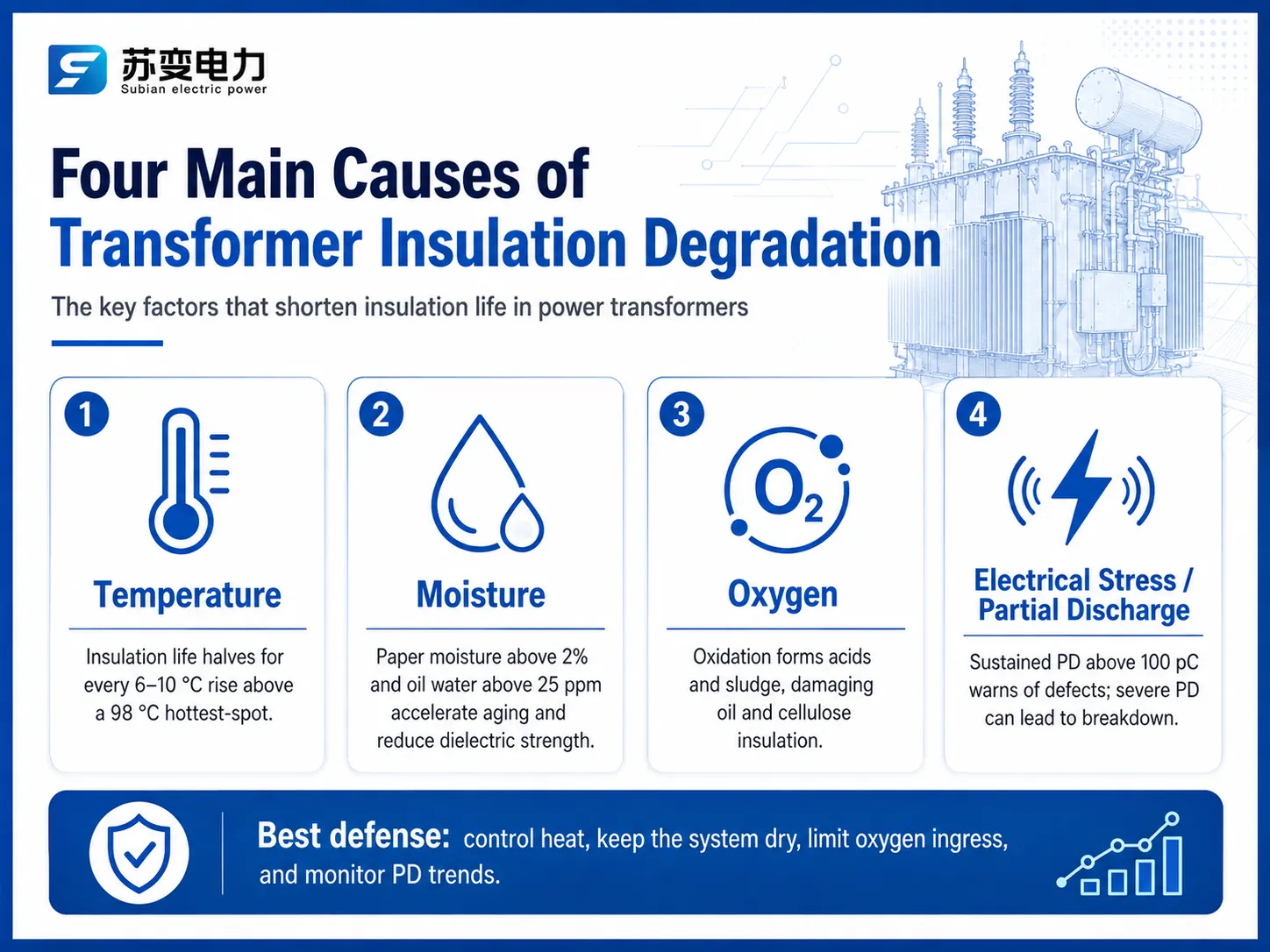
Cuatro mecanismos destruyen el aislamiento al mismo tiempo. El primero de ellos es el mecanismo de degradación térmica, que se describe mediante la ecuación de envejecimiento de Arrhenius, que establece que si el papel mejorado del transformador se opera a una temperatura que está por encima de su punto máximo nominal de 98 °C, su vida se reducirá a la mitad por cada aumento de 6–10 °C en la temperatura. Si se opera un transformador a una temperatura de 110 °C durante algún tiempo, se pueden perder varios años de vida del aislamiento. El agua acelera todos los procesos: reduce la tensión de ruptura del aceite (según las normas IEC 60156, el aceite nuevo debe soportar 40 kV, ya que el aceite dañado por la humedad a menudo tiene una resistencia de menos de 20 kV), reduce la resistencia del papel y duplica el proceso de envejecimiento a 2% de contenido de agua frente a 0.5% de sistema de agua. El oxígeno acelera el proceso de oxidación, produciendo así ácidos, lodos y otros compuestos con propiedades destructivas; las unidades selladas con nitrógeno o herméticas envejecen más lentamente que las que respiran libremente. El estrés eléctrico se manifiesta como descarga parcial que ocurre en vacíos, burbujas o papel dañado, mientras que una descarga parcial excesiva, por encima de 1000pC en voltaje de servicio, sirve como una advertencia seria de posible falla (a más de 10,000pC, puede ocurrir una falla dieléctrica en cuestión de semanas).
Estos mecanismos rara vez actúan sin los otros. El agua acelera el proceso de envejecimiento térmico y disminuye el voltaje para la descarga parcial; el oxígeno agrava el daño térmico; el estrés térmico crea burbujas de gas, lo que lleva a la necesidad de lidiar con el estrés eléctrico. Por lo tanto, una estrategia adecuada de gestión del aislamiento debe estar dirigida a resolver estos cuatro problemas interrelacionados.
Materiales de Aislamiento y Clases de Temperatura
| Material | Clase de Temperatura | Temp. Máx. de Punto Caliente Continuo | Aplicación Típica |
|---|---|---|---|
| Papel kraft + aceite | Clase A (mejorado) | 98 °C | Transformadores sumergidos en aceite estándar |
| Papel Kraft térmicamente mejorado (TUK) | Clase A+ | 98–105 °C | Transformadores de potencia estándar hoy en día |
| NOMEX / papel aramida | Clase C | 220 °C | Diseños de tipo seco y de alta temperatura |
| Aceite mineral | — | — | Dieléctrico estándar + refrigerante |
| Aceite de éster natural | — | Mayor tolerancia a la humedad | Sitios seguros contra incendios y sensibles al medio ambiente |
| Cartón prensado | Clase A | 98–105 °C | Barreras, separadores, cuñas en unidades de aceite |
Se pueden extraer dos puntos de selección de lo anterior. Primero, está la categoría de temperatura como una limitación de diseño: usar un tipo de aislamiento de categoría superior (aramida + éster) te dará un margen real de sobrecarga, ya que un artículo equipado con un aislamiento de clase 220 °C manejará mejor las cargas de estrés aumentadas que un artículo equivalente de clase A. Segundo, la selección de materiales funciona en el contexto de los requisitos relacionados con el fuego y las condiciones ambientales: los líquidos de éster son menos sensibles a un alto contenido de humedad, lo que resulta en un beneficio en regiones húmedas.
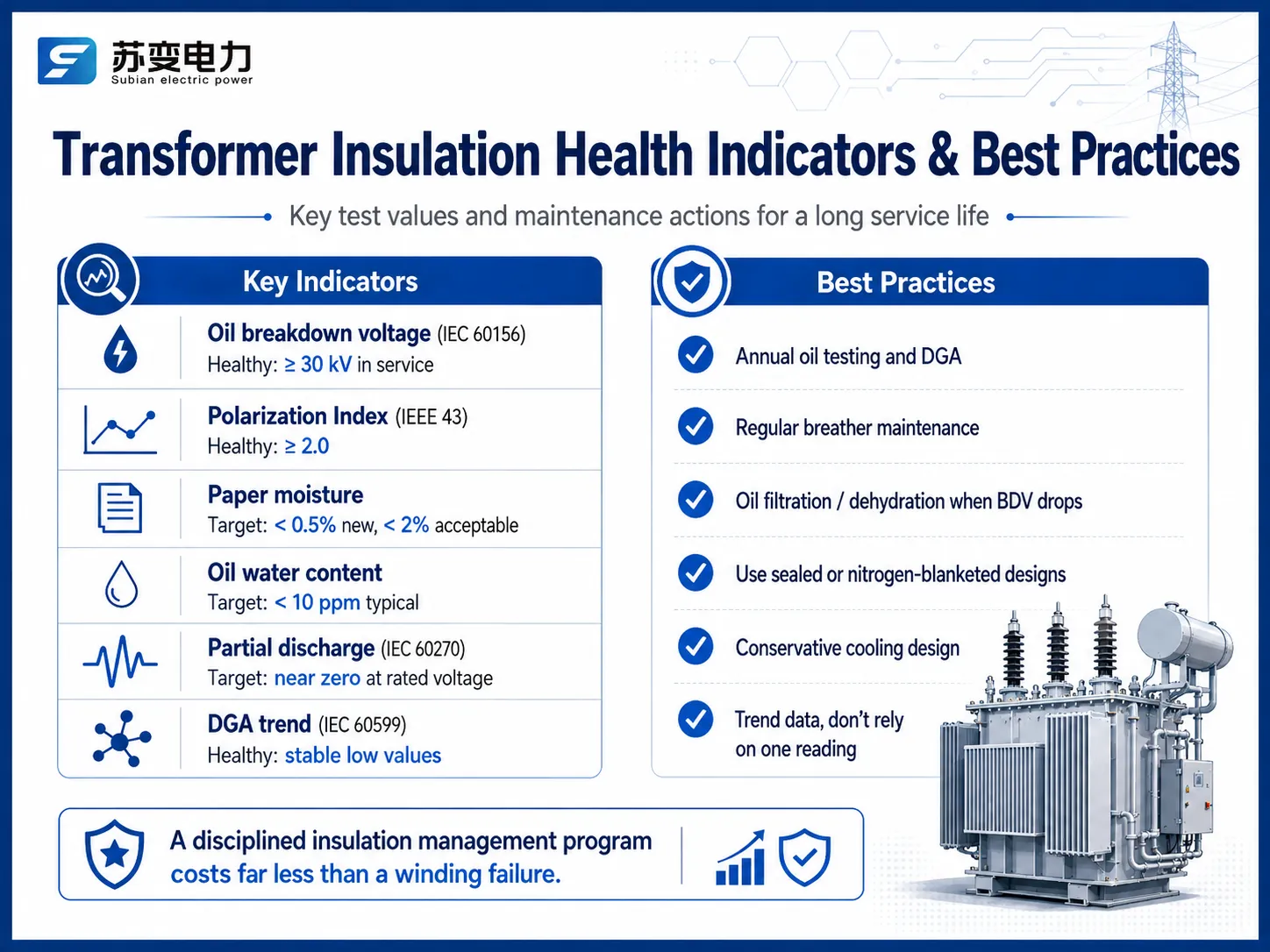
Indicadores Clave de Condición y Rangos Saludables
| Indicador | Prueba / Norma | Rango Saludable | Umbral de Advertencia |
|---|---|---|---|
| Voltaje de ruptura del aceite | IEC 60156 | ≥ 40 kV (nuevo), ≥ 30 kV en servicio | < 30 kV — filtrar o recuperar |
| Índice de polarización | IEEE 43 | ≥ 2.0 | < 1.5 — se sospecha humedad |
| Humedad del papel | Karl Fischer (IEC 60814) | < 0.5% (nuevo), < 2% aceptable | > 2% — envejecimiento acelerado |
| Contenido de agua en el aceite | Karl Fischer | < 10 ppm (típico) | > 25 ppm — secar |
| Descarga parcial | IEC 60270 | Casi cero a voltaje nominal | > 100 pC sostenido — investigar |
| Número de ácido (aceite) | IEC 62021 | < 0.1 mg KOH/g | > 0.2 — reclamación debida |
| Tendencia DGA (hidrógeno) | IEC 60599 | Valores bajos estables | Aumento brusco entre muestras |
Considere estos como herramientas que puede consultar en cualquier momento, pero úselas solo como guía. Saber si su aislamiento está funcionando a un PI de 1.8 es solo el punto de partida en las conversaciones sobre aislamiento. Si el rendimiento del aislamiento cae de un PI de 2.6 a 1.8 en dos años, se deben tomar medidas. Si bien se puede reconocer la ocurrencia de un problema utilizando medidas absolutas, se necesitan tendencias para comprender la degradación continua.
Estrategias de diseño y selección para una larga vida del aislamiento
El rendimiento del aislamiento se determina cuando se están estableciendo las especificaciones. Hay cinco técnicas de diseño que ofrecen beneficios durante años. En primer lugar, el nivel de aislamiento debe definirse correctamente. Una máquina con un BIL suficiente compatible con las condiciones locales de rayos estará a salvo de PD inducido por sobretensiones. En segundo lugar, se deben elegir diseños sellados y con nitrógeno para piezas críticas de equipo, ya que la ausencia de oxígeno disminuye significativamente la oxidación del aceite y prolonga tanto la vida del aceite como del papel. En tercer lugar, se debe utilizar aceite de éster en situaciones donde el control de humedad sea difícil o si la seguridad contra incendios es importante. Los ésteres naturales son mucho más resistentes a la presencia de agua que el aceite mineral cuando se cuestiona la resistencia dieléctrica de un líquido. Por último, es necesario calcular cuidadosamente el sistema de refrigeración para la temperatura ambiente real, ya que cada grado de disminución añadirá años a la vida útil del aislamiento. Además, es más económico agregar un radiador adicional que lidiar con las consecuencias de fallas prematuras. Finalmente, se debe exigir fabricación al vacío y desgasificación, porque 0.5% de humedad en papel y 10 ppm en aceite asegurarán el mejor punto de partida para la unidad.
Se recomienda verificar la realización de estas ideas si hay un informe de prueba de fábrica disponible y registrarlas en la especificación. El fabricante, que registra los valores finales de humedad y descarga parcial, en particular Jiangsu Subian Electric Power (cumpliendo con IEC 60076) es responsable de la implementación de estas ideas.
| Elección de diseño / selección | Beneficio del aislamiento | Prima de costo | Motor de retorno de inversión |
|---|---|---|---|
| BIL adecuado (IEC 60076-3) | Sin daño por PD inducido por sobretensiones | Pequeño, dependiente del diseño | Fallas por rayos evitadas |
| Tanque sellado / con nitrógeno | Oxidación del aceite más lenta, menor acumulación de ácido | +2–5% | Mayor vida del aceite y del papel |
| Aceite de éster | Mayor tolerancia a la humedad, mayor punto de inflamación | +10–25% | Sitios húmedos, ubicación en interiores |
| Dimensionamiento conservador de refrigeración | Menor punto caliente, envejecimiento más lento del papel | +3–8% | Reducción del envejecimiento, margen de sobrecarga |
| Secado al vacío verificado (humedad < 0.5%) | Mejor inicio de aislamiento posible | Incluido en el precio | Menos fallas tempranas |
Mantenimiento del aceite y control de humedad: las mayores palancas
| Práctica | Lo que hace | Costo típico | Frecuencia |
|---|---|---|---|
| Muestreo de aceite y prueba de laboratorio (BDV, agua, ácido, DGA) | Detecta la degradación temprano | $80–$250 por muestra | Anual (más para unidades críticas) |
| Filtración / deshidratación de aceite | Elimina agua y partículas; restaura BDV | $1,000–$5,000 por unidad por tratamiento | Según lo indicado por las pruebas |
| Recuperación de aceite (arcilla completa/percolación) | Elimina ácidos y lodo; restaura color y propiedades | $3,000–$15,000 por unidad | Cada 10–15 años o según lo indicado |
| Mantenimiento del respiradero de gel de sílice | Previene la entrada de humedad | $100–$500 por servicio | Cada 6 meses |
| Monitor de humedad / DGA en línea | Advertencia temprana continua | $15,000–$45,000 por unidad | Continua |
| Cambio de aceite | Reemplazo completo | $5,000–$20,000 por unidad | Fin de la vida útil del aceite (típicamente más de 25 años) |
El aspecto financiero apoya la prevención en lugar de la cura en cada escenario. Una muestra de aceite $200 que detecta un aumento en el número de ácido puede ayudar a evitar la reclamación de $5,000, lo que puede prevenir la degradación del papel y causar una falla en el devanado de $300,000. Las medidas preventivas para mantener los respiraderos y realizar una prueba anual de aceite son medidas de bajo costo, poco interesantes, pero extremadamente ventajosas empleadas por enormes cantidades de flotas.
Pruebas y Monitoreo: Demostrando la Mejora
El éxito del avance debe ser evaluado con precisión. Cualquier programa de gestión de aislamiento debe pasar por cuatro familias de pruebas de acuerdo con su nivel de riesgo. Las pruebas de aceite ayudan a identificar problemas químicos y relacionados con la humedad (descomposición IEC 60156, contenido de agua Karl Fischer, número de ácido según IEC 62021 y DGA según IEC 60599). Las pruebas eléctricas confirman la condición del aislamiento sólido (resistencia de aislamiento y PI de acuerdo con IEEE 43, resistencia de devanado y relación de vueltas). El monitoreo de descarga parcial (IEC 60270) es el método más sensible para identificar problemas locales de aislamiento y debe realizarse siempre que se haya producido algún estrés en el aislamiento y cada vez que se ponga en operación un nuevo equipo. El monitoreo continuo realizado en unidades críticas proporciona información sobre DGA, humedad y temperatura, lo que permite visualizar tendencias.
Los resultados de tal programa son estadísticamente significativos: los activos con un mantenimiento estricto del aislamiento demostraron un PI constante durante décadas, muchas menos interrupciones forzadas y una vida útil significativamente prolongada en comparación con equipos no mantenidos. Todos los datos deben ser recopilados y revisados constantemente.
Proveedores y Rangos de Precios
| Proveedor / Tipo de Producto | Enfoque | Rango de precios típico | Notas |
|---|---|---|---|
| Transformadores Hitachi Energy / Siemens Energy | Sistemas de aislamiento premium, unidades grandes | $35,000–$75,000 (clase de 2,000 kVA) | Opciones de aislamiento de especificaciones más altas |
| Transformadores de distribución Schneider Electric | Diseños estándar y de aceite de éster | $25,000–$55,000 | Opciones de aceite de éster comunes |
| Materiales de aislamiento NOMEX / DuPont | Sistemas de aislamiento de aramida | Recargo de material de 20–40% en tipo seco | Capacidad de clase de 220 °C |
| Equipos de prueba Megger / Doble / OMICRON | Instrumentos de prueba de aislamiento | $1,500–$15,000 por instrumento | Conjuntos IR/PI, TTR, PD |
| Jiangsu Subian Electric Power | Transformadores IEC 60076 con QC de aislamiento verificado | $15,000–$38,000 (clase de 2,000 kVA) | Datos documentados de secado y PD |
Los precios de los productos están sujetos a condiciones y ubicación. Si bien los proveedores globales tienen experiencia y pueden ofrecer una variedad de productos de aislamiento, también vienen con un precio. Por el contrario, Jiangsu Subian Electric Power, una empresa china, puede suministrar soluciones de aislamiento completas transportadas de acuerdo con las normas IEC 60076 y que han pasado todas las pruebas de contenido de humedad y descarga parcial con una tasa de descuento del 20-40%. Cualquiera que sea la empresa que elijas como proveedor, asegúrate de solicitar la etapa del proceso de secado y los hallazgos de descarga parcial.
Preguntas Frecuentes
¿Cuál es el factor más importante en la vida útil del aislamiento de transformadores?
La temperatura es clave porque, según los cálculos de envejecimiento de la industria, la vida útil del aislamiento se reduce a la mitad por cada aumento de 6-10 °C por encima de la temperatura máxima nominal de 98 °C. Después de eso, la humedad es el segundo factor más importante: con un 2 por ciento de humedad en el papel, el envejecimiento se duplica casi. Es importante tener en cuenta que, en la práctica, mantener la temperatura en el punto más caliente cerca de la nominal y mantener la humedad por debajo del 1-2 por ciento te brinda la mayor parte de la vida útil del aislamiento. Además, gestionar factores como el oxígeno (por ejemplo, sellando el tanque) y el estrés eléctrico (por ejemplo, controlando la PD) es suficiente para obtener el efecto completo.
¿Con qué frecuencia debo probar el aceite del transformador para la calidad del aislamiento?
Las pruebas anuales de aceite son la base para unidades saludables: voltaje de ruptura según IEC 60156, contenido de agua por Karl Fischer, número de ácido y DGA. Aumenta a cada 6 meses para unidades de más de 20 años, unidades que han tenido sobrecargas o incidentes de humedad, o unidades con alguna tendencia que no sea plana. Cada muestra cuesta $80–$250 en tarifas de laboratorio, mucho más barato que las fallas que previene. La monitorización en línea, a $15,000–$45,000 por unidad, está justificada solo para activos críticos.
¿Qué significa un índice de polarización bajo?
El índice de polarización (PI) es la relación de la resistencia de aislamiento a los 10 minutos respecto a la de 1 minuto, según IEEE 43. Un PI por debajo de 1.5 generalmente indica aislamiento húmedo o contaminado; 1.5–2.0 es marginal; por encima de 2.0 es saludable para la mayoría de las unidades sumergidas en aceite. Una tendencia de PI en caída — digamos de 2.6 a 1.8 en dos años — es una advertencia más fuerte que una sola lectura baja. Un PI bajo generalmente significa que la unidad necesita secado (circulación de aceite caliente o secado al vacío) antes de que la humedad del papel cause más daños.
¿El aceite de éster realmente mejora el rendimiento del aislamiento?
Sí, de maneras específicas. Los aceites de éster natural toleran un contenido de agua significativamente más alto antes de que la resistencia dieléctrica disminuya — aproximadamente 100–200 ppm en comparación con 20–30 ppm para el aceite mineral — por lo que son más indulgentes con la entrada de humedad. También tienen puntos de inflamación más altos (por encima de 300 °C frente a ~140 °C para el aceite mineral), mejorando la seguridad contra incendios. Cuestan 10–25% más que el aceite mineral, pero para entornos húmedos, sitios interiores o ubicaciones ambientalmente sensibles, la combinación de tolerancia a la humedad y seguridad contra incendios a menudo justifica la prima.
¿Cuál es el costo de un programa de gestión de aislamiento?
Para una unidad gestionada con muestreo y pruebas anuales, presupuestar $1,500–$6,000 por unidad por año dependiendo del alcance de la prueba y las tarifas del laboratorio. Agregar monitoreo en línea en unidades críticas cuesta $15,000–$45,000 por unidad por adelantado más $500–$2,000 por unidad por año para tarifas de plataforma. Compare esto con una falla de bobinado que cuesta $50,000–$500,000 en reparación o reemplazo más pérdidas por interrupciones: la relación de recuperación de un programa de gestión de aislamiento es típicamente de 50:1 o mejor.
Referencias
- IEC 60076-1: Transformadores de potencia – Parte 1: General — el estándar principal para la clasificación y prueba de transformadores, incluyendo referencias de coordinación de aislamiento.
- IEC 60076-3: Transformadores de potencia – Parte 3: Niveles de aislamiento y pruebas dieléctricas — define los niveles de aislamiento (BIL/SIL) y los requisitos de prueba dieléctrica.
- IEC 60156: Líquidos aislantes – Determinación de la tensión de ruptura — el estándar para la prueba de tensión de ruptura del aceite.
- IEEE 43: Práctica recomendada para la prueba de resistencia de aislamiento — la referencia para los criterios de aceptación de IR y PI.
- IEC 60270: Técnicas de prueba de alta tensión – Mediciones de descarga parcial — el estándar de medición para pruebas de PD.
- IEC 60599: Interpretación de resultados de DGA — el marco estándar para la interpretación de fallos basados en gas.
- Jiangsu Subian Electric Power — fabricante de transformadores conforme a IEC 60076 con datos de prueba de fábrica de secado al vacío y descarga parcial verificados.
Conclusión
Mejorar el rendimiento del aislamiento del transformador es una estrategia, no una tarea de mantenimiento. Comienza en la especificación — niveles de aislamiento, tanques sellados, aceite de éster, refrigeración conservadora — y continúa a través de un programa disciplinado de mantenimiento del aceite, control de humedad, gestión térmica y pruebas basadas en tendencias. Los cuatro asesinos — temperatura, humedad, oxígeno y estrés eléctrico — son todos medibles, y los cuatro responden a intervenciones específicas y con costo.
- La temperatura y la humedad del punto más caliente dominan el envejecimiento del aislamiento; gestiona ambos sin descanso.
- Mantén el BDV por encima de 30 kV, el PI por encima de 2.0, la humedad del papel por debajo de 2%, y observa las tendencias de DGA.
- Las pruebas anuales de aceite a $80–$250 por muestra son la inversión en aislamiento de mayor valor que puedes hacer.
- Verifica la calidad del aislamiento en la compra — solicita el punto final de secado y los datos de PD en los informes de fábrica.
- Jiangsu Subian Electric Power ofrece transformadores conformes a IEC con calidad de aislamiento verificada a precios competitivos — una base sólida para un activo de larga duración.