


Seventy-five kVA is the most prevalent three-phase rating used in light commercial applications, which means that owners often make costly mistakes related to it. It is somewhere in between the capacity of a panelboard and a project engineer’s requirements so those who buy one typically do it only once in their lives.
On this page, you will learn the ways in which this capacity is utilized, amperages of different common voltages, combinations of voltages actually ordered, weight and dimensions, wire and breaker specifications, price and installation specifics ensuring that the equipment operates normally for thirty years.
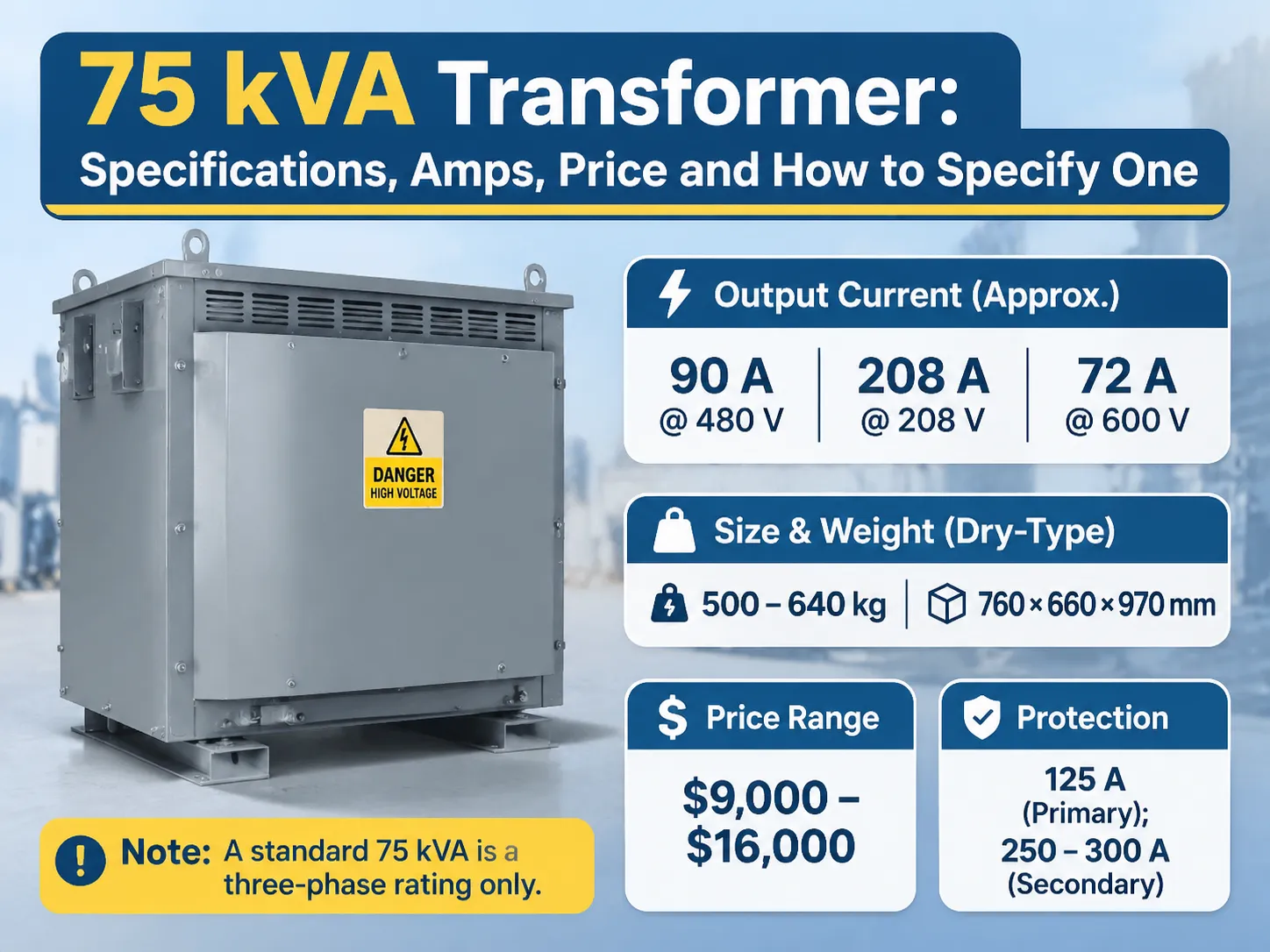
In other words, the 75 kVA three-phase transformer can produce around 90 amps when operated at 480 volts, 208 amps when operated at 208 volts, and 72 amps during operation at 600 volts. The estimated weight range of an air-cooled dry-type 480 to 208Y/120 transformer is between 500–640 kilograms with total dimensions of 760 x 660 x 970 millimetres. Pay in the range of $9,000–$16,000 for the unit and ensure that you protect its primary side, which should be rated at 125 amps along with the rated secondary protection in the range of 250–300 amps.
What a 75 kVA Transformer Is Used For
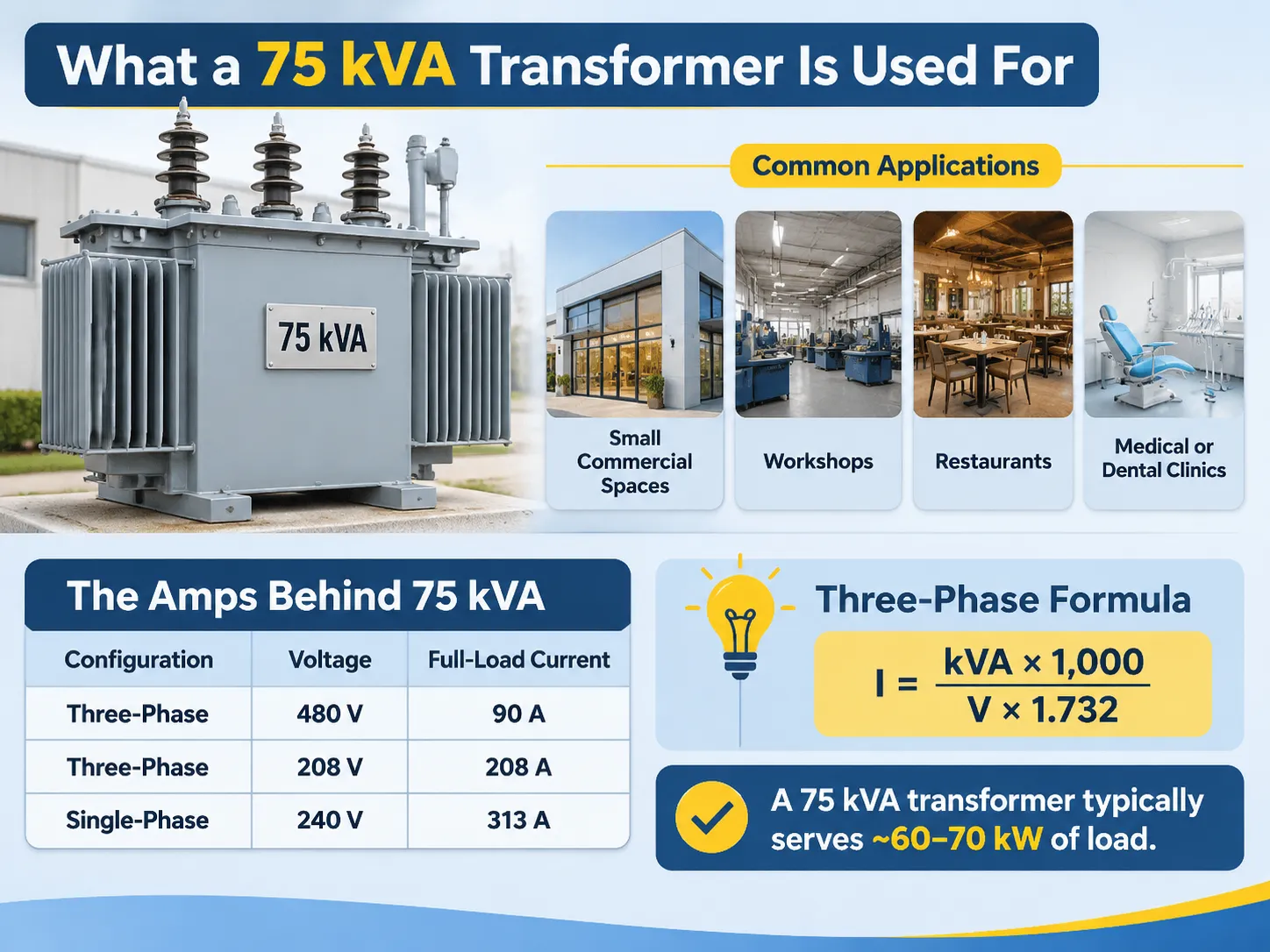
Typically, a 75 kVA transformer modules is associated with small commercial users (shops, workshops for a few machines, restaurants with cooking by electric means, small clinics, small hotels).
In terms of economics, it should be noted that at that very load level (approximately 60–70 kW), single-phase power supply gives way to three-phase distribution, which is a threshold for requiring the transformer ownership by the customer instead of being supplied by utility companies; thus, a lot of 75 kVA transformers have been acquired by comapnies in this way rather than being specified.
The examples of two other applications will also be given here. The first application of a 75 kVA transformer can be found in data systems and laboratories, where the need is mainly for isolation rather than voltage transformation. The second application is forming part of small distributed generation systems. The latter involves having a 75 kVA transformer serve as a step-up transformer for converting the voltage from a smaller inverter (208 or 240 V) up to a larger voltage required for distribution (480 V).
If the arithmetic behind the rating is unfamiliar, the relationship between kVA, voltage and current is the one thing worth understanding before ordering, and this explanation of what kVA means on a transformer nameplate covers it without the algebra.
The Amps Behind 75 kVA, at Every Common Voltage
Three-phase current is kVA multiplied by 1,000, divided by line voltage multiplied by 1.732. The table applies that to the voltages a buyer is likely to meet.
| Configuration | Tension | Courant à pleine charge |
|---|---|---|
| Triphasé | 600 V | 72 A |
| Triphasé | 480 V | 90 A |
| Triphasé | 415 V | 104 A |
| Triphasé | 400 V | 108 A |
| Triphasé | 380 V | 114 A |
| Triphasé | 240 V | 180 A |
| Triphasé | 220 V | 197 A |
| Triphasé | 208 V | 208 A |
| Monophasé | 480 V | 156 A |
| Monophasé | 240 V | 313 A |
There are two surprises for any reader looking at the above table for the very first time. The first surprise is the change in current with the change in voltage and hence the same transformer is a 90 A one when running on a 480 V system but a 208 A one on a 208 V system. The second surprise is that the single-phase rows do not constitute half of the three-phase rows as the single-phase current is calculated as kVA/voltage without the 1.732 factor.
The working method for any rating is the same, and this walk-through of how to convert kVA to amps at any voltage takes it step by step, including the single-phase case that catches people out.
The Voltage Combinations People Actually Buy
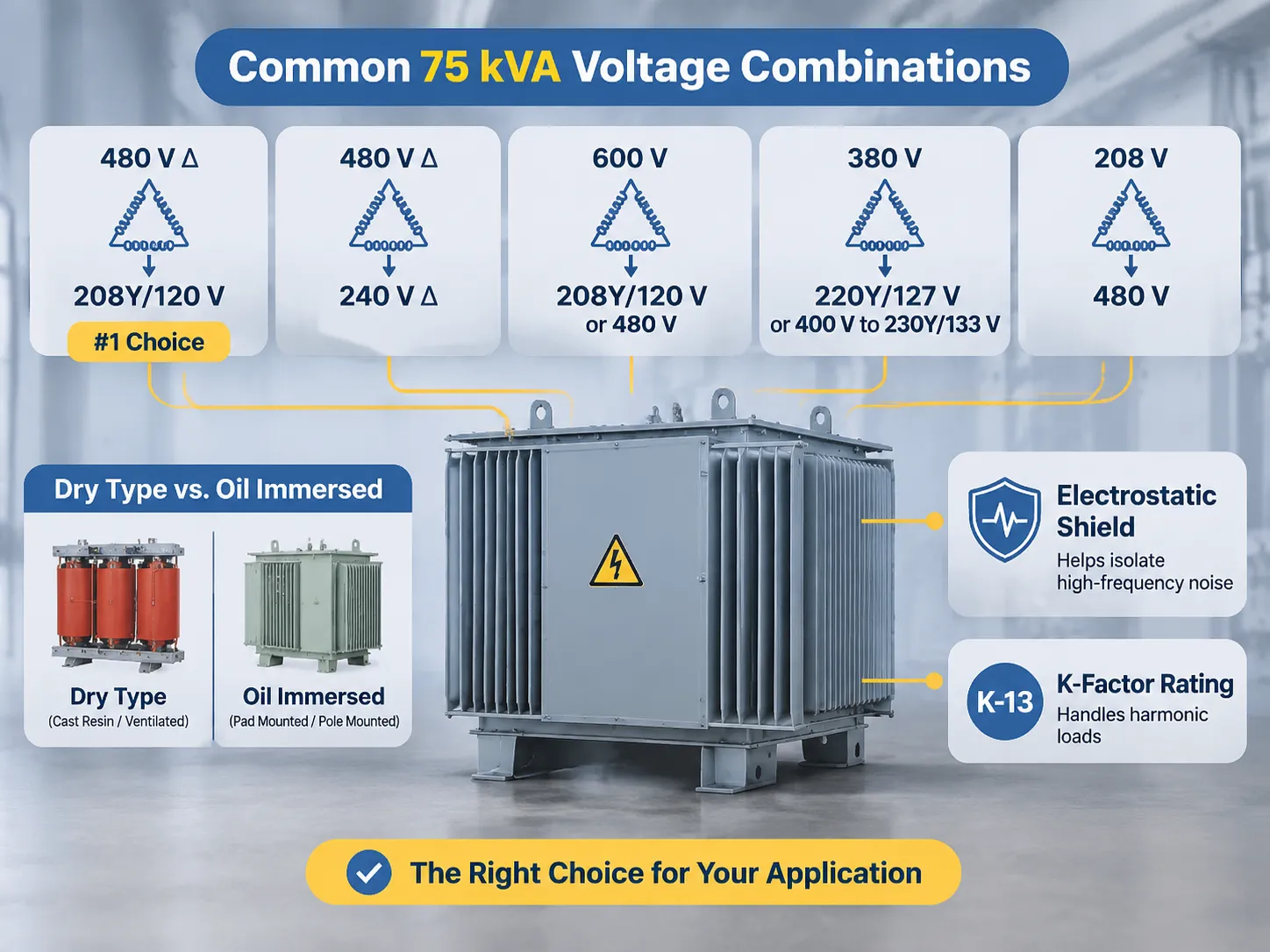
Most 75 kVA transformers sold are usually of five types and one has a high share.
- 480 V delta primary to 208Y/120 V secondary. This is the typical North American commercial step-down transformer. It supplies 208 V three-phase power and 120 V single-phase power, which explains the success.
- 480 V delta to 240 V delta, or 240 V delta to 208Y/120 interconnection. This applies to older buildings and specialized equipment. The 240 V delta connection is often required where existing motor loads are at 240 V.
- 600 V to 208Y/120 or even 600 V to 480 V. This is the usual practice in Canada and is being progressively used in mining and industrial applications using 600 V distribution systems.
- 380 V to 220Y/127 or 400 V to 230Y/133. This is the equivalent of the European or export systems usually meant for IEC.
- 208 V to 480 V step-up. This is a small niche market but the one that features the most technical questions due to the fact that a transformer operating in reverse is not considered suitable for the purpose.
Now let’s consider this last point: a step-down transformer can often be found with a reverse-fed step-up mode, but the capacity used for this reverse function is not equal to the nameplate value. The secondary winding becomes primary and the excite current is taken at the other voltage level leading to the derating that has to do with the design of the transformer. The supplier saying that “yes, it works either way” without clarifying the capacity of the transformer has not actually answered the question.
Dry Type, Oil Immersed and the Other Choices
Four construction choices decide most of the price and all of the installation.
| Taper | Where it goes | Compromis |
|---|---|---|
| Dry type, cast resin | Indoors, plant rooms, near occupied space | No oil, higher unit cost, needs ventilation |
| Dry type, ventilated | Indoors with good air movement | Cheaper than cast resin, dust-sensitive |
| Oil immersed, pad mounted | Outdoors, on a concrete pad | Lowest cost per kVA, needs containment and clearance |
| Oil immersed, pole mounted | Overhead rural distribution | Cheapest of all, small ratings only, utility practice |
For a 75 kVA machine inside a structure, the cast resin dry type is the preferred option as it completely eliminates the need for oil containment and meets the requirements of fire codes for occupied buildings. The cost disadvantages of oil are considerable. At this capacity, the costs are typically 20-40% higher with oil and are generally regarded as acceptable since a vault and a retention basin are more expensive than the price difference.
If the equipment is located outside and there is sufficient space, an oil-immersed unit is a more cost-effective choice and will have better thermal longevity. The problem is that of the environment. Oil needs to be contained, the machine needs to have space from combustible materials, and the old oil may contain PCBs, making the disposal a matter of environmental concern.
There are two features of importance when deciding on what type to choose. First, there is the electrostatic shielding placed between the primary and secondary circuits making the device an isolation in practice eliminating high-frequency noise where sensitive electronics load is concerned. Second, a special rating known as K-factor gives the assurance that the machine can cope with heating due to harmonics which is important in buildings where the use of LED drivers and adjustable speed drives is widespread.
Dimensions and Weight, and Why They Decide the Installation
Physical dimensions are the last requirement that is verified but creates the maximum number of problems at the installation site.
A typical 75 kVA cast-resin dry-type transformer has a dimension of about 760 mm (width), 660 mm (depth), and 970 mm (height), and weights from 500 kg to 640 kg depending on the manufacturer. A ventilated transformer has less weight because it represents a different technology. For the oil-immersed padmount, the figure is higher: 600 kg to 800 kg including the weight of the oil since its outer casing demands a totally different design allowing access to the terminals of the wires and providing the tank, which holds up the cooling liquid inside.
Consequently, a couple of things are imposed on the installation process. The floor should endure a load of at least half a ton together with the seismic load, and this is a structural problem and not a fitting issue. The path is to be organized in such a manner as to deliver the unit, which involves verification of door sizes, lift operation, and turns of the corridors long before the delivery and not on the installation day. Thirdly, the size of ventilation openings is calculated based on technical losses because dry-type transformers are not going to work properly when placed inside sealed cabinets.
The physical size matters significantly when it comes to later replacement of the unit with a different model. The magnitude of physical dimensions of the transformers of a given rating varies by 10% to 15% among producers, which means that when a transformer is chosen based on his/her footprint, the designer may fail when it comes to the replacement of the transformer with other brand of a similar rating. Dimensions and clearance data for the neighbouring size in the range are a useful reference for how much that matters, and this look at dimensions du transformateur de 112,5 kVA shows the same pattern one step up.
Breaker and Wire Sizing for a 75 kVA Unit
Both the arithmetic definition and the arithmetic itself are under surveillance by an inspector.
- Primary protection. The transformer protection device can be set for up to 125% of the primary transformer current when the transformer primary current is above 9 A. For example, with 480 V primary at 90 A, that gives us 112.5 A, the closest standard device size being 125 A.
- Secondary protection. The same rule about 125% applies to the secondary. From a 208 V secondary at 208 A we obtain 260A, leading us to the 250 A standard.
- Primary conductors. Initially sized for primary current and then properly adjusted according to requirements, which is for example, a 3 AWG copper conductor rated for 100 A at 75 °C at 90 A.
- Secondary conductors. Follows the same logic but gives a 4/0 AWG copper conductor rated for 230 A at 75 °C.
A detail that is usually missed is that transformer protection and feeder protection are two different devices subject to different rules so again, if the transformer is part of an assembly, where fed from a distribution panel and not a separate feeder, that must be checked against the inrush of the transformer.
What a 75 kVA Transformer Costs
There are three price points that are driven by quotes, with the market spread on the higher end.
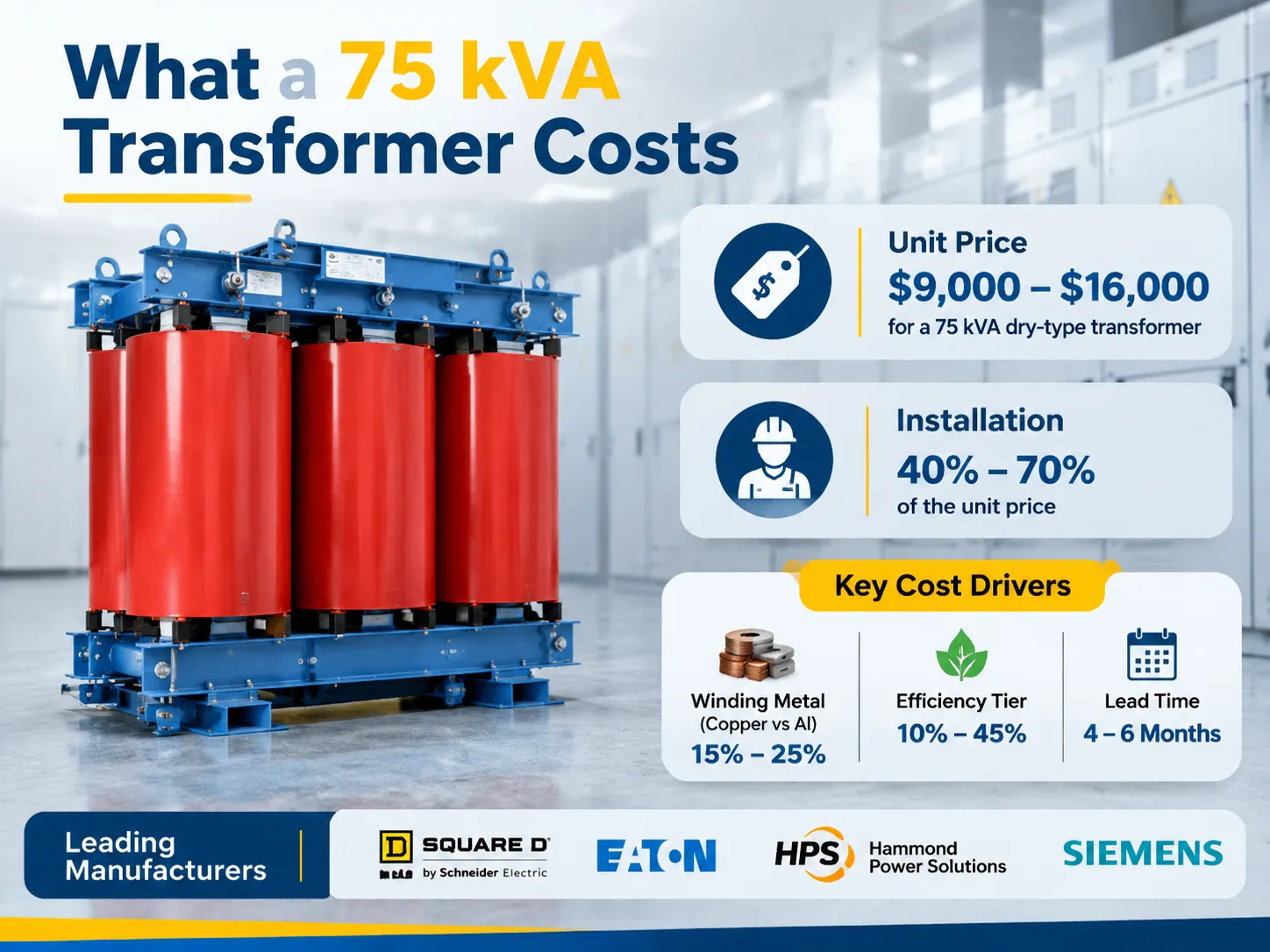
- Unit. For a typical three-phase 75 kVA dry-type transformer, the price ranges between $9,000 and $16,000, depending on different factors like construction, type of metal for winding, efficiency tier, and whether the voltage is standard.
- Installation. In a simple indoor installation, installation costs can be about 40% to 70% of unit’s cost, while for a new plant with additional service installations, installation costs can exceed the price of a unit.
- Accessories. Purchasing a shield, K-factor rating, temperature monitor, wall-mounted enclosure and seismic restraint etc., can add to the costs, though these accessories are more easily priced at the order rather than retrofitted.
Comparison of costs of 75 kVA transformer is not just about comparing two quotes but about comparing two similar quotes, where the price is influenced by copper versus aluminum wiring (15% to 25%), efficiency tier (10% to 45%), and lead time which are four to six months for regular units.The mechanics of that pricing at the neighbouring rating are set out in this breakdown of what drives a 100 kVA transformer price, and the drivers are identical.
Manufacturers and What Their Ranges Cover
There are four main names in the project-driven industry, and all of these names have different reasons for usage.
- Square D (Schneider Electric). The standard in North American industrial projects as a result of deep product range, easy of access on the local markets, and the documentation in line with what the engineer needs.
- Eaton. A wide variety of products available, performing well in industrial and utility-related projects, and often preferred in cases where a customer prefers to have one supplier for switchgear and transformers.
- Hammond Power Solutions. The specialist. The product range comprises dry-type products in many voltage variations resistant, hence, it is frequently used in unusual projects.
- Siemens. Present in European markets and well-known in those projects already using Siemens systems.
The strong advantage of our company is that we are a manufacturer rather than a brand portfolio. We are able to produce dry-type and oil-filled transformers according to any specification including dry-type 75 kVA three-phase product in resin and in oil, and we can produce the most uncommon voltage ratings unavailable in catalogs. What we cannot offer is a nationwide availability, which means that a customer who is in urgent need should contact a dealer.
Installation and Maintenance Points That Get Missed
The five elements responsible for transformer malfunctions have been summarized below.
- Ventilation. A dry transformer uses between 1.5 to 3 percent of its rated power as a source of heat. Therefore, for a 75 kVA device, the heat loss amounts to between 1 and 2 kW of heat. One has to calculate the size of vents according to the amount of heat lost. The inlet vent should be at the bottom while the outlet one at the top. It needs to be ensured that the room is capable of throwing the heat out as well. A device operating at a temperature of 20 K above the base one shortens its working life to twice as long a period.
- Space for the device installation. One should consider sufficient space in front of the device to make it possible for inspection. It should also be possible to remove the cover of the transformer or the cable box.
- Torque and connection of terminals. The vast majority of small transformer breakdowns occurs because of loose terminals of the second circuit. Connections heat, oxidize and stop functioning. Thus, the torque should be adjusted according to the nameplate value with a calibrated wrench.
- Loading. A device operating at 80 percent of its capacity during the whole period of operation is guaranteed to last much longer than the one which operates with 105 percent of the rating. If the load is not known, it is necessary to calculate it taking 20 percent more than expected.
- Inspection intervals. A dry-type transformer needs to be visually inspected once a year. The inspection will take place both visually and by means of infrared scanning. If the unit type is oil, an oil test should be added to the inspection process. The weight and handling data that makes a replacement feasible also belongs in the maintenance file, and this reference on transformer weight and handling shows how quickly that becomes a rigging question as the rating rises.
FAQ
How many amps does a 75 kVA transformer put out?
The electric current for 208 A on a 208 V three-phase secondary power source is equal to 180 A at 240 V, 90 A at 480 V, and 72 A at 600 V. For its single-phase type, it has an electric current of 313 A at 240 V. For its three-phase type, its respective electric current can be calculated using the formula kVA multiplied by 1,000 and divided by voltage as well as 1.732.
What size breaker do I need for a 75 kVA transformer?
125 A on the primary side at a voltage of 480 V is to be paired with 250 A of the secondary side at 208 V. The transformer falls under the 125% rule when the current of the primary exceeds 9 A. Always verify against which code edition your jurisdiction subscribes because exceptions to the next size up rule are present.
How much does a 75 kVA transformer weigh?
The weight of a cast-resin dry type transformer is approximately between 500 to 640 kilograms, while that of an oil-immersed padmount of equal rating is about 600 to 800 kilograms including oil. Besides the total weight, the pallet weight and center of gravity are equally important in rigging.
Can I use a 75 kVA transformer as a step-up?
Generally speaking yes, by supplying the secondary. The capacity in that direction is about whether it is below the nameplate number, and to what extent is subject to design and must be confirmed by the manufacturer rather than assuming from the rating of the device.
Is a 75 kVA transformer available in single phase?
Indeed, this product is not the same as the previous one since the current is different, but still, they have a relation. The capacity of the product is 75 kW, while the voltage is 240 V and current is 313 A, which is a huge single-phase load, but it is not as common in commercial usage as the three-phase version.
Why is a 75 kVA dry type more expensive than an oil unit?
This is due to you purchasing for the lack of oil, which indeed pushes up material prices but on the other hand, avoids the installation of a vault for it, containment and fire separation, so the total installation cost is usually lower than indoors.
How much does a 75 kVA transformer cost in the Philippines or Southeast Asia?
The factory price is not different from the above figures and will have an increased delivery price due to freight, duty, and local expenses, often raising total costs by up to 40%. Always inquire for the landed price at site and not the FOB price as that is where budgets invariably exceed.
Références
- Hammond Power Solutions — Catalogue de transformateurs à sec
- Eaton — Distribution Transformer Product Data
- Siemens — Transformers and Distribution Equipment
- SGB-SMIT Group — Évaluations des transformateurs et données techniques
- U.S. Energy Information Administration — Aujourd'hui dans l'énergie
Conclusion
75 kVA is merely a number, not a specification. Four things matter: the voltage combination, the construction type, the impedance and shielding, and the envelope to get through a door. Get those right, and the price will follow.
Before ordering, the two thing you’ll need to check are the secondary current at your voltage (it affects everything that follows) and the weight (you’ll need to know how it gets to the plant room). Both are easy to verify, but expensive to find out.