


WEG is a recognizable name in the field of electrical equipment, and its transformer business has developed rapidly in North America over the past decade. When searching for the transformers of the WEG brand, engineers and buyers are usually interested in a few specific things: the product range of the company, the product origin, the ratings of each product type produced, and how the products compare with the products of the competitors. The information needs to be gathered from the available sources and provided alongside the necessary technical background needed for writing appropriate rules for creating specifications.
Before we proceed, it should be noted that the article is an independent technical review written by Subian Electric, a transformer manufacturer based in China. We are not affiliated with WEG and are not WEG distributors, agents, or authorized representatives. WEG and its product names are registered trademarks of their owner. To find official data about the products, including their prices and delay in delivery, it is necessary to contact WEG directly.
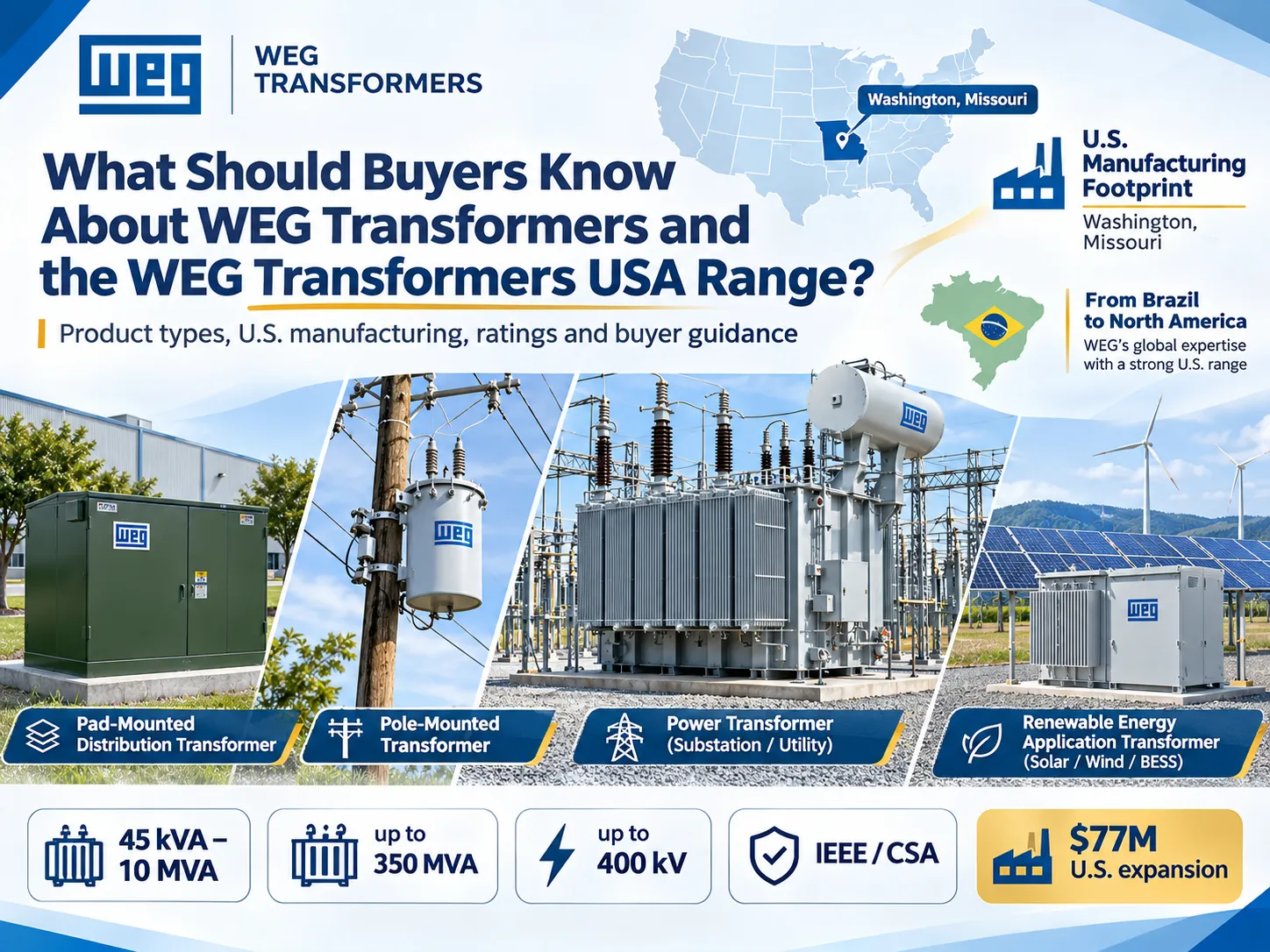
To sum it up in a word, the transformers of the WEG brand are manufactured by WEG, the Brazilian electrical equipment company. In North America, the WEG organization is known as WEG Transformers USA and has three plants located in Washington, Missouri, where it produces distribution, power, and specialty transformers. The number of employees equals roughly 560 people. The publication indicates that the company develops products from 45 kVA pole-mounted and pad-mounted transformers to 350 MVA, 400 kV transformers that are manufactured according to IEEE and CSA standards for networks of 60 Hz frequency. In 2025, WEG planned to invest $77 million in the expansion in Missouri aimed at the output of transformers with power from one to ten MVA and a voltage value of up to 46.5 kV.
What Are WEG Transformers?
From Brazilian Motors to a Global Transformer Business
WEG started operating in Brazil, and the electric motors the company makes have become well-known around the world. Currently, this entity is engaged in its activities in the fields of motors, transmission and distribution, energy, automation and coating, with production facilities located in 12 countries and sales in more than 100 countries. Transformers are becoming increasingly important to the firm by supplying goods to the utility companies, manufacturers, and others.
The production of transformers takes place in Brazil, where the company is based. In 2024, the organization will invest R$543 million to develop production of transformers in Brazil, mostly for the power transformer factory in Betim. Our Brazil power transformer market analysis covers that expansion and the grid investment behind it.
WEG Transformers USA vs WEG Global Operations
WEG Transformers USA is the division of WEG focused on transformers for North America, which operates out of Washington Missouri. The division’s customers are utility companies, industrial customers and commercial clients located in the US and Canada. The available products in the company’s offer are manufactured by WEG in various sites, which means that the company might sell products built outside the United States. This fact is important to customers who have been told that they must comply with the domestic content requirements.
Where Are WEG Transformers USA Manufactured?
WEG has operated transformer factories in Washington, Missouri, since 2017. A third plant opened around 2021, and the North American network now includes five transformer factories: three in Missouri and two in Mexico.
| Article | Published information |
|---|---|
| U.S. location | Washington, Missouri |
| U.S. plants | Three, focused on distribution, power and specialty transformers |
| U.S. workforce | About 560 employees across the three plants |
| Wider North American network | Five transformer factories, including two in Mexico |
| Third Missouri plant | About 147,000 sq ft, built for distribution transformers and opened around 2021 |
The $77 Million Expansion Announced in 2025
In September 2025, WEG introduced a significant investment opportunity amounting to $77 million into its specialty transformer facility located in Washington, Missouri. The investment is expected to create about 50 jobs. The specialty transformer upgrade aims to include the transformers rated between 1 and 10 MVA with the voltage levels rising up to 46.5 kV, and also to implement various innovations such as automation and robotic process among others. According to WEG, after the upgrade is completed, this updated facility will boost production by up to 50%. Ameren Missouri also reported that the completion of the whole transformer facility is planned for 2028.
The capacity range targeted by WEG indicates that the company understands the future demand for transformers in the U.S. With the introduction of transformers rated between 1 and 10 MVA, WEG targets data centers, energy storage solutions, grid stability engineering, and industrial manufacturing markets – the same segments that have seen the longest transformer lead times over the country in recent years. Importantly, it should be noted that WEG aims to boost its production facilities by up to 50% only, meaning that the increase is not in production capacity achieved as of yet.
What Types of Transformers Does WEG Make?
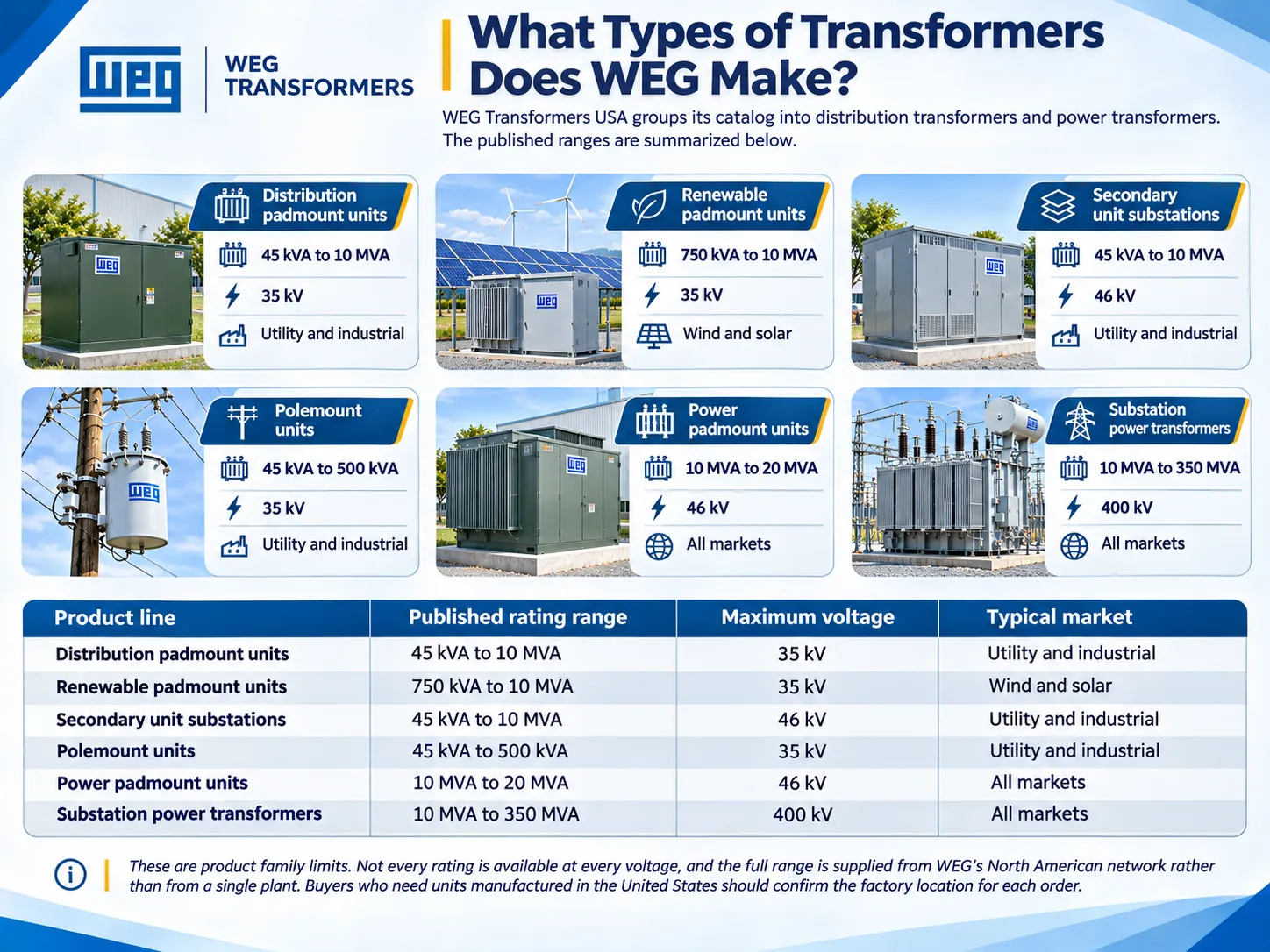
WEG Transformers USA groups its catalog into distribution transformers and power transformers. The published ranges are summarized below.
| Product line | Published rating range | Maximum voltage | Typical market |
|---|---|---|---|
| Distribution padmount units | 45 kVA to 10 MVA | 35 kV | Utilitaire et industriel |
| Renewable padmount units | 750 kVA to 10 MVA | 35 kV | Wind and solar |
| Secondary unit substations | 45 kVA to 10 MVA | 46 kV | Utilitaire et industriel |
| Polemount units | 45 kVA to 500 kVA | 35 kV | Utilitaire et industriel |
| Power padmount units | 10 MVA to 20 MVA | 46 kV | All markets |
| Transformateurs de puissance de sous-station | 10 MVA to 350 MVA | 400 kV | All markets |
These limitations are associated with the product family. Not all ratings are obtainable at any voltage, and instead of being made in one facility, all variations come from WEG’s North American network. Buyers requiring equipment that is produced in the US should verify the manufacturing location before placing an order.
Inside a WEG Padmount Transformer: What Buyers Should Check
Triphasé WEG pad-mounted transformers are the core of the WEG distribution range and the product most buyers compare. WEG’s published options are a useful checklist, because each one is a decision every buyer has to make, whichever supplier they choose.
| Spécification | WEG published option | Pourquoi c'est important |
|---|---|---|
| Puissance | 45 kVA to 10,000 kVA | Sets size, losses and cost; size from the real load, not the panel rating |
| Voltages | HV 2.5 kV to 35 kV; LV 120 V to 25,000 V | Must match the utility feeder and the site’s service voltage, such as 480Y/277 V |
| Fréquence | 50 Hz ou 60 Hz | North American networks require 60 Hz designs |
| Enroulements | Cuivre ou aluminium | Aluminum is common in North American distribution; copper gives a smaller unit |
| Feed | Loop or radial | Loop feed allows the unit to sit on a cable loop and be isolated without an outage downstream |
| Primary terminations | Dead-front wells, inserts and bushings, or live-front porcelain bushings | Dead-front designs keep live parts covered and are the norm for public sites |
| Refroidissement | ONAN, ONAN/ONAF, KNAN, KNAN/KNAF | KN classes indicate less-flammable natural ester fluid; AF adds fans for extra capacity |
| Élévation de température | 55, 55/65, 65 or 75 °C options | A dual rating such as 55/65 °C gives about 12 percent extra capacity at the higher rise |
| Insulating fluid | Mineral oil or FR3 natural ester | Natural ester improves fire safety and can extend insulation life |
| Protection | Bayonet fuses, current-limiting fuses, vacuum interrupters, breakers, arresters | Determines how the unit clears faults and how it coordinates with upstream protection |
| Enceinte | Mild or 304 stainless steel, tamper-resistant cabinet | Stainless steel suits coastal and corrosive sites |
Loop Feed vs Radial Feed
The radial feed configuration presents one connection set and is situated at the terminal end of the cable run, while a loop feed utilizes two connection sets, allowing for the transmission of the MV cables through. Loop feeding is the primary design of the power cable in underground residential and bus networks because isolating a cable fault allows to restore the power of the electricity from the opposite direction. The use of a radial feed is simpler and mostly used for individual industrial or renewable facilities.
Dead-Front vs Live-Front Terminations
Dead-front pad-mounts use separable insulated connectors, providing insulation from energized metal when the cabinet is opened. Live-front units use exposed porcelain bushings and, today, can be found mostly in replacements and some utility standards. In new public sites, dead-front is the usual choice.
WEG Renewable Padmounts for Wind and Solar Projects
A unique renewable padmount line is made available by WEG which ranges from 750 kVA to 10 MVA and has up to 35 kV rating along with a low voltage level ranging from a minimum of 120 V for wind and 200 V for solar up to 25 kV. The wind version might have a low voltage molded case breaker. The solar versions of these renewable transformers come in several configurations compatible with standard inverter connections. Among the design options, there is a possibility of introducing the electrostatic shielding between the windings to increase safety against overexcitation.
This option has a valid reason behind itself. Inverter-based power plants inject harmonics and fast switching transients into the system and solar transformers have to undergo thermal cycling and reverse power flow on a daily basis. So, for the purpose of reducing the effect of high-frequency noise on the windings, a transformer with an electrostatic shield must be used, while lower flux density provides additional safety against over-excitation as well as decrease losses and noise. Subian builds equivalent equipment for international projects, including the YBM-35/0.8 photovoltaic step-up substation et le ZGS-35/0.8 wind power combined substation.
WEG Substation Power Transformers
At the highest end of the spectrum, WEG power transformers have capacities from 10 MVA to 350 MVA and high voltage levels from 24.94 kV to 400 kV. The transformers can be either step-down, generator step-up or autotransformers, featuring de-energized and on-load tap changers, copper windings, optional tertiary windings of 34.5 kV, and different types of cooling systems. These transformers meet the standards set forth by IEEE, CSA, and IEC and are produced according to customer specifications, with a utility or EPC engineering team and a detailed design review process.
WEG Transformer Standards: IEEE and CSA vs IEC
The North American catalog of WEG is essentially molded according to the IEEE and CSA norms related to 60-Hz setups, and the specifications of WEG transformers comply with the practice of North America. Buyers who wish to compare transformers of WEG with those from enemies who build according to IEC standards should know the differences between both.
| Article | North American practice | IEC practice |
|---|---|---|
| Normes principales | IEEE C57.12.00 general requirements, C57.12.90 test code, C57.12.34 for three-phase pad-mounts, CSA C2 and C227 series in Canada | Série IEC 60076 |
| Fréquence | 60 Hz | 50 Hz in most markets |
| Tensions de distribution typiques | 12.47, 13.2, 13.8, 24.94 and 34.5 kV primary; 480Y/277 V and 208Y/120 V secondary | 10, 11, 20, 22 and 33 kV primary; 400/230 V secondary |
| Common three-phase ratings | 75, 112.5, 150, 225, 300, 500, 750, 1,000, 1,500, 2,000, 2,500 kVA | 100, 160, 250, 400, 630, 800, 1,000, 1,250, 1,600, 2,000, 2,500 kVA |
| Élévation de température | Usually 65 °C average winding rise | Usually 65 °C winding, 60 °C top oil |
| Efficiency rules | U.S. DOE minimum efficiency for distribution transformers, with updated rules taking effect in 2029 | Ecodesign in the EU; national rules elsewhere |
| Approval | Utility specifications and approved vendor lists | Rapports d'essai de type et approbation des services publics ou des consultants |
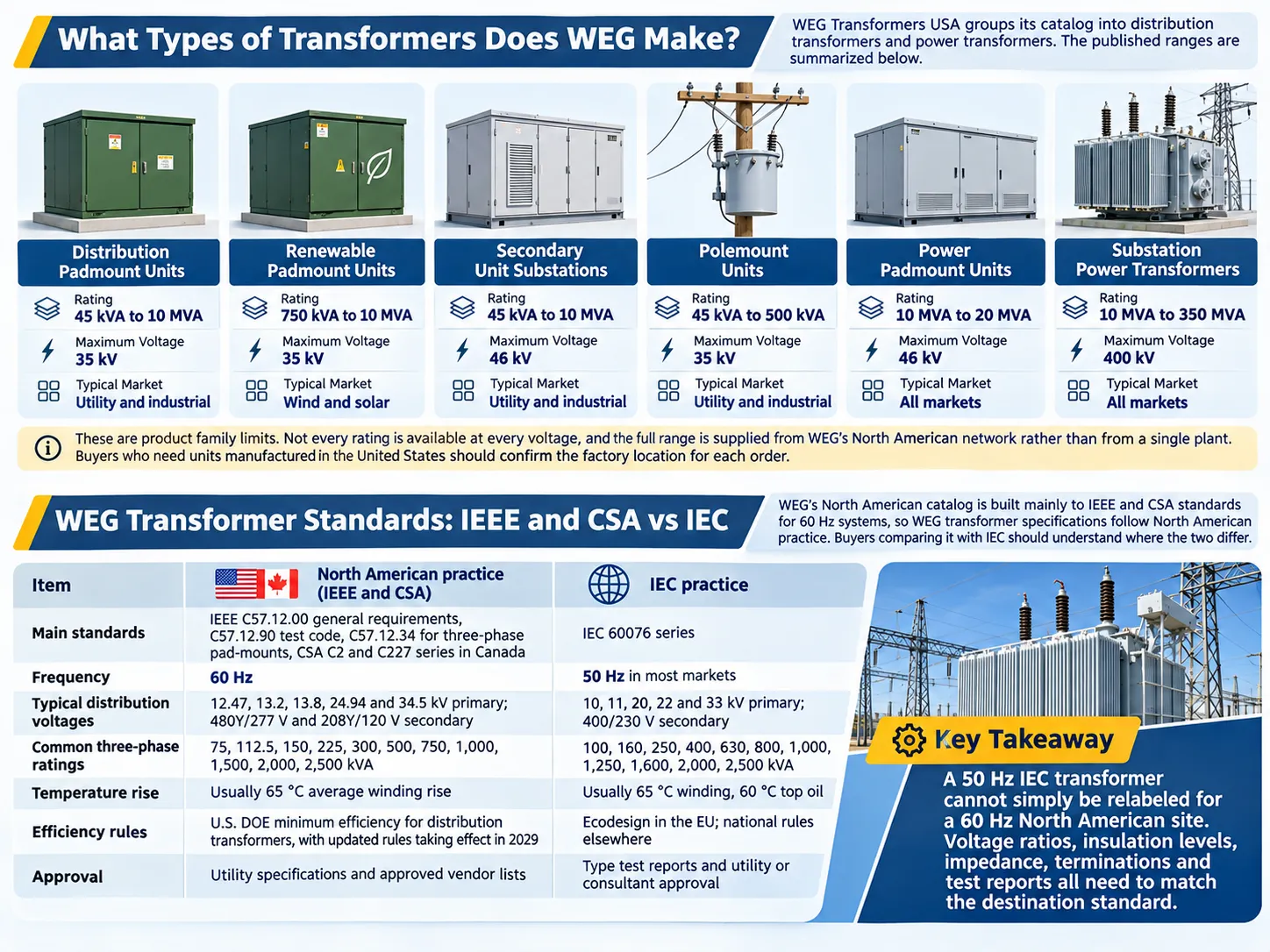
The practical lesson is that a 50 Hz IEC transformer cannot simply be relabeled for a 60 Hz North American site. Voltage ratios, insulation levels, impedance, terminations and test reports all need to match the destination standard.
How To Compare WEG Transformers With Other Vendors?
The most effective way to compare any two companies is to provide both companies a standard specification and compare their responses line by line. The cost becomes relevant only after the technical specifications of offers are made equivalent.
Check the Main Electric Parameters First Of All
Start with the rating (including primary and secondary voltages), basic insulation level, impedance and vector group. One percent difference in impedance will impact the fault levels downstream and may require different protective devices.
Compare Guaranteed Losses
No-load and load losses determine the price of operating transformers for 30 years or more. It is reasonable to ask all the companies for guaranteed information related to the rated temperature and to analyze the total cost of ownership not only the purchase price.
Check Tests, Documentation and Delivery Time
It is wise to ask for the test reports of the company as well as for the type test evidence for the design, drawings company promises to make and the factory acceptance test schedule. Do not forget to verify shipping time, packaging and warranty conditions and the party that will help you with the commissioning. For the assets owned by utility companies make sure that the vendor is already in the approved vendor list of the utility.
Example: A 1,000 kVA Padmount Specification
The table below illustrates a standard specification for a typical site of North America. Sending such a list to each company will help you to compare various offers.
| Paramètre | Sample requirement |
|---|---|
| Puissance | 1,000 kVA, three-phase, 60 Hz, 55/65 °C rise |
| Primary | 12.47 kV grounded wye, 95 kV BIL, loop feed, dead-front |
| Secondaire | 480Y/277 V |
| Impédance | 5.75 percent, tolerance per IEEE C57.12.00 |
| Prises | Plus or minus 2 × 2.5 percent, de-energized |
| Fluid and windings | Natural ester fluid; copper or aluminum per bidder, stated in offer |
| Protection | Bayonet fuses with partial-range current-limiting fuses, under-oil arresters |
| Losses and efficiency | Guaranteed no-load and load losses; compliance with applicable DOE efficiency rules |
| Documents | Outline drawing, routine test report per IEEE C57.12.90, nameplate drawing |
The values above are illustrative. Your utility’s service requirements and your engineer’s design decide the final numbers.
Transformer RFQ Checklist for U.S. Projects
- Single-line diagram, load calculation and planned future load.
- Utility service requirements, including metering and whether the utility or the customer owns the transformer.
- Rating, voltages, BIL, impedance, vector group and tap range.
- Feed type, terminations, fusing and arrester requirements.
- Cooling class, temperature rise, fluid type and enclosure material.
- Efficiency and guaranteed loss requirements.
- Applicable standards: IEEE C57 and, in Canada, CSA; certification or listing requirements if any.
- Factory tests, witness testing, documents, delivery date and warranty terms.
Where Subian Electric Fits
Subian Electric builds des transformateurs montés sur socle triphasés, oil-immersed and dry-type transformers and prefabricated substations at its factory in Xuzhou, China, and supplies projects in more than 50 countries. Our product line is designed mainly for international projects built to IEC standards, and it overlaps with the lower part of the WEG padmount range.
| Article | WEG Transformers USA padmount | Subian Electric pad-mounted |
|---|---|---|
| Published rating range | 45 kVA to 10,000 kVA | Up to 2,500 kVA |
| Normes principales | IEEE and CSA | IEC 60076, with project-specific ANSI and IEEE requirements reviewed per order |
| Main markets | North American utilities, industry and renewables | International distribution, industrial and renewable projects |
| North American utility approval | Confirm per utility | Confirm per utility and project |
To clarify the scope of the claim: we are not making statements regarding WEG-equivalent certification, approval by U.S. utilities, or local manufacturing capabilities. For any applications in North America, documentation of compliance with voltage ratios, 60 Hz design, BIL, terminations, efficiency and testing processes must be available for comparison with other products. If all that is met, then a project-engineered product offered by an international producer could be on the buyer’s short-list.
Questions Fréquemment Posées
What are WEG transformers?
Transformers made by WEG are considered power and distribution transformers designed for general use. The company produces various designs of polemount, padmount, secondary unit substation and substation transformers used in the energy production, power transmission and renewable energies.
Where are WEG transformers manufactured?
WEG builds transformers in Brazil, Mexico, the United States and other countries. In the U.S., WEG Transformers USA operates three plants in Washington, Missouri, for distribution, power and specialty transformers.
Is WEG Transformers USA an American company?
WEG Transformers USA is the U.S. transformer business of WEG, which is headquartered in Brazil. It manufactures in Washington, Missouri, and employs about 560 people across three plants.
Does WEG make pad-mounted transformers?
Yes. WEG’s published three-phase padmount range runs from 45 kVA to 10 MVA at up to 35 kV, with a separate renewable padmount line for wind and solar from 750 kVA to 10 MVA, and power padmounts from 10 to 20 MVA at up to 46 kV.
What is the largest transformer WEG offers in North America?
WEG’s published substation power transformer range reaches 350 MVA and 400 kV, built as step-down, generator step-up or autotransformer units.
What standards do WEG transformers follow?
The North American range is built mainly to IEEE and CSA standards for 60 Hz systems, and substation units are also offered to IEC standards.
What did WEG’s 2025 U.S. expansion include?
A $77 million investment in its specialty transformer plant in Washington, Missouri, targeting 1 to 10 MVA transformers up to 46.5 kV, with 50 new jobs and a planned 50 percent increase in capacity.
Can other manufacturers supply transformers with comparable specifications?
Indeed, a number of manufacturers construct transformers within comparable specifications. In order to make a valid comparison, each bidder should receive the identical specification, standardization, test documentation along with proof of utility approvals or local content requirements.
Références
- Ameren: WEG Transformers USA expansion in Washington, Missouri
- Business Facilities: WEG grows in Missouri with $77M investment
- Missouri Partnership: WEG third facility in Missouri
- ANSI Webstore: IEEE C57.12.34 three-phase pad-mounted transformers
- Pad-mounted transformer, Wikipedia
Whether you end up buying from WEG or another manufacturer, the best results come from a clear specification and a like-for-like comparison of standards, losses, tests and delivery. Jiangsu Subian Electric Power Equipment Co., Ltd. designs and builds pad-mounted transformers, oil-immersed and dry-type transformers and prefabricated substations for international projects, engineered to each project’s voltage, frequency and standard. For private-label or distributor supply, see our programme OEM et ODM. Send your specification sheet through our page de contact, and our engineers will review it and reply with drawings and a factory quotation.