


Lorsqu'un transformateur de puissance tombe en panne—que ce soit en raison d'un court-circuit dans l'un des enroulements, d'une bobine brûlée ou d'une isolation dégradée nécessitant une réparation ponctuelle—les coûts de remplacement peuvent atteindre cinq chiffres, et les délais de livraison peuvent prendre des mois. C'est pourquoi l'industrie du réenroulement de transformateurs existe : un atelier de réparation qualifié démonte le transformateur défaillant, réenroule les bobines avec un nouveau fil de cuivre et une nouvelle isolation, et vous le retourne avec des performances égales ou supérieures à celles d'un neuf à un coût considérablement réduit. Heureusement, la plupart des entreprises à Commerce, Californie, situées au cœur de la section industrielle du sud de la Californie, bénéficient de l'un des meilleurs marchés de services de réenroulement de transformateurs du pays, avec des installations de réparation établies dans des villes voisines telles qu'El Monte, Vernon, Anaheim et Bakersfield, ainsi qu'une multitude d'autres installations de réparation à l'échelle de l'État fournissant des services sur site dans votre établissement.
Vous pouvez trouver des informations complètes sur les services de réenroulement de transformateurs dans l'État de Californie et au-delà, ainsi que sur les différentes entités qui fournissent des services de réenroulement de transformateurs et leurs différences ; et enfin sur le choix de l'atelier de réparation de transformateurs approprié et la prise en compte des principales zones (coût, délai, tests et garantie).
Une brève description : le réenroulement de transformateurs de puissance est le processus de reconstruction de l'enroulement du transformateur d'origine en utilisant un nouveau fil de cuivre/aluminium et une nouvelle isolation, ce qui conduit à un état de fonctionnement similaire à celui du nouveau transformateur pour environ 50-70% du prix du nouveau transformateur. Dans la région de Commerce, CA, la concurrence dans le domaine est assez intensément raisonnable puisque plusieurs entités de service se disputent le marché des réenroulements de transformateurs de puissance à travers l'État de Californie.
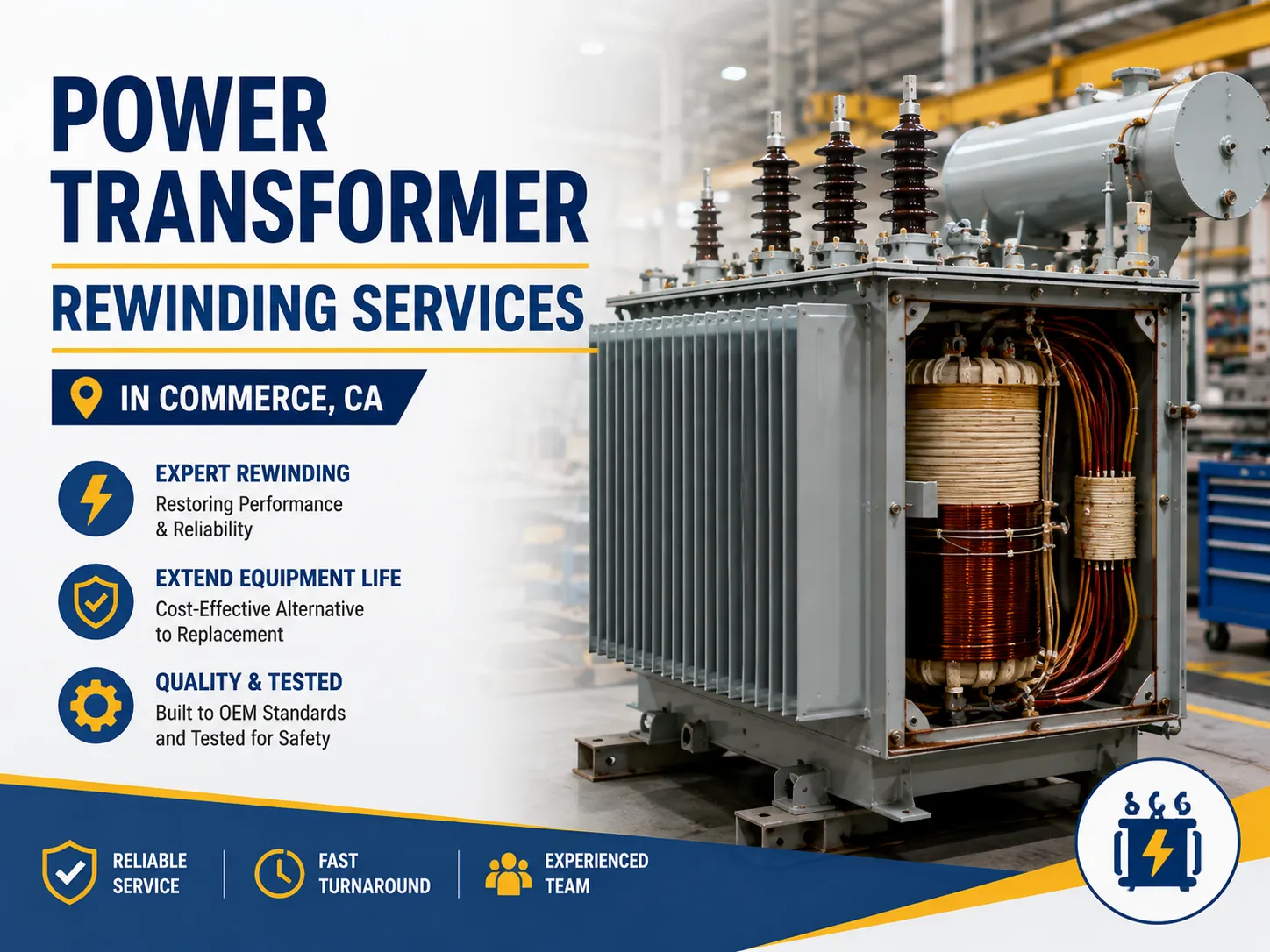
Pourquoi réenrouler au lieu de remplacer ?
Le réenroulement peut permettre d'économiser considérablement sur les coûts et les délais ; cependant, il y a un piège concernant la qualité. L'économie du réenroulement n'est pas difficile à comprendre car cela coûte généralement 50-70% d'un nouveau transformateur ; ainsi, dans le cas d'un transformateur de distribution ou de puissance coûtant des dizaines de milliers, les économies financières peuvent être substantielles. De plus, le délai peut être encore plus critique : avec les bons matériaux, le réenroulement peut généralement prendre seulement quelques semaines, contrairement à des mois pour un nouveau transformateur, surtout en période de pénurie de nouveaux transformateurs de distribution.
Le piège est que le réenroulement n'est aussi bon que le diagnostic. En général, la défaillance ne se produit pas au hasard. Le transformateur échoue généralement en raison de choses telles que la surcharge, le court-circuit, l'humidité ou les connexions lâches et si la véritable cause de la défaillance n'est pas déterminée et corrigée, alors la défaillance se reproduira. Chaque entreprise respectable qui offre des services de réenroulement inclura toujours une analyse des causes profondes, et les clients s'attendent à cela. Notre guide des causes de défaillance des transformateurs passe en revue les mécanismes de défaillance courants afin que vous puissiez poser les bonnes questions avant d'autoriser les travaux.
Ce que l'enroulement de transformateur implique réellement
Un enroulement professionnel implique une série de processus, et la qualité de l'exécution de chacun d'eux déterminera le résultat souhaité.
- Inspection et Test – Dans cette phase, l'unité défaillante est vérifiée pour la résistance des enroulements, la résistance d'isolation, le rapport de tours, et une inspection visuelle pour déterminer quels défauts sont présents et si un enroulement est possible ou non.
- Désassemblage et Nettoyage – Dans cette phase, le réservoir d'huile est vidé (géré de manière appropriée), et l'enroulement est retiré. Les laminations du noyau sont inspectées pour des dommages.
- Enroulement – Dans cette phase, des enroulements en cuivre sont installés (ou en aluminium, selon qu'ils ont été utilisés dans la conception originale) avec une nouvelle isolation, suivis du comptage des tours et des considérations de conception.
- Assemblage du Noyau et Travaux sur le Réservoir – Dans cette phase, les laminations du noyau sont gérées correctement, et toutes les réparations nécessaires au réservoir d'huile sont effectuées (comme le remplacement des joints, des scellés ou des douilles).
- Test Final – Dans cette phase, l'unité est testée selon les normes de l'industrie pour la résistance d'isolation, la résistance des enroulements, le rapport de tours, la polarité, le diélectrique, et la charge.
Les ateliers varient quant à savoir s'ils effectuent leurs enroulements en interne ou sur le terrain. Pour les grandes installations ou les unités stationnaires, l'enroulement sur site est préférable car il élimine les coûts de transport et de réinstallation. Pour les petits articles cependant, les processus en atelier sont mieux équipés pour le contrôle environnemental et les tests.
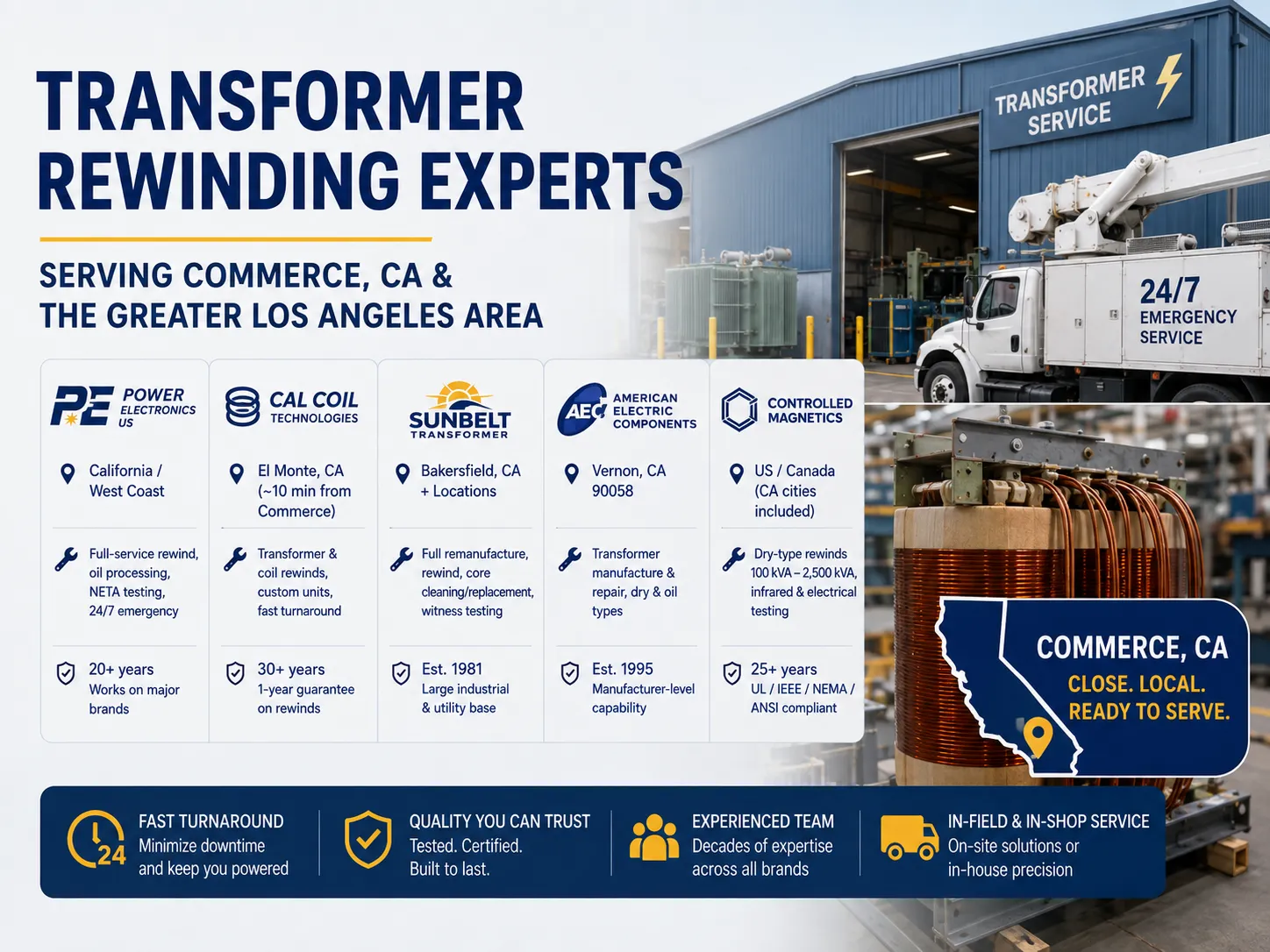
Fournisseurs de Services d'Enroulement Servant la Zone de Commerce, CA
Le Pacifique Ouest est la région de service de transformateurs la plus dense du pays, une courte liste des principaux acteurs du secteur, chacun avec son profil :
| Fournisseur | Emplacement / Portée | Forces | Expérience & Certifications |
|---|---|---|---|
| Électronique de puissance US | Tout le Californie / Côte Ouest, en atelier + sur le terrain | Enroulement complet + redesign, traitement d'huile/DGA, tests NETA, urgence 24/7 | Plus de 20 ans ; travaille sur Cooper, WEG, CG, Virginia Transformer, ABB, Square-D, Prolec-GE, Central Moloney |
| Technologies Cal Coil | El Monte, CA (environ 10 minutes de Commerce) | Enroulements de transformateurs/solénoïdes, transformateurs sur mesure, délai d'exécution rapide | Plus de 30 ans ; garantie d'un an sur les enroulements |
| Transformateur Sunbelt | Bakersfield, CA + emplacements | Remanufacture complète, enroulement, nettoyage/remplacement du noyau, tests en présence du client | Est. 1981 ; grande base industrielle/utilitaire |
| Composants électriques américains | Vernon, CA 90058 (près de LA) | Fabrication et réparation de transformateurs, types secs et à huile, unités de sous-station/distribution | Est. 1995 ; capacité au niveau du fabricant |
| Magnétiques contrôlés | US/Canada (villes de Californie incluses) | Enroulements de type sec 100 kVA-2,500 kVA, tests infrarouges et électriques | Plus de 25 ans ; conformité UL/IEEE/NEMA/ANSI |
Pour la plupart des domaines d'équipement commercial, Power Electronics est généralement le premier choix en raison de son vaste champ d'application, de son support sur le terrain et de sa réponse rapide, suivi généralement par Cal Coil Technologies en raison de sa proximité et de son traitement rapide des petits transformateurs. Les deux autres entreprises sont considérées comme de solides candidates dans la fabrication de transformateurs de spécifications supérieures, le type de transformateur fourni par ces deux entreprises est similaire au type de distribution couvert dans notre gamme de produits.
Comment choisir le bon atelier
Vous devez vous assurer qu'il y a six critères séparant un réenroulement compétent d'une responsabilité par écrit :
- Norme de test : assurez-vous que l'atelier effectue des tests conformément à la norme NETA ou à la norme IEEE/ANSI appropriée, en vous fournissant également des rapports de test.
- Expérience sur votre type de transformateur et tension : un atelier ayant de l'expérience dans le réenroulement de votre marque et modèle particulier aura de l'expérience et des connaissances concernant les matériaux et le processus, demandez des références antérieures avant de les engager.
- Engagement sur la cause profonde : le devis doit contenir des détails concernant l'analyse des pannes et les actions correctives, car vous devez savoir pourquoi le contrat a échoué et ce qui a été fait pour éviter la récurrence. Si l'atelier ne dispose pas de ces informations, trouvez-en un autre.
- Délai et logistique : assurez-vous d'avoir appris le calendrier de la réparation, comment le travail sera effectué et qui est responsable de l'expédition.
- Garantie : Il est impératif de vérifier la garantie car des ateliers fiables fourniront une année de service de garantie.
- Capacité d'urgence : En cas d'unité critique, assurez-vous que l'atelier fournit des services de réponse d'urgence 24/7 et qu'il doit également proposer des options de location ou de prêt.
Notre services de réparation et de réenroulement de transformateurs cette page décrit l'étendue des services que nous soutenons pour les projets du sud de la Californie, y compris l'orientation des fournisseurs et le soutien à la spécification.
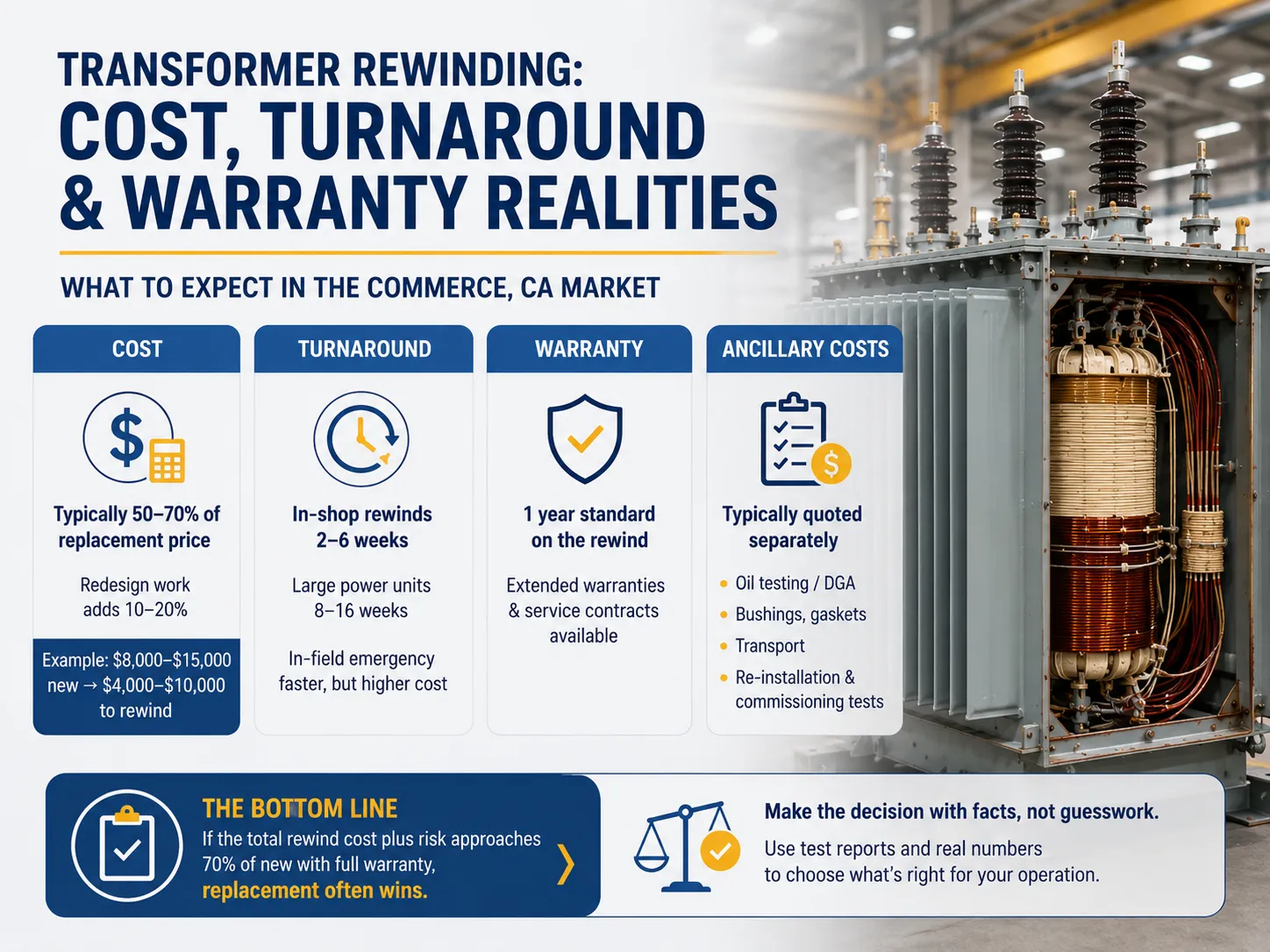
Réalités des coûts, des délais et de la garantie
Chiffres projetés sur le marché commercial (indicatif, basé sur des devis) :
- Coût : Les réenroulements coûtent généralement près de 50-70% du coût de remplacement aux mêmes échelles de notation — c'est-à-dire que par exemple si un transformateur de distribution est neuf et coûte entre $8000-$15000, le réenroulement serait jusqu'à $4000-$10000 et un grand transformateur de puissance à 6 chiffres aurait un ratio similaire. De plus, si des travaux de redesign sont nécessaires — c'est-à-dire, changement de tension ou cuivre vers aluminium, un supplément de 10-20% par considération est appliqué.
- Délai de traitement : le réenroulement des transformateurs de taille normale de transformateur de distribution prend généralement de 2 à 6 semaines selon la disponibilité des matériaux et le réenroulement des unités plus grandes prend de 8 à 16 semaines. Le réenroulement d'urgence sur site n'est pas le même en termes de coût car il peut être plus rapide, le coût par heure augmente.
- Garantie : 1 an pour le réenroulement est la norme dans l'industrie et d'autres garanties ou contrats de service sont négociables sur les unités plus grandes.
- Dépenses accessoires : le test de l'huile est généralement proposé comme une option de devis séparée du réenroulement ainsi que le test de DGA, le remplacement des douilles et des joints et les coûts de test de mise en service ; par conséquent, assurez-vous de demander un devis détaillé afin que l'analyse des coûts entre le réenroulement et le remplacement puisse être basée sur un devis équitable plutôt que sur une simple estimation.
Avant d'autoriser, faites les calculs — le cadre décisionnel complet entre réenroulement et remplacement se trouve dans notre guide de reconstruction vs remplacement: si la variable qui est le devis de réenroulement plus le risque qu'une unité reconstruite ait une durée de vie restante plus courte (comparée à un transformateur neuf) équivaut à environ 70% du prix d'un transformateur neuf avec la garantie complète de l'usine, le remplacement du transformateur est souvent préféré. Chaque cas est différent, et les décisions doivent être soutenues par les résultats finaux des tests de l'atelier plutôt que par un accord informel.
Avant de vous engager : La liste de contrôle de la diligence raisonnable
- Obtenez la documentation de la défaillance, contenant des images, des résultats de tests et un rapport sur la cause racine de l'atelier concerné.
- Contactez 2 ou 3 ateliers pour obtenir des références pour des travaux de votre type et taille et passez des appels téléphoniques à ceux-ci.
- Collectez des devis et comparez les prix de tous les postes, y compris le réenroulement, les matériaux, les douilles/joints, l'huile, le transport, les tests et la garantie.
- Vérifiez quelle norme est suivie pour les tests, soit IEEE soit NETA et demandez des échantillons des formats de rapport de test utilisés par eux.
- Confirmez le calendrier écrit et les pénalités à imposer pour les retards sur toute machine critique.
- Ayez une comparaison numérique pour prendre des décisions basées sur le remplacement ou le réenroulement ; examinez les coûts directs (50-70%) et indirects (durée de vie restante, garantie et délai) lors de cette analyse.
Questions Fréquemment Posées
Le réenroulement d'un transformateur est-il moins cher que son remplacement ?
La plupart du temps, la réponse est oui. Les coûts de réenroulement d'un transformateur représentent environ 50-70% de ceux d'un remplacement et sont généralement plus rapides que les délais de fabrication, surtout en période de pénurie de transformateurs de distribution. La comparaison doit être soigneusement effectuée, car la durée de vie restante du transformateur doit être prise en compte ainsi que la période de garantie (qui est généralement d'un an) pour l'unité réenroulée, et le fait que le noyau, le réservoir et les bornes seront réutilisés — si l'un de ces composants est endommagé, alors le remplacement sera généralement la meilleure option.
Combien de temps prend le réenroulement d'un transformateur ?
Les transformateurs de distribution prennent généralement de 2 à 6 semaines pour être réenroulés dans un environnement d'atelier — les grands transformateurs de puissance peuvent prendre jusqu'à 8-16 semaines selon la charge de travail et les matériaux. Les réenroulements sur site sont plus rapides mais plus coûteux. Assurez-vous toujours d'obtenir le calendrier par écrit, surtout pour une unité critique.
Quels tests sont effectués après un réenroulement ?
Les centres de réparation doivent effectuer des tests conformes aux normes NETA/IEEE : résistance d'isolement (megger), résistance des enroulements, rapport de tours, polarité/phases, et tests diélectriques et d'huile (pour les transformateurs remplis d'huile), et fournir un rapport écrit des tests effectués. Certains ateliers effectuent également des tests de montée en température et de charge sur de grands transformateurs. Insistez pour obtenir ce rapport qui montre que votre transformateur est en bon état.
Comment puis-je trouver des services de réenroulement de transformateurs près de Commerce, CA ?
Commerce se trouve dans la zone industrielle de Los Angeles. Il y a de nombreuses options dans la région. Cal Coil Technologies à El Monte, American Electric Components à Vernon, ou Power Electronics US qui dessert tout l'État de Californie, et bien d'autres. Assurez-vous de vérifier l'expérience de l'atelier sur votre type spécifique de transformateur et d'obtenir une garantie écrite avant de prendre votre décision.
Références
- Power Electronics US — Ventes de transformateurs, réenroulement, tests et maintenance (Californie)
- Cal Coil Technologies — Services de réenroulement de transformateurs et de bobines (El Monte, CA)
- Cal Coil Technologies — Aperçu du bobinage et du réenroulement de bobines
- Controlled Magnetics — Services de réparation, de réenroulement et de reconstruction de transformateurs
- ThomasNet — Services de réparation de transformateurs dans le sud de la Californie
Conclusion
L'industrie de la réwind des transformateurs de puissance est bien établie à Commerce, CA, en raison de la forte densité d'industries dans le couloir de LA créant une richesse d'ateliers qualifiés. Il existe une variété de choix allant de Cal Coil à El Monte, l'atelier le plus proche, à Power Electronics US qui propose la plus large gamme de services, y compris la réwind sur site et en urgence partout dans l'État. Le processus de réwind nécessite cependant de faire le bon choix, basé sur des chiffres qui doivent également passer le contrôle de qualité. La réwind est financièrement attrayante, dans la région de 50%-70% du coût de remplacement et avec un délai d'exécution plus rapide, mais seulement si elle est effectuée correctement après qu'un diagnostic complet a été réalisé, et que l'atelier respecte les normes établies par la National Electrical Testing Association. Il est donc important de sélectionner un atelier de réwind en fonction de la norme de test utilisée, du niveau d'expérience sur votre marque et type de transformateur, des accords de service et de garantie écrits, et de s'assurer que tous les prix cités sont exacts et correctement énoncés. Il est conseillé de réaliser d'abord un diagnostic puis de faire correspondre le diagnostic avec les options disponibles.