


When an engineer is determining the specifications of a medium voltage distribution ring, the decision almost always comes down to the ring main unit specifications on the datasheet. The rated voltage, rated current, short-time withstand current, insulation type, and the relevant IEC standard together will determine whether the unit will withstand the fault, fit in the substation installation, and function for years. This guide sets out the full set of ring main unit specifications and features in one place, explains what each parameter means and how to read it, their descriptions, the ways to read them, and comparisons among the top RMU designs worldwide. You can use this document while preparing tenders or evaluating quotations.
What Is Ring Main Unit (RMU)?
Ring main unit or the RMU is a compact and integral factory assembled medium voltage switchgear. It is utilized in secondary distribution line due to its ability to connect into a loop of underground or aerial cables allowing consumers to get power from two sides of the network. Thus, the reliability of modern cities and industries depends on the RMU, as when one side of a network is lost, the consumers continue to receive electricity due to other side of the ring circuit still functioning.
The unit usually integrates several load-break switches connected to the incoming and outgoing cables and a protected tee-off (switch-fuse or vacuum circuit breaker) feeding the transformer. The entire design of the switchgear is compact and sealed so that it will not need any maintenance during its lifetime. Understanding the ring main unit specifications begins with understanding that every one of these functions has to be rated for the same voltage, current, and fault level.
Ring Main Unit Specifications at a Glance
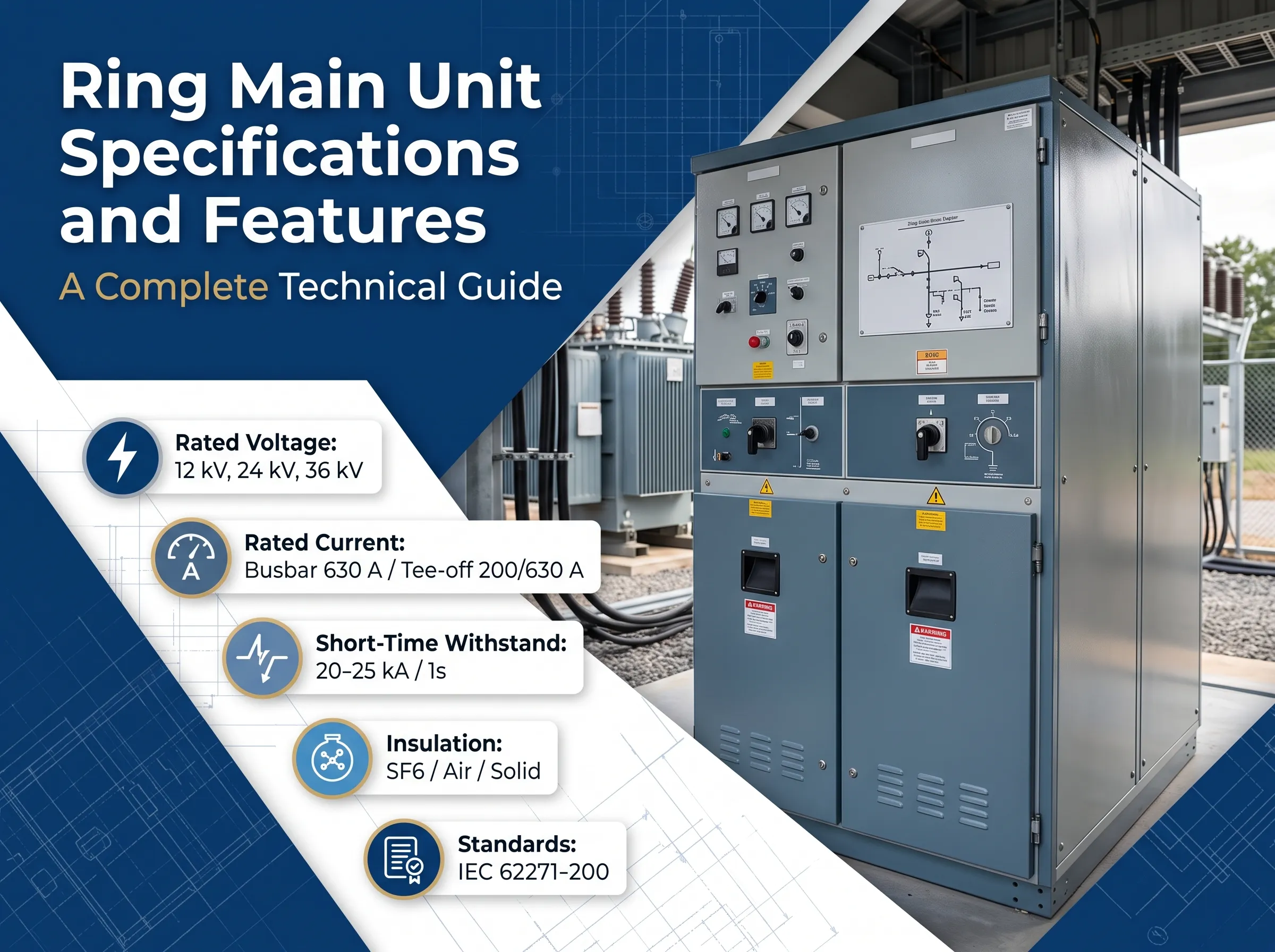
Before looking at each parameter in detail, it helps to see the complete specification set that defines a 12 kV class unit. These are the core ring main unit specifications that appear on virtually every datasheet and tender document:
- Rated voltage: 12kV (also available at 17.5kV, 24kV, 36kV).
Rated frequency: 50Hz or 60Hz.
Rated mainbus current: 630A (more than 1250A for larger models).
Rated tee-off current: 200A (switch-fuse) or 630A (circuit breaker type).
Rated current of short-circuit withstand: 20 or 21 kA for 1 second (up to 25 kA).
Rated peak withstand current: 50 or 52.5kA (2.5 times of short-time value).
Rated short circuit duration: 1 second or 3 seconds upon request.
Lightning impulse withstand voltage (LIWL): 75 kV.
Power frequency withstand voltage: 28 or 42 for one minute.
Insulation media: SF6 gas, air or solid.
Degree of protection: IP65 for gas tank and IP3X for the enclosure.
Applicable standards: IEC 62271-200 and IEC 62271-100/105.This box is the first one of the two technical figures that are suggested for this article, a sole infographic, called “Ring Main Unit Technical Specifications”, that is a good summary of the structure along with the above-mentioned voltage, current, withstand and IEC parameters.Below are the sections explaining the figures that should not be misconstrued by an engineer.
Rated Voltage and Current: 12 kV, 17.5 kV, 24 kV and 36 kV
Rated voltage defines the maximum voltage for which the RMU will function properly and be within its limits. The secondary distribution is based on only a few standard classes, and the right ring main unit specifications start with matching this value to the network:
- 12 kV is the basic class to be employed for the networks with 10 kV and 11 kV rated voltage;
17.5 kV is for the systems rated 13.8 kV and 15 kV;
24 kV is utilized for the networks rated still at 20 kV and 22 kV, mainly in Europe, Asia, and the Middle East;
36 kV represents the last range of secondary distribution applicable for 33 kV systems.Rated current indicates the amount of current that the equipment will be capable of enduring due to the temperature conditions. There are two readings. The main busbar and the ring load break switches have normally 630 A, which means that this value allows one to use the current of the network loop. The transformer tee-off can have either a lower rating due to the utilization of some switch fuse combinations, normally 200 A, or the same 630 A when using a vacuum circuit breaker for protection. The commonest mistake made while reading the ring main unit specifications is confusing the rating of the busbar with the rating of the tee-off.
Short circuit withstanding and breaking capacity
The quality appears in the faultRanked short-term withstand current (Icw). The RMS fault current, which the unit is capable of handling during certain periods, typically 20 or 21 kA for a second without sustaining any thermal or mechanical damage. For networks with greater fault levels, 25 kA can be specified as well. Also, some tenders specify 3 seconds.
Rated peak withstand current (Ipk). The highest amount of instantaneous current the unit, 2.5 times higher than the short-term rating (according to IEC) is capable of withstanding, meaning for the device having rated 20 kA the peak withstand current is 50 kA.
Rated short-circuit breaking capacity. The amount of fault current the protective device is able to interrupt. In the vacuum circuit breaker tee-off, it is the same as the withstand rating, 20 to 25 kA; with switch-fuse tee-off, the fuse takes care of great fault currents and the switch breaks current load.
A device with a withstand rating less than the fault current of the network is not safe and that is the primary reason why it is the first thing that engineers check each other.
Specifications of good ring main unit always include the data describing Icw, duration, and Ipk together.
The units are classified according to the insulation medium used which is an important factor determining unit size, maintenance requirements, and ecological characteristics, thus separating units from each other.
Types of Insulation in RMU: SF6, Air, and Solid
In concluding that insulation plays a pivotal role in separating live electrical conductors and extinguishing discharge arc on breaking the switch, it can be mentioned that its characteristics equipment can be determined. It should be kept in mind that the choice of insulation is an important factor for every ring mains unit specification.
SF6 gas-insulated. The live components are safeguarded by SF6 gas inside the steel tank. SF6 provides an excellent level of dielectric resistance and makes it possible to extinguish arcs even in the tightly sealed unit that is resistant to moisture, dirt and condensation. This insulation type is primarily used for secondary RMUs as well as at places with bad conditions or at coastal territories.
Air-insulated. The equipment consists of live conductors isolated by air in a metal enclosure. This unit is less compact; nevertheless, it is free of greenhouse gases and allows performing visual inspection while being placed indoors.
Solid insulator (SIS). The live conductors are insulated with solid epoxy-like insulators. It is a new type of insulation technology that does not involve the use of gas within the device.
Key Characteristics of Ring Mains Units
Along with specific values of the ring main units specifications the good design is distinguished also from the engineering perspective that ensures safe and convenient operation. Some important characteristics that should be considered when buying include:
Three-position switch. The equipment possesses one load-break switch that has three positions and can be switched from closed to open whether grounded or not in one enclosure.
Interlocking mechanism of five operations. The design contains mechanical and electrical mechanism to eliminate mistakes concerning five popular operations with electrical system.
Hermetically-sealed tank. The service life of the tank is unlimited when it is properly sealed.
Small footprint. It occupies little space while being installed in the compact enclosure that is used mostly in prefabricated buildings. It is very important.
Ability to expand. It is important to observe that the expansion possibilities exist from the functional device and till the busbar extension.
Cable testing and fault indication systems. The equipment allows for cable testing as well as tracking faults along through the unit.
Internal arc classification. The available IAC rating gives you an idea of how the device prevents internal arc faults.
Therefore, it can be stated that the above-mentioned characteristics are those things that can separate the units of equal technical specifications.
Schneider RM6 vs Siemens 8DJH vs ABB SafeRing
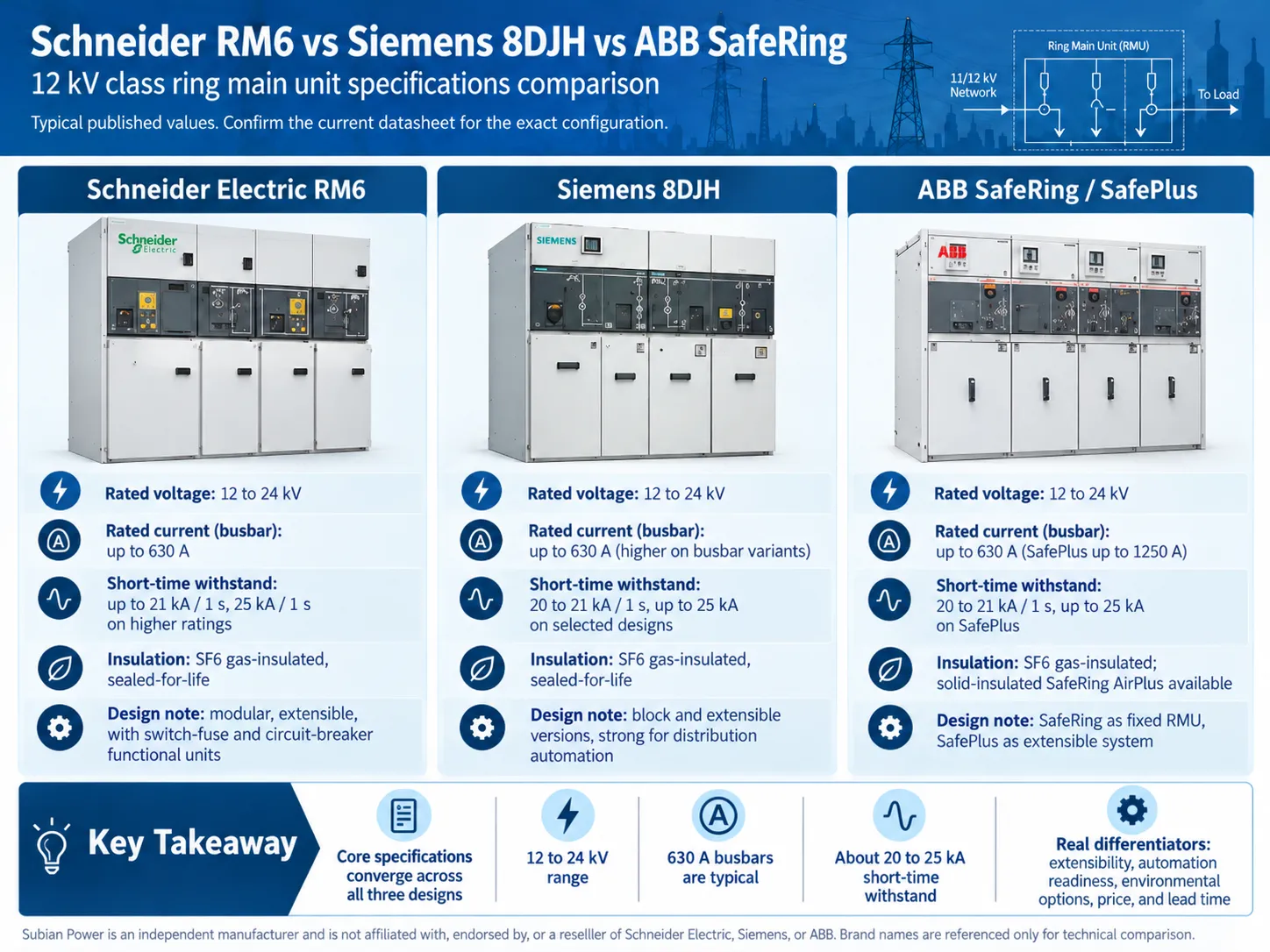
When it comes to ratings, buyers often carry out a side-by-side analysis of the top three internationally established designs since it’s quite common to find specifications of 12 kV class published ring main units available for comparison if their specifications are similar. The following figures represent the general figures generally found in catalogs which need to be checked against the most current configuration datasheets available. This comparison figure is the second of those recommended through this article. It should be stated that Subian Power is an independent manufacturer and has no association with, marketing authorizations from, or intentions of selling Schneider Electric, Siemens, or ABB products – these trademarks serve only for technical reference purposes.
Schneider Electric RM6
Rated voltage: from 12 kV to 24 kV.
Rated current: up to 630 A (should be more for some busbar designs).
Short-time withstand: from 20 kA to 21kA within a 1 s period; moreover, there are some designs at the limit of 25kA/1 s figures.
Insulation: with all parts insulated with SF6 gas and available for sealing life.
Note: all designs are extensible and modular and can be fitted with switch-fuse and circuit breaker units.
Siemens 8DJH
Rated voltage: from 12 kV to 24 kV.
Rated current: up to 630 A (higher for busbar variants).
Short-time withstand: from 20 to 21 kA for a 1 s withstand period with higher models rated at 25 kA.
Insulation: all materials are gas insulated – SF6; there also some elements sealed for life.
Note: all units are available in extensible and block forms.
ABB SafeRing / SafePlus
Rated voltage: from 12 to 24 kV.
Rated current: up to 630 A (for SafePlus – 1250 A).
Short-time withstand: from 20 to 21 kA and with the value of up to 25 kA for SafePlus.
Insulation: all models feature e.g. complete insulation with SF6; models with solid insulation are available.
Note: SafeRing RMUs are fixed ones while SafePlus designs are extensible ones.
The trend discussed above has been observed amongst all three brands that converge on a range of 12 to 24 kV rated voltage values, an even rated current of 630 A, short-time withstand values of 20 to 25 kA, and SF6 insulation, thus complying with IEC 62271 standards. Hence, the most important distinguishing factors are extensibility, automation readiness, eco-friendliness, and also cost and delivery terms where Subian Power, as a competitor manufacturer, is the winner.
IEC 62271 Standards for Ring Main Units
Valid ring main unit specifications cannot exist without a support of the applicable standards and approval through type tests. The main standards are:
– IEC 62271-200: AC switchgear and controlgear in metal-enclosed design which operates at voltage range starting from 1 kV and up to 52 kV, which serves as the main standard for RMU systems and defines internal arc classification rules.
– IEC 62271-100: High-voltage AC circuit-breakers which defines general rules for the tee-off of breakers.
– IEC 62271-102: Disconnectors and earthing switches.
– IEC 62271-103: Switches which is applicable to load-break switches in the ring.
– IEC 62271-105: AC fusible switch combinations which defines the rules of tee-off with fuses.
A reliable supplier always produces type-test certificates according to these standards instead of merely providing proof of conformity. If there is no information in the technical specification where each RMU characteristic has been tested, it should be treated cautiously.
How to Choose RMU for Prefabricated Substation
If specifications are properly followed, the choice will automatically flow from that. In the case of a prefabricated or compact substation, choose the RMU specifications in the following order:
– Rated voltage should correspond to the network class (12, 17.5, 24, 36 kV).
– Short-time withstand current should be greater than site prospective fault current with some safety margin.
– The type of tee-off should be chosen: use a switch-fuse for smaller transformers in terms of economy, and choose circuit breaker to ensure full safety, if bigger and more critical loads are expected.
– The insulation type should be determined by the environment: choose SF6 for compact/harsh environments, and use air or solid insulation in case the gas-free design should be used.
– The dimensions should correspond to the substations and there should be enough space for future expansion.
Subian Power Ring Main Units
Jiangsu Subian Power Equipment Co., Ltd. specializes in medium-voltage switchgear, transformers, and substations construction rated up to 110 kV. The company, which was founded in 2019 in the Chinese city of Xuzhou, supplies power plants and industries, and constructs ring main units to IEC 62271 and GB 3906 standards. There are two designs to meet most secondary distribution applications:
- L' HXGN15-12 metal-enclosed ring network switchgear is a 12 kV, 50 Hz unit with a spring-operated mechanism (manual or electric), load-break switches, and an optional VS1 fixed vacuum circuit breaker for the transformer tee-off, suited to urban distribution and ring networks.
- L' XGN15-12 inflatable (SF6) ring network switchgear is a 12 kV, 50 Hz gas-insulated unit with a three-position SF6 load switch and five-prevention interlocking, built compact and expandable for distribution automation, urban networks, and compact substations.
Both units meet the core ring main unit specifications described in this guide, and Subian provides type-test documentation on request. Because Subian also manufactures the transformer and the enclosure, an RMU can be supplied as part of a complete YB-series prefabricated substation, with the ring switchgear, transformer, and low-voltage equipment engineered and tested together. The engineering team can match the rated voltage, current, withstand level, insulation type, and tee-off configuration to your exact network.
Questions Fréquemment Posées
How many kW can you run on a ring main?
The limits on apparent power are determined by the combination of voltage and rated current of the ring and not just by the RMU. For example, a 630 A 12 kV ring with load-break switches is capable of providing around 13 MVA of apparent power at full rated current, equating to around 11 MW at 0.85 power factor. In reality the limit is imposed by the distribution transformer that feeds from the tee-off, with ratings ranging typically from a few hundred kVA to about 1,600 kVA per RMU, which means that one transformer tee-off serves an actual load in the range of hundreds of kW to just over 1 MW.
What is RMU configuration?
The configuration of the RMU specifies the different functional parts of the unit and their arrangement. The construction of an RMU comprises the two types of module: ways of load break switch (to connect the incoming and outgoing cables of ring) and ways of protected tee-off (to connect the transformer via switch fuse or circuit breaker). The configuration is usually noted using a short symbolic term. For instance, 2 + 1 means that two load switch ways and one tee-off switch way are included in the configuration. The most common layouts include 2 + 1, 3 + 1 and others.
What is the standard size of main cable for a ring circuit?
In the case of a medium voltage distribution ring at 12 kilovolt, the ring cable is usually a three-core XLPE with either copper or aluminum conductor ranging between 95 and 300 square millimetres, depending on the load current and the fault level. The standard sizes of 185 and 240 square millimetre aluminum XLPE are often employed for this purpose. However, the exact size is determined depending on the continuous current, short-circuit withstand, RMU, voltage drop along the ring and the method of installation, thus the precise size is always verified through calculation for the specific network.
What is a 3 way RMU?
A RMU having 3 ways is known as a ring main unit having three functional units or ways. We may come across the most common variant in the form of either 2 ways or 1 way arrangement. Two ways would be load break switch ways for the incoming and outgoing ring cable and the remaining way would be the protected tee-off way. A 3-way unit is the basic component of a distribution/substation connecting to the ring supply unit and feeding one transformer although additional ways can always be added to it as the network expands.
Références
- IEC — IEC 62271-200 AC Metal-Enclosed Switchgear and Controlgear
- IEEE — Standards and Guides for Medium-Voltage Switchgear
- Electrical Engineering Portal — Ring Main Units and Secondary Distribution
- Wikipedia — Ring Main Unit
- Wikipedia — Electric Power Distribution Overview
Conclusion
L' ring main unit specifications that matter most, rated voltage, rated current, short-time and peak withstand current, insulation type, and IEC 62271 compliance, together decide whether a unit is safe, reliable, and the right fit for a distribution ring. Read the withstand ratings against your fault level, match the tee-off to your transformer, choose the insulation for your environment, and insist on type-test certificates. Subian Power builds HXGN15-12 and XGN15-12 ring main units to these ring main unit specifications and features, and can supply them as part of a complete prefabricated substation. To request a datasheet, type-test documentation, or a quotation matched to your network, contact the équipe d'ingénierie de Subian Power.