


The work on the substation is purchased in three separate markets which all share a common vocabulary. An EPC contractor will sell engineering and construction to a utility or developer, a manufacturer will sell equipment, and a specialist service company will sell testing and maintenance. All three can be involved in the same project and the reason projects run late is because a buyer thought one of them covered the other two.
The three markets are explored in the sections that follow, giving indicative costs and lead times for each, along with a description of the strengths and weaknesses of each route and a selection table at the end which maps a requirement to the type of provider that is appropriate. The last section covers where a factory supplier fits in on a US project and where it doesn’t.
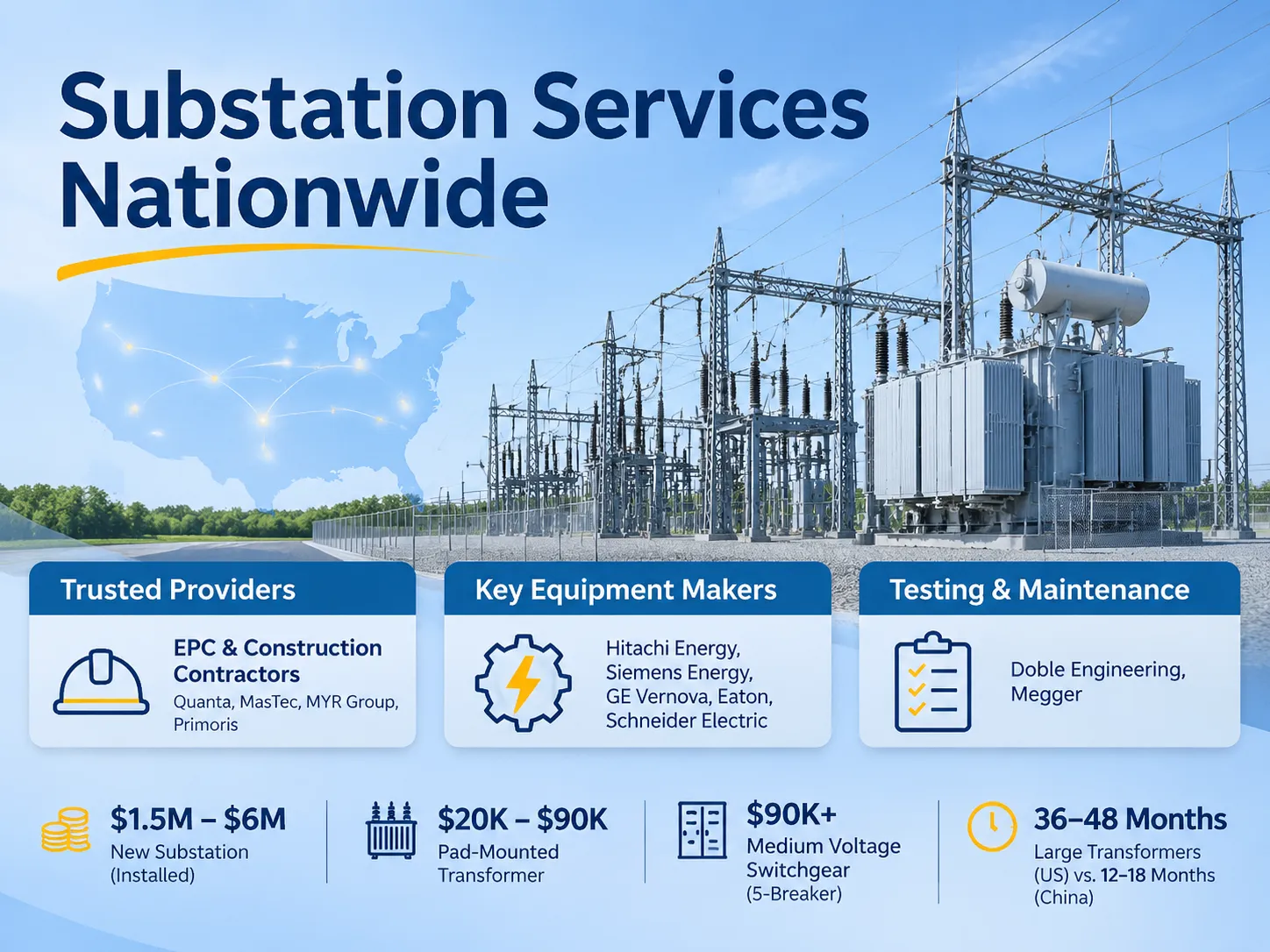
Fast answer: In the US, there are three types of players that provide substation services nationwide: EPC and construction contractors such as Quanta Services, MasTec, MYR Group and Primoris; equipment manufacturers including Hitachi Energy, Siemens Energy, GE Vernova, Eaton and Schneider Electric; and testing and maintenance specialists such as Doble Engineering and Megger. A new distribution substation typically costs $1.5 million to $6 million installed, depending on voltage and capacity. A pad-mounted transformer costs $20,000 to $90,000 and medium voltage switchgear costs from $90,000 for a five-breaker lineup. The limiting factor is lead time: 36-48 months for large power transformers from Western manufacturers versus 12-18 months from Chinese factories. Pick by scope, not by brand.
What “Substation Services” Actually Covers
The phrase comprises six activities, and most contracts address only some of them. Site selection and permitting, civil works and foundations, steel structure and buswork, power transformers and switchgear, protection and control system, commissioning and testing. A full turnkey contract includes all six. The fourth and part of the fifth are covered by an equipment contract.
That distinction is important commercially because that is where delays build up, at the interfaces between those packages. Money is spent on a transformer that arrives on time to a yard that’s not ready. A protection scheme developed for a different breaker model needs to be redesigned. Buyers who know who owns which interface spend less time in claims meetings .
Two terms are used loosely and should not be. The whole facility with transformers, the switchgear, the protection, the civil works is called a substation. A switchyard is an open-air arrangement of busbars, disconnects, breakers and structures that can be inside a substation or be stand-alone at a generating plant. The typical mistake is to purchase “substation services” from a switchyard contractor.
The US Market: Who Does What
The US market is consolidated at the top and fragmented at the bottom, which leads to a predictable pattern of capability and price.
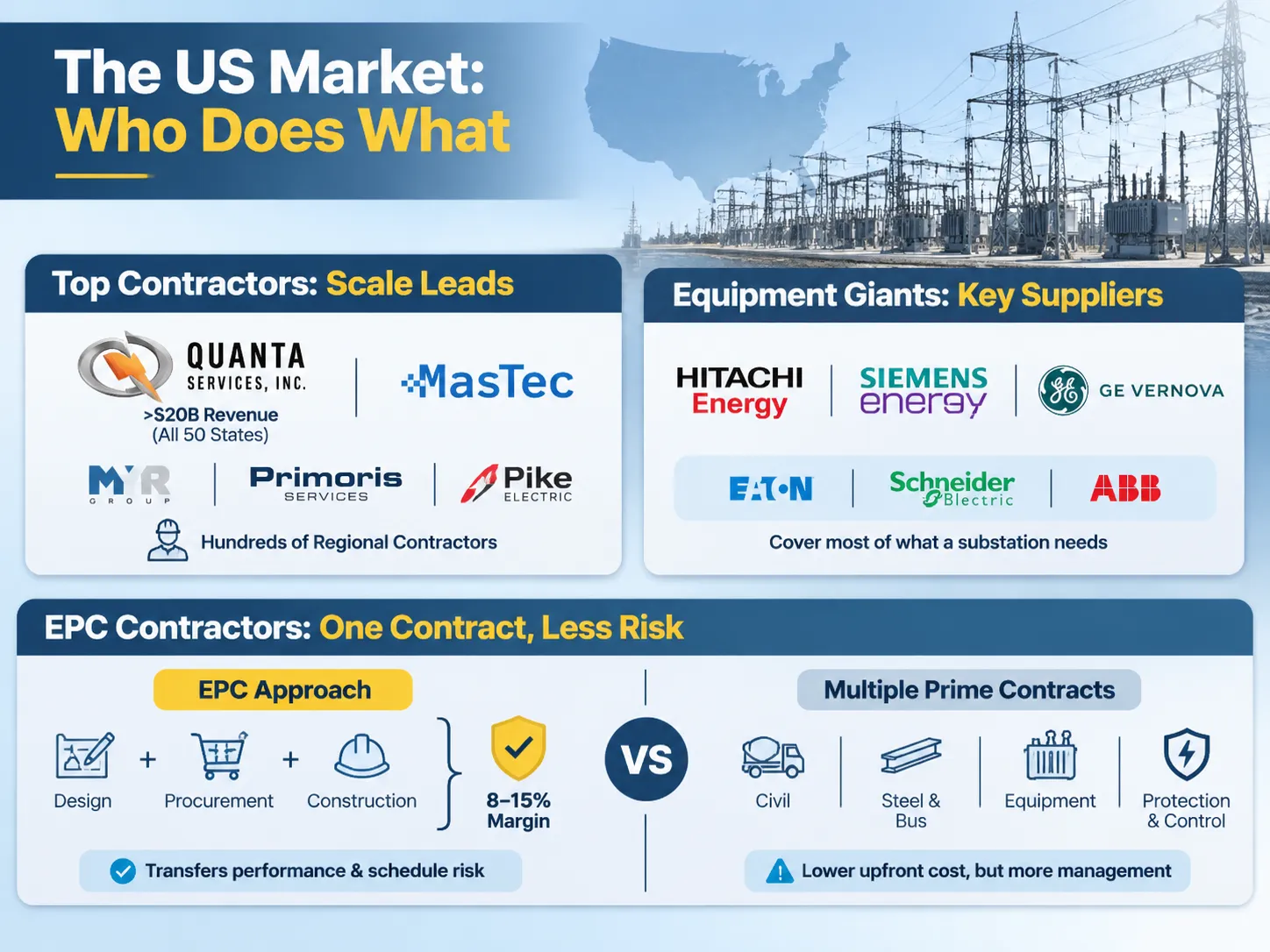
Quanta Services is the largest specialty contractor in North America, providing utility infrastructure services with more than $20 billion in revenues and operating in all 50 states. It includes transmission, distribution, substation construction and ever more renewable interconnections. Its strength is scale and crew availability; its weakness is that a small project is not the priority it would be for a regional contractor.
MasTec is in the same space, with a strong position in transmission and substation work, plus telecommunications and pipeline divisions. MYR Group and Primoris Services are also covering similar ground, but with regional depth. Pike Electric is a stalwart name in utility services on the East Coast and Midwest.
Below those names are hundreds of regional contractors who build distribution substations up to 69 kV and subcontract the protection and testing. Typically for a 15kV or 34.5kV job, a regional contractor with 3 crews will be quicker and cheaper than a national firm, due to the disproportionate mobilization cost of a large contractor to a small job.
On the equipment side, Hitachi Energy, Siemens Energy and GE Vernova dominate the US market for transformers and high voltage apparatus. Eaton, Schneider Electric and ABB are strong players in medium voltage switchgear and protection. Those five names cover most of what a substation contains, and the choice between them is usually determined by the utility’s approved vendor list, not price.
EPC Contractors and What They Own
In an EPC contract, design, procurement and construction risk are transferred to one party and that is what a utility or a large developer is generally buying. The contractor assumes the performance guaranty, the liquidated damages for schedule and the interface risk between equipment and civil works.
The cost of that is a margin on the entire package, usually 8 to 15 percent added to the direct costs, plus any contingency the contractor adds to a fixed lump sum. That premium buys real risk transfer for a mature design, a well-defined project. It buys a large contingency for a project with permitting that is not resolved or an unusual interconnection and the owner pays for it either way.
The alternative is to have several prime contracts, one for civil, one for steel and bus, one for equipment, one for protection and control. On paper it is cheaper and requires an owner’s engineer who can manage the interfaces, a capability most developers do not have in house.”
Equipment Manufacturers and Their Lead Times
Equipment is where the schedule is decided, and the numbers have moved significantly since 2021.
| Équipement | Typical US lead time | Indicative price |
|---|---|---|
| Pad-mounted distribution transformer, 500 kVA | 12 to 24 months | $20,000 to $40,000 |
| Power transformer, 50 MVA, 138 kV | 36 to 48 months | $2.5 million to $5 million |
| Medium voltage switchgear, 15 kV, five breakers | 10 to 16 months | $90,000 to $180,000 |
| Protection and control panel, per bay | 6 to 12 months | $40,000 to $120,000 |
| Steel structure and buswork | 4 to 8 months | Project specific |
| Prefabricated or skid-mounted substation, 15 kV class | 6 to 12 months | $250,000 to $900,000 |
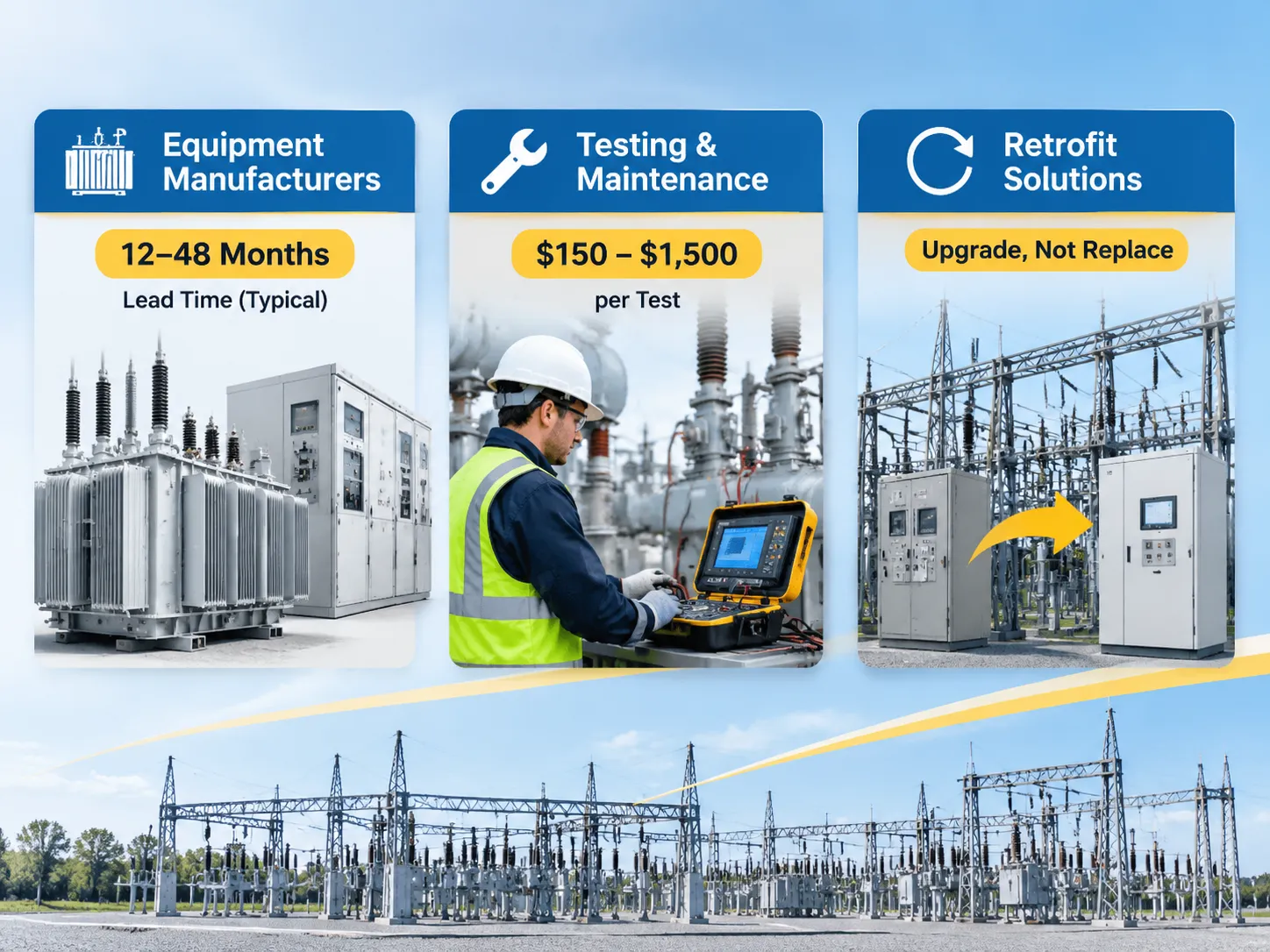
The line transformer is the one that transforms projects. Western manufacturers are sold out through the latter half of the 2020s, with demand and capacity estimated to be about 30 percent apart in 2025, with the shortfall extending out to 2029. Buyers able to accept IEC-tested equipment have been shifting supply as Chinese factories are quoting 12 to 18 months for the same rating.
Trade is not only about price. A US utility specifying a transformer to the utility’s own standard wants the type test in its preferred format, a service depot within a day’s drive and spare parts commitment measured in decades. The first can be dealt with by a factory 8,000 miles away and paperwork, the second not at all, which is why the two routes serve different projects rather than competing head-to-head.
Testing, Maintenance and Retrofit Services
The third market is that which keeps existing substations running. It is smaller, more technical and less visible than the other two.
For insulation testing and diagnostic services, call Doble Engineering . Many utilities use its test sets to assess transformers and breakers. Megger supplies both instruments and services for insulation resistance, earth testing and breaker timing. Regional testing firms also have the same equipment, and do the annual maintenance the utility’s own crews can’t do.
Typical services include transformer oil and dissolved gas analysis, bushing and arrester testing, breaker timing and contact resistance, protective relay calibration, ground grid resistance testing and thermographic surveys. Costs for a dissolved gas analysis are between $150 and $400, a breaker timing test ranges from $500 and $1,500 and a full substation commissioning package ranges between $25,000 and $150,000 depending on size.
The retrofit business is the fastest-growing part of this market because it is cheaper and faster to retrofit a 1970s protection scheme than to build a new substation. The overview of substation solutions for buyers covers the range of configurations available for that kind of upgrade, which is useful context before a scope is written.
What a Substation Project Costs
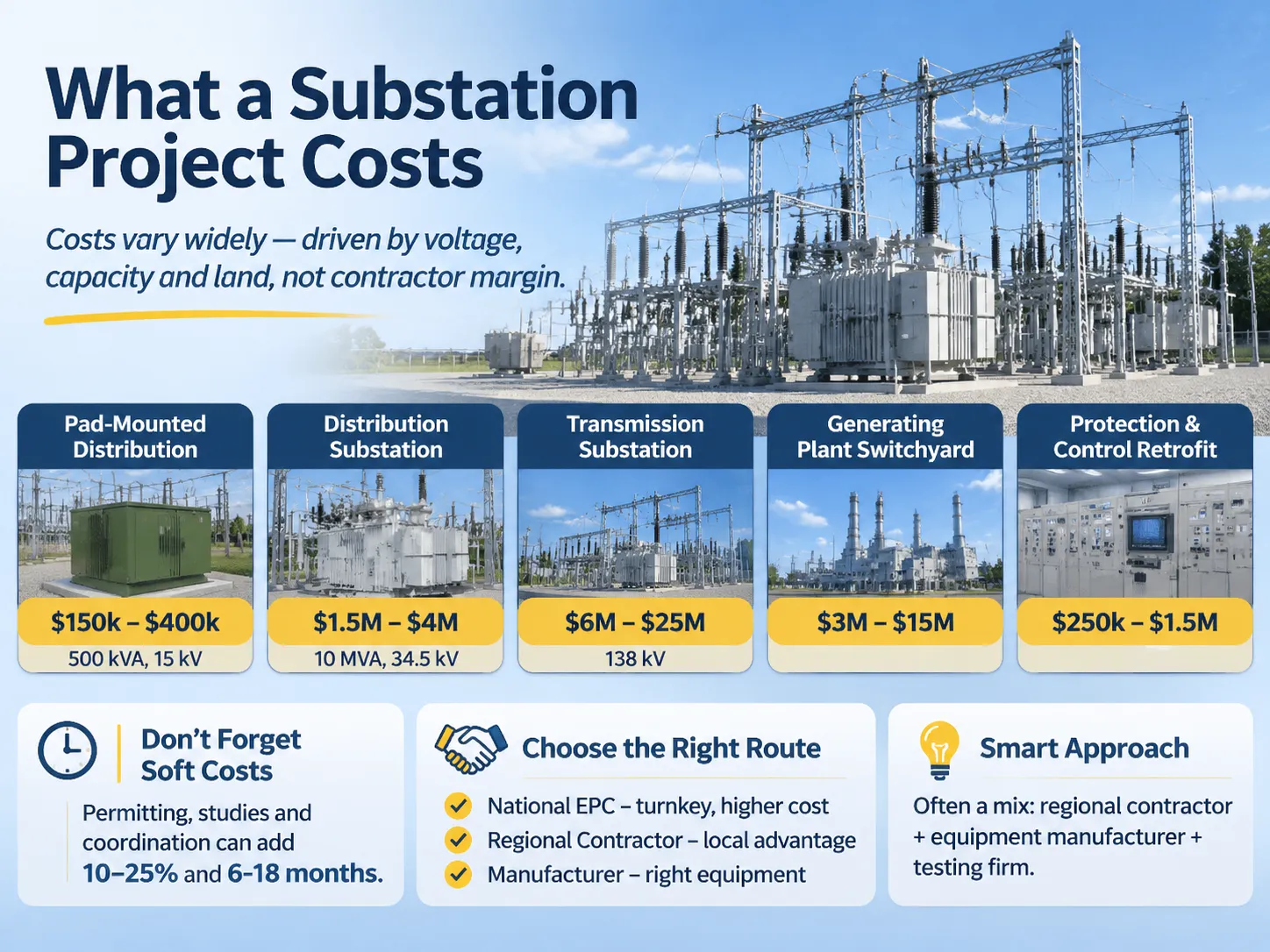
The whole-project costs vary by an order of magnitude and the variation is due to voltage, capacity and land, not contractor margin.
| Project type | Installed cost | What drives it |
|---|---|---|
| Pad-mounted distribution substation, 500 kVA, 15 kV | $150,000 to $400,000 | Foundation, transformer, MV switch, protection |
| Distribution substation, 10 MVA, 34.5 kV | $1.5 million to $4 million | Transformer, switchgear, control house, civil |
| Transmission substation, 138 kV | $6 million to $25 million | Voltage class, bay count, protection redundancy |
| Switchyard for a generating plant | $3 million to $15 million | Bus arrangement, breaker count, relay scheme |
| Protection and control retrofit | $250,000 to $1.5 million | Panel count, relay platform, cutover staging |
The soft cost is the line that hooks owners. Permitting, interconnection studies, and utility coordination can add 10 to 25 percent and 6 to 18 months before any steel is ever ordered. Normally there’s a year of study before a project starts construction in year two and no contractor can cut that.A complete single line diagram explanation is worth reading before the package is priced, because an incomplete drawing is the most common reason a quotation comes back with a large allowance instead of a number.
Strengths and Weaknesses of Each Route
National EPC contractor . Strength: single contract, single schedule, depth of crew and a balance sheet that can absorb liquidated damages. Weakness: cost of mobilization, small project gets a standard design (as opposed to an optimized design)
Regional Contractor Strength: local crews, relationships with local inspectors, and a price that reflects a smaller overhead. Weakness: Limited engineering depth above 69 kv, typically no in house relay setting capability.
Direct from the equipment manufacturer. Strength: the equipment is correctly specified, the warranty is clear and the type test documentation is authentic. Weakness: Civil works are not done by the manufacturer. The interface is the owner’s problem.
Imported equipment + local installation. The strength is in the schedule and price, often 30 to 50 percent below domestic supply. Weakness: No local service network, documentation that may not match utility format, and field evaluation if equipment is not US-market listed.
For most successful US projects, two of these were a regional contractor for civil and erection, a manufacturer for the major apparatus, and a testing firm for commissioning. The guide to compact substation configurations is relevant here because a prefabricated unit collapses two of those packages into one delivery, which reduces interface risk at the cost of design flexibility.
Beyond the US: Where Else to Buy
Outside North America the supplier map changes, and the change is mostly certification and service distance, not capability.
The type-tested assemblies and SF6-free switchgear market is dominated by European manufacturers, with Hitachi Energy, Siemens Energy and Ormazabal dominating the medium voltage market. Korean and Japanese suppliers are well placed in Asia and the Middle East. Chinese factories now account for most of the world’s transformer capacity and 2025 exports reached some ¥64.6 billion, up 36 percent year on year.
That changes the economics completely for a buyer in a market that takes IEC equipment. A 15 kV prefabricated substation from a Chinese factory is offered at less than half the price of a comparable US-built unit, with a delivery time of 6 to 12 months instead of 18, and the documentation is to IEC, not to a utility standard.
We are a factory, not a service organization in that market. We manufacture IEC distribution transformers, medium voltage switchgear and prefabricated substations, all built to a single line diagram with the enclosure, protection scheme and busbar configured accordingly. Routine test reports are provided prior to shipment. The distribution substation equipment range covers the 15 kV and 34.5 kV classes that most of this work falls into.
A Selection Table by Requirement
| If this is your requirement | Provider type that fits | What to check first |
|---|---|---|
| New utility substation, 69 kV and above, US | National EPC contractor plus approved-list manufacturer | Interconnection study status and transformer slot |
| Distribution substation under 34.5 kV, US | Regional contractor plus equipment supply | Local inspector requirements and relay settings |
| Replacement transformer only | Manufacturer direct, installation by local contractor | Physical envelope and impedance match |
| Protection and control retrofit | Testing and integration specialist | Cutover staging and outage windows |
| Annual maintenance and testing | Regional testing firm | Instrument calibration and report format |
| Project outside North America on IEC basis | Factory supply plus local erection | Type test reports and spares policy |
| Fast deployment, limited site work | Prefabricated or skid-mounted substation | Transport envelope and foundation design |
The schedule is defined by the first check in each row. A project that has not completed its interconnection study cannot order a transformer and a project that has not confirmed its physical envelope cannot accept one. Those two facts cause more delay than contractor performance.
Où Subian s'intègre
We are a manufacturer, not a nationwide service company, and that matters to a US buyer.” We don’t do crews, or permits, or commissioning in the United States, and a project that needs those should start with a contractor, not us.
We supply the equipment package including distribution and power transformers from 10 kVA up to about 20 MVA, medium voltage switchgear to IEC 62271-200 and prefabricated substations assembled and tested before shipment. Most of our output is into markets where IEC equipment is the local standard, and into US projects where the owner accepts an IEC assembly with a field evaluation.
L' composants de sous-station électrique side of the business is where most enquiries start, because a buyer usually knows which components are missing before knowing which complete assembly to order. Sending a single line diagram with the fault level and the outgoing schedule is enough to produce an itemised quotation.
FAQ
Who provides substation services nationwide in the US?
Three groups, and they are not fungible. EPC and construction market leaders include Quanta Services, MasTec, MYR Group, Primoris and Pike Electric. Major equipment is supplied by Hitachi Energy, Siemens Energy, GE Vernova, Eaton and Schneider Electric. Doble Engineering, Megger and local testing companies offer commissioning, diagnostics and maintenance. Most projects need at least two of the three.
How much does a substation cost?
Installed cost for a pad-mounted distribution substation around 500 kVA is $150,000 to $400,000. A 10 MVA distribution substation at 34.5 kV costs between $1.5 million and $4 million. A 138 kV transmission substation can start at $6 million and exceed $25 million depending on bay count and protection redundancy. Permitting and interconnection studies add 10 to 25 percent and 6 to 18 months to construction.
How long does it take to get a substation transformer?
12 to 24 months for a distribution unit and 36 to 48 months for a large power transformer from a Western manufacturer, the large transformer market sold out into the late 2020s. Chinese factories quote 12-18 months for equivalents. The transformer is usually the critical path so it should be ordered before the civil package is designed.
Can imported substation equipment be used in the US?
Yes, subject to approval by the authority having jurisdiction. Typically, equipment built to IEC, not UL or IEEE will require a field evaluation, which costs several thousand dollars and takes weeks. Some utilities won’t allow unlisted equipment at all. Ask about the route of acceptance before ordering, because the answer will determine whether the price advantage remains.
Références
- Hitachi Energy — Substations and Grid Integration
- Siemens Energy — Grid Technologies and Substations
- GE Vernova — Grid Solutions and Equipment
- Quanta Services — Electric Power Infrastructure Services
- Doble Engineering — Substation Testing and Diagnostics
Conclusion
One name, three markets. Substation services nationwide. “Contractors build,” he said. Manufacturers sell. Testing firms give testimony. A project that starts with a selection of a brand and then a scope, generally ends up managing interfaces for which it did not budget.
The interconnection study, the transformer slot; those are two things that no contractor has any control over and those dictate the schedule. Then check both before placing a purchase order. Determine whether the equipment is local with a service network or imported with a price and schedule advantage. It is what is right for your project, not someone else’s.