


Switchgear and switchboard are sometimes wrongly identified as one and the same; this can be seen in contract documents, in transmittals via email and in certain specific line diagrams. While both entities serve a common purpose, they are actually two distinct categories with their own UL standards, manufacturing processes, and pricing; therefore, they shouldn’t be confused with size alone. The difference between these two categories becomes evident weeks, months, or even years after the installation has been completed; occasionally this is due to receiving drawings re-designing the installed equipment, and at times it is due to receiving calculations related to fault current that do not match the equipment rating, and, in some instances, it is due to the maintenance personnel realizing that in order to perform maintenance on a feeder, the entire assembly must be de-energized.
Basically, a UL 891 compliant switchboard is a ‘dead front’ product which is supplied with low voltage energy and distributes low voltage to main and feeder devices using moulded-case or insulated case circuit breakers (on an individual or group basis). On the other hand, UL 1558 compliant switchgear is a low voltage circuit breaker with more metallic enclosure and will include UL 1066 compliant circuit breakers for short-circuit rating and bus, breaker and cable compartment enclosures. Both types are intended for use at less than 1000 V, both types will generally look alike since both are designed for distributing low voltage energy; however, the switchgear will be able to withstand faults and to continue operation due to its fault-withstanding rating. You should choose a switchboard when money and space are factors; when you need to do maintenance on the system without turning the system off, choose switchgear. The same principle is true regarding metallic enclosure and interrupting switchgear types that comply with IEEE standards. Subian Electric provides both styles of equipment (open-cut switchgear and low voltage switchgear).
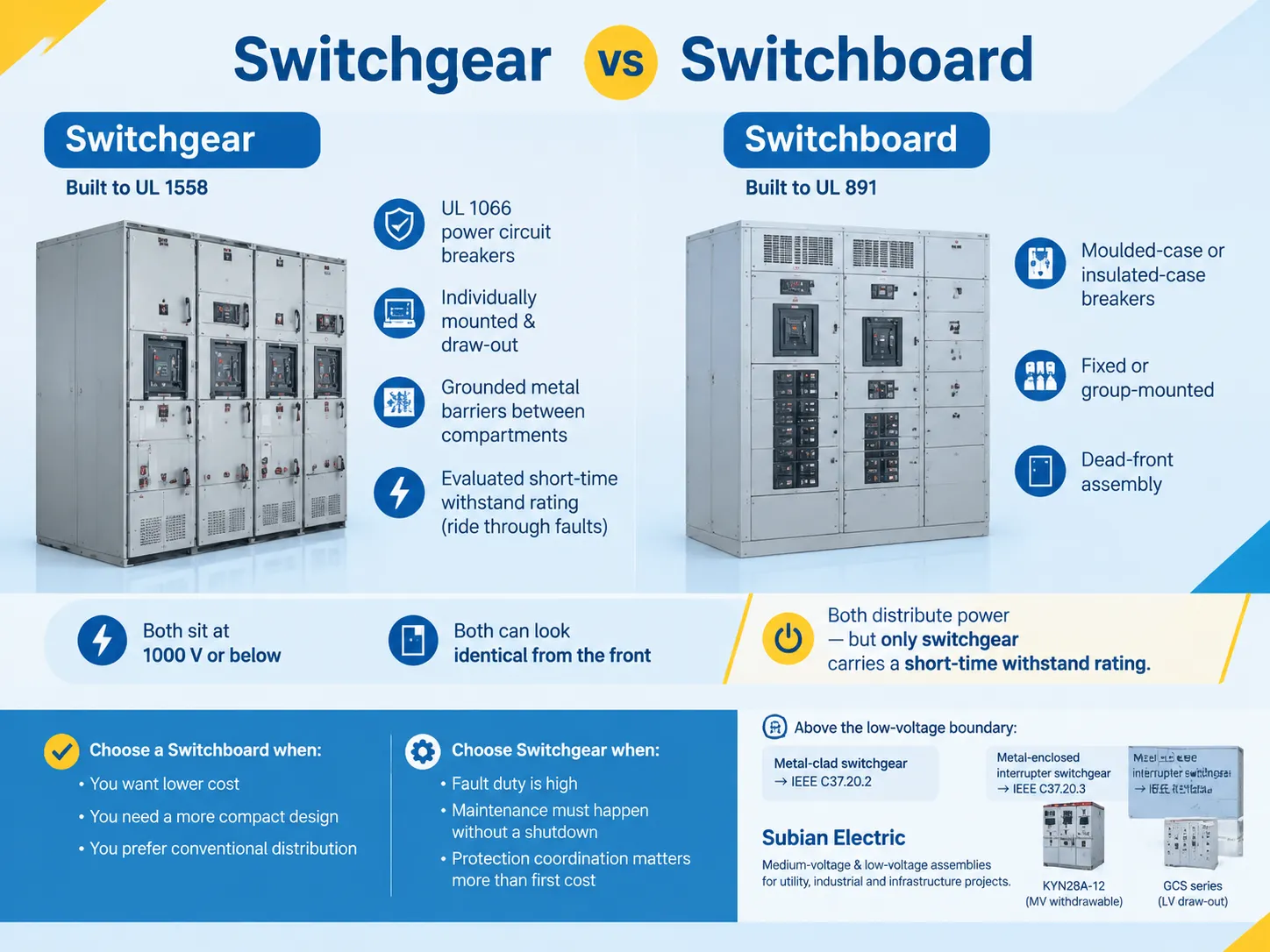
The Short Answer, and Why It Is Not About Size
It is true that one can say that switchboards are the less expensive equipment of the two groups while switchgear is the pricier and larger equipment; however, this is not enough to make a choice between the two items. A switchboard can have a rating of up to 1000 V and be capable of dealing with an available fault current of up to 200,000 A, while a line of switchgear may have ratings the facilities of mid-size businesses will never need.
The true distinguishing factor between the two items is their performance during a fault occurrence and servicing. A switchboard is supposed to interrupt a fault by making its breakers to trip almost instantaneously. In contrast, switchgear is manufactured to be able to handle a fault for a specific time, which is usually 30 cycles and helps clear a downstream fault by a device in the proximity even while the main switch stays closed and other equipment continues to work.
All other points of difference follow this one, including the compartmentalization, grounding means used, draw-out mechanism, space inside the substation, access rules and price. If it is possible to stop the operation of the equipment for maintenance and a local fault may cause the power cut for the whole facility without impact on operation, one can suggest using a switchboard as the best solution. If you need to ensure uninterrupted operation, the higher price of switchgear means that you invest in uninterrupted service.
What Switchgear Is
Low-voltage switchgear in North America refers to low-voltage metal-enclosed power circuit breaker switchgear, which is governed by UL 1558 and connected to ANSI/IEEE C37.20.1 construction and ANSI C37.51 testing standards. This standard applies to equipment rated under 1,000 V AC nominal. New requirements for multi-source switchgear were also added in the sixth edition of UL 1558 released in the month of April 2025, where the first revision was done in June 2026.
Nonetheless, the breaker defines the category rather than the voltage itself. Switchgear consists of low-voltage circuit breakers, tested by UL 1066 standards, which are rated 100% and can function in the enclosure without maintenance and offer full remote operation in exceptional cases of failure and may go through faults for 30 cycles in a row. Usually, the breakers are installed separately and given draw-out designs.
The construction itself echoes the maintenance model. The compartments are separated from each other by grounded metal assembling and each breaker is isolated from the others. The compartments for cables and the bus are separated from each other as well. The use of barriers eliminates propagation of faults from one cubicle to other cubicles creating the necessity to design deeper footprint of the switchgear versus other types of switchboards.
Typically, any switchgear lineup will consist of the main service equipment, critical feeder distribution, multiple-source and main-tie-main arrangements, generator paralleling points, protective relays, measuring equipment, communication and monitoring devices, and, more and more frequently, arc flash reduction items. The construction ultimately allows the performers to achieve the equipment performance rather than simply assume its characteristics. Assembly-level definitions of metal-enclosed constructions are covered in our note on metal-enclosed switch gear.
What a Switchboard Is
A switchboard, as it is known in North America, is a dead-front assembly constructed in accordance with UL 891. According to UL Solutions, UL 891 is referred to as the most widely used standard regarding the installation of dead-front switchboards in North America. The standard being referred to applies to switchboards that have voltage ratings that are not more than 1000V. In terms of fault current capability, it has as high as 200,000 A rms. However, each switchboard has its own specific rating, and also the mark that goes with its rating. In the revision of March 2025, there have been additional or updated requirements regarding several-source switchboards, forced-air cooling, emergency circuits, and service equipment.
The main safety attribute here is the aspect of dead front, which implies that there is no access to live parts from the front side of the equipment under standard operational conditions. However, UL 891 does not stipulate the compartmentalisation requirement of different devices. The breakers that can be found in the switchboard are grouped together, while the protecting equipment usually features moulded-case breakers to UL 489 standards, insulated case breakers, or UL 98 switches that come with UL 248 fuses. Moulded-case breakers are equipment that cannot be repaired. That means, however, that while the equipment is operational, they are usually rated at 80% of the standard rating unless another parameter is stated.
There are two important conclusions that arise from this type of equipment. The first one is that the dead front assemblies are usually smaller than traditional switchgear of the corresponding power, since group mounting allows to install more power per area. In addition, UL 891 does not mean that switchboards might also feature short-time ratings that would enable them to be used in cases of a fault.
The contents of switchboards are also numerous: main insulated or moulded breakers, as well as fusible main switches, main lugs, feeder breakers, fusible feeders, copper or aluminium bushing, neutral and grounding bushing, counter system, surge protection system, cable pull section, and monitoring system, arranged in a standalone system.
How They Work Together in a Single Distribution System
In many organizations, switchgear and switchboards are not in contention for the same place. The two systems are positioned differently within the project, as it is common practice for large projects to use both. A distillation process runs all the way from the utility company through the most powerful equipment, distributing electricity down to less powerful devices.The utility provider or service transformer is the primary source of energy for the electrical equipment. The next level of power distribution circuit will be lower down, followed by the branching circuits level. In fact, the distinction between the first and the second level is what makes the specification of whether to use UL 891 or UL 1558 equipment.
There is another serious naming problem because of which, buyers can make errors in the purchasing process. For example, it has been a common practice in the IEC-based markets to refer to large main distribution systems as “switchgear,” which is a broader term that includes transformers and other power lines. In such cases, the buyers use the term “switchgear” even if they should buy a UL 891 switchboard. The opposite situation may also occur when buyers ask for “switchboard” in a situation where the specification calls for using UL 1558 draws-out circuit breakers. Whenever dealing with such projects abroad, it is important to specify the project type according to the standards used, rather than according to the common word.
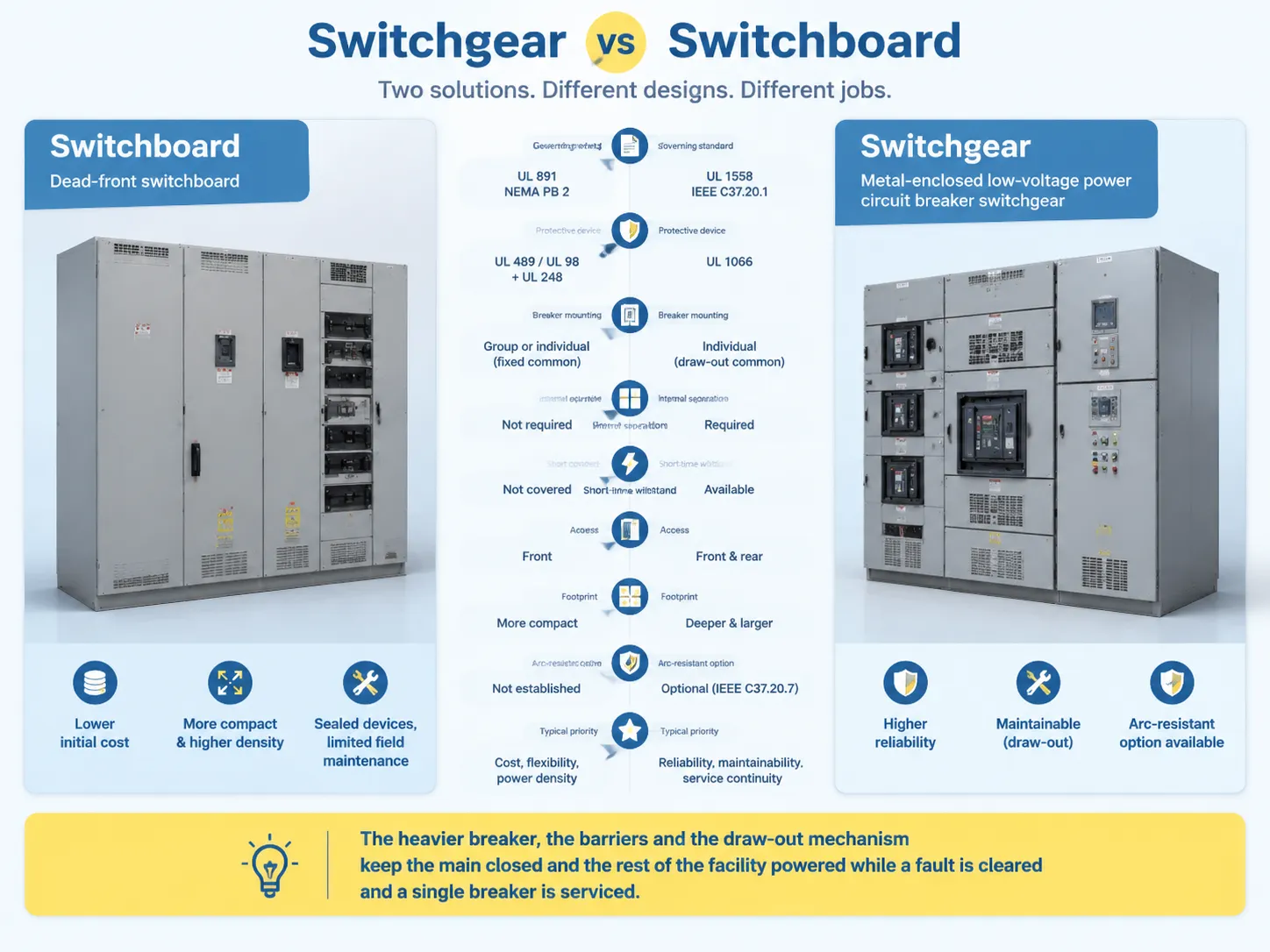
Switchgear vs Switchboard: Side-by-Side
| Fattore | Switchboard | Quadri elettrici |
|---|---|---|
| Norma di riferimento | UL 891; NEMA PB 2 legacy | UL 1558; IEEE/ANSI C37.20.1; ANSI C37.51 |
| Product description | Dead-front switchboard | Metal-enclosed low-voltage power circuit breaker switchgear |
| Dispositivo di protezione | UL 489 moulded-case or insulated-case breakers; UL 98 switches with UL 248 fuses | UL 1066 low-voltage power circuit breakers |
| Breaker mounting | Group-mounted or individually mounted, often fixed | Commonly individually mounted and draw-out |
| Internal separation | Not required between devices | Barriers required between breaker, bus and cable compartments |
| Resistenza a breve termine | Not covered by UL 891 | Available in evaluated configurations |
| Fault behaviour | Devices trip without intentional delay on high fault | Can withstand and operate through a fault, typically up to 30 cycles |
| Maintenance approach | Sealed devices, limited field maintenance | Draw-out breakers maintainable with the bus energised |
| Access | Front access standard | Front and rear access standard |
| Impronta | Usually more compact, higher power density | Usually deeper and larger |
| Arc-resistant option | Not established by the UL 891 listing | Optional, separately specified and evaluated per IEEE C37.20.7 |
| Typical priority | Installed cost, flexibility, power density | Reliability, maintainability, coordination, service continuity |
By reading alongside the short-time withstand row, the rest of the table makes sense. The heavier circuit breaker, the barriers, and the withdraw mechanism are all designed to do one thing: keep the main circuit closed and the facility energized while a fault downstream is cleared and one circuit breaker is maintained.A representative low-voltage assembly built on that logic is described in our GCS low voltage draw-out switchgear.
The Three Types of Switchgear, and the Three Levels of Switchboard
When it comes to classifying equipment, the next logical step will be enquiring what construction class is being dealt with. As it happens, the construction class criteria are clear and straightforward. There are three construction classes for the switchgear, as defined by the National Electrical Manufacturers Association. The rest, including compact switchgear, arc-resistant design, gas-insulated equipment is just a modified version within the basic classes.
| Tipo | Standard | Intervallo di tensione | Distinguishing feature |
|---|---|---|---|
| Metal-enclosed low-voltage power circuit breaker switchgear | IEEE C37.20.1 / UL 1558 | Up to 1000 V AC nominal | Compartmentalised LV assembly with UL 1066 draw-out breakers |
| Metal-clad switchgear | IEEE C37.20.2 | 5 kV to 38 kV, extended to 48.3 kV | Draw-out breakers, grounded metal barriers on all four compartments, automatic shutters, mechanical interlocks |
| Metal-enclosed interrupter switchgear | IEEE C37.20.3 | Above 1 kV up to 48.3 kV | Interrupter switches with power fuses; performance-based rather than structurally prescriptive |
The importance of the metal-clad clause must be understood as the standard is more prescriptive than aspirational. Thus, IEEE C37.20.2 realizes that the breaker, main bus, cable, and low-voltage compartments need to be separated by grounded metal barriers with no intentional openings between them; that the interrupting device is removable with connected, test, and disconnected positions; that there are automatic shutters protecting the primary stabs once the breaker is taken out; and that there are mechanical interlocks that prevent any closed breaker from being racked out or a wrong positioned breaker from being closed. The continuous ratings of the main bus generally fall within the ranges of 1200 A, 2000 A, 3000 A, and 4000 A.
Meanwhile, IEEE C37.20.3 does not share the same approach. Unlike the previous standards, this one governs the metal-enclosed assemblies in which switches interrupt load current inside the grounded enclosure using interrupt switches and fuses instead of the draw-out breakers. Metal-enclosed switchgear is lighter, more compact, and less expensive thus providing a desirable solution for feeders operating rarely while being below the fault levels consistent with draw-out breakers. One of the popular warnings within the industry is relevant for the situation with metal-clad switchgear since it is true that all metal-clad switchgear enables one type of metal-enclosed switchgear yet one cannot say vice versa without proving o the compliance with all previous statements.
With respect to cases when arc resistance is called for it should be emphasized that arc resistance would be mentioned in a specific way and that would be covered by IEEE C37.20.7 which refers to arc-resistant switchgear producing voltage of up to 52 kV and defining access ratings, such as: Type 1 serves only the people working in front of it while Type 2 facilitates the safety of people working in the front, behind, and on either side of it. It is worth mentioning that the arc-resistant construction is becoming widely used in data centers and industries in modern times and should be checked and verified independently of the type of equipment used to create the construction.
The rules regarding levels at the switchboard side are going in the opposite direction since the levels depend on their position in the system and not on their construction classification. As for UL 891, those switchboards are used for main and feeder distribution. UL 67 panelboards, rated within 1200 A, have the purpose of distributing the branch circuits while being mounted onto the wall. The commonly used sequence illustrates the power generating plant and transformer powering the switchboard which is further linked to the panel boards.Buyers comparing switchboards against legacy brand-name line-ups often arrive through a specific manufacturer’s catalogue; Siemens switchgear naming and positioning is a useful example of how one vendor organises an overlapping range, covered in our notes on Siemens switchgear.
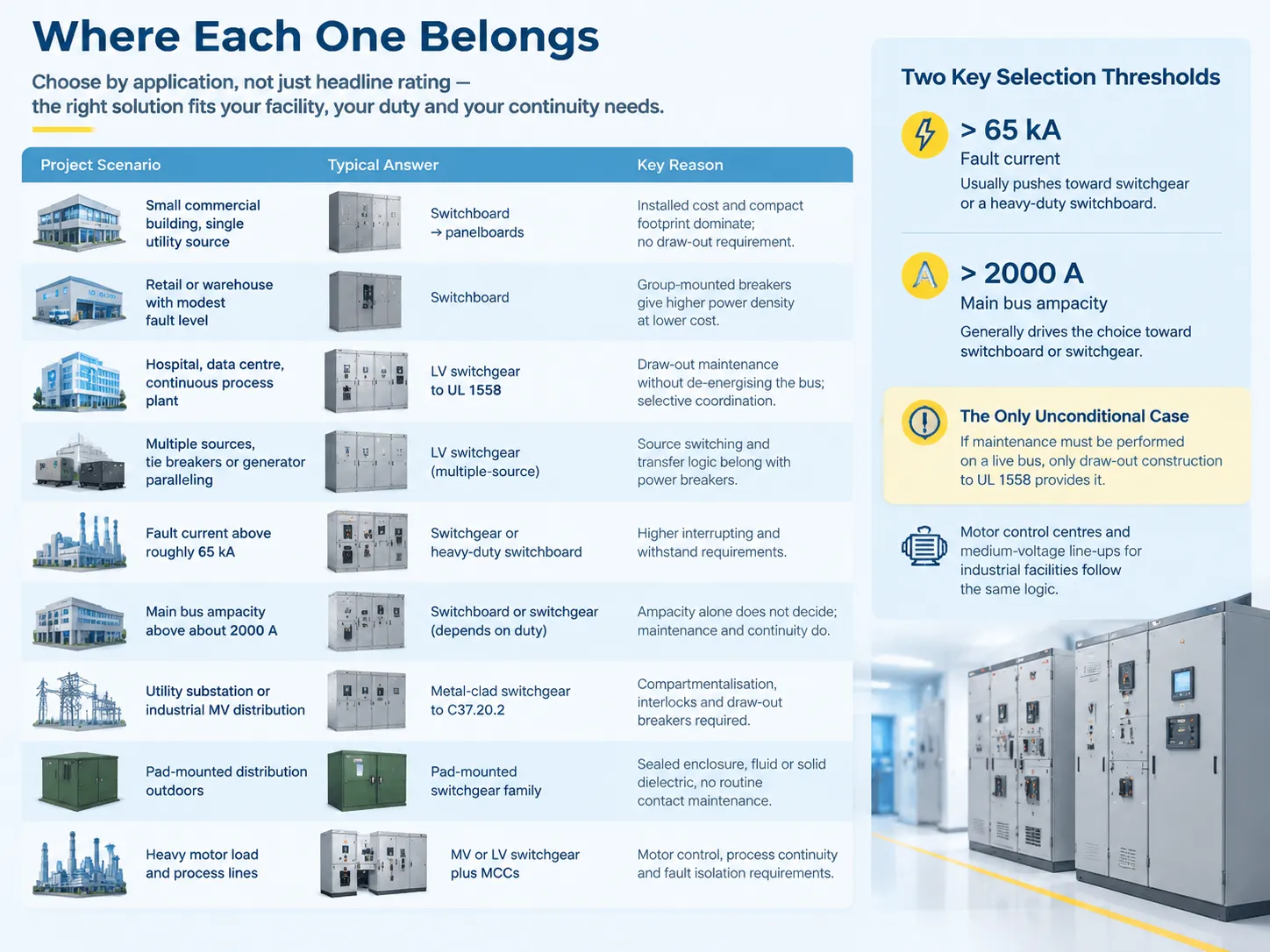
Where Each One Belongs
Deciding by application is more reliable than deciding by headline rating, because the applications cluster naturally around the maintenance and continuity requirements — and in practice they land in the same building types, from industrial manufacturing facilities to hospitals and data halls.
| Project scenario | Typical answer | Motivo |
|---|---|---|
| Small commercial building, single utility source | Switchboard feeding panelboards | Installed cost and compact footprint dominate; no draw-out requirement |
| Retail or warehouse with modest fault level | Switchboard | Group-mounted breakers give higher power density at lower cost |
| Hospital, data centre, continuous process plant | LV switchgear to UL 1558 | Draw-out maintenance without de-energising the bus; selective coordination |
| Facility with multiple sources, tie breakers or generator paralleling | LV switchgear, multiple-source configuration | Both UL 891 and UL 1558 now address multiple-source arrangements, but source switching and transfer logic belong with power breakers |
| Fault current above roughly 65 kA | Switchgear or heavy-duty switchboard | Higher interrupting and withstand requirements push toward heavier construction |
| Main bus ampacity above about 2000 A | Switchboard or switchgear depending on duty | Ampacity alone does not decide; maintenance and continuity do |
| Utility substation or industrial MV distribution | Metal-clad switchgear to C37.20.2 | Compartmentalisation, interlocks and draw-out breakers required |
| MV feeder that switches infrequently | Metal-enclosed interrupter switchgear to C37.20.3 | Lower cost and smaller footprint suit the duty cycle |
| Pad-mounted distribution outdoors | Pad-mounted switchgear family | Sealed enclosure, fluid or solid dielectric, no routine contact maintenance |
| Industrial plant with heavy motor load and process lines | MV or LV switchgear plus MCCs | Motor control, process continuity and fault isolation requirements |
There are typically two selection limits not only in a way industry sometimes mentions that it’d be good to name them carefully, one of them being that it is not a standard itself. The point is that any projects where current flows in excess of around 65 kA normally find themselves utilizing the switchgear as well as heavy-duty switchboards instead of conventional ones. Moreover, if the choice of the bus is around 2000 A, you can bet it is either switchboard or switchgear and turned down anything that lies in the area of a panelboard.Motor control centres and medium-voltage line-ups for industrial facilities are built to the same logic — an example of the MV and LV assemblies used in that combination is described in our KYN28A-12 withdrawable AC metal-enclosed switchgear.
How to Specify the Right One
The following specifications are presented according to the sequence in which the information on them is finally collected. The commonest way for projects to procure the wrong model is by jumping from the equipment specification to the category, before the fault study has been done.
- Determine the existing fault current. It is a project requirement to conduct a short-circuit analysis. An equipment’s short-circuit rating must match or exceed the fault current at the equipment terminals, as per NEC 408.6. Thus, without this analysis, it is impossible to make reliable decisions regarding any downstream ratings.
- Indicate the equipment designations according to their standard numbers. For example, indicate “dead-front switchboard per UL 891” or “metal-enclosed low-voltage power circuit breaker switchgear per UL 1558 and IEEE C37.20.1”. Naming the standards eliminates ambiguity of the term “switchgear”.
- Define the maintenance approach even before pricing it out. Ask whether it will be possible to service any feeder with the rest of the site being energized. If the answer is “yes”, then the requirement becomes draw-out design, and it can no longer be reversed beyond this point without completely replacing the assembly.
- Confirm the short-time withstand criteria separately. It is important to note that UL 891 does not provide any short-time withstand current ratings, which means that if a design presumes a withstand period, this information should be explicitly mentioned in the UL 1558 specification. Do not assume anything by looking at switchboard quotations.
- Make sure the device class and the coordination study stay together. Selective coordination is possible in certain installations on both platforms, but power circuit breakers provide wider possibilities in terms of settings and delay. In case the design depends upon coordination at high fault levels, the class of the circuit breaker and the study should be treated as a single deliverable.
- Specifically indicate the requirement for arc-resistant construction only if this requirement is present. Arc resistance testing is to be performed in compliance with IEEE C37.20.7, while UL 891 and
- UL 1558 do not include any requirements regarding the arc resistance testing. Indicate the type of the equipment access required, Type 1 or Type 2, and ask for the testing results.
- Coordinate the layout of the entire room rather than only the equipment. Room requirements include space for equipment access, entry direction for incoming cables, back distance, space required for ventilation of forced-ventilated designs, and room needed to remove and reload the circuit breaker.
- Plan procurement in accordance with realistic lead times. Lead times for low-voltage draw-out switchgear reached 70-80 weeks in early 2024, which means that procurement decisions for equipment with long delivery times must be finalized at the schematic design stage. Treating switchgear as a last-minute purchase is how projects lose the commissioning window.
A deceptively common issue in manufacturing needs clearing up. It is when there is a specification for “switchgear” in the plans, but the buyer has instead brought in UL 891 switchboards at lower cost. The one-line diagram has been unaffected. However, the installation cannot achieve all the required ratings and thus operation of the plant can be jeopardized and the problem can go unnoticed until the failure occurs. In case switchgear is needed, it will be best if the plans indicate so and provide relevant standards.
FAQ
What is another name for switchgear?
The official term is switchgear assembly – switchgear in IEEE C37.100.1 is outlined as term that encompasses switchgear assembly which includes switching, interrupting and controlling, metering, protective and regulating devices and enclosing structures. Similar concept in IEC market is an assembly of devices, hence the word has broader meaning there. For medium voltage construction terms are, respectively: metal-clad switchgear, metal-enclosed interrupter switchgear, compact switchgear related to IEEE C37.20.9. Old drawings of North America would refer to historical names of NEMA SG 3 and SG 5, which IEEE C37.20 has already replaced. At the facility itself the operators usually refer to switchgear simply as “gear”.
Is a breaker considered switchgear?
No. A circuit breaker is a component; switchgear is a component of the complete set. The importance of the distinction is that breakages and switchgear are governed individually, as in the case of UL1066 low voltage power circuit breaker and UL489 moulded case circuit breaker. After fitting, a breakage is part and parcel of a listed assembly, e.g. switchgear or switchboard assembly, and is subject to rating short circuit current capacity. Thus, the breaker class reflects the corresponding category of the installation: power circuit breaker refers to switchgear and case or insulated case circuit breaker refers to switchboard in every situation.
What are the three types of switchgear?
According to the American Institute of Electrical Engineers and the American National Standards Institute standards that provide coverage for construction within North America, there exist three classifications of machinery: namely, metal-enclosed switchgear circuitry that conforms with IEEE C37.20.1 and UL 1558 standards and has a capacity for operating at voltages of up to 1000V AC; metal-clad switchgear recognized as complying with IEEE C37.20.2 standards that operates with voltages within the range of 5kV through 38 kV and has a bus rating of 1200 A to 4000 A; finally, there is metal-enclosed switchgear that utilizes interrupter functions under standards of IEEE C37.20.3, which includes equipment rated higher than 1kV but within a voltage capacity of 48.3 kV. In addition, a third manner to categorize switchgear is by voltage class where switchgear machinery is divided into three groups: low voltage, medium voltage, and high voltage types.
What is the main purpose of a switchgear?
The goal is to provide controllability and survivability to the power system. This can be divided into four functions, which are often confused: constant carrying of the current without too much temperature rise, switching on and off circuits under load, interrupting the short-circuit and isolating the defective section, while keeping the rest of the system energized, and ensuring the safety of switching off so that people can work on the equipment. The construction features of the switchgear (barriers, draw-out mechanism, interlocks, shutters, withstand rating, etc.) are required for the last functions only. Hence, it is possible to use switchgear where unexpected outages are costly and where maintenance is carried out on the live system, while the use of switchboard works wherever it is not true.
Riferimenti
- IEEE Standards Association — C37.20.1, C37.20.2, C37.20.3, C37.20.7 and C37.100.1
- UL Solutions — UL 891 Switchboards, UL 1558 Switchgear, UL 67 Panelboards
- NEMA — PB 2 Deadfront Distribution Switchboards and SG series
- NFPA — NFPA 70 National Electrical Code, Article 408
- IEC — IEC 61439 and IEC 62271 series for assemblies and switchgear
- Eaton — application guidance on switchgear versus switchboards
- Schneider Electric — low-voltage distribution equipment documentation
- ANSI — C37.51 conformance test procedures
- Electrical Safety Foundation International — workplace electrical injury data
- OSHA — arc flash and electrical safety guidance
Conclusione
Switchgear and Switchboards are two different types of electrical equipment. Each provides a unique function, has its own unique form factor, comes in many different types, etc. There are many different types of switchgear, but they are not the same as a switchboard.In order to ensure you are selecting the proper Switchgear or Switchboard, it is essential to follow the three rules outlined here. The first rule is to use the appropriate standard(s) when using either an Electrical Schematic Diagram or Architectural Document that specifies the switchgear or switchboard. Simply stating the common name of an item is not sufficient. The second principle states that you should select the maintenance program prior to determining the pricing of the equipment. A maintenance program cannot be added to the group type after pricing has been established, because the draw-out feature in a maintenance program, if not originally designed in, cannot be easily retrofitted. Finally, the third principle states that a short circuit analysis should be performed early in the project implementation process, as this analysis will help determine the type of switchgear or switchboard selections.