


La valutazione standard in kVA utilizzata per la distribuzione nell'elettricità trifase in Nord America è di 112,5 kVA. Con questo numero e i requisiti del Codice Elettrico Nazionale riguardanti le installazioni di tipo secco, la sua prevalenza diventa facile da comprendere. Questo potrebbe sembrare un fatto inaspettato, ma due trasformatori che condividono lo stesso kVA e rapporto di tensione possono differire significativamente in molte caratteristiche, ad esempio, nel volume e nel peso che possono variare di centinaia di libbre. In questo articolo, ti fornisco le specifiche esatte ed esploro i fattori che hanno un impatto significativo sulle dimensioni dei trasformatori.
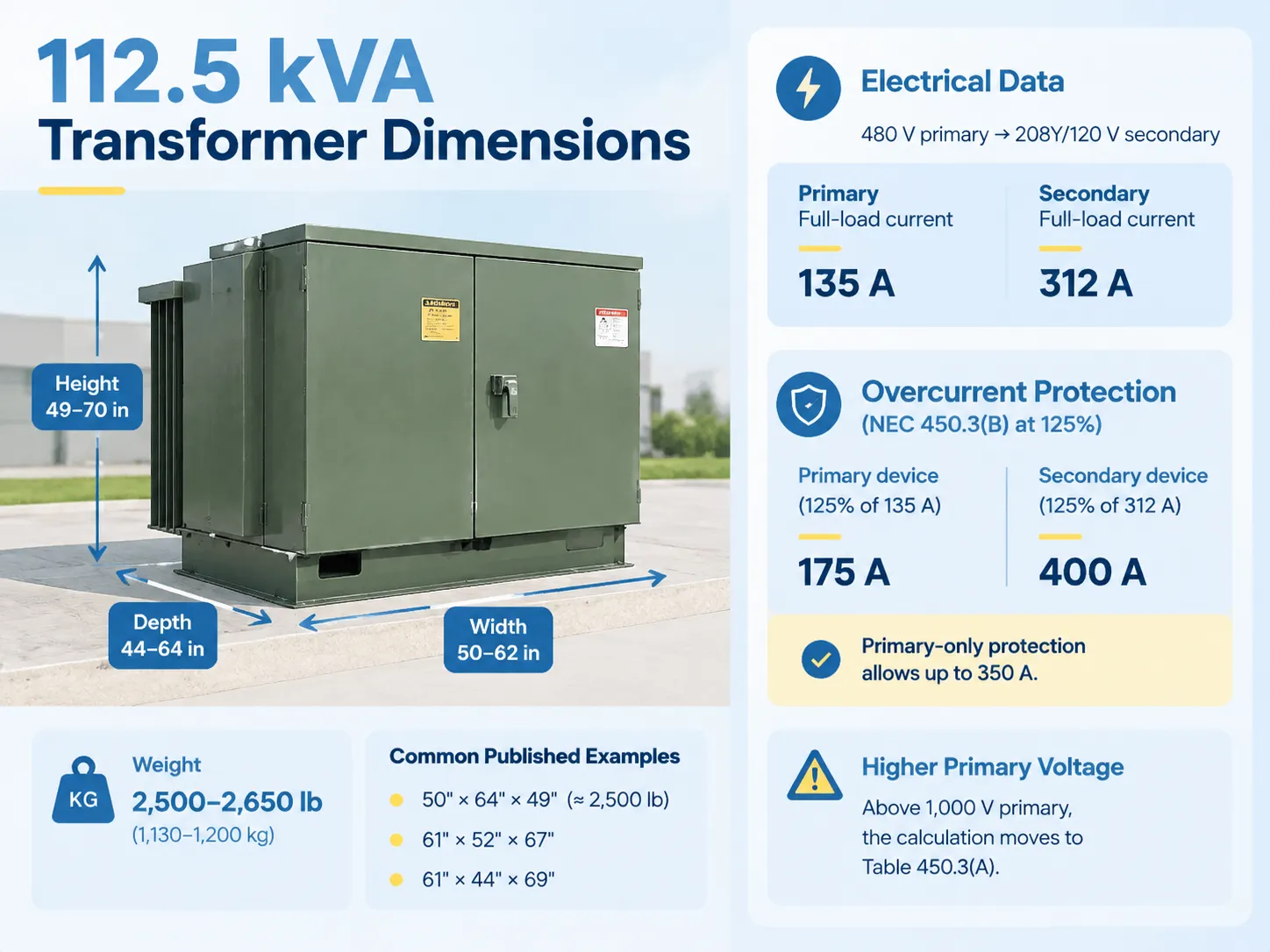
In breve, un trasformatore trifase con una valutazione di 112,5 kVA è di circa 50–62 pollici di larghezza, 44–64 pollici di profondità e 49–70 pollici di altezza mentre pesa circa 2.500–2.650 lb (1.130–1.200 kg). Ad esempio, le dimensioni pubblicate di questo trasformatore sono 50″ × 64″ × 49″ e circa 2.500 lb, 61″ × 52″ × 67″ e 61″ × 44″ × 69″. In termini di capacità, quando 480V è la tensione primaria che fornisce 208Y/120V, la scala di carico completo primaria legge 135A e la corrente di carico completo secondaria legge 312A; pertanto, l'unità primaria di 175A e un'unità secondaria di 400A forniscono una protezione adeguata secondo il Codice Elettrico Nazionale 450.3 (B) a 125%.
Cosa significa realmente 112,5 kVA
Un kVA di 112,5 appartiene alla comune serie di distribuzione ANSI. Le valutazioni standard vanno da 15-30-45-75-112,5-150-225-300-500-750-1000 e superiori. È un numero che si colloca tra 75 e 150, essendo un numero preferito per gli edifici commerciali perché consente livelli di carico superiori a quelli che 75 kVA può giustificare senza pagare per una capacità non necessaria di un impianto da 150 kVA.
Questa cifra funge anche da cifra soglia per il Codice. I trasformatori di tipo secco inferiori o uguali a 112,5 kVA possono essere installati senza una camera blindata e all'aperto secondo NEC 450.21(A), a condizione che siano distanziati dal materiale combustibile di almeno un piede, a meno che non si utilizzi una barriera isolata o un trasformatore completamente chiuso (eccetto per le aperture di ventilazione). Per le capacità superiori a 112,5, un dispositivo di tipo secco situato all'interno deve essere collocato in una sala trasformatori che soddisfi i requisiti di resistenza al fuoco, mentre le esenzioni si applicano all'installazione con materiale isolante di Classe 155 o superiore. Pertanto, passare dalla gamma di 112,5 kVA alla gamma di 150 kVA può modificare le caratteristiche della stanza che deve essere costruita e non solo il tipo di attrezzatura acquistata.
È importante notare cosa rappresenta il kVA dal punto di vista elettrico poiché non è uguale al kW. Il trasformatore con una capacità nominale di 112,5 kVA produce solo 112,5 kW per carico puramente resistivo; nella pratica, la sua uscita in watt reali è inferiore nonostante il fatto che l'avvolgimento consuma l'intero importo di kVA. La relazione, e come dimensionare rispetto a un carico connesso reale piuttosto che a uno presunto, è esposta in questa spiegazione di cosa sia una valutazione del trasformatore in kVA.
Le dimensioni su cui dovresti pianificare
I numeri forniti sono tratti da dati originali ottenuti da unità montate a pavimento trifase da 112,5 kVA, che sono completamente auto-raffreddate (KNAN), hanno un aumento di temperatura di 65 °C e operano a una frequenza di 60 Hz secondo gli standard DOE 2016 e gli standard ANSI/IEEE C57.12.
| Configurazione | Larghezza | Profondità | Altezza | Peso |
|---|---|---|---|---|
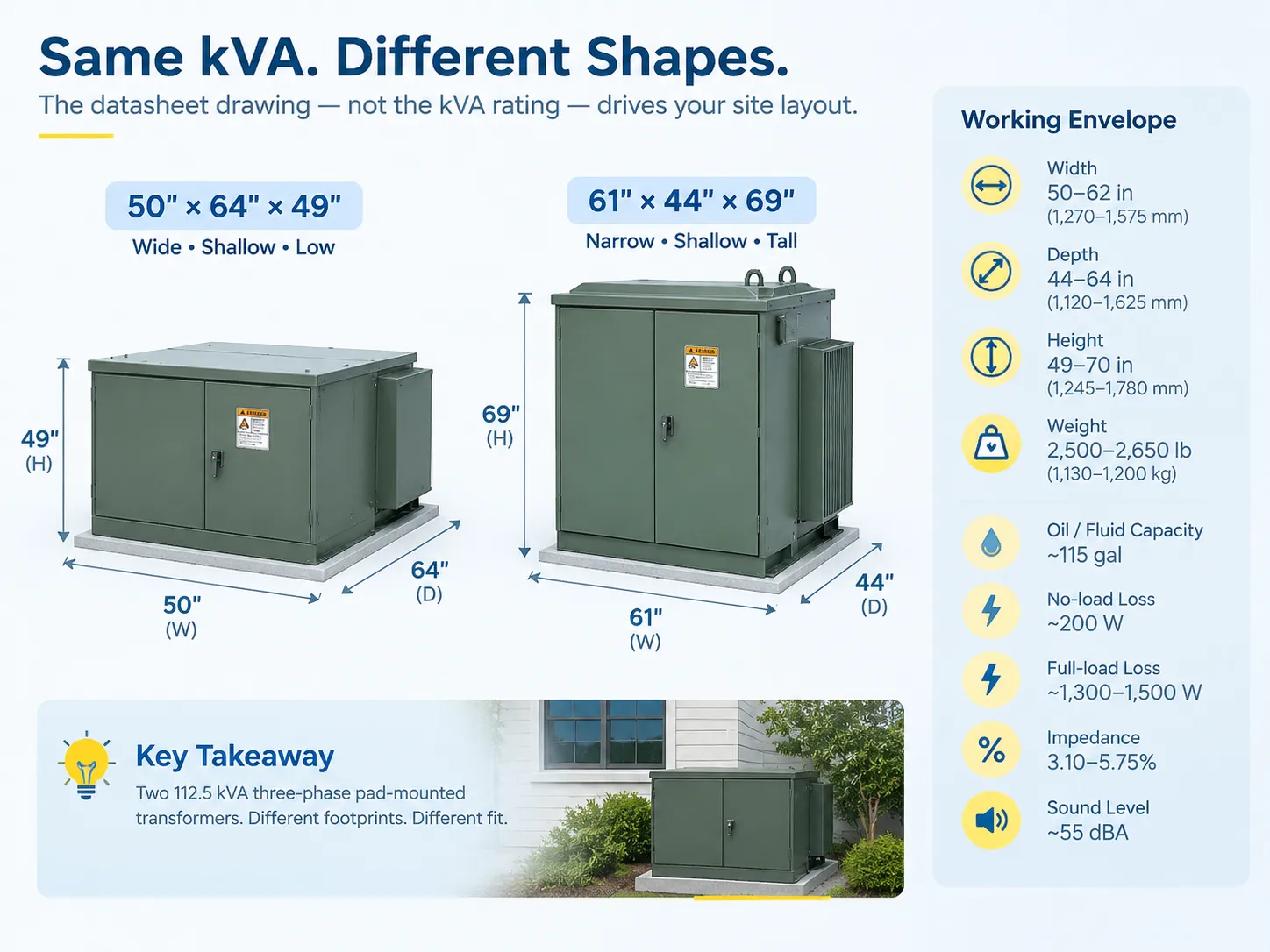
| 600Y/12.470 V → 208Y/120 V, frontale morto, alimentazione a loop, avvolgimento in alluminio | 50 in | 64 in | 49 in | ±2.500 lb |
| 160 V → 480Y/277 V, avvolgimento in rame | 61 in | 52 in | 67 in | — |
| 200 V → 480Y/277 V, avvolgimento in rame | 61 in | 44 in | 69 in | — |
| Famiglia generale di trasformatori montati a pavimento trifase, ampie opzioni di tensione | — | — | — | 640 lb |
Convertito nell'involucro di lavoro per una specifica:
| Parametro | Intervallo di pianificazione |
|---|---|
| Larghezza | 50–62 in (1.270–1.575 mm) |
| Profondità | 44–64 in (1.120–1.625 mm) |
| Altezza | 49–70 in (1.245–1.780 mm) |
| Peso | 500–2.650 lb (1.130–1.200 kg) |
| Capacità dell'olio o del fluido | Circa 115 galloni USA su un design a serbatoio sigillato |
| Perdita a vuoto | Circa 200 W |
| Perdita a carico completo | Circa 1.300–1.500 W |
| Impedenza | 3.10–5.75% |
| Livello sonoro | Circa 55 dBA |
Quando si confrontano le dimensioni dei trasformatori, è più importante preoccuparsi delle loro forme piuttosto che dei numeri. Il trasformatore con dimensioni di 50 pollici di larghezza, 64 pollici di lunghezza e 49 pollici di altezza ha una forma larga e bassa, mentre il trasformatore con dimensioni di 61 pollici di lunghezza, 44 pollici di larghezza e 69 pollici di altezza ha una forma stretta e alta. Anche se la loro valutazione in kVA è la stessa a 112,5, uno di essi può essere posizionato sotto la finestra mentre l'altro no. Pertanto, il processo di disposizione del sito dovrebbe essere guidato dal disegno sulla scheda dati piuttosto che dalla valutazione in kVA.
Le Sei Variabili Che Muovono i Numeri
Comprendendo la diffusione dei numeri, puoi stimare l'importo prima che arrivi il preventivo.
- Tensione primaria e BIL. Una primaria a 4160 volt richiede solo un'isolamento moderato, mentre una primaria a stella messa a terra di 21600 volt ha un BIL di 95 kV. Un aumento del BIL comporta un aumento delle distanze di sicurezza all'interno del serbatoio, un aumento dell'altezza del manicotto e un involucro profondo. Il trasformatore a 4,16 kV è lungo 52 pollici, mentre l'altro trasformatore ha un'altezza di 64 pollici.
- Un trasformatore frontale morto rispetto a un trasformatore frontale attivo. Un design frontale morto incorpora terminazioni ad alta tensione isolate e connessioni a gomito, il che significa che è necessaria una compartimentazione più ampia. Il motivo per cui i trasformatori moderni sono più ingombranti rispetto ai loro analoghi degli anni '90 è che devono soddisfare le specifiche moderne per le attrezzature frontali morte.
- L'avvolgimento in rame del trasformatore contrasta con l'avvolgimento in alluminio del trasformatore. L'avvolgimento in rame occupa meno spazio rispetto all'alluminio e, quindi, quando viene utilizzato un avvolgimento in rame, le dimensioni complessive del trasformatore diminuiscono. Questo fattore è particolarmente importante quando i produttori cercano di determinare l'impronta del pavimento per il trasformatore.
- Metodo di avvolgimento: alimentazione a loop rispetto ad alimentazione radiale. Il metodo di avvolgimento a loop richiede più punti di connessione e ulteriore sviluppo tecnologico, aumentando così le dimensioni del trasformatore. Ecco perché due trasformatori di “stesso” design realizzati secondo i diversi metodi di avvolgimento avranno parametri diversi.
- Classe di raffreddamento. Man mano che la classe di raffreddamento aumenta, anche la temperatura di raffreddamento aumenta. Pertanto, la classe di raffreddamento KNAF è maggiore di KNAN, mentre i parametri del trasformatore rimangono invariati. Ad esempio, possiamo dire che un trasformatore con un aumento di 65 °C sarà più grande di un trasformatore con un aumento di 55 °C.
- Classe di efficienza. Secondo i requisiti di efficienza delineati nel 10 CFR Parte 431 che sono stati imposti ai produttori nel 2016 e che hanno influenzato l'industria da allora, le dimensioni dei trasformatori prodotti prima e dopo questi limiti saranno distinte, e i prezzi per l'attrezzatura usata non forniranno cifre accurate.
Dimensioni per tipo di trasformatore
La valutazione di 112,5 kVA appare in più di una famiglia di prodotti, e le famiglie non hanno la stessa forma.
| Tipo | Carattere di ingombro tipico | Dove viene utilizzato |
|---|---|---|
| Tre fasi montate su basamento, riempite d'olio | Involucro ampio, basso e a prova di manomissione su una base in cemento | Sviluppi commerciali e residenziali, distribuzione all'aperto |
| Tre fasi di tipo secco, ventilato | Più alto, più stretto, necessita di spazio per la ventilazione e spazio per il flusso d'aria | Stanze elettriche interne, riduzione da 480 V a 208Y/120 V |
| Tre fasi di tipo secco, resina colata | Ingombro simile a quello ventilato ma senza spazio di respirazione | Ospedale, centro dati e qualsiasi luogo interno dove l'olio non è gradito |
| Montato su palo monofase | Serbatoio più piccolo, montato in alto, serie di valutazione diversa | Distribuzione aerea; la serie monofase va da 5, 10, 15, 25, 37,5, 50, 75, 100, 167, 250 kVA piuttosto che 112,5 |
| Sottostazione unitaria / compatta | Trasformatore, interruttore primario e quadro secondario in un unico involucro | Impianti industriali e installazioni di servizi pubblici dove è preferito un blocco assemblato |
Dalla tabella fornita, emergono due punti pratici che devono essere considerati. Primo, se il tuo progetto richiede una riduzione da 480 V a 208Y/120 V, l'unità per il progetto avrà bisogno di 112,5 kVA che tipicamente sarebbe un trasformatore trifase montato su basamento o di tipo secco piuttosto che uno montato su palo poiché il termine 112,5 si riferisce al valore della serie trifase. Secondo, se c'è un confronto tra un trasformatore montato su basamento e un trasformatore di tipo secco, allora è tra una scatola esterna ampia e bassa e una scatola interna alta e stretta, implicando una differenza nello spazio. Entrambe le famiglie sono coperte nella gamma di trasformatori trifase montati su basamento.
Dimensione della base e spazio di lavoro, non solo la scatola
La dimensione del trasformatore è solo un aspetto minore. Tuttavia, lo spazio effettivo di cui hai bisogno sarà significativo, e questo è un motivo per cui i piani di sito di solito falliscono.
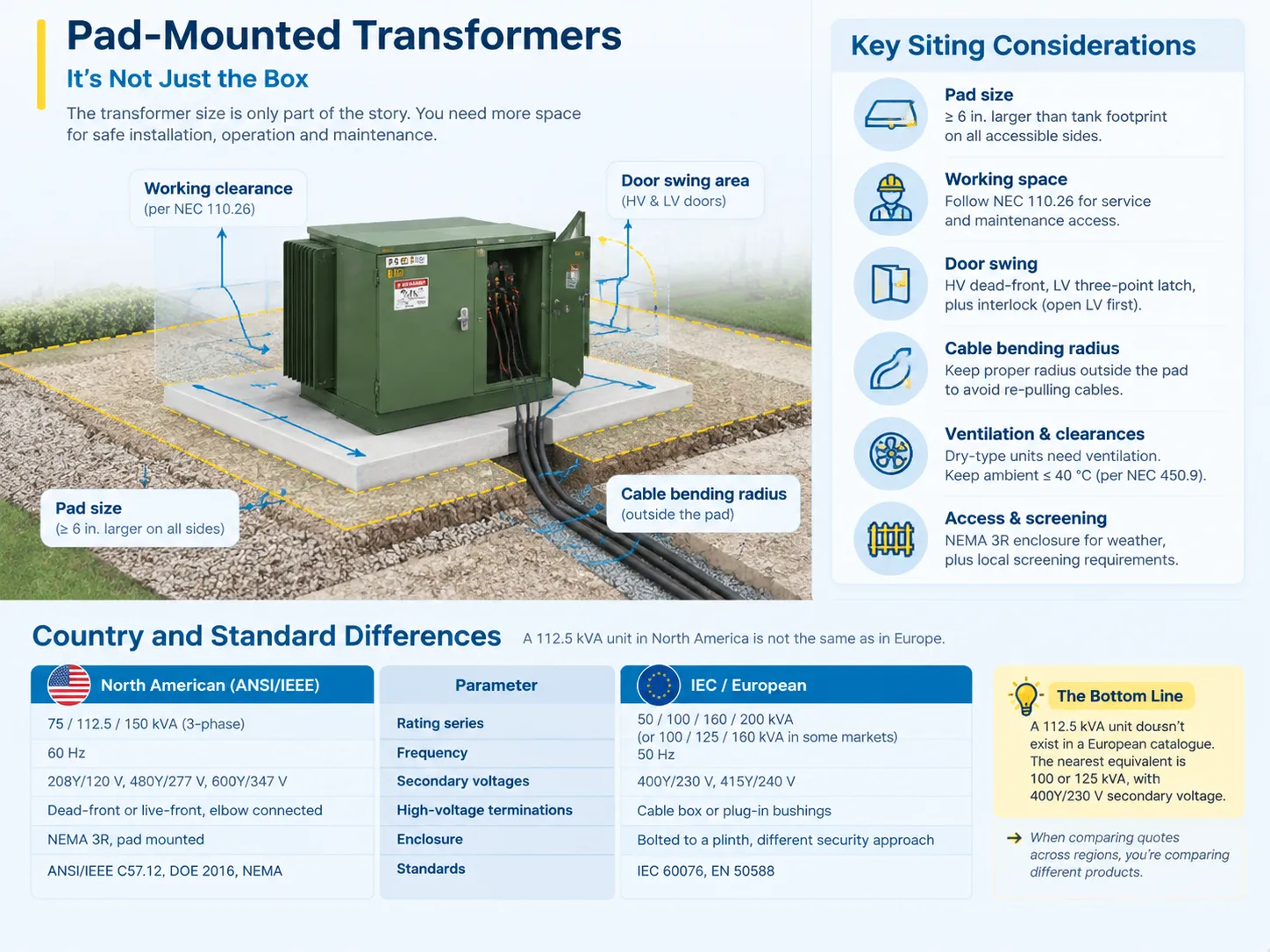
- Dimensione della base. La base in cemento dovrebbe essere progettata almeno 6 pollici più grande dell'ingombro del serbatoio su tutti i lati esposti, corrispondente alla posizione del condotto e della trincea per i cavi.
- Area accessibile. L'articolo 110.26 del NEC delinea le normative sullo spazio di lavoro per qualsiasi attrezzatura manutenibile, e nel caso di un trasformatore montato su basamento su cui si sta lavorando, devi assicurarti che ci sia abbastanza spazio attorno a ciascuna porta ad alta e bassa tensione.
- Apertura della porta. Nel caso di una porta ad alta tensione frontale morta e una porta a bassa tensione con chiusura a tre punti, è importante considerare anche l'area che deve essere spazzata davanti all'unità a causa dell'apertura delle porte.
- Raggio di curvatura del cavo. All'interno della costruzione del trasformatore avrai spazio per il cavo. Tuttavia, sarà comunque necessario un raggio di curvatura sufficiente per i cavi, poiché non dovrebbero essere piegati quando vengono disposti accanto alla base.
- Ventilazione e spazio. Le unità Vegiper dovrebbero avere una fonte d'aria per il corretto funzionamento che non dovrebbe dipendere dalla presenza di spazio per materiali combustibili.
- Posizionamento. Di solito, un involucro resistente alle manomissioni ovviamente svolge il lavoro, ma a seconda delle normative locali potrebbe essere necessario anche una struttura che svolga il compito di schermare l'attrezzatura elettrica e persino ottenere collegamenti a questo involucro.
Dove uno sviluppo prevede diversi pad piuttosto che uno solo, la disciplina di distanza cambia il piano di progetto più della selezione del trasformatore. Le considerazioni di posizionamento che contano realmente in uno sviluppo residenziale o commerciale sono trattate in questo sguardo a trasformatori montati su pad per comunità moderne.
Differenze di Paese e Standard
Un'unità con una potenza nominale di 112,5 kVA costruita secondo gli standard IEC e installata in Europa non è lo stesso oggetto del suo equivalente ANSI, e le dimensioni lo riflettono.
| Parametro | Nord America (ANSI/IEEE) | IEC / Europeo |
|---|---|---|
| Serie di potenza | 75 / 112,5 / 150 kVA per trifase | 50 / 100 / 160 / 200 kVA, o 100 / 125 / 160 kVA in alcuni mercati |
| Frequenza | 60 Hz | 50 Hz |
| Tensioni secondarie | 208Y/120 V, 480Y/277 V, 600Y/347 V | 400Y/230 V, 415Y/240 V |
| Terminazioni ad alta tensione | Frontale morto o frontale attivo, collegato a gomito | Spesso scatola per cavi o manicotti plug-in |
| Involucro | Antimanomissione, NEMA 3R, montato su pad | Spesso fissato a un plinto, approccio alla sicurezza diverso |
| Normative | ANSI/IEEE serie C57.12, DOE 2016, NEMA | IEC serie 60076, efficienza EN 50588 |
Il risultato è che un modello da 112,5 kVA non si trova nel catalogo europeo. La specifica IEC equivalente migliore è 100 o 125 kVA, e la sua tensione secondaria è 400Y/230 V invece di 208Y/120 V. Nel fare confronti regionali delle offerte, si stanno confrontando due prodotti diversi che semplicemente appartengono alla stessa fascia di prezzo. Il confronto completo vale la pena di essere letto prima di qualsiasi approvvigionamento transfrontaliero, ed è esposto in questa analisi delle principali differenze tra trasformatori americani ed europei.
I marchi differiscono?
Sebbene la classe di tensione influisca su vari aspetti da un fornitore all'altro, ha molto meno a che fare con le differenze fisiche nell'attrezzatura di quanto ci si aspetterebbe. In pratica, osservando i produttori di trasformatori montati su pad nel panorama nordamericano che producono unità da 112,5 kVA con la stessa classe primaria, secondaria, di raffreddamento e alimentazione, hanno dimensioni praticamente identiche: si osservano solo differenze di pochi pollici nelle dimensioni. Qualsiasi variazione percepita del “marchio” non è semplicemente vera, poiché le aziende potrebbero trattare alimentazioni a ciclo con 95 kV BIL o alimentazioni radiali con BIL inferiori, attribuendo differenze di nome a attrezzature completamente diverse.
There are, however, three tangible differences among the products. Winding material choice plays a role but is rather a function of specification than brand characteristic. Efficiency tiers are important to consider, given that in 2016, the DOE regulations segmented products into pre-and post-2016 designs, meaning that a transformer used in 2012 will occupy less volume than the work of both years. Finally, it is enclosure design that really shows up competition among manufacturers. Enclosure that falls into the utility’s standard dimensions without variances gives one a commercial advantage.
What is ultimately required is to stop comparing brands and comparing transformer dimensions with the pad one has instead. Brand differences among inch dimensions between suppliers are negligible; for instance, a 12-inch depth gap between a 12.47 kV transformer and a 4.16 kV transformer is significant.
Breaker and Conductor Sizing for a 112.5 kVA Unit
This is the question that follows the dimension question, and the arithmetic is straightforward once you fix the voltages.
| Configurazione | Primary FLA | Primary OCPD at 125% (next size up) | Secondary FLA | Secondary OCPD at 125% (next size up) |
|---|---|---|---|---|
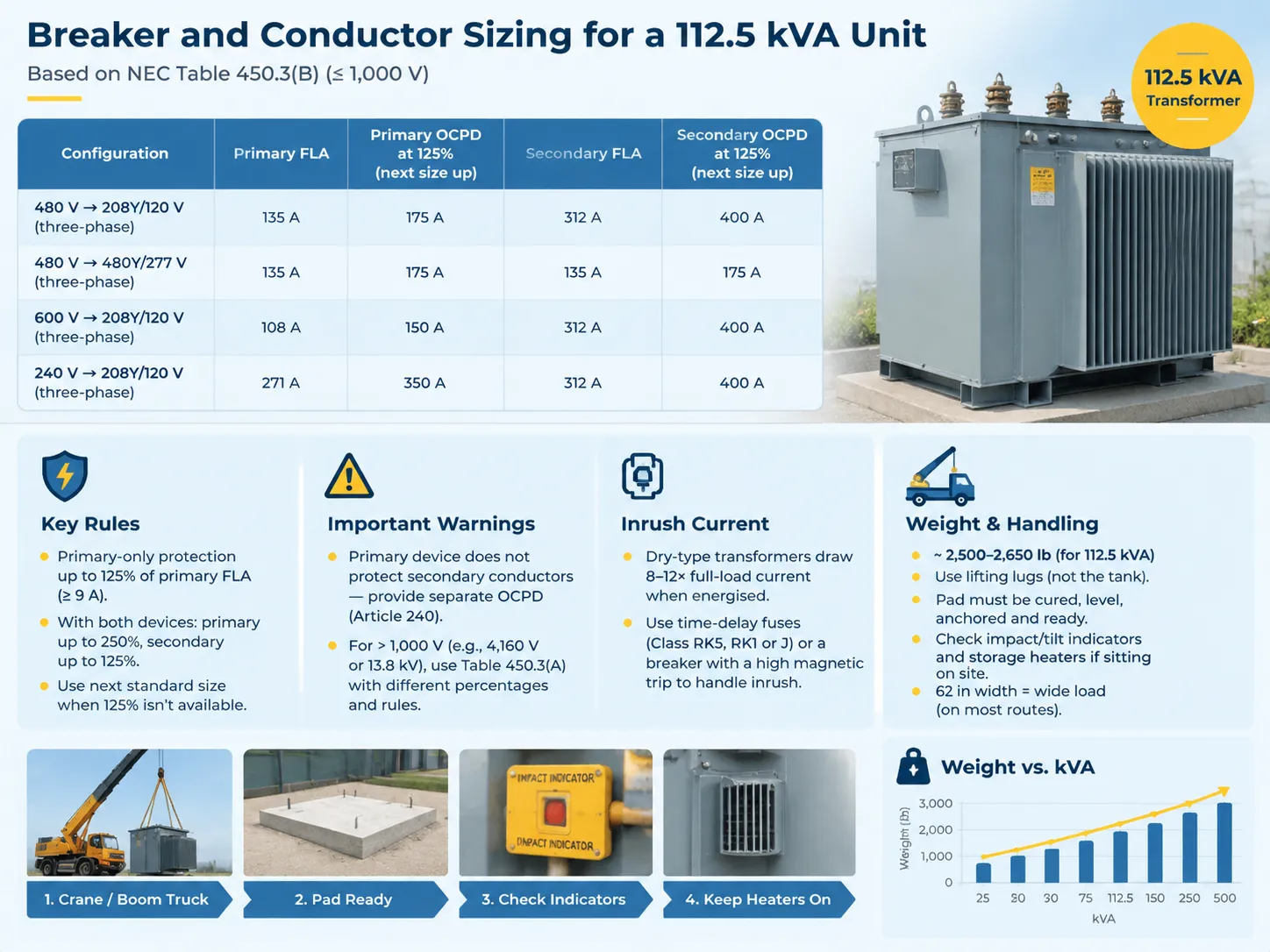
| 480 V → 208Y/120 V, three-phase | 135 A | 175 A | 312 A | 400 A |
| 480 V → 480Y/277 V, three-phase | 135 A | 175 A | 135 A | 175 A |
| 600 V → 208Y/120 V, three-phase | 108 A | 150 A | 312 A | 400 A |
| 240 V → 208Y/120 V, three-phase | 271 A | 350 A | 312 A | 400 A |
The guidelines for those data are found in Table 450.3(B), which is valid for transformers with a voltage rating up to 1,000 V. For transformers with a primary current of 9 A and more, primary only protection is allowed; the minimum value for this device is 125% of the full-load current (FLC). If 125% cannot be achieved with the help of the available number of values, the nearest value can be used instead. In case both primary and secondary devices are used, the ratio for the primary device can be 250% of the FLC and for the secondary device – 125% of the SLC. For instance, in case of a 112.5 kVA transformer connected to a primary voltage of 480 V, such a transformer can have a primary protection rated for 350 A when a secondary protection is provided.
However, there are two warnings with this table. First, the primary device does not protect any secondary conductors, for which separate overcurrent protection should be applied according to Article 240. One should also keep in mind that the table is valid for voltages lower than 1,000 V. For a 112.5 kVA transformer with a primary voltage of either 4,160 V or 13.8 kV, Table 450.3(A) should be used instead.
The second size consideration is inrush. Dry-type transformers consume 8 to 12 times of the rated or FLC for a very limited period of time when becoming operational. For this reason, a fuse with a rating of 125% must be used, which will burn off on activation. Instead, a time delay fuse (Class RK5, RK1 or J) or magnetic circuit breaker has to be used in order for inrush currents not to create problems in case there is a fault in an electrical circuit.
Weight, Handling and Delivery
Weight is a factor in the cost of the project since moving a unit weighing 2500-2650 lbs is something that a small team cannot do manually and not every type of transport can deliver such a unit.
- Crane or boom truck. There must be a plan describing which area will be used for lifting the unit and where it will be put after the lifting. The rigging needs to be connected to the tank lifting lugs instead of the tank.
- Pad readiness. Before the unit’s arrival the pad has to be leveled, cured, and tested for anchoring and the conduit stubs must be installed. The transformer cannot be left on a truck if the pad is not ready.
- Impact and tilt indicators. The unit must have been delivered with all necessary indicators; if one of the indicators was triggered it means it is necessary to carry out an internal inspection before the unit is energized.
- Storage. If the unit stays on site for weeks prior to installation its heaters must be energized so that no moisture gets into the insulation.
- Transport clearance. A unit of 62 inches in width is a wide load and so it may require special permits and have specific time limitations on the transport route.
How the weight and loss figures scale with rating is worth understanding before you decide between 112.5 kVA and its neighbours, and the trend across the distribution series is illustrated in this study of 500 kVA transformer weight. The short version: weight rises roughly with kVA but not exactly linearly, because the enclosure, tank and accessories form a fixed component that stops growing once it is big enough to hold the core and coils.
FAQ
What are the dimensions of a 112.5 kVA transformer?
50 in. to about 62 in. in width, about 44 in. to 64 in. in depth, and from about 49 in. to approximately 70 in. in height, while weighing around 2,500 lb (1,130 kg to 1,200 kg). Some published examples include a specification of 50 in. × 64 in. × 49 in. with a weight of about 2,500 lb, and others 61 in. × 52 in. × 67 in. and 61 in. × 44 in. × 69 in. All dry-type indoor units with the same capacity usually have a narrower profile, but different size in the depth is expected in the very case of ventilation requirements, rather than simply enclosures of the units.
What size breaker for an 112.5 kVA transformer?
The voltages dictate the regulations. For a primary voltage of 480 V to supply a 208Y/120 V circuit, the typical full-load primary current would equal 135 A, while concerning the secondary it would be equal to 312 A. If both the primary and the secondary protection schemes are used, according to NEC Table 450.3(B) it would be allowed to use a primary device with the rating of 125% of the current to be equal to 169 A, it would be rounded to the next standard size which is 175 A, and concerning the secondary protection it should not be more than 125% of the current which is 312 A, that would give the rating of 390 A rounded to 400 A. If only the primary protection scheme is implemented, the primary device should be rated how much could be 250% of the primary current which would give 338 A rounded to 350 A. In case there are primary voltages above 1,000 V NEC Table 450.3(A) shall be used. It’s recommended to use time delay fuses or trip high-magnetic breaker to protect the device from damaging due to magnetizing inrush.
What are the dimensions of a 100 kVA transformer?
The voltages serve as a guiding factor for the laws. In the case where the primary voltage of 480 V has been utilized in the circuit of 208Y/120 V, the full-load primary current’s value would be up to 135 A and the full-load current of the secondary power source would be 312 A. It would allow for the use of the primary device rated at 125% of the proposed current which would be equal to 169 A if both of the primary and the secondary protection schemes have been used according to the provided information from NEC Table 450.3(B) and it would be rounded to the nearest available size equal to 175 A. It should be mentioned that the secondary power source device must not exceed 125% of its full-load capacity meaning not more than 312 A and the final rounding procedure would give the result in the form of 400 A from 390 A. If only the primary protection mechanism has been employed, the device must be rated at 250% of its current that would provide a result of 338 A which should be rounded to 350 A. For the primary voltages in excess of 1000 volts the standard presented in NEC Table 450.3(A) must be referenced. Time delay or high-magnetic circuit breakers are recommended for the situation where magnetizing inrush may occur.
What is the size of a kVA transformer?
kVA mentions capacity; physical size is not mentioned. The physical size of the transformer depends on kVA and four more parameters: voltage class and impulse power, cooling class, winding material, and type of enclosure. As a rough guide, a three-phase oil-immersed pad-mounted transformer varies from about 75 kVA (about 30″ wide) to over 2,500 kVA (more than 100″), but for dry-type indoor designs, the same kVA will be in a completely different shape. Therefore, always ask for dimensional drawings with kVA.
Do 112.5 kVA transformers differ between brands?
In almost all cases, the difference between two units is due to configuration instead of popularity. If two machines have the same specifications concerning primary, secondary, cooling class, arrangement of feed, and efficiency, their sizes will be practically the same, regardless of the manufacturer. If the specifications provided bring about the change in the size of the machine, it is usually due to the use of a different specification, e.g., looping and radial feeds, the application of higher BIL for the primary winding or the use of another winding material, but not due to the brand’s differences.
Is 112.5 kVA relevant to the electrical code?
Yes, it is indeed a threshold value. NEC 450.21(A) allows the installation of dry-type transformers rated at 112.5 kVA or lower in the open without a vault, provided it is kept 12 in away from combustibles, unless a fire-resistant heat-insulating barrier is used, or unless the unit is enclosed with the exception of ventilating openings. Above 112.5 kVA, dry-type transformers usually need to be installed in a fire-resistant transformer room, except in the case of insulation systems with the Class of 155 or higher. The surpassing of the value may alter the room, and not only the equipment.
Riferimenti
- IEEE Standards Association — ANSI/IEEE C57.12 series, distribution transformer standards
- NFPA — NFPA 70, Codice Elettrico Nazionale (Articolo 450, trasformatori)
- UL Solutions — transformer testing and certification services
- UL Standards & Engagement — UL 1562, Trasformatori, Distribuzione, Tipo Secco
- International Electrotechnical Commission — IEC 60076 series, power transformers
Conclusione
The response to the question “how significant is a 112.5 kVA transformer?” is not easy and the ones who provide an answer generally reference and depend on their own catalogues. The right answer to this question is a range, approximately 50 to 62 inches in width, about 44 to 64 inches in depth, between 49-70 inches (high) in height, and from 2500 to 2650 pounds for a three-phase pad-mounted model.
Three steps can be taken in relation to this knowledge. First, before purchasing the pad, obtain the creation drawing as well as the weight; depth is where the voltage class comes into focus. Secondly, ensure that the model and type are checked before starting a comparison of the prices since it is the four reasons that cause price differences which people connect with the brands. Finally, do not forget that the 112.5 kVA transformer is the number in NEC 450.21 meaning it is the limit that you need to focus on.