


In discussion with a European utility engineer regarding the origins of various transformers, the reply could be quite different compared to what one would have received three years back. Delivery timeframes from traditional Western participants can take anything from 36 to 48 months. As a result, the clients have had to look for alternatives. However, what appears to be one market may turn out to be several layers. These layers include some state-owned companies whose monopoly is so strong that they manufacture ultra-high-voltage equipment exclusively for their own networks and several private enterprises which became serious exporters, as well as thousands of small companies that are only assembling the frames with transformers inside and call their products substations. Knowing which level to buy from is important in terms of purchasing.
The profiles described below are based on published information, disclosures of companies and the exported quantities instead of data from directories. They are ordered according to the level of largeness and not according to the level of usefulness as the large company does not necessarily suit a project of 2,000 kVA.
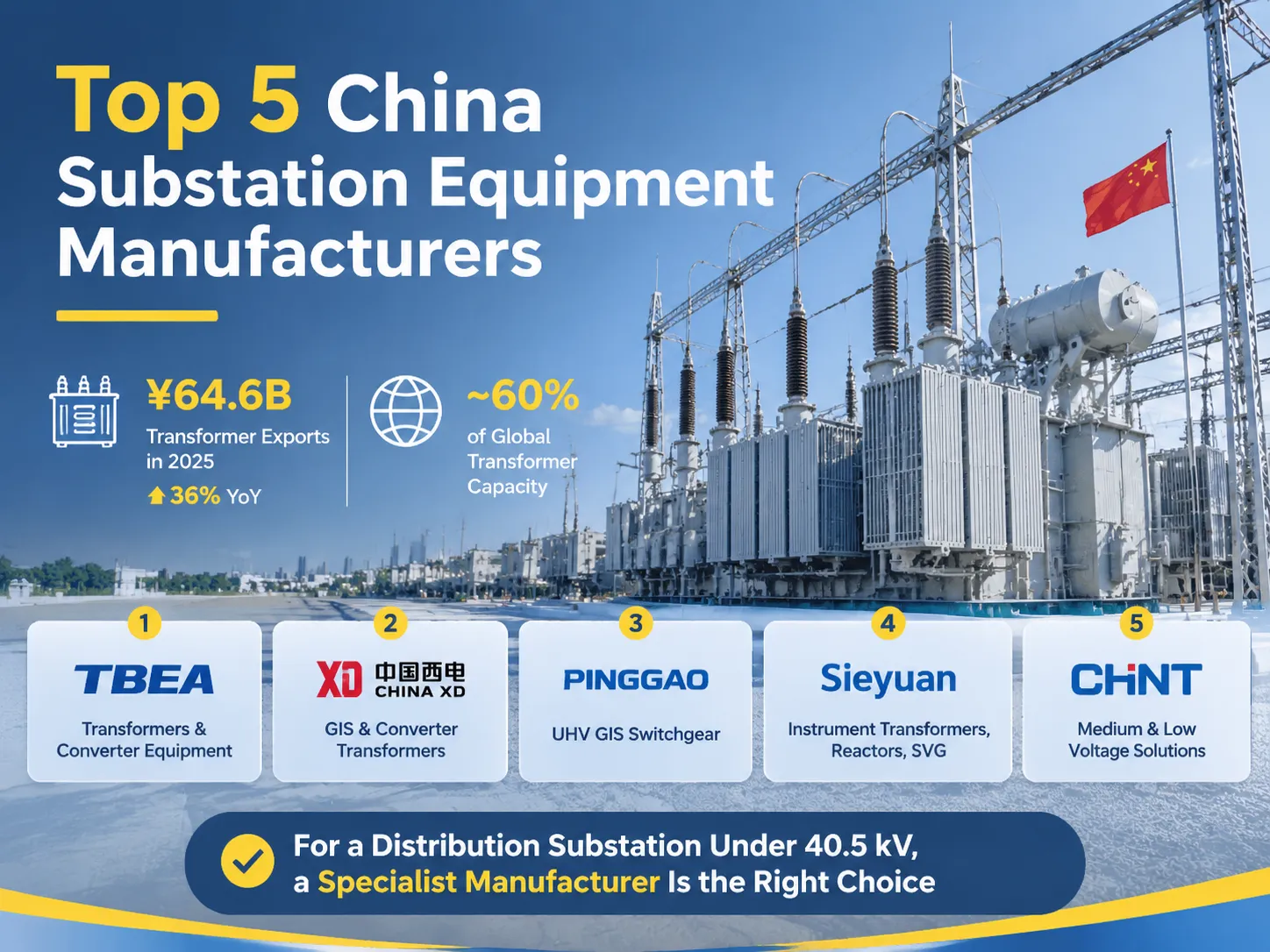
In summary, key manufacturers of substation equipment in China include TBEA (the only transformer manufacturer among the top 10 producers in the world with transformer output of about 495 million kVA), China XD (manufacturer of transformers under any kind of including gas-insulated substations and converting transformers, estimated revenue more than RMB 23.8 billion by 2025), Pinggao Electric (maker of GIS switchgear that takes a 36-44 percent of the national market share), Sieyuan Electric (manufacturer of instrument transformers, reactive power compensation equipment with revenue of RMB 21.2 billion in the first nine months of 2025 which is 37 percent more than in 2024), and CHINT (low and medium voltage equipment which is relatively cheap and one of the most exported ones). In general, for the year 2025 China’s transformers exports reached RMB 64.6 billion in total, or 36 percent more than in 2024, having about 60 percent of the global market for transformers. Overall, for equipment being built below 40.5 kV and having a standard delivery term, the giants are not the best option to be involved, experts should enter the market.
What “Substation Equipment” Actually Covers Before You Shortlist Anyone
The term actually represents four different choices in buying. A substation comprises transformers, switchgear, protection and control instruments and structure, and additional devices. Almost no company manufactures all four types satisfactorily, and no Chinese manufacturer has produced all four types of equipment for all required voltages.
On the transmission side, the equipment is designed according to specifications, i.e., for voltages from 220 kV and above, it is special and has been pre-tested, and a full documentation package has been created for the public utility. On the distribution side, the equipment is manufactured. The distribution transformer substation range is the second category, and it is where most export volume actually sits.
This division helps to clarify the pattern that confuses the buyers. The same country makes big converter transformers and exports many small pad mounted devices, but the factories that manufacture both are separate plants with distinct quality systems. Ask what your contact is before requesting a quotation.
The Five Manufacturers Worth Shortlisting
| Azienda | Base | Forza principale | Scale signal (2025) | Migliore adattamento |
|---|---|---|---|---|
| TBEA | Changji, Xinjiang | Power and converter transformers, full vertical integration from silicon to equipment | Revenue RMB 73.0 bn (9 months); transformer capacity 495 million kVA | UHV and HVDC projects, large power transformers, utility tenders |
| China XD | Xi’an, Shaanxi | Full voltage range, GIS, converter transformers, system integration | Revenue RMB 23.8 bn | Turnkey substations, mixed-voltage packages, state utility work |
| Pinggao Electric | Pingdingshan, Henan | UHV and HV gas-insulated switchgear | 36 to 44% domestic UHV GIS share | GIS bays, 126 kV and above, switchgear-only scopes |
| Sieyuan Electric | Shanghai | Instrument transformers, reactors, SVG, hybrid DC breakers | Revenue RMB 21.2 bn (9 months), up 37% | Substation components, reactive compensation, overseas projects |
| CHINT | Wenzhou, Zhejiang | Medium and low voltage, distribution equipment, broad catalogue | Large export footprint across emerging markets | Distribution substations, LV assemblies, cost-driven tenders |
There are two additional contenders that merit brief mention. Jinpan Technology is a UL-approved dry-type specialist, and since it has proven export volume in North America, it shows that it has passed the UL gate, an obstacle that most Chinese factories could not. Baoding Tianwei Baobian is a specialist in high-end transformers, such as those made for the ITER fusion project, and it is best suited for the production of unique specialized devices, not repeat orders.
TBEA: The Vertical Integrator
TBEA is the sole Chinese entity in the global top ten for transformer revenue, and that is primarily because it is a case of vertical integration. The company backs its products by manufacturing in-house: silicon, wire, insulation and everything else. This allows it to avoid the material fluctuations which are the bane for everyone else.
In terms of transformer capacity, TBEA showcases a figure of 495 million kVA which is beyond the capabilities of most industries.
The product range is wide, including 1,000 kV AC transformers, ±1,100 kV converters, reactors, capacitors, bushings, switchgear as well as cables. The company was involved in many Chinese experimental UHV projects, thus establishing its credibility as a supplier of proven insulation technology under the pumps of converter transformers.
As for the weakness of TBEA, it is a limited capacity for processing clients’ orders. The production of a 400 kVA transformer may be treated as an insignificant deal for a company with such capacities; therefore, it may take a long time to get a quotation from TBEA.
China XD and Pinggao: The State-Backed Duo
China XD is a company that provides equipment for all the voltage levels and can be considered a one-stop shop among substation suppliers because it offers transformers, GIS, surge arresters, capacitors, and their integration. The revenue in 2025 reached RMB 23.8 billion as the company expands its business internationally with Europe being one of the increasing markets and the most significant reference LI being the Saudi contract in NEOM. In case a buyer is looking to buy a 132 kV or 220 kV substation from one company, s/he should choose this supplier.
As for Pinggao, its core business is making gas-insulated switchgear, but it can also be known for reaching 36 to 44% of the total domestic UHV GIS market and for being, therefore, included in many projects of electric networks in China because of its high market share. Such success overseas has been achieved thanks to the increased international sales of the first half of 2025, and that proves that the company is exporting now and that this opportunity does not only remain a theory anymore.
These two companies are owned by the state, and that has certain effects on their business. The paperwork is very detailed because the domestic market requires it from the producers. Payments and warranties become issue because of the company being state-owned, and that leads to the fact that any deviation from the established business is very complicated.If your project needs a high voltage substation equipment package with type-test reports for every assembly, this is where those reports exist.
Sieyuan and CHINT: The Private Challengers
Within the five companies examined, Sieyuan is the fastest growing with revenue growth of 37% for the first nine months of 2025 and growing orders for transformers abroad by 89%. Sieyuan’s advantages lie in components and not in complete substations. The company offers various products such as instrument transformers, shunt reactors, SVG systems, and a 126 kV hybrid DC breaker with a switching time of about 3 milliseconds. Consequently, for a client with a supplier of transformers who needs all supplementary equipment, Sieyuan provides all missing details.
Unlike Sieyuan, CHINT operates on different principles. This company is engaged in low voltage distribution and operates a broad catalogue of goods and well-established export operation which allows CHINT to enter markets that are neglected by state giants. As a result, the company can offer its clients better terms of price and availability of products. This is not a criticism. For example, a 24 kV ring main unit set for a shopping mall does not need any high-voltage history; it is important to receive it on time and make it work.
Both of these companies compete in mid-market segment meanwhile this is the best place for a client to gain maximum value. This means that the size of the project is so small that it is not interesting for TBEA, but still requires many engineering solutions. The intelligent integrated substation range is the product category that lives in that gap, combining protection, metering and switching in one prefabricated enclosure.
What These Five Do Not Do Well
They don’t like dealing with minor orders with a high level of engineering sophistication. A compact power station with 630 kVA having a proprietary design of the low-voltage board, a non-standard shade and a delivery time of 10 weeks can hardly be called a success story for a supplier that has an order book of 300 pages, therefore the pricing on the project will be unfavorable or absent at all.
They don’t like being a fast source of spare parts for previously purchased solutions. The manuals for a device manufactured primarily for the Chinese market might be available only in Chinese and certification documents might refer to GB standards rather than the IEC ones which might be problematic for certain European insurance companies and inspectors who might be asking for confirmation.
They won’t tell you that the specification you have provided is incorrect. If you need a new 40.5 kV switchgear variant to be tested according to certain non-applicable standards, all you will get is the quotation rather than answers. Thus, this is the reason why going through a specialist who performs an audit is beneficiary.
Lead Time Is the Real Product Being Sold Here
It’s not price that has brought Chinese suppliers into the discussions about high-voltage transformers. According to Citigroup, there will be a global shortage of high-voltage transformers in 2025 where demand will outstrip supply by 30 percent and shortages will last from now till 2029, resulting in a cumulative deficit of nearly 1700 gigavolt amperes (GVA). Due to this, the lead-time of 36 to 48 months is a reality for the Western suppliers while the Chinese suppliers promise around 12 to 18 months turnover.
In that light, the price comparison takes on a different quality. The Chinese price advantage is real, but it is not that much. For example, 24 months earlier completion of a project can outweigh even this price advantage because the cost of overdue energization exceeds the cost of equipment itself. If there is a risk involved, securing the supply with the help of the Chinese suppliers might turn up to be a better decision.
Thus, risk assessment changes too when it comes to working with suppliers that have already sold out their capacity two years in advance. As a result, they have no engineering resources to implement your changes and zero incentive to speed up warranty issues.
Price Bands and What Moves Them
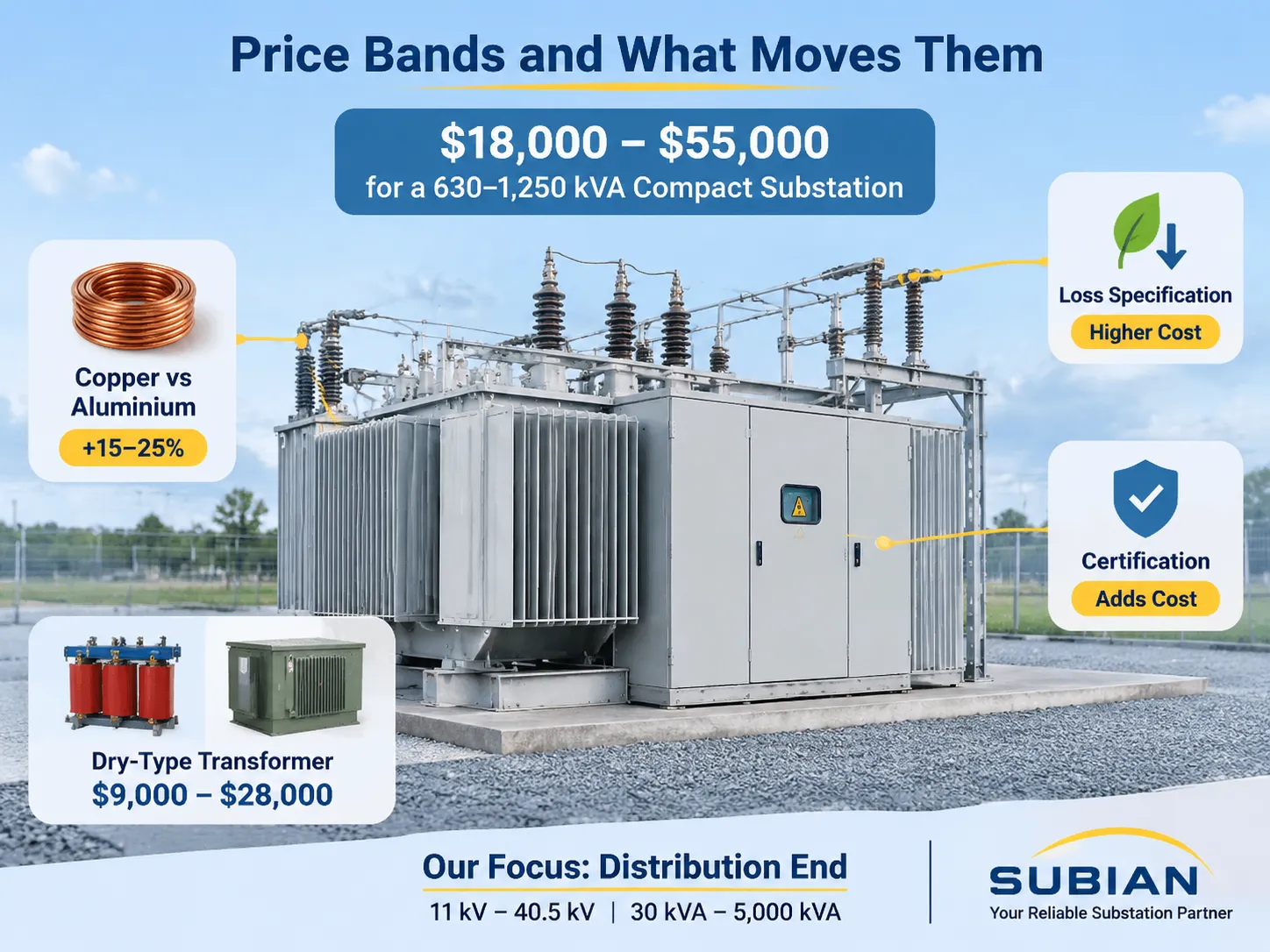
A compact distribution-class substation with 630-1,250 kVA capacity costs around $18,000-55,000 based on the type of transformer, switchgear used, and inclusion of the protection and measuring devices. The cost of a dry-type transformer within this range is $9,000-28,000. Cost of pad-mounted units available in foreign markets remains in a similar range, thanks to specific installation.
There are three factors which influence the price considerably more than the location of the factory. The first one is copper vs. aluminum windings that affect the cost of the material by 15-25%. The second factor is the specification of losses, as a low-loss design requires considerably more steel and more advanced laminating. The third factor is the certification process of UL, CSA or EU which adds not only to the cost but also takes time.
That last point is worth dwelling on. The pad-mounted transformer project in Ecuador is a useful reference because it shows the pattern: the equipment was standard, and the engineering work was in matching the enclosure, the voltage ratio and the protection to a solar plant’s export profile. The factory’s value was in adapting a standard product, not in inventing one.
Where SUBIAN Sits in This Landscape
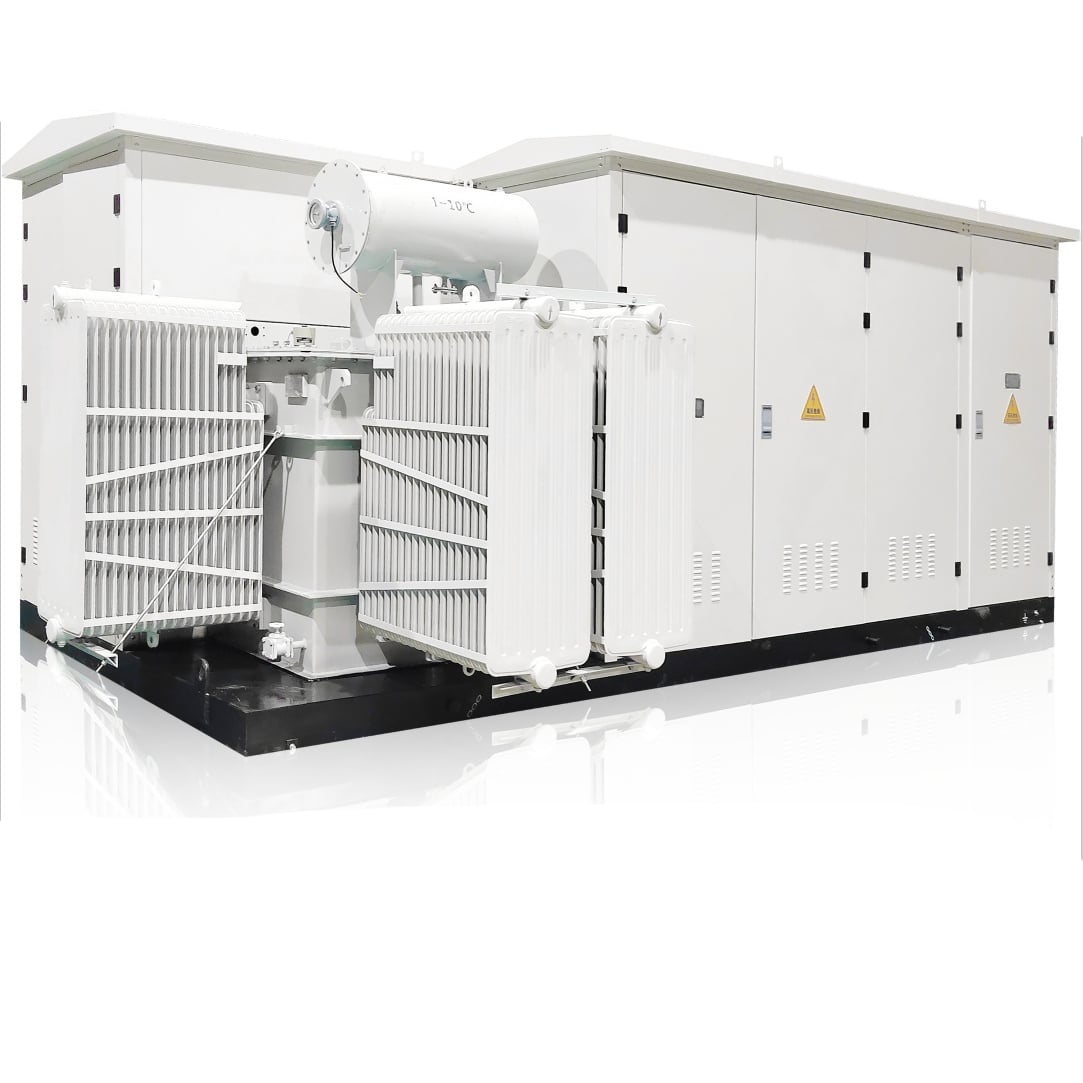
We are not among the big five. Our company is a specialist factory on the distribution side, which means we specialize in projects that the state-owned giants won’t undertake: voltages between 11 kV and 40.5 kV, power ratings between 30 kVA and 5,000 kVA, and both dry and oil-filled types of machinery either in pieces or in small quantities.
This gives us one tangible advantage. When dealing with a project team of 20 people, the buyer gets an engineer who has visited the site and a specification analysis at the stage of the cost estimation rather than after the order placement. But there is a downside to this position as well: our company does not produce UHV equipment, so we won’t even quote for it.
Il electrical substation components range covers the assemblies that surround the transformer: protection, metering, low-voltage distribution and the enclosure that holds them. For a project that needs one supplier to take responsibility for the whole distribution substation instead of five separate shipments arriving separately, that scope is the relevant one.
How to Shortlist for Your Actual Project
When coming from the voltage and scope perspective, the ranking is not relevant. For lines over 145 kV, the companies that need consideration are China XD, Pinggao, and TBEA and we are discussing only type tests and references. For lines between 40.5 and 145 kV, we add Sieyuan to the list of suppliers of components. We eliminate state-owned enterprises from consideration for voltages lower than 40.5 kV.
After this, we check four questions. First, do they have a test report from the accredited lab? The report has to correspond to the exact equipment you are buying; second, do they have documentation written according to the IEC standard and in English; third, do they have experience of exporting to countries that have a reliable inspection system? Finally, do they agree on the pre-shipment testing by your engineer? A supplier that answers positively to all four questions can be considered a potential partner regardless of its size.
Finally, think about whether you are going to buy equipment or to buy a package. Equipment is cheaper but you need to bear the interface risk. Package costs more (8-15 percent) but transfers the risks to the vendor. For the first project in an unknown market it is better to buy a package since it is the reason the turnkey approach exists.
FAQ
Who manufactures substations in China?
Substations are put together, not produced, by an individual company, and the Chinese industry consists of three levels. The state-run companies TBEA, China XD and Pinggao deal with the production of top-level electrical equipment. The private companies such as Sieyuan and CHINT work with electrical components and construction of systems for medium voltage. Under them, there are thousands of manufacturing companies that are engaged in the construction of delivery systems for low voltage.
Who are the top transformer manufacturers in China?
The top firms in terms of capacity and revenues are TBEA, whose transformer capacity amounts to about 495 million kVA and who posted revenues of RMB 73 billion in the first nine months of 2025; China XD, which generated revenues of approximately RMB 23.8 billion over the entire year; Sieyuan, which has revenues of RMB 21.2 billion after nine months; and Baoding Tianwei Baobian specialized in high-end special units. Jinpan Technology is a leader in dry-type transformers and is one of the few companies on the market with actual volumes in North America, as well as UL certification.
Who is the world’s largest transformer manufacturer?
There is no singular answer as the criteria differ. In terms of unit and capacity, TBEA is commonly mentioned, with the majority of the production capacity of transformers in the world located in China, where TBEA occupies 60 percent of the market. In terms of revenue, Hitachi Energy and Siemens Energy are leading companies in the market of transformers. In turn, those who dominate in terms of converter transformers in HVDC technologies are Hitachi Energy, Siemens Energy and TBEA at the same time. Please clarify which variable is important for your work before quoting a ranking.
What is the lead time for Chinese substation equipment?
The delivery time for standard distribution equipment is between 10 and 16 weeks from the factory. For the compact substations, the delivery time including the design process and testing can be between 20 and 24 weeks. For power transformers in the range of 20-100 MVA, the time is from 12 to 18 months compared to the 36-48 months needed for Western manufacturers today. To this period, at least 4-8 weeks must be added for transportation and customs purposes. This gap is exactly the reason for the consideration of Chinese manufacturers and it is larger than the price difference when the projects are time-persistent.
Is Chinese substation equipment IEC compliant?
Yes, it is possible, provided that documentation of compliance is done per project and not assumed per plant. All domestic equipment manufactured in China must follow GB standards, which mainly align with IEC. However, there might be some clauses in GB standards that differ from IEC standards. The plant manufacturing for exports is expected to comply with IEC standards (for example, IEC 62271 for switchgear and IEC 60076 for transformers – an appropriate type test report can be obtained from accredited laboratories upon request). It is advisable to check and ask for the respective report, laboratory accreditation, and current edition of standards being applied for the manufacture (please note that a report dated 2011 may not be valid in 2026).
How do I verify a Chinese substation manufacturer before ordering?
Most of the risks can be covered by four checks. You have to ask for a business license and check if the scope of registration includes manufacturing and not just trade. You will need to obtain test reports conducted in an accredited laboratory for the particular assembly type. You will be required to get in touch with two export references from countries with a very similar inspection system as yours. And you should also make the factory acceptance test in the presence of your engineer or an independent inspector, with agreed testing procedure documented in advance. If a supplier objects to the last check, he or she is giving you a clue.
Riferimenti
- TBEA — Transformer and Converter Equipment
- China XD Group — Full Voltage Range Substation Equipment
- Sieyuan Electric — Instrument Transformers and Reactive Compensation
- Pinggao Electric — Gas Insulated Switchgear
- CHINT Group — Medium and Low Voltage Distribution Equipment
Conclusione
Layer is more important than rating. There are almost no manufacturers in HV segment, and almost entirely it’s comprised of state monopolies because type-tested UHV equipment is not something that can be manufactured by any factory. As for the low voltage, here the situation is completely different and an expert who makes compact substations for a living may beat any company from several angles: in terms of delivery and quality of documentation provided, let alone readiness to answer any questions on the installation process.
First, it is necessary to determine the layer, and then check if such details as having type test of the specific product, English-language documentation with IEC references, export contracts, and acceptance test performed at the factory are satisfied. In case you send us the voltage, capacity and installation conditions, we will inform you whether you are right to blame us or the specialists.