


닝보의 한 공장 소유자가 우리에게 간단한 질문을 보냅니다: “우리의 2,500 kVA 배전 변압기는 2009년부터 운영되고 있습니다. 이를 업데이트된 비정질 코어 유닛으로 교체하면 전기 요금이 얼마나 줄어들까요?” 이 질문은 유효합니다. 에너지 효율적인 변압기 혁신은 이제 더 이상 친환경 슬로건이 아닌 상업적 논거가 되었습니다. IEC 60076-20 및 그에 상응하는 중국 표준 GB 20052는 구형 변압기가 충족할 수 없는 무부하 손실 수준을 설정했습니다. 이는 계산을 간단하게 만듭니다. 이 예에서 무부하 손실 한도가 2,300 kWh/년으로 설정된 63 kVA 변압기와 구형 설계가 자력을 유지하기 위해 최소 4,000 kWh를 소비하는 경우를 비교할 수 있습니다. 이 차이는 20년 동안 수만 달러에 누적됩니다.
이 기사는 이러한 절약의 출처—코어 재료, 권선 재료, 기하학적 설계, 냉각 방법 및 모니터링 결과에 기반한 부하—를 설명하고, 견고한 투자 수익 사례를 만들 수 있도록 적절한 가격 프리미엄을 제공합니다.
에너지 절약 변압기의 현재 개발은 다섯 가지 주요 범주를 중심으로 진행됩니다: 기존의 실리콘 강철 결정 지향 제조와 비교하여 무부하 손실을 60-80% 줄이는 비정질 금속 코어 사용; 결정 지향 실리콘 강철의 업그레이드 버전 사용(예: 23ZH90); 부하 손실을 최소화하기 위한 순수 구리 또는 순수 알루미늄 권선 사용; 코어 설계 최적화 및 레이저 각인 얇은 강철 사용; 마지막으로, 변압기가 정격 부하에서 최대 효율로 작동하도록 보장하는 스마트 모니터링 도구 사용.
에너지 절약 변압기란 무엇인가요?
에너지 효율적인 변압기는 당시의 표준 변압기보다 더 나은 효율 성능을 가진 장치로 인식됩니다. 효율성은 무부하 및 부하 조건에서의 손실을 기반으로 하며, IEC 60076-1에 따라 75 °C에서 측정된 매개변수에 따라 결정됩니다. 효율성의 차이는 미미해 보일 수 있지만, 현대 변압기는 일반적으로 98.5–99.5% 효율로 평가되므로, 지속적으로 작동하는 변압기를 고려할 때, 변압기 스테이션에서 0.5%의 개선은 상당한 금액이 됩니다. 10 MVA 변압기는 연간 약 50,000 kWh를 절약하며, 이는 산업 요금에 따라 6,000–12,000 달러에 해당합니다.
이 용어의 정의는 1990년대와 2000년대에 일본, 미국, 그리고 나중에 중국이 배전 변압기에 대한 효율성 범주를 개발하면서 제품 범주로 설정되었습니다. 중국의 표준 GB 20052-2020 및 DOE의 2016 효율성 표준은 비정질 코어 기술의 사용을 촉진합니다. 따라서 오늘날 에너지 효율적인 변압기는 IEC 60076-20 표준에 따라 최소한 두 번째 효율 등급을 충족하는 변압기이며, 가장 높은 등급은 비정질 코어와 내부에 향상된 권선 재료를 가진 변압기에 해당합니다.
에너지 손실이 발생하는 방법: 절약의 물리학
변압기에는 두 가지 종류의 손실이 있으며, 에너지를 절약하는 방법은 특정 종류에 따라 다릅니다. 무부하 손실(코어 손실 또는 철 손실이라고도 함)은 변압기가 켜지는 즉시 발생하며, 사용되지 않더라도 발생합니다. 무부하 손실은 두 부분으로 나눌 수 있습니다: 히스테리시스 손실은 코어를 만드는 데 사용되는 재료와 주파수에 따라 달라지고, 와류 손실은 적층 두께와 주파수에 따라 달라집니다. 이 두 가지 손실은 일반적인 배전 변압기가 중간 부하에서 작동할 때 발생하는 총 손실의 약 30–50%를 차지합니다. 이는 곡률 방향 강철보다 훨씬 낮은 히스테리시스 손실을 제공하는 비정질 금속 기술을 개선하는 이유입니다.
부하 손실(구리 손실)과 관련하여, 이 유형의 손실은 권선에서의 I²R 가열과 변압기 프레임을 만드는 데 사용되는 재료의 손실에 의해 결정됩니다. 부하 손실은 기하급수적으로 증가합니다. 비율은 다음과 같이 설명할 수 있습니다: 50% 부하에서 부하 손실은 최대 손실의 약 25%이며, 110% 부하에서 부하 손실은 최대 부하의 121%입니다. 부하 손실을 최소화하기 위해 설계를 변경할 수 있습니다. 예를 들어, 도체의 면적을 늘리거나, 구리 대신 알루미늄을 사용하는 것입니다. 구리의 저항률은 알루미늄보다 40% 낮습니다(구리 = 0.0172 Ω·mm²/m; 알루미늄 = 0.0282 Ω·mm²/m). 일부 설계 특징도 중요합니다: 특정 종류의 권선 패턴은 누설 손실을 줄일 수 있으며, 다양한 장치를 적절히 배치하면 순환 전류 생성을 피할 수 있습니다.
주요 에너지 절약 기술 및 절약 잠재력
| 기술 | 변화하는 점 | 일반적인 손실 감소 | 추가 초기 비용 |
|---|---|---|---|
| 비정질 금속 코어 | 코어 재료 | 60–80% 낮은 무부하 손실 | +15–30% |
| 프리미엄 곡률 방향 실리콘 강철(GOES) | 코어 재료 등급 | 이전 등급 대비 15–30% 낮은 무부하 손실 | +5–15% |
| 레이저 각인 / 도메인 정제 강철 | 코어 표면 처리 | 8–15% 낮은 코어 손실 | +2–5% |
| 알루미늄 대신 구리 권선 | 권선 재료 | 동일 정격에서 20–30% 낮은 부하 손실 | +10–20% |
| 더 큰 도체 단면적 | 권선 기하학 | 10–20% 낮은 부하 손실 | +5–10% |
| 개선된 냉각(ONAN→ONAF, 업그레이드된 라디에이터) | 열 설계 | 추가 손실 없이 더 높은 부하 허용 | +3–8% |
| 스마트 부하 모니터링 및 최적화 | 운영 | 3–8% 전체 에너지 감소 | +$1,500–$8,000 단위당 (모니터링) |
기술은 서로 쌓여 있습니다. 구리 권선과 레이저로 제작된 강철로 만든 고품질 비정질 코어는 20년 된 실리콘 강철 디자인보다 총 손실이 50-60% 적음을 보여줄 수 있습니다. 그러나 거래를 인식해야 합니다: 비정질 코어는 기계적 힘에 더 민감하고 포화 자속 밀도가 감소하여 설계자들이 보상을 위해 더 큰 코어를 만들도록 유도하므로 초기 비용이 증가합니다. 선택은 변압기가 작동하는 시간 수에 따라 달라집니다; 만약 변압기가 대부분의 작업 시간 동안 20-30% 수준에서 작동하고 있다면, 무부하 손실이 지배적이며 비정질 코어가 수요가 있습니다.
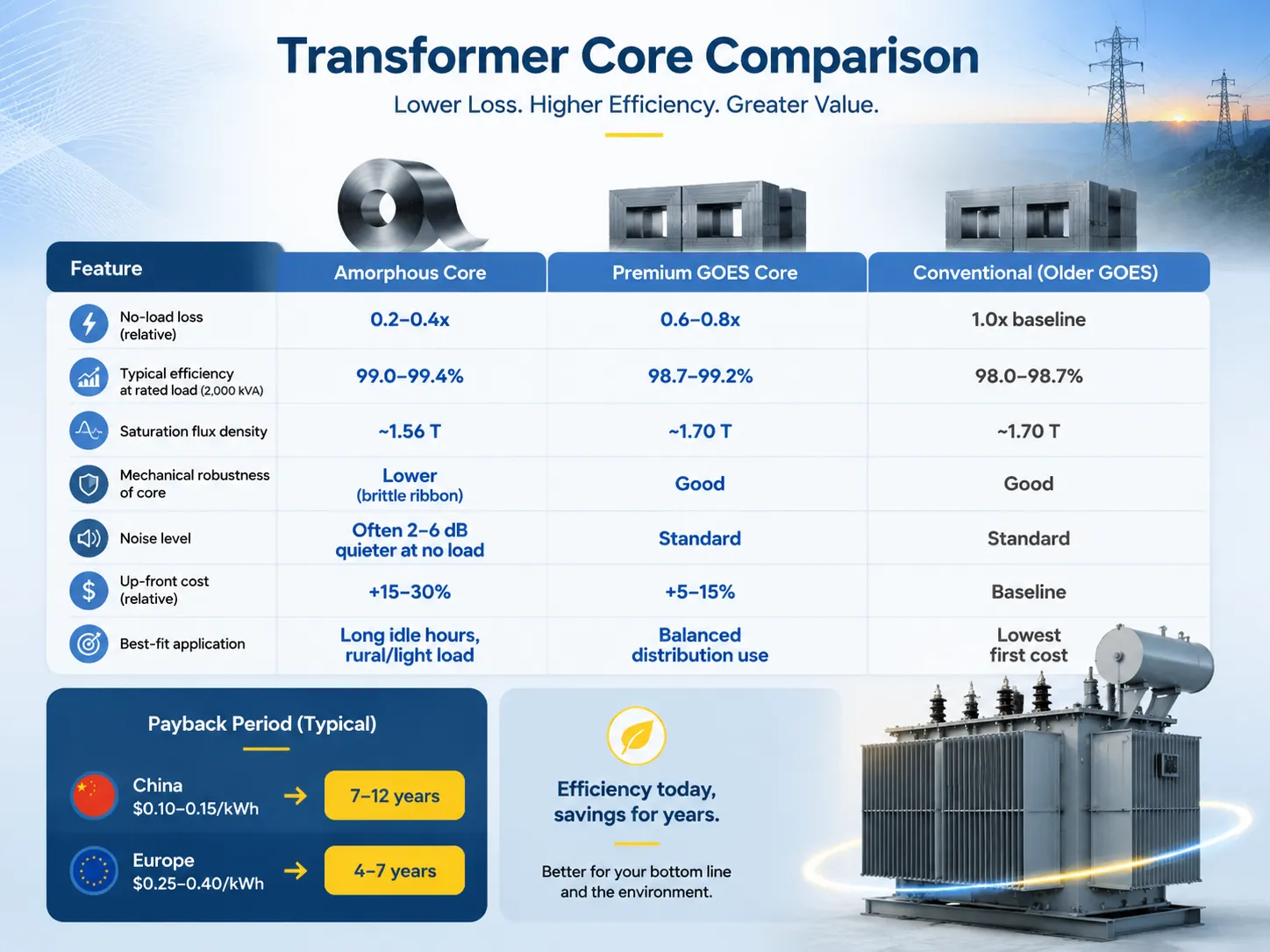
비정질 대 실리콘 강철 대 기존 변압기
| 기능 | 비정질 코어 | 프리미엄 GOES 코어 | 기존 (구형 GOES) |
|---|---|---|---|
| 무부하 손실 (상대적) | 0.2–0.4x | 0.6–0.8x | 0x 기준선 |
| 정격 부하에서의 전형적인 효율 (2,000 kVA) | 99.0–99.4% | 98.7–99.2% | 98.0–98.7% |
| 포화 플럭스 밀도 | ~1.56 T | ~1.70 T | ~1.70 T |
| 코어의 기계적 강도 | 낮음 (취성 리본) | 좋음 | 좋음 |
| 소음 수준 | 무부하 상태에서 종종 2–6 dB 더 조용함 | 표준 | 표준 |
| 초기 비용 (상대적) | +15–30% | +5–15% | 기준선 |
| 최적의 적용 | 긴 유휴 시간, 농촌/경량 부하 | 균형 잡힌 분배 사용 | 가장 낮은 초기 비용 |
| 투자 회수 기간 (전형적) | 6–12년 | 3–8년 | 해당 없음 |
투자 회수 열의 맥락은 중요합니다. 중국의 산업 요금이 $0.10-0.15/kWh인 경우, 비정형 업그레이드는 7-12년 내에 회수되며, 유럽에서는 산업 전력 비용이 $0.25-0.40/kWh인 반면, 동일한 업그레이드는 단 4-7년 내에 회수됩니다. 이것이 효율 우선 규제가 점점 더 널리 퍼지고 있는 이유입니다 — 절약에 대한 수학은 환경적 이점을 고려하기 전에도 작동합니다.
효율 클래스 및 기준
| 표준 | 정의하는 것 | 상태 / 비고 |
|---|---|---|
| IEC 60076-20 | 배전 변압기에 대한 에너지 효율 클래스 (클래스 1 = 최고) | 현재 국제 기준 |
| GB 20052-2020 | 중국의 전력 및 배전 변압기에 대한 에너지 효율 값 | 의무; 세 가지 효율 등급 |
| 미국 DOE 10 CFR 431 (2016 규칙) | 액체 침지 배전 변압기에 대한 최소 효율 | 2027년부터 미국에서 더 엄격한 기준으로 수정됨 |
| EU 규정 548/2014 (2019년 수정) | 변압기에 대한 에코 디자인 1단계 및 2단계 효율 수준 | EU에서 가장 낮은 효율 클래스의 판매 금지 |
| IEC 60076-1 | 일반 전력 변압기 등급 및 손실 측정 방법 | 손실 보증 및 시험 절차의 기초 |
제품 시트에서 언급된 “에너지 절약 변압기”의 기준을 반드시 확인하십시오. “GB 20052 3급”이 있는 장치는 등급이 없는 장치보다 우수하지만 “1급”이 있는 장치에 비해 훨씬 덜 우수합니다. 일반적인 최고 성능 장치는 “IEC 60076-20 클래스 1”이 있는 장치입니다. 손실에 대한 보증도 협상 가능합니다: IEC 60076 규범에 따라 제품을 생산하는 장쑤 수비안 전력과 같은 회사는 P0 및 Pk 값을 제안서에 포함하고 생산 중에 이를 시험할 것입니다. 이렇게 하면 IEC 60076-1에 따른 허용 오차 조항의 도움으로 언급된 수치에 대해 그들을 책임질 수 있습니다.
에너지 절약 변압기가 가장 효과적인 곳
경제적 관점은 애플리케이션에 따라 상당히 다르며, 홍보 자료보다는 부하 프로파일에 따라 결정하는 것이 중요합니다. 유틸리티 및 농촌 배전은 고전적인 비정질 코어 애플리케이션을 나타냅니다: 농촌 변압기는 연간 8,760시간 작동하지만, 종종 25% 미만의 부하를 방전하고 있어 무부하 손실이 우세하며, 투자 회수율이 가장 매력적입니다. 24시간 운영되는 산업 플랜트는 높은 부하 계수를 가지고 있으며, 이 경우 최소 부하 손실에 중점을 두어 구리 권선, 상당한 도체 및 때때로 병렬 소형 변압기가 사용됩니다. 상업용 건물 및 데이터 센터는 효율성과 낮은 소음 수준이 모두 필요하며, 비정질 코어는 다른 코어보다 조용하므로 드라이 타입 또는 주조 수지 유닛이 자주 채택됩니다. 재생 에너지 농장은 그들만의 특성이 있습니다: 인버터는 출력에서 높은 고조파를 가지고 있으며, 생성 패턴은 경량 부하에서 긴 시간 동안 작업하는 것이 특징으로, 이는 낮은 무부하 손실과 고조파로부터의 보호를 요구합니다.
이러한 모든 경우에 접근 방식은 동일합니다: 연간 사용 프로파일을 계산하고, 요금제를 기반으로 에너지 비용을 계산한 후, 15년에서 20년 동안의 총 소유 비용을 구매 비용과 비교합니다.
| 응용 | 부하 패턴 | 주요 손실 | 권장 기술 | 일반적인 투자 회수율 |
|---|---|---|---|---|
| 농촌 배전 | 8,760시간/년, 낮은 부하 | 무부하 손실 | 비정질 코어 | 5–10년 |
| 도시 유틸리티 변전소 | 주기적 피크, 보통 평균 | 혼합 | 프리미엄 GOES + 구리 | 4–8년 |
| 24/7 industrial plant | High load factor 70–90% | 부하 손실 | Copper windings, larger conductors | 2–5 years |
| Commercial building / data center | Daytime peaks, high availability | Mixed + noise | Dry-type, low-noise, premium steel | 3–6 years |
| Solar / wind farm | Cyclic generation, harmonics | No-load + stray losses | Amorphous or premium GOES, harmonic-tested | 4–8년 |
Top Brands & Price Ranges
| 브랜드 | Specialty | Typical Price Range (2,000 kVA class) | Region |
|---|---|---|---|
| Hitachi Energy (ABB) | Amorphous & large power transformers | $35,000–$70,000 | Switzerland/Global |
| 지멘스 에너지 | Power transformers, grid solutions | $38,000–$75,000 | Germany/Global |
| 슈나이더 일렉트릭 | Distribution & dry-type transformers | $25,000–$55,000 | France/Global |
| TBEA | Amorphous & large power transformers | $20,000–$45,000 | 중국 |
| China XD / Baoding Tianwei | Power transformers, UHV expertise | $22,000–$50,000 | 중국 |
| 장쑤 수비안 전력 | Distribution & power transformers to IEC 60076 | $15,000–$38,000 | China/Global export |
The prices can differ depending on specification, efficiency class, cooling type, and accessories, so consider them as guiding values. Popular global manufacturers such as Hitachi Energy, Siemens Energy, and Schneider Electric have a good reliability record. Their prices reflect that. Chinese companies such as Jiangsu Subian Electric Power have managed to close much of the gap in terms of quality, as modern Chinese distribution and power transformers comply with established IEC 60076 and are made using the same measurement techniques. They are also sold globally 20-40% cheaper than their European counterparts. Those who maintain budget consciousness but want assured low losses can opt for a Chinese IEC-compliant product, just make sure to check the test report from the manufacturer and include a third-party test in the contract in case the order is significant.
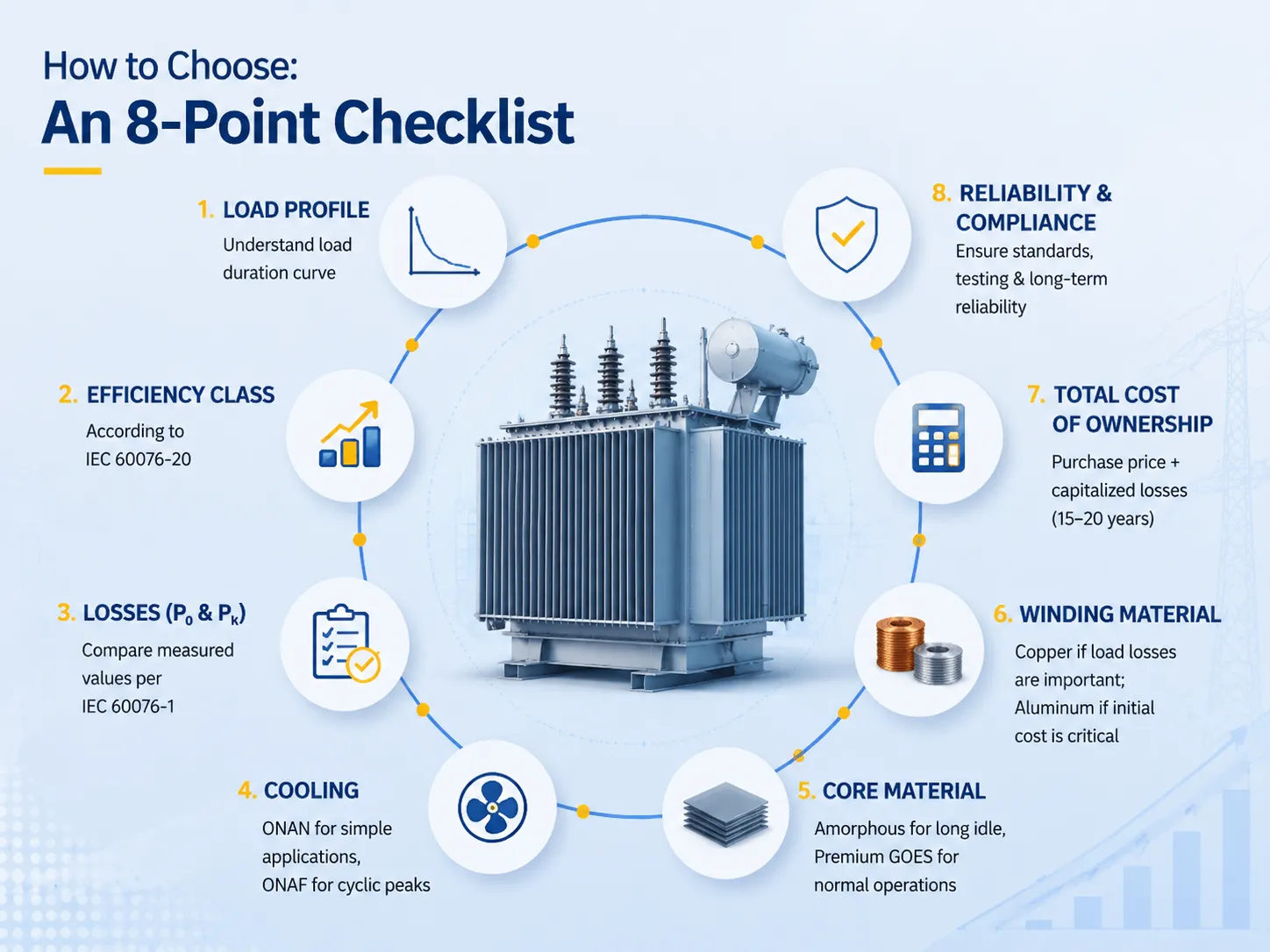
How to Choose: An 8-Point Checklist
- What is load profile? Estimate the annual load duration curve to determine whether no-load losses or load losses are predominant.
- Next, determine the efficiency class. IEC 60076-20 defines classes 1, 2 and 3 or the equivalent local standard based on tariff, load factor and estimated working life.
- Now compare P0 and Pk values as declared in measurements. Ensure that the manufacturer has conducted tests in accordance with IEC 60076-1 and not just relied on the catalog data.
- Make sure that the cooling is appropriate for the application. ONAN for simple applications or ONAF or forced cooling for cyclic peaks.
- Next check if the core material is suitable for the application. Use amorphous core for long idle conditions and premium GOES for normal operations, and also make sure you comply with noise and saturation limits.
- Decide what winding material has to be used in the transformer. Copper if load losses are important; aluminum only if initial cost is critical and load factor is low.
- Finally, calculate total cost of ownership. Price of acquisition and capitalized losses during next 15 – 20 years from the moment of commissioning will give you total cost.
Maintaining Efficiency Over the Long Run
Efficiency is not a static feature but one that erodes gradually over time or because of poor maintenance practices. The core losses will often remain unchanged for decades as long as the core is not subjected to mechanical disturbance, while winding losses will rise due to deterioration of the paper insulation and the increase of oxidation in oil, although this effect is relatively small. The major losses are caused by humidity and loading conditions. The moisture in the oil higher than 2% will help the paper insulation to age faster, resulting in an increase of dielectric losses; it is important to maintain high BDV, preferably above 30 kV and at all times test the oil to verify the moisture content (IEC 60156, Karl Fischer). It is important also to monitor the loading process because the prolonged overloading will increase I²R losses, so that at 120% load the load losses are already 44% higher than they should be.
For maintenance with regard to efficiency, the company must conduct annual DGA and oil quality controls, quarterly tests for the performance of the cooling system, continuous cleaning of the oil cooler from dust and vegetation, as well as quarterly analysis of the load data in order to detect any discrepancies. One more important thing to consider is the optimization of the voltage during the re-energizing process and the tap changer positions, since overloading can drastically increase the no-load losses in a unit. For example, by increasing the voltage by 5%, the core losses will grow by 10-12% approximately and hence accurate position should be chosen for the tap changer.
자주 묻는 질문
How much electricity does an energy-saving transformer actually save?
Savings rely on load profile. For a distribution transformer of 2000 kVA replaced from an outdated silicon-steel design to an amorphous-core version, the typical known energy-saving potential is in the range of 8000 to 15000 kWh per year, which translates to a monetary equivalent of $1000 to $2500 at the electricity price of $0.12-$0.24 per kWh. If we include improvements in loss of power due to the application of copper winding technology, then in the case of high load factor, the total saving can be estimated at the magnitude up to 15000-30000 kWh per year. Power loss is greatest at low load and long duration of operation.
Is an amorphous core transformer worth the higher price?
Normally, this is true for devices that spend a lot of time operational under low load – for example, rural electrical distribution and renewable energy devices. The extra expense associated with this technology is about 15–30% more than the cost of traditional silicon steel, and the payback time is around 6–12 at standard industrial prices and 4–7 years in highly priced areas. In case the distribution transformer operates mostly under maximum load, the no-load savings become of less value, thus, the steel core made of premium materials and a copper winding wire can benefit more in this specific case overall.
What efficiency class should I specify for a new transformer?
In many markets, IEC 60076-20 class 2 should generally be taken as the minimum, with class 1 being used at times of high tariffs or low load factor. Under the rules of the EU eco-design, class 1 has almost turned into the standard for new distribution transformers. China’s GB 20052-2020 standard establishes three levels of efficiency, with Level 1 being the most efficient of the three. The efficiency premium can usually be recovered within less than a decade for an asset with a lifespan of 15 to 20 years; hence specifying the highest class is seen as the only rational economic option most of the time.
Does using copper instead of aluminum really matter?
Yes, it can be measured. Copper’s resistivity is around 40% lower than aluminum’s (0.0172 versus 0.0282 Ω·mm²/m, respectively, at 20 °C), so the copper winding uses less conductor volume to achieve the same loss and works at lower temperatures – it can carry a bigger current for the same losses. For high load factors, copper windings can decrease load losses by 20-30% compared to the equivalent aluminum design. What is the disadvantage? The pricing – copper windings increase the cost of the transformer by 10-20% approximately.
How do I verify a manufacturer’s loss figures?
Ask for the factory tests results performed according to IEC 60076-1 standards, which lay down required measurements for both the no-load losses and loading losses with tolerances applied. For large orders, ensure that a third party is there to witness the testing at the factory or in an independent testing lab along with getting a loss guarantee clause added to the contracts with penalties in case of exceeding losses above the contracted ones. The leading manufacturers such as Jiangsu Subian Electric Power will never hesitate to share the testing methods, references, and installations used unless they are trying to hide some facts.
참고 문헌
- IEC 60076-20: Power transformers – Part 20: Energy efficiency — the international standard defining efficiency classes for distribution transformers.
- IEC 60076-1: Power transformers – Part 1: General — defines rating, loss measurement, and testing procedures.
- US DOE – Energy Efficiency of Distribution Transformers — US regulatory minimum-efficiency rules and technical background.
- EU Regulation 548/2014 on transformer eco-design — European efficiency requirements and tiered phase-in schedule.
- GB 20052-2020 (Chinese national standard) reference — efficiency grades for power and distribution transformers in China.
- Amorphous metal core technology resources — technical background on amorphous core properties and applications.
- 장쑤 수비안 전력 — IEC 60076-compliant transformer manufacturer offering amorphous and premium steel designs with verifiable loss reports.
결론
The invention of energy-efficient transformers has shifted from being a special feature to become an important criterion in purchasing decisions. The theory behind energy-efficient transformers is easy: the use of amorphous cores leads to a reduction in no-load losses by 60-80%, copper winding reduces load losses from the point of view of physics by 20-30%, and with smart load management, the transformer operates most efficiently. The key question asked is not “Are these transformers energy-efficient?” but “Does the payback period suit my loading and tariff?” The answer is positive in most cases within 4-12 years.
- Amorphous cores work well in case of idle transformers with little load, whereas the combination of GOES material and copper is more appropriate for transformers with high load factor.
- Make sure to choose transformers of IEC 60076-20 class 1 or 2 and to ask for graphs of factory transformer test results.
- Compare the total life cost over 15-20 years instead of purchasing cost.
- Make sure that you control tap position and keep oil dry.