


냉장고, TV, 전자레인지 및 차고 문 개폐기와 같은 가전제품의 고장은 전선 내 변압기의 고장으로 자주 귀속됩니다. 어떤 경우에는 실제로 그럴 수 있지만, 다른 경우에는 단순히 “변압기가 고장났다”고 말하는 것보다 가전제품의 고장을 유발한 원인을 파악하는 데 훨씬 더 복잡할 수 있습니다. 이러한 경우, 고장의 원인을 정확히 파악하면 향후 유사한 고장을 피하기 위한 예방 조치를 취할 수 있으며, 책임이 있는 당사자가 고장에 대해 책임을 져야 하는지 여부를 결정할 수 있습니다. 이 기사에서는 변압기가 가전제품에 손상을 줄 수 있는 방법, 가전제품 고장으로 이어질 수 있는 다섯 가지 주요 고장 목록을 제공하고, 최악의 유형의 가전제품 고장이 존재하는지 평가할 것입니다. 또한 독자들에게 가전제품의 잠재적인 고장을 식별하는 방법에 대한 정보를 제공할 것입니다.
요약하자면, 변압기가 제대로 작동하지 않으면 가전제품에 문제가 발생할 수 있습니다. 그러나 대부분의 경우 실제 변압기 고장이 아니라 중성선과 관련된 다른 문제입니다. 중성선은 변압기에 중성점을 제공하는 역할을 하며, 이는 안정적인 120 V 전원을 제공합니다. 중성선이 끊어지면 두 개의 전원선은 본질적으로 240 V를 받게 됩니다. 일반적으로 변압기에 적용되는 부하의 유형에 따라 변압기는 일부 에너지를 잃게 되며, 이는 일반적으로 출력 중 하나의 출력 전압이 낮아지는 결과를 초래합니다. 출력선 중 하나에 작은 부하가 있는 경우, 전압은 최대 70 V를 초과할 수 없습니다. 이러한 상황에서는 에너지 손실이 해당 에너지로 전원 공급되는 전기 가전제품을 파괴하고 손상시키거나, 예를 들어 냉장고나 에어컨과 같은 일부 장치를 고장낼 만큼 충분합니다.
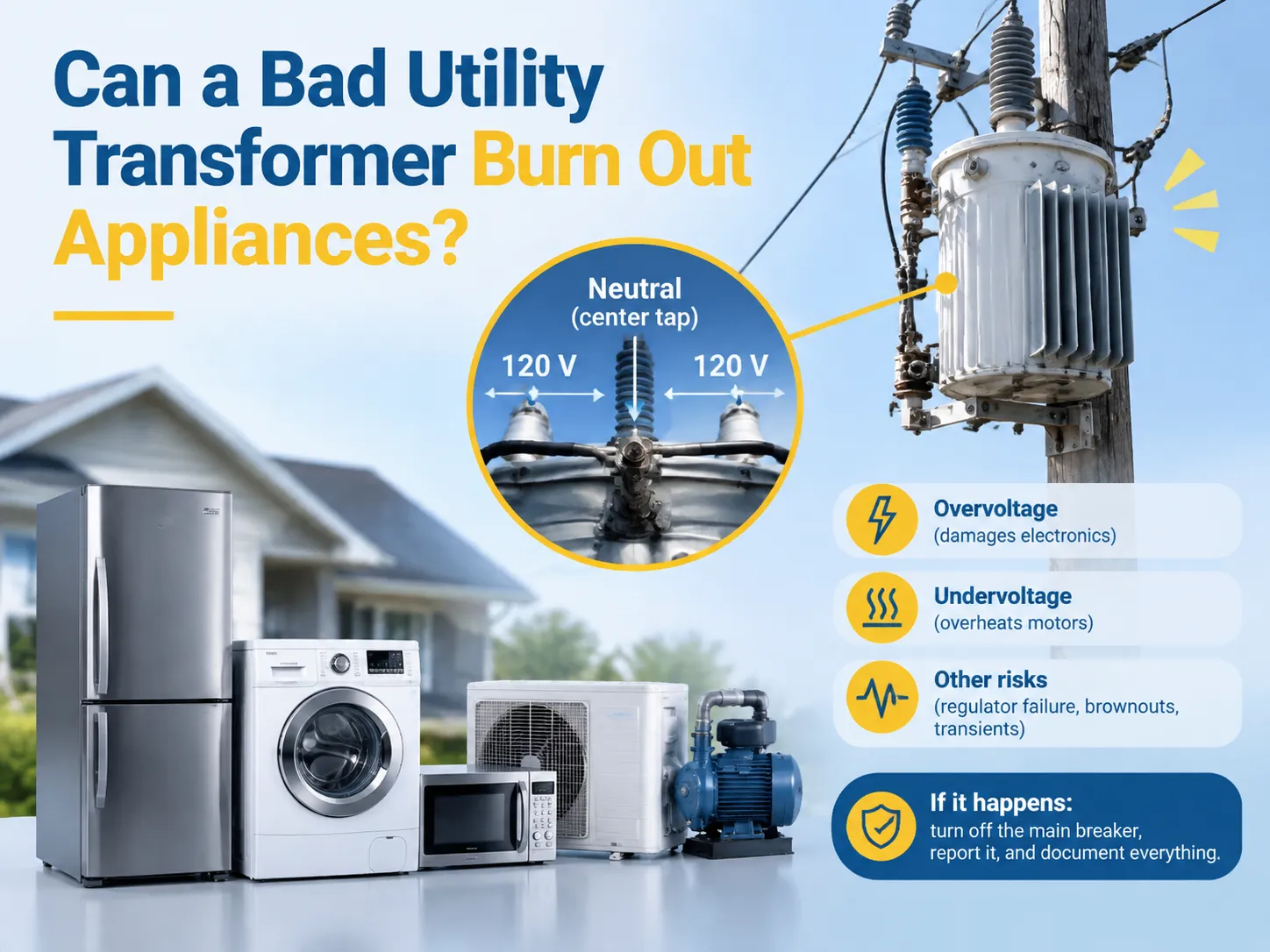
변압기가 가전제품에 손상을 주는 방법
변압기는 주택과 같은 주거용 건물에서 사용할 수 있도록 변압기의 작동 전압을 낮게 유지합니다. 북미에서는 배전 변압기가 중앙 탭이 있는 전선을 사용하여 고전압을 낮춥니다. 이 전선은 기준점 또는 중성선으로 작용합니다. 이 전선은 접지에 연결되어 있어 임시 연결 없이 기능합니다.
나가는 전선은 서로 다른 지점 간의 전압을 전달합니다. 두 경우 모두 전선은 고정 전압을 가지고 있습니다. 전원 공급원에 연결된 가전제품의 수와 관계없이 변압기는 항상 기존 시스템의 이점을 유지합니다.
따라서, 기기와의 연결 문제는 변압기보다는 기기와 관련된 손상을 초래한다고 말할 수 있습니다. 드물게 변압기가 고장날 수 있지만, 대부분의 경우는 중성선과 관련이 있습니다. 고장을 진단하기 전에 공급 배치의 기본 물리학을 이해하는 것이 중요하며, 이는 우리의 가이드에서 첫 번째 원리로 설명됩니다. 배전 변압기 기초.
잃어버린 중성선: 진짜 범인
개방 중성선 문제는 때때로 잃어버린 중성선 또는 느슨한 중성선 결함으로도 알려져 있으며, 주거용 전력 공급에서 가장 일반적인 결함입니다. 이 문제의 증상은 일반적으로 다양한 기기의 무작위 고장으로 나타나기 때문에 원인을 놓칠 수 있습니다.
이러한 사건에서의 과정은 항상 중성선에 의해 전력의 두 다리가 연결되는 것입니다. 그러나 중성선이 실패하면 두 다리는 더 이상 안정적인 기준점을 가지지 않습니다. 두 다리는 직렬 연결된 회로처럼 작용합니다. 한 다리의 부하가 다른 다리의 부하와 동일한 양의 전류를 경험해야 하며, 두 다리가 하나의 회로가 되기 때문입니다. 따라서 전압은 회로의 두 다리 간의 저항에 따라 분배됩니다.
상황은 각 다리에 연결된 부하의 종류에 따라 상당히 다를 수 있습니다. 한 경우, 한 다리가 적은 부하만을 수용하고 다른 다리가 큰 부하를 수용하는 경우, 대부분의 전압은 전력을 덜 소비하는 부하에 공급됩니다. 예를 들어, 한 다리의 부하가 6암페어이고 다른 다리가 4암페어인 경우, 가벼운 부하에는 144볼트가 공급되고 무거운 부하에는 96볼트가 공급됩니다.
개방 중성선으로 인한 전기 문제의 결과로 손상이 발생할 수 있는 두 가지 방법이 있습니다. 과부하가 걸린 다리의 경우, 너무 많은 전압이 특정 회로 구성 요소를 통해 너무 많은 전류가 흐르게 하여 이들이 너무 빨리 가열되고 오작동하게 만듭니다. 반면 두 번째 다리에서는 기기가 동일한 출력을 달성하려고 하지만 전압이 적기 때문에 더 많은 전류를 끌어당기고 과열됩니다.
이 과정에 영향을 미치는 비대칭성은 전기 레인지, 온수기 및 건조기와 같은 대형 기기가 시스템의 두 다리에 연결되어 있으며 중성선이 손실되더라도 대략 동일한 전압을 받는다는 것입니다. 나머지 스커팅은 대부분의 현대 가정에서의 120볼트 라인과 관련이 있습니다.
중성선은 시스템에서 가장 외부 요소에 노출된 부분이며, 가장 자주 실패하는 연결은 아무도 점검하지 않는 부분입니다. 변압기, 날씨 헤드 또는 계량기 베이스에서 느슨하거나 부식된 중성선은 유지보수 문제이며, 이는 수리 호출보다는 예방 프로그램에 포함되어야 합니다. 변압기 유지보수 체크리스트.
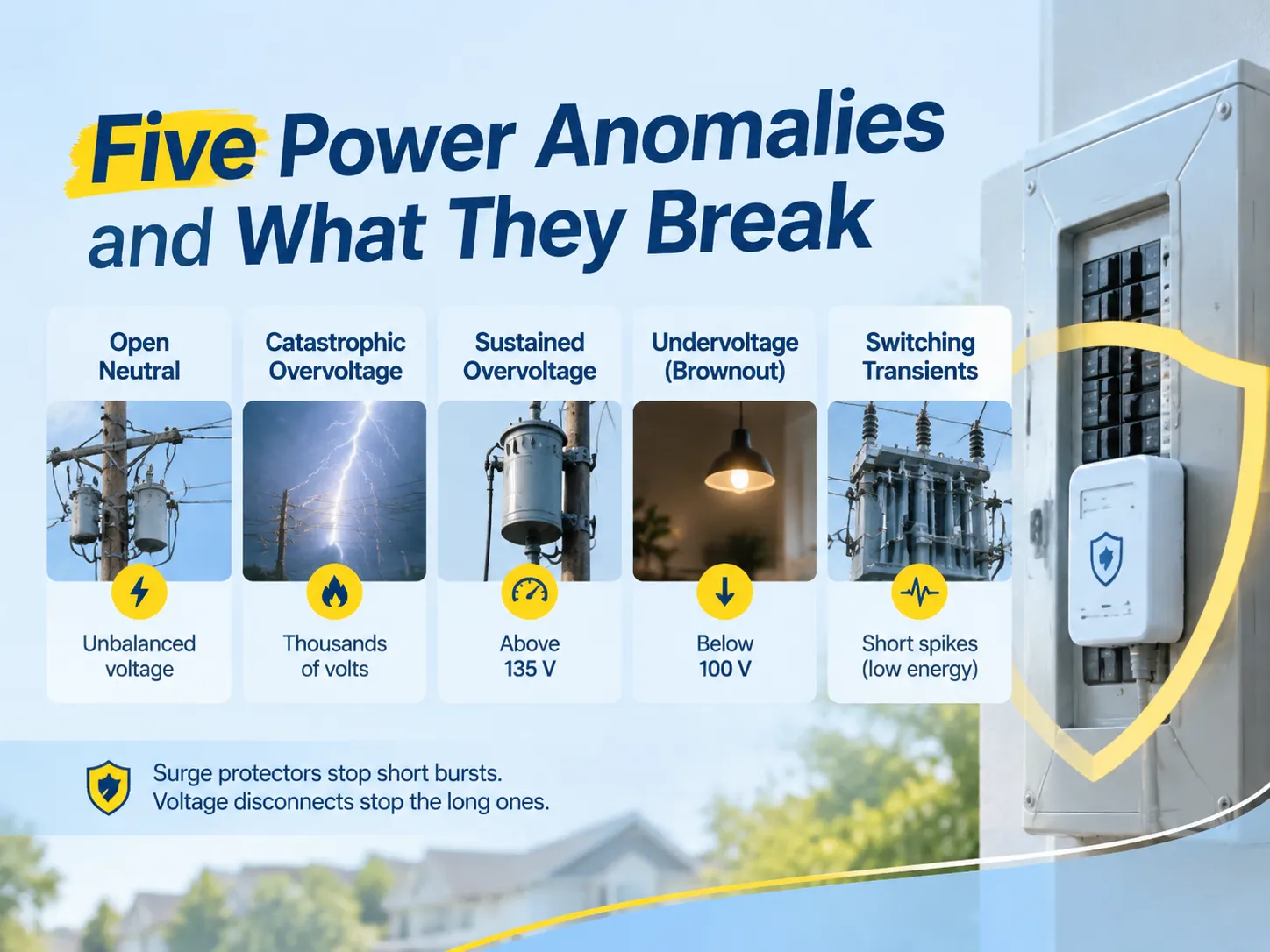
다섯 가지 전력 이상 현상과 그들이 파손하는 것
이러한 경우의 차이를 인식하는 것은 각 경우가 다른 예방 계획과 책임 상황으로 접근해야 하기 때문입니다.
| 이상 현상 | 원인 | 전압 동작 | 전형적인 손상 |
|---|---|---|---|
| 개방 중성선 | 변압기, 서비스 드롭, 날씨 헤드, 미터 베이스 또는 패널에서 파손되거나 부식되었거나 고저항 중성선 | 한 쪽 전압이 120 V를 초과(약 170-240 V까지)하고, 다른 쪽은 70 V 이하로 떨어짐 | 고전압 쪽의 전자기기 및 제어 보드; 저전압 쪽의 모터 권선 |
| 치명적인 과전압 | 고전압 선이 얼음, 떨어진 나무 또는 차량 사고를 통해 저전압 선과 접촉 | 수천 볼트가 서비스에 유입될 수 있음 | 연결된 장비의 광범위한 파괴; 화재 위험 |
| 지속적인 과전압 | 고장난 유틸리티 전압 조정기 또는 손상된 배전 변압기 | 일반적으로 120 V 서비스에서 약 135 V 이상 | 전자기기, 램프 및 모터 절연체의 조기 고장 |
| 저전압(브라운아웃) | 과부하 변압기, 과부하 유틸리티 또는 건물 배선, 결함 있는 조정기 | 일반적으로 120 V 서비스에서 약 100 V 이하 | 모터가 과열되어 고장; 전자기기가 불규칙하게 작동 |
| 스위칭 과도현상 | 유틸리티 스위칭 작업 | 짧은 지속 시간의 전압 스파이크, 일반적으로 낮은 에너지 | 일반적으로 억제에 의해 제어됨; 경미한 누적 스트레스 |
차트는 많은 주택 소유자를 놀라게 하는 제한 사항도 보여줍니다. 서비스 진입 지점에 위치한 서지 억제기는 짧지만 강력한 서지로부터 보호하도록 설계되었습니다. 그러나 이는 장기간의 과전압이나 중성선 손실에 대해서는 크게 보호하지 않으며, 이러한 조건은 서지 억제기의 한계를 초과하므로 금속 산화물 서지 억제기와 같은 이 장비는 열 폭주를 겪고, 타버리며 기능을 멈추게 됩니다. 이러한 경우 실제 보호 도구는 과전압 상황에서 공급을 차단하는 회로 차단기입니다. 이러한 구분과 보호 구성 요소를 건강하게 유지하는 유지 관리 체계는 변압기 고장 원인에 대한 기사와 함께 다루어집니다. 변압기가 고장나는 원인.
경고 신호
결함 있는 중성선이나 변압기는 전기 고장이 발생하기 전에 신호를 보냅니다. 이 신호는 쉽게 인식할 수 있습니다.
- 다른 장비가 켜지거나 꺼질 때 깜박이는 조명. 이는 사소해 보일 수 있는 주요 신호입니다.
- 일부 조명이 어두워지는 동안 다른 조명이 매우 밝은 경우. 이러한 차이는 단서를 제공합니다.
- 특히 집의 한 쪽에서 전구가 예상보다 훨씬 더 자주 나가는 경우.
- 이상하게 작동하는 일부 장치 — 냉장고가 이상하게 작동하거나, 전자레인지가 스스로 리셋되거나, 컴퓨터가 재부팅되거나, 차고 문 개폐기가 오작동하는 경우.
- 벽 소켓 근처에서 나는 타는 냄새 또는 색이 있는 페이스플레이트.
- 금속 케이스가 있는 기기에서 전기 충격을 받는 것은 전기가 의도하지 않은 경로를 찾았음을 의미합니다.
- Burnt or damaged surge protectors, especially if happened with several devices simultaneously.
Any combination of these symptoms needs an immediate reaction instead of beain observing. A voltage test on several wall sockets that are connected to different circuits will give a quick answer: one leg of the circuits shows 120V voltage while the other one demonstrates much lower values.
What to Do When It Happens
One needs to focus on the order of the process since the first thing to do is to turn off the electricity.
- The first step would be to disconnect the main switch. Turning off the source of power stops the losses and takes away the chances of fire while there is still a defect. This is the most important thing here.
- You need to contact the utility immediately and use the emergency number instead of the regular inquiry department. The problem is usually in their part of the meter, for example, at the transformer, and only they can fix it.
- The main switch may not be turned on again until the utility personnel or a licensed specialist have checked the source of power supply. If you turn the electricity back while the problem is still there, the problem may reappear even worse than it was before.
- Write down everything. Take photos of the damaged appliances, make sure they are kept and not thrown away, keep bills and some information on when the event happened or when the appliances were bought.
- One needs to provide the diagnosis in writing. A statement that will identify the cause of the failure will be crucial for the claim and will separate issues with the service provider from the failure of your system.
- When the electricity is back to normal, have an electrician visit and check the panel and service drop since it can be damaged, with the grounding connection being broken.
Who Pays for the Damage
The straightforward answer to the aforementioned question is that it relies on the location of where the fault occurs. Nevertheless, it can still be stated that the system is reliable enough to respond in a similar manner each time.
If the issue occurs in the utility’s area of the meter (e.g., transformer, service drops, connection points on poles), the utility will be liable in this case, and most utilities have a claims procedure in place for the equipment that is damaged in this respect. When the damage happened from the point where the meter is found and in the building’s electrical system, this may be termed as the property owner’s responsibility, thus the electrician should be contacted for further assistance. It is essential to point out that in case a landlord, property manager, or body corporate is responsible for the distribution equipment, the liability for the fault lies with them instead of the utility, so it is advisable to check on this matter before turning to a utility for compensation.
In practice, there are three key factors that determine whether the claim would be successful, namely timely notice depending on the timeframe set by the utility, proof that the fault originated from an equipment problem and proof of the damage of equipment. It is worth considering that homeowner’s insurance may insure the loss, or some surge protection devices have equipment coverage, but the insurance limits in this case are not significant. The main point remains that it is advisable to report the accident on the same day, keep the damaged devices and learn more about the utility’s claims process instead of having a false assumption that the matter has no value.
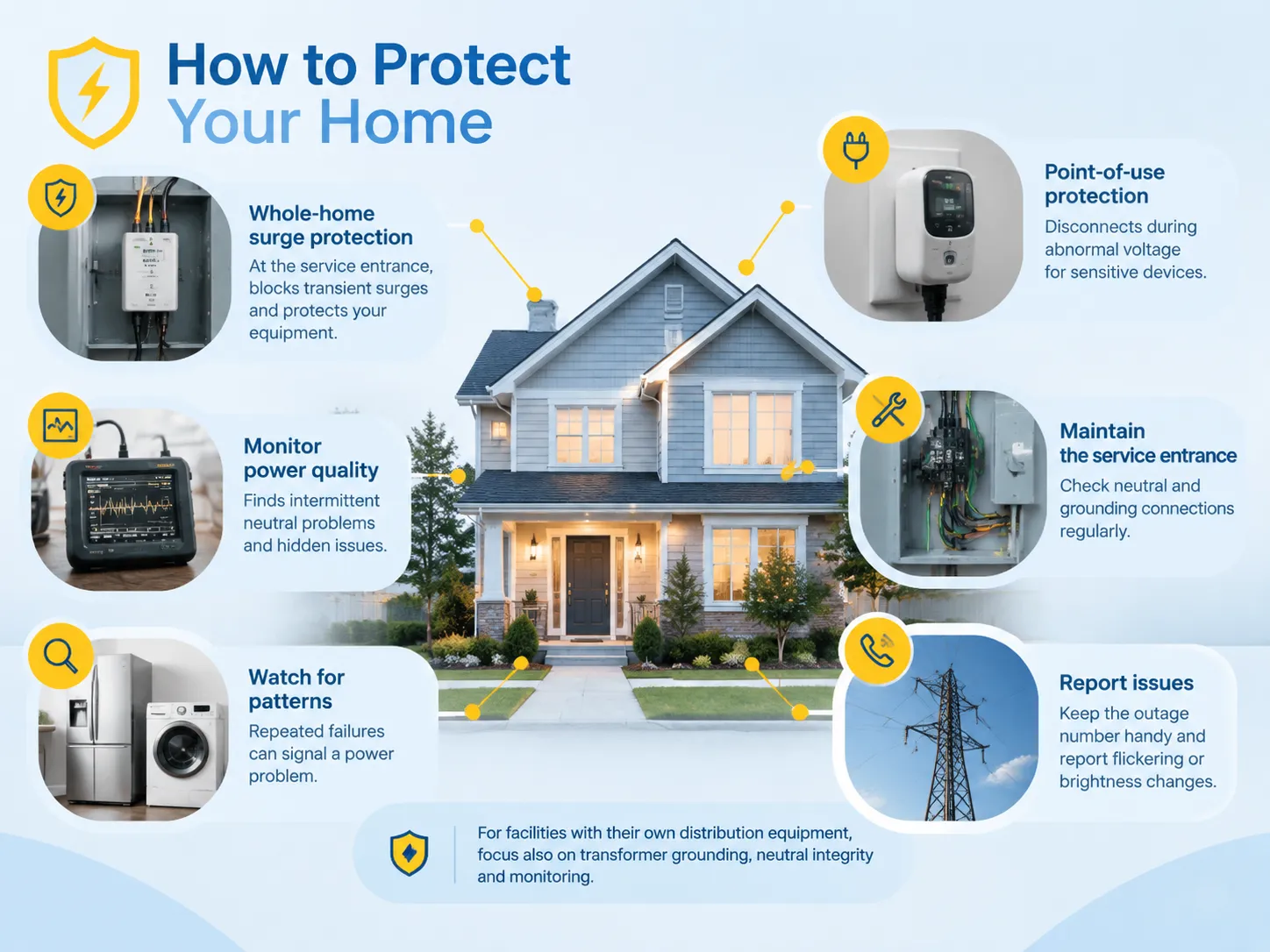
How to Protect Your Home
A homeowner may not be able to stop the corroding of the utility neutral, but it can be minimized.
- Buy a whole-house surge protection device. This piece of safety equipment does not help in case of overvoltage or loss of the neutral, but it does eliminate momentary malfunctions useful in prolonging the life of equipment and saving lots of money.
- Think about adding point-of-use protection in regard to touchy electronic devices. Devices helping with electrical protection through electrical disconnection when voltage is outside the acceptable range are nice to use and are much better than non-active devices.
- Think about purchasing a voltage monitor or power quality recorder. Problems with neutral may be rather hard to detect so the recorder left for a week can do what a single measurement cannot.
- Check service equipment regularly. Ensure connections for the neutral and grounding are checked regularly by an electrician.
- Make sure to check if there are similar failures. One appliance failure can be perceived as a coincidence; three failures in a small period of time may be a key to what is happening.
- Also remember about utility outage phone number and don’t hesitate calling them in case of flickering even if nothing bad has happened yet.
For facilities with their own distribution equipment, the same logic applies with more at stake, and the protective measures available at the transformer level — earthing arrangements, neutral integrity, and monitoring — are covered in our guide to 변압기 접지 기초.
Where a site is specifying new distribution equipment and wants documented protection characteristics rather than assumptions, a certified unit with published test data is the starting point. Our 배전 변압기 범위 shows the specification detail a buyer should expect to see.
Why Transformers Fail in the First Place
The comprehension of several types of failures is Valuable because it gives distinction between failure-provoking events and those that are just turning off power supply.
- Overloading and overheating. A transformer which is overloaded deteriorates faster, as the insulation is temperature-dependent; the relation between the temperature and insulation quality is strict and clear – the insulation will last half as less at 6-8 degrees higher than its norm.
- Insulation deterioration. Paper insulation degrades chemically within decades of time making it fragile and losing its dielectric qualities until the failure takes place.
- Lightning strikes and switching type surge. Lightning strikes take a toll on the insulation of transformer windings over many years.
- Oil deterioration and moisture ingress. In oil-filled transformers, moisture and oxidation make the dielectric properties lower.
- Corroded or loosened joints. The terminations of transformer and neutral become corroded and unattached with time. It is not the most interesting type of failures because just having failed neutral one can’t see anything apart from gradual minor failures of equipment till someone checks voltage.
- External damage. Broken vehicles, storm debris, and animals cause many failures.
The key factor is that failures that cause damage are of least evident nature. A transformer that fails catastrophically causes visible power outage and calling a repair crew, while the failed neutral only generates slow accumulation of new non-explained failures of equipment.
자주 묻는 질문
What are the signs that a transformer is going bad?
From the consumer’s perspective, signs of transformer trouble are electrical rather than mechanical. For example, lights flickering or dimming every time equipment on different circuits is used, strange bulb brightness (sometimes one bulb is too bright while others are dim), lamp burning out frequently, malfunction of electronic gadgets, unusual smell. From the electrical supplier’s viewpoint, the signs include leakage of oil, strange sound, overheating, and increased level of gas dissolved in the insulating oil. Importantly, sometimes malfunctioning transformers give no visible signs on the outside so as soon as electricity-related problems occur, one should take measurements to identify faulty equipment instead of ascribing everything to bad luck.
Who pays when a power surge ruins your appliances?
It is possible to determine the responsibility depending on the specific circumstances. In general, when a power surge takes place due to an issue occurring on the electricity supply side of the meter (e.g., faulty transformer neutral, damaged service drop, faulty regulator), the electricity supplier will be liable and may offer you a formal procedure for making a complaint for damaged appliances. On the other hand, if the electrical failure took place after the meter and was linked to the building wiring, the property owner will be responsible for that. If the distribution cable is owned by the landlord/property management company, the latter will be liable for damages. To get reimbursement, one should report the issue to the electricity company as soon as possible within the time frame the utility specifies.
What causes a transformer to burn out?
The leading reasons for transformer malfunction are prolonged overload, insulation aging over the decades, lighting and switching surges, humidity and oil deterioration for oil-filled transformers, and damage from rain, cars, and animals. Out of all these causes, overloading and aging insulation makes up the majority of cases. In fact, transformer burnout causes blackout, while failure of the transformer neutral connection may result in burning of the electrical appliances.
Does the power company know when a transformer blows?
Usually, utility companies are aware of the situation sometimes. New generating plants are equipped with various monitoring systems that help identify problems that have occurred at substations and along the feeder lines, while smart meters give them information about the voltage at particular houses. In case of dramatic transformer failure, protection systems will go off and alert the utility. However, in case of slow neutral problems or gradual insulation degradation, no alerts can be sent by the transformer which is why customers’ reports are so important.
참고 문헌
- NFPA — National Electrical Code, Service Grounding and Bonding Requirements
- U.S. Department of Energy — Power Quality and Distribution System Reliability
- EPRI — Distribution Transformer Failure Modes and Condition Assessment
- IEEE — Power Quality Standards and Transformer Loading Guides
- UL Solutions — Surge Protective Devices (UL 1449)
결론
It is not typical to think about a transformer causing a catastrophe. The overwhelming majority of transformer failures are spectacular events, as in those instances when transformers develop catastrophic failure, often causing fantastic amounts of electricity loss through a transformer; however, none of this energy will harm other electrical devices connected to the transformer. On the other hand, when an appliance fails due to loss of power, it creates no noise and often far less noticeable than would typically occur; because there is a loose or corroded neutral connection, reference voltages can continue to fluctuate from a low of 40 volts and up to a high of 200 volts. The following indicators may be used to indicate that a neutral failure has occurred, including the brightness of the kitchen appliances and the presence of current in both circuits: 120 volts and the “blinking” lights at both 40 volts and 200 volts. To fix a faulty appliance, turn off the main breaker and contact the utility driver about the issue.