


A área de teste da fábrica de um fabricante estrangeiro tinha um engenheiro de comissionamento sentado lá, observando atentamente o teste de aquecimento realizado em um transformador de 10 MVA que seu serviço de utilidade havia encomendado. A conformidade com a IEC 60076 foi estipulada na especificação do projeto e sua presença lá para conduzir um teste de aceitação de fábrica foi motivada pelo incidente do fornecedor anterior, onde as unidades fornecidas foram submetidas a testes de rotina mostrando perdas aceitáveis, mas sem evidências de testes de tipo realizados no design. Desta vez, sua lista de verificação incluía a posição do ponto de teste, a edição que foi utilizada e a temperatura. No campo dos transformadores, a documentação desempenha um papel enorme e se você souber como interpretá-la, verá sucesso em vez de surpresas.
A Parte I deste manual tratou das normas IEC e da estrutura da série IEC 60076. A segunda parte do manual cobre detalhes de resolução de problemas que fornecem proteção ao comprador: como entender o relatório de teste do transformador, como os testes de rotina, tipo e especiais estão conectados, como a conformidade com a IEC se correlaciona com a IEEE e outras normas nacionais, e como aplicá-la ao elaborar contratos. O público para esta parte do guia são engenheiros e departamentos de compras que devem garantir a validade dos dados que lhes são apresentados.
O que a Parte II Cobre — e Por Que Isso Importa
A Parte Um tratou da questão do que se entende por normas IEC, enquanto a Parte Dois busca abordar a questão mais difícil de como verificar a conformidade. Em uma situação onde os prazos de entrega podem levar dois anos e se um teste falhar, a subestação pode permanecer fechada por meses, a diferença entre um fornecedor conforme e um não conforme se torna evidente muito antes do teste ser realizado no local. Nesta edição, você recebe a ordem de leitura, parâmetros de tolerância e disposições contratuais necessárias para tornar a conformidade uma realidade em vez de um ideal.
Como Ler um Relatório de Teste de Transformador
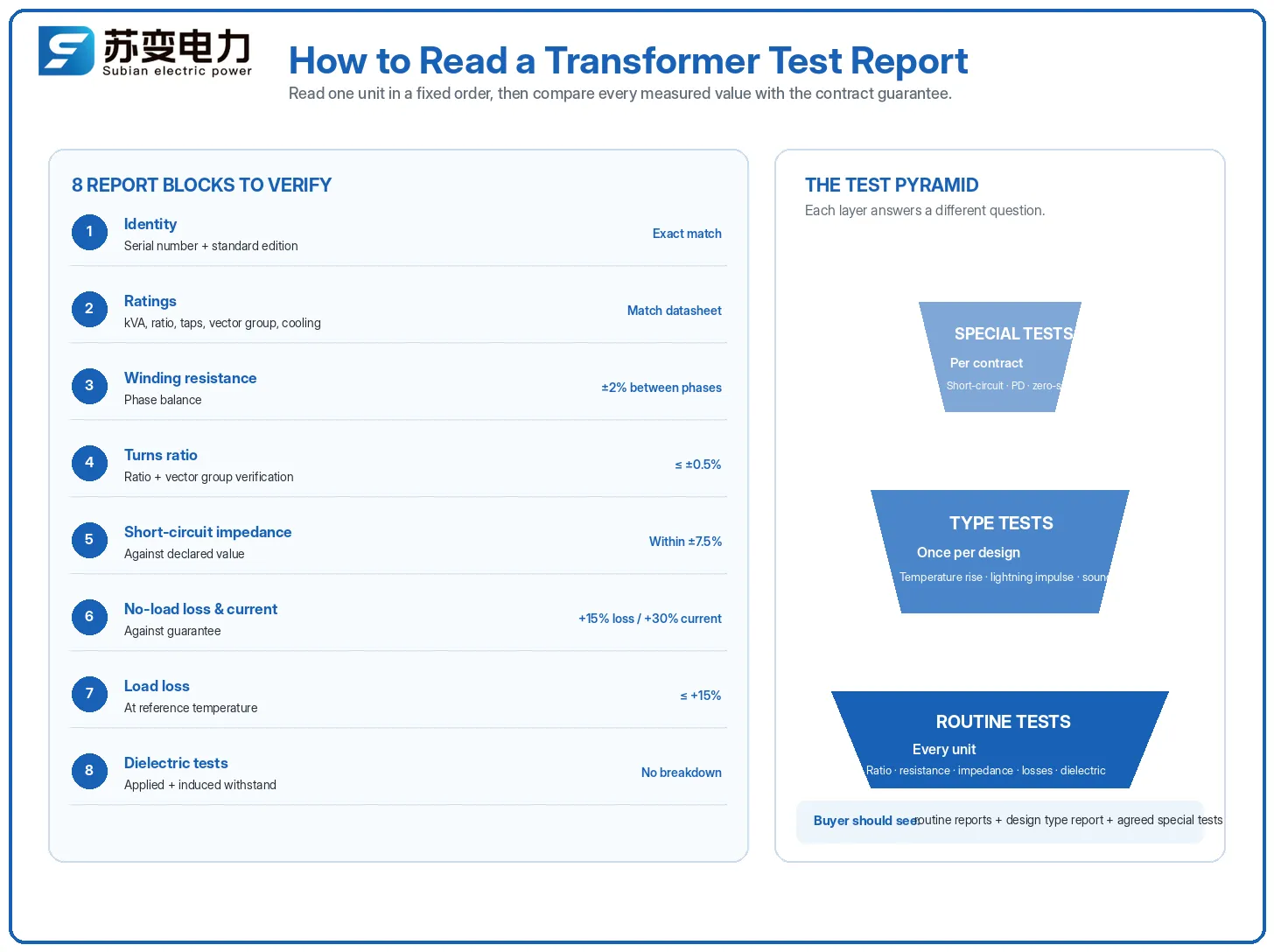
Um relatório de teste de rotina bem preparado é uma biografia técnica compacta de uma unidade específica. Deve ser lido em uma ordem fixa, verificando cada bloco em relação aos valores garantidos da cotação.
| Bloco no relatório | O que verificar | Critério de aprovação típico |
|---|---|---|
| Identidade | O número de série corresponde ao seu pedido; edição padrão declarada | Correspondência exata |
| Classificações | kVA, relação de tensão, pontos de derivação, grupo vetorial, classe de resfriamento | Correspondência com a ficha técnica |
| Resistência do enrolamento | Balanceado entre fases | ±2% entre fases |
| Relação de enrolamentos | Verificação da relação e do grupo vetorial | ≤ ±0.5% de desvio |
| Impedância de curto-circuito | Comparado com o valor declarado | Dentro de ±7.5% (IEC) |
| Perda em vazio e corrente | Comparado com a garantia | Perda ≤ +15%; corrente ≤ +30% |
| Perda de carga | Na temperatura de referência (75°C para óleo) | ≤ +15% |
| Testes dielétricos | Resistência à tensão aplicada e induzida | Sem ruptura |
Existem duas regras importantes que lidam com quase todos os obstáculos. Primeiro, você precisa comparar os resultados obtidos com os garantidos na licitação, não com o catálogo do fabricante. Segundo, é necessário verificar se a data do teste e o número de série estão relacionados à unidade real sendo entregue, pois o relatório do mesmo pedido não é uma opção aceita.
A Pirâmide de Testes na Prática
Testes de rotina, tipo e especiais formam uma pirâmide, e cada camada responde a uma pergunta diferente.
| Camada | Frequência | Exemplos | Quem testemunha |
|---|---|---|---|
| Testes de rotina | Cada unidade | Relação, resistência, impedância, perdas, dielétrico | QA de fábrica; comprador opcional |
| Testes de tipo | Uma vez por projeto | Aumento de temperatura, impulso de raios, nível de som | Laboratório acreditado ou testemunhado |
| Testes especiais | Por contrato | Resistência a curto-circuito, descarga parcial, sequência zero | Geralmente testemunhado por terceiros |
Testes de rotina demonstram que cada peça está funcionando. Testes de tipo mostram que a implementação pode ser realizada. Testes especiais mostram que o projeto pode suportar situações extremas, mas credíveis, ou seja, o curto-circuito com parafusos apresenta um requisito comum nas avaliações de curto-circuito de transformadores de potência médios e grandes. O comprador deve obter tanto os relatórios padrão sobre suas partes quanto o relatório sobre o tipo e concordar antecipadamente sobre as avaliações especiais que devem ser realizadas de acordo com o contrato.
Valores Garantidos, Tolerâncias e Penalidades
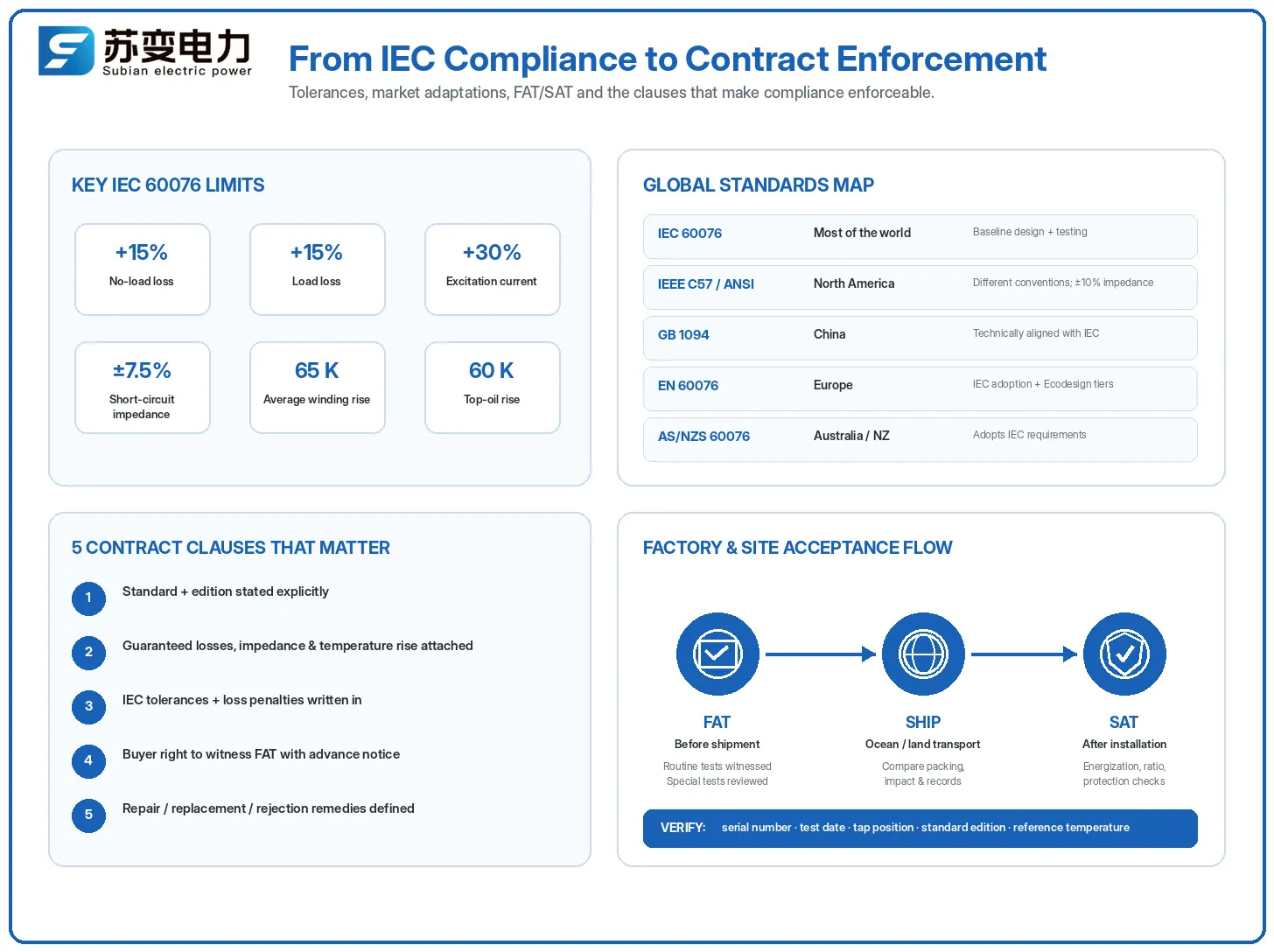
As tolerâncias IEC 60076 existem para que “o transformador falhou” seja uma reivindicação mensurável em vez de um argumento. Os valores padrão são amplamente utilizados em contratos:
| Parâmetro | Tolerância IEC 60076 | Consequência contratual se excedido |
|---|---|---|
| Perda em vazio | +15% | Penalidade de perda ou rejeição |
| Perda de carga | +15% | Penalidade de perda ou rejeição |
| Corrente de excitação | +30% | Geralmente documentada; penalidade se severa |
| Impedância de curto-circuito | ±7.5% | Impacto da coordenação de proteção; deve ser corrigido |
| Aumento de temperatura | Deve permanecer dentro do limite | Não conformidade de projeto; revisão completa |
Penalidades de perda são o mecanismo de aplicação mais comum. Um contrato típico aplica uma penalidade capitalizada por watt de perda excessiva — por exemplo, $2,000–$10,000 por kW de perda em vazio excessiva em um transformador de potência médio — o que dá força à garantia. Se um fabricante recusar penalidades de perda, isso é um forte sinal de que os valores garantidos são flexíveis.
Conformidade IEC em Diferentes Mercados
Projetos internacionais raramente dependem apenas da IEC. A tabela mostra como a IEC 60076 se relaciona com os sistemas que você encontrará na prática.
| Mercado | Sistema governante | Relação com a IEC 60076 |
|---|---|---|
| A maior parte do mundo | IEC 60076 | Base para projeto, teste, certificação |
| América do Norte | IEEE C57 / ANSI | Convenções diferentes; tolerância de impedância ±10%; testes separados |
| China | GB 1094 | Alinhado tecnicamente com a IEC 60076 |
| Europa | EN 60076 (IEC adotada) | Adota o conteúdo da IEC; adiciona níveis de eficiência de Ecodesign |
| Austrália / Nova Zelândia | AS/NZS 60076 | Adota os requisitos da IEC |
Se um projeto abrange vários mercados, como uma empresa de turbinas eólicas que adquire transformadores para projetos em diferentes continentes ao redor do mundo, então a solução prática seria ter um turbo-gerador fabricado de acordo com as especificações IEC 60076, permitindo a integração de normas IEEE ou peculiaridades nacionais do local conforme necessário. Essa competência dupla do fabricante é algo que vale a pena confirmar em vez de apenas mencioná-la na descrição do fabricante.
Usando a Conformidade IEC em Contratos e Negociação
A conformidade IEC em contratos pode funcionar como um ponto chave de negociação. Cinco cláusulas essenciais devem ser incorporadas:
O padrão e a versão. Use “IEC 60076, edição a partir de [data]” para mostrar que edições posteriores não podem ser usadas como desculpa.
Os valores garantidos. Coloque um valor garantido das perdas, impedância e aumento de temperatura em um cronograma que será anexado ao contrato.
A tolerância e penalidades. Use as tolerâncias IEC e, adicionalmente, aplique a cobrança de penalidade por perda em caso de a perda exceder a quantidade permitida.
A testemunha do teste. Faça uma reserva para testemunhar todos os testes de rotina e FAT sob a penalidade de mentir para aviso prévio.
Os remédios. Defina claramente o que acontece em caso de falha nos testes — seja reparos, ou substituições, ou rejeição em casos de limitação de tempo.
Armadilhas Comuns na Verificação de Conformidade
- De acordo com a experiência com numerosos pedidos, existem alguns erros repetitivos. A conscientização sobre esses erros oferece proteção considerável para você.
Aceitando o relatório de teste. Relatórios de rotina devem conter os números de série da sua unidade, em vez de “valores típicos.”
Confundindo carta com certificado. Declaração de conformidade sem identificação de laboratório, valores medidos e assinaturas não significa nada.
Ignorando a edição. Relatórios antigos testados para edições obsoletas podem não estar em conformidade com os critérios de aprovação.
Esquecendo o ponto de teste. Testes de aumento de temperatura devem ser realizados no ponto de aumento máximo – certifique-se de que isso esteja mencionado no relatório.
Confiando no relatório de tipo do concorrente. O teste de tipo é específico para um determinado design; os resultados de testes realizados em um tipo diferente não podem ser emprestados.
Isentando FAT para grandes pedidos. O teste de aceitação de fábrica testemunhado cuida da maioria dos defeitos antes que eles apareçam em campo.
Testes de Aceitação de Fábrica e Aceitação no Local
O FAT lhe dá a oportunidade de recusar um defeito às custas do fabricante, em vez das suas. O método tradicional envolve duas etapas — teste de aceitação de fábrica no qual testes padrão são observados e testes especiais são realizados, seguido pelo teste de aceitação no local em que o equipamento é colocado em operação e testado sob condições de carga.
| Estágio | é negligenciável | O que é verificado | Quem participa |
|---|---|---|---|
| Teste de Aceitação de Fábrica (FAT) | Antes do envio | Testes de rotina testemunhados; testes especiais revisados; dados da placa de identificação | Comprador, inspetor de terceiros, QA da fábrica |
| Teste de Aceitação no Local (SAT) | Após a instalação | Energização, relação e perdas sob carga, verificações de proteção | Comprador, instalador, representante ou agente da fábrica |
A documentação do SAT deve comparar os valores medidos com o relatório da fábrica para identificar danos de transporte — um problema que é mais comum do que a maioria dos compradores supõe, especialmente em remessas marítimas longas.
Marcas e Suporte à Conformidade
O nível de suporte à conformidade, que se refere à capacidade e prontidão para produzir documentação, receber visitas de testemunhas e conformar-se aos requisitos locais, varia entre fabricantes de diferentes níveis, assim como o hardware varia entre eles. Fabricantes premium como ABB, Siemens Energy, Schneider Electric e Hitachi Energy possuem programas de teste acreditados, bem como grandes equipes de documentação, o que se reflete em seus preços – $150.000 – $380.000 para uma unidade de 1 – 10 MVA. Fabricantes que produzem em grandes volumes ou pequenos fabricantes competem com preços de $50.000 – $200.000 para o mesmo transformador da mesma categoria, mas é necessário verificar a qualidade do suporte à conformidade para cada pedido separado.
Líderes globais na fabricação de transformadores – ABB, Siemens Energy, Schneider Electric, Hitachi Energy introduziram um padrão que todos os outros fabricantes devem cumprir, e seus métodos de produção de documentação devem ser analisados primeiro. A Jiangsu Subian Electric Power atende a esse padrão e o cumpre na produção de transformadores na classe de valor. Ela produz transformadores imersos em óleo, transformadores do tipo seco, subestações do tipo caixa e outros transformadores de acordo com a IEC 60076, e toda a documentação sobre fabricação é fornecida em conformidade com o padrão e a inspeção de terceiros também é permitida.
Perguntas Frequentes
Qual é a diferença entre testes de rotina e testes de tipo?
Para garantir o desempenho eficaz de cada unidade de produção, testes de rotina são realizados para verificar características como relações, resistências, impedâncias, perdas e integridade dielétrica, enquanto os testes de tipo devem ser realizados apenas uma vez, em uma unidade representativa, para verificar as capacidades de projeto em termos de elevação de temperatura, impulso de raios e nível de ruído. Ambos os relatórios devem ser recebidos pelo cliente: os relatórios de rotina confirmando a eficiência da respectiva unidade e o relatório de tipo verificando as capacidades de projeto.
Um relatório de teste pode cobrir todas as partes da IEC 60076?
Não. Cada relatório especifica as seções particulares testadas — por exemplo, IEC 60076-1 para requisitos gerais, IEC 60076-2 para elevação de temperatura, IEC 60076-3 para testes de isolamento.
Um pacote de conformidade abrangente contém as seções relevantes que correspondem à sua especificação, e cada edição é importante: edições anteriores podem passar sob critérios diferentes.
A conformidade com a IEC 60076 é suficiente para um projeto na América do Norte?
Normalmente não sozinho. Projetos nos EUA e no Canadá geralmente exigem conformidade com IEEE C57 / ANSI, que utiliza diferentes convenções de classificação e uma tolerância de impedância de ±10% em comparação com a de ±7.5% da IEC. Confirme se o fabricante pode adaptar o design e os testes ao padrão local vigente antes de se comprometer.
Como posso verificar se uma fábrica realmente realizou os testes?
Solicite relatórios assinados com a identidade do laboratório e números de série, organize testes de testemunha de terceiros através da SGS, TÜV, Bureau Veritas ou Intertek, ou participe do teste de aceitação da fábrica pessoalmente. Para pedidos significativos, o FAT testemunhado combinado com um teste de aceitação no local após a entrega é a verificação mais forte.
O que devo fazer se uma unidade entregue falhar em seu teste de rotina?
Faça valer o contrato: documente a divergência em relação aos valores e tolerâncias garantidos, notifique o fornecedor por escrito e aplique a solução acordada — reparo, substituição ou rejeição com penalidades. Um contrato que declare a edição padrão, valores garantidos, tolerâncias e soluções de antemão torna isso um exercício documental em vez de uma negociação.
Referências
- Comissão Eletrotécnica Internacional (IEC) — fonte oficial para normas IEC e informações do comitê (TC 14).
- Loja Web da IEC — texto oficial das edições e emendas da IEC 60076.
- Avaliação de Conformidade IEC (Esquema IECEE CB) — sistema de certificação internacional referenciado em licitações de transformadores.
- IEEE — editora do IEEE C57, o equivalente norte-americano da IEC 60076.
- NEMA — normas elétricas norte-americanas e orientações da indústria.
- ISO — editora da ISO 9001, a norma de sistema de gestão da qualidade tipicamente exigida juntamente com a IEC 60076.
Conclusão
A eficácia da conformidade com a norma IEC 60076 é determinada principalmente pelos documentos de suporte. As várias técnicas explicadas neste guia — seguindo a ordem do relatório de teste, comparando perdas e impedância com as garantias, distinguindo testes de tipo de testes de rotina, incluindo as cláusulas sobre a norma e sua versão no contrato, e testemunhando o FAT — tornam a declaração certa e auditável. Com as limitações descritas na Parte I do documento (aumento de 65 K na temperatura dos enrolamentos, tolerância de +15% para perdas, tolerância de ±7.5% para impedância), torna-se possível para um cliente estar protegido em relação à liberação aduaneira, questões de financiamento e aceitação no local.
Fabricantes como Jiangsu Subian Electric Power facilitam essa verificação por design: documentação completa de testes de tipo e testes de rotina em cada pedido, inspeção de terceiros bem-vinda e adaptação a normas IEEE, GB ou EN disponível. Para colocar a documentação à prova em seu próximo pedido, entre em contato Subian Elétrico e solicite o pacote completo de testes juntamente com a cotação.