


Should you be on the lookout for a dry-type transformer and continually come across the model number “SCB13,” then you have come across what could be described as the “workhorse” of the cast resin transformer market in China. The SCB13 is among the most frequently manufactured low-loss cast resin transformer models in the world and offers one of the most favorable comparisons to other branded models in Europe for global buyers who may be looking for the key descriptive phrase behind the code SCB13, how it compares with international Epoxy Resin dry-type transformers and how to ascertain whether a particular transformer conforms to the IEC standards of your project.
This buyer’s guide explains how to decode the SCB identifier, debunks the idea that “13” represents any one specific meaning, compares SCB13 against other claims of المحولات المصنوعة من الراتنج on an IEC basis rather than using marketing considerations, and describes the specific data that customers need to verify before placing any order with a dry type transformer manufacturer or supplier in China.
What the Code SCB13 means
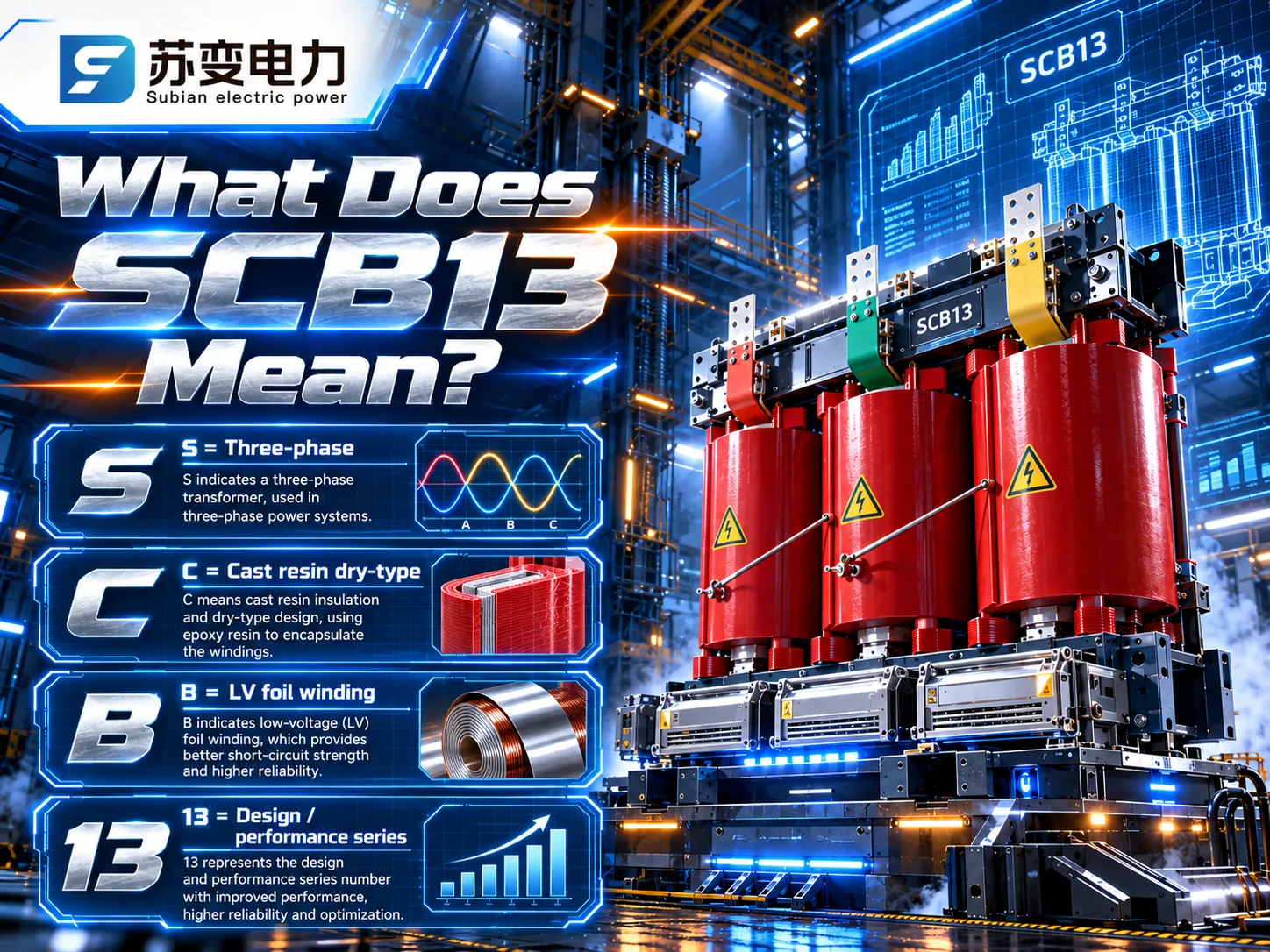
The SCB model code is a Chinese designation comprising several parts that need interpretation in order to properly compare SCB13 dry type epoxy resin transformers with any international equivalent.According to a full catalog code, the rated capacity in kVA as well as the voltage class are specified, for instance, SCB13-1000-10 for a 1000 kVA apparatus in a 10 kV network. Thus, the model designation gives enough information to any buyer about the fact that this is a three-phase resin-cast dry-type transformer featuring a distinctive engineering design generation.
A common misconception about “13”
A popular idea about the number “13” is misleading and needs an explicit clarification. The number “13” does not indicate the level of energy efficiency 13. The transformer energy efficiency standard in China (GB 20052) indicates only three levels of energy efficiency – the first, second, and third grades. The numeral is a code of engineering design series of codes. More precisely, there is only a design code in which the higher digit is connected to the notion of new design due to low energy losses. In practice, SCB13 is a design of low energy loss generation with the improved characteristics of the former SCB10, SCB11, and SCB12 models. The exact energy efficiency level of any apparatus is equal to that configured on the basis of level 1 of GB 20052 because this is the only reason why the tests should be performed.
SCB10, SCB11, SCB12 and SCB13: How are they different?
The SCB series includes design generations the losses of which are reduced as compared to the previous one. The ladder of evolution in designs. To start with, the transformer SCB10, SCB11, and SCB12 can be called low-energy generations; the transformer SCB13 is the first generation widely accepted in the world; higher generations SCB14 and SCB18 are created for their own purposes on difficult sites like data storage and underground metro as famous examples. The loss of energy in the process of the creation of new GB 20052 editions leads to the gradual exit of older generations from new development; SO SCB13 and up are really good and suitable for modern projects. In parallel with that the branch SCBH was developed to utilize the core of amorphous alloy to make a further step to decrease idle losses.
Importance of the use of foil windings
The letter “B” in the name of the transformer means the use of low-voltage foil winding so it is not only the letter. The low-voltage winding assures even distribution of the current which improves the durability of the transformer under short-circuit conditions and it creates the strength that is expected from modern cast resin dry transformers. It is one of those things that allows a well-manufactured transformer SCB13 to be comparable with the highest world standards of short-circuit performance.
Copper vs Aluminum Winding
The units manufactured in SCB series may have either copper or aluminum winding. Copper construction gives better performance as copper is a better conductor that is a good solution for high power applications. Aluminum represents lower weight and less cost and is useful for some applications.In order to make a fair assessment of the SCB13 transformer compared to any other transformer in the world, the winding material used in the two must be checked, as a transformer wound with copper cannot be compared on price nor losses to a similarly designed transformer wound with aluminum.
GB 20052 and IEC Efficiency: Reading the Grades Correctly
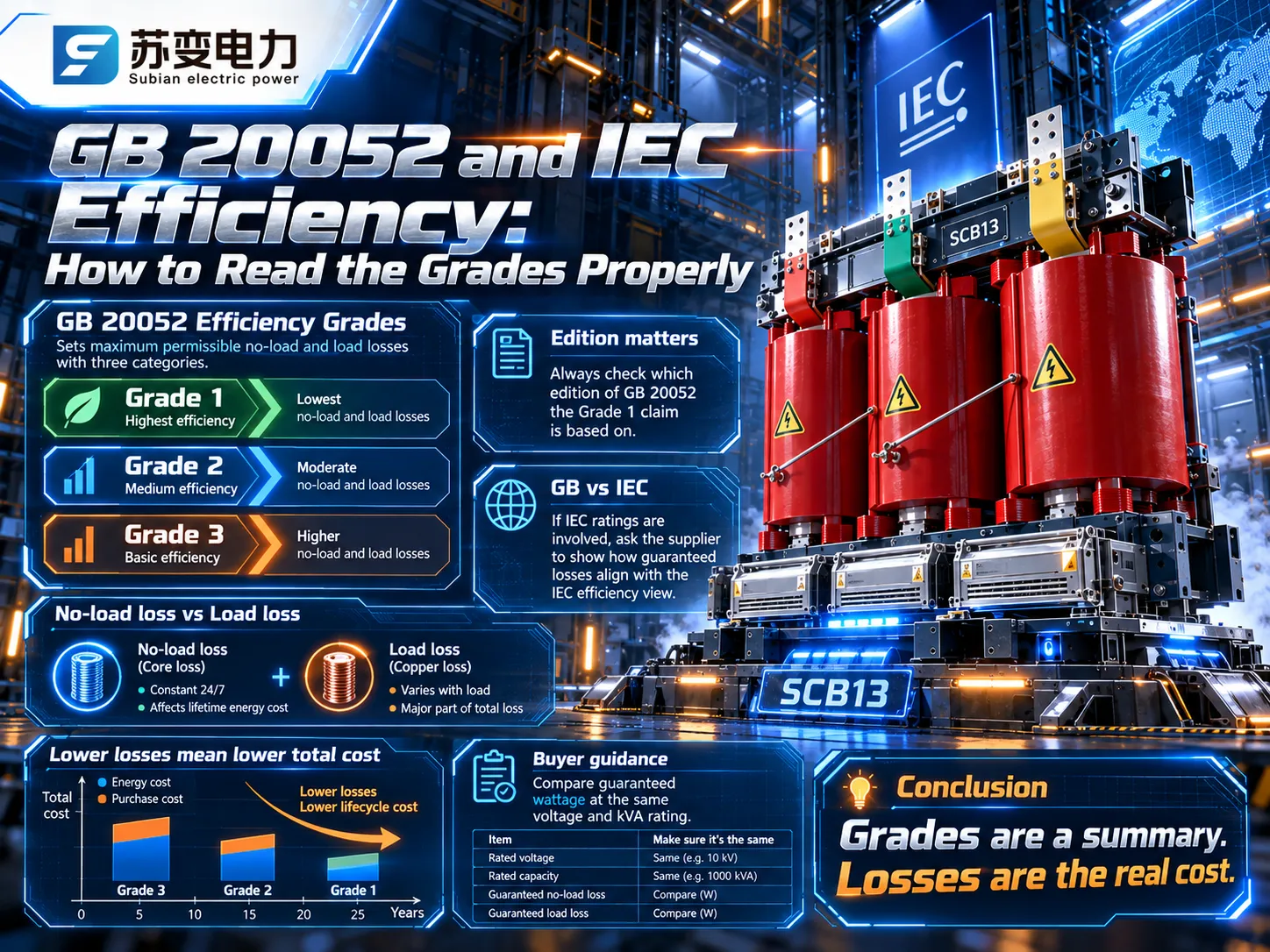
Energy efficiency is the field in which there are most misunderstandings regarding SCB comparisons, and therefore it is important to explain how it is graded. The GB 20052 standard sets the maximum permissible values for idle and load losses and distinguishes transformers into three categories according to the current standard, with the first category being the most energy-efficient one. As the standard is upgraded periodically, older generations of SCBs are being left behind.
Importance of the issue
When a product is labeled as “Grade One” it is necessary to know what edition of GB 20052 the Grade 1 rating is based on. When discussing the SCB13 epoxy resin dry type transformer, ask what edition of GB 20052 is used and compare it against what your industry requires. If the project also uses any other efficiency ratings, please ask the producer to show you how the lost of transformer fits in the IEC scale as well.
The practical conclusion for a buyer is that grades make the summary, while losses are the actual costs.A transformer can accumulate an expensive energy bill due to its no-load loss for several years, and this means that two transformers of similar type can have differing overall costs of ownership. To make a fair comparison, always compare the guaranteed wattage figures of the two transformers of the same voltage and power rating, and should treat the name of the class as only an initial filtering tool.
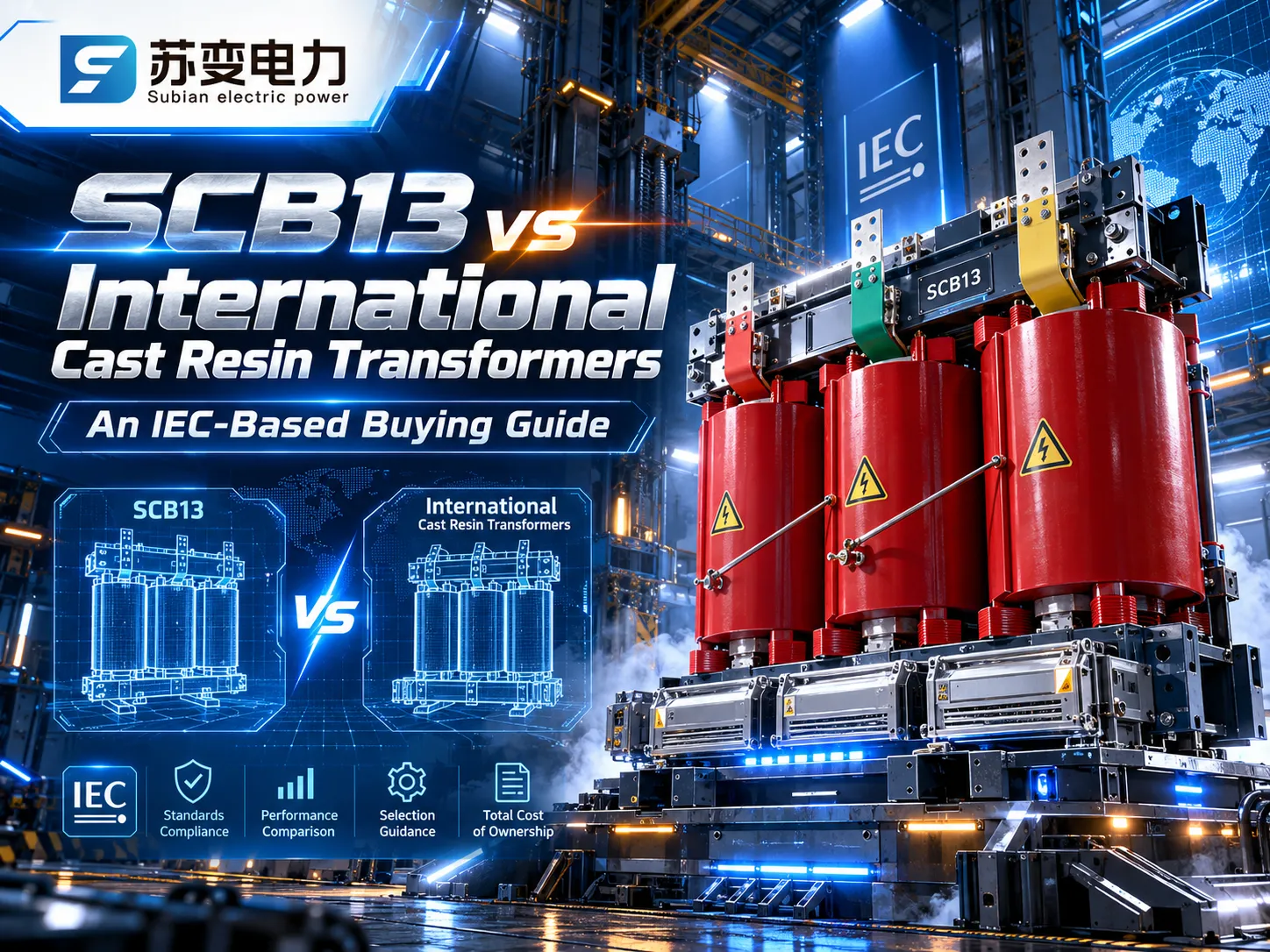
SCB13 vs International Cast Resin Ranges: An IEC View
The International products are not very different from the SCB product line. They belong to the same general category and originate from the same technology, which makes it possible to make comparisons based on the standards established by IEC, rather than on marketing claims.
Common Standards
The SCB series of cast epoxy type transformers satisfies both IEC 60076-11 and GB standards applicable to the Chinese market, while the other products under assessment, including GB/T 1094.11 for safety and GB 20052 for energy efficiency. The international ranges this series is compared against, such as the محولات الراتنج المصبوب من شneider Trihal وSiemens GEAFOL and the glass-fiber-reinforced ABB and Hitachi Energy RESIBLOC range, are likewise built to IEC 60076-11. Because the governing dry-type standard is shared, the meaningful comparison is unit-to-unit on measured parameters, not country-of-origin.
The Gap Is Still There
However, there are big differences between the two technologies. One of the biggest advantages of the international brands is their longer history of operation and their more significantly bigger capabilities in the rating of powerful units. The SCB13 transformer is primarily designed for the standard use in typical indoor power distribution applications, being a cost effective solution in this area.If you require a distribution transformer with a voltage level of 10 kV, 11 kV, 20 kV, 22 kV, 33 kV, or 35 kV, it can easily be matched by an SCB13 appliance of a reliable manufacturer. However, in case of an unusual requirement – e.g. high-voltage, high-power, or high-stress operation – it will be reasonable to check whether this specific appliance is designed and tested for it, rather than relying on claims of equivalence.
A little note on loss comparisons
Loss figures are an essential part of comparing cast resin transformers, so they have to be compared properly. For example, for SCB13 transformer of 1000 kVA capacity, the losses will be about 1270 W no-load losses and about 7000 W load losses, but correct values will depend on the transformer capacity, voltage, core material, and catalog number. Do not compare no-load losses of one manufacturer with load losses of another, i.e. always compare the same capacity and voltage values. The only values that matter are the guaranteed ones as indicated in your sales contract and confirmed by the routine test report.
What Technical Data to Verify Before Buying SCB13
- It is wrong to buy a المحول الجاف من الراتنج المصبوب on the basis of its model number, either you buy a Chinese or a European one. The model only indicates the family, the test report allows making conclusions about the unit.The checklist of verification involves checking the following
Rated capacity, primary voltage, secondary voltage, and whether the transformer meets the system requirements (10/11 kV, 20/22 kV, or 33/35 kV).
Confirmed-no load loss and load loss, with energy efficiency class supported by the latest edition of GB 20052 and, if applicable, IEC rules.
Classes of environmental (E), climatic (C), and fire behavior (F1) according to IEC 60076-11 must be confirmed in the documentation.
Procedure of minimal partial discharge levels, temperature rise testing, dielectric strength testing etc.
Vector group, short circuit impedance, tapping range, and short-circuit resistance.
Winding materials (Al copper); and thermal class of insulation, cooling system power rating.
Routine test report has to be provided for the serial number, and appropriate type test certification and certification on the quality management system are also necessary.
Be alert of the edition and wording of the insulation class
There are two points that can mislead customers. The first is that energy efficiency requirements change over time, so check which edition of GB 20052 the specified class corresponds to, otherwise the transformer may meet outdated requirements. The second point is to not confuse thermal class (usually F or H), which relates to temperature, with fire class F1 of IEC 60076-11. Though it looks similar in letters, they stand for different things, as the first relates to thermal properties of insulation, and the second relates to fire behavior. The specifications should clearly state both.
Lead Time, Logistics, Documentation while buying from China
When purchasing cast resin transformers one has to be mindful not only of electrical characteristics but also import issues. Pay attention to these issues from the very beginning; otherwise, it could lead to misunderstandings later on.
وقت التسليم: confirm the time of production and testing, as well as the time of delivery to take into account deadlines
Documents: make sure to obtain confirmed routine test report, type certificate, quality management system certificate, dimensional and connection drawings prior to shipment
Packing and transport: dry type transformers need to be properly packed, and protection measures need to be taken during transport; confirm the quality of packing
Standards mapping: if your project states IEC or national standards, make sure that the imported transformer manufacturer clearly states the compliance with those standards rather than simply indicating.
After-sales service: request information about warranty conditions of delivery processes, and technical assistance.
Buying an Epoxy Resin Dry Type Transformer from China
Once you have received the specifications and verification checklist, the process of sourcing from a dry-type transformer manufacturer based in China can be a very simple and logical task. Subian Electric is a fully independent China manufacturer providing cast resin and amorphous core dry-type transformers. It is important to clarify that Subian Electric is not connected to any kind of partnership with, or association with Schneider Electric, Siemens, ABB, and Hitachi Energy.
For the voltage bands most international projects need, Subian builds the محول SCB من سلسلة الراتنج المصبوب الجاف بجهد 6–10 kV و ال محول SCB من سلسلة الراتنج المصبوب الجاف بجهد 20–35 kV, both vacuum-cast SCB13-class designs to IEC 60076-11 and GB standards, with low partial discharge and maintenance-free operation. Where standby-loss reduction is the priority, the المحول الجاف من سبيكة SCBH غير المتبلور targets the lowest no-load loss. Buyers can request model data, drawings, routine-test reports, and OEM/ODM quotations, and can review the full dry-type transformer range before enquiring. The right way to buy, from any supplier, is to fix the specification, demand the test evidence, and compare on documented figures.
الأسئلة المتكررة
What does SCB13 stand for?
In the coding of SCB13 transformer, S denotes three-phase, C stands for cast epoxy resin (dry type), B for low-voltage foil winding, and 13 is the design-series or performance code. It refers to a three-phase dry type transformer built with foil winding and belonging to a specific series of transformers having low-loss generation.
Does “13” mean GB 20052 energy efficiency level 13?
No. GB 20052 lists only three efficiency levels (1, 2, and 3). The “13” is a model code by which the higher the number, the lower the losses. The efficiency classification of any given SCB13 epoxy resin cast dry type transformer is determined by the efficiency that can be achieved per the latest version of the GB 20052, mentioned in the test report.
How does SCB13 compare with Schneider, Siemens, ABB or Hitachi cast resin transformers?
All the above-mentioned المحولات المصنوعة من الراتنج comply with the requirements of IEC 60076-11, thus they are comparable to all others in the medium voltage distribution market. The so-called premium models may feature a bigger rated voltage and power range, but they all are operating as intended. When it comes to comparing different brands, it is better to operate with numbers, IEC classes, and test results rather than with the brand name.
Can I buy an SCB13 transformer for an 11 kV or 33 kV system?
Yes, recognized manufacturers provide SCB series in 10/11 kV, 20/22 kV, and 33/35 kV ranges. It is important to state the nominal voltage of the system as well as the equipment rating, and to check the exact voltage parameters.
Where can I buy a reliable SCB13 cast resin transformer in China?
Purchase from an accredited محول من النوع الجاف producer in China who manufactures to IEEE 60076-11 and GB standards and provides complete routine-test reports. Subian Electric manufactures 6-35 kV SCB and SCBH dry-type transformers along with testing documents as well as OEM/ODM support; check every unit specification according to its test report before making a purchase.
Should I choose copper or aluminum windings for an SCB13 transformer?
Once copper winding has less loss than aluminum winding and takes less room. Otherwise, it is mainly used in continuous or heavy-load service. Copper has a better price effectiveness than aluminum windings. To be able to compare prices or losses of SCB13 transformer with any other transformer make sure you are provided with price information on equipment of the same winding technology.
How long does it take to get an SCB13 transformer from China?
Medium voltage cast resin dry type transformer equipment is produced on a per-order basis, hence you should reckon in terms of production, testing, and shipping time. Check your quotation for lead time, put it into your project timeline, and demand the standard test report before dispatching the equipment from the manufacturer’s premise.
المراجع
- IEC 60076-11 — المحولات الكهربائية، الجزء 11: المحولات الجافة
- ويكيبيديا — أنواع المحولات (المحولات الجافة من الراتنج المصبوب)
- بوابة الهندسة الكهربائية — المحولات الجافة
تحدث إلى سوبين إلكتريك
The choice between SCB13 and an alternative international cast resin range must depend on documented engineering and not pure guesswork. Subian Electric is an independent Chinese manufacturer of المحول الجاف من الراتنج الإيبوكسي و المحول الجاف من الراتنج المصبوب products ranging from 6 kV to 35 kV built to IEC 60076-11 and GB standards, and supplied with full routine-test documentation and OEM/ODM support. Tell us your capacity, voltage system, loss targets, and IEC class requirements; the Subian team will recommend you the right SCB13 or SCBH configuration and provide the test evidence, such that you can confidently carry out a comparison against any branded alternative.