


Als das betreibende Unternehmen einer Bergbaustätte in Westaustralien beschloss, die Verarbeitungsanlage zu vergrößern, sah sich der Elektroingenieur mit einem Problem konfrontiert, das er gewohnt war zu lösen. Der Haupttransformator, der an der Stätte verwendet wurde, war ein gewöhnlicher Transformator, da seine dreiadrigen Phasen bedeuteten, dass kein Neutralleiter verfügbar war. Die Einrichtung benötigte einen Neutralleiter für ein Verfahren zum Schutz der Strömung des Brechgeräts sowie für die 240-Volt-Stromversorgung für die Elektrizität und Wasserversorgung der Fabrik. Die richtige Entscheidung war es, den Transformator nicht zu ersetzen, der eine 10 MVA-Einheit war und seit fünfzehn Jahren gut funktionierte. Das Unternehmen entschied sich für einen Delta-Transformator, der ein Delta-Wye-Transformator mit einem künstlichen Neutralleiter war, der in der Lage war, den Leitungsschutz zu liefern sowie die benötigte Hilfsstromversorgung für die Stätte bereitzustellen. Mit der Installation des Delta-Transformators wurde der Neutralleiter eingerichtet, sodass die Fabrik pünktlich mit ihren Betriebsabläufen beginnen konnte. Wie man den richtigen Delta-Transformator auswählt, hängt von der angewandten Wicklungsstruktur ab: Delta-Delta-Verbindung oder eine völlig andere Kombination.
Zusammenfassung: Delta-Transformatoren sind solche, bei denen eine der Wicklungen oder beide in Delta-Form verbunden sind. Delta bezieht sich auf eine geschlossene Dreiecks-Konfiguration, bei der jede Phasenwicklung an ihrem Ende mit der nächsten verbunden wird. Bei Delta-Transformatoren entspricht die Spannung der Leitung der Spannung der Phase.
Was eine Delta-Verbindung ist – und warum sie verwendet wird.
Bei der Delta-Verbindung sind die dreiphasigen Wicklungen des Transformators end-zu-end verbunden, um eine geschlossene Schleife zu bilden, die wie ein Delta aussieht. Es gibt keinen Neutralpunkt, was bedeutet, dass es keine Neutralleiter gibt, und die Leitungsspannungen sind gleich den Phasenspannungen. Die Ströme, die durch die Leitungen fließen, entsprechen der vektoriellen Summe der Drahtströme. Die Delta-Verbindung hat viele elektrische Eigenschaften, die ihre Effektivität für bestimmte Anwendungen beweisen und ihr einige Vorteile gegenüber der Sternverbindung (Wye) verschaffen. Das Fehlen eines Neutralleiters ermöglicht es, Lasten nur zwischen den Leitungen, jedoch nicht zwischen einer Leitung und einem Neutralleiter zu verbinden, was bedeutet, dass die Last höhere Spannungswerte haben muss (230V oder 120V Geräte können nicht an eine höhere Spannungslinie in der Delta-Verbindung angeschlossen werden). Die Delta-Verbindung sorgt dafür, dass die dreifachen harmonischen Ströme (dritte, sechste und neunte Harmonische) innerhalb der Wicklungs-Deltaverbindung gehalten werden, wodurch verhindert wird, dass sie entweder auf der Versorgungsseite oder der Lastseite gelangen. Dies ist der Hauptvorteil einer Delta-Verbindung in Verteilungstransformatoren, die mit nichtlinearen Lasten arbeiten – Computer, Frequenzumrichter, LED-Beleuchtung und USV-Systeme erzeugen keine nichtlinearen Ströme, die auf die Primärseite gelangen, wodurch die Erwärmung der Transformatoren, Kabel, Turbinen und Motoren vermieden wird. Darüber hinaus ist die Delta-Verbindung in der Lage, mit unausgeglichenen Lasten zu arbeiten, sodass, wenn eine Phase eines delta-verbundenen Geräts stärker belastet ist als die anderen Phasen, der zirkulierende Strom innerhalb des Deltas sicherstellt, dass die Lasten gleichmäßig verteilt werden.
Die physikalischen und wirtschaftlichen Eigenschaften einer Delta-Verbindung sollten ebenfalls berücksichtigt werden. Das Design der Wicklung im Fall der Delta-Verbindung verwendet Kupferleiter, die nicht dicker sind als Kupferdrähte im Fall der Wye-Verbindung, und die Isolierung ist für die Leitungsspannung erforderlich. Für eine Einführung in die gesamte Palette von Transformatorwicklungsanordnungen und deren Anwendungen siehe den Produktkatalog unter Subian Electric, der Delta-Deltatransformatoren, Delta-Wyetransformatoren und Wye-Deltatransformatoren sowie Erdungstransformatoren, Isolationstransformatoren und Spezialleistungstransformatoren für den globalen Markt umfasst.
Die drei Hauptkonfigurationen von Delta-Transformatoren – und wo jede dazugehört
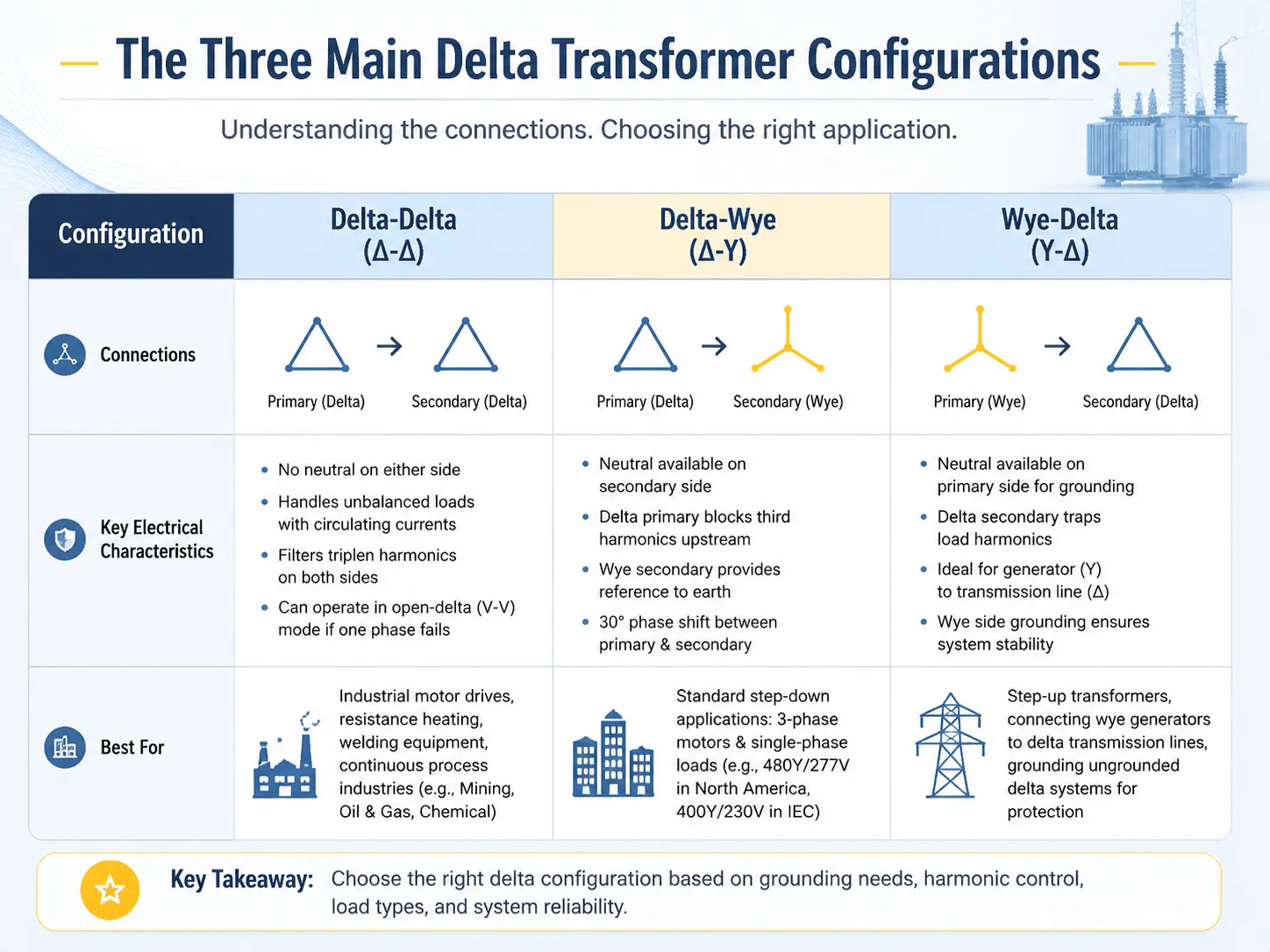
Die folgende Tabelle fasst die drei Haupttransformator-Konfigurationen zusammen, die eine Delta-Wicklung beinhalten, ihre definierten elektrischen Eigenschaften und die Anwendungen, bei denen jede die richtige Wahl ist.
| Konfiguration | Primärverbindung | Sekundärverbindung | Wichtige elektrische Eigenschaften | Am besten geeignet für |
|---|---|---|---|---|
| Delta-Delta (Δ-Δ) | Delta | Delta | Es gibt keinen Neutralpunkt an beiden Wicklungen; die unausgeglichene Last wird aufgrund der zirkulierenden Ströme im Delta effizient gehandhabt. Es filtert auch die Triplen-Harmonischen auf beiden Seiten. Die einphasige Versorgung kann über zwei beliebige Leitungen bei voller Leitungs-Spannung entnommen werden. Im Falle eines Fehlers einer Phase eines Delta-Delta-Transformators kann der Transformator im offenen Delta (V-V) Modus mit reduzierter Kapazität verwendet werden; somit wird diese dringend benötigte Fehlertoleranz in industriellen Anwendungen gewährleistet, bei denen die kostspielige Stilllegung eines Produktionsprozesses involviert ist. | Dreiphasige Delta-Verbindungen sind geeignet für industrielle Motorantriebe, Widerstandsheizungen, Schweißgeräte usw., wo Neutralleiter nicht erforderlich sind. Die Ausnahmebehandlungs-Eigenschaft der dreiphasigen Delta-Verbindung ist wichtig in kontinuierlichen Prozessindustrien wie der Kohlenbergbauindustrie, der Öl- und Gasindustrie und der chemischen Verarbeitung. |
| Delta-Wye (Δ-Y) | Delta | Wye (Stern) | Für einphasige Lasten und zur Erdung des Systems gibt es einen Neutralleiter auf der Sekundärseite. Die Delta-Wicklung auf der Primärseite verhindert den Fluss von dritten Harmonischen stromaufwärts von der Versorgungsseite. Die Wye-Wicklung bietet einen Bezug zur Erde für die Last. Zusammen mit der Spannungsumwandlung, die mit einem 30-Grad-Phasenunterschied zwischen Primär- und Sekundärspannungen einhergeht, verdient dies sorgfältige Überlegung beim Anschluss von Transformatoren in Parallelbetrieb. | Standard-Abwärtstransformatoren teilen den Strom in dreiphasige und einphasige Typen auf. Sie beziehen Energie von derselben Sekundärleitung, zum Beispiel dreiphasige Motoren, die mit 480V und 277V Beleuchtung von einer Sekundärleitung mit 480Y/277V in Nordamerika betrieben werden. Ähnlich versorgen in IEC-Märkten Abwärtstransformatoren entweder 400V Motoren oder 230V Lasten von 400Y/230V Sekundär. Diese Transformatoren sind das am häufigsten angewandte Layout in kommerziellen und industriellen Sektoren. |
| Wye-Delta (Y-Δ) | Wye (Stern) | Delta | Es liefert den Neutralleiter auf der Primärseite, der eine Erdung für den Schutz in einem System ermöglicht. Das Delta auf der Sekundärseite fängt lastinduzierte Harmonische ein und verhindert so, dass sie zur Primärseite gelangen. Der Zweck ist, mit einem Generator einer Wye-Verbindung zu arbeiten, wenn man auf eine Übertragungsleitung einer Delta-Verbindung hochtransformiert. Die Wye-Seite kann geerdet werden, um eine stabile Systemspannung aufrechtzuerhalten und den Erdschlussstrom zu leiten. | Hochtransformatoren werden verwendet, um einen wye-verbundenen Generator mit einer delta-verbundenen Übertragungsleitung zu verbinden. Sie sind ein Beispiel für einen Erdungstransformator, der einen Neutralpunkt eines ungeerdeten Delta-Systems etabliert. Diese Art der zusätzlichen Erdung ist in Industrien beliebt, die über eine delta-verbundene Quelle versorgt werden, aber einen Neutralleiter zum Schutz gegen Kurzschlussströme benötigen. |
Harmonische, Erdung und die Open-Delta-Option: Drei praktische Überlegungen
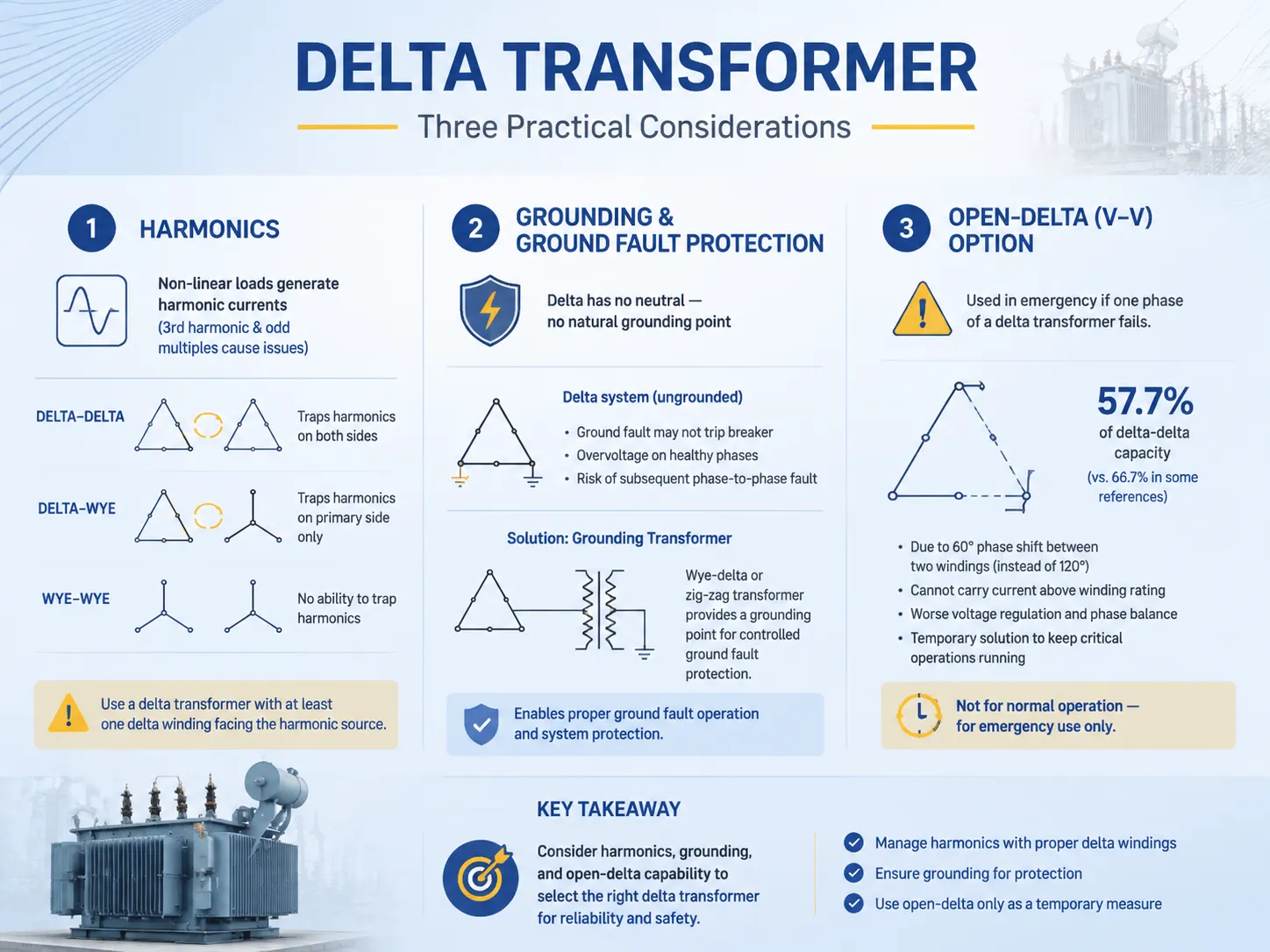
Abgesehen von der grundlegenden Wicklungskonfiguration helfen drei Hauptfaktoren dabei, den geeigneten Delta-Transformator für jeden Fall zu finalisieren.
Der erste ist die Harmonischen. Nichtlineare Anwendungen wie Frequenzumrichter, unterbrechungsfreie Stromversorgungen, LED-Lampen und elektronische Vorschaltgeräte erzeugen harmonische Ströme, die in den Transformator fließen. Die dritte Harmonische, die 180 Hz in einem 60 Hz-System und 150 Hz in einem 50 Hz-System beträgt, sowie ihre ungeraden Vielfachen (Triplen-Harmoniken) können erheblich stören, da sie sich im Neutralleiter eines Delta-Stern-Systems kombinieren, was zu Überhitzung führen kann. Delta-Verbindungen fangen diese Triplen-Harmoniken ein, indem sie innerhalb des Delta zirkulieren und in Wärme umgewandelt werden. Delta-Delta ist in der Lage, Harmoniken auf beiden Seiten seines Betriebs einzufangen. Delta-Stern fängt nur auf der Seite der Primärseite ein. Stern-Stern hat keine Fähigkeit, Harmoniken einzufangen und wird aufgrund dessen in der Industrie selten verwendet. Falls die Lasten zu viele Harmoniken erzeugen, sollte der Delta-Transformator mit mindestens einer Delta-Wicklung (insbesondere derjenigen, die der harmonischen Quelle zugewandt ist) verwendet werden.
Die zweite Überlegung ist die Erdung und der Schutz vor Erdschluss. Delta wird niemals einen Neutralleiter haben, sodass es keinen natürlichen Erdungspunkt gibt, der verwendet werden kann. Wenn der Versorgungstransformator delta-verbunden ist, ist das System ungeerdet, es sei denn, ein Erdtransformator wird verwendet. Ein solches ungeerdetes System birgt spezifische Gefahren: Wenn ein Erdschluss auftritt, löst der Schutzschalter nicht aus, und es gibt eine Überspannung an den nicht fehlerhaften Phasen, und es kann einen zweiten Erdschluss geben, der einen Fehler zwischen den Phasen verursacht. Der Einsatz des Stern-Delta-Erdtransformators oder des Zickzack-Erdtransformators ermöglicht die Erdung des Systems, die für den ordnungsgemäßen Betrieb mit der Nutzung des Erdschlusses erforderlich ist. Der Erdtransformator wird mit dem Delta-Bus verbunden, während sein Neutralleiter (der entweder direkt geerdet oder mit Hilfe eines Widerstands, der den Fehlerstrom so weit wie nötig für den Betrieb des Schutzrelais begrenzt, geerdet wird) ein kontrolliertes Verhalten des Erdschlusses ermöglicht.
Der dritte Verbindungstyp ist die offene Delta (V-V) Konfiguration. Wenn der Delta-Delta-Transformator in einer seiner Phasen (eine Wicklung oder eine Phase) ausfällt, können die restlichen Phasen im offenen Delta-Verbindungsmodus arbeiten, wodurch eine bestimmte dreiphasige Last versorgt werden kann. In der Konfiguration des offenen Delta beträgt die Kapazität nur 57,7% der Kapazität der Delta-Delta-Verbindung (statt 66,7%), da dies aufgrund der 60-Grad-Phasenverschiebung zwischen den beiden Wicklungen anstelle von 120 Grad geschieht, was es unmöglich macht, den Stromwert über die Nennwerte für jede der Wicklungen bereitzustellen. Die Verbindung des offenen Delta wird in Notfallsituationen verwendet — sie ermöglicht es, einen kritischen Prozess weiterzuführen, während der neue Transformator beschafft wird — aber sie wird nicht für den normalen Betrieb des Delta-Delta-Transformators verwendet. Die Spannungsregelung im offenen Delta-Modus ist schlechter als die des Delta-Delta-Modus, ebenso wie das Phasenungleichgewicht. Falls der Transformatorausfall zu erheblichen Verlusten für das Fertigungswerk führt, diente die offene Delta-Option als vorübergehende zuverlässige Lösung. Für einen tieferen Einblick, wie Transformator-Konfigurationen mit dem breiteren elektrischen Verteilungssystem integriert werden, lesen Sie unseren Artikel über die beste grundlegende Käuferleitfaden für elektrische Transformatoren einen umfassenden Rahmen für die Spezifizierung und Bewertung eines jeden Transformator-Kaufs.
Wie man einen Delta-Transformator spezifiziert: Die Parameter, die wichtig sind.
Die Erstellung einer Einkaufsspezifikation für einen Delta-Transformator erfordert, dass der Käufer die elektrischen Spezifikationen angibt, die der Transformator erfüllen soll, und ein hohes Maß an Details bereitstellt, damit jeder Bieter ein ähnliches Produkt anbietet. Die wichtigsten Parameter sind die kVA-Bewertung (die durch die Lastberechnung unter Anwendung der 80%-Regel für die Dauerbelastung definiert werden muss), Primär- und Sekundärspannung sowie Wicklungsanordnung (z. B. bei einem Delta-Y-Transformator — “13,8 kV Delta-Primär, 480Y/277 V Sekundär” oder im Fall eines Delta-Delta-Isolationstransformators — “480 V Delta-Primär, 480 V Delta-Sekundär”), Impedanz (ausgedrückt als Prozentsatz der kVA-Basis des Transformators und liegt normalerweise zwischen 5% und 6% für Verteilungstransformatoren; eine zu niedrige Impedanz führt zu einer geringeren Spannungsqualität, aber höheren Fehlerströmen, und sollte mit Schutzmitteln und der Kurzschlussbewertung der Geräte koordiniert werden), Isolierklasse und Temperaturanstieg (für einen Trockentransformator Klasse F oder Klasse H, wobei der Anstieg zwischen 80 und 150 Grad Celsius liegen kann, oder für Öltransformatoren der Temperaturanstieg normalerweise etwa 65 Grad Celsius über 30 Grad Celsius beträgt), Kühlmethode (ONAN für Öltransformatoren, AN oder AF für Trockentransformatoren; Zwangskühlung ermöglicht es, die kVA-Bewertung eines Trockentransformators auf bis zu 25-33% zu erhöhen. Daher sollte der Käufer angeben, ob die zusätzlichen Kapazitäten erforderlich sind), Abzapfungen (Abzapfungen außerhalb des Stromkreises sind Standard und normalerweise in 2.5%-Schritten nach oben und unten zur nominalen Primärspannung, um die tatsächliche Versorgungsspannung anzupassen; Lastabgriff ist teurer, kann jedoch für kritische Anwendungen angewendet werden, wenn die Primärspannung stark variiert), Gehäuse (NEMA 1 für trockene Innenbedingungen, NEMA 3R für außen, NEMA 4X für Waschvorgänge oder NEMA 12 für staubdichte Industrie) und Norm (IEC 60076, IEEE C57.12 oder Norm des lokalen Nationalen, da eine Norm bestimmt, wie Tests durchgeführt werden sollten und die Methoden, die für die Dokumentation der Geräte erforderlich sind). Eine gute Spezifikation zwingt den Lieferanten, auf all dies zu antworten, während eine vage Spezifikation dem Hersteller die Möglichkeit gibt, sein eigenes Urteil zu fällen.
Häufig gestellte Fragen
Was ist der Unterschied zwischen einem Delta- und einem Wye-Transformator?
Eine Delta-Wicklung besteht aus einem geschlossenen Dreieck ohne Neutralleiter. Die Leitungsspannung eines delta-verbundenen Systems entspricht der Phasenspannung; jedoch ist der Leitungsstrom in dieser Konfiguration √3 mal so hoch wie der Phasenstrom. Eine Wye-Wicklung hat einen Neutralpunkt, an dem sich die drei Wicklungen schneiden, was es ermöglicht, dass die Leitungsspannung √3 mal so hoch ist wie die Phasenspannung, während der Leitungsstrom gleich dem Phasenstrom ist. Darüber hinaus nutzen viele Anwender aufgrund der Vorteile der Wye-Verbindung, wie Neutralität für einphasige Lasten und die Möglichkeit, das System zu erden, diese in Verbindung mit Delta-Wicklungen.
Wann sollte ich einen Delta-Delta-Transformator verwenden?
Versuchen Sie, einen Delta-Delta-Transformator unter einer Lastbedingung zu verwenden, die normalerweise durch die Verwendung von Drehstrom- oder Dreileitersystemen gekennzeichnet ist, die hauptsächlich Motoren, Heizgeräte oder Schweißmaschinen umfasst, wobei zu beachten ist, dass in beiden Transformatoren kein Neutralleiter erforderlich ist. Darüber hinaus kann ein Delta-Delta-Transformator leicht unter unausgeglichenen Lastbedingungen arbeiten, die Harmonischen auf beiden Seiten dieser Transformatoren einfangen und kann auch im Falle eines Ausfalls einer einzelnen Phase in einer offenen Delta-Verbindung verwendet werden. Daher ist ein Delta-Delta-Transformator eine perfekte Lösung für industrielle Anwendungen, die das Laden schwerer Motoren implizieren, zum Beispiel.
Kann ein Delta-Transformator einphasige Lasten versorgen?
In der Tat kann ein delta-verbundener Sekundärkreis zur Versorgung einphasiger Lasten verwendet werden, die zwischen zwei beliebigen Leitungen verbunden sind und in der Lage sind, den vollen Wert der Leitungsspannung zu ertragen. Allerdings sollten einphasige Lasten so konstruiert sein, dass sie die Leitungsspannung des verwendeten Delta-Systems handhaben können — d.h. 480-Volt-Geräte für 480-Volt-Delta-Systeme — und auf allen drei Phasen ausgewogen sein, damit keine übermäßige Ungleichheit auftritt. Ein Delta-Sekundärkreis kann nicht auf Lasten angewendet werden, die einen Neutralleiter für den Betrieb bei Niederspannung benötigen, wie z.B. 120-Volt- oder 277-Volt-Lasten.
Was ist eine offene Delta-Transformatorverbindung?
Die offene Delta-Verbindung besteht aus zwei einphasigen Transformatoren, die in zwei der drei Phasen verbunden sind, um eine Drehstromlast zu bedienen. Die Einrichtung nutzt 57,7% der Kapazität eines Transformators in einer vollständigen Drehstrom-Delta-Verbindung. Diese Art von Verbindung wird im Falle eines Ausfalls einer der Phasen in einem vollständigen Drehstromsystem oder als kostengünstige und dauerhafte Lösung in einigen Anwendungen mit geringer Last verwendet. Die Spannungsregelung ist schlechter und auch das Phasenverhältnis ist nicht so stabil wie das des vollständigen Drehstromsystems.
Referenzen
- IEEE C57.12.00 — Standard für allgemeine Anforderungen an flüssigkeitsgetauchte Verteilungs-, Leistungs- und Regeltransformatoren. Der grundlegende IEEE-Standard für das Design, die Prüfung und die Leistung von Transformatoren, einschließlich der Delta- und Wye-Wicklungskonfigurationen und der zugehörigen elektrischen Eigenschaften.
- IEC 60076 — Leistungstransformatoren. Die internationale Normenreihe, die die Design-, Prüf- und Leistungsanforderungen für Leistungs- und Verteilungstransformatoren definiert, einschließlich der Vektorgruppenauszeichnungen — Dyn11, YNd1 und andere — die die Wicklungskonfiguration und das Phasenverhältnis spezifizieren.
- Eaton — Transformator-Wicklungskonfigurationen und Anwendungshinweise. Hersteller von Delta-Delta-, Delta-Wye- und Wye-Delta-Transformatoren, mit technischer Dokumentation, die die Auswahl, die Installation und die Erdungsanforderungen für jede Konfiguration abdeckt.
- Schneider Electric — Transformator-Vektorgruppen und Wickelverbindungen. Herstelleranleitungen zur Spezifikation und Anwendung von Delta- und Wye-Transformatorwicklungskonfigurationen für kommerzielle und industrielle Stromsysteme.
Der Prozess der Auswahl des idealen Delta-Transformators umfasst die Identifizierung eines Wicklungsdesigns, das dem Typ des elektrischen Systems und seinen Eigenschaften wie Spannung, Erdung, Harmoniken und Neutralleiter entspricht. Ein Delta-Delta-Transformator wird für die dreiphasige und dreileitige industrielle Last verwendet und verfügt über die notwendigen harmonischen Minderungselemente und Sicherheitselemente für kontinuierliche Verarbeitungsanlagen. Ein Delta-Wye-Transformator reduziert die Spannung und erzeugt einen Neutralleiter für eine gemischte Last aus sowohl einphasigen als auch dreiphasigen Systemen und hat die Fähigkeit, Harmoniken aus der Eingangsversorgung zu mindern. Ein Wye-Delta-Transformator erhöht die Generatorspannung für die Elektrizitätsübertragung oder erzeugt einen Neutralleiter für ein Delta-System, um die Sicherheit zu erhöhen. Jede Konfiguration von Delta-Transformatoren erfüllt ihren Zweck, und ein sachkundiger Käufer weiß, welcher Transformator für die Anwendung benötigt wird, anstatt den auszuwählen, den der Verkäufer zufällig auf Lager hat. Co. Subian ist ein Hersteller von Delta-Transformatoren in allen drei Konfigurationen und in der Lage, Transformatoren mit dem erforderlichen kVA-Bereich und der Spannungsgruppe, Impedanz und Zertifizierungen bereitzustellen, die vom Markt gefordert werden. Es ist entscheidend, korrekt gefertigte Transformatoren für den Betrieb von Fabriken, Minen oder Verarbeitungsanlagen zu verwenden, wo die Transformatoren angemessen für das elektrische System ausgelegt sein müssen, was den Konfigurationsprozess äußerst wichtig macht.