


Die Wahl eines Lieferanten für den Padmount-Transformator, der in kommerziellen Projekten verwendet wird, ist entscheidend, da nach der Entscheidung und Bestellung der Einheit keine Möglichkeit besteht, den Kauf nach der Herstellung noch werttechnisch zu optimieren. Daher ist es bei der Auswahl des Lieferanten wichtiger, sich vor der Preisverhandlung auf den Erhalt von drei spezifischen Dokumenten zu konzentrieren, anstatt sich nur am Preis zu orientieren. Ein Käufer, der diese Dokumente anfordert, wird eine wesentlich bessere Erfahrung machen als jemand, der lediglich Angebote vergleicht.
Schnelle Antwort: Kommerzielle Immobilienprojekte erfordern typischerweise dreiphasige Padmount-Transformatoren, die nach IEEE C57.12.34 gebaut sind. Diese Einheiten sind normalerweise entweder für 480Y/277 Volt oder 208Y/120 Volt ausgelegt, und die kVA-Bewertung liegt typischerweise zwischen 500 und 2.500. Alle kommerziellen Padmount-Transformatoren müssen gemäß DOE 2016 Betriebseffizienz getestet werden. Zusätzlich sollte ein Bericht über einen Routine-Test der bestellten Einheit Ihrer Bestellung beiliegen. Die Lieferanten, die Sie als Hersteller dieser Einheiten als glaubwürdig einstufen können, fallen in eine von drei Kategorien: 1. US-Hersteller, die ihre eigenen Gehäuse produzieren (zum Beispiel ERMCO, Howard Industries, Eaton, Siemens und Prolec), 2. Versorgungsorientierte Originalgerätehersteller (OEMs), die über Vertreterfirmen verkaufen, oder 3. Überholer und Händler. Der Preis für einen neuen Padmount-Transformator liegt ungefähr zwischen 15.500 USD für eine 500 kVA Einheit und etwa 30.500 USD für eine 1.500 kVA Einheit, und die Herstellung des Transformators dauert in der Regel zwischen 16 und 30 Wochen. Der neue Padmount-Transformator hat in der Regel einen höheren Preis und eine längere Lieferzeit als die überholte Einheit, aber der Käufer trägt bei überholten Einheiten ein höheres Risiko, da der Käufer den Transformator erst nach bestandener Inspektion besitzt.
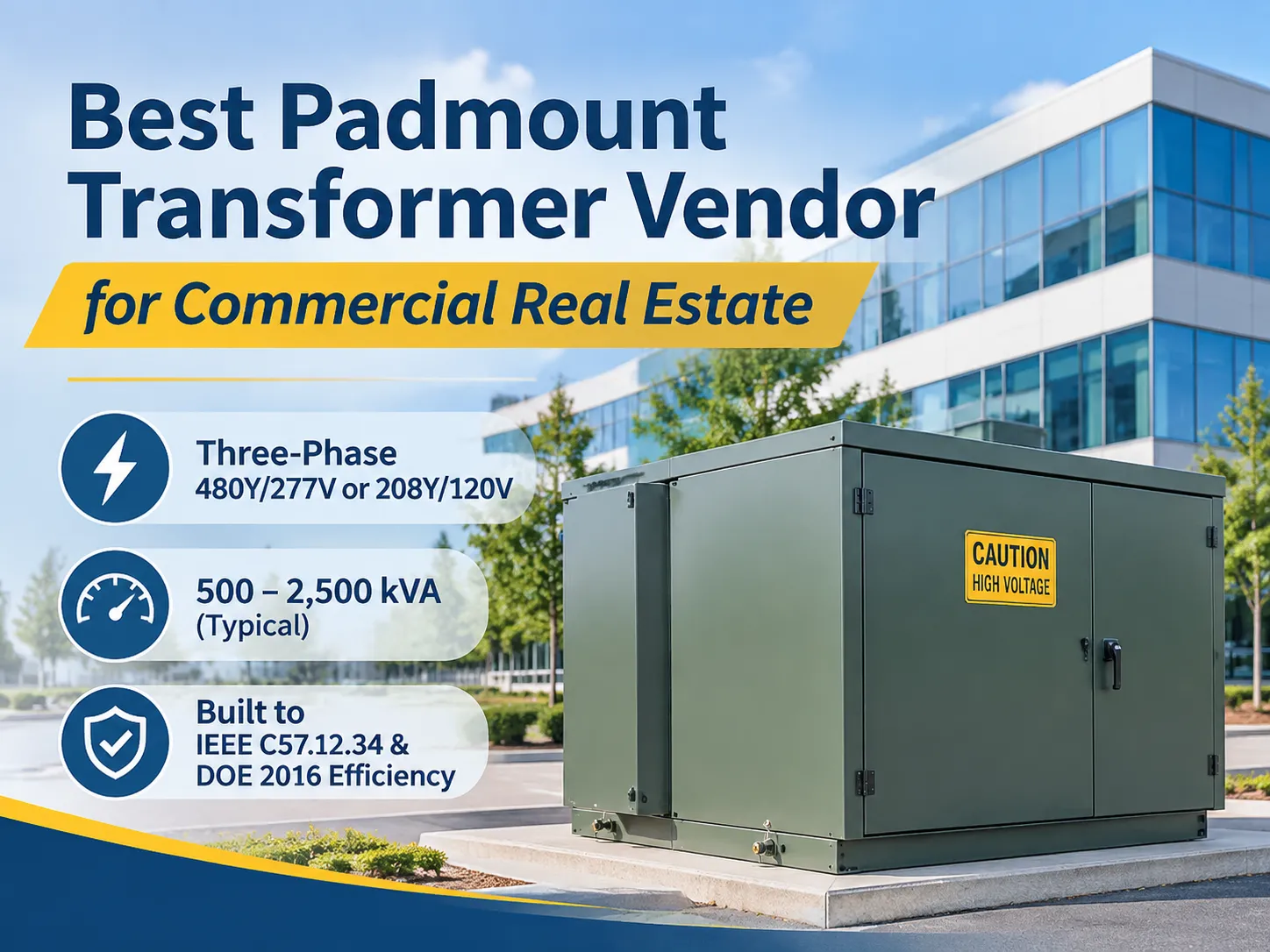
Was kommerzielle Immobilien tatsächlich benötigen
Alle Bürogebäude, Einzelhandelskomplexe, Hotels und Lagerhäuser verwenden dasselbe Produkt, jedoch aus unterschiedlichen Gründen, und die einzigen Unterschiede liegen in der Last und der Spannung an jedem Sekundäranschluss. Dies hat nichts mit dem Transformator selbst zu tun.
Ein Büro- und Einzelhandelsgebäude benötigt normalerweise 480Y/277 V für Beleuchtung, Pumpen und HLK sowie ein zweites System mit 208Y/120 V nur für Steckdosenlasten und kleine Verbraucher. Zusätzlich beladen Hotels ihre Anlagen oft mit großen Mengen Warmwasser und versorgen die Gästezimmer mit 208Y/120 V. Das gesamte Lagerhaus besteht praktisch ausschließlich aus Motorlasten, meist bei 480 V, mit sehr hohen Lastfaktoren während der Arbeitszeit (24 Stunden) und nahezu keiner Last während der Nacht.
Die Lastprofile bestimmen, wie diese Transformatoren aus Sicht des Herstellers angewendet werden. Das Lastprofil eines Artikels bestimmt, wie hoch der Fehlerstrom bei 480 V sein wird, was die Bewertung jedes Schaltschranks unterhalb des Transformators festlegt, und wie viele Stunden die Einheit läuft, was die Energiekosten bestimmt: Eine 2.000 kVA Einheit, die 6.000 Stunden pro Jahr läuft, verursacht über einen Zeitraum von 20 Jahren mehrere Male ihren Kaufpreis.
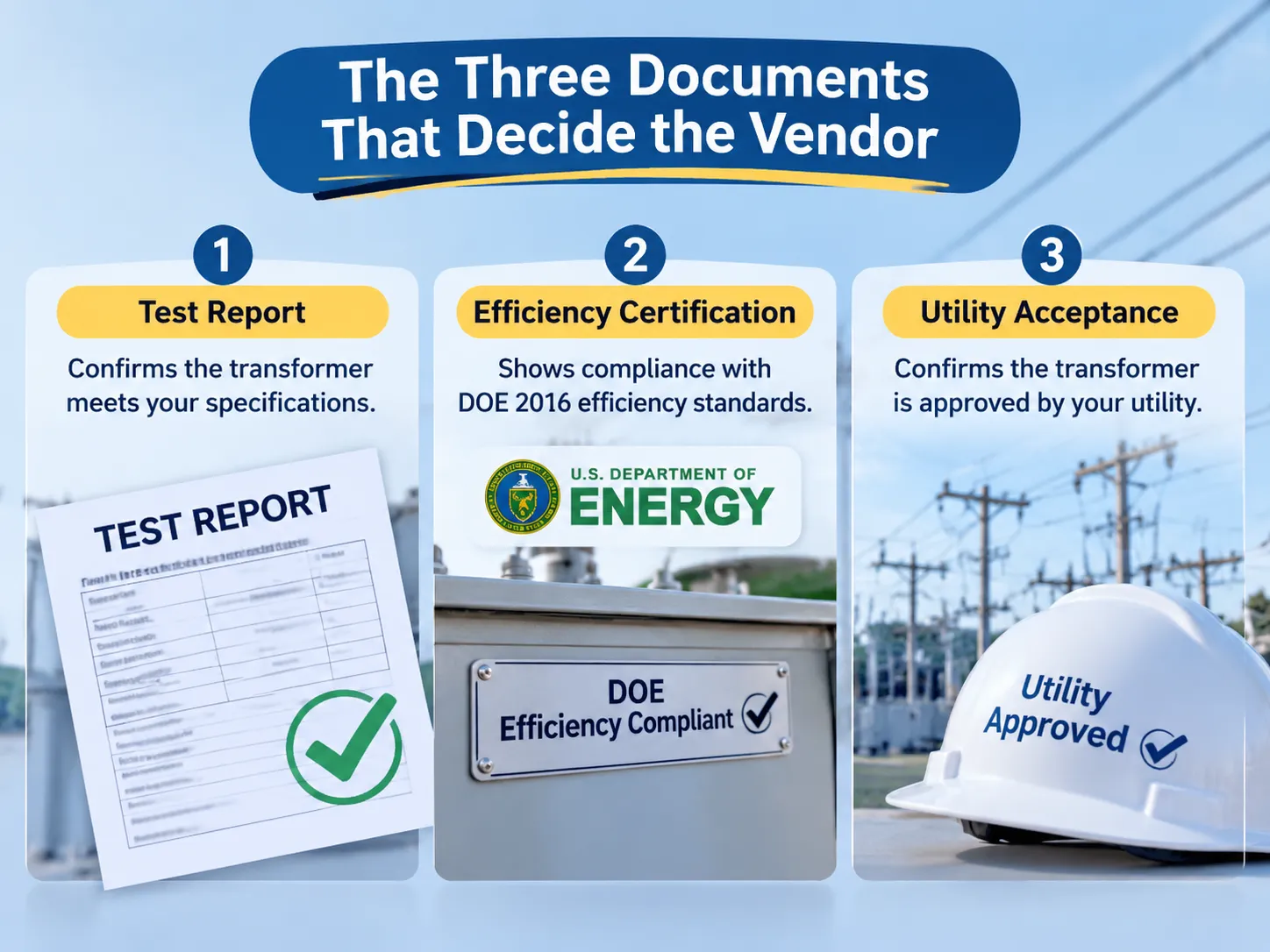
Die drei Dokumente, die den Anbieter entscheiden
Der Testbericht des Anbieters ist das erste. Jeder Transformator wird einzeln getestet. Der Testbericht enthält numerische Werte, die bestimmen, ob Ihr Transformator gemäß Ihren Bestellspezifikationen gebaut wurde oder nicht. Ein Anbieter, der den Typprüfbericht sendet, liefert dokumentierten Nachweis bezüglich des Designs des Anbieters, nicht jedoch einen Leistungsnachweis für Ihren speziellen Transformator.
Die Effizienz-Zertifizierung ist die zweite und gesetzlich vorgeschrieben für Verteilungstransformatoren, die hauptsächlich für kommerzielle Anwendungen in den Vereinigten Staaten bestimmt sind: Sie müssen die vom Bundesministerium (DOE) 2016 festgelegten Mindestwirkungsgrade erfüllen. Diese Zertifizierung bescheinigt, dass dieses spezifische Design den Standard erfüllt, und sie wird auf dem Typenschild angebracht und in den Einreichungsunterlagen referenziert. Ohne diese Nachweise der Konformität (die Effizienz-Zertifizierung) bringt ein generalüberholter oder importierter Transformator, der ohne diese Nachweise erstellt wurde, den Eigentümer in einen Status der Nichtkonformität, und der Eigentümer muss diesen Status verteidigen, nicht der Anbieter.
Eine weitere Variable ist die Akzeptanz durch den Netzbetreiber, und genau diese Variable hat viele Entwickler überrascht. In den meisten Teilen der USA sind die Netzbetreiber diejenigen, die entweder den Transformator besitzen oder diejenigen, die den Transformator spezifizieren, der zum Zeitpunkt der Installation an den Stromzähler in ihr Netzsystem angeschlossen wird; daher führen die Netzbetreiber eine Liste genehmigter Transformatoren. Sobald eine IEEE-konforme Einheit gekauft wurde, ist es notwendig, vor der Inbetriebnahme dieser speziellen Einheit eine Verhandlungsphase zu durchlaufen, wenn sie nicht in der aktuellen Anbieterliste aufgeführt ist.
Die Anbieterlandschaft und wer an welchen Käufer verkauft
Die Anbieterlandschaft gibt uns Einblick, welche Art von Anbietern Produkte an verschiedene Käufer verkaufen.
| Anbietergruppe | Beispiele | Bereich | Am besten für | Vorsicht bei |
|---|---|---|---|---|
| US-Hersteller | ERMCO, Howard Industries, Central Moloney | 5 bis 2.500 kVA | Projekte von Versorgungsunternehmen und Entwicklern, US-Lieferzeiten | Längere Angebotszyklen, nur Direktverkauf ab Werk über Vertreter |
| Globale OEMs | Eaton, Siemens, Hitachi Energy, Prolec | Kleine Einphasen- bis große Dreiphasen-Transformatoren | Multi-Standort-Portfolios, standardisierte Spezifikationen | Premium-Preis, plattformbasierte Konfigurationen |
| Spezial- und Großleistung | VanTran, Niagara Transformer, Maddox | Maßgeschneiderte und größere Nennwerte | Nicht standardisierte Spannungen, Anforderungen an hohe Impedanz | Längere Lieferzeit, ingenieurintensiv |
| Generalüberholer | Sunbelt Solomon und regionale Wiederaufbereiter | Was auch immer auf Lager ist | Notfallersatz, temporärer Service | Keine DOE-Konformität, begrenzte Testaufzeichnungen |
| Makler und Importeure | Versorgungshäuser, Handelsunternehmen | Breit, diskontinuierlich | Schnelle Verfügbarkeit bei Standardbewertung | Keine Werksbeziehung, unklare Herkunft |
Anbieter in den USA wie “ERMCO”, “Howard Industries” und “Central Moloney” haben Einheiten von 5 kVA bis 2.500 kVA und arbeiten hauptsächlich mit Versorgungsunternehmen und Entwicklern, die Projekte innerhalb der USA durchführen. Sie geben in der Regel Lieferzeiten an, die deutlich länger sind als bei anderen Herstellern, und versenden nur direkt ab Werk über ihre Werksvertreter.
Hersteller, die an Entwickler oder andere große Unternehmen verkaufen, umfassen “Eaton”, “Siemens”, “Hitachi Energy” und “Prolec” und bieten Einheiten von kleinen Einphasen- bis zu großen Dreiphasen-Transformatoren an. Diese Hersteller bedienen in der Regel Multi-Standort-Portfolios und verfügen über standardisierte Spezifikationen für die von ihnen hergestellten Geräte, oft zu einem Premium-Preis.
Spezial- und Großstromanbieter wie “VanTran”, “Niagara Transformer” und “Maddox” bieten große Kapazitäten sowie kundenspezifische Einheiten und Einheiten, die Spannungsanforderungen erfüllen, die in den USA typischerweise nicht verwendet werden. Viele dieser Anbieter haben längere Lieferzeiten und sind oft stärker ingenieurtechnisch ausgerichtet, sodass es länger dauern kann, Ihren maßgeschneiderten elektrischen Transformator oder Ihre Einheit zu erhalten.
Überholer wie “Sunbelt Solomon” und kleinere regionale Wiederaufbereiter haben in der Regel Einheiten, die als temporärer Ersatz oder als Notfall-Backup-Quelle gekauft werden können. Sie testen ihre Einheiten nicht auf Einhaltung der Department of Energy-Standards und haben in der Regel keine ausreichende Historie zu ihren Einheiten.
Makler und Importeure, einschließlich Versorgungshäuser und Handelsunternehmen, verfügen über große Lagerbestände von Einheiten verschiedener Hersteller. Viele Makler haben Einheiten vorrätig, die schnell geliefert werden können, obwohl sie keine Kommunikation mit dem Originalhersteller haben und keine Möglichkeit, die Herkunft der Geräte zu ermitteln oder deren Qualität zu überprüfen. Die Palette der für Verteiltransformatoren und Umspannwerke spezifizierten Geräte ist nach Anwendung organisiert. Die Produktbeschreibungen sollen dem Käufer helfen, zu bestimmen, welche Konfigurationen Katalogbauten sind und welche Einzelanfertigungen.
Bewertungen, die ein CRE-Projekt tatsächlich spezifiziert
Most commercial work is covered by four ratings, and the numbers should be known before the first meeting.
Three-phase pad-mounted transformers are manufactured to IEEE C57.12.34. Typical primary voltages for these units are 2.4 kV to 34.5 kV and secondary voltages are 208Y/120 V, 480Y/277 V or 600 V. Single-phase pad-mounted transformers are built to IEEE C57.12.38 and typically top out at 250 kVA.
Commercially available sized transformers include 500 kVA, 750 kVA, 1,000 kVA, 1,500 kVA, 2,000 kVA and 2,500 kVA. A 1,000 kVA transformer rated 13.8 kV on the primary side and 480Y/277 V on the secondary side will have a maximum load current of 41.8 A on the primary side and 203 A on the secondary side. The secondary current is the figure on which the service switchboard and conductor size will be based.
Typically for these ratings, the percentage impedance rating will be 5.75 percent since that is the standard utility value, and therefore not an option. If a building has a large motor load, a 5.75 percent impedance rating will improve voltage regulation and increase the fault level which will, in turn, increase the interrupting rating for all downstream devices. Der 20 kV ölgetauchte Verteilungstransformator is the format most non-US projects specify at that voltage class, and the plate data are the same for all transformers in that class.
The BIL rating is per voltage class as follows: The 15 kV class has BIL of either 95 kV or 110 kV. The 25 kV class has BIL of 150 kV and the 34.5 kV class has BIL of 200 kV. A project that indicates “34.5 kV class” only, with no mention of BIL, has left a cost variable open to being able to move by as much as 10 percent.
Price: What a Padmount Costs and What Moves It
| Rating, three-phase pad | New, indicative | Refurbished, indicative | Lead time, new |
|---|---|---|---|
| 300 kVA | $9,000 to $14,000 | $4,500 to $8,000 | 14 to 22 weeks |
| 500 kVA | $13,000 to $19,000 | $7,000 to $11,000 | 16 to 26 weeks |
| 750 kVA | $17,000 to $24,000 | $9,000 to $14,000 | 18 to 28 weeks |
| 000 kVA | $20,000 to $29,000 | $11,000 to $17,000 | 18 to 30 weeks |
| 500 kVA | $27,000 to $38,000 | $15,000 to $22,000 | 20 to 34 weeks |
There are five factors that impact these numbers: The kVA is obvious. The secondary voltage is the next, because a 208Y/120 V winding requires more copper per kVA than a 480Y/277 V winding. The impedance and loss specifications are the third factor. The addition of a low-loss core will increase price by 10 to 15 percent. The enclosure and finish are the fourth factor. A location on the coast will require enclosures with a corrosion class that is more expensive than standard paint. The accessory set is the fifth factor: Bayonet fuses, load-break switches, surge arrestors, fault indicators and stainless steel sills are all accessories that will increase cost on your padmount, but not necessarily appear on every project.
What is not included in the price quotations but is most important regarding a project’s development schedule is a cost associated with a delayed energisation. In general, the transformer lead time affects how much of a rent-free period an occupant receives. In most cases, this rent-free period will typically be greater than the difference between the two extremes of the price quotes received.
Lead Time: New, Refurbished and Rental
The lead times for new three-phase padmount transformers are currently between 16 weeks and 30 weeks. The delivery date is determined by the availability of core steel, winding capability and test bay space rather than the amount of assembly work to be done. Any padmount transformer rated above 1,500 kVA has a longer lead time, especially when the transformer is configured for either a non-standard voltage or for high BIL.
Refurbished transformers typically come with much shorter lead times, and if the required-rated transformer is in stock, it can usually be shipped within a few days to a week. The primary reason for the use of refurbished transformers as emergency replacements is availability, but there is a trade-off: there is no formal documentation such as a DOE compliance statement, a test record or any service history for the unit. If the refurbished transformer will be used temporarily for construction purposes, this lack of documentation may be acceptable; however, it would not be acceptable if the transformer will be used for permanent power in a facility that has been sold.
The third lead time option concerns rental transformers. This option is seldom thought of by developers. A rental transformer that is mounted on a skid can be used as temporary power until construction is completed or until a failed unit can be replaced. The cost of a rental transformer is, of course, a monthly expense rather than a capital outlay. Either option requires a rental supplier with the proper rating and a location capable of accepting a skid instead of a pad.
No matter which path is taken, the schedule must be created in reverse from the interconnection date with the utility, as opposed to being created in forward motion from the order date, since the review of the utility typically takes longer than ordering the transformer from the supplier. There is no way to expeditiously compress the utility’s review by simply increasing payment to the transformer supplier.
Utility Approval, Metering and the Ownership Question
Determining who owns the transformer needs to be done before choosing suppliers. In many state jurisdictions in the US, the utility will own the transformer associated with a single meter. If that is the case, then the developer contributes to the installation of the transformer, but the responsibility for choosing the supplier is that of the utility; therefore, it is the developer’s responsibility to submit electrical load information and building site information.
In cases when the customer owns the transformer, which is not uncommon for many larger sites and for sites located in industrial parks, the customer will buy the transformer based on specifications received from the utility and the utility will conduct an inspection prior to energising the transformer. The written specifications must be obtained during the design phase of the project, as it lists all of the manufacturers that are considered approved to build the transformer, specifies the maximum allowable impedance, BIL ratings and the components that are included in the transformer.
The metering arrangement will also depend upon who owns the transformer. When the transformer belongs to the customer, the utility will typically meter on the primary side of the transformer; as a result, there will be different switchgear and protection devices associated with this arrangement, and these additional costs will be easiest to absorb during design than at any other point in time, which is after the purchase order has been completed.
Clearances are the other regulated item. The National Electric Code (NEC) 450.27 states the minimum distance between outdoor oil-filled transformers and any combustibles, such as walls, windows or doors, must be measured from the transformer casing rather than the pad it is resting on. A pad placed against a combustible wall during value engineering will become a relocation after the plan review.
Where Cheap Vendors Fail
There are four ways cheap vendors fail and generate the most complaints about padmount purchases. All four ways will be visible before you complete your order.
The vendor did not provide a test report. If there is no serial number on the report and the values for each component within the same design are identical, this is not a routine test.
The vendor did not provide a DOE compliance statement. A rebuilt transformer or a transformer that was imported and sold as new, may not meet the 2016 efficiency standards. The owner bears the risk of noncompliance and any compliance audit will be conducted by someone else later.
The enclosure of the transformer does not match the site. For example, if you use a standard painted finish on an enclosure located in a coastal area, you will notice that the sill of the enclosure and the hinge areas on the top will fail first, and you will need to repaint the enclosure in the fourth year, instead of filing a warranty claim. Therefore, if you are using a coastal site, the corrosion class must be identified in your specifications before you receive quotes.
The vendor does not have any service relationship with the buyer. If a transformer fails after three years, there needs to be provisions for obtaining a replacement and loaner unit, as well as making a warranty decision. A broker who has moved on to another product line cannot provide any of the three.
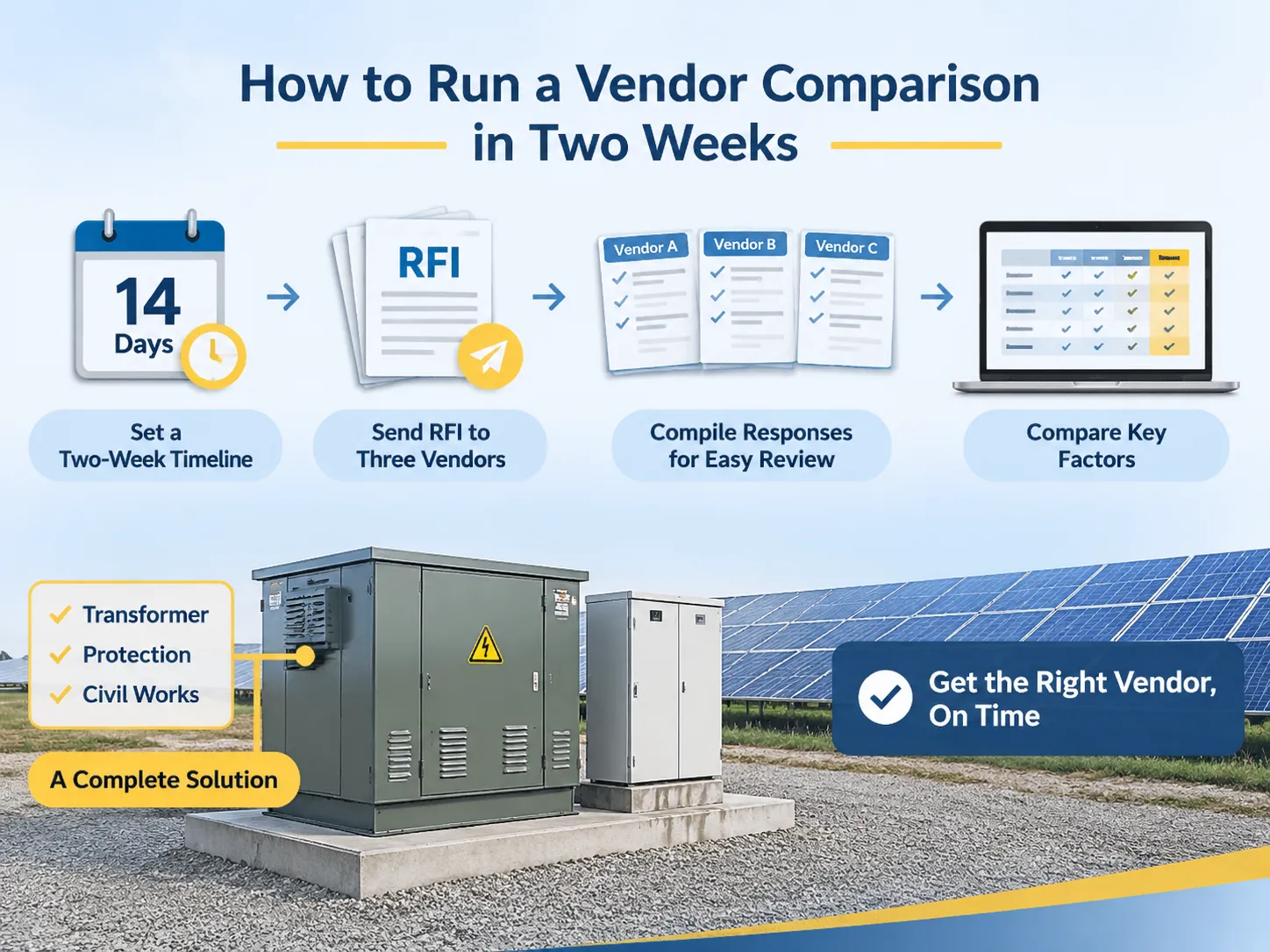
How to Run a Vendor Comparison in Two Weeks
An alternate item will be selected within two weeks of receiving written approval of the specific work to start. During that time frame, a vendor comparison can be created by reviewing the available price quotes, developing a complete list of available products and sending the electronic file with all of the information requested for the chosen item to three separate vendors.
After sending out the request for information (the RFI), compile the three vendor responses into one document for easier review of the information coming back. Once all three vendors’ responses have been compiled, contact the vendors to request clarification or additional information needed for a vendor comparison.
While you will receive the same information from all three vendors, it is important to follow a standard procedure when conducting vendor comparisons. All eight questions listed must be asked of each vendor at the same time in order to allow for comparison. The tests requested by each vendor should be conducted at the same time to provide the most accurate information.
Additional resources may need to be utilized in the vendor comparison process, including trade publications, trade shows, and internet searches, which can provide valuable information on the vendor’s company and their products. Following these guidelines, as well as other suggestions in this section, will enable the first vendor order to be processed quickly, with complete accuracy, and on-time.
A vendor comparison should be limited to the selected vendors listed above. Vendor comparisons can be created quickly, if completed correctly, and this will allow for quicker processing of vendors for comparison purposes. By completing a thorough vendor comparison within the parameters described above, the estimated timeframe for receiving vendor responses is two weeks; therefore, completing this process will allow the vendor comparison process to begin as early as two weeks and end as quickly as possible.
Using the methods described above will provide the first order that will be processed, but this does not preclude processing additional vendors as part of the vendor selection process in the future; however, the first vendor order will be completed accurately and processed in a timely manner based on your company guidelines and industry best practices. In this comparison, it becomes more about the factory and documentation than the price, which is the right order.
Whether the project is just the transformer or the transformer with the substation, the pad mounted transformer installation for the solar power station showed that the transformer, the protection and the civil works were packaged together as one, which is what the developer can take to the EPC.
What We Supply, and What We Do Not
We will describe what we provide and what we do not.
We manufacture oil-immersed distribution transformers in the range of 30 kVA to several MVA rated for 11, 22, 33 and 35 kV. Each unit is built to IEC specifications with routine testing for each unit and all units have documented loss testing records for the product. The 20 kV distribution transformer is the size range most frequently specified for commercial projects outside North America and are configured as per order product including the transformer enclosure, finish, and accessory packages.
What we do not have is a US factory, a UL listing under ANSI product standards, or a place on any approved list for any US utility. For any US commercial project connecting to a utility grid that requires IEEE C57.12.34 equipment, that will be a project of ERMCO, Howard, Central Moloney, or one of the other global OEMs, and we will provide you that information and not provide a quote for a specification that we cannot meet.
Where we are of use to you is for the adjacent markets: projects outside of North America that accept IEC, developer portfolios in countries where the utility specification follows IEC, and for the substation package around a transformer that you purchase locally. The benefit of purchasing a transformer from a factory is that you get the benefit of a full test record and you have one point of interface for your transformer, switchgear, and enclosure.
Installation Constraints That Ruin a Good Purchase
Installation constraints are the biggest factor in ruining your purchase of a transformer. If you put the right transformer in the wrong location or don’t consider site constraints, you will run into problems with your project.
There are five main site constraints that create the bulk of problems:
- Drainage and pad height. When a pad collects water, that water becomes part of the foundation of the transformer. Corrosion starts at the foundation, even with a good finish.
- Clearances from buildings, as defined by NEC 450.27, must be measured from the case.
- Access for cranes and boom lifts for 1,500 kVA units because lifting is required for this size transformers, as rolling is not possible due to weight and physical size.
- Where cables enter, because in a pad design where the cables enter from the bottom, if you do not have a duct bank to install the cables you will need to add modifications in the field.
- Security; pad mounts located in parking lots need bollards and locks that will allow utilities access.
None of these items incur a cost at the design phase, but all of them are costly after the fact. Using a compact format for substations that use a transformer and switchgear located in the same physical structure can give you more flexibility when it comes to space constraints at the installation site. The kompakte Umspannstation Anleitung is there to provide insight as to where compact substations might work best and where they will not.
FAQ
Which company produces the best padmount transformer for commercial use?
There is no “one-size-fits-all” answer, as each type of transformer has different application requirements. The strongest manufacturers of three-phase padmount transformers from 500 kVA to 2,500 kVA with proven testing processes are ERMCO and Central Moloney. Howard Industries provides a wider range of Single-Phase Transformers. Eaton, Siemens and Hitachi Energy provide a uniform standardization across platforms and portfolios. The best vendor for a specific project is one in which their unit is on the utility service provider’s approved list and whose routine testing reports you can review before placing an order.
What is the average cost of a Padmount Transformer?
Typical prices for newly manufactured three-phase Padmount Transformers are $13,000 to $19,000 for 500 kVA, $20,000 to $29,000 for 1,000 kVA, and $27,000 to $38,000 for 1,500 kVA. Prices vary based on voltage rating, transformer impedance, losses and associated accessories. Refurbished units are priced typically at 40 to 55 percent of factory-new prices. Energy costs over two decades will typically exceed the initial purchase price by many multiples, which is why the loss specification matters more than the discount in determining the relative value of a padmount transformer.
How long do padmount transformers typically require to produce?
New three-phase padmount transformers take from 16 weeks up to 30 weeks to manufacture and lead times can be longer still for non-standard voltages (greater than 1,500 kVA). Refurbished Transformers may vary in production time depending on stock availability while a Utility’s Interconnection Review may require significantly more time to perform than the actual manufacture of the transformer(s). Thus, the project timeline should be built from the anticipated time of energisation of the transformer(s) rather than the date the unit(s) were ordered.
Are UL Listed Transformers required for commercial buildings?
If the utility is connected to the property and the authority having jurisdiction (AHJ) has jurisdiction over it, then yes, for commercial buildings, UL listed transformers would typically be required by the utility because most utility companies in the US require all their approved equipment to be from a listing agency and an inspector may also require the listing mark. Equipment constructed by the IEC under IEC standards, without a US Listing, could potentially be acceptable on the customer’s installation if accepted by the AHJ. However, any such acceptance should be clearly documented before the purchase order is placed.
Referenzen
- Hitachi Energy — Distribution Transformers and Grid Equipment
- Prolec GE — Distribution Transformers for Utility Networks
- Eaton — Distribution Transformers and Utility Equipment
- US Department of Energy — Distribution Transformer Efficiency Standards
Fazit
For the purchase of a Padmount Transformer for a commercial property, there are three documents and one question that must be answered before a padmount purchase is made. The three documents are 1) a routine test report with the serial number, 2) the DOE efficiency statement and 3) evidence from the utility that it will accept the transformer for use. The one question is “who owns the transformer” as that will dictate whether or not the developer has purchased an item or has made an investment into the utility’s transformer.
Once the three documents and the one question are settled, the Vendor Comparison is based on lead times (using the same basis), finish (to fit the site), and service relationships (at least lasting through year 3). Price is a byproduct of all of these factors, and any project that buys transformers based on price first will likely incur greater expenses due to delayed energisation subsequently causing the transformer to cost more than anticipated.