


Kompakte Umspannwerke kommen mit allen notwendigen Komponenten für Mittelspannungsversorgungsinstallationen. Während Projektplaner möglicherweise Transformatorgeräte separat erwerben möchten, kümmert sich ein werkseitig gefertigtes kompaktes Umspannwerk um die gesamte Beschaffung der Ausrüstung, um die Kundenspezifikationen zu erfüllen.
Die Definition mag jedoch zunächst zu eng erscheinen. Diejenigen, die an einem 11kV kompakten Umspannwerk interessiert sind, möchten Zugang zu einem festen MV/LV-Verteilungssystem erhalten. Diejenigen mit einem Bedarf an kompakten mobilen Umspannwerken müssen sie möglicherweise in abgelegenen Gebieten oder beim Umzug zu dringenden Stromversorgungsstandorten einsetzen. Kompakte Umspannwerke für Energiespeicher benötigen spezielle Elemente, da Batterien für die Energieumwandlung in das Projekt involviert sind.
Diese Übersicht präsentiert einige technische Unterschiede bei kompakten Umspannwerken, Spezifikationen, die angefordert werden sollten, und Fragen, die helfen können, Unterschiede in den Angeboten von EPC-Firmen, Versorgungsunternehmen und Entwicklern zu identifizieren.
Zusammenfassend lässt sich sagen: Ein kompaktes Umspannwerk integriert Mittelspannungsumschaltung, einen Verteilungstransformator und Niederspannungsverteilung in ein platzsparendes und oft vorgefertigtes Gerät. Bei der Bestellung eines 11 kV-Systems ist es wichtig, dass ein Käufer auf die Leistungskapazität eines Transformators, das Fehlerniveau des Netzes, den Schutz, die Belüftung und die Prüfanforderungen für die Montage achtet. Ein kompaktes Kiosk kann nicht als geeignet für den Betrieb unter bestimmten Bedingungen betrachtet werden, nur weil es kompakt ist.
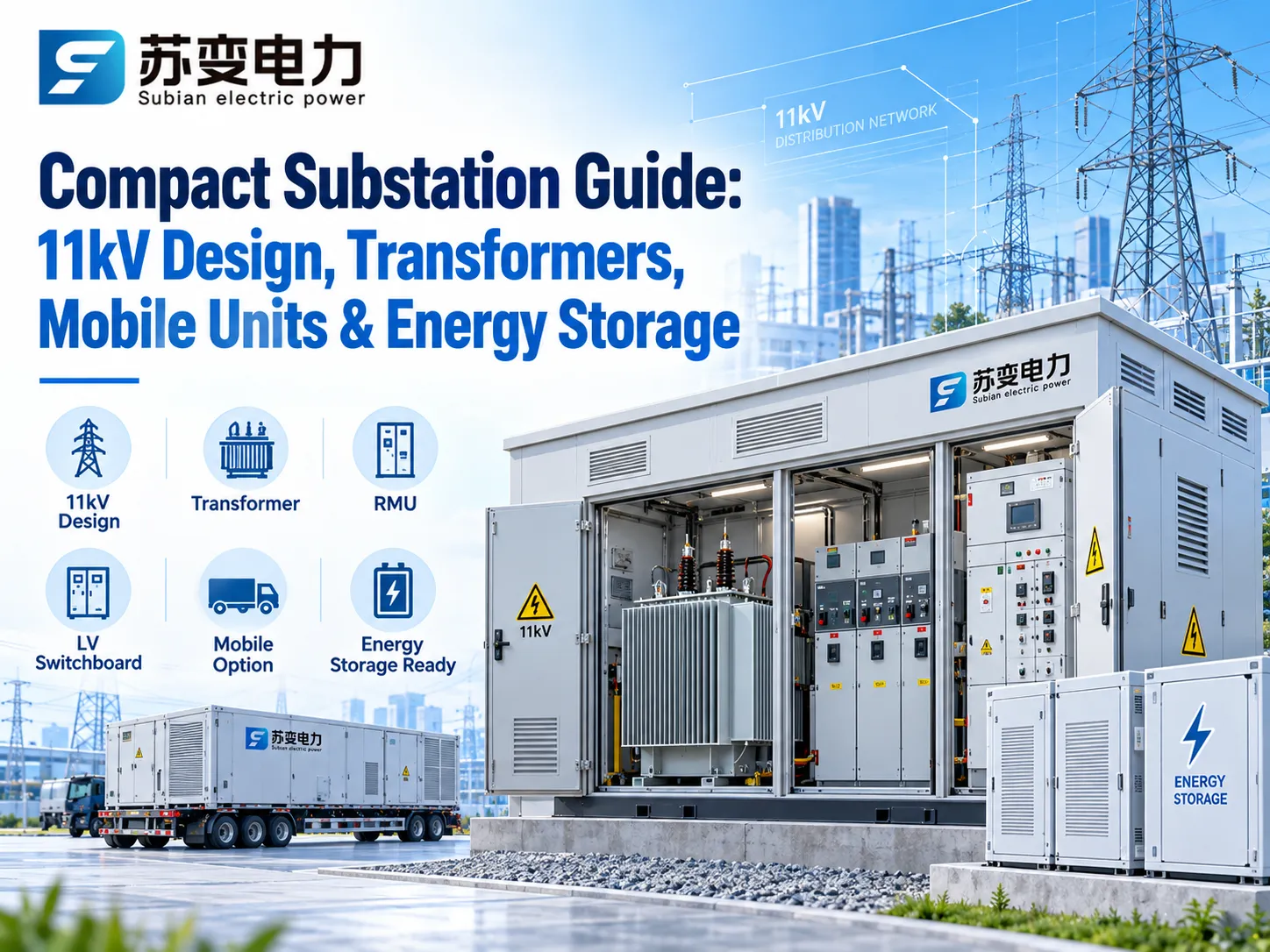
Was ist ein kompaktes Umspannwerk?
Ein kompaktes Umspannwerk ist ein elektrisches Gerät, das eine platzsparende Installation ist, die aus mehreren Elementen wie MV-Umschaltung und -schutz, Verteilungstransformator, LV-Verteilung und den Hilfsgeräten besteht. Die meisten Designs werden in der Fabrik hergestellt und an den Endbenutzer als Kioske, Container oder modulare Elemente geliefert. Der Begriff kompakt wird verwendet, um sein wirtschaftlich vorteilhaftes Design zu kennzeichnen, während der Begriff vorgefertigt verwendet wird, um den Ansatz der fertiggestellten Station zu beschreiben. Sie werden jedoch oft verwechselt, da sie beide eng mit der Idee der Kompaktheit und Vorfertigung verbunden sind.
Die Grundstruktur des einfachen kompakten MV/LV-Verteilungsumspannwerks umfasst normalerweise den folgenden Stromversorgungsfluss:
MV-Eingangsversorgung → MV-Ringeinheit oder Leistungsschalter-Schaltanlage → Verteilungstransformator → LV-Hauptschaltanlage → ausgehende LV-Zuleitungen.
Um ein Einliniendiagramm (SLD) zu entwickeln, ist es erforderlich, zwei MV-Ringzuleitungen, Transformatorschutz, Messung, Überspannungsableiter, Hilfsstromversorgung und Fernüberwachung des Systems hinzuzufügen. In Bezug auf ein Ringversorgungssystem sollte die Konstruktion des RMU mit der Richtlinie des Netzbetreibers hinsichtlich Umschalt- und Schutzmethoden kompatibel sein.
Kompakt, vorgefertigt, Paket und Kiosk: Sind sie dasselbe?
In internationalen Katalogen überschneiden sich diese Namen:
| Begriff | Was Käufer normalerweise meinen | Wichtige Unterscheidung |
|---|---|---|
| Kompaktes Umspannwerk | Kleinflächige MV/LV-Verteilungsstation | Kann Kiosk, begehbar oder integriertes Paket sein |
| Vorgefertigtes Umspannwerk | Station im Werk montiert und getestet | Beschreibt Bau- und Liefermethode |
| Kiosk- / Box-Transformatorstation | Geschlossene, üblicherweise nicht begehbare Verteilungsstation | Der Zugang für den Betreiber und die Anordnung der Fächer variieren |
| Paket-Transformatorstation | Werkseitig koordinierte Schaltanlagen- und Transformatorpakete | Kann je nach Markt geschlossen oder offen sein |
| E-Haus | Großes modulares elektrisches Zimmer | Deckt oft viele Zuleitungen, Steuerungen und Antriebe ab, anstatt einer kompakten Transformatorstation |
| Mobile Transformatorstation | Für Umzüge oder temporäre Einsätze konzipiert | Erfordert Transport-, mechanische und wiederholte Anschlussüberlegungen |
Diese Terminologie ist in der Angebotsphase wichtig. Ein 630kVA städtischer Kiosk und eine 10MVA auf einem Anhänger montierte Notstrom-Transformatorstation sollten nicht verglichen werden, als wären sie Variationen desselben Produkts.
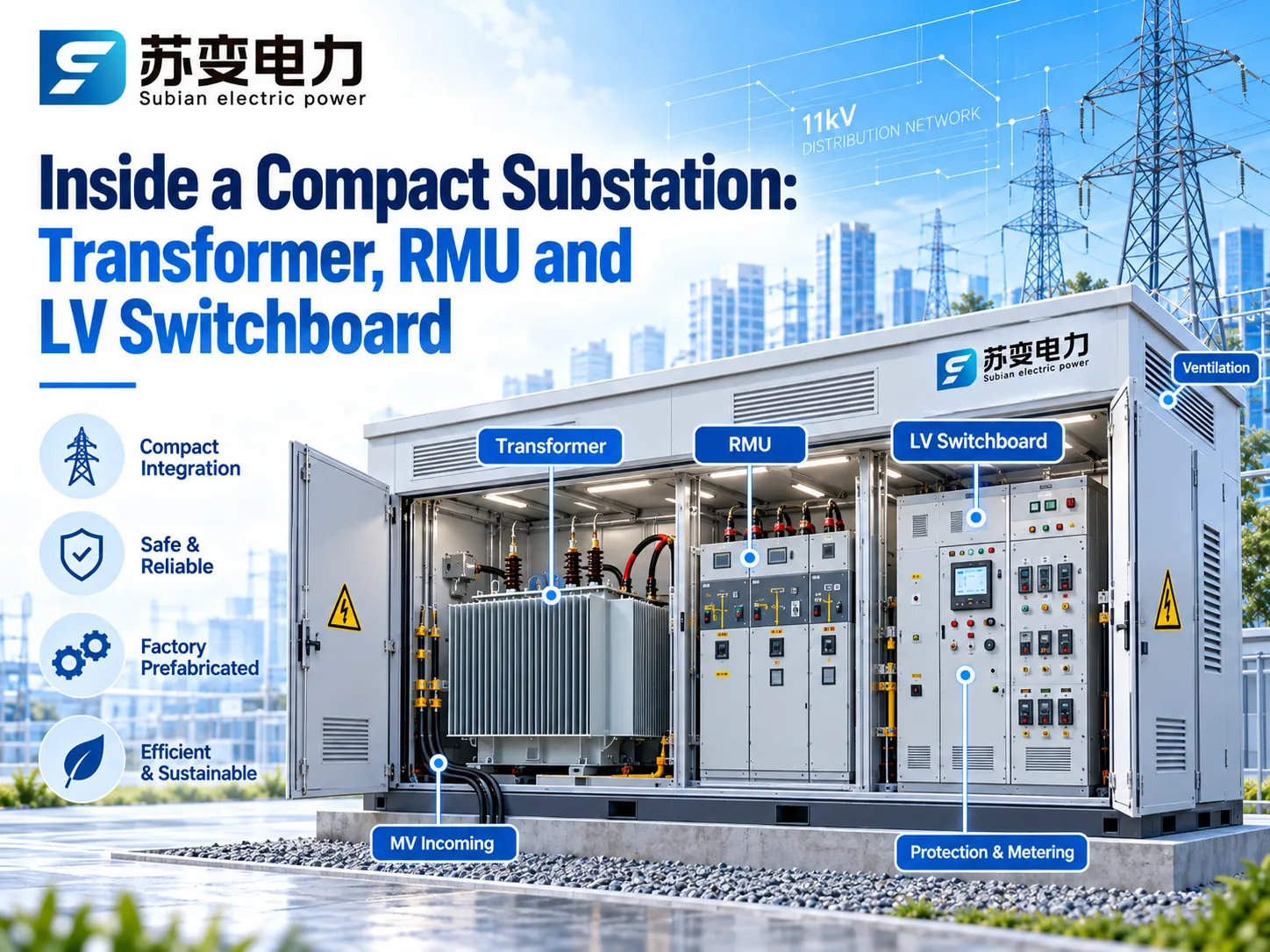
Innenansicht einer kompakten Transformatorstation: Transformator, RMU und Niederspannungsschaltanlage
Der beste Weg, das Paket zu bewerten, besteht darin, seine drei Hauptfunktionen und deren Schnittstellen zu inspizieren, nicht nur das äußere Gehäuse.
Mittelspannungs-Schaltung und -Schutz
MV-Geräte verbinden den Knoten mit dem vorherigen Netzwerk. Häufig wird gesagt, dass eine Ringhauptschaltanlage (RMU) einen eingehenden und einen ausgehenden Lasttrennschalter zusammen mit einem gesicherten Transformator-Zuleitung oder einem Leistungsschalter-Zuleitung hat, wenn der Schutz dies erfordert. Die Konfiguration muss den Spannungswerten und dem Dauerstrom, dem potenziellen Kurzschlussstrom, der Schutzstudie und den Vorschriften für das Schalten des Versorgungsunternehmens entsprechen.
Für Parameterdefinitionen und einen Modellvergleich siehe Subians Ringhauptschaltanlagen-Spezifikationen und -Merkmale.
Kompakte Transformatorstation: ölgetaucht oder trocken?
Die Leistung/Abmessungen des kompakten Transformatorstationstransformators beeinflussen wichtige Aspekte der Station, wie Effizienz, Temperaturmanagement und Verluste, die durch den Transformator verursacht werden. Verschiedene Typen von ölgetauchten kompakten Transformatorstationstransformatoren werden häufig verwendet; trockene kompakte Transformatorstationstransformatoren werden für Installationen in einigen Innen- oder feuerempfindlichen Anwendungen bevorzugt. Die Auswahl sollte von den Feuerklassifikationen des Standorts, der verfügbaren Belüftung der Installation, den Außentemperaturen, den akustischen Anforderungen und dem Wartungszugang abhängen.
Der Transformator sollte durch seine Kapazität in kVA, Spannung in Primär- und Sekundärkreisen, Verluste, Impedanz und andere relevante Parameter definiert werden. Die Umgebung des Transformators zum Zeitpunkt des Betriebs sollte so beschaffen sein, dass unerwünschte Wärme, die durch die Arbeit des Transformators verursacht wird, problemlos abgeführt werden kann.
Niederspannungsschaltanlage und Integration
Der LV-Bereich umfasst den Haupteingang, die Sammelschienen, die Ausgangsleitungen, die Messung sowie die erforderlichen Schutz- oder Überwachungsmaßnahmen. Die LV-Strompegel werden in 0,4 kV-Stationen aufgrund der steigenden Kapazität der Transformatoren erheblich, was erfordert, dass die thermischen Bewertungen des Panels mit der Sammelschiene und dem Transformator sowie die Lastanalyse des Standorts ordnungsgemäß abgestimmt werden. Vor der Genehmigung des Layouts des Gehäuses ist es erforderlich, das Programm der Ausgangsleitungen und das Kabelanschlussschema abzuschließen.
11kV Kompaktstation Spezifikationen: Was auf das Datenblatt gehört
Obwohl die 11kV kompakten Umspannwerk als Referenz für internationale Verteilungsprojekte dienen kann, sollte beachtet werden, dass “11kV” im Allgemeinen die Nennspannung eines MV-Netzes bezeichnet. Die dort verwendete Schaltanlage gehört normalerweise zur 12kV Gerätekategorie. Dabei sollten das Übersetzungsverhältnis des Transformators, das Isolationsniveau der Schaltanlage und die Netzanforderungen separat angegeben werden, da der Begriff “11kV” allein als technische Spezifikation unzureichend ist.
| Spezifikation | Was der Käufer definieren muss | Warum es das Design beeinflusst |
|---|---|---|
| MV-Netz / Gerätekategorie | Nenn-11kV-Netz; geeignetes 12kV-Klassen-Gerät | Isolierung, Auswahl und Tests der Schaltanlage |
| LV-Spannung | Oft 0,4 kV, aber projektspezifisch | Transformatorsekundär- und LV-Schaltanlagen |
| Transformatorleistung | Projektlaststudie und zukünftiges Wachstum in kVA | Wärme, Abmessungen, Verluste und Kosten |
| Netzkurzschlussniveau | Erwarteter Fehlerstrom und erforderliche Dauer | Schaltanlagen- und Sammelschienen-Beständigkeitseinstufungen |
| MV-Konfiguration | Ringversorgung, radialer Anschluss, Sicherung oder Leistungsschalter | Kontinuität, Schaltung und Schutz |
| Transformator-Details | Öl- oder Trockenbauweise, Verluste, Impedanz, Vektorgruppe | Effizienz, thermische und Fehlerleistung |
| Gehäuse und Zugang | Nicht begehbar / begehbar, IP-Bewertung, Türen und Abstände | Wartung und Personensicherheit |
| Betriebsbedingungen | Umgebungstemperatur, Höhe, Verschmutzung, Korrosionsbelastung | Kühlung, Herabstufung und Materialien |
| Testnachweise | Typprüfungen für relevante Komplettmontagen und Routineprüfungen | Konformität und Projektakzeptanz |
Zum Beispiel, aber ohne Universalisierung: Ein bestimmter EPC-Auftragnehmer soll eine 11-0,4 kV 630 kVA Einheit mit integriertem MV RMU, Verteilungstransformator sowie einem LV-Panel bei 400 V bereitstellen. Der tatsächliche Wert für die Stromkapazität, Kurzschlussimpulswerte, Abmessungen und interne Lichtbogenklasse dieser speziellen Lösung sollte den Entwurfs- und Systemstudien folgen, die möglicherweise die Quelle anderer Werte sind als die in diesem Beispiel genannten.
Im Falle eines 20 kV Stromverteilungsnetzes wird die Auswahl der Geräte aus der 24 kV-Kategorie getroffen, für ein 33 kV-Netz – aus der 36 kV-Ausrüstung, während die Anforderungen an die Isolierung in einem Stromsystem erfüllt werden. Subian führt auch eine spezielle 33kV Kompaktstation Produkt- und Beschaffungsseite für Projekte mit höherer Spannung.
Kompakte mobile Station vs. feste kompakte Station
Es ist notwendig, den Suchbegriff “kompakte mobile Station” separat aufgrund der Tatsache, dass die Betriebsbedingungen erheblich von denen des permanenten kompakten Kiosks abweichen können.
Eine kompakte Umspannstation wird normalerweise an einem vorbereiteten Standort installiert und nach der Lieferung dort als dauerhafte Installation verwendet, indem sie auf Fundamenten platziert, angeschlossen, in Betrieb genommen und vor Ort getestet wird. Eine mobile Umspannstation ist dafür ausgelegt, transportiert zu werden (möglicherweise auf einem Anhänger oder einer Unterlage), schnell gesichert, angeschlossen, mehrfach in Betrieb genommen und geerdet zu werden.
| Entscheidungspunkt | Feste kompakte Umspannstation | Kompakte mobile / transportable Umspannstation |
|---|---|---|
| Hauptverwendung | Permanente Verteilung | Temporäre Versorgung, geplante Arbeiten, Notfallreaktion |
| Mechanisches Design | Foundation and long-term outdoor service | Transport restraints and repeated movement |
| Connections | Normally permanent cable terminations | Accessible, repeatable connection scheme as specified |
| Installation | Site foundation, cable and earth works | Faster redeployment is possible when engineered for it |
| Typical constraint | Footprint, access, network approval | Road transport, lifting, vibration and setup procedures |
A mobile option is mentioned on Subian’s YB Series Prefabricated Substation product page. The user must confirm whether the specification of the offer indicates that it is just a relocatable modular unit or designed as a trailer/skid unit for repeated deployments at an operational site. It should not be taken for granted that the term “mobile” conveys all the necessary capabilities.
Energy Storage Compact Substation: What Changes for BESS?
A battery energy-storage system is usually connected to the medium-voltage electric grid using a power converter and a step-up transformer. There is a possibility of combining the transformer, medium-voltage switchgear, and the required low voltage/auxiliary switching in a compact energy storage substation close to the battery and power converter installations. The battery frames themselves don’t have to be installed in the substation.
The electrical route can be illustrated as follows:
Battery frames (DC) ↔ Power converter/inverter (AC) ↔ step-up transformer ↔ medium-voltage switchgear ↔ power network.
Four aspects should be stressed:
1. Power converter output and voltage ratios – the transformer should be tailored to the converter’s output voltage and to the medium-voltage grid to which it is connected. They are project-related and cannot be treated as the same as a regular 11/0.4 kV load connection.
2. The bidirectionality and cyclicness of the operation – as a BESS can provide both charging and discharging, there should be specified the transformer requirements depending on the expected load matrix, temperature increase, and thermal cycling.
3. Considering harmonics, grounding, and protection – the converter features, harmonics and fault-current profiles, as well as grid-code requirements influence the transformer design and protection coordination.
4. Safety and approval at a site level – there are such aspects as BESS fire safety, inverter certification, utility approval, and compact substation compliance. They should be handled separately since IEC conformity of one element does not mean that the whole project is compliant.
As a separate example, a YBM-35/0.8 Photovoltaic Step-Up Substation is mentioned by Subian. This product is an example of renewable-energy step-up equipment, but it does not mean that the particular BESS PCSs have been verified for this design. The BESS buyers should obtain engineering confirmation about the type of the converter.
Compact Substation Design Checklist: IEC Standards and Safety
The central standard for many enclosed AC prefabricated substations is IEC 62271-202:2022. The specifications specify the service conditions, rated parameters, design, and verification of appropriate modular substations connected to AC systems having parameters not exceeding or equal to 52kV. The standards being used and their editions must be verified in relation to the project and local requirements.
Serious tenders must provide the entire set of equipment and not only certificates for single units:
IEC 62271-202: type tests and operational characteristics of a given prefabricated substation consisting of appropriate enclosure/temperature and internal arc parameters.
IEC 62271-200 with relevant components: MV enclosure-based switchgear and its switching function.
IEC 60076 series: tests and requirements for electrical and thermal parameters of transformers.
IEC 61439 series: LV switchgear and control gear assemblies.
IEC 60529: levels of protection by means of enclosure.
Just because the switchgear is type-tested does not mean a complete assembly is type-tested; you must inquire whether the layout you receive is covered by the type testing of the assembly or if some modifications exclude its use without additional testing.
Internal arc, ventilation and access
Verify which parts of the enclosure can be accessed, the internal arc classification if applicable, and the arc duration and current. You should measure the prospective fault current with respect to your choice of configuration. Ventilation of the enclosure is very important as insufficient cooling may lead to transformer derating while the nameplate says otherwise. You should also make sure that the access to circuit breaker handles, grounding points, low-voltage breakers, and equipment replacement pathways is in fact possible.
Does IEC compliance guarantee utility approval?
No. The project authorities are allowed to implement controlled vendor list, requirements of local installations, grounding rules and documentation. This is essential when purchasing plants abroad. Before completing the design, you should inquire about the specifications of the electric utility of the target country.
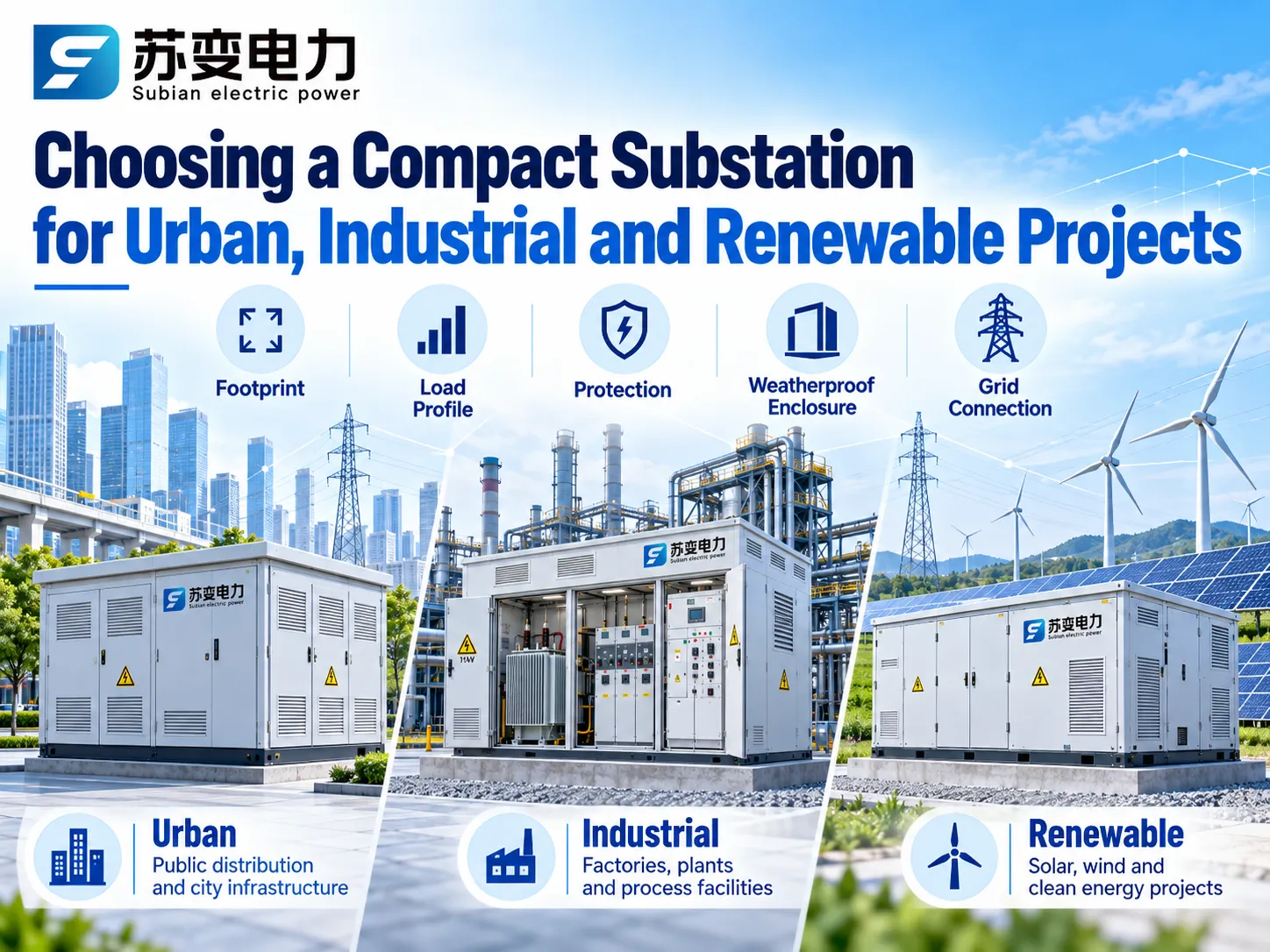
Choosing a Compact Substation for Urban, Industrial and Renewable Projects
Compact does not mean there is one preferred arrangement for every application.
| Anwendung | Common design priority | Typical option to evaluate |
|---|---|---|
| Urbane Verteilung | Small footprint, access control, quiet operation | Enclosed kiosk with integrated MV/LV functions |
| Industrial factory | Load growth, protection grading, maintenance access | Customized YB-style MV/LV station |
| Construction / temporary supply | Deployment and relocation | Purpose-engineered mobile or modular station |
| Solar power generation | Inverter output and MV grid connection | Step-up transformer station with MV protection |
| Battery energy storage | PCS compatibility and bidirectional power flow | Converter-specific compact step-up station |
| Commercial development | 11kV network compatibility, capacity and LV feeders | 11/0.4kV package/substation, utility-approved |
You should define the electrical job before asking for an estimate. The box type needs to be based on the one-line diagram, the load to be handled, and maintenance requirements rather than on appearance.
Comparing Compact Substation Suppliers: Technical Evidence Before Price
When a purchaser is comparing a locally operating company, a big global corporation and a manufacturer located in China, this comparison must be much more precise than a general statement about one country’s equipment being less expensive than others. The best way to make a correct comparison is to compare specification ratings, types of protection measures, compliance with international standards, and origin and documents for component elements supplied.
The RFQ should include full;
1. Destination of the shipment, country of network operators and application on the site.
2. Single line diagram, MV voltage, LV voltage, and frequency.
3. Transfomer kVA/MVA rating, impedance, losses, cooling, and type of winding preferred.
4. Available fault current, protection philosophy, and arrangement of RMU/switchgear.
5. Enclosure materials, ingress protection, dimensions, climate conditions, and requirements for access.
6. Internal arc, and requirements for enclosure class if applicable.
7. Required IEC/EN/GB standards and their editions for tests/reports.
8. Locations for cable entries, drawings, installation, and transportation provisions.
9. FAT content, language, warranty, Incoterms, and start-up services.
For European sourcing comparisons, read Welche Anbieter von Fertigstationen in Europa sollten Sie 2026 vergleichen?, which separately discusses Schneider Electric, Siemens, Ormazabal, ZPUE, Efacec and Lucy Electric. This article is not a manufacturer ranking; its purpose is the compact substation design and buying decision.
Compact Substations from Subian Electric
Subian Electric’s YB Series Prefabricated Substation integrates MV switchgear, a distribution transformer and LV equipment in an enclosed factory-assembled design. The product page presents a standard 10/0.4kV configuration and broader customizable voltage and capacity options. Exact availability, dimensions, switchgear duty, IP rating and test documentation must be confirmed against the quotation for the chosen configuration.
Where the application calls for an integrated American-style arrangement, the ZGS Series Combined Substation is a separate product family. Solar step-up applications can be discussed against the YBM series, while more specialized 33kV projects should be evaluated against the corresponding 33kV substation information.
Subian’s value proposition is a coordinated quotation for transformer, MV switching and LV distribution in one package, with OEM/ODM configuration and factory documentation arranged for the project. This does not imply that every configuration is already type-tested or pre-approved by every network operator; those requirements must be checked before purchase.
Planning a compact substation project? Contact Subian Electric with your SLD, network voltage, transformer capacity, site conditions and destination country to request drawings, an equipment schedule, applicable test evidence and a factory quotation.
FAQ
What is a compact substation?
In compact substation technology, there is a necessity for the combination of various elements that can be used in the electrical sector of generation and distribution of power. Compact substations include among other mentioned components, transformers and equipment for switching MV systems. A number of compact substations are manufactured as prefabricated modules.
What are the four types of substations?
There is no common classification system based on the four types because you can classify substations according to their functionality; voltage; construction/design and equipment installation. Examples of functional classification are transmission, distribution, switching and converter substations. A compact substation is more of a design of distribution substations rather than a separate voltage category.
How much does a small substation cost?
A small compact substation cannot have one particular price because price is influenced by the incoming voltage and fault level, transformer capacity and type, configuration of RMU and LV distribution board, quality of enclosure, internal arc considerations, testing, transportation and commissioning costs. Compare suppliers by using the same equipment list and delivery terms. In order to obtain the project-specific price, please give information about the voltage in the network (11kV, etc.), transformer kVA, and provide the diagram and destination country.
What is a mini substation used for?
Mini substations are often applied in the distribution of power in residential estates, limited commercial areas, manufacturing plants and EV-charging sites that require smaller-sized substations. They perform a function of reducing medium voltage to the required low voltage, however in renewable-energy or temporary situations additional engineering should be applied as the ordinary mini kiosk cannot be considered a mobile or BESS-ready substation.
What is the difference between a compact substation and a prefabricated substation?
“Compact” emphasizes the small footprint; “prefabricated” emphasizes factory assembly and testing. Many designs are both. Neither term alone proves that the station is mobile.
What specifications are important for an 11kV compact substation?
Confirm the 11kV network rating, matching 12kV equipment class, transformer voltage ratio and capacity, LV feeders, fault level, protection, enclosure, thermal design, standards and test documentation.
Is a compact mobile substation the same as a kiosk substation?
Not always true. A mobile unit is built to be moved to different places but a kiosk is a kind of enclosure that essentially implies a permanent placement. A factory-made kiosk is designed to be mobile but it does not mean that it can move around.
What is a compact substation transformer?
It is the power transformer integrated into a compact station. Its rated voltage, capacity, losses, thermal performance, cooling and physical dimensions must be coordinated with the enclosure, MV protection and LV distribution system.
Can a compact substation be used with battery energy storage?
Yes, if it is engineered around the battery PCS and grid connection. Transformer duty, bidirectional power, harmonic effects, protection and approval requirements must be verified for the specific BESS configuration.
Which IEC standard covers prefabricated compact substations?
IEC 62271-202:2022 is the principal assembly standard for enclosed AC prefabricated substations. The relevant transformer and MV switchgear and LV assembly standards are additional specifications rather than alternatives to the overall verification of the station.
Can I order a customized compact substation from China?
Yes. Provide the producer with the network specifics, a single-line diagram, load analysis, fault level, environmental factors, and target specifications. Ensure that the precise specified design, corresponding type-test proof, and local network permission are verified prior to placing the order.
Referenzen
- IEC 62271-202:2022 — Prefabricated substations (official IEC publication)
- Subian YB Series Prefabricated Substation — product data
- Subian 33kV Substation — product and procurement page
- Hitachi Energy — Mobile Substations
Fazit
A compact substation is an efficient choice when the complete MV/LV distribution arrangement fits the site’s electrical and physical constraints. Select it by transformer capacity, voltage ratio, fault withstand, thermal performance, access, and documented testing—not by enclosure size alone. Mobile and BESS installations introduce additional requirements that must be engineered and verified separately.
For a specification-based quotation, review Subian’s YB Series Prefabricated Substation und send your single-line diagram and project requirements to the engineering team.