


Sottostazioni compatte vengono fornite con tutti i componenti necessari per le installazioni di fornitura a media tensione. Mentre i pianificatori di progetto possono voler acquistare separatamente l'attrezzatura per trasformatori, una sottostazione compatta realizzata in fabbrica si occupa dell'intero approvvigionamento dell'attrezzatura per soddisfare le specifiche del cliente.
Tuttavia, la definizione può sembrare troppo ristretta all'inizio. Coloro che sono interessati ad acquistare una sottostazione compatta 11kV vogliono accedere a un sistema di distribuzione MV/LV fisso. Coloro che hanno bisogno di sottostazioni mobili compatte potrebbero doverle utilizzare in aree remote o durante il trasferimento verso siti di fornitura di energia urgenti. Le sottostazioni compatte per lo stoccaggio di energia necessitano di elementi speciali perché nel progetto sono coinvolte batterie per la conversione dell'energia.
Questa panoramica presenta alcune differenze tecniche nelle sottostazioni compatte, specifiche da richiedere e domande che possono aiutare a identificare le differenze nelle proposte delle aziende EPC, delle utility e degli sviluppatori.
In sintesi: una sottostazione compatta integra l'interruttore a media tensione, un trasformatore di distribuzione e la distribuzione a bassa tensione in un dispositivo compatto e spesso prefabbricato. Quando si ordina un sistema da 11 kV, è importante che un acquirente presti attenzione alla capacità di potenza di un trasformatore, al livello di guasto della rete, alla protezione, alla ventilazione e ai requisiti di test per l'assemblaggio. Un chiosco compatto non può essere considerato adatto per l'operazione in determinate condizioni solo perché è compatto.
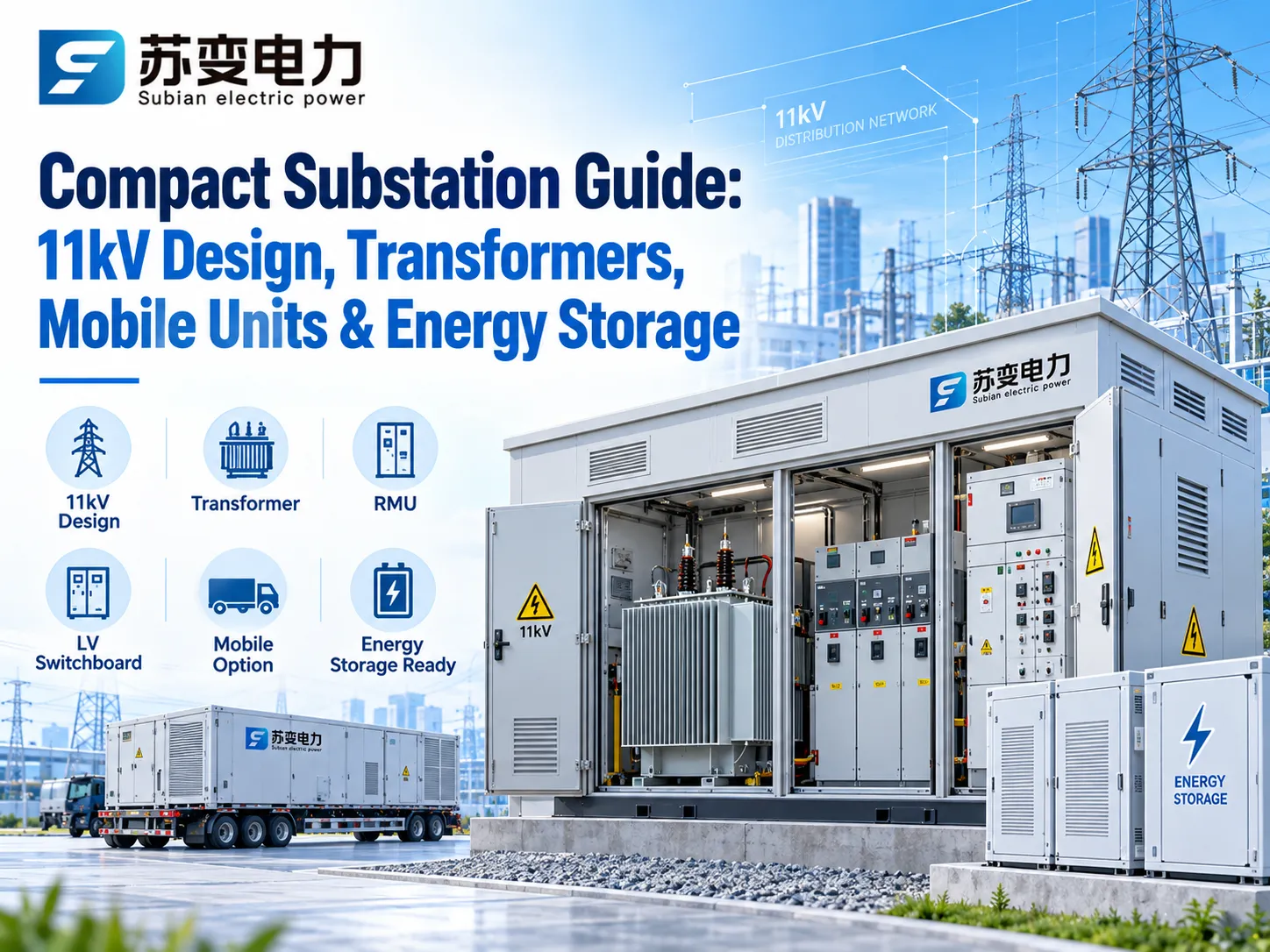
Che cos'è una sottostazione compatta?
Una sottostazione compatta è un dispositivo elettrico che è un'installazione salvaspazio composta da diversi elementi come l'interruttore MV e la protezione, il trasformatore di distribuzione, la distribuzione LV e gli apparecchi ausiliari. La maggior parte dei progetti è costruita in fabbrica e inviata all'utente finale come chioschi, contenitori o elementi modulari. Il termine compatto è usato per denotare il suo design economicamente favorevole, mentre il termine prefabbricato è usato per descrivere l'approccio della stazione già pronta. Tuttavia, spesso vengono confusi poiché entrambi sono strettamente legati all'idea di compattezza e prefabbricazione.
La struttura di base della semplice sottostazione di distribuzione MV/LV compatta include solitamente il seguente flusso di fornitura di energia:
Fornitura MV in ingresso → unità ad anello MV o interruttore automatico → trasformatore di distribuzione → quadro principale LV → feeder LV in uscita.
Per sviluppare un diagramma unifilare (SLD), è necessario aggiungere due feeder ad anello MV, protezione del trasformatore, misurazione, arrestatore di sovratensione, alimentazioni ausiliarie e monitoraggio remoto del sistema. Riguardo a un sistema di fornitura ad anello, la costruzione dell'RMU dovrebbe essere compatibile con la politica del fornitore di rete riguardo ai metodi di commutazione e protezione.
Compatto, prefabbricato, pacchetto e chiosco: sono la stessa cosa?
Nei cataloghi internazionali, questi nomi si sovrappongono:
| Termine | Cosa intendono solitamente gli acquirenti | Distinzione importante |
|---|---|---|
| Sottostazione compatta | Stazione di distribuzione MV/LV a ingombro ridotto | Può essere chiosco, walk-in o pacchetto integrato |
| Sottostazione prefabbricata | Stazione assemblata e testata in fabbrica | Descrive il metodo di costruzione e consegna |
| Stazione di trasformazione tipo kiosk / box | Stazione di distribuzione chiusa, comunemente non accessibile | L'accesso dell'operatore e le disposizioni dei compartimenti variano |
| Stazione di pacchetto | Pacchetto di quadri elettrici e trasformatori coordinato in fabbrica | Può essere chiusa o aperta, a seconda del mercato |
| E-Casa | Grande sala elettrica modulare | Spesso copre molti feeder, controlli e azionamenti piuttosto che una singola stazione di trasformazione compatta |
| Stazione di trasformazione mobile | Progettata per il trasferimento o l'uso temporaneo | Richiede considerazioni di trasporto, meccaniche e di connessione ripetuta |
Questo vocabolario è importante nella fase di offerta. Un kiosk urbano da 630kVA e una stazione di trasformazione di emergenza montata su rimorchio da 10MVA non dovrebbero essere confrontati come se fossero variazioni dello stesso prodotto.
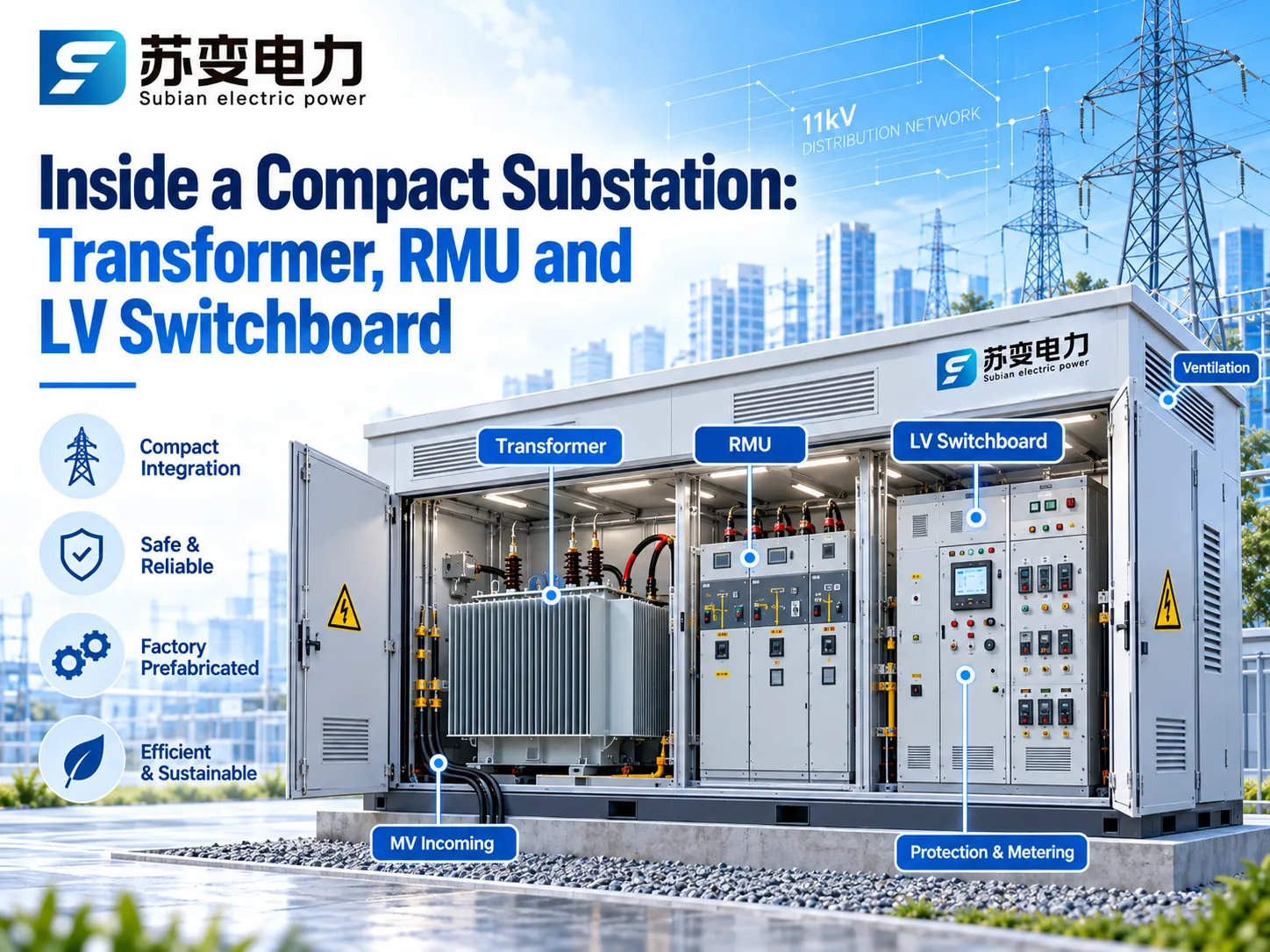
All'interno di una Stazione di Trasformazione Compatta: Trasformatore, RMU e quadro LV
Il modo migliore per valutare il pacchetto è ispezionare le sue tre principali funzioni elettriche e le loro interfacce, non solo l'involucro esterno.
Commutazione e protezione a media tensione
L'apparecchiatura MV collega il nodo alla rete precedente. Comunemente si dice che un'unità di rete anello (RMU) abbia un interruttore di carico in ingresso e in uscita insieme a un alimentatore di trasformatore di potenza sicuro o un alimentatore di interruttore automatico se la protezione lo richiede. La configurazione deve essere conforme alla tensione nominale e alla corrente continua, alla corrente di cortocircuito prospettica, allo studio di protezione e alle normative di commutazione dell'utility.
Per definizioni dei parametri e un confronto dei modelli, vedere le specifiche e le caratteristiche dell'unità di rete anello di Subian Specifiche e Caratteristiche dell'Unità di Rete Anello.
Trasformatore di stazione di trasformazione compatta: immerso in olio o tipo secco?
L'uscita/dimensioni del trasformatore di stazione di trasformazione compatta influenzano aspetti importanti della stazione, come efficienza, gestione della temperatura e perdite causate dal trasformatore. Diversi tipi di trasformatori di stazione di trasformazione compatta immersi in olio sono ampiamente utilizzati; i trasformatori di stazione di trasformazione compatta di tipo secco sono preferiti per installazioni in alcune applicazioni interne o sensibili al fuoco. La selezione dovrebbe dipendere dalle classificazioni antincendio del sito, dalla ventilazione disponibile dell'installazione, dalle temperature esterne, dai requisiti acustici e dall'accesso per la manutenzione.
Il trasformatore dovrebbe essere definito dalla sua capacità in kVA, tensione nei circuiti primari e secondari, perdite, impedenza e altri parametri rilevanti. L'ambiente circostante del trasformatore al momento dell'operazione dovrebbe essere tale da consentire l'estrazione senza problemi del calore indesiderato causato dal lavoro del trasformatore.
Quadro elettrico a bassa tensione e integrazione
The LV section comprises the main entry, busbars, outgoing feeders, metering, as well as necessary protection or monitoring. The LV current levels become quite significant in 0.4kV stations along with the increase of the capacity of transformers, which requires to properly match the thermal ratings of the panel with the bus-bar and transformer as well as the load analysis of the location. Prior to agreeing on the layout of the enclosure, it is required to finalize the outgoing feeder program and the cable input scheme.
11kV Compact Substation Specifications: What to Put on the Datasheet
Although the sottostazione compatta 11kV can serve as a reference for international distribution projects, it should be noted that “11kV” generally refers to the nominal voltage of an MV network. The switchgear used there usually belongs to the 12kV equipment class. At that, the transformer voltage ratio, switchgear insulation level and network requirements should be stated separately as the term “11kV” alone is insufficient as a technical specification.
| Specifica | What the buyer must define | Why it affects the design |
|---|---|---|
| MV network / equipment class | Nominal 11kV network; suitable 12kV-class equipment | Insulation, switchgear selection and tests |
| LV voltage | Often 0.4kV, but project-specific | Transformer secondary and LV boards |
| Capacità del trasformatore | Project load study and future growth, in kVA | Heat, dimensions, losses and cost |
| Network short-circuit level | Prospective fault current and required duration | Switchgear and busbar withstand ratings |
| MV configuration | Ring feed, radial feed, fuse or circuit breaker | Continuity, switching and protection |
| Transformer details | Oil or dry type, losses, impedance, vector group | Efficiency, thermal and fault performance |
| Enclosure and access | Non-walk-in / walk-in, IP rating, doors and clearances | Maintenance and personnel safety |
| Operating conditions | Ambient temperature, altitude, pollution, corrosion exposure | Cooling, derating and materials |
| Test evidence | Type tests for relevant complete assembly and routine tests | Compliance and project acceptance |
For instance, but without implying universality: A certain EPC contractor shall provide an 11-0.4 kV 630 kVA unit with built-in MV RMU, distribution transformer as well as an LV panel at 400 V. Actual value for current capacity, short-circuit impulse ratings, dimensions and internal arc class of this particular solution shall follow its design and system studies, which might be the source of different values from those mentioned in this example.
In case of 20 kV power distribution network the choice of equipment is taken from 24 kV category, for a 33 kV network – from 36 kV equipment while meeting requirements of insulation used in a power system. Subian also maintains a dedicated 33kV compact substation product and procurement page for higher-voltage projects.
Compact Mobile Substation vs Fixed Compact Substation
It is necessary to consider the search phrase “compact mobile substation” separately due to the fact that its service conditions can vary considerably from those of the permanent compact kiosk.
A compact substation is usually installed at the site on a prepared base and used as a lasting installation after being supplied there, put on foundations, connected, commissioned and tested on-site. A mobile substation is designed to be transported (possibly on a trailer or skid), secured, connected quickly, re-commissioned and grounded multiple times.
| Decision point | Fixed compact substation | Compact mobile / transportable substation |
|---|---|---|
| Uso principale | Permanent distribution | Temporary supply, planned works, emergency response |
| Mechanical design | Foundation and long-term outdoor service | Transport restraints and repeated movement |
| Connections | Normally permanent cable terminations | Accessible, repeatable connection scheme as specified |
| Installazione | Site foundation, cable and earth works | Faster redeployment is possible when engineered for it |
| Typical constraint | Footprint, access, network approval | Road transport, lifting, vibration and setup procedures |
A mobile option is mentioned on Subian’s YB Series Prefabricated Substation product page. The user must confirm whether the specification of the offer indicates that it is just a relocatable modular unit or designed as a trailer/skid unit for repeated deployments at an operational site. It should not be taken for granted that the term “mobile” conveys all the necessary capabilities.
Energy Storage Compact Substation: What Changes for BESS?
A battery energy-storage system is usually connected to the medium-voltage electric grid using a power converter and a step-up transformer. There is a possibility of combining the transformer, medium-voltage switchgear, and the required low voltage/auxiliary switching in a compact energy storage substation close to the battery and power converter installations. The battery frames themselves don’t have to be installed in the substation.
The electrical route can be illustrated as follows:
Battery frames (DC) ↔ Power converter/inverter (AC) ↔ step-up transformer ↔ medium-voltage switchgear ↔ power network.
Four aspects should be stressed:
1. Power converter output and voltage ratios – the transformer should be tailored to the converter’s output voltage and to the medium-voltage grid to which it is connected. They are project-related and cannot be treated as the same as a regular 11/0.4 kV load connection.
2. The bidirectionality and cyclicness of the operation – as a BESS can provide both charging and discharging, there should be specified the transformer requirements depending on the expected load matrix, temperature increase, and thermal cycling.
3. Considering harmonics, grounding, and protection – the converter features, harmonics and fault-current profiles, as well as grid-code requirements influence the transformer design and protection coordination.
4. Safety and approval at a site level – there are such aspects as BESS fire safety, inverter certification, utility approval, and compact substation compliance. They should be handled separately since IEC conformity of one element does not mean that the whole project is compliant.
As a separate example, a YBM-35/0.8 Photovoltaic Step-Up Substation is mentioned by Subian. This product is an example of renewable-energy step-up equipment, but it does not mean that the particular BESS PCSs have been verified for this design. The BESS buyers should obtain engineering confirmation about the type of the converter.
Compact Substation Design Checklist: IEC Standards and Safety
The central standard for many enclosed AC prefabricated substations is IEC 62271-202:2022. The specifications specify the service conditions, rated parameters, design, and verification of appropriate modular substations connected to AC systems having parameters not exceeding or equal to 52kV. The standards being used and their editions must be verified in relation to the project and local requirements.
Serious tenders must provide the entire set of equipment and not only certificates for single units:
IEC 62271-202: type tests and operational characteristics of a given prefabricated substation consisting of appropriate enclosure/temperature and internal arc parameters.
IEC 62271-200 with relevant components: MV enclosure-based switchgear and its switching function.
IEC 60076 series: tests and requirements for electrical and thermal parameters of transformers.
IEC 61439 series: LV switchgear and control gear assemblies.
IEC 60529: levels of protection by means of enclosure.
Just because the switchgear is type-tested does not mean a complete assembly is type-tested; you must inquire whether the layout you receive is covered by the type testing of the assembly or if some modifications exclude its use without additional testing.
Internal arc, ventilation and access
Verify which parts of the enclosure can be accessed, the internal arc classification if applicable, and the arc duration and current. You should measure the prospective fault current with respect to your choice of configuration. Ventilation of the enclosure is very important as insufficient cooling may lead to transformer derating while the nameplate says otherwise. You should also make sure that the access to circuit breaker handles, grounding points, low-voltage breakers, and equipment replacement pathways is in fact possible.
Does IEC compliance guarantee utility approval?
No. The project authorities are allowed to implement controlled vendor list, requirements of local installations, grounding rules and documentation. This is essential when purchasing plants abroad. Before completing the design, you should inquire about the specifications of the electric utility of the target country.
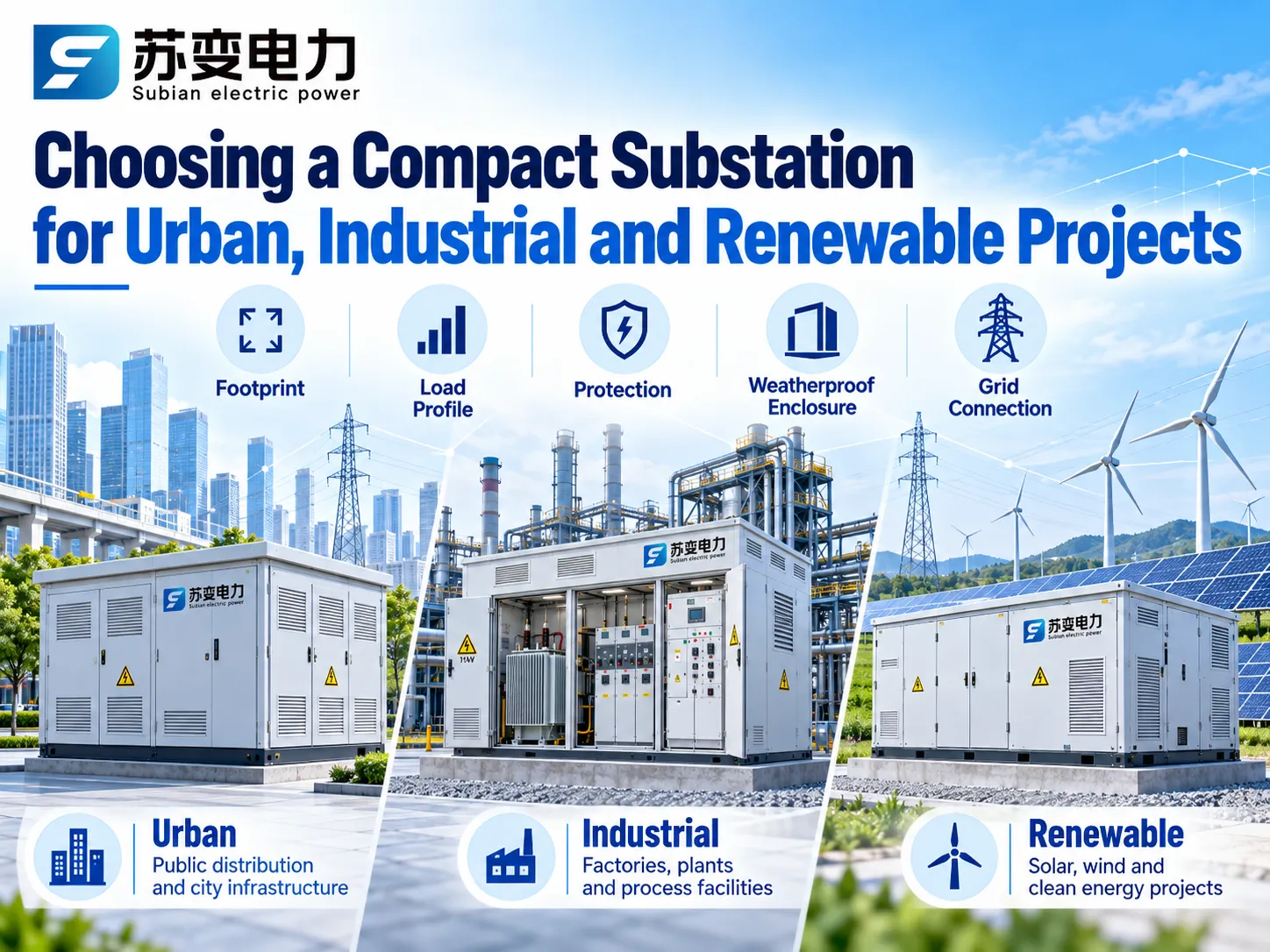
Choosing a Compact Substation for Urban, Industrial and Renewable Projects
Compact does not mean there is one preferred arrangement for every application.
| Applicazione | Common design priority | Typical option to evaluate |
|---|---|---|
| Distribuzione urbana | Small footprint, access control, quiet operation | Enclosed kiosk with integrated MV/LV functions |
| Industrial factory | Load growth, protection grading, maintenance access | Customized YB-style MV/LV station |
| Construction / temporary supply | Deployment and relocation | Purpose-engineered mobile or modular station |
| Solar power generation | Inverter output and MV grid connection | Step-up transformer station with MV protection |
| Battery energy storage | PCS compatibility and bidirectional power flow | Converter-specific compact step-up station |
| Commercial development | 11kV network compatibility, capacity and LV feeders | 11/0.4kV package/substation, utility-approved |
You should define the electrical job before asking for an estimate. The box type needs to be based on the one-line diagram, the load to be handled, and maintenance requirements rather than on appearance.
Comparing Compact Substation Suppliers: Technical Evidence Before Price
When a purchaser is comparing a locally operating company, a big global corporation and a manufacturer located in China, this comparison must be much more precise than a general statement about one country’s equipment being less expensive than others. The best way to make a correct comparison is to compare specification ratings, types of protection measures, compliance with international standards, and origin and documents for component elements supplied.
The RFQ should include full;
1. Destination of the shipment, country of network operators and application on the site.
2. Single line diagram, MV voltage, LV voltage, and frequency.
3. Transfomer kVA/MVA rating, impedance, losses, cooling, and type of winding preferred.
4. Available fault current, protection philosophy, and arrangement of RMU/switchgear.
5. Enclosure materials, ingress protection, dimensions, climate conditions, and requirements for access.
6. Internal arc, and requirements for enclosure class if applicable.
7. Required IEC/EN/GB standards and their editions for tests/reports.
8. Locations for cable entries, drawings, installation, and transportation provisions.
9. FAT content, language, warranty, Incoterms, and start-up services.
For European sourcing comparisons, read Quali fornitori di cabine prefabbricate in Europa dovresti confrontare nel 2026?, which separately discusses Schneider Electric, Siemens, Ormazabal, ZPUE, Efacec and Lucy Electric. This article is not a manufacturer ranking; its purpose is the compact substation design and buying decision.
Compact Substations from Subian Electric
Subian Electric’s YB Series Prefabricated Substation integrates MV switchgear, a distribution transformer and LV equipment in an enclosed factory-assembled design. The product page presents a standard 10/0.4kV configuration and broader customizable voltage and capacity options. Exact availability, dimensions, switchgear duty, IP rating and test documentation must be confirmed against the quotation for the chosen configuration.
Where the application calls for an integrated American-style arrangement, the ZGS Series Combined Substation is a separate product family. Solar step-up applications can be discussed against the YBM series, while more specialized 33kV projects should be evaluated against the corresponding 33kV substation information.
Subian’s value proposition is a coordinated quotation for transformer, MV switching and LV distribution in one package, with OEM/ODM configuration and factory documentation arranged for the project. This does not imply that every configuration is already type-tested or pre-approved by every network operator; those requirements must be checked before purchase.
Planning a compact substation project? Contact Subian Electric with your SLD, network voltage, transformer capacity, site conditions and destination country to request drawings, an equipment schedule, applicable test evidence and a factory quotation.
FAQ
What is a compact substation?
In compact substation technology, there is a necessity for the combination of various elements that can be used in the electrical sector of generation and distribution of power. Compact substations include among other mentioned components, transformers and equipment for switching MV systems. A number of compact substations are manufactured as prefabricated modules.
What are the four types of substations?
There is no common classification system based on the four types because you can classify substations according to their functionality; voltage; construction/design and equipment installation. Examples of functional classification are transmission, distribution, switching and converter substations. A compact substation is more of a design of distribution substations rather than a separate voltage category.
How much does a small substation cost?
A small compact substation cannot have one particular price because price is influenced by the incoming voltage and fault level, transformer capacity and type, configuration of RMU and LV distribution board, quality of enclosure, internal arc considerations, testing, transportation and commissioning costs. Compare suppliers by using the same equipment list and delivery terms. In order to obtain the project-specific price, please give information about the voltage in the network (11kV, etc.), transformer kVA, and provide the diagram and destination country.
What is a mini substation used for?
Mini substations are often applied in the distribution of power in residential estates, limited commercial areas, manufacturing plants and EV-charging sites that require smaller-sized substations. They perform a function of reducing medium voltage to the required low voltage, however in renewable-energy or temporary situations additional engineering should be applied as the ordinary mini kiosk cannot be considered a mobile or BESS-ready substation.
What is the difference between a compact substation and a prefabricated substation?
“Compact” emphasizes the small footprint; “prefabricated” emphasizes factory assembly and testing. Many designs are both. Neither term alone proves that the station is mobile.
What specifications are important for an 11kV compact substation?
Confirm the 11kV network rating, matching 12kV equipment class, transformer voltage ratio and capacity, LV feeders, fault level, protection, enclosure, thermal design, standards and test documentation.
Is a compact mobile substation the same as a kiosk substation?
Not always true. A mobile unit is built to be moved to different places but a kiosk is a kind of enclosure that essentially implies a permanent placement. A factory-made kiosk is designed to be mobile but it does not mean that it can move around.
What is a compact substation transformer?
It is the power transformer integrated into a compact station. Its rated voltage, capacity, losses, thermal performance, cooling and physical dimensions must be coordinated with the enclosure, MV protection and LV distribution system.
Can a compact substation be used with battery energy storage?
Yes, if it is engineered around the battery PCS and grid connection. Transformer duty, bidirectional power, harmonic effects, protection and approval requirements must be verified for the specific BESS configuration.
Which IEC standard covers prefabricated compact substations?
IEC 62271-202:2022 is the principal assembly standard for enclosed AC prefabricated substations. The relevant transformer and MV switchgear and LV assembly standards are additional specifications rather than alternatives to the overall verification of the station.
Can I order a customized compact substation from China?
Yes. Provide the producer with the network specifics, a single-line diagram, load analysis, fault level, environmental factors, and target specifications. Ensure that the precise specified design, corresponding type-test proof, and local network permission are verified prior to placing the order.
Riferimenti
- IEC 62271-202:2022 — Prefabricated substations (official IEC publication)
- Subian YB Series Prefabricated Substation — product data
- Subian 33kV Substation — product and procurement page
- Hitachi Energy — Mobile Substations
Conclusione
A compact substation is an efficient choice when the complete MV/LV distribution arrangement fits the site’s electrical and physical constraints. Select it by transformer capacity, voltage ratio, fault withstand, thermal performance, access, and documented testing—not by enclosure size alone. Mobile and BESS installations introduce additional requirements that must be engineered and verified separately.
For a specification-based quotation, review Subian’s YB Series Prefabricated Substation e send your single-line diagram and project requirements to the engineering team.