


محطات فرعية مدمجة تأتي مع جميع المكونات اللازمة لتركيبات إمداد الجهد المتوسط. بينما قد يرغب مخططو المشاريع في شراء معدات المحولات بشكل منفصل، فإن محطة فرعية مدمجة مصنوعة في المصنع تعتني بجميع عمليات شراء المعدات لتلبية مواصفات العملاء.
ومع ذلك، قد يبدو التعريف ضيقًا جدًا في البداية. أولئك الذين يهتمون بشراء محطة فرعية مدمجة 11kV يرغبون في الوصول إلى نظام توزيع ثابت للجهد المتوسط/الجهد المنخفض. أولئك الذين لديهم متطلبات لمحطات فرعية مدمجة متنقلة قد يحتاجون إلى استخدامها في مناطق نائية أو أثناء الانتقال إلى مواقع إمداد الطاقة العاجلة. تحتاج المحطات الفرعية المدمجة لتخزين الطاقة إلى عناصر خاصة لأن البطاريات لتحويل الطاقة متضمنة في المشروع. تقدم هذه النظرة العامة بعض الاختلافات الفنية في المحطات الفرعية المدمجة، والمواصفات التي يجب طلبها والأسئلة التي يمكن أن تساعد في تحديد الاختلافات في مقترحات شركات EPC، والمرافق والمطورين.
باختصار: تدمج محطة فرعية مدمجة تبديل الجهد المتوسط، ومحولات التوزيع، وتوزيع الجهد المنخفض في جهاز موفر للمساحة وغالبًا ما يكون مسبق الصنع. عند طلب نظام 11 kV، من المهم أن ينتبه المشتري إلى سعة الطاقة للمحول، ومستوى العطل في الشبكة، والحماية، والتهوية، ومتطلبات الاختبار للتجميع. لا يمكن اعتبار كشك مدمج مناسبًا للتشغيل تحت ظروف معينة لمجرد أنه مدمج.
ما هي المحطة الفرعية المدمجة؟.
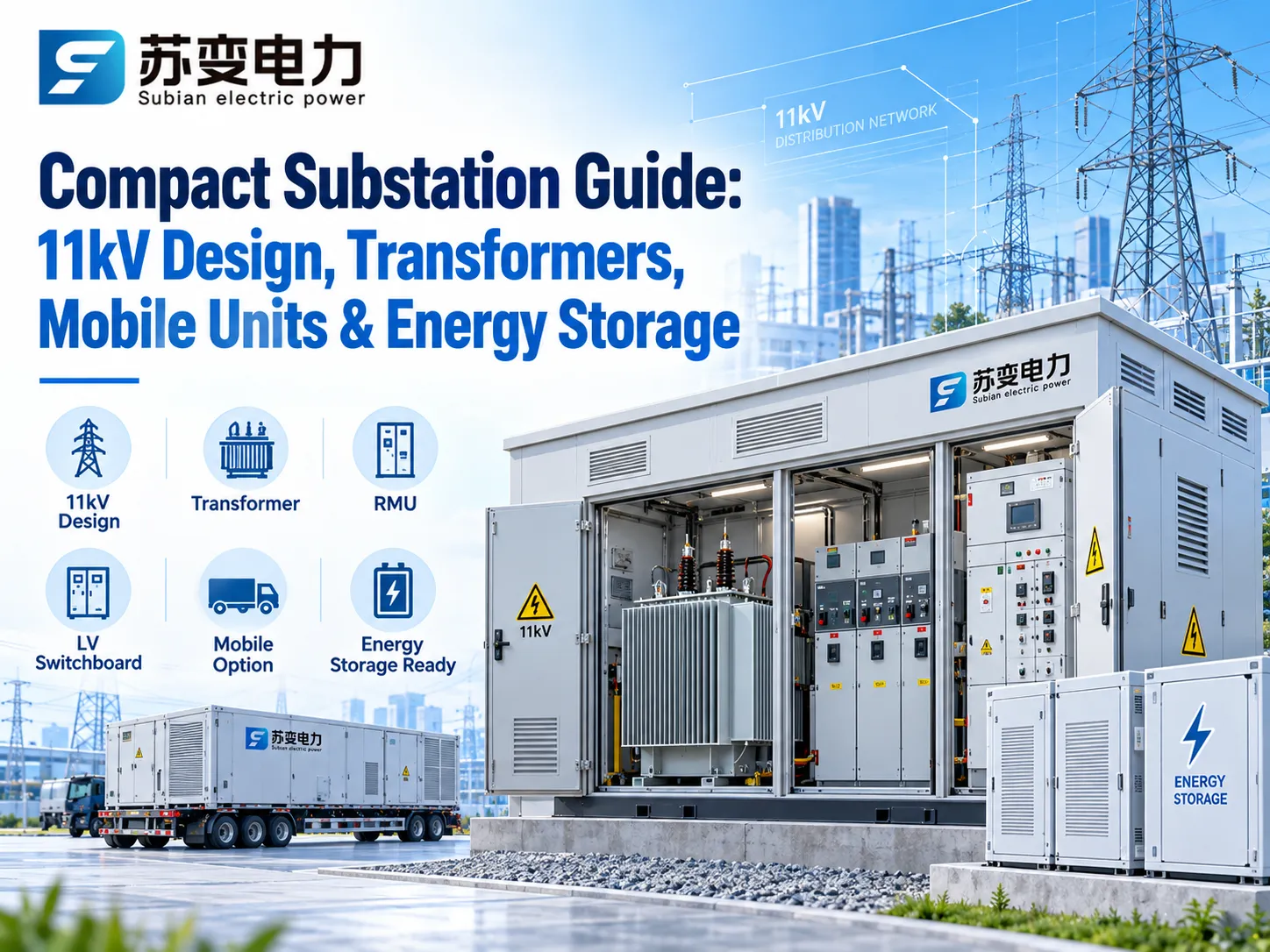
المحطة الفرعية المدمجة هي جهاز كهربائي يمثل تركيبًا موفرًا للمساحة يتكون من عدة عناصر مثل تبديل الجهد المتوسط والحماية، ومحولات التوزيع، وتوزيع الجهد المنخفض والأجهزة المساعدة. يتم بناء معظم التصاميم في المصنع وإرسالها إلى المستخدم النهائي كأكشاك، حاويات أو عناصر معيارية. يُستخدم مصطلح مدمج للدلالة على تصميمه الاقتصادي المفضل، بينما يُستخدم مصطلح مسبق الصنع لوصف نهج المحطة الجاهزة. ومع ذلك، غالبًا ما يتم الخلط بينهما حيث يرتبط كلاهما ارتباطًا وثيقًا بفكرة التوفير في المساحة والمسبقة الصنع.
الهيكل الأساسي لمحطة توزيع الجهد المتوسط/الجهد المنخفض المدمجة البسيطة عادةً ما يتضمن تدفق الطاقة التالي:.
إمداد الجهد المتوسط الوارد → وحدة حلقة الجهد المتوسط أو معدات قواطع الدائرة → محول التوزيع → لوحة المفاتيح الرئيسية للجهد المنخفض → مغذيات الجهد المنخفض الخارجة.
لتطوير مخطط خط واحد (SLD)، من الضروري إضافة مغذيين حلقيين للجهد المتوسط، وحماية المحول، والقياس، ومثبطات الصدمات، والإمدادات المساعدة والمراقبة عن بُعد للنظام. فيما يتعلق بنظام إمداد حلقي، يجب أن تكون بنية RMU متوافقة مع سياسة مزود الشبكة بشأن طرق التبديل والحماية.
مدمج، مسبق الصنع، حزمة وكشك: هل هم نفس الشيء؟.
في الكتالوجات الدولية، تتداخل هذه الأسماء:
ما يعنيه المشترون عادةً
| مصطلح | تمييز مهم | محطة فرعية مدمجة |
|---|---|---|
| محطة توزيع جهد متوسط/جهد منخفض صغيرة الحجم | قد تكون كشكًا، أو دخولًا، أو حزمة متكاملة | محطة فرعية مسبقة الصنع |
| محطة فرعية مسبقة الصنع | محطة تم تجميعها واختبارها في المصنع | يصف طريقة البناء والتسليم |
| محطة فرعية من نوع كشك / صندوق | محطة توزيع مغلقة، عادةً غير قابلة للدخول | تختلف ترتيبات الوصول إلى المشغل والأقسام |
| محطة فرعية حزمة | حزمة مفاتيح ومحولات منسقة في المصنع | قد تكون مغلقة أو مفتوحة، حسب السوق |
| منزل إلكتروني | غرفة كهربائية كبيرة معيارية | غالبًا ما تغطي العديد من المغذيات، والتحكم والمحركات بدلاً من محطة محول مدمجة واحدة |
| محطة فرعية متنقلة | مصممة لإعادة الموقع أو الاستخدام المؤقت | تتطلب اعتبارات النقل والميكانيكية والاتصالات المتكررة |
هذه المصطلحات مهمة في مرحلة الاقتباس. لا ينبغي مقارنة كشك حضري بقدرة 630kVA ومحطة فرعية طارئة مثبتة على مقطورة بقدرة 10MVA كما لو كانت اختلافات في نفس المنتج.
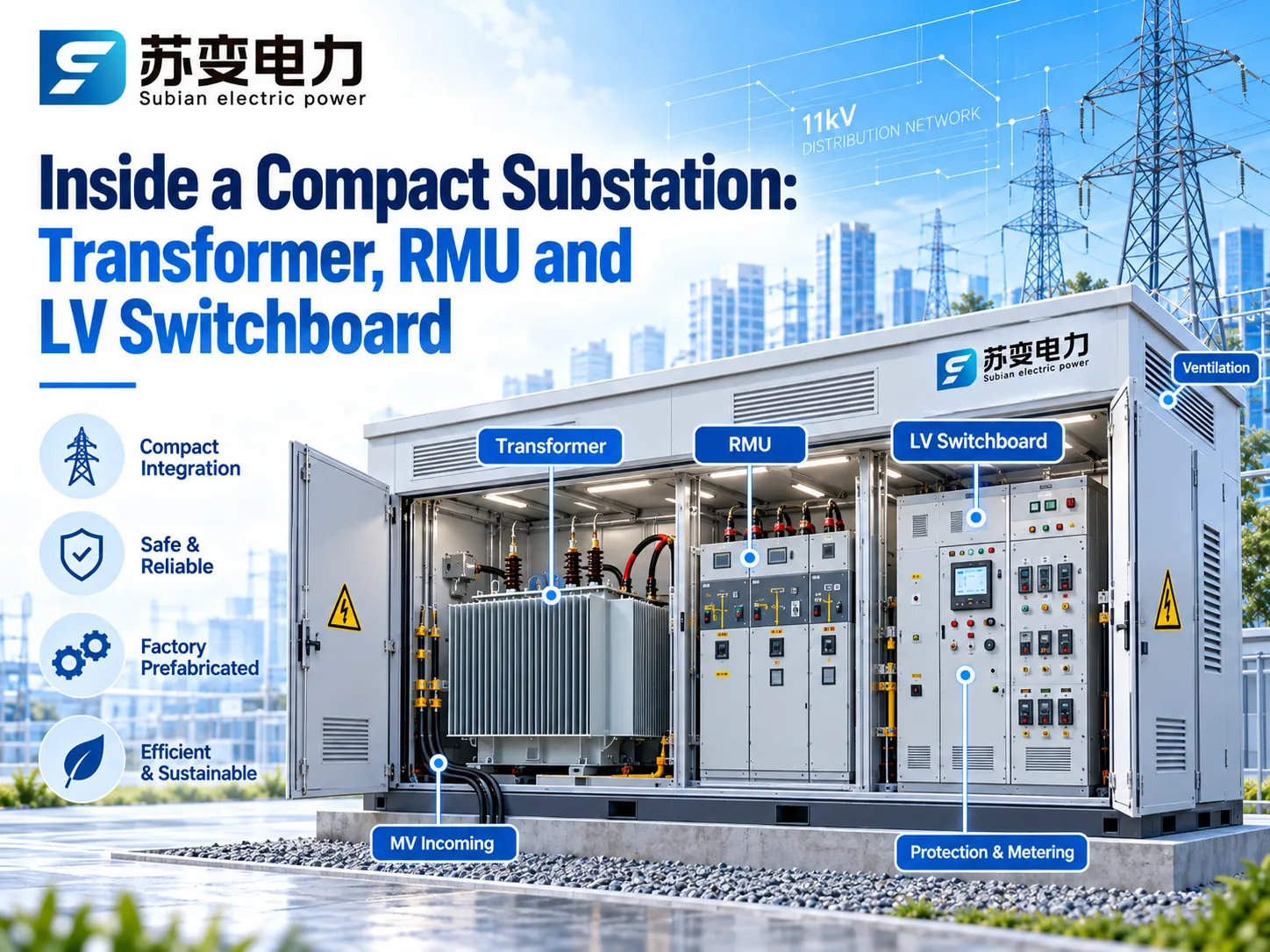
داخل محطة فرعية مدمجة: محول، RMU ولوحة مفاتيح LV
أفضل طريقة لتقييم الحزمة هي فحص وظائفها الكهربائية الثلاث الرئيسية وواجهاتها، وليس مجرد الغلاف الخارجي.
تبديل وحماية الجهد المتوسط
يربط جهاز الجهد المتوسط العقدة بالشبكة السابقة. يقول الكثيرون إن وحدة الحلقة الرئيسية (RMU) تحتوي على مفتاح تحميل داخلي وخارجي مع مغذي محول طاقة مؤمن أو مغذي قاطع دائرة إذا كانت الحماية تتطلب ذلك. يجب أن تكون التكوينات وفقًا لتصنيف الجهد والتيار المستمر، والتيار المحتمل للدوائر القصيرة، ودراسة الحماية، ولوائح تبديل المرافق.
لمعرفات المعلمات ومقارنة النماذج، انظر إلى مواصفات وميزات وحدة الحلقة الرئيسية.
محول محطة فرعية مدمجة: مغمور بالزيت أم نوع جاف؟
الناتج / الأبعاد لـ محول محطة فرعية مدمجة تؤثر على جوانب مهمة من المحطة، مثل الكفاءة، وإدارة الحرارة والخسائر الناتجة عن المحول. تُستخدم أنواع مختلفة من محولات المحطات الفرعية المدمجة المغمورة بالزيت على نطاق واسع؛ بينما تُفضل محولات المحطات الفرعية المدمجة من النوع الجاف في بعض التطبيقات الداخلية أو الحساسة للنيران. يجب أن يعتمد الاختيار على تصنيفات الحريق للموقع، والتهوية المتاحة للتثبيت، ودرجات الحرارة الخارجية، والمتطلبات الصوتية والوصول للصيانة.
يجب تعريف المحول بسعته بالكيلو فولت أمبير، والجهد في الدوائر الأولية والثانوية، والخسائر، والممانعة والمعلمات ذات الصلة الأخرى. يجب أن يكون محيط المحول في وقت التشغيل بحيث يسمح بإزالة الحرارة غير المرغوب فيها الناتجة عن عمل المحول دون مشاكل.
لوحة مفاتيح الجهد المنخفض والتكامل
The LV section comprises the main entry, busbars, outgoing feeders, metering, as well as necessary protection or monitoring. The LV current levels become quite significant in 0.4kV stations along with the increase of the capacity of transformers, which requires to properly match the thermal ratings of the panel with the bus-bar and transformer as well as the load analysis of the location. Prior to agreeing on the layout of the enclosure, it is required to finalize the outgoing feeder program and the cable input scheme.
11kV Compact Substation Specifications: What to Put on the Datasheet
Although the 11kV can serve as a reference for international distribution projects, it should be noted that “11kV” generally refers to the nominal voltage of an MV network. The switchgear used there usually belongs to the 12kV equipment class. At that, the transformer voltage ratio, switchgear insulation level and network requirements should be stated separately as the term “11kV” alone is insufficient as a technical specification.
| المواصفة | What the buyer must define | Why it affects the design |
|---|---|---|
| MV network / equipment class | Nominal 11kV network; suitable 12kV-class equipment | Insulation, switchgear selection and tests |
| LV voltage | Often 0.4kV, but project-specific | Transformer secondary and LV boards |
| سعة المحول | Project load study and future growth, in kVA | Heat, dimensions, losses and cost |
| Network short-circuit level | Prospective fault current and required duration | Switchgear and busbar withstand ratings |
| MV configuration | Ring feed, radial feed, fuse or circuit breaker | Continuity, switching and protection |
| Transformer details | Oil or dry type, losses, impedance, vector group | Efficiency, thermal and fault performance |
| Enclosure and access | Non-walk-in / walk-in, IP rating, doors and clearances | Maintenance and personnel safety |
| Operating conditions | Ambient temperature, altitude, pollution, corrosion exposure | Cooling, derating and materials |
| Test evidence | Type tests for relevant complete assembly and routine tests | Compliance and project acceptance |
For instance, but without implying universality: A certain EPC contractor shall provide an 11-0.4 kV 630 kVA unit with built-in MV RMU, distribution transformer as well as an LV panel at 400 V. Actual value for current capacity, short-circuit impulse ratings, dimensions and internal arc class of this particular solution shall follow its design and system studies, which might be the source of different values from those mentioned in this example.
In case of 20 kV power distribution network the choice of equipment is taken from 24 kV category, for a 33 kV network – from 36 kV equipment while meeting requirements of insulation used in a power system. Subian also maintains a dedicated 33kV compact substation product and procurement page for higher-voltage projects.
Compact Mobile Substation vs Fixed Compact Substation
It is necessary to consider the search phrase “compact mobile substation” separately due to the fact that its service conditions can vary considerably from those of the permanent compact kiosk.
A compact substation is usually installed at the site on a prepared base and used as a lasting installation after being supplied there, put on foundations, connected, commissioned and tested on-site. A mobile substation is designed to be transported (possibly on a trailer or skid), secured, connected quickly, re-commissioned and grounded multiple times.
| Decision point | Fixed compact substation | Compact mobile / transportable substation |
|---|---|---|
| الاستخدام الأساسي | Permanent distribution | Temporary supply, planned works, emergency response |
| Mechanical design | Foundation and long-term outdoor service | Transport restraints and repeated movement |
| Connections | Normally permanent cable terminations | Accessible, repeatable connection scheme as specified |
| التركيب | Site foundation, cable and earth works | Faster redeployment is possible when engineered for it |
| Typical constraint | Footprint, access, network approval | Road transport, lifting, vibration and setup procedures |
A mobile option is mentioned on Subian’s YB Series Prefabricated Substation product page. The user must confirm whether the specification of the offer indicates that it is just a relocatable modular unit or designed as a trailer/skid unit for repeated deployments at an operational site. It should not be taken for granted that the term “mobile” conveys all the necessary capabilities.
Energy Storage Compact Substation: What Changes for BESS?
A battery energy-storage system is usually connected to the medium-voltage electric grid using a power converter and a step-up transformer. There is a possibility of combining the transformer, medium-voltage switchgear, and the required low voltage/auxiliary switching in a compact energy storage substation close to the battery and power converter installations. The battery frames themselves don’t have to be installed in the substation.
The electrical route can be illustrated as follows:
Battery frames (DC) ↔ Power converter/inverter (AC) ↔ step-up transformer ↔ medium-voltage switchgear ↔ power network.
Four aspects should be stressed:
1. Power converter output and voltage ratios – the transformer should be tailored to the converter’s output voltage and to the medium-voltage grid to which it is connected. They are project-related and cannot be treated as the same as a regular 11/0.4 kV load connection.
2. The bidirectionality and cyclicness of the operation – as a BESS can provide both charging and discharging, there should be specified the transformer requirements depending on the expected load matrix, temperature increase, and thermal cycling.
3. Considering harmonics, grounding, and protection – the converter features, harmonics and fault-current profiles, as well as grid-code requirements influence the transformer design and protection coordination.
4. Safety and approval at a site level – there are such aspects as BESS fire safety, inverter certification, utility approval, and compact substation compliance. They should be handled separately since IEC conformity of one element does not mean that the whole project is compliant.
As a separate example, a YBM-35/0.8 Photovoltaic Step-Up Substation is mentioned by Subian. This product is an example of renewable-energy step-up equipment, but it does not mean that the particular BESS PCSs have been verified for this design. The BESS buyers should obtain engineering confirmation about the type of the converter.
Compact Substation Design Checklist: IEC Standards and Safety
The central standard for many enclosed AC prefabricated substations is IEC 62271-202:2022. The specifications specify the service conditions, rated parameters, design, and verification of appropriate modular substations connected to AC systems having parameters not exceeding or equal to 52kV. The standards being used and their editions must be verified in relation to the project and local requirements.
Serious tenders must provide the entire set of equipment and not only certificates for single units:
IEC 62271-202: type tests and operational characteristics of a given prefabricated substation consisting of appropriate enclosure/temperature and internal arc parameters.
IEC 62271-200 with relevant components: MV enclosure-based switchgear and its switching function.
IEC 60076 series: tests and requirements for electrical and thermal parameters of transformers.
IEC 61439 series: LV switchgear and control gear assemblies.
IEC 60529: levels of protection by means of enclosure.
Just because the switchgear is type-tested does not mean a complete assembly is type-tested; you must inquire whether the layout you receive is covered by the type testing of the assembly or if some modifications exclude its use without additional testing.
Internal arc, ventilation and access
Verify which parts of the enclosure can be accessed, the internal arc classification if applicable, and the arc duration and current. You should measure the prospective fault current with respect to your choice of configuration. Ventilation of the enclosure is very important as insufficient cooling may lead to transformer derating while the nameplate says otherwise. You should also make sure that the access to circuit breaker handles, grounding points, low-voltage breakers, and equipment replacement pathways is in fact possible.
Does IEC compliance guarantee utility approval?
No. The project authorities are allowed to implement controlled vendor list, requirements of local installations, grounding rules and documentation. This is essential when purchasing plants abroad. Before completing the design, you should inquire about the specifications of the electric utility of the target country.
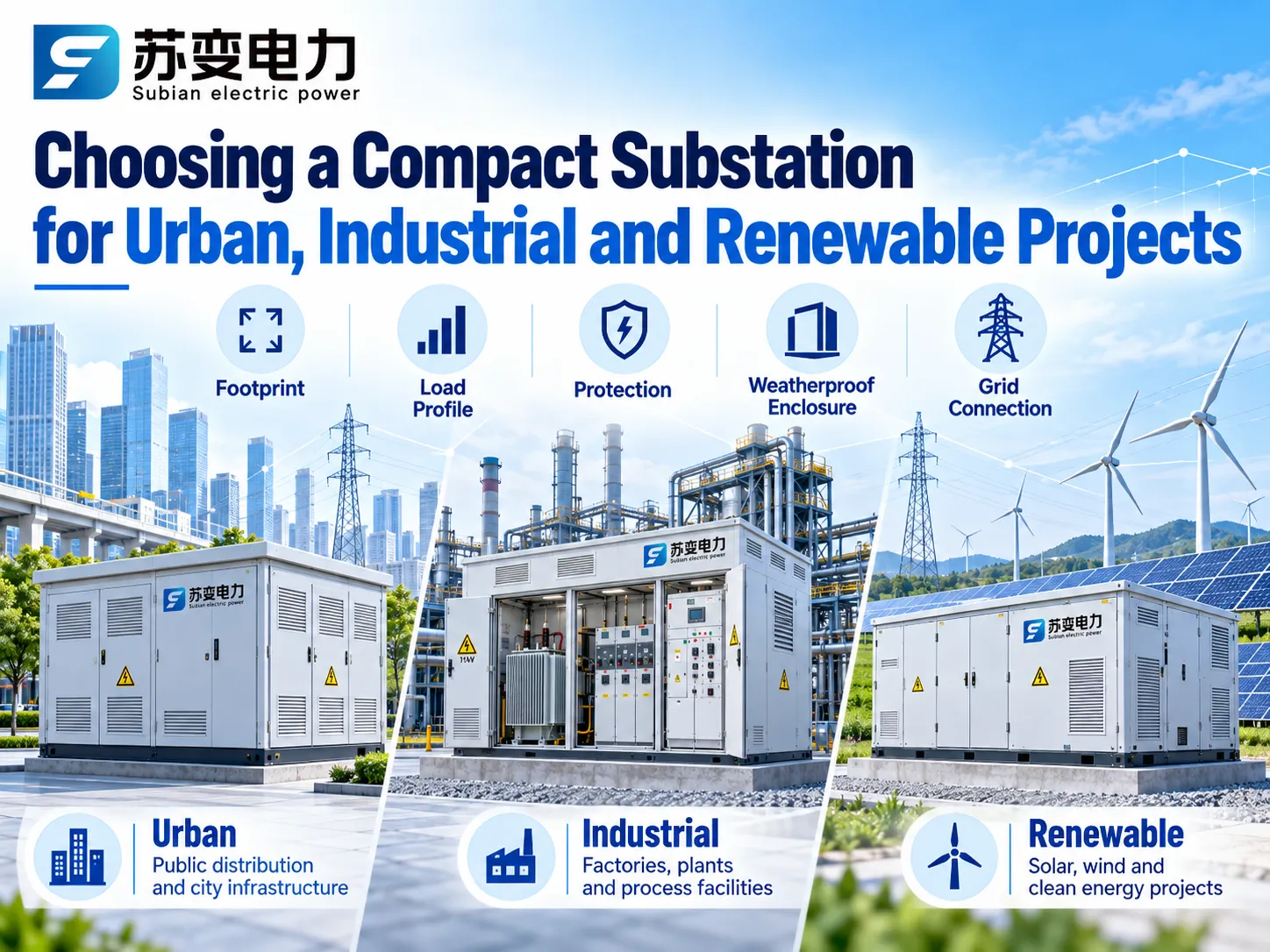
Choosing a Compact Substation for Urban, Industrial and Renewable Projects
Compact does not mean there is one preferred arrangement for every application.
| التطبيق | Common design priority | Typical option to evaluate |
|---|---|---|
| التوزيع الحضري | Small footprint, access control, quiet operation | Enclosed kiosk with integrated MV/LV functions |
| Industrial factory | Load growth, protection grading, maintenance access | Customized YB-style MV/LV station |
| Construction / temporary supply | Deployment and relocation | Purpose-engineered mobile or modular station |
| Solar power generation | Inverter output and MV grid connection | Step-up transformer station with MV protection |
| Battery energy storage | PCS compatibility and bidirectional power flow | Converter-specific compact step-up station |
| Commercial development | 11kV network compatibility, capacity and LV feeders | 11/0.4kV package/substation, utility-approved |
You should define the electrical job before asking for an estimate. The box type needs to be based on the one-line diagram, the load to be handled, and maintenance requirements rather than on appearance.
Comparing Compact Substation Suppliers: Technical Evidence Before Price
When a purchaser is comparing a locally operating company, a big global corporation and a manufacturer located in China, this comparison must be much more precise than a general statement about one country’s equipment being less expensive than others. The best way to make a correct comparison is to compare specification ratings, types of protection measures, compliance with international standards, and origin and documents for component elements supplied.
The RFQ should include full;
1. Destination of the shipment, country of network operators and application on the site.
2. Single line diagram, MV voltage, LV voltage, and frequency.
3. Transfomer kVA/MVA rating, impedance, losses, cooling, and type of winding preferred.
4. Available fault current, protection philosophy, and arrangement of RMU/switchgear.
5. Enclosure materials, ingress protection, dimensions, climate conditions, and requirements for access.
6. Internal arc, and requirements for enclosure class if applicable.
7. Required IEC/EN/GB standards and their editions for tests/reports.
8. Locations for cable entries, drawings, installation, and transportation provisions.
9. FAT content, language, warranty, Incoterms, and start-up services.
For European sourcing comparisons, read أي من موردي المحطات الفرعية الجاهزة في أوروبا يجب أن تقارنهم في 2026؟, which separately discusses Schneider Electric, Siemens, Ormazabal, ZPUE, Efacec and Lucy Electric. This article is not a manufacturer ranking; its purpose is the compact substation design and buying decision.
Compact Substations from Subian Electric
Subian Electric’s YB Series Prefabricated Substation integrates MV switchgear, a distribution transformer and LV equipment in an enclosed factory-assembled design. The product page presents a standard 10/0.4kV configuration and broader customizable voltage and capacity options. Exact availability, dimensions, switchgear duty, IP rating and test documentation must be confirmed against the quotation for the chosen configuration.
Where the application calls for an integrated American-style arrangement, the ZGS Series Combined Substation is a separate product family. Solar step-up applications can be discussed against the YBM series, while more specialized 33kV projects should be evaluated against the corresponding 33kV substation information.
Subian’s value proposition is a coordinated quotation for transformer, MV switching and LV distribution in one package, with OEM/ODM configuration and factory documentation arranged for the project. This does not imply that every configuration is already type-tested or pre-approved by every network operator; those requirements must be checked before purchase.
Planning a compact substation project? Contact Subian Electric with your SLD, network voltage, transformer capacity, site conditions and destination country to request drawings, an equipment schedule, applicable test evidence and a factory quotation.
الأسئلة الشائعة
What is a compact substation?
In compact substation technology, there is a necessity for the combination of various elements that can be used in the electrical sector of generation and distribution of power. Compact substations include among other mentioned components, transformers and equipment for switching MV systems. A number of compact substations are manufactured as prefabricated modules.
What are the four types of substations?
There is no common classification system based on the four types because you can classify substations according to their functionality; voltage; construction/design and equipment installation. Examples of functional classification are transmission, distribution, switching and converter substations. A compact substation is more of a design of distribution substations rather than a separate voltage category.
How much does a small substation cost?
A small compact substation cannot have one particular price because price is influenced by the incoming voltage and fault level, transformer capacity and type, configuration of RMU and LV distribution board, quality of enclosure, internal arc considerations, testing, transportation and commissioning costs. Compare suppliers by using the same equipment list and delivery terms. In order to obtain the project-specific price, please give information about the voltage in the network (11kV, etc.), transformer kVA, and provide the diagram and destination country.
What is a mini substation used for?
Mini substations are often applied in the distribution of power in residential estates, limited commercial areas, manufacturing plants and EV-charging sites that require smaller-sized substations. They perform a function of reducing medium voltage to the required low voltage, however in renewable-energy or temporary situations additional engineering should be applied as the ordinary mini kiosk cannot be considered a mobile or BESS-ready substation.
What is the difference between a compact substation and a prefabricated substation?
“Compact” emphasizes the small footprint; “prefabricated” emphasizes factory assembly and testing. Many designs are both. Neither term alone proves that the station is mobile.
What specifications are important for an 11kV compact substation?
Confirm the 11kV network rating, matching 12kV equipment class, transformer voltage ratio and capacity, LV feeders, fault level, protection, enclosure, thermal design, standards and test documentation.
Is a compact mobile substation the same as a kiosk substation?
Not always true. A mobile unit is built to be moved to different places but a kiosk is a kind of enclosure that essentially implies a permanent placement. A factory-made kiosk is designed to be mobile but it does not mean that it can move around.
What is a compact substation transformer?
It is the power transformer integrated into a compact station. Its rated voltage, capacity, losses, thermal performance, cooling and physical dimensions must be coordinated with the enclosure, MV protection and LV distribution system.
Can a compact substation be used with battery energy storage?
Yes, if it is engineered around the battery PCS and grid connection. Transformer duty, bidirectional power, harmonic effects, protection and approval requirements must be verified for the specific BESS configuration.
Which IEC standard covers prefabricated compact substations?
IEC 62271-202:2022 is the principal assembly standard for enclosed AC prefabricated substations. The relevant transformer and MV switchgear and LV assembly standards are additional specifications rather than alternatives to the overall verification of the station.
Can I order a customized compact substation from China?
Yes. Provide the producer with the network specifics, a single-line diagram, load analysis, fault level, environmental factors, and target specifications. Ensure that the precise specified design, corresponding type-test proof, and local network permission are verified prior to placing the order.
المراجع
- IEC 62271-202:2022 — Prefabricated substations (official IEC publication)
- Subian YB Series Prefabricated Substation — product data
- Subian 33kV Substation — product and procurement page
- Hitachi Energy — Mobile Substations
الخاتمة
A compact substation is an efficient choice when the complete MV/LV distribution arrangement fits the site’s electrical and physical constraints. Select it by transformer capacity, voltage ratio, fault withstand, thermal performance, access, and documented testing—not by enclosure size alone. Mobile and BESS installations introduce additional requirements that must be engineered and verified separately.
For a specification-based quotation, review Subian’s YB Series Prefabricated Substation و send your single-line diagram and project requirements to the engineering team.