


컴팩트 변전소 중전압 공급 설치에 필요한 모든 구성 요소가 포함되어 있습니다. 프로젝트 계획자는 변압기 장비를 별도로 구매하고 싶어할 수 있지만, 공장에서 제작된 컴팩트 변전소는 고객 사양을 충족하기 위해 전체 장비 조달을 처리합니다.
그러나 정의가 처음에는 너무 좁게 보일 수 있습니다. 구매에 관심이 있는 사람들은 11kV 컴팩트 변전소 고정된 MV/LV 배전 시스템에 접근하고자 합니다. 컴팩트 이동식 변전소 원격 지역에서 또는 긴급 전력 공급 사이트로 이동할 때 사용할 필요가 있을 수 있습니다. 에너지 저장을 위한 컴팩트 변전소는 에너지 변환을 위한 배터리가 프로젝트에 포함되기 때문에 특별한 요소가 필요합니다.
이 개요는 컴팩트 변전소의 기술적 차이점, 요청해야 할 사양 및 EPC 회사, 유틸리티 및 개발자의 제안에서 차이를 식별하는 데 도움이 될 수 있는 질문을 제시합니다.
요약하자면: 컴팩트 변전소는 중전압 스위칭, 배전 변압기 및 저전압 배전을 공간 친화적이고 종종 조립식 장치로 통합합니다. 11 kV 시스템을 주문할 때 구매자는 변압기의 전력 용량, 네트워크의 고장 수준, 보호, 환기 및 조립에 대한 테스트 요구 사항에 주의해야 합니다. 컴팩트 키오스크는 단순히 컴팩트하다는 이유만으로 특정 조건에서 작동에 적합하다고 간주될 수 없습니다.
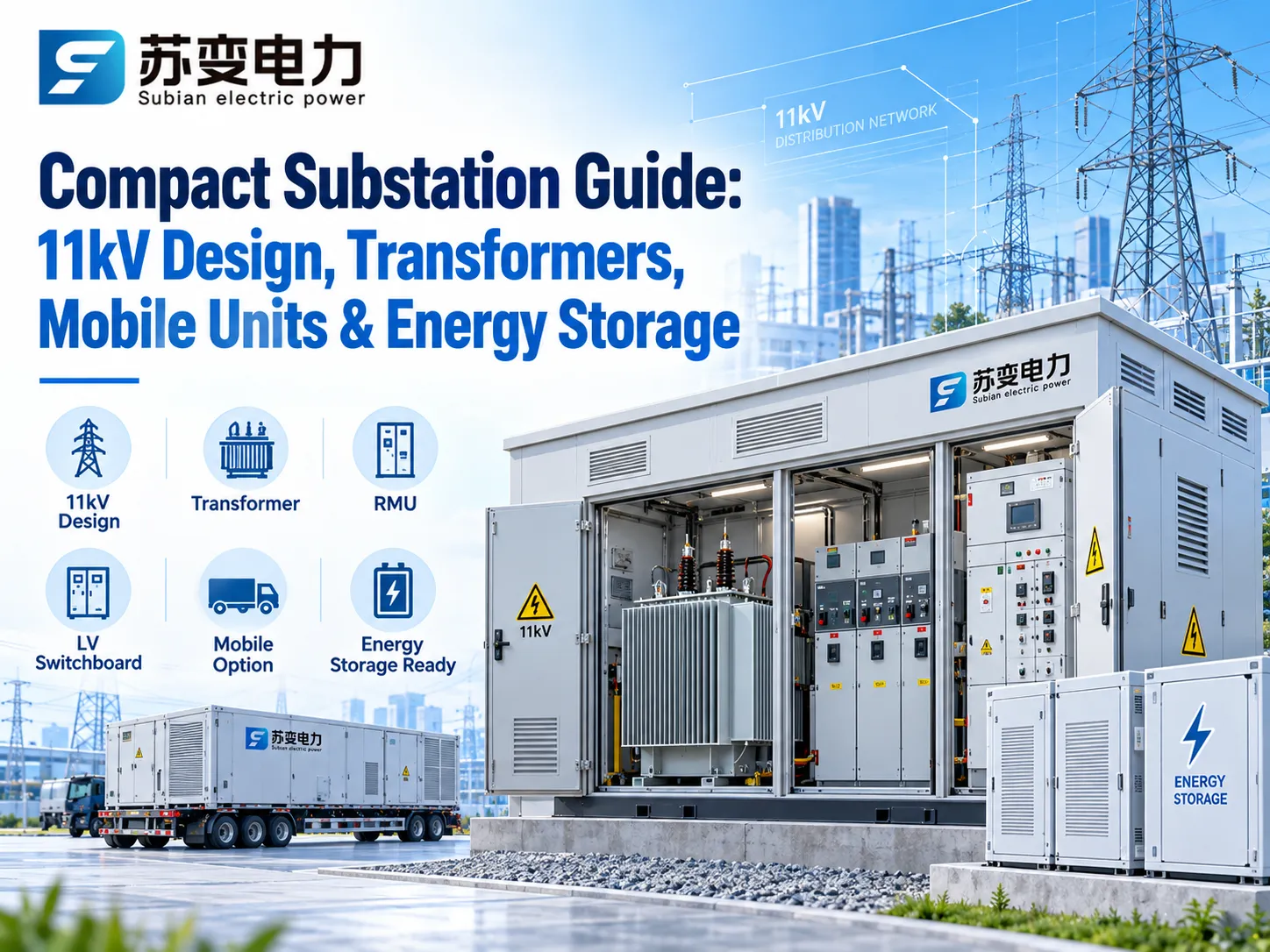
컴팩트 변전소란 무엇인가요?
컴팩트 변전소는 MV 스위칭 및 보호, 배전 변압기, LV 배전 및 부속 장치와 같은 여러 요소로 구성된 공간 절약형 설치의 전기 장치입니다. 대부분의 설계는 공장에서 제작되어 최종 사용자에게 키오스크, 컨테이너 또는 모듈형 항목으로 전송됩니다. 컴팩트라는 용어는 경제적으로 유리한 설계를 나타내기 위해 사용되며, 조립식이라는 용어는 완제품 변전소 접근 방식을 설명하는 데 사용됩니다. 그러나 두 용어는 모두 컴팩트함과 조립식의 개념과 밀접하게 관련되어 있기 때문에 종종 혼동됩니다.
간단한 컴팩트 MV/LV 배전 변전소의 기본 구조는 일반적으로 다음과 같은 전력 공급 흐름을 포함합니다:
MV 입력 공급 → MV 링 유닛 또는 차단기 스위치기어 → 배전 변압기 → LV 주 배전반 → 나가는 LV 피더.
단선도(SLD)를 개발하기 위해서는 두 개의 MV 링 피더, 변압기 보호, 계량, 서지 억제기, 보조 전원 및 시스템의 원격 모니터링을 추가해야 합니다. 링 공급 시스템과 관련하여 RMU의 구조는 스위칭 및 보호 방법에 대한 네트워크 제공자의 정책과 호환되어야 합니다.
컴팩트, 조립식, 패키지 및 키오스크: 같은 것인가요?
국제 카탈로그에서 이러한 이름은 겹칩니다:
| 조건 | 구매자가 일반적으로 의미하는 것 | 중요한 구분 |
|---|---|---|
| 컴팩트 변전소 | 소형 MV/LV 배전소 | 키오스크, 워크인 또는 통합 패키지일 수 있습니다. |
| 조립식 변전소 | 공장에서 조립 및 테스트된 변전소 | 건설 및 배송 방법 설명 |
| 키오스크 / 박스형 변전소 | 밀폐형, 일반적으로 비보행형 배전소 | 운영자 접근 및 구획 배치가 다양함 |
| 패키지 변전소 | 공장에서 조정된 스위치기어 및 변압기 패키지 | 시장에 따라 밀폐형 또는 개방형일 수 있음 |
| E-하우스 | 대형 모듈형 전기실 | 종종 하나의 컴팩트 변압기 변전소보다 여러 피더, 제어 및 드라이브를 포함함 |
| 이동식 변전소 | 재배치 또는 임시 용도로 설계됨 | 운송, 기계적 및 반복 연결 고려 사항이 필요함 |
이 용어는 견적 단계에서 중요합니다. 630kVA 도시 키오스크와 10MVA 트레일러 장착 비상 변전소는 동일한 제품의 변형으로 비교해서는 안 됩니다.
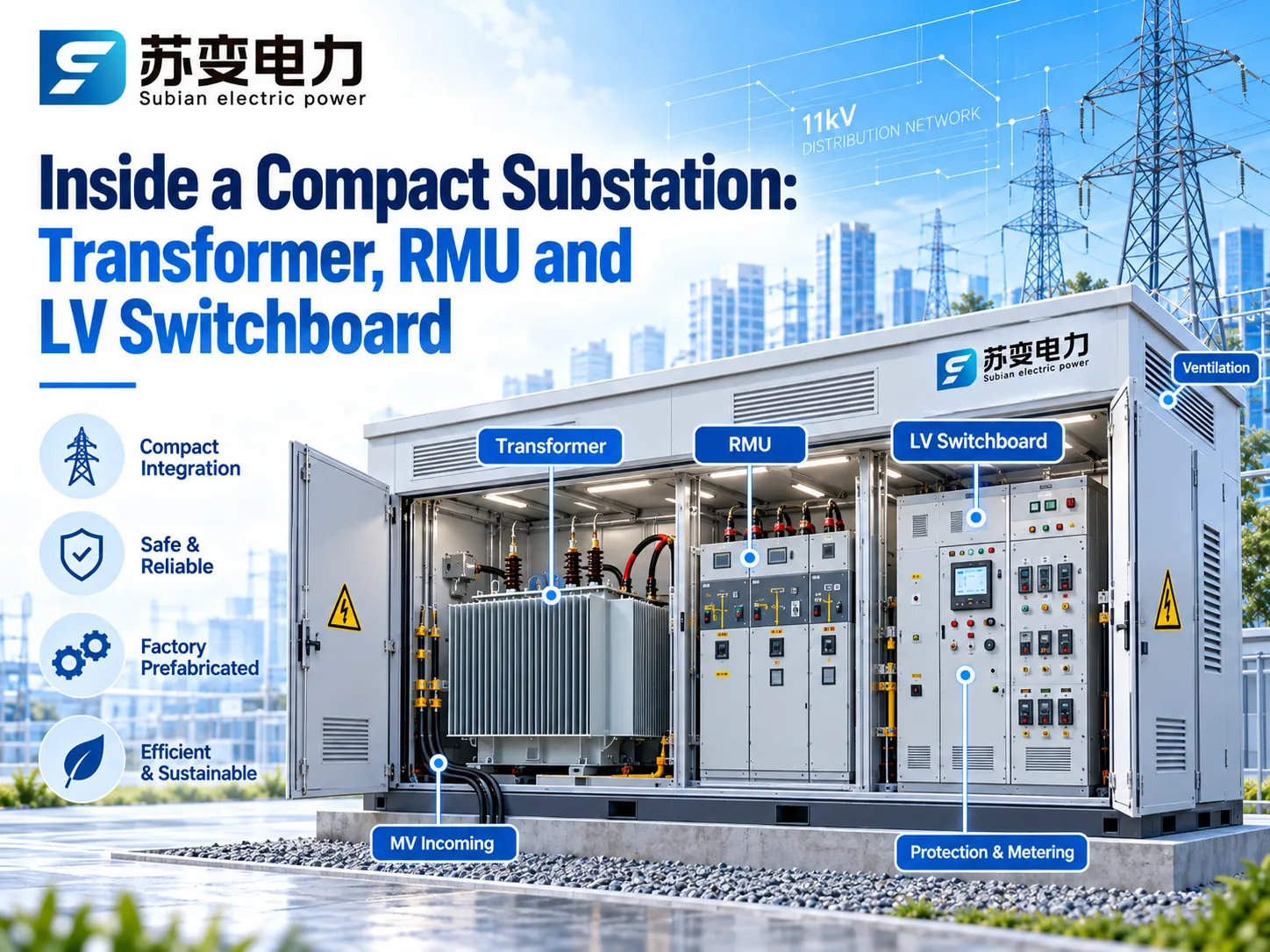
컴팩트 변전소 내부: 변압기, RMU 및 LV 스위치보드
패키지를 평가하는 가장 좋은 방법은 외부 인클로저가 아니라 세 가지 주요 전기 기능과 그 인터페이스를 검사하는 것입니다.
중전압 스위칭 및 보호
MV 장치는 노드를 이전 네트워크에 연결합니다. 일반적으로 링 메인 유닛(RMU)은 들어오는 및 나가는 부하 차단 스위치와 함께 보안된 전력 변압기 피더 또는 보호가 필요한 경우 회로 차단기 피더를 갖추고 있습니다. 구성은 전압 등급 및 연속 전류, 예상 단락 전류, 보호 연구 및 유틸리티 스위칭 규정에 따라야 합니다.
매개변수 정의 및 모델 비교는 Subian의 링 메인 유닛 사양 및 특징을 참조하십시오..
컴팩트 변전소 변압기: 오일 침지형 또는 건식형?
컴팩트 변전소 변압기의 출력/치수 변전소의 중요한 측면에 영향을 미침, 예를 들어 효율성, 온도 관리 및 변압기로 인한 손실. 다양한 유형의 오일 침지형 컴팩트 변전소 변압기가 널리 사용되며, 건식형 컴팩트 변전소 변압기는 일부 실내 또는 화재 민감한 응용 프로그램에 설치하는 것이 선호됩니다. 선택은 현장의 화재 분류, 설치의 가용 환기, 외부 온도, 소음 요구 사항 및 유지보수 접근성에 따라 달라져야 합니다. 변압기는 kVA 단위의 용량, 1차 및 2차 회로의 전압, 손실, 임피던스 및 기타 관련 매개변수로 정의되어야 합니다. 변압기 작동 시 주변 환경은 변압기의 작업으로 인해 발생하는 원치 않는 열을 문제 없이 추출할 수 있도록 해야 합니다.
저전압 스위치보드 및 통합.
저전압 스위치보드 및 통합
LV 섹션은 주요 진입로, 버스바, 출구 피더, 계량 및 필요한 보호 또는 모니터링으로 구성됩니다. LV 전류 수준은 0.4kV 변전소에서 상당히 중요해지며, 이는 변압기의 용량 증가와 함께 패널의 열 정격을 버스바 및 변압기와 적절히 일치시켜야 하며, 위치의 부하 분석이 필요합니다. 인클로저의 레이아웃에 동의하기 전에 출구 피더 프로그램과 케이블 입력 계획을 최종 확정해야 합니다.
11kV 컴팩트 변전소 사양: 데이터 시트에 포함할 내용
비록 11kV 컴팩트 변전소 국제 배급 프로젝트의 참고 자료로 사용될 수 있지만, “11kV”는 일반적으로 MV 네트워크의 명목 전압을 나타낸다는 점에 유의해야 합니다. 그곳에서 사용되는 스위치기어는 보통 12kV 장비 클래스에 속합니다.. 이때 변압기 전압 비율, 스위치기어 절연 수준 및 네트워크 요구 사항은 “11kV”라는 용어만으로는 기술 사양으로는 불충분하므로 별도로 명시해야 합니다.
| 사양 | 구매자가 정의해야 할 사항 | 설계에 미치는 영향 |
|---|---|---|
| MV 네트워크 / 장비 클래스 | 명목 11kV 네트워크; 적합한 12kV 클래스 장비 | 절연, 스위치기어 선택 및 테스트 |
| LV 전압 | 종종 0.4kV, 그러나 프로젝트에 따라 다름 | 변압기 2차 및 LV 패널 |
| 변압기 용량 | 프로젝트 부하 연구 및 향후 성장, kVA 단위 | 열, 치수, 손실 및 비용 |
| 네트워크 단락 수준 | 예상 고장 전류 및 필요한 지속 시간 | 스위치기어 및 버스바 내구성 등급 |
| MV 구성 | 링 피드, 방사형 피드, 퓨즈 또는 회로 차단기 | 연속성, 스위칭 및 보호 |
| 변압기 세부 사항 | 오일 또는 건식 유형, 손실, 임피던스, 벡터 그룹 | 효율성, 열 및 고장 성능 |
| 인클로저 및 접근 | 비보행형 / 보행형, IP 등급, 문 및 간격 | 유지보수 및 인원 안전 |
| 작동 조건 | 주변 온도, 고도, 오염, 부식 노출 | 냉각, 감량 및 재료 |
| 테스트 증거 | 관련 완전 조립에 대한 유형 테스트 및 일상 테스트 | 준수 및 프로젝트 수용 |
예를 들어, 그러나 보편성을 암시하지 않음: 특정 EPC 계약자는 내장된 MV RMU, 배급 변압기 및 400V의 LV 패널이 포함된 11-0.4 kV 630 kVA 유닛을 제공해야 합니다. 이 특정 솔루션의 실제 전류 용량, 단락 임펄스 등급, 치수 및 내부 아크 클래스 값은 설계 및 시스템 연구에 따라 달라질 수 있으며, 이는 이 예에서 언급된 값과 다를 수 있습니다.
20 kV 전력 배급 네트워크의 경우 장비 선택은 24 kV 카테고리에서 이루어지며, 33 kV 네트워크의 경우 – 36 kV 장비에서 이루어지며 전력 시스템에서 사용되는 절연 요구 사항을 충족해야 합니다. Subian은 또한 전압이 높은 프로젝트를 위한 전용 33kV 컴팩트 변전소 제품 및 조달 페이지를 유지합니다. 고전압 프로젝트를 위한.
컴팩트 모바일 변전소 대 고정형 컴팩트 변전소
“컴팩트 모바일 변전소"라는 검색어를 별도로 고려해야 합니다.” 별도로 고려해야 하는 이유는 서비스 조건이 영구적인 컴팩트 키오스크의 조건과 상당히 다를 수 있기 때문입니다.
컴팩트 변전소는 일반적으로 준비된 기초 위에 설치되며, 공급된 후 기초에 놓이고, 연결되고, 현장에서 시운전 및 테스트를 거쳐 지속적인 설치로 사용됩니다. 모바일 변전소는 운반(트레일러나 스키드에 가능)할 수 있도록 설계되었으며, 빠르게 고정되고 연결되며, 여러 번 재시운전 및 접지될 수 있습니다.
| 결정 지점 | 고정형 컴팩트 변전소 | 컴팩트 모바일 / 이동식 변전소 |
|---|---|---|
| 주요 용도 | 영구 배전 | 임시 공급, 계획된 작업, 비상 대응 |
| 기계적 설계 | Foundation and long-term outdoor service | Transport restraints and repeated movement |
| Connections | Normally permanent cable terminations | Accessible, repeatable connection scheme as specified |
| 설치 | Site foundation, cable and earth works | Faster redeployment is possible when engineered for it |
| Typical constraint | Footprint, access, network approval | Road transport, lifting, vibration and setup procedures |
A mobile option is mentioned on Subian’s YB Series Prefabricated Substation product page. The user must confirm whether the specification of the offer indicates that it is just a relocatable modular unit or designed as a trailer/skid unit for repeated deployments at an operational site. It should not be taken for granted that the term “mobile” conveys all the necessary capabilities.
Energy Storage Compact Substation: What Changes for BESS?
A battery energy-storage system is usually connected to the medium-voltage electric grid using a power converter and a step-up transformer. There is a possibility of combining the transformer, medium-voltage switchgear, and the required low voltage/auxiliary switching in a compact energy storage substation close to the battery and power converter installations. The battery frames themselves don’t have to be installed in the substation.
The electrical route can be illustrated as follows:
Battery frames (DC) ↔ Power converter/inverter (AC) ↔ step-up transformer ↔ medium-voltage switchgear ↔ power network.
Four aspects should be stressed:
1. Power converter output and voltage ratios – the transformer should be tailored to the converter’s output voltage and to the medium-voltage grid to which it is connected. They are project-related and cannot be treated as the same as a regular 11/0.4 kV load connection.
2. The bidirectionality and cyclicness of the operation – as a BESS can provide both charging and discharging, there should be specified the transformer requirements depending on the expected load matrix, temperature increase, and thermal cycling.
3. Considering harmonics, grounding, and protection – the converter features, harmonics and fault-current profiles, as well as grid-code requirements influence the transformer design and protection coordination.
4. Safety and approval at a site level – there are such aspects as BESS fire safety, inverter certification, utility approval, and compact substation compliance. They should be handled separately since IEC conformity of one element does not mean that the whole project is compliant.
As a separate example, a YBM-35/0.8 Photovoltaic Step-Up Substation is mentioned by Subian. This product is an example of renewable-energy step-up equipment, but it does not mean that the particular BESS PCSs have been verified for this design. The BESS buyers should obtain engineering confirmation about the type of the converter.
Compact Substation Design Checklist: IEC Standards and Safety
The central standard for many enclosed AC prefabricated substations is IEC 62271-202:2022. The specifications specify the service conditions, rated parameters, design, and verification of appropriate modular substations connected to AC systems having parameters not exceeding or equal to 52kV. The standards being used and their editions must be verified in relation to the project and local requirements.
Serious tenders must provide the entire set of equipment and not only certificates for single units:
IEC 62271-202: type tests and operational characteristics of a given prefabricated substation consisting of appropriate enclosure/temperature and internal arc parameters.
IEC 62271-200 with relevant components: MV enclosure-based switchgear and its switching function.
IEC 60076 series: tests and requirements for electrical and thermal parameters of transformers.
IEC 61439 series: LV switchgear and control gear assemblies.
IEC 60529: levels of protection by means of enclosure.
Just because the switchgear is type-tested does not mean a complete assembly is type-tested; you must inquire whether the layout you receive is covered by the type testing of the assembly or if some modifications exclude its use without additional testing.
Internal arc, ventilation and access
Verify which parts of the enclosure can be accessed, the internal arc classification if applicable, and the arc duration and current. You should measure the prospective fault current with respect to your choice of configuration. Ventilation of the enclosure is very important as insufficient cooling may lead to transformer derating while the nameplate says otherwise. You should also make sure that the access to circuit breaker handles, grounding points, low-voltage breakers, and equipment replacement pathways is in fact possible.
Does IEC compliance guarantee utility approval?
No. The project authorities are allowed to implement controlled vendor list, requirements of local installations, grounding rules and documentation. This is essential when purchasing plants abroad. Before completing the design, you should inquire about the specifications of the electric utility of the target country.
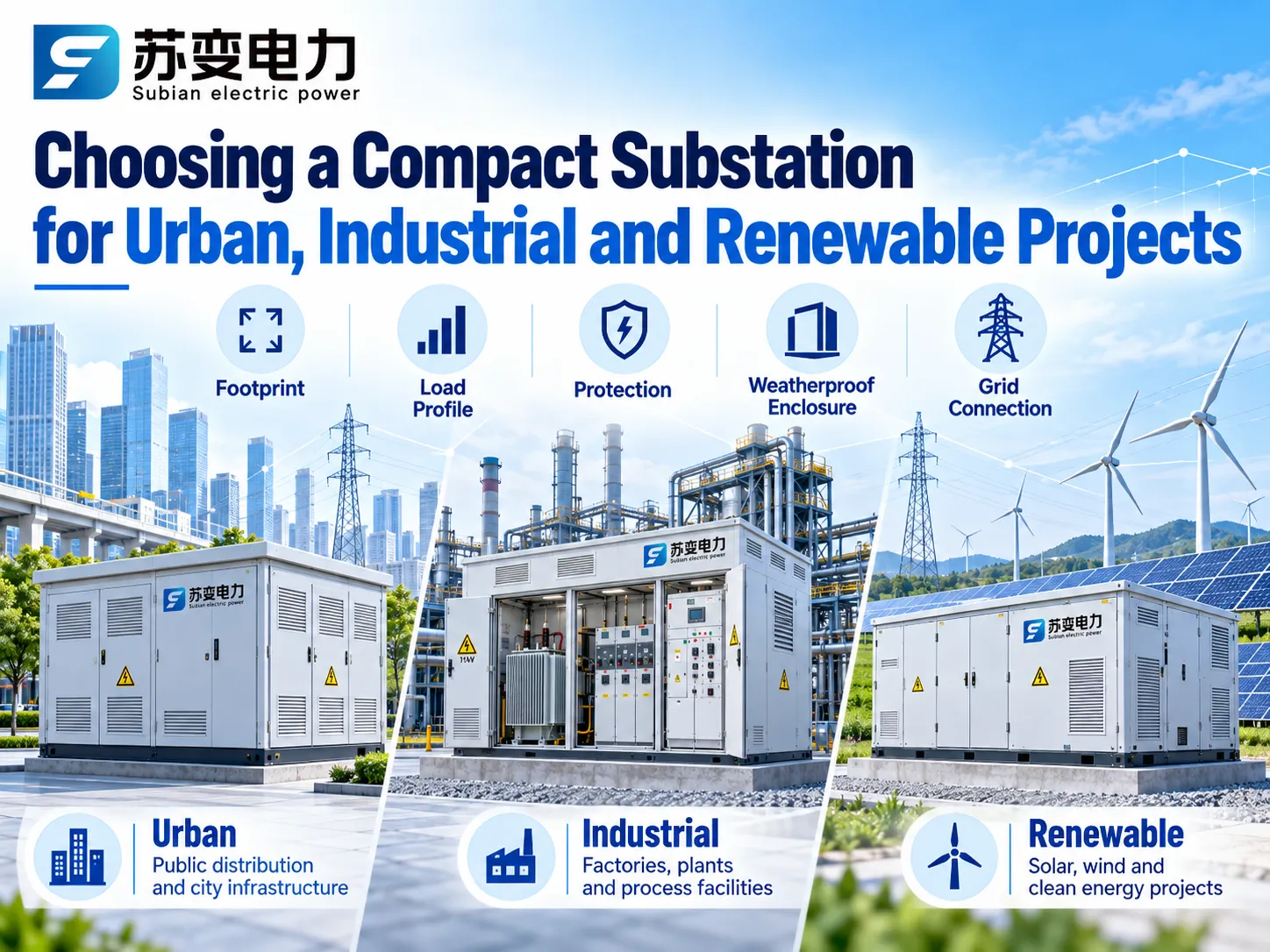
Choosing a Compact Substation for Urban, Industrial and Renewable Projects
Compact does not mean there is one preferred arrangement for every application.
| 응용 | Common design priority | Typical option to evaluate |
|---|---|---|
| 도시 배전 | Small footprint, access control, quiet operation | Enclosed kiosk with integrated MV/LV functions |
| Industrial factory | Load growth, protection grading, maintenance access | Customized YB-style MV/LV station |
| Construction / temporary supply | Deployment and relocation | Purpose-engineered mobile or modular station |
| Solar power generation | Inverter output and MV grid connection | Step-up transformer station with MV protection |
| Battery energy storage | PCS compatibility and bidirectional power flow | Converter-specific compact step-up station |
| Commercial development | 11kV network compatibility, capacity and LV feeders | 11/0.4kV package/substation, utility-approved |
You should define the electrical job before asking for an estimate. The box type needs to be based on the one-line diagram, the load to be handled, and maintenance requirements rather than on appearance.
Comparing Compact Substation Suppliers: Technical Evidence Before Price
When a purchaser is comparing a locally operating company, a big global corporation and a manufacturer located in China, this comparison must be much more precise than a general statement about one country’s equipment being less expensive than others. The best way to make a correct comparison is to compare specification ratings, types of protection measures, compliance with international standards, and origin and documents for component elements supplied.
The RFQ should include full;
1. Destination of the shipment, country of network operators and application on the site.
2. Single line diagram, MV voltage, LV voltage, and frequency.
3. Transfomer kVA/MVA rating, impedance, losses, cooling, and type of winding preferred.
4. Available fault current, protection philosophy, and arrangement of RMU/switchgear.
5. Enclosure materials, ingress protection, dimensions, climate conditions, and requirements for access.
6. Internal arc, and requirements for enclosure class if applicable.
7. Required IEC/EN/GB standards and their editions for tests/reports.
8. Locations for cable entries, drawings, installation, and transportation provisions.
9. FAT content, language, warranty, Incoterms, and start-up services.
For European sourcing comparisons, read 2026년에 비교해야 할 유럽의 조립식 변전소 공급업체는 어디인가요?, which separately discusses Schneider Electric, Siemens, Ormazabal, ZPUE, Efacec and Lucy Electric. This article is not a manufacturer ranking; its purpose is the compact substation design and buying decision.
Compact Substations from Subian Electric
Subian Electric’s YB Series Prefabricated Substation integrates MV switchgear, a distribution transformer and LV equipment in an enclosed factory-assembled design. The product page presents a standard 10/0.4kV configuration and broader customizable voltage and capacity options. Exact availability, dimensions, switchgear duty, IP rating and test documentation must be confirmed against the quotation for the chosen configuration.
Where the application calls for an integrated American-style arrangement, the ZGS Series Combined Substation is a separate product family. Solar step-up applications can be discussed against the YBM series, while more specialized 33kV projects should be evaluated against the corresponding 33kV substation information.
Subian’s value proposition is a coordinated quotation for transformer, MV switching and LV distribution in one package, with OEM/ODM configuration and factory documentation arranged for the project. This does not imply that every configuration is already type-tested or pre-approved by every network operator; those requirements must be checked before purchase.
Planning a compact substation project? Contact Subian Electric with your SLD, network voltage, transformer capacity, site conditions and destination country to request drawings, an equipment schedule, applicable test evidence and a factory quotation.
자주 묻는 질문
What is a compact substation?
In compact substation technology, there is a necessity for the combination of various elements that can be used in the electrical sector of generation and distribution of power. Compact substations include among other mentioned components, transformers and equipment for switching MV systems. A number of compact substations are manufactured as prefabricated modules.
What are the four types of substations?
There is no common classification system based on the four types because you can classify substations according to their functionality; voltage; construction/design and equipment installation. Examples of functional classification are transmission, distribution, switching and converter substations. A compact substation is more of a design of distribution substations rather than a separate voltage category.
How much does a small substation cost?
A small compact substation cannot have one particular price because price is influenced by the incoming voltage and fault level, transformer capacity and type, configuration of RMU and LV distribution board, quality of enclosure, internal arc considerations, testing, transportation and commissioning costs. Compare suppliers by using the same equipment list and delivery terms. In order to obtain the project-specific price, please give information about the voltage in the network (11kV, etc.), transformer kVA, and provide the diagram and destination country.
What is a mini substation used for?
Mini substations are often applied in the distribution of power in residential estates, limited commercial areas, manufacturing plants and EV-charging sites that require smaller-sized substations. They perform a function of reducing medium voltage to the required low voltage, however in renewable-energy or temporary situations additional engineering should be applied as the ordinary mini kiosk cannot be considered a mobile or BESS-ready substation.
What is the difference between a compact substation and a prefabricated substation?
“Compact” emphasizes the small footprint; “prefabricated” emphasizes factory assembly and testing. Many designs are both. Neither term alone proves that the station is mobile.
What specifications are important for an 11kV compact substation?
Confirm the 11kV network rating, matching 12kV equipment class, transformer voltage ratio and capacity, LV feeders, fault level, protection, enclosure, thermal design, standards and test documentation.
Is a compact mobile substation the same as a kiosk substation?
Not always true. A mobile unit is built to be moved to different places but a kiosk is a kind of enclosure that essentially implies a permanent placement. A factory-made kiosk is designed to be mobile but it does not mean that it can move around.
What is a compact substation transformer?
It is the power transformer integrated into a compact station. Its rated voltage, capacity, losses, thermal performance, cooling and physical dimensions must be coordinated with the enclosure, MV protection and LV distribution system.
Can a compact substation be used with battery energy storage?
Yes, if it is engineered around the battery PCS and grid connection. Transformer duty, bidirectional power, harmonic effects, protection and approval requirements must be verified for the specific BESS configuration.
Which IEC standard covers prefabricated compact substations?
IEC 62271-202:2022 is the principal assembly standard for enclosed AC prefabricated substations. The relevant transformer and MV switchgear and LV assembly standards are additional specifications rather than alternatives to the overall verification of the station.
Can I order a customized compact substation from China?
Yes. Provide the producer with the network specifics, a single-line diagram, load analysis, fault level, environmental factors, and target specifications. Ensure that the precise specified design, corresponding type-test proof, and local network permission are verified prior to placing the order.
참고 문헌
- IEC 62271-202:2022 — Prefabricated substations (official IEC publication)
- Subian YB Series Prefabricated Substation — product data
- Subian 33kV Substation — product and procurement page
- Hitachi Energy — Mobile Substations
결론
A compact substation is an efficient choice when the complete MV/LV distribution arrangement fits the site’s electrical and physical constraints. Select it by transformer capacity, voltage ratio, fault withstand, thermal performance, access, and documented testing—not by enclosure size alone. Mobile and BESS installations introduce additional requirements that must be engineered and verified separately.
For a specification-based quotation, review Subian’s YB Series Prefabricated Substation 가장 큰 send your single-line diagram and project requirements to the engineering team.