


Bei der Anfrage von Angeboten bei fünf verschiedenen Transformatorenherstellern erhält man fünf Preisangebote, deren Inhalte ähnlich sind, aber nicht unbedingt dasselbe bedeuten. Zum Beispiel kann ein Angebot die Nennleistung und den Preis des Transformators angeben, während das zweite Informationen zu Verlusten, Impedanz, Abgriffbereich, Kühlklasse sowie zu den Prüfmethoden bereitstellt, die den Preis erheblich beeinflussen würden. Das Interessante und Frustrierende an diesem Prozess ist, dass oft das günstigste Angebot das richtige ist, während das teuerste manchmal der einzige Transformator ist, der vollständig den Anforderungen der Versorgungsnorm entspricht. Dieser Artikel beschreibt, wie man die verschiedenen Angebote entschlüsseln kann und was man beachten sollte, wenn man sie betrachtet.
Einfach ausgedrückt variiert die Zuverlässigkeit von Transformatoren je nach Spezifikationen, was der Hauptgrund dafür ist, dass die Preise der Angebote verschiedener Hersteller von diesen fünf Faktoren abhängen: kVA, Kupfer-/Aluminiumwicklung, Leistungsverlust (Effizienzklasse), Kühltyp und Zertifizierung sowie Prüfung. Als Faustregel liegt der Preis für kleine Trocken- oder Pad-montierte Transformatoren mit einer Nennleistung von 25 kVA zwischen $3.000-$6.000, während ein 500 kVA Pad-montierter Transformator zwischen $10.000-$25.000 kosten kann. Die Kosten für einen 1-2,5 MVA Transformator können zwischen $40.000-$120.000 liegen. Schließlich liegt der Preis für einen 20-60 MVA Transformator zwischen $250.000-$1.200.000. Es ist sehr wichtig, immer verschiedene Angebote zu vergleichen, wenn Impedanz, Verlust und Prüfung gleich sind.
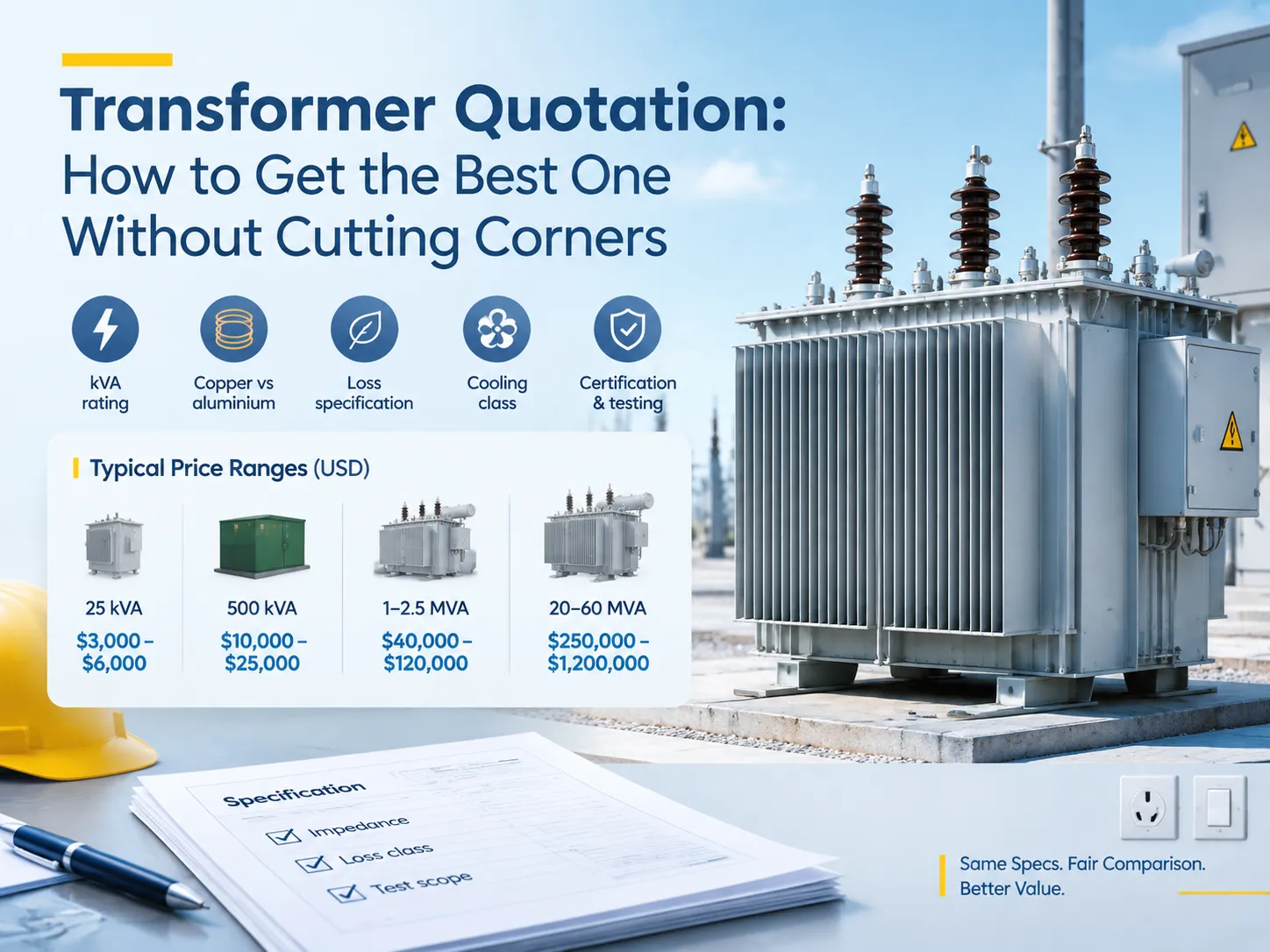
Was ein Transformatorenangebot tatsächlich enthalten muss
Bevor Sie mit Preisvergleichen beginnen, stellen Sie zunächst sicher, dass alle Angebote die gleichen Spezifikationen angeben. Ein Angebot, das Komponenten auslässt, sollte nicht als günstiger betrachtet werden; es handelt sich um ein unvollständiges Angebot, das später durch eine Änderungsanordnung ergänzt werden könnte. Die erforderlichen Spezifikationen sind:
- Leistungsbewertung – kVA oder MVA, Primär- und Sekundärspannungen und ob es sich um Daten im Leerlauf oder unter Last handelt.
- Kernart, Frequenz und Vektorgruppe – Dy11 oder Dyn1, und 50Hz klingt anders als 60Hz.
- Wickeldraht – Kupfer oder Aluminium, wobei die Anforderung klar angegeben sein muss.
- Die Impedanz – normalerweise in Form eines Prozentsatzes; dies ist der wichtigste Parameter bei der Berechnung der Kurzschlussfähigkeiten.
- Verluste – Leerlaufverluste (oder Kernverluste) und Lastverluste (Kupferverluste), ausgedrückt in Watt und unter Berücksichtigung der Effizienzklassifizierung.
- Kühlklasse – ONAN oder ONAF oder AN oder AF, Temperaturanstieg der Wicklungen und des Öls.
- Abgriffmethode – durchgeführt mit unterbrochenem Stromkreis oder unter Last.
- Haus und Umgebung – ob es sich um eine Innen- oder Außeneinheit handelt; die Art des Gehäuses, Höhen- und Temperaturaspekte sowie seismologische Anforderungen.
- Schutz und Zubehör – ob ein Buchholz-Relais, Sicherheitsventil, Temperatursensoren, Entlüfter und Verteilungsbox vorhanden sind; wie und ob eine Überwachung enthalten ist.
- Normen und Prüfungen – nach welchen Standards das Gerät hergestellt wurde (IEC 60076, IEEE C57) und welche Tests durchgeführt wurden.
- Lieferung und Garantie – die Lieferzeit, Incoterms, die Genehmigung der Zeichnung und was durch die Garantiebedingungen abgedeckt ist.
Wie unser Angebotsprozess funktioniert, Schritt für Schritt
Obwohl viele unserer Angebote dazu neigen, mit einer Angabe der kVA-Zahl durch den Kunden zu beginnen, lassen Sie uns unseren Prozess durchgehen, was wir tatsächlich tun. Der Prozess ist relativ schnell, aber der Anfangsteil des Prozesses beeinflusst den Betrag, den Sie zahlen würden.
- Wir vergleichen die kVA-Zahl mit der erwarteten Last, da die kVA-Zahl allein nicht ausreicht, um festzustellen, ob das Gerät Wärme erzeugt. Deshalb möchten wir das Lastprofil erhalten, das die erwartete Arbeitszeit, die Umgebungsbedingungen und ob eine Notstromversorgung im Falle eines Stromausfalls verfügbar ist, zeigt.
- Wir richten den elektrischen Kontext ein. Dazu gehören Widerstand, Phasenanschluss, Spannungsverhältnis, Frequenz und Vektorguppe. Dies ist die Phase, in der die Mehrheit der angegebenen technischen Details festgelegt wird.
- Wir richten den physischen Kontext ein. Dazu gehört, ob das Gerät drinnen oder draußen verwendet wird, ob es auf dem Boden oder frei installiert wird, wie viel Platz für das Gerät bleibt usw.
- Wir beschreiben mögliche Konfigurationen. In der Regel umfassen sie zwei Optionen, von denen eine effizienter ist als die andere. Das Gute ist, dass beide Optionen mit dem Preis angeboten werden, sodass es die Möglichkeit gibt, die Auswirkungen der Standardeffizienz zu analysieren.
- Wir bereiten einen Geschäftsangebot vor, das die Angebote enthält. Dies wird eine Seite und ein Technisches Annex mit allen technischen Details und Testplänen, die ausdrücklich aufgeführt sind, umfassen.
- Wir stellen die Zeichnung zur Genehmigung zur Verfügung und beginnen erst dann mit dem Herstellungsprozess.
Wenn Sie das Detailniveau sehen möchten, das in diesem Anhang endet, unser Bericht über was Transformatorenspezifikationen tatsächlich bedeuten deckt die Parameter Zeile für Zeile ab – es ist die gleiche Liste, mit der unsere Ingenieure arbeiten.
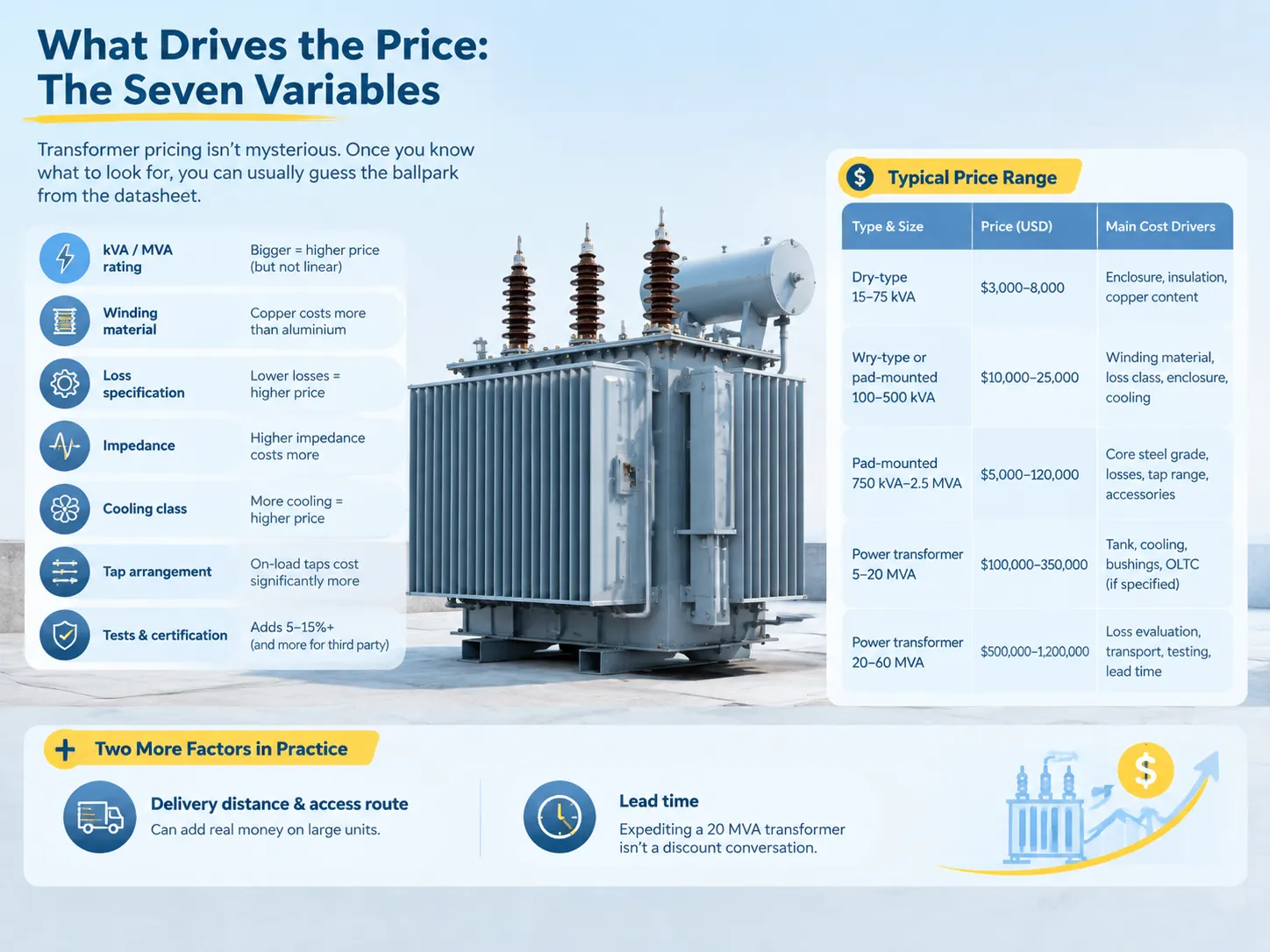
Was den Preis antreibt: die sieben Variablen
Der Preis des Transformators ist kein Geheimnis, und nach mehrmaliger Beobachtung kann man ihn ungefähr mit Hilfe des Datenblatts schätzen. Sieben Aspekte leisten den Großteil der Arbeit.
| Variabel | Einfluss auf den Preis | Worauf man achten sollte |
|---|---|---|
| kVA / MVA Bewertung | Grob proportional, aber nicht linear – kleine Geräte tragen proportional mehr Arbeits- und Gehäuskosten pro kVA | Überschätzen Sie nicht aus Gewohnheit; die Verluste laufen, ob Sie die Kapazität nutzen oder nicht |
| Wickelmaterial | Kupfer kostet typischerweise 15-30% mehr als Aluminium für die gleiche Bewertung | Kupfer kauft einen kleineren Platzbedarf und geringere Verluste; Aluminium kauft Kapital |
| Verlustspezifikation | Kann den Preis um 10-25% zwischen minimal-effizienten und verlustarmen Designs verschieben | Verluste werden monatlich über Jahrzehnte bezahlt – kalkulieren Sie die Lebensdauer-Kosten, nicht nur den Kaufpreis |
| Impedanz | Höhere Impedanz kostet mehr Material und reduziert den Fehlerstrom | Angetrieben durch den oberen Schutz, nicht durch Vorliebe |
| Kühlklasse | ONAF und AF fügen Radiatoren, Lüfter und Steuerungen hinzu; Zwangskühlung fügt Ausfallmodi hinzu | Geben Sie nur an, was die Aufgabe tatsächlich benötigt |
| Abgriffanordnung | On-load tap changers are a significant cost step over off-circuit taps | Decide from your voltage-quality history, not from ambition |
| Tests and certification | Witnessed or special tests can add 5-15%; third-party certification adds more | Never cut this line — it’s the one that proves the unit is what the datasheet says |
| Transformer type and size | Typical price band | Where the money goes |
|---|---|---|
| Dry-type, 15-75 kVA | ,000-8,000 | Enclosure, insulation class and copper content |
| Dry-type or pad-mounted, 100-500 kVA | ,000-25,000 | Winding material, loss class, enclosure and cooling |
| Pad-mounted, 750 kVA to 2.5 MVA | 5,000-120,000 | Core steel grade, losses, tap range and accessories |
| Power transformer, 5-20 MVA | 0,000-350,000 | Tank, cooling, bushings, on-load tap changer if specified |
| Power transformer, 20-60 MVA | 50,000-1,200,000 | Loss evaluation, transport, testing and lead time |
Two other factors are important in practical situations. Delivery distance and access route may incur real costs for large units along with the lead time prices, which is true. For example, expediting the delivery of a 20 MVA transformer cannot be considered a discount question. If you want a fuller breakdown of where the money goes by size and type, our guide to what an electrical transformer costs works through the numbers unit by unit.
Where our pricing sits against the big brands
It’s a fair query, and it should be answered with the truth rather than a catchy phrase. If we conduct a comparison of similar transformer types — equal rating, equal impedance, equal loss class, and all tests performed within the same scope — it’s likely that our pricing will be lower than that of the European and American industry leaders. This situation is a consequence of where the transformer was produced, as well as of the distribution structure.
What should be sacrificed in this case is exactly what big-name pricing is associated with: large installed systems in your market, proper local service organization, presence of spare spare parts in the country, and a brand that your supplier (or insurance company) would recognize without discussion. In the case of a simple transformer it may not be worth the price difference, but when it comes to critically important stations it may be.
What should not be sacrificed is documentation. Each of our transformers is supplied with service reports on tests performed, declared standard, and material traceability. In the case of a cheaper transformer one should expect much thinner documentation.
Custom, OEM and private label: what we do and what we don’t
Sure, we construct products based on our customers’ preferences. This means we can apply any customization that the client may request, such as unusual voltage ratio, specific vector groups, non-standard tap range, particular enclosure finishes, peculiar colors of paint, special specifications of nameplates and documentation packages in a desired language. If a client plans to order several systems, we can manufacture the products according to the customer’s specifications labeling and documentation.The only area of customization we reject is the case of dishonest customizations. We point out that we won’t modify a regular core to produce a kVA output that it cannot support and we will not create a testing report for testing we have not conducted.
One thing worth doing early: send us the load data, not just the kVA. Sizing a transformer properly is a calculation, and it changes the answer more often than people expect — our guide to transformer sizing and load calculations explains the method we use, and going through it before you issue an enquiry tends to shorten the whole cycle.
How to compare quotations fairly
First bring three quotes together and make sure that they have the same effect. The trick of comparison is revealed in four checks.
- Is there a similar impedance? The quotes which have a 4% impedance and the ones with a 6% impedance are two different products with different implications.
- Do they have the same class of losses? The unit of minimum technical efficiency and the unit with minimum losses can have a difference of 20% in price and many times bigger gap over the period of 20 years of usage.
- Have they passed the same tests? The routine test results do not equal the one which comes with the routine test plus the type test plus special test.
- What about the delivery conditions? The conditions of Ex-works delivery can seriously differ from the stated terms of delivery, customs clearance and local transportation.
Once these factors are equal, implement a second filter: who provided answers in numerical values instead of descriptive adjectives. If a supplier responds to a question like “what is short-circuit endurance?” with “it’s very strong,” they provide you with some valuable insight into their experience regarding the project.The qualification checklist we’d expect a buyer to apply to us and to everyone else is set out in wie man einen Transformatorenlieferanten auswählt.
Choosing the right transformer for the project
Pricing is the last aspect to be examined instead of the first. Specifically, four essential queries must be addressed to finalize a specification before any deal with any vendor.
- What will be the real load, both now and after five years? You take the optimal demand and add your feasible growth and come up with the needed size. The idea of “we may need more” results in a situation where installations are working with 25% of the transformer load and losing no-load losses on the capacity that does not exist.
- Where does the fault current come from and how far it actually travels? Impedance and ratings should be coordinated with the upstream and downstream protection or there will be an improper coordination, unwanted trips, and failure to interrupt the current.
- What environment does the device reside in? The coastal area, desert weather, high altitude, and wash-down result in a distinction of materials and cooling options. Thus, a standard enclosure is not the necessary enclosure.
- What options are required by utility or inspector? The question eliminates a number of options that look impressive in the beginning.
Practical questions to ask before you sign
- Which standard is the unit constructed and tested, and is it mentioned in the contract?
What tests are part of the cost, and will I be able to see some of them?
What is the no-load and load loss guarantee, and what happens if it is not satisfied?
What is the time required for approval drawings and how many times can it be corrected?
Who is responsible for the commissioning and is it free of charge?
What spare parts will I realistically require and how long will they be available?
How is lead time measured — from order, or advance payment, or the drawing being approved?
If you’d like to see how a specific product family is documented before you decide what to ask, our Verteiltransformatorbereich shows the specification detail that goes out with every enquiry, including the parameters we need from you to quote accurately.
FAQ
How much does a typical transformer cost?
It is nearly solely dependent on size and type. Small dry-type and pad-mounted distribution transformers run from roughly $3,000 for a 25 kVA to $25,000 for a 500 kVA unit. 1-2.5 MVA units usually range between $40,000 to $120,000. Large power transformers of 20-60 MVA range begin at $250,000 and can surpass $1.2 million. Winding material, quality of losses and testing procedure alter those amounts with different 20-30% depending on their level.
What is the average price of a transformer?
The term “average” does not reflect the reality as the distribution is formed by small units in volume and big units in value. It would be better to categorize the pricing. For example, low-voltage distribution transformers under 1 MVA are provided at a price ranging from a few thousands to tens of thousands, medium transformers between 1 and 20 and classified as “tens of thousands,” and above 20 MVA built for transmission means that the price is the amount of hundreds of thousands.
Was ist die 80%-Regel für Transformatoren?
Sizing a transformer so that it runs at about 80% of its nameplate kVA could be considered an engineering guideline as opposed to an enforced regulation. This ensures that the device has sufficient excess capacity to be used as demands grow, that it operates in a way that allows it not to be continuously overloaded, and that it becomes less likely for a momentary overload event to become business as usual. A related, though codified practice, is the continuous-load rule, which stipulates that continuous loads should be treated as being 125% of their actual value during the sizing of supply and protection systems, which provides for the original 80% figure. Hence, if the calculations that you do justify operating at 90% of the nameplate value of the transformer, then it can be a good design decision.
Why is one transformer quote much cheaper than another?
Common suspects are: a different loss type, aluminum instead of copper, a reduced testing range, a lower impedance, a less complicated case, or contract terms that can hide something. In rare cases, the factory is simply cheap. Just request the details and the testing list, and in 10 minutes, everything clears up.
Do you supply custom and OEM transformers?
That’s right. We manufacture products according to customer specifications, which may include special voltage ratios, vector groups, tapping options, enclosures, finishing options and documentation packages. In addition, we also provide OEM products for ongoing projects. However, we will not increase the thermal capacity of products in order to achieve a certain kVA value or create test reports for tests not conducted.
How long does it take to get a quotation?
For an off-the-shelf transformer that meets the full spec requirements, a quote can usually be returned within 2-3 days. Custom designs, strange specifications or projects that require a certification from a third-party will take longer since the price is established only once the drawings and tests are agreed upon. The longest delay, by far, is caused by an incomplete request. Give the load details, voltages, environment and standard, and the quote arrives much quicker.
Referenzen
- International Electrotechnical Commission — IEC 60076: Power Transformers
- IEEE — IEEE C57.12.00: General Requirements for Liquid-Immersed Distribution, Power and Regulating Transformers
- NFPA — NFPA 70 National Electrical Code, Article 450 (Transformers and Transformer Vaults)
- US Department of Energy — Distribution Transformer Energy Conservation Standards
- European Commission — Ecodesign Requirements for Transformers
- UL Solutions — Transformer Certification and Listing Programmes
Fazit
A transformer quote can be defined as a certain document containing a price, but this price is meaningless until what has to be calculated is established. As soon as the loss class, the Impedance, the type of winding, the extent of testing and shipping are specified, the quote will stop being a secret. Indeed, over 90% of the differences in quotations are due to two specifications different though with the same kVA number. Making use of this information, one can calculate how much money will be spent during the transformer lifetime, as no matter how much you pay for its manufacture, the losses are to be settled every month. In our opinion, we would prefer to start this conversation with the customer very early: just give us the necessary load, habitat and standard and we will be able to calculate a quote for the necessary transformer model, indicating when it is profitable to use a less expensive model.