


When requesting quotes from five different transformer manufacturers, one receives five price quotes whose contents are similar but do not necessarily mean the same thing. For example, one quote may provide the rating and price of the transformer while the second one may provide information on losses, impedance, tap range, cooling class, as well as the testing methods, which would affect its price significantly. The interesting and frustrating thing about this process is that often the cheapest quote is the one that is correct, while the most expensive sometimes is the only transformer that would fully comply with the requirements of the utility standard. This article will describe how to decipher the different quotes and what things to keep in mind when looking at them.
In simple terms, transformer reliability varies according to specifications which is the main reason why the prices of quotations made by various manufacturers vary from these five factors: kVA, copper/aluminum winding, loss of power (efficiency class), cooling type, and certification and testing. As a rule of thumb, the cost of small dry type or pad-mounted transformers rated at 25 kVA ranges between $3,000-$6,000, while a 500 kVA pad-mounted transformer can cost $10,000-$25,000. The cost of a 1-2.5 MVA transformer can be anywhere between $40,000-$120,000. Finally, the price of a 20-60 MVA transformer is from $250,000-$1,200,000. It is very important to always compare various offers when impedance, loss, and testing are the same.
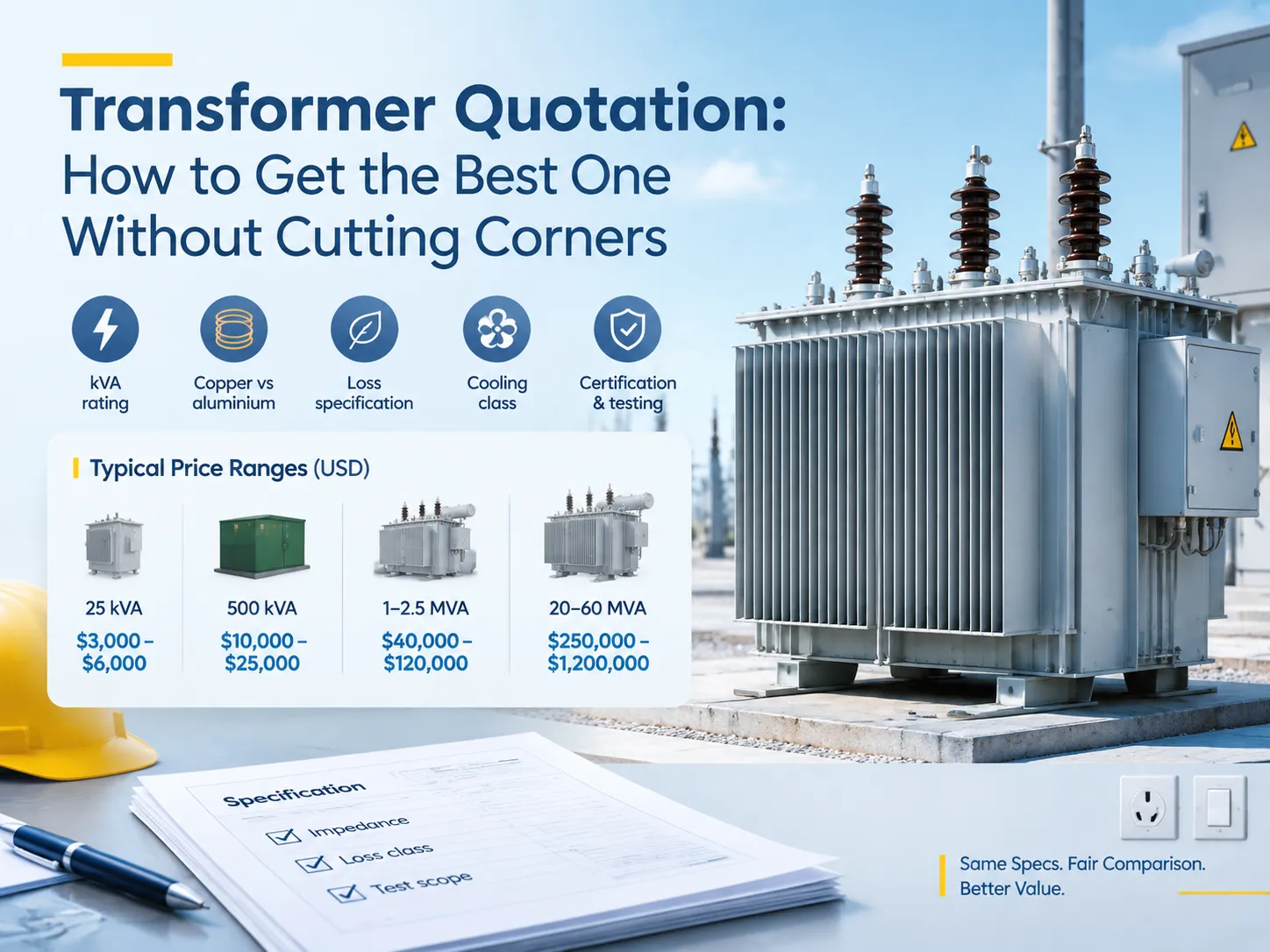
What a transformer quotation actually has to contain
Before you begin with price comparisons, first make sure that all of the quotations state the same specifications. A quotation that leaves components out should not be considered cheaper; it is an incomplete quote and it could be followed up by a change order at a later stage.The required specifications are:
- Power rating – kVA or MVA, primary and secondary voltages, and whether these are no-load or under-load data.
- Core type, frequency and vector group – Dy11 or Dyn1, and 50Hz sounds different from 60Hz.
- Winding wire – copper or aluminum with the requirement being stated clearly.
- The impedance – usually in form of a percentage; this is the most important parameter when calculating the short circuit capabilities.
- Losses – no-load (or core losses) and load losses (copper losses) expressed in watts and taking into account the efficiency classification.
- Cooling class – ONAN or ONAF or AN or AF, temperature rise of coils and oil.
- Tapping method – done with the circuit broken or under load.
- House and environment – whether it is an indoor or an outdoor unit; the type of housing, elevation and temperature aspects, and seismology requirements.
- Protection and accessories – whether there is Buchholz relay, safety valve, temperature sensors, breather, and distribution box; how and whether monitoring is included.
- Standards and tests – what standards the unit was manufactured according to (IEC 60076, IEEE C57) and what tests were done.
- Delivery and warranty – the delivery time, Incoterms, the drawing approval and what is covered by the warranty policy.
How our quotation process works, step by step
Although many of our quotes tend to begin with a client providing a kVA number only, let’s go through our process of what we actually do. The process is relatively fast, but the start part of the process is the one which influences the amount you would pay.
- We compare the kVA figure with the expected load because the kVA number alone is not enough to state if the unit will generate heat. This is why we want to receive the load profile, which shows the expected working time, the ambient conditions, and whether there is a backup supply available in case of a power system downtime.
- We set up the electrical context. This includes resistance, phase connection, voltage ratio, frequency, and vector group. This is the stage when the majority of the technical details specified are stated.
- We set up the physical context. This includes whether the unit will be used indoors or outdoors, if it is going to be installed on the ground or freely, how much space is left for the unit, etc.
- We describe possible configurations. Usually, they include two options, one of which is more efficient than the second. The good thing is that both options are provided with the price, so there is an opportunity to analyze the standard efficiency impact.
- We prepare a business proposal that includes the quotations. This will be one page and a Technical Annex with all technical details and test plans listed explicitly.
- We provide the drawing for your approval and only then start manufacturing process.
If you want to see the level of detail that ends up in that annex, our write-up on what transformer specifications actually mean covers the parameters line by line — it’s the same list our engineers work from.
What drives the price: the seven variables
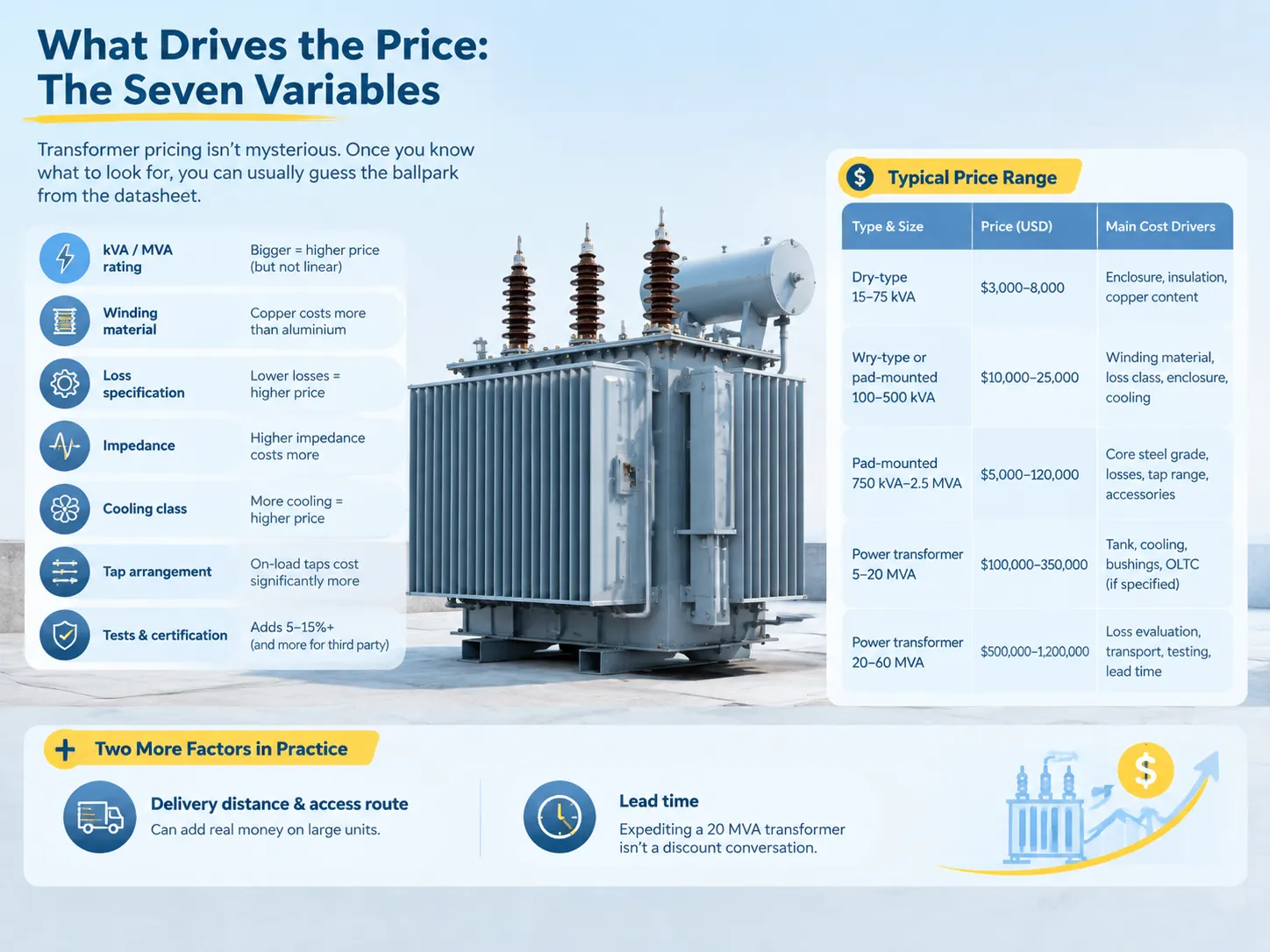
The price of the transformer is not a secret, and after observing it several times, one can estimate it approximately with the help of the datasheet. Seven aspects do most of the work.
| Variable | Effect on price | What to watch |
|---|---|---|
| kVA / MVA rating | Roughly proportional, but not linear — small units carry proportionally more labour and enclosure cost per kVA | Don’t oversize by habit; the losses run whether you use the capacity or not |
| Winding material | Copper typically adds 15-30% over aluminium for the same rating | Copper buys a smaller footprint and lower losses; aluminium buys capital |
| Loss specification | Can shift price by 10-25% between minimum-efficiency and low-loss designs | Losses are paid monthly for decades — price the lifetime cost, not just the purchase |
| Impedance | Higher impedance costs more in material and reduces fault current | Driven by the upstream protection, not by preference |
| Cooling class | ONAF and AF add radiators, fans and controls; forced cooling adds failure modes | Only specify what the duty actually needs |
| Tap arrangement | On-load tap changers are a significant cost step over off-circuit taps | Decide from your voltage-quality history, not from ambition |
| Tests and certification | Witnessed or special tests can add 5-15%; third-party certification adds more | Never cut this line — it’s the one that proves the unit is what the datasheet says |
| Transformer type and size | Typical price band | Where the money goes |
|---|---|---|
| Dry-type, 15-75 kVA | ,000-8,000 | Enclosure, insulation class and copper content |
| Dry-type or pad-mounted, 100-500 kVA | ,000-25,000 | Winding material, loss class, enclosure and cooling |
| Pad-mounted, 750 kVA to 2.5 MVA | 5,000-120,000 | Core steel grade, losses, tap range and accessories |
| Power transformer, 5-20 MVA | 0,000-350,000 | Tank, cooling, bushings, on-load tap changer if specified |
| Power transformer, 20-60 MVA | 50,000-1,200,000 | Loss evaluation, transport, testing and lead time |
Two other factors are important in practical situations. Delivery distance and access route may incur real costs for large units along with the lead time prices, which is true. For example, expediting the delivery of a 20 MVA transformer cannot be considered a discount question. If you want a fuller breakdown of where the money goes by size and type, our guide to what an electrical transformer costs works through the numbers unit by unit.
Where our pricing sits against the big brands
It’s a fair query, and it should be answered with the truth rather than a catchy phrase. If we conduct a comparison of similar transformer types — equal rating, equal impedance, equal loss class, and all tests performed within the same scope — it’s likely that our pricing will be lower than that of the European and American industry leaders. This situation is a consequence of where the transformer was produced, as well as of the distribution structure.
What should be sacrificed in this case is exactly what big-name pricing is associated with: large installed systems in your market, proper local service organization, presence of spare spare parts in the country, and a brand that your supplier (or insurance company) would recognize without discussion. In the case of a simple transformer it may not be worth the price difference, but when it comes to critically important stations it may be.
What should not be sacrificed is documentation. Each of our transformers is supplied with service reports on tests performed, declared standard, and material traceability. In the case of a cheaper transformer one should expect much thinner documentation.
Custom, OEM and private label: what we do and what we don’t
Sure, we construct products based on our customers’ preferences. This means we can apply any customization that the client may request, such as unusual voltage ratio, specific vector groups, non-standard tap range, particular enclosure finishes, peculiar colors of paint, special specifications of nameplates and documentation packages in a desired language. If a client plans to order several systems, we can manufacture the products according to the customer’s specifications labeling and documentation.The only area of customization we reject is the case of dishonest customizations. We point out that we won’t modify a regular core to produce a kVA output that it cannot support and we will not create a testing report for testing we have not conducted.
One thing worth doing early: send us the load data, not just the kVA. Sizing a transformer properly is a calculation, and it changes the answer more often than people expect — our guide to transformer sizing and load calculations explains the method we use, and going through it before you issue an enquiry tends to shorten the whole cycle.
How to compare quotations fairly
First bring three quotes together and make sure that they have the same effect. The trick of comparison is revealed in four checks.
- Is there a similar impedance? The quotes which have a 4% impedance and the ones with a 6% impedance are two different products with different implications.
- Do they have the same class of losses? The unit of minimum technical efficiency and the unit with minimum losses can have a difference of 20% in price and many times bigger gap over the period of 20 years of usage.
- Have they passed the same tests? The routine test results do not equal the one which comes with the routine test plus the type test plus special test.
- What about the delivery conditions? The conditions of Ex-works delivery can seriously differ from the stated terms of delivery, customs clearance and local transportation.
Once these factors are equal, implement a second filter: who provided answers in numerical values instead of descriptive adjectives. If a supplier responds to a question like “what is short-circuit endurance?” with “it’s very strong,” they provide you with some valuable insight into their experience regarding the project.The qualification checklist we’d expect a buyer to apply to us and to everyone else is set out in how to choose a transformer supplier.
Choosing the right transformer for the project
Pricing is the last aspect to be examined instead of the first. Specifically, four essential queries must be addressed to finalize a specification before any deal with any vendor.
- What will be the real load, both now and after five years? You take the optimal demand and add your feasible growth and come up with the needed size. The idea of “we may need more” results in a situation where installations are working with 25% of the transformer load and losing no-load losses on the capacity that does not exist.
- Where does the fault current come from and how far it actually travels? Impedance and ratings should be coordinated with the upstream and downstream protection or there will be an improper coordination, unwanted trips, and failure to interrupt the current.
- What environment does the device reside in? The coastal area, desert weather, high altitude, and wash-down result in a distinction of materials and cooling options. Thus, a standard enclosure is not the necessary enclosure.
- What options are required by utility or inspector? The question eliminates a number of options that look impressive in the beginning.
Practical questions to ask before you sign
- Which standard is the unit constructed and tested, and is it mentioned in the contract?
What tests are part of the cost, and will I be able to see some of them?
What is the no-load and load loss guarantee, and what happens if it is not satisfied?
What is the time required for approval drawings and how many times can it be corrected?
Who is responsible for the commissioning and is it free of charge?
What spare parts will I realistically require and how long will they be available?
How is lead time measured — from order, or advance payment, or the drawing being approved?
If you’d like to see how a specific product family is documented before you decide what to ask, our distribution transformer range shows the specification detail that goes out with every enquiry, including the parameters we need from you to quote accurately.
FAQ
How much does a typical transformer cost?
It is nearly solely dependent on size and type. Small dry-type and pad-mounted distribution transformers run from roughly $3,000 for a 25 kVA to $25,000 for a 500 kVA unit. 1-2.5 MVA units usually range between $40,000 to $120,000. Large power transformers of 20-60 MVA range begin at $250,000 and can surpass $1.2 million. Winding material, quality of losses and testing procedure alter those amounts with different 20-30% depending on their level.
What is the average price of a transformer?
The term “average” does not reflect the reality as the distribution is formed by small units in volume and big units in value. It would be better to categorize the pricing. For example, low-voltage distribution transformers under 1 MVA are provided at a price ranging from a few thousands to tens of thousands, medium transformers between 1 and 20 and classified as “tens of thousands,” and above 20 MVA built for transmission means that the price is the amount of hundreds of thousands.
What is the 80% rule for transformers?
Sizing a transformer so that it runs at about 80% of its nameplate kVA could be considered an engineering guideline as opposed to an enforced regulation. This ensures that the device has sufficient excess capacity to be used as demands grow, that it operates in a way that allows it not to be continuously overloaded, and that it becomes less likely for a momentary overload event to become business as usual. A related, though codified practice, is the continuous-load rule, which stipulates that continuous loads should be treated as being 125% of their actual value during the sizing of supply and protection systems, which provides for the original 80% figure. Hence, if the calculations that you do justify operating at 90% of the nameplate value of the transformer, then it can be a good design decision.
Why is one transformer quote much cheaper than another?
Common suspects are: a different loss type, aluminum instead of copper, a reduced testing range, a lower impedance, a less complicated case, or contract terms that can hide something. In rare cases, the factory is simply cheap. Just request the details and the testing list, and in 10 minutes, everything clears up.
Do you supply custom and OEM transformers?
That’s right. We manufacture products according to customer specifications, which may include special voltage ratios, vector groups, tapping options, enclosures, finishing options and documentation packages. In addition, we also provide OEM products for ongoing projects. However, we will not increase the thermal capacity of products in order to achieve a certain kVA value or create test reports for tests not conducted.
How long does it take to get a quotation?
For an off-the-shelf transformer that meets the full spec requirements, a quote can usually be returned within 2-3 days. Custom designs, strange specifications or projects that require a certification from a third-party will take longer since the price is established only once the drawings and tests are agreed upon. The longest delay, by far, is caused by an incomplete request. Give the load details, voltages, environment and standard, and the quote arrives much quicker.
References
- International Electrotechnical Commission — IEC 60076: Power Transformers
- IEEE — IEEE C57.12.00: General Requirements for Liquid-Immersed Distribution, Power and Regulating Transformers
- NFPA — NFPA 70 National Electrical Code, Article 450 (Transformers and Transformer Vaults)
- US Department of Energy — Distribution Transformer Energy Conservation Standards
- European Commission — Ecodesign Requirements for Transformers
- UL Solutions — Transformer Certification and Listing Programmes
Conclusion
A transformer quote can be defined as a certain document containing a price, but this price is meaningless until what has to be calculated is established. As soon as the loss class, the Impedance, the type of winding, the extent of testing and shipping are specified, the quote will stop being a secret. Indeed, over 90% of the differences in quotations are due to two specifications different though with the same kVA number. Making use of this information, one can calculate how much money will be spent during the transformer lifetime, as no matter how much you pay for its manufacture, the losses are to be settled every month. In our opinion, we would prefer to start this conversation with the customer very early: just give us the necessary load, habitat and standard and we will be able to calculate a quote for the necessary transformer model, indicating when it is profitable to use a less expensive model.