


If you are new to the electrical world, few labels look more confusing than the one bolted to the side of a transformer. It usually starts with a number and three letters: 25 kVA, 100 kVA, 1000 kVA. That number is the single most important thing about the unit, yet almost nobody explains what it actually means. This guide fixes that. In plain language, it explains what a kVA transformer is, what the kVA number tells you, how to turn it into amps, and how engineers pick the right size. By the end, the nameplate will make sense, and you will be able to answer the questions that beginners ask most.
A glass of beer is a good analogy to understand the difference between kVA and kW. In this case, a full glass of beer symbolizes the apparent power which is the total power rating of a transformer. On the other hand, the beer in this case would be the real power. The foam rests on top of the beer which takes up some of the space in the glass without any use. In the same way, it is important to state that transformer is rated in kVA instead of kW because the transformer needs to account for the entire glass including the foam.
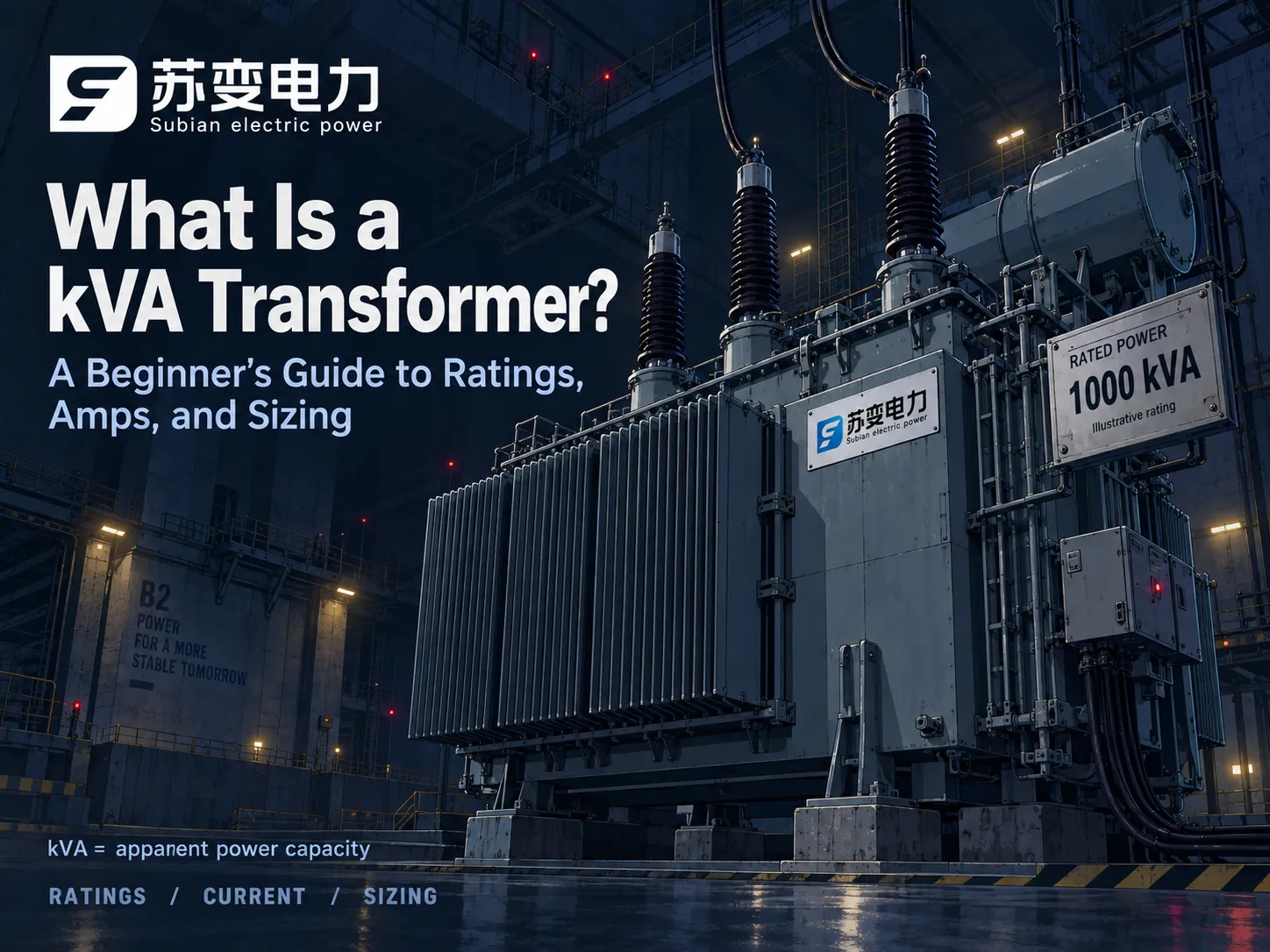
What Is a kVA Transformer?
A kVA transformer is referred to as a transformer indicating its ability to carry power that is measured as kVA. The kV stands for kilo-voltage-ampere, where “kilo” means thousand and volt-ampere is a unit of electrical power referred to as apparent power by engineers. For instance, a 100 kVA transformer is electrically capable of using 100,000 volt-amperes at any time.
The transformer refers to a machine that converts electricity from one voltage to another. For instance, it can change the high voltage from the power lines into a usable voltage of the building or from low voltage to high voltage for long-distance transmission. Whenever the voltage has changed it should be noted that there is a limit to the amount of current which the transformer can transmit. This limit is called kVA.
This is why people casually name transformers by their capacity. When an electrician says “we need a 500 kVA unit,” they are describing exactly how much power the transformer must carry. The physical size, the weight, and the price all scale with that number.
What Does kVA Actually Mean?
A sound understanding of a kVA transformer requires an understanding of the three types of power. This might sound complicated, so let it be illustrated with a simple diagram.
Apparent power is defined as total power measured in kVA, which the transformer has to carry.
Real power is the useful part of the current measured in kW that does actual work. Here, one may think of the running motor or heating equipment.
Also, some power is called reactive power and is measured in kVAR. It is the part of the current that does not carry out any work.
The connection of these three kinds of power is explained by the so-called power factor which is a number measuring between 0 and 1.
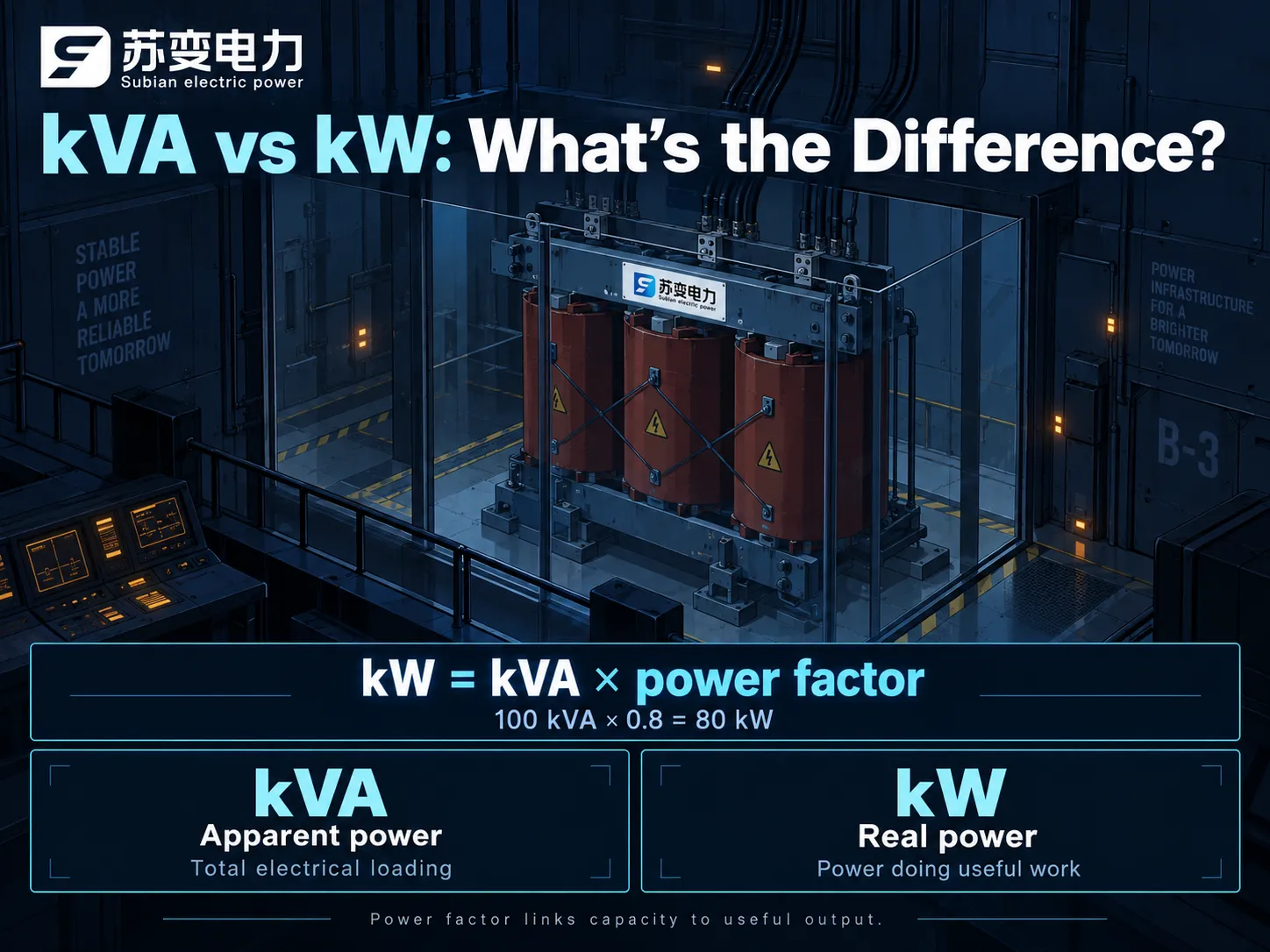
In simple terms, the essence of the formula is as follows: kW = kVA * power factor.
If you have a 100 kVA transformer working at 0.8 power factor, the useful power provided by the transformer will be 80 kW. The rest of the power will go to producing reactive power.
kVA vs kW: Why Transformers Are Rated in kVA
A common question from those purchasing transformers for the first time is, “Why don’t we simply rate transformers in kilowatts like we do with heaters and motors?” The answer to this question is simple. Transformers generate heat based on the current flowing through their wires as well as the voltages involved, regardless of the “usage” of that energy.
Because the heat generated depends on the load applied, transformers should be rated by their apparent power and not in kilowatts. If you only use kilowatts with a transformer to size it, you will risk overloading it.
How to Calculate Amps from a kVA Transformer
One of the most frequently asked questions by novices relates to a transformer’s ampacity. The term amp refers to amperes which is the measure of electricity current and understanding this term is crucial in determining cable size, breakers and panels too. Fortunately, one can determine the current once he/she knows the voltage since current varies according to both the kVA number and voltage.
The formula for the calculation of current in the case of a single-phase transformer is as follows:
Current = (kVA × 1000) ÷ Voltage
In the case of three-phase transformer which is used across most industries, here one will need to include a constant number 1.732 (the square root of three) while calculating current.
The calculation is as follows:
Current = (kVA × 1000) ÷ (Voltage × 1.732)
Here are several calculated examples for better understanding:
A transformer rated at 25 kVA with single phase at voltage 240 will give about 104 amps.
A three-phase transformer rated at 100 kVA with voltage of 400 will produce the amps close to 144.
A three-phase transformer rated at 1000 kVA with voltage of 480 will produce 1203 amps.
It can be noticed that kVA number stays the same but amps are different due to differences involtage and this tendency of the relationship of current and voltage is a key concept.
VA, kVA, and MVA: Making Sense of the Units
People who are just getting started are often confused by the unit of measurement concerning transformer capacity. The various terms referenced all have the same meaning, which is that they measure apparent power, but simply describe different levels.
The smallest unit of power is VA (volt-ampere). The power associated with a volt-ampere is a minimal amount used in specific control transformers.
The next larger unit is kVA (kilovolt-ampere), which is equal to one thousand volt-amperes. This is the unit of measurement used in most distribution transformers, making kVA the main unit of power used in the electrical industry.
Then there is MVA (megavolt-ampere), which is equal to one thousand kilovolt-amperes, or one million volt-amperes. This unit is only used in the extremely large transformers found in substations.
This means that any transformer with a capacity of-kVA can be written as MVA without it losing any of its meaning. After understanding that these terms only signify the number of zeros, determining the capacity of the transformer will not be hard in this case.
Common kVA Transformer Sizes and What They Power
Transformers are made in a number of standard sizes, and the range typically corresponds to what the transformer is used for.
In the small range that includes a 25 kVA transformer or 50 kVA, you have transformers that can supply small groups of homes, farms, shops, or control installations.
The mid-range includes ratings like 100 kVA transformers, 250 kVA transformers, and 500 kVA transformers that are used to supply residential areas, commercial buildings, schools, and light industry requirements.
For the large range of transformers, you can take 1000 kVA transformer or larger, as in the case of 1600 kVA transformer, that can be used directly for factories and such big establishments.
In this category, the very large range includes ratings like 2000 kVA transformers and above that can be used to provide for heavy industries and major infrastructure requirements, including huge electricity distribution needs.
In choosing a transformer, it is also important to factor in future loads and not just the current load requirements.
How to Choose the Right kVA Transformer Size
Choosing a transformer is a balance. Too small, and it overheats, trips, and ages early. Too large, and you waste money and run the unit inefficiently at light load. Professionals follow a few simple rules to get kVA transformer sizing right.
- The first thing one needs to do is to find out the actual load. One needs to calculate the total capacity in kW for systems that will be powered by this transformer and convert it to kVA using expected power factor.
Plan not for the average load, but the maximum one. Electricity consumption is a dynamic process meaning that there will be peaks like that one on a hot day when everyone uses their air-conditioners at full speed. The transformer must be prepared for such kind of peak situations.
Stick to the 80 pct rule. The general advice is to use the transformer with loading capacity of no more than 80 pct of its kVA rating. This way it will be able to accommodate future load growth and sudden demand spikes without overheating.
Think ahead. If there are reasons to believe that the load requirements will increase in the future, then the next standard transformer should be purchased now instead of having to replace the transformer later. 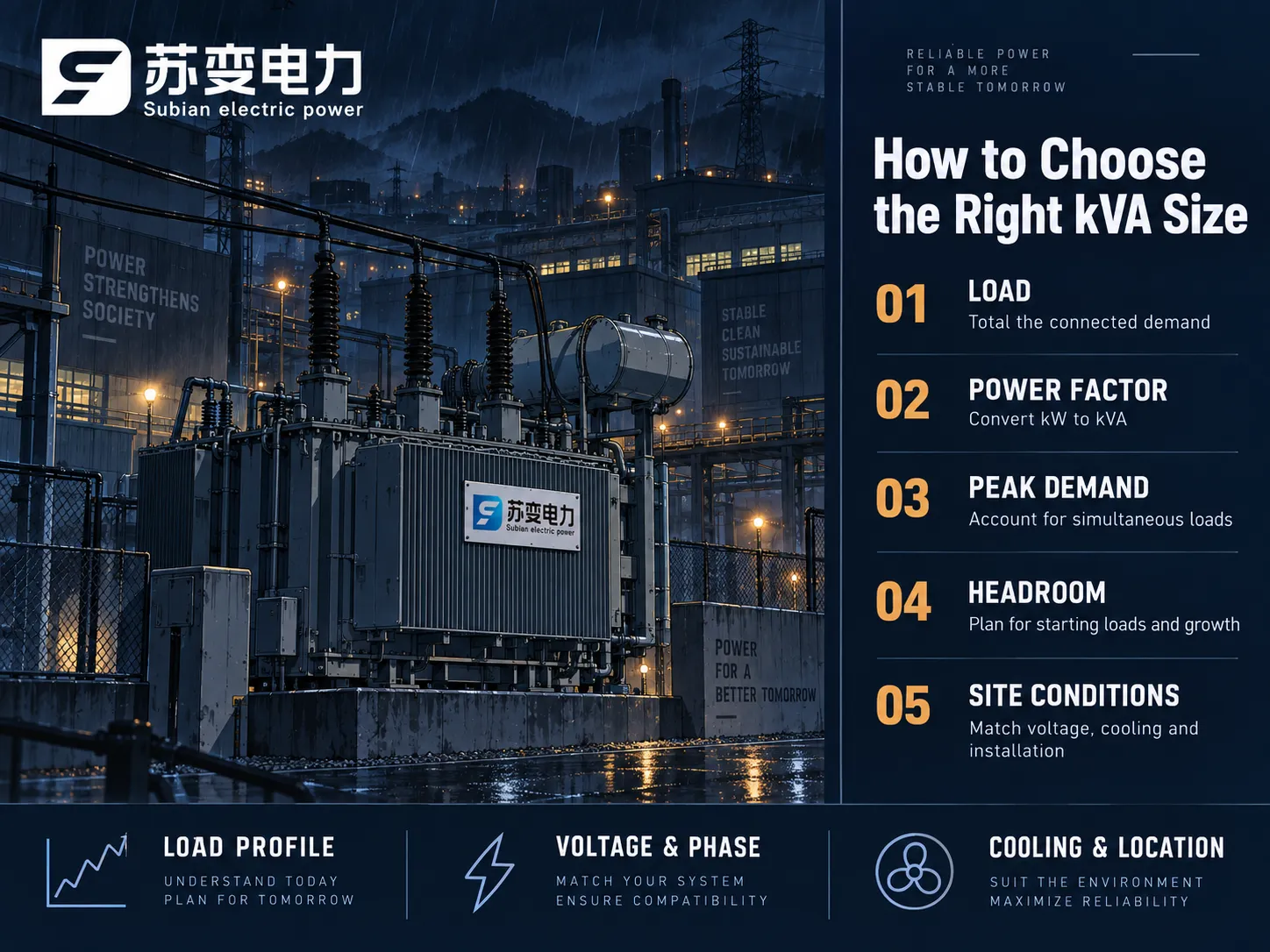
Dry-Type vs Oil-Immersed kVA Transformers
The kVA transformer is divided into two major types, which differ in the cooling and insulation mechanism. The dry-type transformer uses air for cooling and solid resin insulation for the design, which makes it a safe option for indoor installations such as residential buildings, offices, and tunnels. Oil-immersed transformers use oil for insulation and also to cool coil portions. This type of transformer works more efficiently compared to dry-type transformers, which gives it a preference in outdoor substations.
These transformers have same rating, meaning a 1,000 kVA transformer will have the same kVA regardless it is classified as the dry-type or the oil-immersed transformer. When checking the received quotes, please, ensure you compare the same kVA.
How to Read a kVA Transformer Nameplate
Once the kVA number is in place, the remaining information becomes relatively simple to comprehend. The metal sheet attached to the side of every kVA transformer gives some fundamental information that even kVA novices can understand:
Rated power. This is the kVA number that will now make sense to you.
Voltage ratings. These indicate the input voltage value and output voltage respectively, e.g. 11,000 V / 400 V. They show how far down/up the voltage is changed.
Phase and frequency. This shows whether the unit has a single-phase or three-phase voltage and its operating frequency, 50 Hz or 60 Hz for example.
Impedance. This is usually indicated as a percentage and varies between 4 and 6 percent. It determines how steady the voltage is going to be and how much fault current is going to flow. The lower the impedance is, the stiffer the voltage is going to be, but the greater fault current is going to be.
Cooling and temperature rise. This gives you a number of codes including ONAN for transformers working with oil.
Subian Power kVA Transformers
Jiangsu Subian Power Equipment Co., Ltd. is a Chinese high-tech manufacturer of power and distribution transformers rated 110 kV and below, along with prefabricated substations and high- and low-voltage switchgear. Founded in 2019 in Xuzhou, Jiangsu Province, Subian operates a 30,000-square-meter facility and supplies equipment for utilities, renewable energy, industrial, and infrastructure projects. Because it builds both technologies in-house, Subian can supply the right kVA transformer for almost any load and environment:
- For clean, fire-safe indoor and enclosed applications, Subian’s dry-type transformers include the 6-10 kV SCB epoxy resin cast dry-type transformer and the low-loss 10 kV SCBH amorphous alloy dry-type transformer.
- For outdoor substations and utility distribution, Subian’s oil-immersed transformers include the 6-10 kV oil-immersed distribution transformer for reliable, low-loss service.
Across these ranges, Subian covers the small, medium, and large kVA transformer sizes described above, and its engineering team can match the kVA rating, voltage class, cooling type, and enclosure to your project. If you know your load but not your size, the team can help you calculate the correct kVA transformer sizing before you request a quotation.
Frequently Asked Questions
How many amps is a 2000 kVA transformer good for?
It is contingent upon the voltage. Based on the three-phase transformer calculative formula, a transformer rated at 2000 kVA delivers around 2,406 amps at the voltage of 480 V. It is customary to round this figure to approximately 2,400 amps. At a lower voltage of 208V, this unit is capable of over 5,500 amps, the reason being that lower voltage means higher current which equals to the same amount of power consumed. It is important to understand that engineers usually design transformer operation which is approximately 80% of the maximum rated capacity, thus the operational current will be lower than the achievable one.
How many houses can a 100 kVA transformer handle?
The correct number may differ from one situation to another and depend on the specific peak power demand of each house as well as how many other homes are using power in the same moment (the so-called diversity factor). A 100 kVA transformer can service approximately any of the following types of homes: about 5 large all-electric homes with EV chargers, about 14 homes in line with normal utility planning guidelines, or 20-30 normal homes or apartments with light demand. Therefore, the best solution is to perform a proper load study that estimates the peak demand rather than make a quick guess about “houses per kVA,” which is known to contribute to transformer overload.
What does a 25 kVA transformer mean?
A transformer that has a capacity of 25 kVA would thus be a small unit in terms of power capacity with a 25k VA (that is, 25,000-volt amps). So, this translates into an output of around 20 kW of useful power at the power factor of 0.8. At 240 volts in the single-phase connection, this means that this unit draws around 104 amps. Generall, this kind of unit is used in small distribution transformers that are used in feeding a limited number of houses, farms, or small businesses.
How big is a 1000 kVA transformer?
The dimensions and weight of a transformer rated at 1000 kVA are significant, at an average of around 2 meters in all dimensions. A typical oil filled transformer would measure around 1.8 – 2.1 meters in length, 1.1 – 1.4 meters in width and 1.5 – 1.9 meters in height making the weight of such a transformer to be between about 2800 kg to 4000 kg including the oil. A dry type transformer would have almost similar dimensions and weight, estimated to be around 1800 to 2500 kgs.
References
- IEC — IEC 60076 Power Transformer Standards
- IEEE — C57 Transformer Standards and Loading Guides
- NFPA — National Electrical Code, Article 450 Transformers
- Electrical Engineering Portal — Transformer Sizing and Calculations
- Wikipedia — Transformer and Distribution Transformer Overview
Conclusion
Once you know that the number on the nameplate is the apparent power the unit can safely carry, the whole subject opens up. A kVA transformer is rated in kVA because that measure captures the full load the windings feel, a simple formula turns that rating into amps, and good sizing means planning for the peak with room to spare. Whether your project calls for a small distribution unit or a large substation transformer, Subian Power builds both dry-type and oil-immersed kVA transformers across the full range and can help you choose the right rating for your load. To size a unit or request a quotation, contact the Subian Power engineering team.