


In North America, it has become challenging to acquire power transformers compared to other grid equipment. Various factors cause this to happen: utility companies are renewing their old transformer fleets, data centers require enormous sources of energy, and new generation and transfer projects are all looking to acquire transformers capable of stepping up and stepping down voltage levels. Moreover, on the market there have always been very few producers of transformers, which implies that the goods are being imported. Suppliers have always faced an issue with some key materials being under tariffs, thus leading to issues with supply.
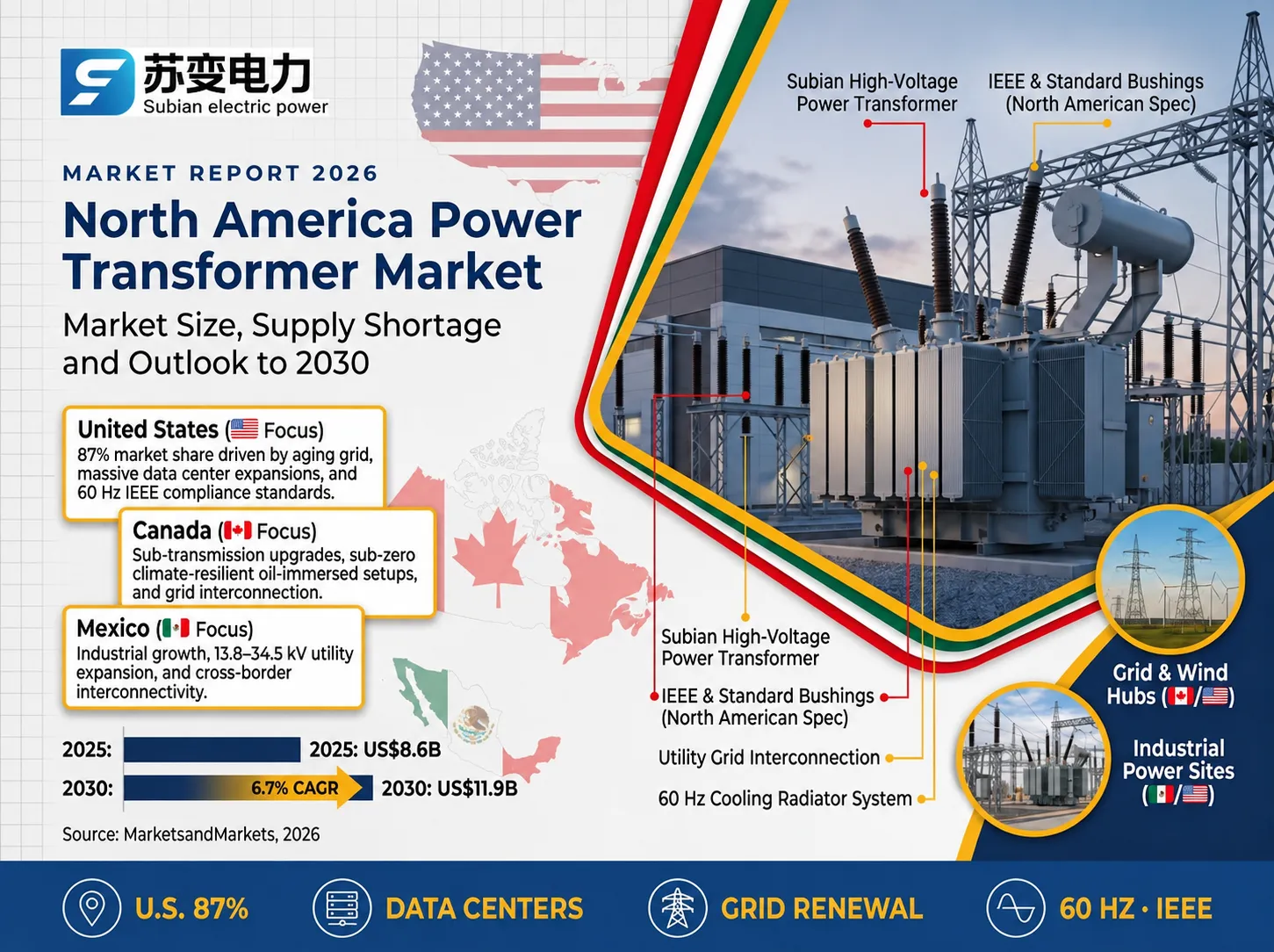
In short, according to MarketsandMarkets, North American transformer market was valued at approximately 8.6 billion dollars in 2025 and is forecasted to reach 11.9 billion by 2030, which corresponds to about 6.7 percent growth annually. The US constitutes about 87 percent of this market. Demand is driven by grid replacement technology, electrification, installations of renewables and demand for power transformers in AI data centers, while supply is hurt by import dependence, limited domestic availability of iron and multiyear factory building timeframes. Major manufacturers have announced more than one billion dollars of new capacities in North America, however, a number of big factories will not start producing until 2027-2029.
Brand names mentioned in this article belong to their owners. Subian Electric is an independent transformer manufacturer and is not affiliated with any company named here.
How Large Is the North America Power Transformer Market?
The 2025 Baseline and 2030 Forecast
MarketsandMarkets, in a report published in August 2026, estimates the North America power transformer market at US$8,590.5 million in 2025 and forecasts US$11,880.6 million by 2030, a compound annual growth rate of about 6.7 percent. The country figures behind that total are shown below.
| Country | 2025 estimate | 2030 forecast | Growth rate, 2025–2030 | Share of 2025 total |
|---|---|---|---|---|
| United States | US$7,441.7 million | US$10,349.9 million | 6.8 percent | About 87 percent |
| Canada | US$744.0 million | US$1,000.4 million | 6.1 percent | About 9 percent |
| Mexico | US$404.7 million | US$530.3 million | 5.6 percent | About 5 percent |
| North America | US$8,590.5 million | US$11,880.6 million | 6.7 percent | 100 percent |
One detail is worth flagging for anyone quoting these numbers. On the regional summary page, the country comparison chart shows the U.S. at US$10,349.9 million with a 2025 label. That figure is in fact the U.S. 2030 forecast, as the dedicated U.S. report confirms, and the three country estimates above add up to the regional total to within rounding. Use the country-level reports, not the summary chart, when citing a single year.
Why Market Size Estimates Differ
Other research firms reach different totals because they define the market differently.
| Source | Estimate | Scope notes |
|---|---|---|
| MarketsandMarkets (2026) | US$8.59 billion in 2025, US$11.88 billion by 2030 | United States, Canada and Mexico; power transformers |
| Strategic Revenue Insights (2026) | US$6.85 billion in 2025, US$13.11 billion by 2035 | Includes Central American countries; largest 2025 segments were 100–500 MVA units and renewable collector step-up transformers |
Some reports cover distribution transformers while others only account for units above specific MVA ratings and there are some that include Central America and Caribbean in their reports. There are much broader ‘transformers market’ reports that cover distribution transformers, dry-type transformers and instrument transformers too. Nevertheless, these numbers should not be summed or averaged out. The overall outcome is matched in all reports and is about 6-7% growth every year, which is a high rate for a mature industry.
Power Transformers vs Distribution Transformers
Power transformers are used at generation, transmission, and sub-transmission stations, usually at 69 kV and higher and from approximately 10 MVA to several hundred MVA. Large power transformers are usually regarded as those that are of 100 MVA and above, being custom-made, able to weigh several hundred tons and requiring special rail or road transport. Distribution transformers, on the other hand, lower the medium voltage for residential and commercial use and are manufactured in high volumes and via completely different supply chains. Both types of transformers are currently in short supply, but the reasons for that and the lead times involved are different.
What factors are driving demand for power transformers in North America?
Outdated Grid Infrastructure
Much of the North American grid infrastructure was installed between the 1960s and 1990s, and many of their substation transformers have surpassed their expected lifespan. Studies conducted by the U.S. National Renewable Energy Laboratory revealed that about half of distribution transformers in the U.S. are over 33 years old, which is similarly seen with large power transformers. As a result, utility companies are consistently replacing these devices in order to avoid costly breakdowns resulting in long downtimes.
Electrification and Resurgence of Manufacturing
Electric vehicles, heat pumps, and the revival of energy-intensive manufacturing, such as battery, semiconductor, and steel plants continue to escalate power demand after years of stagnation. Hence, any modern industrial plant requires high voltage substations.
Renewable Solutions, Storage, and Transmission Development
Every utility scale wind, solar, and battery project requires a collection and generator step up transformers as well as a new transmission line to connect to power grid. Hence, renewable step up transformers as well as substations rated at 100-500 MVA account for a large segment of the market.
How Is Transformer Demand Being Influenced by AI Data Centers?
Data centers have emerged as the most significant recent source of transformer demand. A report from Lawrence Berkeley National Laboratory for the U.S. Department of Energy concluded that data centers consumed around 4.4 percent of U.S. electrical energy in 2023, with the possibility of them consuming between 6.7 and 12 percent of it by 2028, mostly as a result of the influence of AI.
Load Concentration
A large AI facility may demand several hundred megawatts at one location, which is often more energy than a middle-sized town. The load arrives at a single point in the grid, thus the facility usually needs a dedicated transmission substation with several large power transformers.
Multiplication of Equipment due to Redundancy
Data centers are indeed built to be highly reliable, with N+1 or 2N backup typically included. Hence, the facility that has an electricity need of 200 MVAs may install much more transformer capacity than is required at a time of peak demand, and several medium voltage transformers in its internal structure. The EV charging market has undergone a similar development.
Connection Needs in Terms of the Grid
Because it takes years for power companies to construct new transmission power stations, many data center owners are treating transformer availability as a selection factor when choosing a site. Some companies have even begun to purchase the equipment with a long lead time in order to get a place in a factory to produce transformers.
Why Is the United States Facing a Power Transformer Shortage?
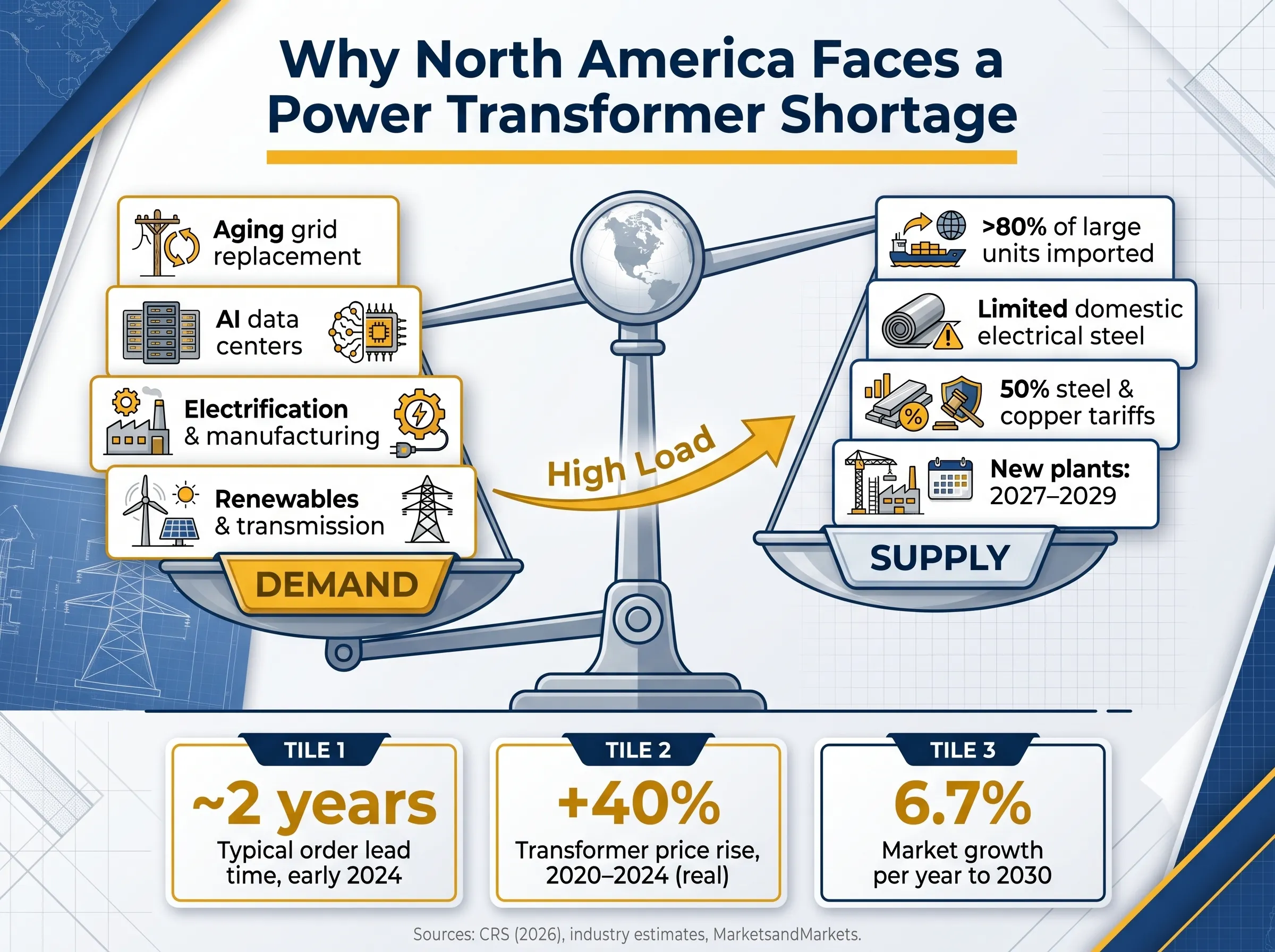
The power transformer shortage in the USA is the result of demand growing faster than a highly specialized supply chain can respond. The graphic below sums up both sides of the balance, and the table that follows sets out the evidence behind each constraint.
| Constraint | What the evidence shows |
|---|---|
| Import dependence | More than 80 percent of large power transformers used in the U.S. are imported, according to industry estimates cited by Siemens Energy. About 25 to 30 percent of finished distribution transformers were imported in 2023. |
| Electrical steel | The U.S. has one dominant domestic producer of grain-oriented electrical steel, and between half and three-quarters of the cores used in domestically assembled transformers are imported. |
| Tariffs | Section 232 tariffs on steel were raised to 50 percent in June 2025 and extended in August 2025 to derivative products including electrical cores and laminations; a 50 percent tariff also applies to certain copper products, including winding wire. |
| Prices | U.S. producer price data show transformer prices rose roughly 40 percent from 2020 to 2024 after inflation. |
| Lead times | Orders took about two years to fill in early 2024, roughly four times pre-2022 levels. Distribution transformer waits have since eased, but large custom units remain the longest-lead items. |
| Manufacturing and transport | Large units need skilled hand labor, heavy cranes, high-voltage test bays and special rail cars, so capacity cannot be added quickly. |
These figures come from a Congressional Research Service review of transformer supply published in April 2026 and from manufacturer statements. The overall picture is clear: even with strong investment, supply will take several years to catch up with demand.
Which Power Transformer Manufacturers Are Expanding in North America?
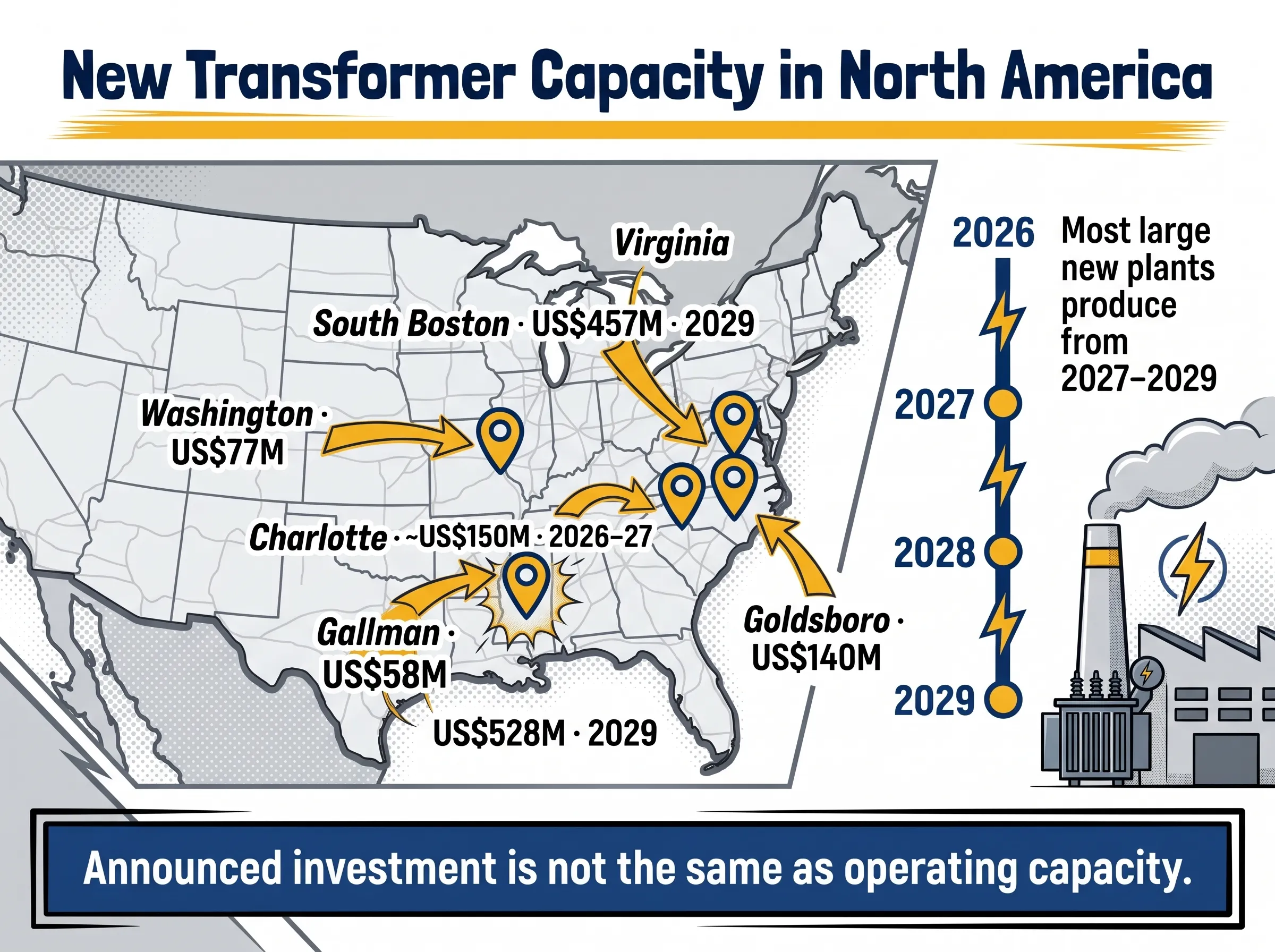
The leading power transformer manufacturers in North America have responded with a wave of investment. It is important to separate announced investment from operating capacity: several of the largest projects are still under construction. The map shows where the main projects are located and when they are expected to produce; the table gives the details.
| Manufacturer | Project | Investment | Status and timeline |
|---|---|---|---|
| Hitachi Energy | Large power transformer plant expansion, South Boston, Virginia | US$457 million, about 825 jobs | Ground broken June 2026; completion targeted for 2029 |
| Hitachi Energy | New power transformer factory, Gallman, Mississippi | US$528 million, more than 700 jobs | Announced September 2026; construction from late 2026, production planned for 2029 |
| Siemens Energy | Large power transformer factory, Charlotte, North Carolina | About US$150 million, 559 jobs | Announced February 2024; production originally targeted for early 2026, with later reports pointing to 2027 |
| Prolec GE | Goldsboro, North Carolina expansion | US$140 million, 330 jobs | Part of more than US$300 million of recent U.S. and Mexico investment; GE Vernova agreed in October 2025 to buy the remaining 50 percent of Prolec GE for about US$5.3 billion |
| WEG | Specialty transformer plant, Washington, Missouri | US$77 million, 50 jobs | Announced 2025; focused on 1–10 MVA units, planned 50 percent capacity increase |
Hitachi Energy describes the Virginia and Mississippi projects as part of a U.S. manufacturing program of roughly US$1.5 billion. For more detail on WEG’s North American range and factories, see our guide to WEG transformers and WEG Transformers USA.
The timing matters. If the largest new plants start producing in 2027 to 2029, then much of the demand growth forecast for 2025 to 2030 will have to be met by existing factories, imports and refurbishment before new domestic capacity arrives.
Comparison of the Markets in USA, Canada, and Mexico
USA
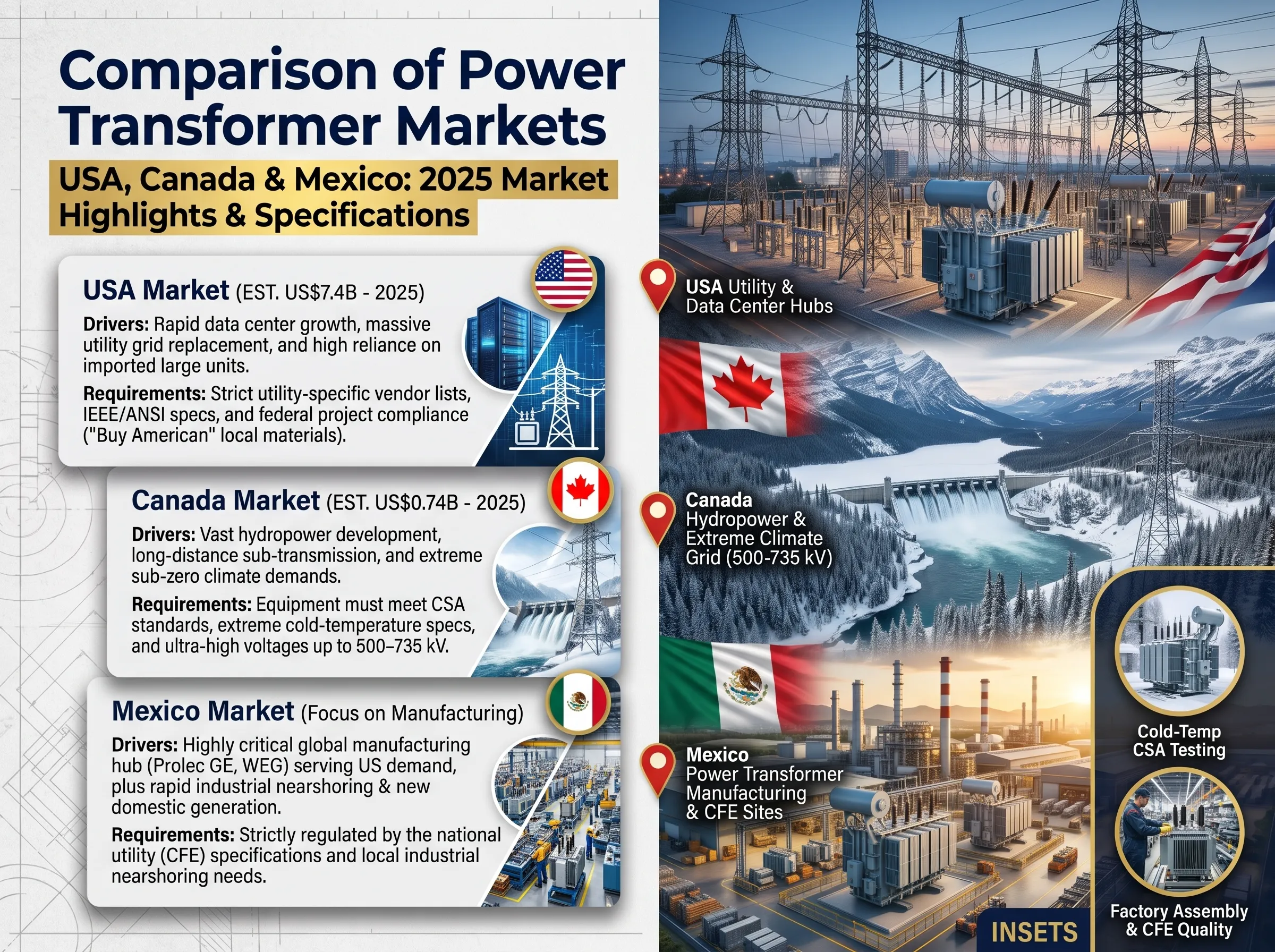
The power transformer market in the United States is leading the estimated value of about US$7.4 billion in the year of 2025, because of the great replacement requirements for the USA power transformers, allowing for fast growth of data centers and dependency on the imported large products. The utilities purchase power transformers according to the specifications and vendor lists, while there are also some federal projects whose requirements might include the use of locally manufactured materials.
Canada
The power transformer market in Canada is estimated to be approximately US$ 0.74 billion in the year of 2025, mainly due to the development of a huge hydropower system, long-distance electricity transmission, and severe climate conditions. The utilities from the provinces such as Quebec, Ontario, and British Columbia are using the high voltage level of even 500-735 kV, where their equipment is compliant with CSA standards and extremely low-temperature specifications.
Mexico
The situation in the Mexican power transformer market is slightly different as it is less developed in comparison with the USA, but very important as a manufacturing center for transformers. It produces the transformers for such companies as Prolec GE and WEG, using the United States as a market for its products. The domestic market for transformers is associated with the national utility company named CFE, industrial nearshoring, and the need for new power plants to be built. The projects are subject to the local regulations such as utility requirements and national standards from CFE for power transformers.
Which Power Transformer Types Are in Highest Demand?
| Transformer type | Typical rating | Main demand drivers |
|---|---|---|
| Large power transformers and autotransformers | 100 MVA and above, 230 to 765 kV | Transmission expansion, interconnections, data center substations |
| Generator step-up transformers | Tens to hundreds of MVA | Gas, nuclear uprates, wind, solar and storage |
| Substation power transformers | 10 to 100 MVA, 69 to 161 kV | Utility load growth, industrial campuses, sub-transmission |
| Collector and medium power transformers | 5 to 50 MVA, up to 46 kV | Renewable collector systems, battery storage, data center medium-voltage distribution |
| Distribution transformers (related segment) | Up to about 10 MVA | Housing, commercial loads, electrification |
According to the U.S. report by MarketsandMarkets, oil-cooled units are the leading cooling segment as well as the air-cooled units being the fastest growing one. Both oil-filled types still lead above a few MVA installations, while dry types have proved their superiority in indoor, urban and data center environments where fire safety is of high importance.
North American Transformer Standards and Procurement Requirements
Buyers sourcing from outside the region, or comparing suppliers who usually build to IEC standards, should understand how North American requirements differ.
| Item | North American practice | Typical IEC practice |
|---|---|---|
| Frequency | 60 Hz | 50 Hz in most markets |
| Transmission voltages | 115, 138, 161, 230, 345, 500 and 765 kV; 735 kV in Quebec | 110, 132, 220, 330, 400 and 500 kV |
| Main standards | IEEE C57.12.00 and C57.12.90 in the U.S.; CSA standards in Canada; CFE and NOM requirements in Mexico | IEC 60076 series |
| Temperature rise | 65 °C average winding rise, often with ONAN/ONAF/ONAF ratings | 65 °C winding and 60 °C top oil |
| Insulation levels | BIL values tied to North American voltage classes | Lightning impulse levels tied to IEC voltage classes |
| Approval | Utility specifications, design reviews and approved vendor lists | Type test reports and utility or consultant approval |
A transformer designed for 110 kV or 132 kV at 50 Hz cannot simply be offered for a 115 kV or 138 kV, 60 Hz substation. Voltage ratio, impedance, BIL, tap range, bushings, cooling stages and accessories all need to be engineered to the project specification, and test reports must follow the applicable standard.
Forecast of Power Transformer Market in North America until 2030
The analyses have nearly arrived at the same conclusion regarding the annual market growth of approximately 6%-7% until at least 2030. The following factors will determine whether forecasts hold true.
Timely availability of newly constructed capacity: several largest domestic power transformer plants will become operational by 2027-2029 while at least one of them has missed the deadlines.
Import and export regulations: the supply of steel and copper, tariffs, or trade rules adjustment will affect expenses for the units produced domestically or imported.
Pace of large-load connections: establishing data centers and industrial projects can be postponed, resized, or cancelled, thus significantly altering demand.
Market forecasts are models and not actual orders. They let the buyers understand the direction of the market but the planning must rely on confirmed capacities of suppliers and real delivery dates rather than sensational rates of market development.
What Should Transformer Buyers Check Before Sourcing?
With long lead times and limited factory slots, a clear specification and an early start matter more than ever.
| Category | What to confirm |
|---|---|
| Electrical data | MVA rating and cooling stages, voltage ratio, frequency, impedance, BIL, vector group, tap changer type and range |
| Standards | IEEE C57 or CSA requirements, utility specifications and any Mexican CFE or NOM requirements |
| Losses | Guaranteed no-load and load losses, evaluated on total owning cost |
| Design review | Short-circuit withstand, sound level, transport dimensions and weights |
| Testing | Routine, type and special tests; witness testing; factory acceptance test plan |
| Approval | Whether the supplier is on the utility’s approved vendor list or needs qualification |
| Delivery | Confirmed factory slot, shipping route, heavy-haul transport and site installation support |
| Commercial | Warranty, spare parts, domestic content requirements and tariff exposure |
Where Subian Electric Fits
Subian Electric builds oil-immersed and dry-type transformers and prefabricated substations at its factory in Xuzhou, China, mainly to IEC standards for international projects. Relevant product families include 110–132 kV oil-immersed transformers, 35 kV-class oil-immersed power transformers and three-phase pad-mounted transformers. These are IEC-based designs, and Subian does not claim existing North American utility approval. For any North American enquiry, the design would need to be engineered to the project’s 60 Hz voltage ratios, BIL, standards and utility specification, with test documentation reviewed before award. For a view of a fast-growing market in South America, see our Brazil power transformer market analysis.
Frequently Asked Questions
How big is the North America power transformer market?
MarketsandMarkets estimates the market at about US$8.59 billion in 2025, rising to about US$11.88 billion by 2030, a growth rate of about 6.7 percent a year. Other firms using different scopes report different totals.
What is driving power transformer demand in the United States?
Replacement of aging equipment, electrification, new manufacturing plants, renewable and storage connections, transmission expansion and the rapid growth of AI data centers.
Why are large power transformers in short supply?
Most large units used in the U.S. are imported, domestic electrical steel supply is limited, tariffs have raised material costs, and building and testing large units requires specialized factories that take years to add.
Who are the major power transformer manufacturers in North America?
Major suppliers include Hitachi Energy, Siemens Energy, Prolec GE, WEG and others, along with importers. Several are building or expanding North American plants scheduled to produce between 2026 and 2029.
How long does it take to get a large power transformer?
Lead times vary by supplier and rating. In early 2024 orders were taking about two years, and large custom units remain among the longest-lead items in the power sector.
What is the difference between power and distribution transformers?
Power transformers serve generation and transmission substations, usually at 69 kV and above. Distribution transformers step medium voltage down for end users and are produced in much higher volumes.
Does North America use 50 Hz or 60 Hz transformers?
The United States, Canada and Mexico all operate 60 Hz grids, so transformers must be designed and tested for 60 Hz.
Can imported transformers meet U.S. utility requirements?
Yes, imports already supply most U.S. large power transformers. They must meet the utility’s specification and IEEE standards, pass the required tests and, in many cases, come from a supplier on the utility’s approved vendor list.
References
- MarketsandMarkets: North America Power Transformer Market, 2025–2030
- MarketsandMarkets: US Power Transformer Market, 2025–2030
- Congressional Research Service: Electricity Distribution Transformers, Supply, Tariffs and Policy Options (2026)
- ENR: Hitachi breaks ground on US$457M Virginia transformer plant expansion
- Interesting Engineering: Hitachi Energy US$528M Mississippi transformer plant
- Manufacturing Dive: Siemens Energy large power transformer facility in Charlotte
- T&D World: GE Vernova to acquire remaining 50 percent stake of Prolec GE
The North American market is growing steadily, but the real constraint for most projects is not demand; it is getting the right transformer, built to the right specification, delivered on time. Jiangsu Subian Electric Power Equipment Co., Ltd. designs and builds oil-immersed transformers, dry-type transformers and prefabricated substations for international projects, engineered to each project’s frequency, voltage and standard. For private-label or distributor supply, see our OEM and ODM programme. Send your specification through our contact page, and our engineers will review the requirements and reply with a technical proposal and factory quotation.