


В Северной Америке стало сложно приобрести силовые трансформаторы по сравнению с другим оборудованием сетей. На это влияют различные факторы: коммунальные компании обновляют свои старые парки трансформаторов, центры обработки данных требуют огромных источников энергии, а новые проекты по генерации и передаче электроэнергии стремятся приобрести трансформаторы, способные повышать и понижать уровни напряжения. Более того, на рынке всегда было очень мало производителей трансформаторов, что подразумевает импорт продукции. Поставщики всегда сталкивались с проблемой тарифов на некоторые ключевые материалы, что приводит к проблемам с поставками.
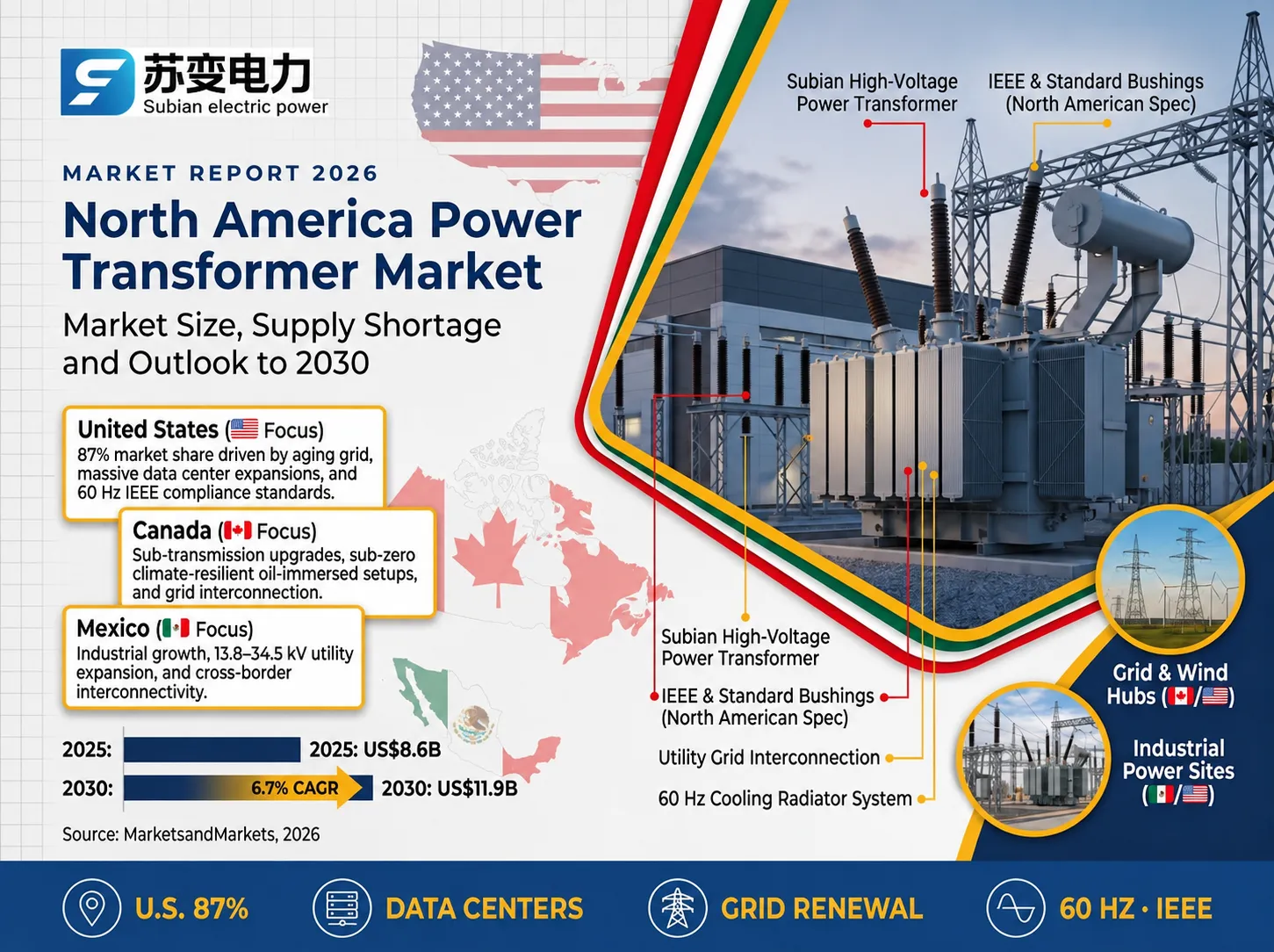
Короче говоря, согласно MarketsandMarkets, Рынок трансформаторов Северной Америки был оценен примерно в 8,6 миллиарда долларов в 2025 году и прогнозируется достичь 11,9 миллиарда к 2030 году, что соответствует примерно 6,7% ежегодного роста. США составляют около 87% этого рынка. Спрос обусловлен технологиями замены сетей, электрификацией, установкой возобновляемых источников энергии и спросом на силовые трансформаторы в AI-центрах обработки данных, в то время как предложение страдает из-за зависимости от импорта, ограниченной внутренней доступности железа и многолетних сроков строительства заводов. Крупные производители объявили о новых мощностях на сумму более одного миллиарда долларов в Северной Америке, однако ряд крупных заводов начнут производство только в 2027-2029 годах.
Торговые марки, упомянутые в этой статье, принадлежат их владельцам. Subian Electric является независимым производителем трансформаторов и не аффилирован с какой-либо компанией, упомянутой здесь.
Насколько велик рынок силовых трансформаторов Северной Америки?
Базовый уровень 2025 года и прогноз на 2030 год
MarketsandMarkets в отчете, опубликованном в августе 2026 года, оценивает рынок силовых трансформаторов Северной Америки в 8 590,5 миллионов долларов США в 2025 году и прогнозирует 11 880,6 миллионов долларов США к 2030 году, что соответствует среднегодовому темпу роста около 6,7%. Ниже приведены данные по странам, составляющим эту сумму.
| Страна | 2025 estimate | Прогноз на 2030 год | Темп роста, 2025–2030 | Доля от общего объема 2025 года |
|---|---|---|---|---|
| Соединенные Штаты | 7 441,7 миллиона долларов США | 10 349,9 миллиона долларов США | 6,8 процента | Около 87 процентов |
| Канада | 744,0 миллиона долларов США | 1 000,4 миллиона долларов США | 6,1 процента | Около 9 процентов |
| Мексика | 404,7 миллиона долларов США | 530,3 миллиона долларов США | 5,6 процента | Около 5 процентов |
| Северная Америка | 8 590,5 миллиона долларов США | 11 880,6 миллиона долларов США | 6,7 процента | 100 процентов |
Один момент стоит отметить для тех, кто цитирует эти цифры. На странице регионального обзора диаграмма сравнения стран показывает США с 10 349,9 миллиона долларов США с пометкой 2025 год. Эта цифра на самом деле является прогнозом США на 2030 год, как подтверждает отдельный отчет по США, а три оценки по странам выше в сумме дают региональный итог с точностью до округления. При цитировании данных за один год используйте отчеты по странам, а не сводную диаграмму.
Why Market Size Estimates Differ
Другие исследовательские компании получают разные итоги, поскольку они по-разному определяют рынок.
| Источник | Оценка | Примечания к области охвата |
|---|---|---|
| MarketsandMarkets (2026) | 8,59 миллиарда долларов США в 2025 году, 11,88 миллиарда долларов США к 2030 году | США, Канада и Мексика; силовые трансформаторы |
| Strategic Revenue Insights (2026) | 6,85 миллиарда долларов США в 2025 году, 13,11 миллиарда долларов США к 2035 году | Включает страны Центральной Америки; крупнейшими сегментами в 2025 году были блоки мощностью 100–500 МВА и трансформаторы повышения напряжения для возобновляемых источников энергии |
Некоторые отчёты охватывают распределительные трансформаторы, в то время как другие учитывают только блоки с определёнными рейтингами МВА, а также есть отчёты, включающие Центральную Америку и Карибский регион. Существуют более широкие отчёты по ‘рынку трансформаторов’, которые охватывают распределительные трансформаторы, сухие трансформаторы и измерительные трансформаторы. Тем не менее, эти показатели не следует суммировать или усреднять. Общий результат совпадает во всех отчётах и составляет около 6-7% роста ежегодно, что является высоким показателем для зрелой отрасли.
Силовые трансформаторы против распределительных трансформаторов
Силовые трансформаторы используются на электростанциях, линиях передачи и подстанциях, обычно при напряжении 69 кВ и выше и мощностью от примерно 10 МВА до нескольких сотен МВА. Крупные силовые трансформаторы обычно считаются трансформаторами мощностью 100 МВА и выше, изготавливаются на заказ, могут весить несколько сотен тонн и требуют специального железнодорожного или автомобильного транспорта. Распределительные трансформаторы, напротив, понижают среднее напряжение для жилых и коммерческих нужд и производятся в больших объёмах по совершенно другим цепочкам поставок. В настоящее время оба типа трансформаторов испытывают дефицит, но причины и сроки поставки различаются.
Какие факторы стимулируют спрос на силовые трансформаторы в Северной Америке?
Устаревшая инфраструктура сети
Большая часть инфраструктуры электросети Северной Америки была установлена в период с 1960-х по 1990-е годы, и многие трансформаторы подстанций превысили ожидаемый срок службы. Исследования, проведённые Национальной лабораторией возобновляемой энергии США, показали, что около половины распределительных трансформаторов в США старше 33 лет, что аналогично наблюдается и у крупных силовых трансформаторов. В результате коммунальные компании постоянно заменяют эти устройства, чтобы избежать дорогостоящих поломок и длительных простоев.
Электрификация и возрождение производства
Электромобили, тепловые насосы и возрождение энергоёмкого производства, такого как заводы по производству аккумуляторов, полупроводников и стали, продолжают увеличивать спрос на электроэнергию после многих лет стагнации. Следовательно, любому современному промышленному предприятию необходимы подстанции высокого напряжения.
Возобновляемые решения, хранение и развитие передачи энергии
Каждый проект ветровой, солнечной и аккумуляторной энергетики крупного масштаба требует трансформаторов сбора и повышения напряжения генератора, а также новой линии передачи для подключения к электросети. Следовательно, трансформаторы повышения напряжения для возобновляемых источников энергии, а также подстанции мощностью 100-500 МВА составляют значительный сегмент рынка.
Как спрос на трансформаторы влияет на центры обработки данных с ИИ?
Data centers have emerged as the most significant recent source of transformer demand. A report from Lawrence Berkeley National Laboratory for the U.S. Department of Energy concluded that data centers consumed around 4.4 percent of U.S. electrical energy in 2023, with the possibility of them consuming between 6.7 and 12 percent of it by 2028, mostly as a result of the influence of AI.
Load Concentration
A large AI facility may demand several hundred megawatts at one location, which is often more energy than a middle-sized town. The load arrives at a single point in the grid, thus the facility usually needs a dedicated transmission substation with several large power transformers.
Multiplication of Equipment due to Redundancy
Data centers are indeed built to be highly reliable, with N+1 or 2N backup typically included. Hence, the facility that has an electricity need of 200 MVAs may install much more transformer capacity than is required at a time of peak demand, and several medium voltage transformers in its internal structure. The EV charging market has undergone a similar development.
Connection Needs in Terms of the Grid
Because it takes years for power companies to construct new transmission power stations, many data center owners are treating transformer availability as a selection factor when choosing a site. Some companies have even begun to purchase the equipment with a long lead time in order to get a place in a factory to produce transformers.
Why Is the United States Facing a Power Transformer Shortage?
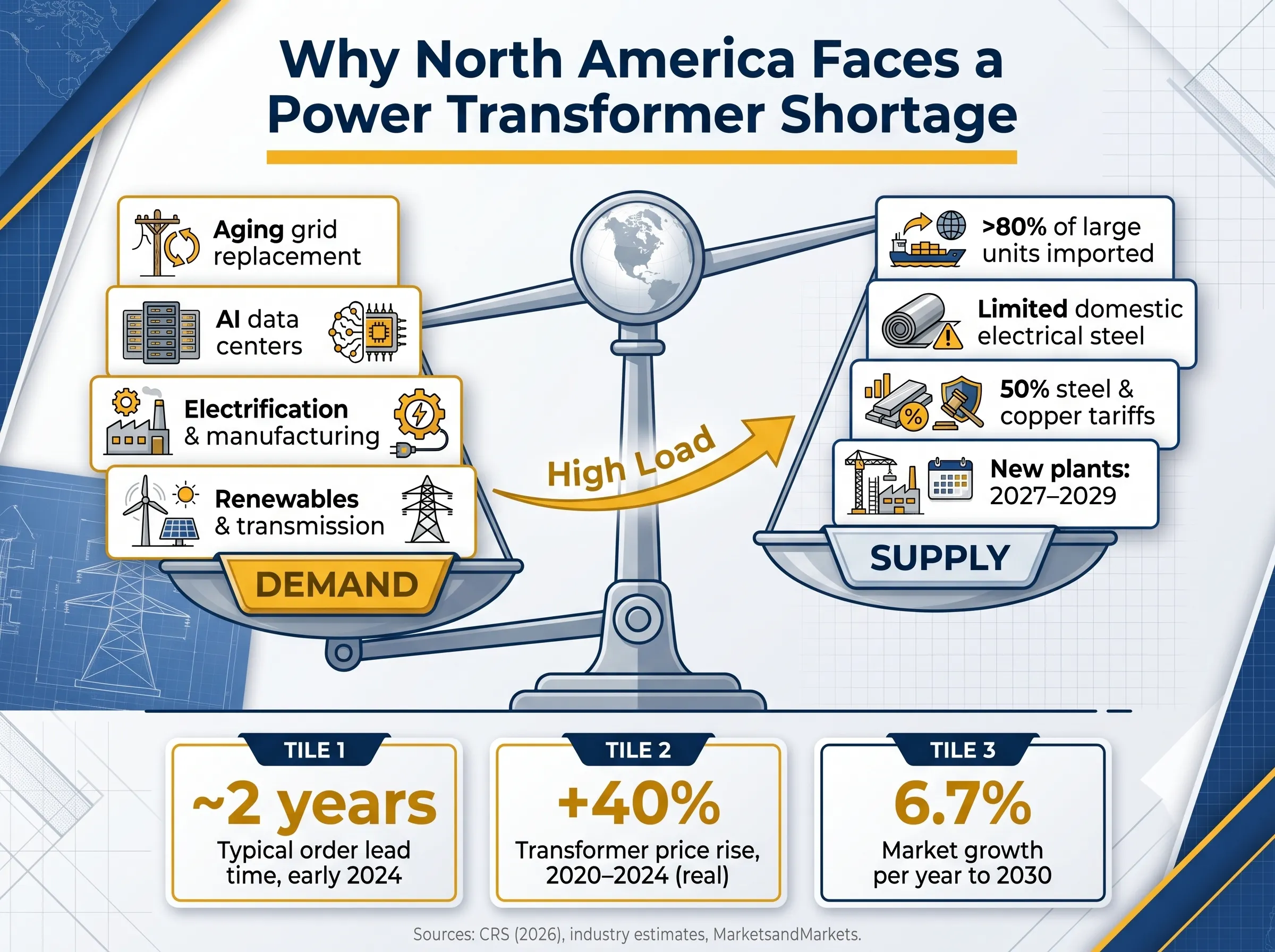
Этот power transformer shortage in the USA is the result of demand growing faster than a highly specialized supply chain can respond. The graphic below sums up both sides of the balance, and the table that follows sets out the evidence behind each constraint.
| Constraint | What the evidence shows |
|---|---|
| Import dependence | More than 80 percent of large power transformers used in the U.S. are imported, according to industry estimates cited by Siemens Energy. About 25 to 30 percent of finished distribution transformers were imported in 2023. |
| Electrical steel | The U.S. has one dominant domestic producer of grain-oriented electrical steel, and between half and three-quarters of the cores used in domestically assembled transformers are imported. |
| Tariffs | Section 232 tariffs on steel were raised to 50 percent in June 2025 and extended in August 2025 to derivative products including electrical cores and laminations; a 50 percent tariff also applies to certain copper products, including winding wire. |
| Prices | U.S. producer price data show transformer prices rose roughly 40 percent from 2020 to 2024 after inflation. |
| Lead times | Orders took about two years to fill in early 2024, roughly four times pre-2022 levels. Distribution transformer waits have since eased, but large custom units remain the longest-lead items. |
| Manufacturing and transport | Large units need skilled hand labor, heavy cranes, high-voltage test bays and special rail cars, so capacity cannot be added quickly. |
These figures come from a Congressional Research Service review of transformer supply published in April 2026 and from manufacturer statements. The overall picture is clear: even with strong investment, supply will take several years to catch up with demand.
Which Power Transformer Manufacturers Are Expanding in North America?
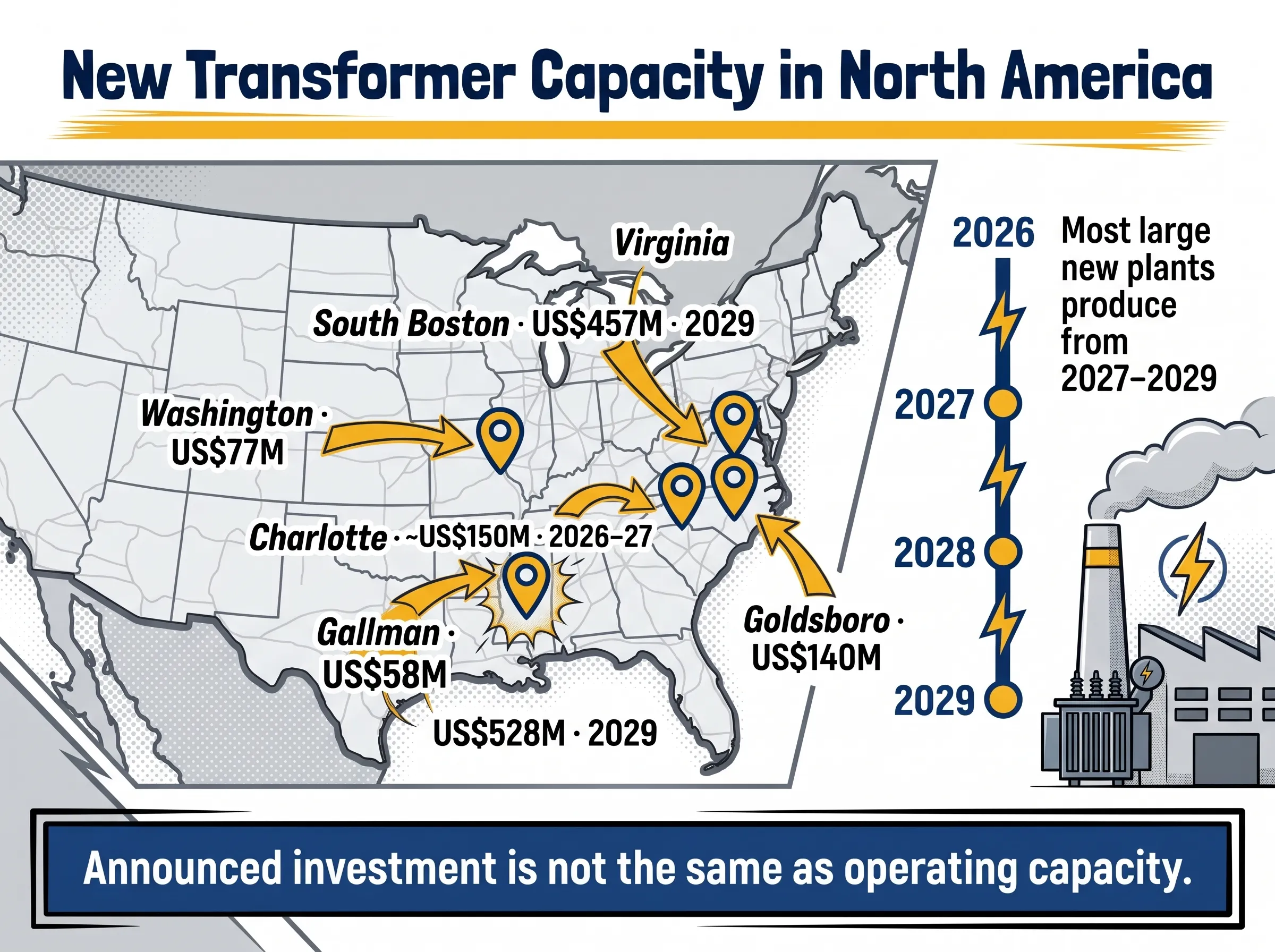
The leading power transformer manufacturers in North America have responded with a wave of investment. It is important to separate announced investment from operating capacity: several of the largest projects are still under construction. The map shows where the main projects are located and when they are expected to produce; the table gives the details.
| Производитель | Проект | Инвестиции | Status and timeline |
|---|---|---|---|
| Hitachi Energy | Large power transformer plant expansion, South Boston, Virginia | US$457 million, about 825 jobs | Ground broken June 2026; completion targeted for 2029 |
| Hitachi Energy | New power transformer factory, Gallman, Mississippi | US$528 million, more than 700 jobs | Announced September 2026; construction from late 2026, production planned for 2029 |
| Siemens Energy | Large power transformer factory, Charlotte, North Carolina | About US$150 million, 559 jobs | Announced February 2024; production originally targeted for early 2026, with later reports pointing to 2027 |
| Prolec GE | Goldsboro, North Carolina expansion | US$140 million, 330 jobs | Part of more than US$300 million of recent U.S. and Mexico investment; GE Vernova agreed in October 2025 to buy the remaining 50 percent of Prolec GE for about US$5.3 billion |
| WEG | Specialty transformer plant, Washington, Missouri | US$77 million, 50 jobs | Announced 2025; focused on 1–10 MVA units, planned 50 percent capacity increase |
Hitachi Energy describes the Virginia and Mississippi projects as part of a U.S. manufacturing program of roughly US$1.5 billion. For more detail on WEG’s North American range and factories, see our guide to WEG transformers and WEG Transformers USA.
The timing matters. If the largest new plants start producing in 2027 to 2029, then much of the demand growth forecast for 2025 to 2030 will have to be met by existing factories, imports and refurbishment before new domestic capacity arrives.
Comparison of the Markets in USA, Canada, and Mexico
США
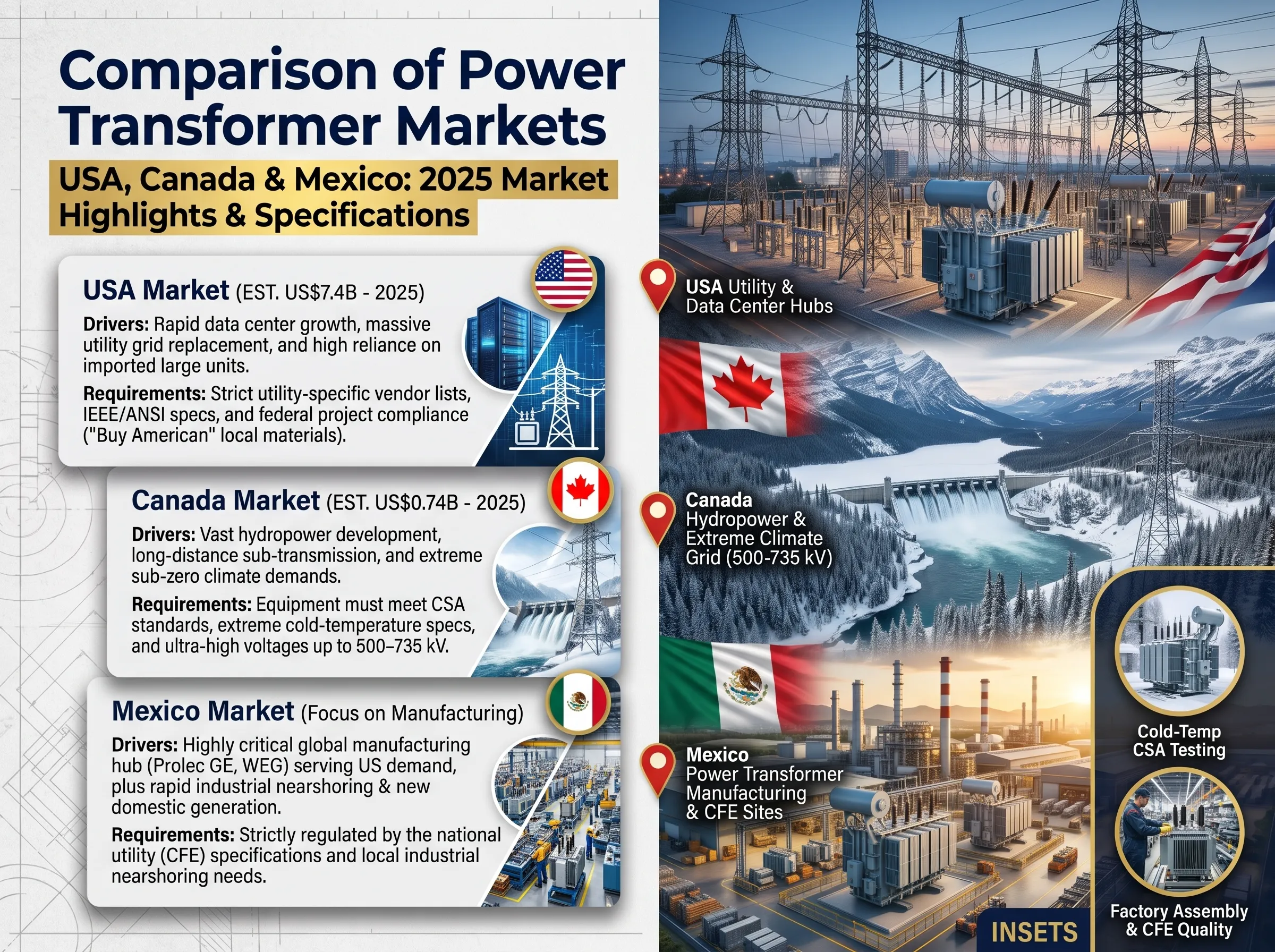
The power transformer market in the United States is leading the estimated value of about US$7.4 billion in the year of 2025, because of the great replacement requirements for the USA power transformers, allowing for fast growth of data centers and dependency on the imported large products. The utilities purchase power transformers according to the specifications and vendor lists, while there are also some federal projects whose requirements might include the use of locally manufactured materials.
Канада
The power transformer market in Canada is estimated to be approximately US$ 0.74 billion in the year of 2025, mainly due to the development of a huge hydropower system, long-distance electricity transmission, and severe climate conditions. The utilities from the provinces such as Quebec, Ontario, and British Columbia are using the high voltage level of even 500-735 kV, where their equipment is compliant with CSA standards and extremely low-temperature specifications.
Мексика
The situation in the Mexican power transformer market is slightly different as it is less developed in comparison with the USA, but very important as a manufacturing center for transformers. It produces the transformers for such companies as Prolec GE and WEG, using the United States as a market for its products. The domestic market for transformers is associated with the national utility company named CFE, industrial nearshoring, and the need for new power plants to be built. The projects are subject to the local regulations such as utility requirements and national standards from CFE for power transformers.
Which Power Transformer Types Are in Highest Demand?
| Transformer type | Типичное номинование | Основные факторы спроса |
|---|---|---|
| Large power transformers and autotransformers | 100 MVA and above, 230 to 765 kV | Transmission expansion, interconnections, data center substations |
| Generator step-up transformers | Десятки до сотен МВА | Gas, nuclear uprates, wind, solar and storage |
| Силовые трансформаторы подстанций | 10 to 100 MVA, 69 to 161 kV | Utility load growth, industrial campuses, sub-transmission |
| Collector and medium power transformers | 5 to 50 MVA, up to 46 kV | Renewable collector systems, battery storage, data center medium-voltage distribution |
| Distribution transformers (related segment) | Up to about 10 MVA | Housing, commercial loads, electrification |
According to the U.S. report by MarketsandMarkets, oil-cooled units are the leading cooling segment as well as the air-cooled units being the fastest growing one. Both oil-filled types still lead above a few MVA installations, while dry types have proved their superiority in indoor, urban and data center environments where fire safety is of high importance.
North American Transformer Standards and Procurement Requirements
Buyers sourcing from outside the region, or comparing suppliers who usually build to IEC standards, should understand how North American requirements differ.
| Артикул | North American practice | Typical IEC practice |
|---|---|---|
| Частота | 60 Гц | 50 Hz in most markets |
| Transmission voltages | 115, 138, 161, 230, 345, 500 and 765 kV; 735 kV in Quebec | 110, 132, 220, 330, 400 and 500 kV |
| Основные стандарты | IEEE C57.12.00 and C57.12.90 in the U.S.; CSA standards in Canada; CFE and NOM requirements in Mexico | IEC 60076 серия |
| Повышение температуры | 65 °C average winding rise, often with ONAN/ONAF/ONAF ratings | 65 °C winding and 60 °C top oil |
| Insulation levels | BIL values tied to North American voltage classes | Lightning impulse levels tied to IEC voltage classes |
| Approval | Utility specifications, design reviews and approved vendor lists | Отчеты о типовых испытаниях и одобрение коммунальных служб или консультантов |
A transformer designed for 110 kV or 132 kV at 50 Hz cannot simply be offered for a 115 kV or 138 kV, 60 Hz substation. Voltage ratio, impedance, BIL, tap range, bushings, cooling stages and accessories all need to be engineered to the project specification, and test reports must follow the applicable standard.
Forecast of Power Transformer Market in North America until 2030
The analyses have nearly arrived at the same conclusion regarding the annual market growth of approximately 6%-7% until at least 2030. The following factors will determine whether forecasts hold true.
Timely availability of newly constructed capacity: several largest domestic power transformer plants will become operational by 2027-2029 while at least one of them has missed the deadlines.
Import and export regulations: the supply of steel and copper, tariffs, or trade rules adjustment will affect expenses for the units produced domestically or imported.
Pace of large-load connections: establishing data centers and industrial projects can be postponed, resized, or cancelled, thus significantly altering demand.
Market forecasts are models and not actual orders. They let the buyers understand the direction of the market but the planning must rely on confirmed capacities of suppliers and real delivery dates rather than sensational rates of market development.
What Should Transformer Buyers Check Before Sourcing?
With long lead times and limited factory slots, a clear specification and an early start matter more than ever.
| Категория | Что подтвердить |
|---|---|
| Electrical data | MVA rating and cooling stages, voltage ratio, frequency, impedance, BIL, vector group, tap changer type and range |
| Стандарты | IEEE C57 or CSA requirements, utility specifications and any Mexican CFE or NOM requirements |
| Потери | Guaranteed no-load and load losses, evaluated on total owning cost |
| Design review | Short-circuit withstand, sound level, transport dimensions and weights |
| Испытания | Routine, type and special tests; witness testing; factory acceptance test plan |
| Approval | Whether the supplier is on the utility’s approved vendor list or needs qualification |
| Доставка | Confirmed factory slot, shipping route, heavy-haul transport and site installation support |
| Коммерческое | Warranty, spare parts, domestic content requirements and tariff exposure |
Where Subian Electric Fits
Subian Electric builds oil-immersed and dry-type transformers and prefabricated substations at its factory in Xuzhou, China, mainly to IEC standards for international projects. Relevant product families include 110–132 kV oil-immersed transformers, 35 kV-class oil-immersed power transformers изоляции трехфазные трансформаторы на подставке. These are IEC-based designs, and Subian does not claim existing North American utility approval. For any North American enquiry, the design would need to be engineered to the project’s 60 Hz voltage ratios, BIL, standards and utility specification, with test documentation reviewed before award. For a view of a fast-growing market in South America, see our Brazil power transformer market analysis.
Часто задаваемые вопросы
How big is the North America power transformer market?
MarketsandMarkets estimates the market at about US$8.59 billion in 2025, rising to about US$11.88 billion by 2030, a growth rate of about 6.7 percent a year. Other firms using different scopes report different totals.
What is driving power transformer demand in the United States?
Replacement of aging equipment, electrification, new manufacturing plants, renewable and storage connections, transmission expansion and the rapid growth of AI data centers.
Why are large power transformers in short supply?
Most large units used in the U.S. are imported, domestic electrical steel supply is limited, tariffs have raised material costs, and building and testing large units requires specialized factories that take years to add.
Who are the major power transformer manufacturers in North America?
Major suppliers include Hitachi Energy, Siemens Energy, Prolec GE, WEG and others, along with importers. Several are building or expanding North American plants scheduled to produce between 2026 and 2029.
How long does it take to get a large power transformer?
Lead times vary by supplier and rating. In early 2024 orders were taking about two years, and large custom units remain among the longest-lead items in the power sector.
What is the difference between power and distribution transformers?
Power transformers serve generation and transmission substations, usually at 69 kV and above. Distribution transformers step medium voltage down for end users and are produced in much higher volumes.
Does North America use 50 Hz or 60 Hz transformers?
The United States, Canada and Mexico all operate 60 Hz grids, so transformers must be designed and tested for 60 Hz.
Can imported transformers meet U.S. utility requirements?
Yes, imports already supply most U.S. large power transformers. They must meet the utility’s specification and IEEE standards, pass the required tests and, in many cases, come from a supplier on the utility’s approved vendor list.
Ссылки
- MarketsandMarkets: North America Power Transformer Market, 2025–2030
- MarketsandMarkets: US Power Transformer Market, 2025–2030
- Congressional Research Service: Electricity Distribution Transformers, Supply, Tariffs and Policy Options (2026)
- ENR: Hitachi breaks ground on US$457M Virginia transformer plant expansion
- Interesting Engineering: Hitachi Energy US$528M Mississippi transformer plant
- Manufacturing Dive: Siemens Energy large power transformer facility in Charlotte
- T&D World: GE Vernova to acquire remaining 50 percent stake of Prolec GE
The North American market is growing steadily, but the real constraint for most projects is not demand; it is getting the right transformer, built to the right specification, delivered on time. Jiangsu Subian Electric Power Equipment Co., Ltd. designs and builds 6-10 кВ масляный распределительный трансформатор, dry-type transformers and prefabricated substations for international projects, engineered to each project’s frequency, voltage and standard. For private-label or distributor supply, see our программу OEM и ODM. Send your specification through our страницу контактов, and our engineers will review the requirements and reply with a technical proposal and factory quotation.