


Industrial transformers are the equipment that determines whether or not a plant will function at all. They are also the last piece of equipment anyone thinks about until it breaks down. Industrial transformers take in the voltage from the electric company and convert it into the voltage that the components of the machinery require. In addition, the transformers determine the fault current, the protection scheme, and much of the cost of electricity for the next thirty years.
In short, an industrial transformer reduces and increases voltages between the supply and the distribution system of a plant. Industrial voltage transformers are typically rated at 11 kV or 33 kV down to 400 V, 480 V, or 690 V. The primary types of transformers are oil immersed, cast resin dry type, and unit substations. A single unit of a 1,000 kVA dry type transformer will cost approximately $18,000 to $45,000 at the ex-works price, while an oil immersed unit with the same rating will be about 25% to 40% less expensive to purchase but will cost more to site.
There will be some principles and regulations which you cannot alter later. The most important ones are voltage ratio, impedance, vector group, and temperature rise.The last section is about the place of a factory supplier and about other cases when factory suppliers are not included.
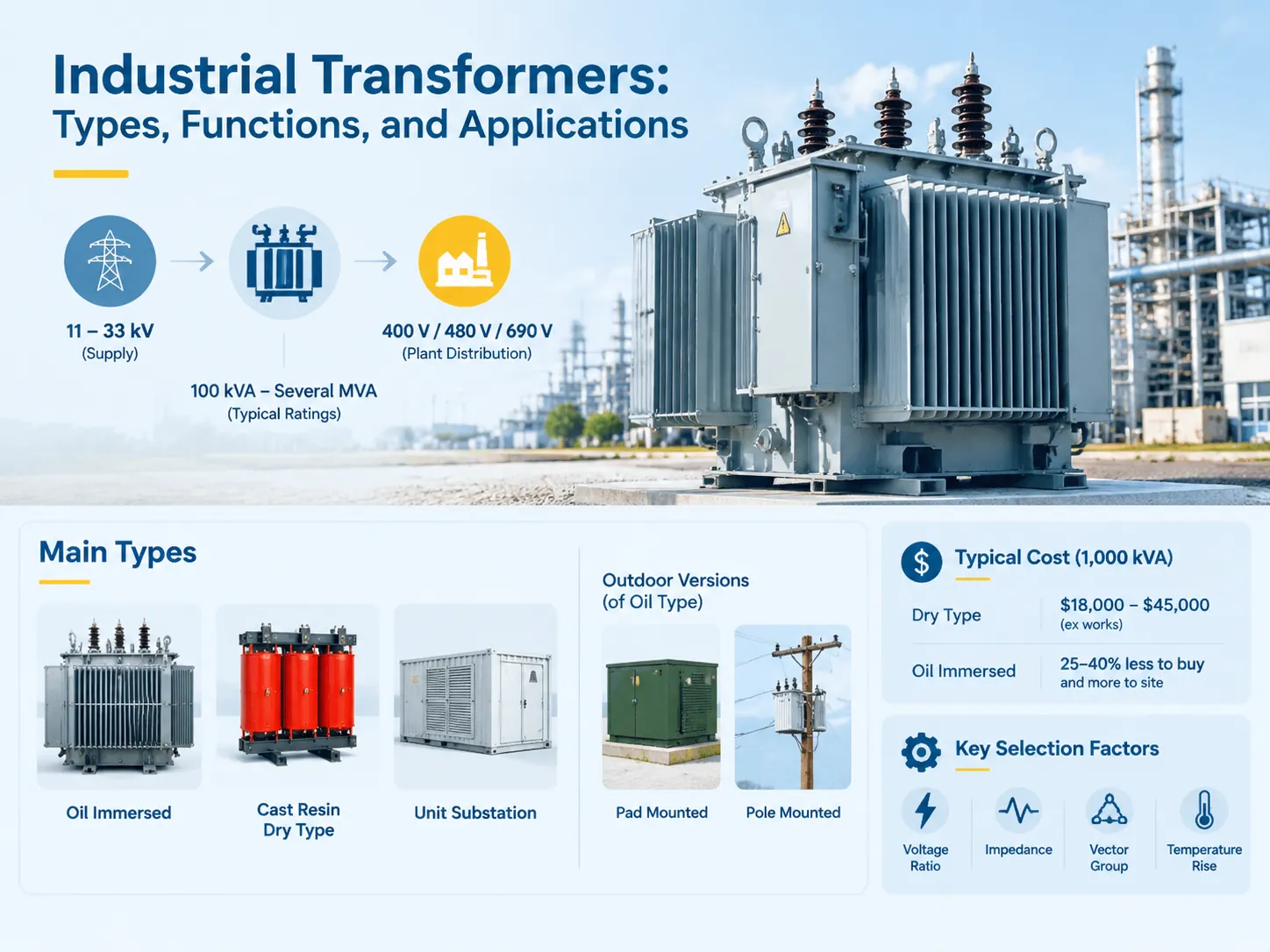
What is Industrial Transformer?
It is one of the static devices that work without moving parts. This device transfers electric energy from one circuit to other circuit by utilizing magnetic fields. In industrial usage, the term industrial transformer involves transformers used in factories, power plants and industries. Thus it differs from transmission transformer or distribution transformer in a pole.
The loading capacity starts from 100 kVA for one machine center to 20 MVA or more for industrial substation transformer. The voltage at primary side depends on the utility provided or internal ring main supply. Normally it is about 11, 13.8, 20, 22, 33 or 34.5 kV. On secondary side voltage will equal to utility voltage which normally ranges 400 V for most of countries, 480 V for USA and 690 V for heavy motor systems.
Industrial transformer distinguishes from commercial transformers in relation to three factors. First of all, it has been created for continuous operation under similar load. Second, it includes harmonic loads which create certain requirements for its winding and neutral design. Finally, industrial transformer is required to have required K-factor to give its platform against harmonic violations
How the Transformer works: 3 key Functions of a Transformer
As the primary coil circuit receives alternating current, the primary coil creates fluctuating magnetic field inside the core, and due to this magnetic field voltage is induced on the secondary coil. The primary coil and secondary coil have certain number of coil turns, which creates a specific voltage ratio in the transformer. That is why it is true that a transformer having 1000 primary turns and 100 secondary turns would reduce the 11 k volts to 1.1 k volts.
It converts voltage and current in contrary proportion. Power can never be generated through a transformer. When we talk about a power transformer, with 1000 kVA power rating and 11 k volts input it can draw about 52 Amperes at primary side and give hundreds of amperes at 400 volts.
It serves isolation between the circuits. There is no way of establishing electrical connection between circuits. Only field is there between them. That is why the electrical plant can ground secondary neutral independently and in the same way it may be used with isolation transformer in order to suppress high frequency noise.
It makes phase relationship as well. The way of connecting windings (delta or Y type) establishes phase-shift between input and output voltage.
The heat produced in the core is due to the energy loss from the flux reversal and the winding losses when current is drawn. The above losses are the topic for the section discussing efficiency and are also the major contributors to the total cost of maintaining transformers.
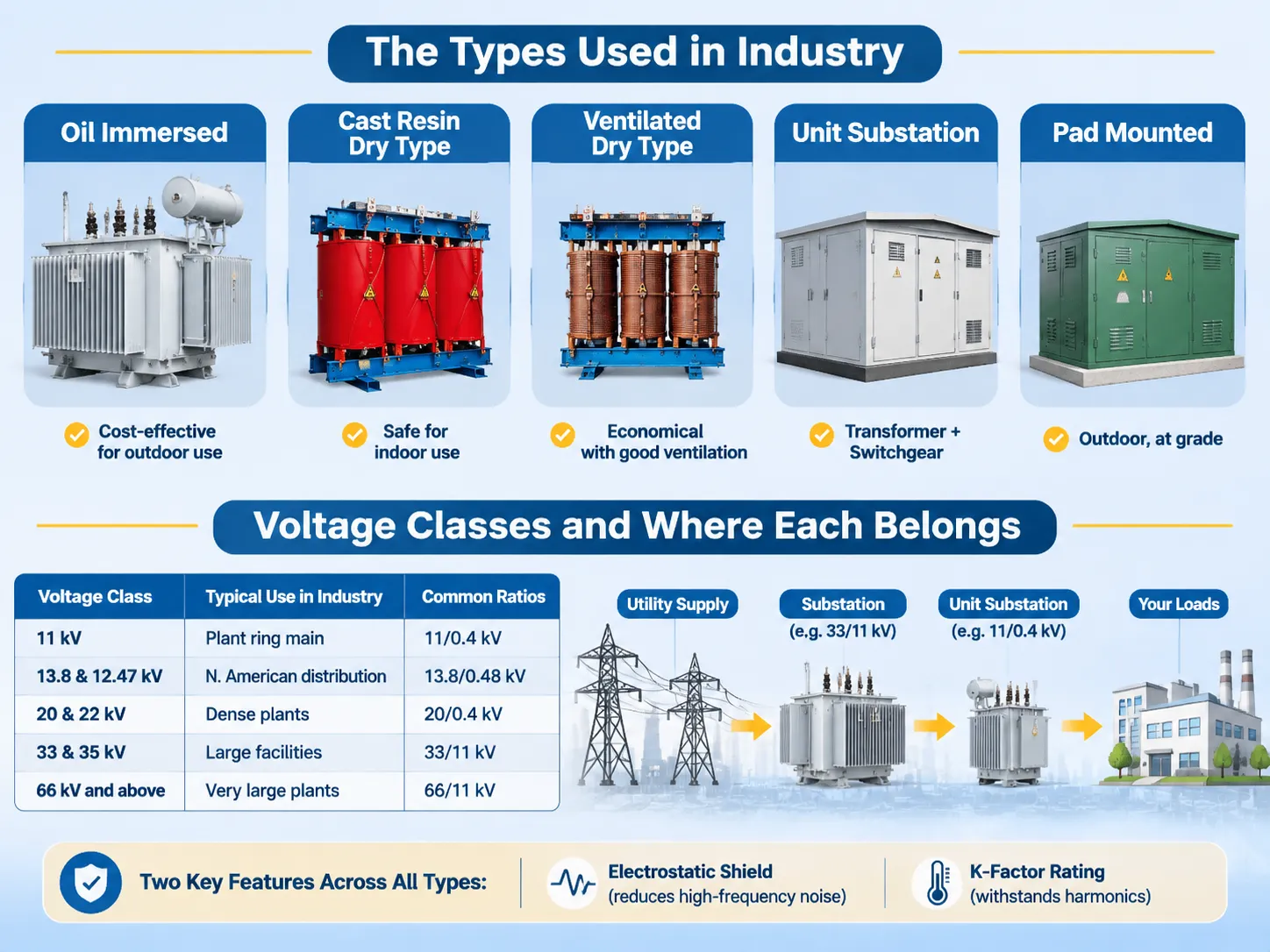
The Types Used in Industry
There are five types of transformers used in the industry, which depends on the condition where the transformer is mounted and operated.
- Oil immersed transformers have the winding placed in mineral oil, which circulates through convection thus removing excess heat through radiator. However, this type works best when the voltage requirement is beyond 500 kVA due to the reason of low cost of operation and better thermal characteristics. One has to keep in mind though that this type of transformer cannot be placed inside an occupied building without fire rated enclosure.
- Cast resin transformers have the winding encapsulated in epoxy resin so that there is no liquid containment and risk of fire. This type is used in tropical and subtropical countries. Disadvantage of resin transformers is higher initial costs and low thermal limits. An example of the series is a 10 kV cast resin transformer with core and coil capacity built in a factory using tooling and its enclosure is developed at the time of ordering.
- Ventilated dry type. The windings are open and cooled by air. They are cheaper than cast resin transformers at low power levels; they are very popular in ventilated plant rooms. They are susceptible to dust and moisture; hence, they should be kept clean in a dry space away from any washing area.
- Unit substation. A transformer which is bolted directly to the section for receiving power from the medium voltage line and low voltage distribution section in one unit. This is good for saving cable and space and is preferable when all loads are located in one area and also there is no coordination problem in the installation.
- Pad mounted. This type consists of an oil transformer in a enclosed unit, which sits at the ground level with separable connections and fuses on the tank, which do not require opening. By using this type of unit, there is no need to have a fenced area. It is mostly used when a plant is receiving supply at high power rating and needs outdoor distribution.
All the five types have a feature which is common namely the electrostatic shield in between the primary and the secondary, which allows using any type of unit as an isolation transformer, so that the impact of High-frequency noise due to the drives/rectifier is reduced. The K-factor, which is generally given as either K-4 or K-13 means that the unit is provided with the proper capacity for dealing with harmonic heating.
Voltage Classifications and Applications
Entities use voltage classifications to determine water and electricity usage at your plant. The voltage classification will determine the magnitude of useful electric and water capacity to your facility prior to ordering any transformers for equipment inside your facility.
| Classification applications | Usage in industry | Typical ratios |
|---|---|---|
| 11 kV | 11 kV plant-rings and incoming supply used by the majority of utilities in the world. | 11/0.4 kV, 11/0.415 kV |
| 13.8 kV and 12.47 kV | Usage in industrial settings in North America. | 13.8/0.48 kV, 13.8/4.16 kV |
| 20 kV and 22 kV | Taken from dense applications in Europe and China. | 20/0.4 kV or 22/0.4 kV |
| 33 kV and 35 kV | Sub-transmission into large factories where your voltage load ratio will not affect your operations. | 33/11 kV or 33/0.4 kV. |
| 66 kV and above | Very large operations such as captive generation plants. | 66/11 kV or 110/33 kV. |
It can be shown that the factory receives the electric power it needs at one voltage level, distributes the electricity according to its lower voltage class which is below the voltage classification being drawn by the utility and the final voltage used for the voltages that supply loads.
Current flows similarly, but in reverse. For instance, a 2,000 kVA transformer will take in approximately 105 A at 11 kV and will deliver approximately 2,887 A at 400 V from the low voltage busbars, not cables. If a specification only states the kVA without the voltage ratio, the statement is incomplete because it does not provide the necessary kW rating.
Where voltage ratings are 20 kV or 22 kV, the 20 kV oil immersed transformer unit tends to be the model specified for most facilities because this rating covers both the feed supply as well as the internal circuit in a single voltage.
Losses, Efficiency and Cost Over Ownership
Once a transformer is energized regardless of whether or not production is taking place it will incur losses with the differential between the two losses indicating which system will be the most cost effective over the span of twenty years.
No load loss is always present once the first line is connected at full power. It is a result of the magnetization of the core as well as the eddy currents flowing through the laminations and it will remain unchanged by load levels. Load loss on the other hand happens due to resistance in the windings and increases with the square of the current. For example, the operation of a unit at only a 25% load will be dictated by no load loss while a unit operating at full capacity is driven by load loss.
Knowing these principles has practical implications for pricing structure. When a plant runs just slightly above no load loss, a low no load loss configuration should be specified although at a higher price. On the other hand at full capacity a low load loss configuration featuring more copper as its characteristic will be required.
For instance, a unit with a capacity of around 1,000 kVA consumes about 1.2% and 1.8% of its capacity in no load losses which is equal to 105,000 kWh and 158,000 kWh, respectively, in a year based on 8,760 hours of operation. If an industrial consumer pays kVA at the real tariff rate, the buyer will have a payback period of about four to seven years in spite of paying a premium price of 10% to 15% for its designs allowing for a reduction of 20% in no load losses. This is the reason utilities and large consumers have loss evaluation formulas and small consumers incur higher cost of their units without giving consideration to no load losses.
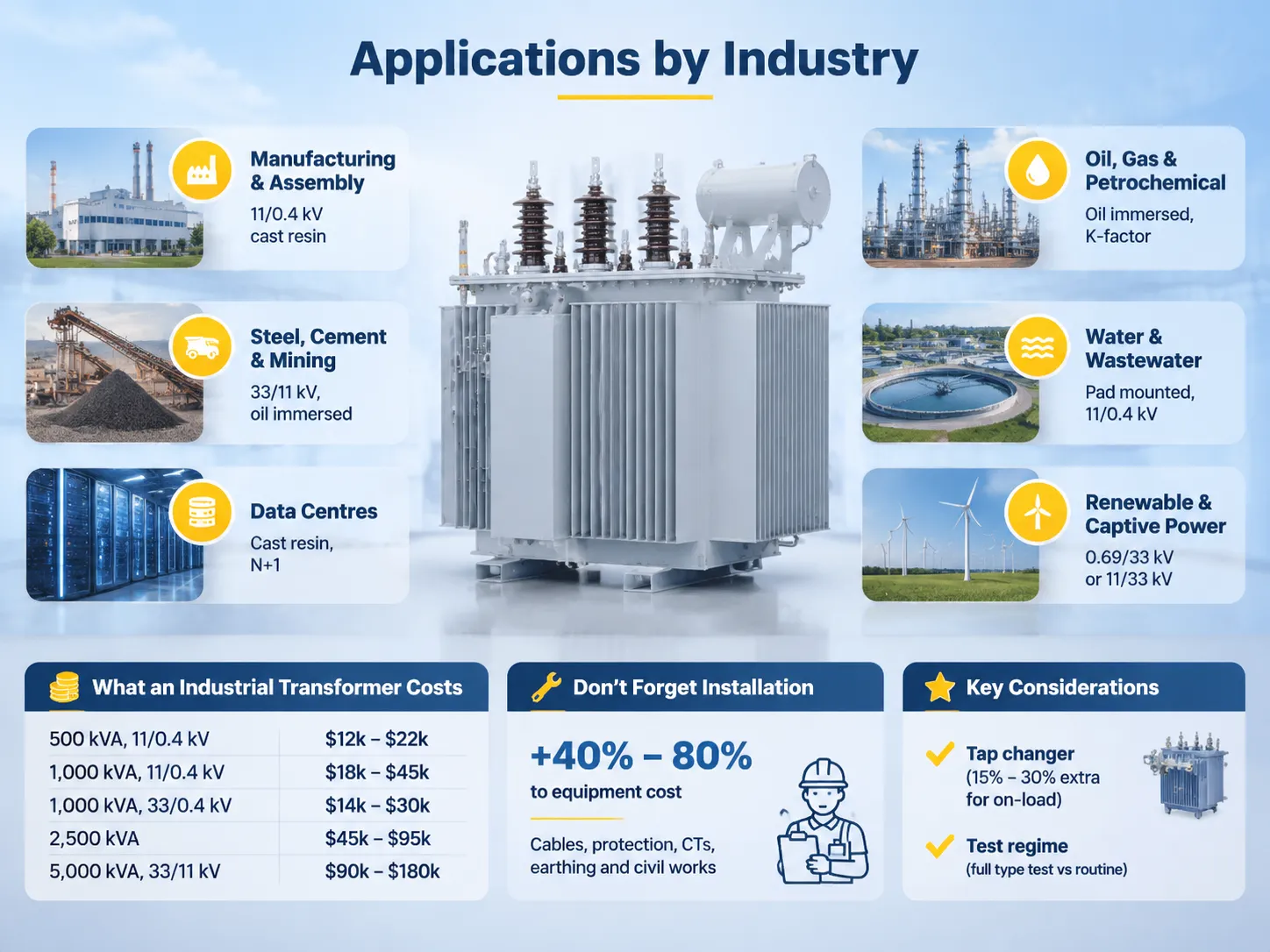
Industry Applications
The application provides information on types, enclosures and impedances for six sectors of the market.
| Sector | Regular structure | Justification |
|---|---|---|
| Production and assembly | 11/0.4 kV transformers, resin insulated indoors | Different locations for different load centers in the plant. Fire load to be considered. |
| Steel, cement and minerals extraction | 33/11 kV and 11/0.69 kV, immersed in oil outside | Large motor load, high fault level, and dusty environment. |
| Data centers | Resins insulated multiple transformer units in parallel, N+1 | Redundancy, low fire loads and impedance matching. |
| Oil and gas and petrochemical | Immersed in oil with enhanced safety; a k-factor where there is predominance of drives | Hazardous area classification and harmonic load. |
| Water and sewage | Pad mounted oil transformers, 11/0.4 kV | For outdoor plants with periodic pumping loads and for maintenance from a distance. |
| Renewable and/or captive power generation | Step-up transformers 0.69/33 kV or 11/33 kV; assemblage of generation. |
There is a clear trend of using dry insulated transformers in the case of indoor installation, whereas the outdoor plants generally use oil insulated transformers for reasons of cost. Exception is an installation involving a high harmonic load requiring the use of k-rated transformers.
In an installation requiring supply of the complete medium voltage distribution system rather than just one transformer, the conversation will begin at the medium voltage power distribution system. It will most likely be in the context of a new plant, since the interfaces between transformers, cubicles and relay become the focus of commissioning issues.
What Is the Price of an Industrial Transformer?
The pricing provided here are ex works prices in the year 2026 and are influenced by conductor type, impedance, housing, and testing regimes. The price differences between different manufacturers tend to reflect the variations that occur between their quotations for the same specifications. In general, Western manufacturers charge 30 to 50 percent more than Asian manufacturers.
Transformer specifications will drive pricing in the following ways:
| Transformer Specifications | Price Range |
|---|---|
| 500kVA Cast Resin Transformer, 11/0.4 kV | $12,000 to $22,000 |
| 1000kVA Cast Resin Transformer, 11/0.4 kV | $18,000 to $45,000 |
| 1000kVA Oil-filled Transformer, 33/0.4 kV | $14,000 to $30,000 |
| 2500kVA Oil-filled or Cast Resin Transformer | $45,000 to $95,000 |
| 5000kVA Oil-filled Transformer, 33/11 kV | $90,000 to $180,000 |
The installation components surprise buyers. When the cost of terminations of medium voltage cables, protection relays, current transformers, lightning protection systems, grounding systems, and construction services are added together, 40 to 80 percent may be added to the price of the other electrical equipment purchased.
There are two items that should be priced during the proposal phase. The first component is the type of tap changer that is used. An off-circuit tap changer is included in all standard units, but an on-load tap changer will be an additional cost that ranges between 15 to 30 percent of the cost of the generator. The second item is the test procedure that is performed on the transformer. A full type testing program conducted on the new transformer will cost more than the routine testing that would be conducted on subsequent units produced.
Specified Manufacturers
Due to logistical considerations of transporting a three-ton unit, the market is regionally constrained, and the manufacturers to be listed below reflect that limitation.
SGB-SMIT Group boasts the title of being the largest independent transformer group in Europe. It has manufacturing facilities in Germany, the Netherlands, the Czech Republic, India, and the United States and produces goods that range from small distribution units to large power transformers. It is strong because it can provide a very long list of voltage combinations.
Spain’s Ormazabal offers the medium voltage network as a package that includes switchgear, transformers, and substations that work in unison when installed in conjunction with each other. This integration makes their pitch to plant owners that want a single point of contact for the entire installation.
Hammond Power Solutions is the North American dry-type specialist whose published design specifications and distribution network allows for cast resin units to be procured off a catalogue rather than being custom engineered for a specific project.
Hitachi Energy and Siemens Energy supply the upper end of the market and the utility sector with the type test facilities and service organizations that support it. For 132 kV equipment, they represent a top-level provider; they also work for distribution transformers up to 1000 kVA.
The Chinese manufacturers are responsible for more than half of the global transformer production market today, and approximately ¥64.6 billion in exports was recorded for 2025, representing a massive 36% growth over last year. The reputable companies have IEC type testing certificates and, when applicable, UL or CSA certifications and letters of reference within the destination country.
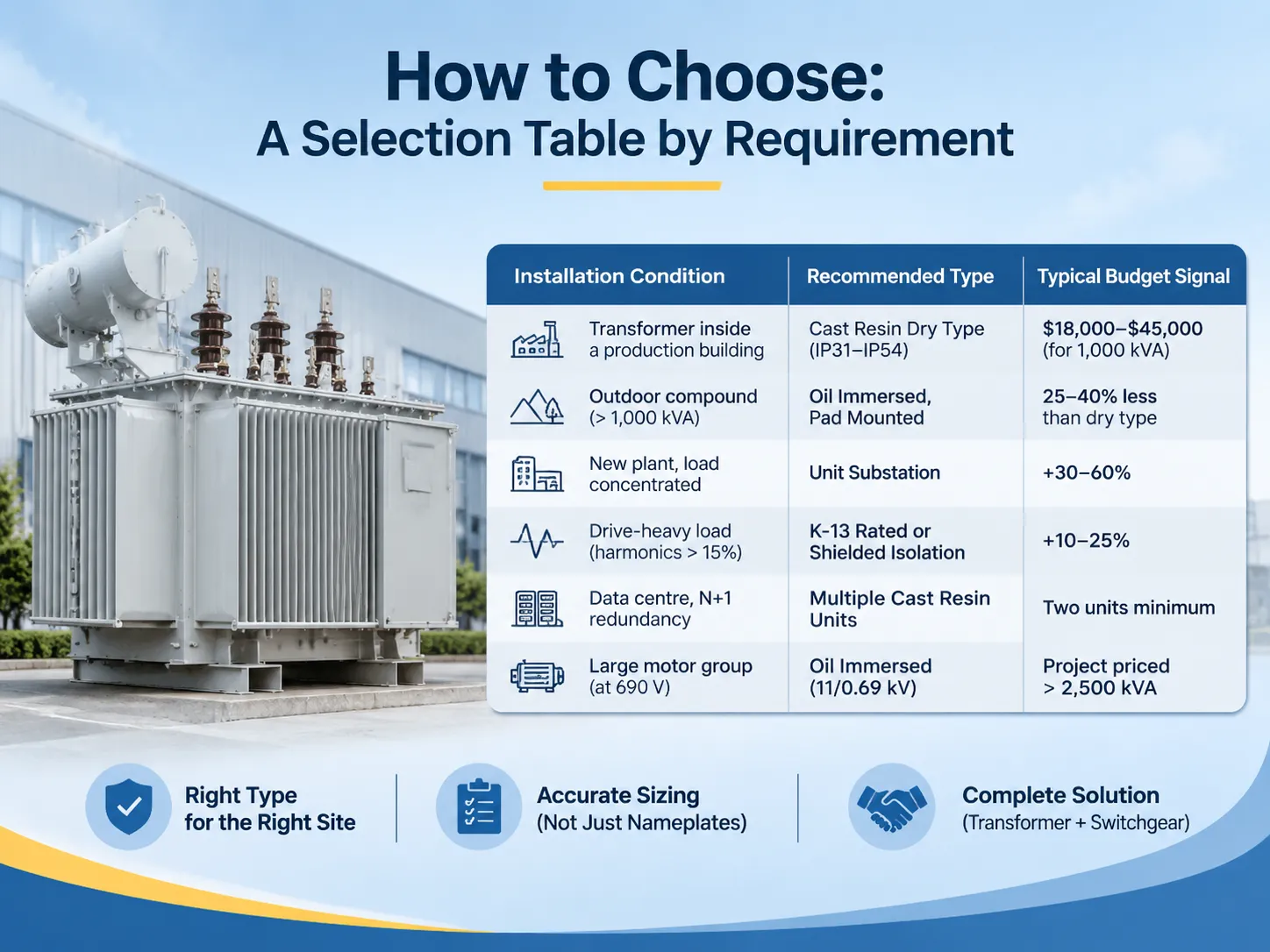
When Picking: A Selection Chart According to Specification
| If you’re in this position | The type of transformer needed | The pricing range |
|---|---|---|
| Transformer located within a manufacturing plant, considerations of fire load | cast resin, dry type, IP31 to IP54 | $18,000 to $45,000 for 1,000 kVA |
| Transformer installed outdoor, rating of over 1,000 kVA – | Oil immersed, pad-mounted | 25-40 percent less than dry type |
| New plant and concentrated load and want one delivery | Unit substation with MV application and LV distribution | 30-60 percent more than a bare transformer |
| Drive-heavy load with distortion over 15 percent | K-13 rated or shielded isolation transformer | 10-25 percent more |
| Data centre with N+1 redundancy | Several cast resin transformers with matched impedance | Minimum of two transformers with an impedance within 10 percent |
| Big motor group at 690 V | Oil immersed 11kV/0.69kV with high impedance | pricing exceeds 2,500 kVA |
Is it best to read this chart by first beginning with installations needing specification, then move on to the rating, because the type decision regarding the transformer is generally made due to the installation and not due to the load. The discussion of power transformer versus distribution transformer shows the different reasons these units are sized and priced differently which becomes essential when a plant must make a decision regarding whether to purchase one large unit or numerous smaller units.
By far, the major specification error with transformers in this category is sizing to the sum of connected nameplates rather than to a diversified load. Transformers wired in this way will run at 30 percent load constantly wasting no load losses every hour. Because of this, the proper choice should usually be one size below and a plan for another transformer when load rises.
Where SUBIAN Fits
We manufacture distribution and power transformers that range from 10kVA to around 20MVA, with the majority in the range of 30kVA to 2,500kVA at 10, 20, 33, and 35kV, and with both oil immersed and cast resin types. The end customers utilize our transformers as either an EPC contractor, distributor, or plant that requires a standard product.
For the purpose of discussing our products, our output in this sector is the indoor end of that spectrum in cast resin and outdoor work in oil immersed products; we carry standard core and coil designs in stock; however, the enclosure, IP rating, temperature rise, and vector group are based on the customer’s specifications. The oil immersed transformers will include pad mounted and outdoor units for values above 500 kVA.
There are three specific reasons why buyers will be inclined to work with us:
- we will always provide quotes according to a single line diagram, which will indicate the vector group, tap range, and impedance.
- We will provide the routine test report prior to shipping, which includes all information, including no-load and load losses
- we will inform the customers right away when the project is outside of our scope (i.e., above 35kV).
For a project requires the transformers, the switchgear and the protection together at one, the distribution transformer and substation range can meet your demand, which is usually much cheaper to buy a plant substation, since it will be the problem of one supplier to solve the interfaces, not three of them.
FAQ
What does industrial transformer do?
Industrial transformer usually involves voltage transformation between supply, and plant distribution system isolated magnetically. A typical industrial transformer takes 11 kV or 33 kV from the utility or plant ring main and provides 400 V, 480 V or 690 V to the electrical distribution system of the industrial plant. The industrial transformer also determines the amount of fault current available down below, defines the phase relationship between primary and secondary, and identifies the earthing arrangement for the low voltage system.
How much does the industrial transformer cost?
For example, the cost of a 500 kVA of cast resin unit may run from $12,000 to $22,000 ex works, while a 1,000 kVA unit may cost you anywhere between $18,000 and $45,000 and a 2,500 kVA unit will fall into the $45,000 – $95,000 range. On the other hand, oil immersed unit for the same rating may cost you 25 to 40 percent less to purchase. Installation constitutes an addition of 40 to 80 percent expenditure in case of a single unit project, and more than that in case of a new substation building or medium voltage cable installation.
What are the major types of transformers used in the industry?
The major types of transformers that are employed in the industry are oil immersed, cast resin dry type, and unit substation.
The first category pertains to the outdoor and substation services above 500 kVA; the second refers to the indoor installations where the fire load becomes significant; while the third category deals with installations that comprise the transformer’s assembly along with transmission of MV from the incoming power lines followed by the distribution of LV. The first two categories also provide two types of transformers known as pad-mounted and ventilated types.
What are the types of transformers?
Voltage-wise, there are four types of transformers namely the step-up transformer, step-down transformer, isolation transformer, and autotransformer. A step-up transformer is used to increase the voltage for electrical transmission; a step-down transformer is used to decrease the voltage for distribution; an isolation transformer passes a 1:1 ratio between circuits while separating the circuits; while the autotransformer has only one winding with tapped connection. There are four types of transformers based upon materials such as oil-immersed transformer, dry transformers, gas-insulated transformers, and cast resin transformers. While using industrial transformers, one should keep in mind the second classification affects mostly the installation process.
Reference
- SGB-SMIT Group- Power and Distribution Transformers
- Hammond Power Solutions- Dry Type Transformer Design Data
- Ormazabal- MV Networks and Substations
- US Energy Information Administration-Today in Energy
- Hitachi Energy- Transformers and Grid Equipment
Conclusion
The industrial transformers are selected based on four parameters that cannot be changed once the transformer gets manufactured. They are the voltage ratio, and the impedance, vector group, and temperature rise. The category is determined by the position of the transformer and the price depends on the category of the items and the test regime employed on the equipment.