


Ein Solarenergieentwickler auf den Philippinen war bereit, eine Bestellung für 18 Verteilungstransformatoren aufzugeben, um drei 5 MW große, bodenmontierte PV-Anlagen mit dem 22 kV-Netz zu verbinden. Im letzten Moment wies der Elektroingenieur darauf hin, dass der ausgewählte 500 kVA, obwohl er die richtige Kapazität in kVA hatte, nicht der erforderlichen Vektorgruppe und Eingangsimpedanz entsprach, die es ihnen ermöglichen würde, im Parallelbetrieb mit den bestehenden Zuleitungen des Versorgungsunternehmens übereinzustimmen, und dass das nächstgelegene Servicezentrum 400 km vom Standort entfernt war. Dementsprechend musste die Bestellung angepasst werden. Die Lektion wurde zu Herzen genommen: Die Wahl des Leistungstransformators betrifft mehr als nur kVA. Jede spezielle Situation – ob es sich um ein Versorgungsunternehmen, ein photovoltaisches Kraftwerk, eine Industrieanlage, eine Mine, ein Rechenzentrum oder ein Krankenhaus handelt – bringt ihre eigenen spezifischen Anforderungen an den Betrieb des Transformators in Bezug auf Übersetzungsverhältnis, Kühlung, Impedanz, Schutz und Logistik mit sich.
Der Leitfaden bietet eine Aufschlüsselung des Entscheidungsprozesses in Elemente, die aus praktischer Sicht wirklich wichtig sind, und gibt den Ingenieuren die spezifischen numerischen Daten, die sie benötigen: kVA-Größen, Impedanzgrenzen, Temperaturerhöhungen, IP-Bewertungen und Kostenbenchmarks. Infolgedessen werden Sie mit einer Klassifizierungsmethode vertraut gemacht, die Sie auf Ihre nächsten Branchenspezifikationen anwenden können.
Kurz gesagt, die Wahl des richtigen Leistungstransformators für eine bestimmte Anwendung bedeutet, dass man einmal alle fünf Gruppen von Parametern abgeglichen hat: (1) Kapazität – kVA basierend auf der angeschlossenen Last mit einem zusätzlichen 10-20% berechnen; (2) Spannung – primäre und sekundäre kV und Vektorgruppe wie Dyn11; (3) Bauart – ölgetauchte Typen für draußen, trockene Typen für Innenräume; (4) elektrische Parameter – Impedanz (uk%), Leerlauf- und Lastverluste, Temperaturanstieg (55K/65K); (5) Umgebung – IP-Klassifizierung oder Bewertung, Höhenreduzierung, Klasse des Kühlsystems.
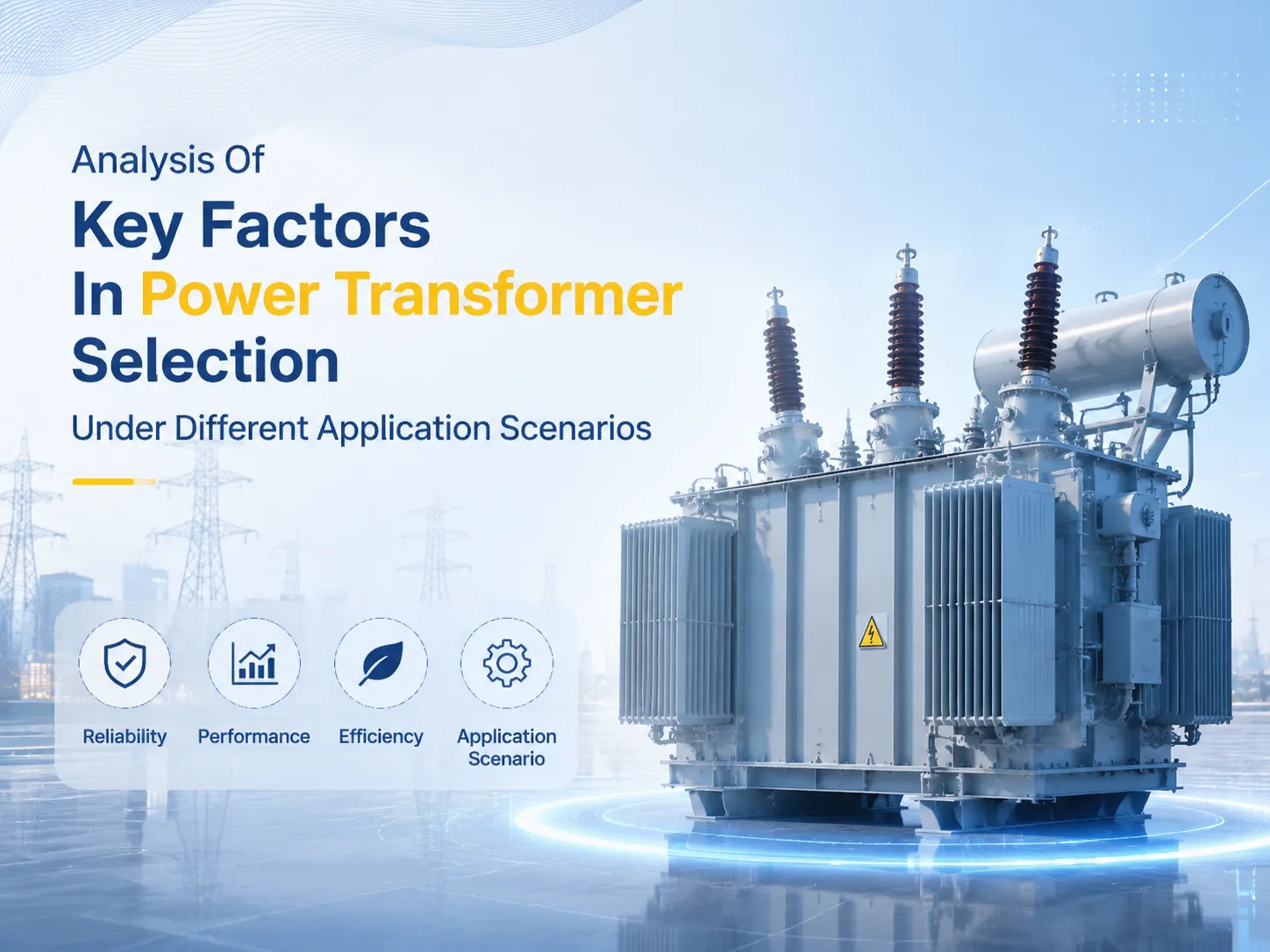
Die Kernfaktoren bei der Auswahl von Leistungstransformatoren
Die Spezifikation jedes Transformators reduziert sich auf einige grundlegende interagierende Parameter. Eine Änderung eines Parameters – zum Beispiel der Wechsel von einer Innen- zu einer Außeninstallation – führt zu Änderungen in der Hälfte der anderen Parameter. Die sechs Hauptentscheidungsgruppen, die die Praxis dominieren:
- Kapazität (kVA/MVA): bestimmt durch die angeschlossene Last, Diversität und Spielraum für Wachstum.
- Spannungsparameter: primäre kV/sekundäre kV, Abgriffbereich und Vektorgruppe.
- Bauart: ölgetaucht, trockene Bauart, Gießharz oder amorpher Kern.
- Elektrische Leistung: Impedanzspannung, Verluste im Leerlauf und unter Lastbedingungen, Temperaturanstieg.
- Kühlung und Umgebung: Kühlklasse (ONAN/ONAF/AN/AF), Schutzgrad IP, Höhe, Umgebungstemperatur.
- Kommerzielle Faktoren: Zeitrahmen für die Herstellung, Testdokumentation, Garantiebedingungen und After-Sales-Support.
Wenn eines der sechs oben aufgeführten Elemente weggelassen wird, kann der Transformator theoretisch funktionieren, wird jedoch in der Praxis versagen, was durch das oben genannte Projekt veranschaulicht wird. Die Konsistenz der Informationen in diesem Artikel führt den Leser in die Besonderheiten jeder Gruppe ein, um die effektive Anwendung der oben genannten Faktoren in ihrem eigenen technischen Fall zu ermöglichen.
Anwendungsszenarien und ihre dominierenden Einschränkungen
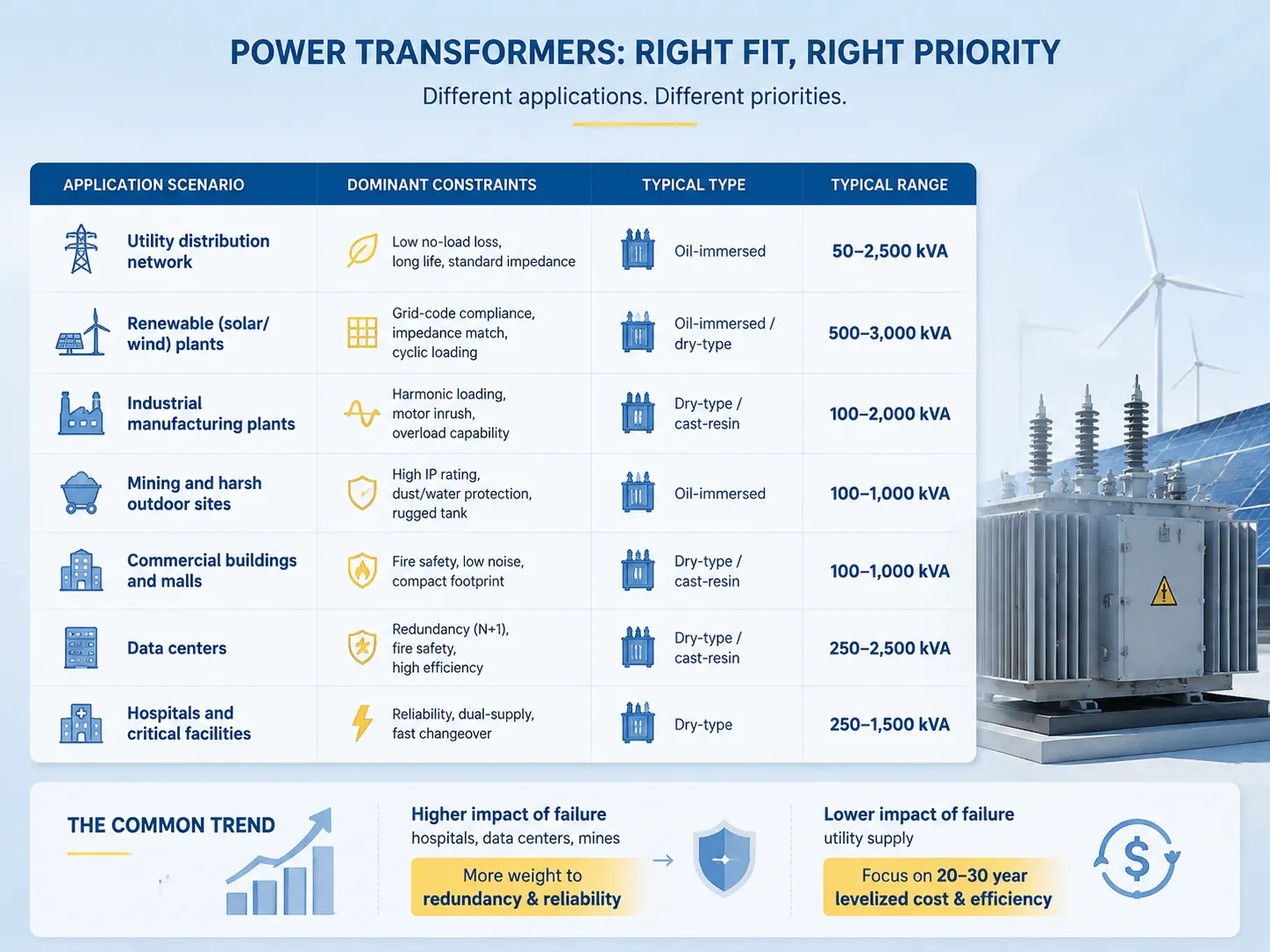
Die Prioritäten der verschiedenen Endbenutzer unterscheiden sich jedoch erheblich voneinander. Ein Versorgungsunternehmen schätzt minimierte Leerlaufverluste, da ihre Transformatoren immer mehr als 30 Jahre lang unter Spannung stehen müssen; ein Bergbaubetreiber bewertet Robustheit und IP-Schutz aufgrund der Betriebsbedingungen seiner Geräte am höchsten; ein Rechenzentrum legt Wert auf Brandschutz und Trockentyp-Technologie; und ein Solarunternehmen achtet auf eine ordnungsgemäße Impedanzanpassung und die Einhaltung des Netzcodes.
| Anwendungsszenario | Dominierende Einschränkungen | Typischer Typ | Typischer Bereich |
|---|---|---|---|
| Versorgungsnetz | Geringe Leerlaufverluste, lange Lebensdauer, Standardimpedanz | Ölgetaucht | 50–2.500 kVA |
| Erneuerbare (Solar/Wind) Anlagen | Einhaltung des Netzcodes, Impedanzanpassung, zyklische Belastung | Ölgetaucht / Trockentyp | 500–3.000 kVA |
| Industrielle Fertigungsanlagen | Harmonische Belastung, Motoranlauf, Überlastfähigkeit | Trockenbau / Gießharz | 100–2.000 kVA |
| Bergbau und raue Außenstandorte | Hohe IP-Bewertung, Staub-/Wasserschutz, robusten Tank | Ölgetaucht | 100–1.000 kVA |
| Gewerbliche Gebäude und Einkaufszentren | Brandschutz, geringe Geräuschentwicklung, kompakte Stellfläche | Trockenbau / Gießharz | 100–1.000 kVA |
| Rechenzentren | Redundanz (N+1), Brandschutz, hohe Effizienz | Trockenbau / Gießharz | 250–2.500 kVA |
| Krankenhäuser und kritische Einrichtungen | Zuverlässigkeit, doppelte Versorgung, schneller Umschaltvorgang | Trockenbau | 250–1.500 kVA |
Es gibt einen gemeinsamen Trend: Je höher die Auswirkungen eines möglichen Ausfalls — wie bei Krankenhäusern, Rechenzentren und Bergwerken — desto weniger Gewicht sollte dem Preis und desto mehr der Redundanz und Zuverlässigkeit beigemessen werden. Im Falle der Versorgungsversorgung gibt es eine gegenteilige Situation: Das Wichtigste wird die 20–30-jährige nivellierte Kosten mit Effizienzmetriken, die dafür entscheidend sind.
Kapazitätsdimensionierung unter verschiedenen Lastprofilen
Die kVA-Zahl ist der Bereich, in dem die größten Fehler bei der Auswahl eines Geräts auftreten werden, normalerweise weil das Lastprofil vermutet und nicht tatsächlich gemessen wird. Die richtigen Schritte sind:
- Bestimmen Sie die gesamte Scheinleistung aller angeschlossenen Lasten (gemessen in kVA, nicht in kW).
- Verwenden Sie einen Diversitätsfaktor, der den gleichzeitigen Betrieb widerspiegelt, wobei 0,6–0,7 für gewerbliche Lasten, 0,7–0,85 für industrielle Lasten und 0,95–1,0 für den Dauerbetrieb verwendet wird.
- Fügen Sie 10–20% für Erweiterungen hinzu.
- Überprüfen Sie die Spitzenlast, da der Anlauf des Motors einen Strom von 5–8 mal der Nennlast verursachen kann, wobei die Impedanz des Transformators den Spannungsabfall definiert.
- Der erhaltene Wert sollte auf den nächsthöheren Standardwert gemäß IEC 60076 gerundet werden.
Die motorgetriebene Kompressorlinie von 500 kW bei 0,85 zieht 588 kVA während des Betriebs. Unter Berücksichtigung eines Diversitätsfaktors von 0,8 für vier solcher Linien ergibt sich eine angenäherte Nachfrage von 1.880 kVA. Hinzufügen einer 15%-Wachstumsreserve ergibt ungefähr 2.160 kVA, was einem Standardwert von 2.500 kVA entspricht, anstelle von 2.000 kVA, die durch die schnelle Summe gegeben sind. Der Unterschied von 1.500 kVA führt entweder zu einem Preisunterschied von $15.000 bis $25.000 oder zur Modifikation des Unterstationsdesigns und -layouts.
Spannungsverhältnis, Abgriffe und Vektorgruppe
Um die Eingangsspannung und ihre Abgriffswerte auf der Eingangsseite anzupassen, während die Ausgangsseite die erforderliche Arbeitsspannung für die Last bereitstellen sollte. Die Standard-Transformationsverhältnisse haben Werte wie 33 kV/11 kV, 11 kV/0,4 kV, 22 kV/0,4 kV, 35 kV/10 kV und 66 kV/11 kV, und die Abgriffänderungen im Leerlauf können bei ±2×2.5% oder unter Lastwechseln (OLTC) im Falle schnell wechselnder Netze vorgenommen werden.
Die als Dyn11, Yyn0, Yd11, Dd0 identifizierte Vektorgruppe bestimmt die Phasenverschiebung und ob die Einheiten parallel betrieben werden können oder nicht. Die Einheiten müssen auch das gleiche Spannungsverhältnis sowie einen prozentualen Impedanzwert von nicht mehr als 10 Prozent haben. Wenn dieser Aspekt vernachlässigt wird, führt dies zur Entstehung von zirkulierenden Strömen, die beide Einheiten erhitzen, obwohl die Last abwesend ist.
| Vektorgruppe | Phasenverschiebung | Allgemeine Verwendung |
|---|---|---|
| Dyn11 | 30° (HV delta, LV wye) | Most common distribution ratio, grounded neutral |
| Yyn0 | 0° | Small distribution units, 3-phase 4-wire |
| Yd11 | 30° (HV wye, LV delta) | Step-up in generation plants |
| Yd1 | −30° | Step-up applications, industrial |
| Dd0 | 0° | Industrial, no neutral required |
Therefore, grid codes often stipulate a particular vector group and impedance (usually 6-8% uk for collector transformers) for solar and wind projects to limit the contribution of faults and harmonic propagation. Always check the local grid code prior to placing your order, as retrofitting a vector group is impossible once you receive the product, and you’ll have to go through the entire rewinding process.
Oil-Immersed vs. Dry-Type by Scenario
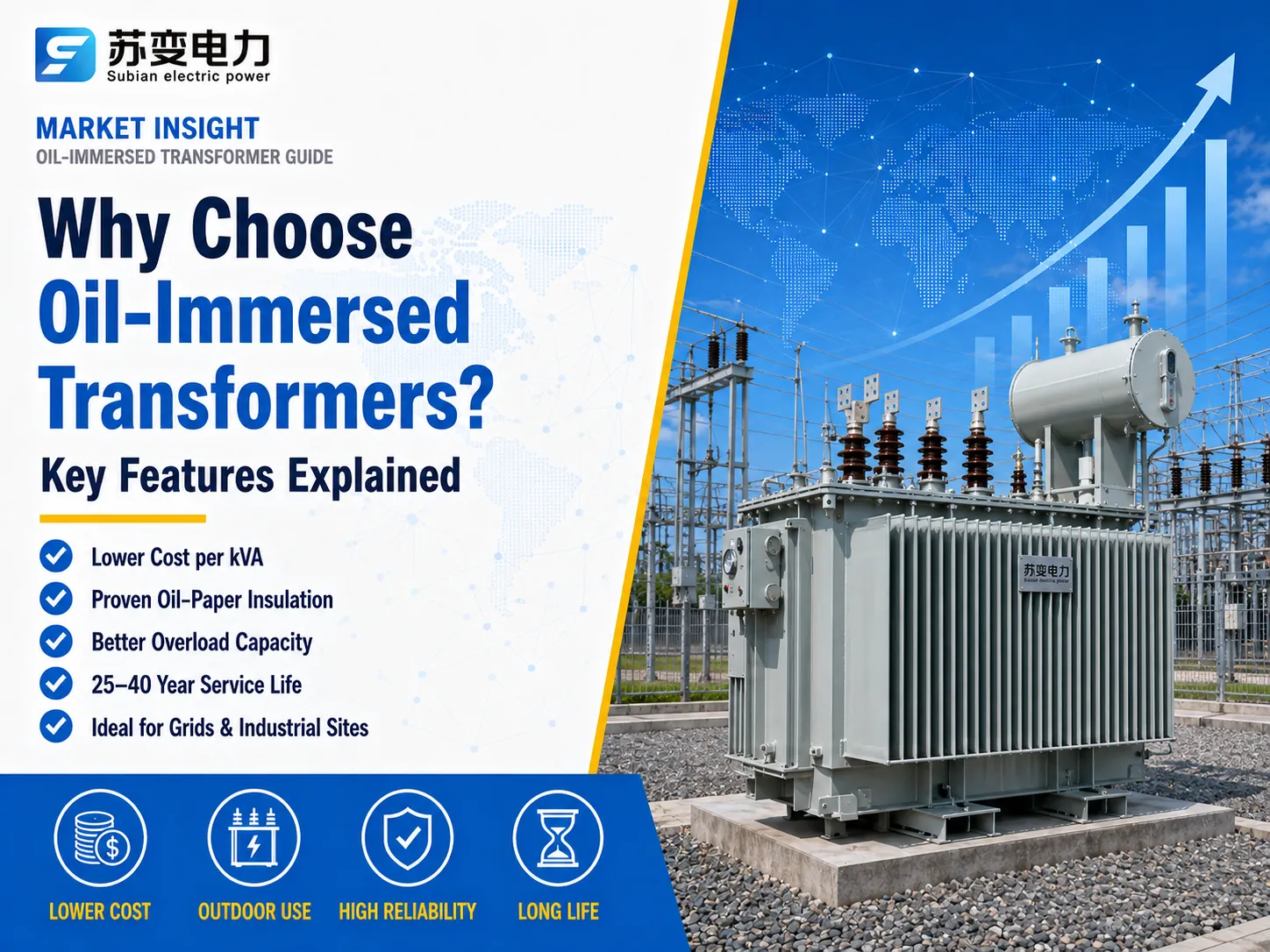
The kind of construction is largely dictated by the geographical location of the transformer. Transformers which operate in oil have mineral oil or ester liquid as the insulation and cooling fluid and are cheaper in terms of cost per kVA (kilovolt-ampere), have higher short-term overload capability, and are manufactured for outdoor substations. Dry transformers use either air or cast-resin to give them insulation.
| Parameter | Ölgetaucht | Trockentyp (Gießharz) |
|---|---|---|
| Kühlmedium | Mineral oil / ester | Air / epoxy resin |
| Fire safety | Requires containment, fire barriers | Self-extinguishing, low fire load |
| IP rating typical | IP54–IP56 | IP21–IP44 (IP54 on request) |
| Short-term overload | 1.3–1.5× for hours (IEC 60076-7) | Limited, ~1.1× briefly |
| Typical price (500 kVA) | $8.000–$16.000 | $12.000–$24.000 |
| Best-fit scenarios | Utility, solar farms, mining, outdoor substations | Buildings, data centers, tunnels, hospitals |
In the case of outdoor utility substations, the use of oil-immersed transformers is almost always the appropriate choice in most situations. If the transformer is located in the basement of the tall building, the law and insurance will compel its use of dry-type transformers. Some newly established solar energy facilities also use dry-type transformers indoors with the installation of inverters to prevent the responsibility for any oil spill from happening at all.
Impedance, Losses, and Temperature Rise
Certain performance parameters warrant attention as they influence the short-circuit characteristics and the operational lifespan. The percentage of impedance (uk%) value of small distribution transformers is 4%, for medium voltage transformers and connected generators transformers it is between 6-8%, it determines short-circuit current and voltage regulation behavior. Thus, lower impedance results in improved voltage regulation but maximum fault current flows through transformers.
Losses are defined as no-load losses (a constant value, meaning that losses occur 24 hours a day 7 days a week) and load losses (losses are proportional to the square of the load). A 500 kVA unit with an amorphous core provides losses reduction during no-load operation from 1200 W to 400 W. This translates to more than 21000 dollars across 30 years of operation when electricity costs 0.1 dollar per kilowatt hour which is a total amount that is more than the price of many manufactured units.
| Nennleistung (kVA) | Typical No-Load Loss (W) | Typical Load Loss (W) | Impedanz (uk%) | Temp Rise (K) |
|---|---|---|---|---|
| 100 | 180–300 | 1,500–2,000 | 4.0 | 55–65 |
| 250 | 350–600 | 3,200–4,200 | 4.0–4.5 | 55–65 |
| 500 | 600–1,200 | 5,500–7,500 | 4.5–6.0 | 55–65 |
| 1,000 | 1,000–2,000 | 9,500–13,000 | 5.5–6.5 | 55–65 |
| 2,500 | 2,200–4,000 | 20,000–28,000 | 6.0–8.0 | 55–65 |
When comparing prices, request assurance of guaranteed losses with IEC 60076-1 allowances and ask for actual measured loss values in the factory reports. Manufacturers’ reported losses are “typical” and may be 10% more than actual at delivery; the inclusion of a guaranteed plus tolerance clause protects the operating cost projection over 30 years.
Environmental Factors: IP Rating, Altitude, Climate
Environmental conditions affect rating, not only the enclosure. According to IEC 60076-1, units operating 1000 m above sea level must have their rating reduced (approximately 1% for each additional 100 m) because thinner air is not as effective in cooling. The same applies to ambient temperatures over 40 degrees C. A unit designed for a rise in temperature of 55 K in an ambient of 45 degrees C loses its rating.
IP rating (IEC 60529) refers to protection against dust and water. Units immersed in oil but located outdoors normally have IP54 rating in dry areas and IP56 rating when used in coastal locations. Dry-types operated indoors have IP21-IP44 rating range. For mining or coastal applications an IP54 rating should be specified with careful selection of gasketing material (a gasket made of silicone that operates in the range of −40°C to +150°C ).
Comparison: Selection Priorities by Scenario
| Scenario | Priority #1 | Priority #2 | Priority #3 |
|---|---|---|---|
| Utility distribution | Low no-load loss | Standard impedance, long life | Standardized parts |
| Solar / wind plant | Grid-code vector group | Cyclic overload capability | Impedance match |
| Industrial plant | Harmonic and inrush tolerance | Overload headroom | Maintenance access |
| Bergbau | IP rating, rugged tank | Spare parts availability | Transportability |
| Data center | Fire safety (dry-type) | Redundancy, N+1 | Low losses |
| Commercial building | Low noise, compact | Fire safety | Aesthetic enclosure |
| Hospital | Reliability, dual feed | Fast changeover | Leiser Betrieb |
Prioritization has the primary purpose of facilitating decision-making regarding difficult tradeoffs that need to be made. For example, a mining purchaser who chooses to buy IP56 material even though it costs more and avoids paying for loss efficiency is making a sound choice. Likewise, a utility that chooses the inverse is also right in making that choice. The mistake is not making a choice based on priorities, which leads to an IP21 dry-type unit being placed in the coal yard.
Top Brands and Price Benchmarks
Worldwide customers analyze multiple well-known names along with the increasingly rising number of IEC-approved manufacturers in China. Global players offer proven engineering along with after-sales service; meanwhile, Chinese manufacturers are catching up with standard tests and have a considerable price advantage for distribution-level equipment.
| Marke | Home Region | Stärke | Indicative Price (500 kVA) |
|---|---|---|---|
| ABB | Schweiz/Schweden | Full grid-to-load portfolio, strong service | $18.000–$30.000 |
| Siemens | Deutschland | High-efficiency and digital transformer options | $18,000–$32,000 |
| Schneider Electric | Optimierungsmaßnahmen in der Praxis | Dry-type leadership, LV integration | $15,000–$28,000 |
| Hitachi Energie | Schweiz | Grid strength, large power transformers | $17,000–$30,000 |
| Eaton | USA | North American compliance, pad-mount range | $14.000–$26.000 |
| CG Power, TBEA | India/China | High volume, competitive pricing | $10,000–$18,000 |
| Jiangsu Subian Electric Power | China | IEC 60076 certification, copper windings, factory test reports | $8.000–$16.000 |
The prices mentioned refer to a 500 kVA oil-insulated unit, FOB China or ex-works where they may differ based on specifications, and manufacturer, and location in which which it is situated. From the international heavyweights mentioned previously, we can conclude that they lead the industry by finding best formulas for reliability and after-sales services established for decades. The situation is different when it comes to Jiangsu Subian Electric Power: it can boast the use of IEC 60076-approved design, copper windings as a minimum requirement, and a factory testing report that is attached to every unit. For distributive engineering projects with limited budgets, for solar parks, electrification of rural areas or industrial zones, this is the combination of parameters that will result in the right solution. Whenever you are analyzing any supplier from China, you should request the same documentation that you would usually ask ABB; the suppliers that provide the documentation are those who should be taken into consideration.
A Step-by-Step Selection Procedure
- Establish the purpose of application and rank the six groups of factors based on importance.
- Determine kVA on the basis of the actual load profile with diversity and a margin for growth of 10-20%.
- Set the voltage ratio, taps, and vector group on the basis of drawings from the grid and specifications from the code.
- Select the type of construction (oil or dry) based on the installation environment and regulations regarding fire safety.
- Determine the value of the impedance, how much energy is guaranteed to be lost, and how much heat is expected to accumulate and find out if OLTC will be necessary given the situation with the grid.
- Examine environmental factors: altitude, climate, IP number, sound limits.
- Make a shortlist of 3-4 suppliers and compare their bids based on total cost of ownership in relation to their offers.
Get the reports from testing labs and devise a routine testing plan for critical projects.
Organize transport, installation, oil servicing, and spare provision for commissioning before the placement of the order.
Häufig gestellte Fragen
What is the most important factor in power transformer selection?
Capacity is the important part as everything else is based upon the kVA rating of the device. However, it depends on the scenario when we talk about what matters more: for an installation, the loss due to no-load is the main parameter used for 30-years cost calculations; for solar plants, the impedance of grid codes and the vector group are essential conditions; and for data centers, fire safety and redundancy are the most important requirements.
How much does a power transformer cost in 2025?
The cost of a 100 kVA distribution unit ranges from $2,500 to $6,000 FOB, while that of a 500 kVA unit ranges from $8,000 to $16,000, and a 2500 kVA unit costs between $38,000 and $75,000. Dry-type units are 40–80% pricier than oil-immersed at the same kVA. In addition, copper units cost 20–40% more than aluminum ones. Prices depend on specifications, brands, and regions, with international brands being 2–3 times costlier than IEC-certified Chinese vendors in the same class test.
Should I choose a dry-type or oil-immersed transformer for a solar plant?
For outdoor collector substations, oil-immersed is the most common type of technology due to its cost-effective kVA efficiency and ability to cope with solar load variations and to alleviate the need for indoor ventilation. For rooftop solar or for solar systems built into buildings with inverters indoors, the preferred equipment is dry type units, which eliminate the risk of oil leakage and fire to a certain extent. It is important to choose the equipment according to the location in which it is installed and not according to trends.
Why does vector group matter in transformer selection?
The vector group is defined in terms of phase shift of primary and secondary with respect to neutral — Dyn11 means that the LV side is grounded wye for 3-phase 4-wire distribution. The same vector group, voltage ratio and impedance in the range of ~10% are required for parallel operation of the units.
How do I evaluate a Chinese transformer manufacturer?
Request three documents: IEC 60076 test certifications, the routine factory test report for a unit you propose, and references from projects in your area. Check for ISO 9001 and 14001 certifications, inspect the factory if the total order is greater than about $50,000, and find out the warranty (normally 18 to 24 months) and spare-parts policies. Tested-performance transparency is the best screening rule.
Referenzen
- IEC 60076-1: Leistungstransformatoren — Allgemeines — the baseline standard for ratings, tolerances, and test requirements.
- IEC 60076-7: Loading Guide for Oil-Immersed Power Transformers — cyclic loading and overload temperature guidance.
- IEEE C57.12.00: Allgemeine Anforderungen für flüssigkeitsgetauchte Transformatoren — North American rating and testing framework.
- Electrical4U — Vector Group of Transformer — a clear reference for Dyn11, Yyn0, and parallel operation rules.
- Eaton — Transformer Consulting — selection tools and engineering guidance for industrial applications.
- Siemens Energy — Power Transformers — manufacturer reference for transformer technologies and specifications.
- Wikipedia — Transformer Types — background on oil-immersed, dry-type, and specialty transformer classes.
Fazit
Choosing a power transformer is not an act of chance. It begins with establishing the appropriate capacity based on actual load characteristics before taking into account voltage and vector group parameters of the given grid. Finally, one has to choose the appropriate design, optimizing losses, impedance, and temperature rise according to the priority ranking.
- Ranking that has to be done before consulting the specification sheet and making an informed choice of the power transformer.
- Capacity has to be expressed in kVA and taking into account some diversity and 10-20% increase margin.
- The vector group, impedance, and losses should be checked against grid code and laboratory test results.
- Suppliers have to be compared based on the overall performance of their transformers and the total cost of ownership, not on prices quoted.