


A solar power developer in the Philippines was all set to place an order for 18 distribution transformers to connect three 5 MW ground-mounted PV plants to the 22 kV grid network. At the last moment, the electric engineer pointed out that the selected 500 kVA, while having the correct capability in kVA terms, did not conform to the necessary vector group and input impedance that would allow them, when operated in parallel mode, to match the utility’s existing feeders, and that the closest available service depot was located 400 km from the site. Accordingly, the order had to be modified accordingly. The lesson was taken to heart: power transformer choice is about more than just kVA. Each particular situation – whether it is a utility, photovoltaic power plant, industrial facility, mine, data center, or hospital – brings its own specific requirements concerning transformer operation in terms of voltage ratio, cooling, impedance, protection, and logistics.
The guide provides a breakdown of the decision-making process into elements that are really important from the practical standpoint and gives engineers the specific numerical data they need: kVA sizing, impedance limits, temperature increases, IP ratings, and cost benchmarks. As a result, you will come to be familiarized with a method of classification that you will be able to apply to your next industry specifications.
In short, choosing the right power transformer for a given application means choosing once all the five groups of parameters have been matched: (1) capacity — calculate kVA based on connected load with an extra 10-20%; (2) voltage — primary and secondary kV and vector group such as Dyn11; (3) type of construction — oil-submerged types for outdoors, dry types for inside buildings; (4) electrical parameters — impedance (uk%), no-load and load losses, temperature rise (55K/65K); (5) environment — IP classification or rating, altitude reduction, class of cooling system.
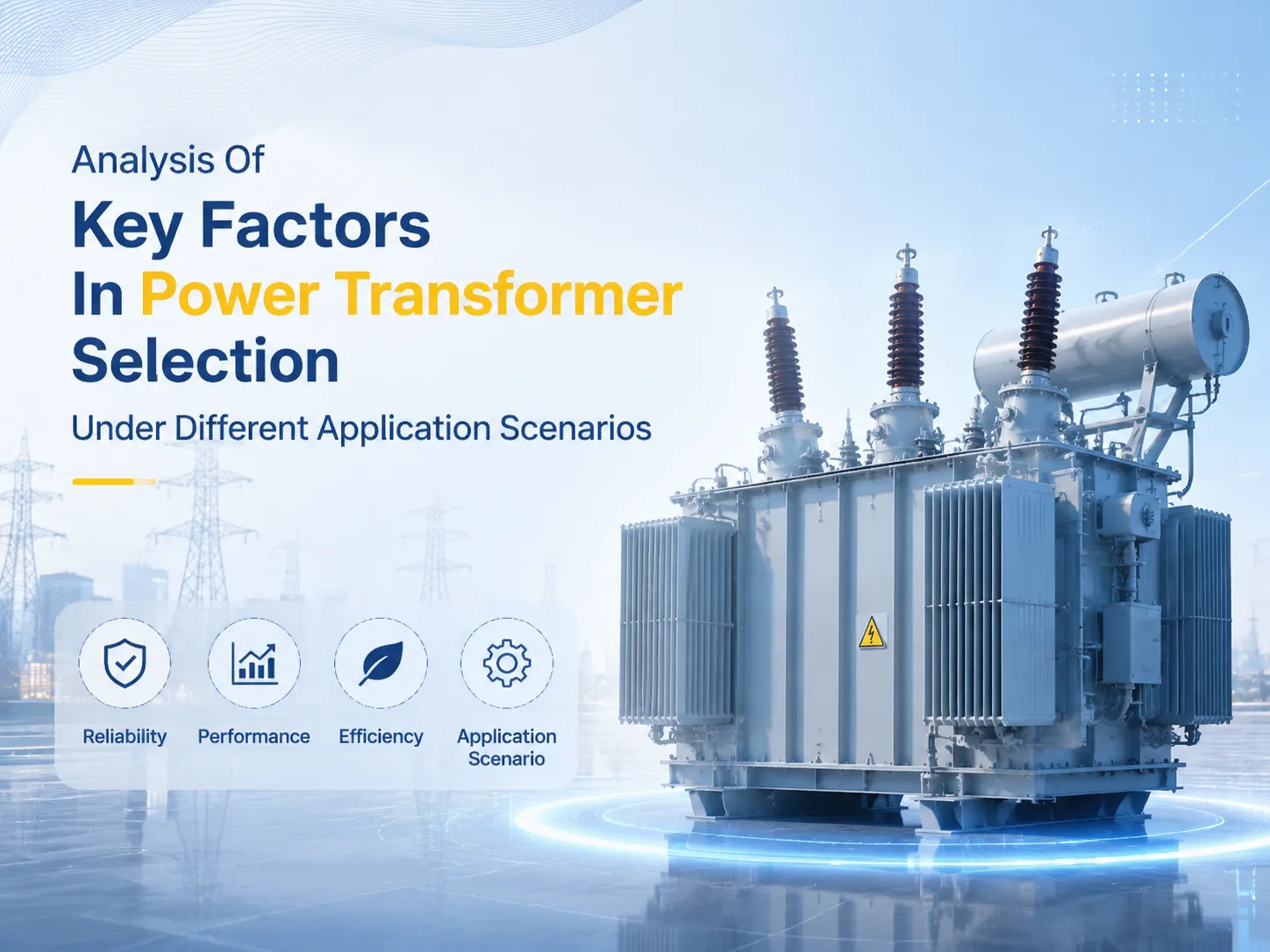
The Core Factors in Power Transformer Selection
The specification of every transformer comes down to a few basic interacting parameters. Changing one parameter — for example, switching from indoor to outdoor installation — leads to changes in half of the other parameters. The six main decision groups that dominate the practice:
- Capacity (kVA/MVA): determined by the load being connected, diversity, and margin for growth.
- Voltage parameters: primary kV/secondary kV, tap range, and vector group.
- Construction type: oil-immersed, dry-type, cast-resin or amorphous core.
- Electrical performance: impedance voltage, losses in no-load and under load conditions, rise in temperature.
- Cooling and environment: cooling class (ONAN/ONAF/AN/AF), degree of protection IP, altitude, ambient temperature.
- Commercial factors: time frame for manufacture, test documentation, warranty provisions, and after-sale support.
If any one of the six listed above is omitted, the transformer may theoretically work, but will fail in practice, which is illustrated by the case project mentioned above. The consistency of information in this article introduces the reader to the particulars of each group for effective application of the mentioned above factors in their own technical case.
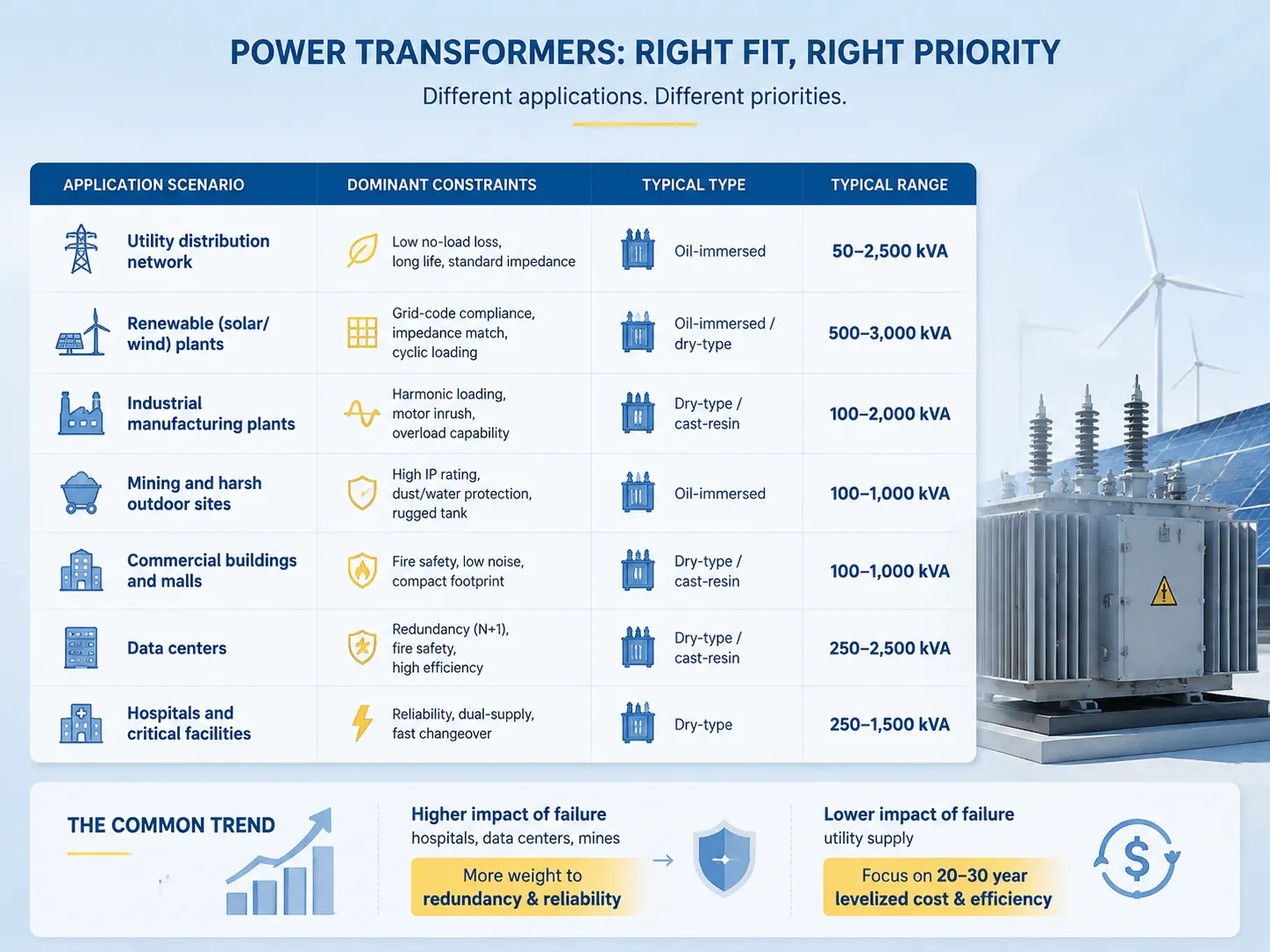
Application Scenarios and Their Dominant Constraints
However, the priorities of various end-users differ significantly from one another. A utility values minimized no-load losses since their transformers have to be always energized for more than 30 years; a mining operator gives the highest score to ruggedness and IP protection due to the operating conditions of its devices; a data center values fire protection and dry-type technology; and a solar company pays attention to proper impedance matching and compliance with the grid code.
| Application Scenario | Dominant Constraints | Typical Type | Typical Range |
|---|---|---|---|
| Utility distribution network | Low no-load loss, long life, standard impedance | Oil-immersed | 50–2,500 kVA |
| Renewable (solar/wind) plants | Grid-code compliance, impedance match, cyclic loading | Oil-immersed / dry-type | 500–3,000 kVA |
| Industrial manufacturing plants | Harmonic loading, motor inrush, overload capability | Dry-type / cast-resin | 100–2,000 kVA |
| Mining and harsh outdoor sites | High IP rating, dust/water protection, rugged tank | Oil-immersed | 100–1,000 kVA |
| Commercial buildings and malls | Fire safety, low noise, compact footprint | Dry-type / cast-resin | 100–1,000 kVA |
| Data centers | Redundancy (N+1), fire safety, high efficiency | Dry-type / cast-resin | 250–2,500 kVA |
| Hospitals and critical facilities | Reliability, dual-supply, fast changeover | Dry-type | 250–1,500 kVA |
There is a common trend: the higher the effect of possible failure — such as hospitals, data centers, and mines — the less weight shall be given to price and the more to redundancy and reliability. In the case of utility supply, there is an opposite situation: the most important thing becomes the 20–30 year levelized cost with efficiency metrics being crucial for it.
Capacity Sizing Under Different Load Profiles
The kVA figure is where the biggest mistakes in selecting a unit will occur, usually because the load profile is presumed rather than actually measured. The proper steps are:
- Determine the total apparent power of all loads connected (measured in kVA, not kW).
- Use a diversity factor that reflects simultaneous operation, where 0.6–0.7 will be used for commercial load, 0.7–0.85 for industrial load, and 0.95–1.0 for continuous operation.
- Add 10–20% for expansion.
- Check peak short-term loading, as starting of the motor may cause a current of 5–8 times the full load with the impedance of the transformer defining the dip of the voltage.
- The obtained value should be rounded to the nearest upper standard IEC 60076 standard value.
The motor-driven compressor line of 500 kW at 0.85 draws 588 kVA while operating. Considering a diversity factor of 0.8 for four such lines, the approximated demand of 1,880 kVA is coming out. Adding a 15% growth margin gives approximately 2,160 kVA, which is a standard value of 2,500 kVA instead of 2,000 kVA, which is given by the quick sum. The 1,500 kVA difference leads to either $15,000 to $25,000 price difference or modification of substation design and layout.
Voltage Ratio, Taps, and Vector Group
To match the input supply voltage and its tap values on the input side while the output side should give the load the required working voltage. The standard transformation ratios have values like 33 kV/11 kV, 11 kV/0.4 kV, 22 kV/0.4 kV, 35 kV/10 kV, and 66 kV/11 kV and the off-circuit tap changes can be made at ±2×2.5% or on-load tap changers (OLTC) in case of rapidly changing grids.
The vector group identified as Dyn11, Yyn0, Yd11, Dd0 determines the phase displacement and if the units can operate in parallel or not. The units must also have the same voltage ratio as well as percentage impedance not exceeding 10 percent. If this aspect is missed it will result in appearance of circulating currents which will heat up both units despite the fact that the load is absent.
| Vector Group | Phase Shift | Common Use |
|---|---|---|
| Dyn11 | 30° (HV delta, LV wye) | Most common distribution ratio, grounded neutral |
| Yyn0 | 0° | Small distribution units, 3-phase 4-wire |
| Yd11 | 30° (HV wye, LV delta) | Step-up in generation plants |
| Yd1 | −30° | Step-up applications, industrial |
| Dd0 | 0° | Industrial, no neutral required |
Therefore, grid codes often stipulate a particular vector group and impedance (usually 6-8% uk for collector transformers) for solar and wind projects to limit the contribution of faults and harmonic propagation. Always check the local grid code prior to placing your order, as retrofitting a vector group is impossible once you receive the product, and you’ll have to go through the entire rewinding process.
Oil-Immersed vs. Dry-Type by Scenario
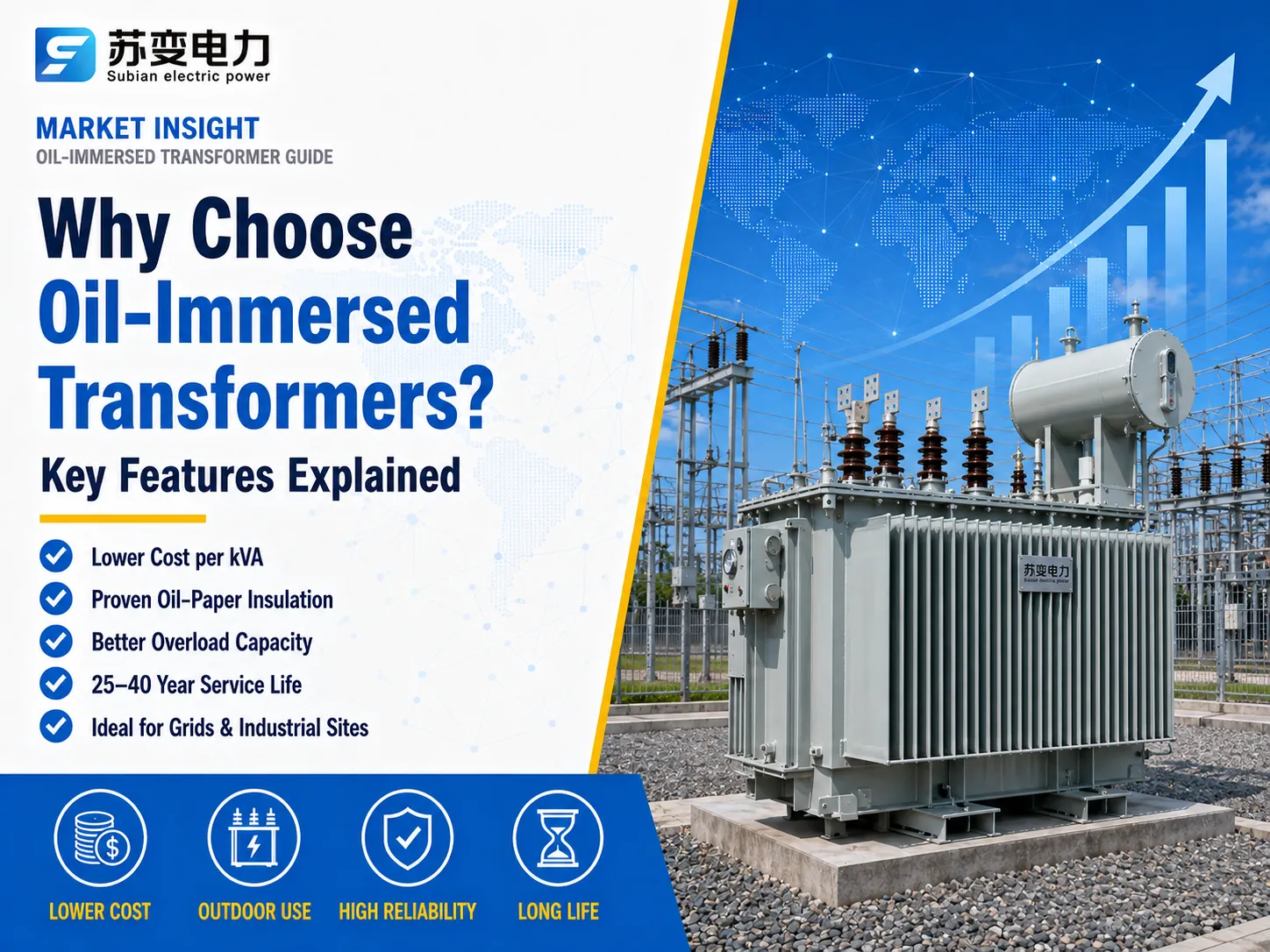
The kind of construction is largely dictated by the geographical location of the transformer. Transformers which operate in oil have mineral oil or ester liquid as the insulation and cooling fluid and are cheaper in terms of cost per kVA (kilovolt-ampere), have higher short-term overload capability, and are manufactured for outdoor substations. Dry transformers use either air or cast-resin to give them insulation.
| Parameter | Oil-Immersed | Dry-Type (Cast-Resin) |
|---|---|---|
| Cooling medium | Mineral oil / ester | Air / epoxy resin |
| Fire safety | Requires containment, fire barriers | Self-extinguishing, low fire load |
| IP rating typical | IP54–IP56 | IP21–IP44 (IP54 on request) |
| Short-term overload | 1.3–1.5× for hours (IEC 60076-7) | Limited, ~1.1× briefly |
| Typical price (500 kVA) | $8,000–$16,000 | $12,000–$24,000 |
| Best-fit scenarios | Utility, solar farms, mining, outdoor substations | Buildings, data centers, tunnels, hospitals |
In the case of outdoor utility substations, the use of oil-immersed transformers is almost always the appropriate choice in most situations. If the transformer is located in the basement of the tall building, the law and insurance will compel its use of dry-type transformers. Some newly established solar energy facilities also use dry-type transformers indoors with the installation of inverters to prevent the responsibility for any oil spill from happening at all.
Impedance, Losses, and Temperature Rise
Certain performance parameters warrant attention as they influence the short-circuit characteristics and the operational lifespan. The percentage of impedance (uk%) value of small distribution transformers is 4%, for medium voltage transformers and connected generators transformers it is between 6-8%, it determines short-circuit current and voltage regulation behavior. Thus, lower impedance results in improved voltage regulation but maximum fault current flows through transformers.
Losses are defined as no-load losses (a constant value, meaning that losses occur 24 hours a day 7 days a week) and load losses (losses are proportional to the square of the load). A 500 kVA unit with an amorphous core provides losses reduction during no-load operation from 1200 W to 400 W. This translates to more than 21000 dollars across 30 years of operation when electricity costs 0.1 dollar per kilowatt hour which is a total amount that is more than the price of many manufactured units.
| Rating (kVA) | Typical No-Load Loss (W) | Typical Load Loss (W) | Impedance (uk%) | Temp Rise (K) |
|---|---|---|---|---|
| 100 | 180–300 | 1,500–2,000 | 4.0 | 55–65 |
| 250 | 350–600 | 3,200–4,200 | 4.0–4.5 | 55–65 |
| 500 | 600–1,200 | 5,500–7,500 | 4.5–6.0 | 55–65 |
| 1,000 | 1,000–2,000 | 9,500–13,000 | 5.5–6.5 | 55–65 |
| 2,500 | 2,200–4,000 | 20,000–28,000 | 6.0–8.0 | 55–65 |
When comparing prices, request assurance of guaranteed losses with IEC 60076-1 allowances and ask for actual measured loss values in the factory reports. Manufacturers’ reported losses are “typical” and may be 10% more than actual at delivery; the inclusion of a guaranteed plus tolerance clause protects the operating cost projection over 30 years.
Environmental Factors: IP Rating, Altitude, Climate
Environmental conditions affect rating, not only the enclosure. According to IEC 60076-1, units operating 1000 m above sea level must have their rating reduced (approximately 1% for each additional 100 m) because thinner air is not as effective in cooling. The same applies to ambient temperatures over 40 degrees C. A unit designed for a rise in temperature of 55 K in an ambient of 45 degrees C loses its rating.
IP rating (IEC 60529) refers to protection against dust and water. Units immersed in oil but located outdoors normally have IP54 rating in dry areas and IP56 rating when used in coastal locations. Dry-types operated indoors have IP21-IP44 rating range. For mining or coastal applications an IP54 rating should be specified with careful selection of gasketing material (a gasket made of silicone that operates in the range of −40°C to +150°C ).
Comparison: Selection Priorities by Scenario
| Scenario | Priority #1 | Priority #2 | Priority #3 |
|---|---|---|---|
| Utility distribution | Low no-load loss | Standard impedance, long life | Standardized parts |
| Solar / wind plant | Grid-code vector group | Cyclic overload capability | Impedance match |
| Industrial plant | Harmonic and inrush tolerance | Overload headroom | Maintenance access |
| Mining | IP rating, rugged tank | Spare parts availability | Transportability |
| Data center | Fire safety (dry-type) | Redundancy, N+1 | Low losses |
| Commercial building | Low noise, compact | Fire safety | Aesthetic enclosure |
| Hospital | Reliability, dual feed | Fast changeover | Quiet operation |
Prioritization has the primary purpose of facilitating decision-making regarding difficult tradeoffs that need to be made. For example, a mining purchaser who chooses to buy IP56 material even though it costs more and avoids paying for loss efficiency is making a sound choice. Likewise, a utility that chooses the inverse is also right in making that choice. The mistake is not making a choice based on priorities, which leads to an IP21 dry-type unit being placed in the coal yard.
Top Brands and Price Benchmarks
Worldwide customers analyze multiple well-known names along with the increasingly rising number of IEC-approved manufacturers in China. Global players offer proven engineering along with after-sales service; meanwhile, Chinese manufacturers are catching up with standard tests and have a considerable price advantage for distribution-level equipment.
| Brand | Home Region | Strength | Indicative Price (500 kVA) |
|---|---|---|---|
| ABB | Switzerland/Sweden | Full grid-to-load portfolio, strong service | $18,000–$30,000 |
| Siemens | Germany | High-efficiency and digital transformer options | $18,000–$32,000 |
| Schneider Electric | France | Dry-type leadership, LV integration | $15,000–$28,000 |
| Hitachi Energy | Switzerland | Grid strength, large power transformers | $17,000–$30,000 |
| Eaton | USA | North American compliance, pad-mount range | $14,000–$26,000 |
| CG Power, TBEA | India/China | High volume, competitive pricing | $10,000–$18,000 |
| Jiangsu Subian Electric Power | China | IEC 60076 certification, copper windings, factory test reports | $8,000–$16,000 |
The prices mentioned refer to a 500 kVA oil-insulated unit, FOB China or ex-works where they may differ based on specifications, and manufacturer, and location in which which it is situated. From the international heavyweights mentioned previously, we can conclude that they lead the industry by finding best formulas for reliability and after-sales services established for decades. The situation is different when it comes to Jiangsu Subian Electric Power: it can boast the use of IEC 60076-approved design, copper windings as a minimum requirement, and a factory testing report that is attached to every unit. For distributive engineering projects with limited budgets, for solar parks, electrification of rural areas or industrial zones, this is the combination of parameters that will result in the right solution. Whenever you are analyzing any supplier from China, you should request the same documentation that you would usually ask ABB; the suppliers that provide the documentation are those who should be taken into consideration.
A Step-by-Step Selection Procedure
- Establish the purpose of application and rank the six groups of factors based on importance.
- Determine kVA on the basis of the actual load profile with diversity and a margin for growth of 10-20%.
- Set the voltage ratio, taps, and vector group on the basis of drawings from the grid and specifications from the code.
- Select the type of construction (oil or dry) based on the installation environment and regulations regarding fire safety.
- Determine the value of the impedance, how much energy is guaranteed to be lost, and how much heat is expected to accumulate and find out if OLTC will be necessary given the situation with the grid.
- Examine environmental factors: altitude, climate, IP number, sound limits.
- Make a shortlist of 3-4 suppliers and compare their bids based on total cost of ownership in relation to their offers.
Get the reports from testing labs and devise a routine testing plan for critical projects.
Organize transport, installation, oil servicing, and spare provision for commissioning before the placement of the order.
Frequently Asked Questions
What is the most important factor in power transformer selection?
Capacity is the important part as everything else is based upon the kVA rating of the device. However, it depends on the scenario when we talk about what matters more: for an installation, the loss due to no-load is the main parameter used for 30-years cost calculations; for solar plants, the impedance of grid codes and the vector group are essential conditions; and for data centers, fire safety and redundancy are the most important requirements.
How much does a power transformer cost in 2025?
The cost of a 100 kVA distribution unit ranges from $2,500 to $6,000 FOB, while that of a 500 kVA unit ranges from $8,000 to $16,000, and a 2500 kVA unit costs between $38,000 and $75,000. Dry-type units are 40–80% pricier than oil-immersed at the same kVA. In addition, copper units cost 20–40% more than aluminum ones. Prices depend on specifications, brands, and regions, with international brands being 2–3 times costlier than IEC-certified Chinese vendors in the same class test.
Should I choose a dry-type or oil-immersed transformer for a solar plant?
For outdoor collector substations, oil-immersed is the most common type of technology due to its cost-effective kVA efficiency and ability to cope with solar load variations and to alleviate the need for indoor ventilation. For rooftop solar or for solar systems built into buildings with inverters indoors, the preferred equipment is dry type units, which eliminate the risk of oil leakage and fire to a certain extent. It is important to choose the equipment according to the location in which it is installed and not according to trends.
Why does vector group matter in transformer selection?
The vector group is defined in terms of phase shift of primary and secondary with respect to neutral — Dyn11 means that the LV side is grounded wye for 3-phase 4-wire distribution. The same vector group, voltage ratio and impedance in the range of ~10% are required for parallel operation of the units.
How do I evaluate a Chinese transformer manufacturer?
Request three documents: IEC 60076 test certifications, the routine factory test report for a unit you propose, and references from projects in your area. Check for ISO 9001 and 14001 certifications, inspect the factory if the total order is greater than about $50,000, and find out the warranty (normally 18 to 24 months) and spare-parts policies. Tested-performance transparency is the best screening rule.
References
- IEC 60076-1: Power Transformers — General — the baseline standard for ratings, tolerances, and test requirements.
- IEC 60076-7: Loading Guide for Oil-Immersed Power Transformers — cyclic loading and overload temperature guidance.
- IEEE C57.12.00: General Requirements for Liquid-Immersed Transformers — North American rating and testing framework.
- Electrical4U — Vector Group of Transformer — a clear reference for Dyn11, Yyn0, and parallel operation rules.
- Eaton — Transformer Consulting — selection tools and engineering guidance for industrial applications.
- Siemens Energy — Power Transformers — manufacturer reference for transformer technologies and specifications.
- Wikipedia — Transformer Types — background on oil-immersed, dry-type, and specialty transformer classes.
Conclusion
Choosing a power transformer is not an act of chance. It begins with establishing the appropriate capacity based on actual load characteristics before taking into account voltage and vector group parameters of the given grid. Finally, one has to choose the appropriate design, optimizing losses, impedance, and temperature rise according to the priority ranking.
- Ranking that has to be done before consulting the specification sheet and making an informed choice of the power transformer.
- Capacity has to be expressed in kVA and taking into account some diversity and 10-20% increase margin.
- The vector group, impedance, and losses should be checked against grid code and laboratory test results.
- Suppliers have to be compared based on the overall performance of their transformers and the total cost of ownership, not on prices quoted.