


Gas insulated switchgear is the boundary between control in a transmission or distribution network. A GIS is an electrical substation including circuit breakers, disconnectors, earthing switches, current and voltage transformers, and busbars, which are housed in a sealed, gas-insulated enclosure. A GIS bay occupies much less space than air-insulated equipment, which is why utility companies find it useful at locations where land is expensive, the weather is harsh, and strict reliability rules apply. Choosing a GIS supplier is one of the most critical purchases in a utility capital program, since the product must last for forty years, remain serviceable during that period, and work with protection and control systems which will be changed multiple times until the end of its service life. This article discusses GIS technology, its most dominant suppliers, and what has to be specified in the project.
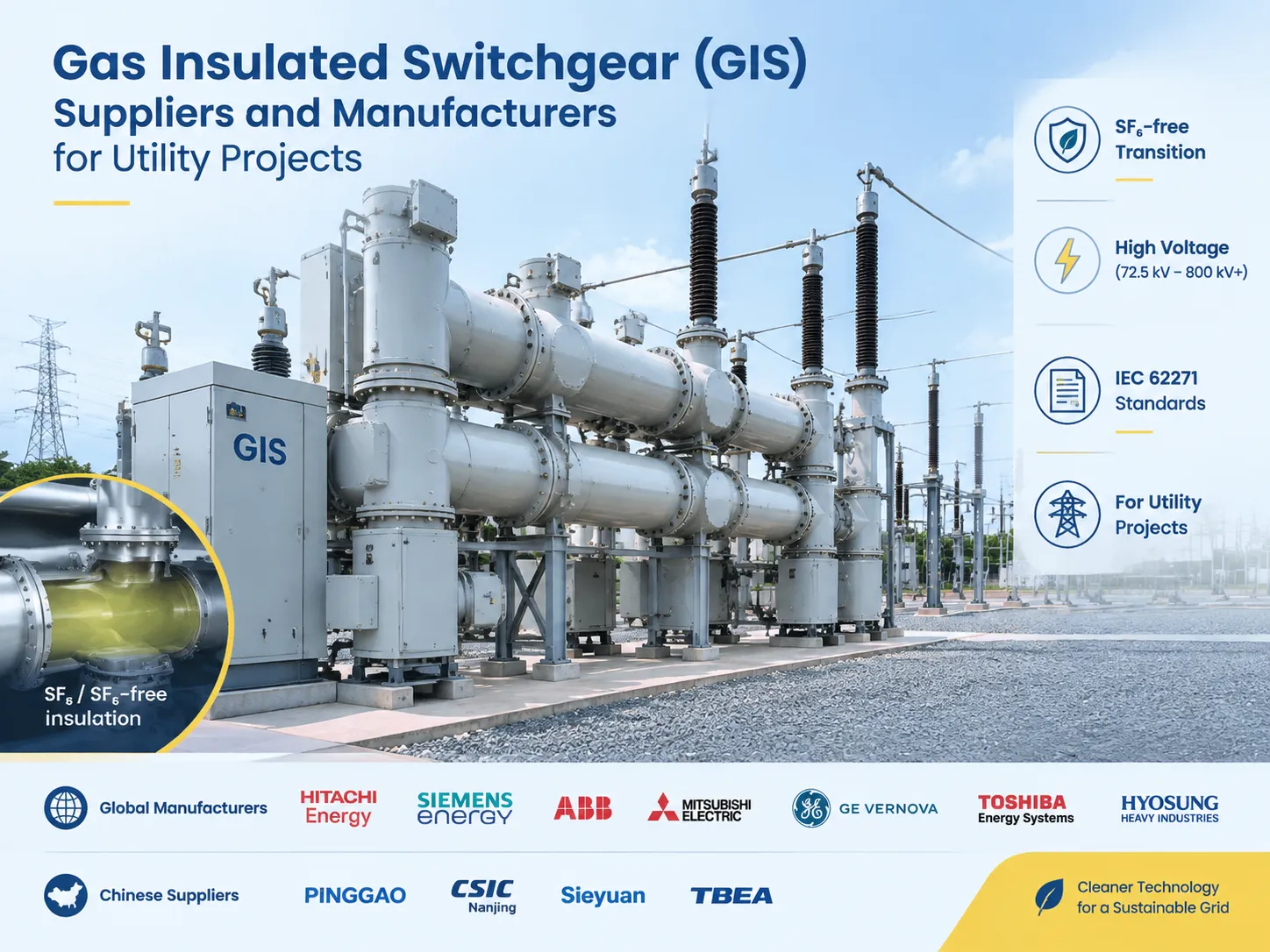
In essence, gas-insulated switchgear (GIS) refers to the switchgear designed to operate at a high voltage level, which ensures that the live components are enclosed in a sealed metal casing filled with gas insulation. Sulphur hexafluoride (SF₆) has traditionally been used as gas insulation, but now there are also air-insulated switchgear systems or gas-insulated switchgears using SF₆-free gas insulation. The major manufactures of GIS devices operating in the global market are Hitachi Energy, Siemens Energy, ABB, Mitsubishi Electric, GE Vernova, Toshiba Energy Systems, and Hyosung Heavy Industries . In China, GIS devices are produced by Pinggao Group, CSIC Nanjing, Sieyuan, and TBEA. There are certain specifications in GIS devices, such as rated voltage, breakdown voltage level (BIL), rated current, rated short-circuit breaking current, and amount of the island. The trend that has been observed lately is firms switching from SF₆ to SF₆-free gas insulation due to the policies of the EU that regulate the use of SF₆ in new medium voltage switchgears. In this regard, it should be also stated that Subian does not act as a GIS commercial specialist; that is, it is involved in manufacturing transformers for other devices placed in substations.
What GIS Is and Why Utilities Use It
Traditional substations depend on air and distance for the insulation of current-carrying conductors. This simple and economical principle is well-known but needs considerable space. The clearances needed for the transmission voltage substations reach several meters, making the air-insulated substations (AIS) occupy an area of several hectares.
On the other hand, the gas-insulated switchgear operates using a completely different principle. Its circuit breakers, conductors, disconnection switches, earthing switches, and transformers are installed in special capsules that are filled with gas under pressure. Due to the fact that the strength of dielectric of gas is much bigger than the one of air, the clearances also decrease substantially. The GIS for 245 kV can be installed in a building that is much smaller than one used for the AIS.
The implementation of such systems allows making maximum use of space and is being rapidly employed in four cases.
- Urban and land-limited areas are places in which a substation must be located in cities, business complexes, or even underground facilities where GIS is the only viable technology.
- Extreme and contaminated locations encompass those environments in which the live components are hermetically sealed and thus are unaffected by salt sprays, dust particles, sand, moisture, or industrial pollution; for this reason, GIS technology has gained many applications in coastal, desert, and industrial parts of the world.
- High reliability standards mean that a sealed technology eliminates most of the external conditions that cause flashover of the air-insulated installation and thus cuts the frequency of maintenance work.
- Renewable energy and remote connections state that technologies such as wind and solar, rely on compact or pre-built GIS substations that minimize both civil works and time needed for installation as well as site exposure.
The trade-off here is in the cost and complexity of this technology, one GIS bay requires many more funds than one AIS bay and implies high requirements to the environment of use, staff involved, equipment for gas managing as well as the manufacturing quality control that allows no imperfection in joints or impurity of the installation, while when there are no limitations of space and environment, air insulation technology remains more cost-efficient.
Voltage Classes and Configurations
GIS is defined through its rated voltage and the ratings that are usually obtained for utility projects, which center around different standards.
| Rated voltage | Typical application | Indicative lightning impulse withstand (BIL) | Typical short-circuit breaking current |
|---|---|---|---|
| 72.5 kV | Sub-transmission, large industrial supply | 325 kV | 31.5-40 kA |
| 145 kV | Transmission and primary distribution | 650 kV | 40 kA |
| 170 kV | Transmission | 750 kV | 63 kA |
| 245 / 253 kV | Transmission, renewable connections | 1050 kV | 50-63 kA |
| 300 kV | Transmission | 1050 kV | 63 kA |
| 420 kV | Extra-high-voltage transmission | 1425 kV | 63 kA |
| 550 kV and above | Bulk transmission, UHV corridors | Above 1550 kV | 63 kA and above |
The data presented here has been gathered from several published manufacturer data for integrated GIS applications and shows the specifications that need to be determined for them to be approved. The rated normal current for busbars and feeders lies between the range of 3150 A and 5000 A at various voltage levels and the short-time withstand current is usually specified for a duration of three seconds. The lightning impulse withstand voltage or basic insulation level is the specification whose importance must be fully appreciated as it shows that an underspecification can become dangerous and not only costly.
Configuration is also crucial in addition to rating. The simplest scheme is a single-busbar configuration, which is also affordable; the double-busbar options provide redundancy and flexibility at a higher price; and sectioned configurations allow isolating some part of the station for maintenance while another operates. It is a reliability choice rather than equipment choice and has to be made before the supplier is chosen and not just retrofitted afterward.
The SF₆ Transition
The insulation-gas issue must be addressed in every discussion of GIS procurement in 2026, as it causes changes in both ranges and commercialization processes of production systems.
Sulfur hexafluoride has unique dielectric properties, which is the reason for its ever-lasting popularity in the electric switchgear. However, it has an ecological factor: SF₆ has a warming potential that exceeds the one of carbon dioxide many times over and is able to exist for many years. During the operation of the equipment and its disposal, losses and leakages happen which turn it into one of the greenhouse gases broadly used in the electricity sector.
There were regulatory responses. The European Union has restricted the use of SF₆ in the medium-voltage electric switchgear produced after January of 2026, and various manufacturers started offering alternatives. There are two main alternatives available on the market: one is using dry air as an insulator with vacuum switching, the other one is some type of innovative technology developed by General Electric (like g³ technology). Progress has been quite fast, as Hitachi Energy was able to provide GIS without the use of SF₆ of 550 KV and got a contract for another similar project for a Japanese firm, GE Vernova introduced solutions at 170 KV, and Siemens is entering the market of clean air technologies designed for voltage levels reaching 420 KV.
This could lead to three different consequences for companies working in this field. First, specifications might clearly state whether the equipment produced without using SF₆ is required or vice versa, whether there are some limitations regarding possible leakages. The second thing is that calculations of the overall cost must comprise not only the initial cost of production but also the price to manage gas during its lifecycle, i.e. to monitor it and to recover it when necessary. Finally, this transition brings some time-related risks as companies may invest into technologies that get outdated at once or choose the newest machines only recently introduced into the market, which means that they might not have enough work experience. Both decisions are understandable.
The GIS Supplier Landscape
Concentration is significant in the high-voltage GIS industry. The companies that dominate in terms of revenue in this area are outlined below, subject to the remark that the amounts given represent the guesstimates based on publicly available information rather than audited segment data.
| Supplier | Headquarters | Voltage range | Positioning |
|---|---|---|---|
| Hitachi Energy | Zurich, Switzerland | 72.5-800 kV, up to 1200 kV in portfolio | Grid decarbonisation and digital GIS leader; EconiQ SF₆-free platform; strong utility relationships globally |
| Siemens Energy | Munich, Germany | 72.5-550 kV | Blue GIS clean-air portfolio with vacuum switching; strong European and utility base; DC GIS capability |
| ABB | Zurich, Switzerland | 72.5-550 kV, ELK series to 1200 kV | Broad transmission and industrial footprint; compact designs and digital integration; SF₆-free medium-voltage ranges |
| Mitsubishi Electric | Tokyo, Japan | 72.5-800 kV | High-reliability transmission and HVDC projects; dry-air insulated designs; long manufacturing heritage |
| GE Vernova | Cambridge, Massachusetts, USA | 72.5-550 kV | g³ SF₆-free gas; turnkey substation capability; grid modernisation focus |
| Toshiba Energy Systems | Tokyo, Japan | 72.5-550 kV | Compact phase-segregated and three-phase encapsulated designs; strong in Japan with selective global projects |
| Hyosung Heavy Industries | Seoul, South Korea | 72.5-800 kV | Cost-competitive GIS with strong EPC partnerships; established in Asia, Middle East, and Africa |
| Nissin Electric | Tokyo, Japan | 72.5-245 kV | Compact GIS specialist for utilities and transport applications |
| Pinggao Group | Henan, China | 72.5-550 kV | Price-aggressive supplier expanding internationally, particularly in Asia, Africa, and Latin America |
| CSIC Nanjing / Sieyuan / TBEA | China | 72.5-550 kV | Localised manufacturing scale; competitive on large-volume programmes |
Next in the rankings and closely match the necessary competencies are regional and specialist manufacturers of the likes of Hyundai Electric in Korea, CG Power and BHEL in India, Fuji Electric and Meiden in Japan, Schneider Electric and Eaton in medium-voltage and primary distribution and ILJIN Electric in Korea. For projects in the Indian sub-continent, BHEL and CG Power are the companies of choice while for utility work in Africa and the Middle East, Hyosung has created a significant market presence owing to its pricing edge over European and Japanese companies.
Supplier Profiles
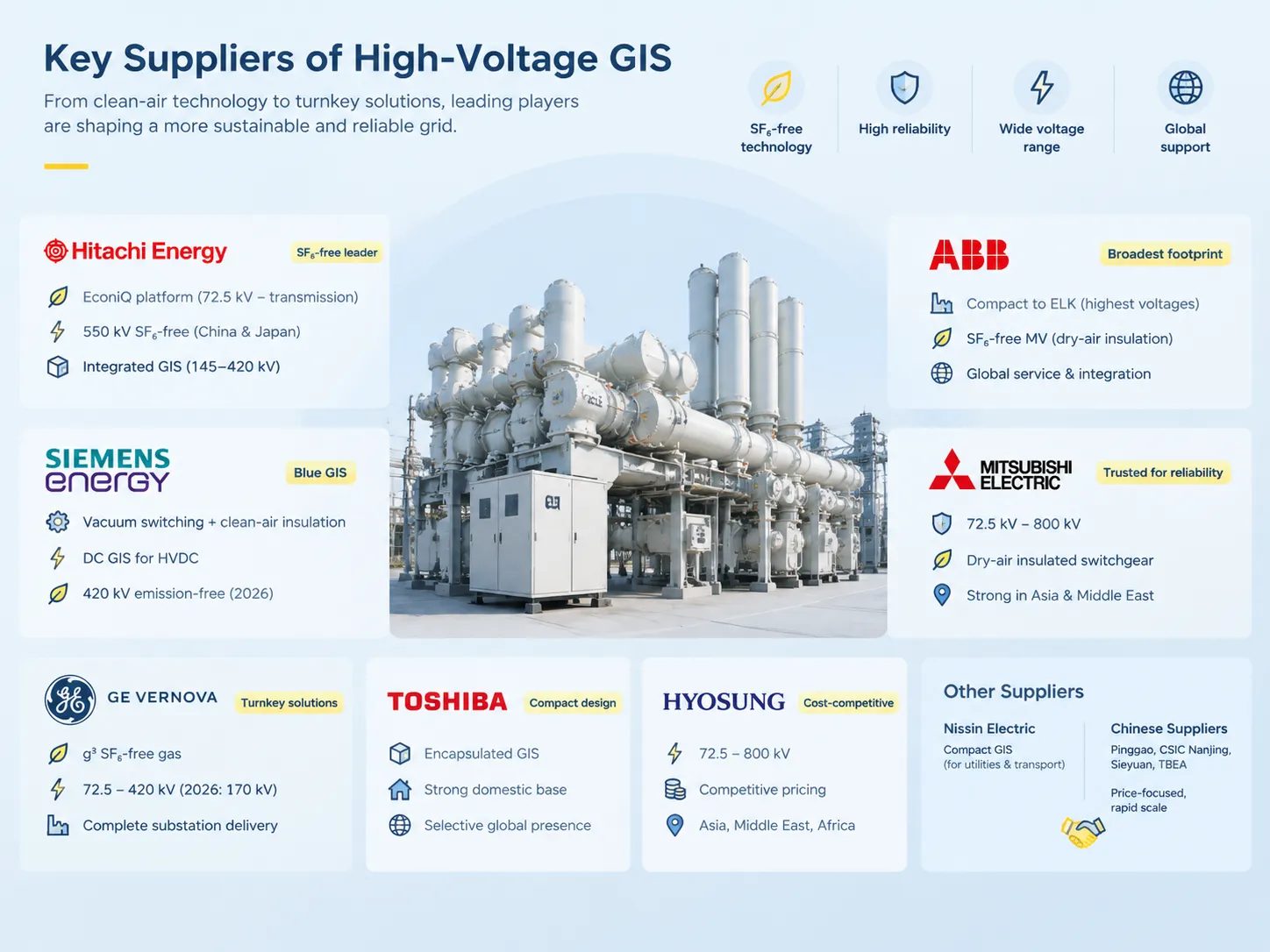
- Hitachi Energy is recognized as the top economic performer of GIS technology globally. Its EconiQ platform entering into the transmission market has been successful as the manufacturer has already started utilizing SF₆-free cavities in the skyline with deliveries of 550 kV innovative technology intended for the Shanghai transmission operator in China and its counterpart in Japan. The comprehensive GIS solutions available from the producer are particularly advantageous for various customers requiring energization such as emergency and replacement bays as well as oil, gas, and mining operations. The advantage of having all the components from one company will certainly facilitate the work of utility companies.
- Siemens Energy, benefitting from long-standing partnerships with various European electricity transmission companies, is leading its changes with the help of Blue GIS technology, which uses clean-air insulation combined with vacuum switching. The company successfully carried out Blue GIS installations at the latest Nordic transmission operator and produced DC GIS technology aimed at voltage direct current market. The 2026 initiative on creating emission-free GIS at the level of 420 kV is one of the most important initiatives in the field of clean-air technology in extra-high voltage technology.
- Among the three major manufacturers from Europe, ABB offers the greatest industrial tradition, with its transmission sector offering gas-insulated switchgear (GIS). The company’s GIS line-a complete solution from compact units in areas with spatial limitations up to ELK range for the highest voltages, points to ABB being prepared to adapt to the transformation process from SF₆ gas. Through dry-air-insulated products and a partnership with one of the most renowned German electric firms, ABB is on track to transform the industry. Its specialty in utility projects encompasses availability not only of its own equipment but also wide-ranging bundled solutions and global expertise.
- Mitsubishi Electric is regarded as the top option in cases when reliability comes first and the customers utilized Japanese transmission devices before. It provides GIS production in the range from 72.5 kV to 800 kV through dry-air insulation while also participating in the development of switching technology based on zero-global-warming-potential gases. The company is also highly active in Asia and the Middle-East securing some projects in other markets as well.
- GE Vernova makes its presence felt via g³ gas technology and the provision of full-scale substations. The launch of g-free insulated unit of 170 kV in 2026 complete the line of devices ranging from 72.5 kV to 420 kV, including the first 245 kV g-free unit installed in the USA.
- Toshiba and Hyosung provide quite different approaches and values. The first company suggests compact designs with large installed base in Japan and considerable yet not comprehensive presence abroad while the latter is able to deliver devices in the range of 72.5 kV to 800 kV at very reasonable prices.
- Nissin Electric has narrow specialization in compact GIS for utility and transport segments, while the Chinese manufacturers offer low-cost solutions, gaining momentum in manufacturing scale in such markets like Africa, Southeast Asia and Latin America.
What to Specify
Good GIS specifications spell out the above points clearly. The biggest reason for expensive change orders is poorly written specifications.
- Rated voltage and insulation level. This is the nominal voltage of the system together with voltage impulse withstand voltage (BIL) and power frequency withstand voltage.This is essential to the design of the dielectric and cannot be changed after manufacture.
- Rated normal current for busbars and feeders together with the temperature at which this is defined. Thus busbars rated for 40°C and the running at 50°C constitute different i mains.
- Rated short circuit breaking current and the short time withstand current together with the time duration of these currents. These electrical characteristics need to be matched to the fault level of the system which means current system study as opposed to antiquated methods.
- Configuration of busbars which may be single, double, double with hop or sectionalized as well as number of bays both incoming and outgoing, bus coupler, bus section bay and transformer bay.
- Gas insulated switchgear – the type of insulation gas or SF6 in case the latter is allowed and the maximum leakage of gas as well as means of gas supervision have to be defined.
- Instrument transformers ratios of current transformers and voltage transformers plus basic parameters for metering and protection of these transformers. These are essential elements of the whole system and if not defined properly will incur lot of expenditures to put the whole scheme into place.
- Protection, control and monitoring systems – the IEC 61850 compliance, communication systems as well as provision of secondary systems by suppliers.
- Physical envelope which includes width and height of the switchgear and circumstances of its building and environment.
- Testing and documentation – the certificates of type tests, reports and protocols of the completed tests.
Component-level expertise is especially important with two aspects: the short-circuit rating and specifications concerning instrumental transformers, because that sort of information is determined by the network data and metering philosophy and not by the manufacturer of the switchgear. The parameters themselves follow the same discipline as any high-voltage equipment specification, which is set out in our guide to transformer specifications explained.
How to Choose a Supplier
There are six distinguishing criteria that determine a successful GIS procurement from a costly procurement.
- Verifying the equipment already in use by similar ratings is necessary, as well as checking the installations of the equipment used on the same voltage class in the similar environment with several years of operation. For instance, a voltage class of 145 kV cannot provide enough information for a 420 kV device used in a coastal desert location, even though this is what suppliers advertise.
- Obtaining the type test certificate according to IEC 62271 for the corresponding voltage ratings needs to be ensured, as the type tests are performed based on the design and not based on the family of devices. Therefore, even having a certificate for a different voltage does not provide any data on the necessary one.
- Checking the local capabilities for the service is also important, as switchgear can last for decades and what matters during this period is whether there are properly trained service personnel and spare parts available in a reasonable distance and ability to handle the gas. Without this being in place, it cannot be imagined to use the SF₆ equipment.
- Establishing the technology roadmap is critical as well. The buyers need to ask the supplier what is being provided for the technology and what their future plans are concerning making the technology free from SF₆ gases. If the design is getting phased out, then its cost of maintenance will only increase.
- Another important point is estimating the lifecycle instead of estimating the bay, as one needs to take into account gas management, condition monitoring, availability of spare parts, training, and outage cost. Very often having the lowest price for the purchase leads to having the highest overall spending for replacement and maintenance.
- It is necessary to ensure that the schedule provided by the supplier coincides with the project as indicated. High voltage switchgear supplies imply very long delivery times that are increasing across the industry and therefore it is necessary to guarantee that the schedule being provided has been confirmed with milestones.
In case the equipment is supplied with the provision that other equipment is a part of the complete substation, the testing and commissioning procedure needs to be adhered to, the same way as it has been done for primary technologies. Our guide to transformer testing covers the equivalent regime for the transformers that share the station.
Where Subian Fits
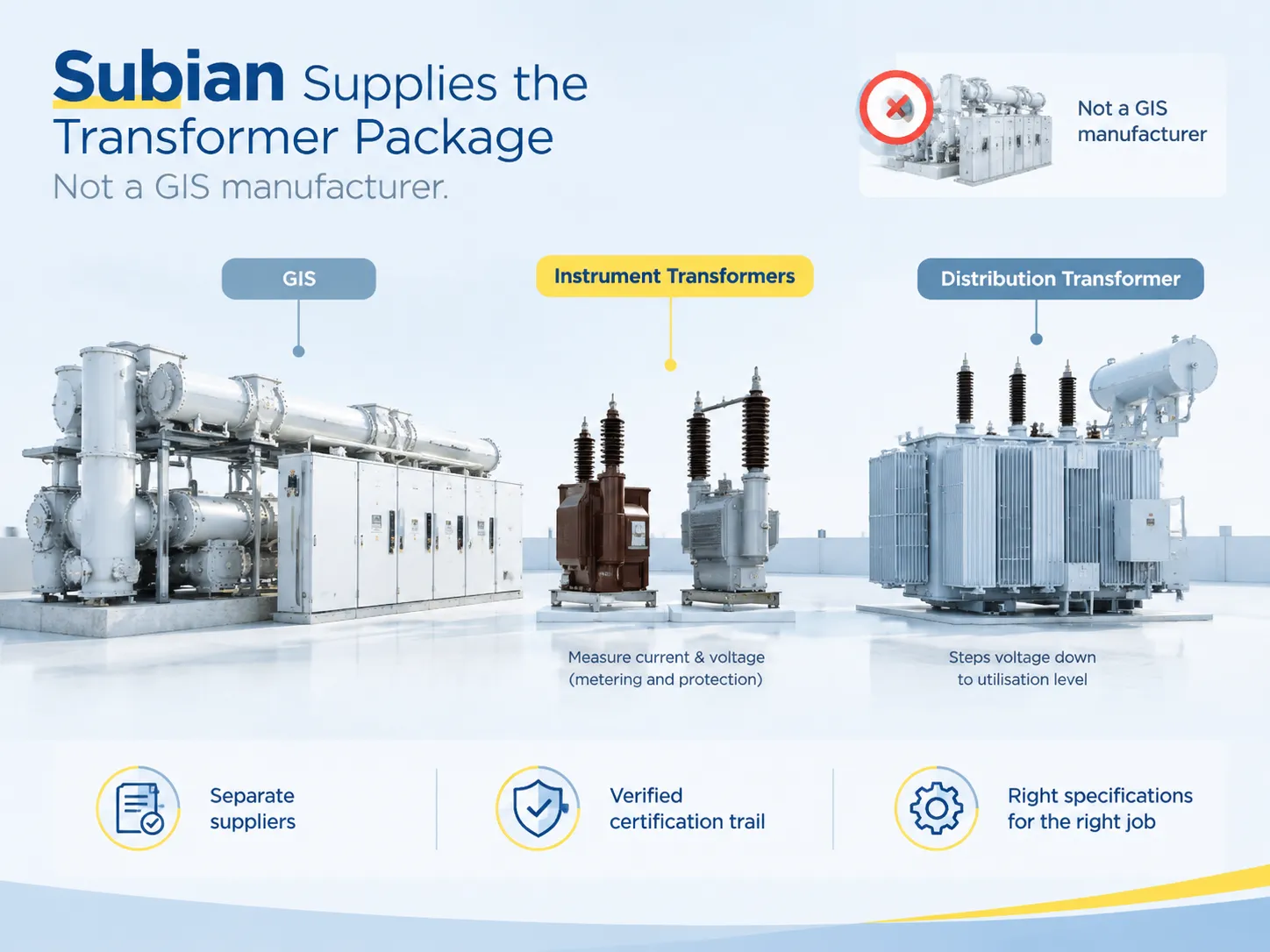
An honest guide must state this clearly so let us state it clearly. Subian is not a gas insulated switchgear manufacturer. GIS is a specialized product that requires the manufacture of enclosures, technology for sealing gas inside it, the development of arc quenching technology, and the ability to carry out type tests at insulation voltage levels which we do not manufacture. Any supplier claiming to be able to supply such equipment is misrepresenting himself.
What is supplied by Subian are appliances which complete the same substation. A GIS assembly cannot be used as a stand-alone product as it needs instrument transformers to measure current and voltage for the protection and metering systems and it also needs the distribution transformers used in distribution connected stations for transforming the voltage to a consumption level. These components are manufactured by us as well as various types of grounding and protection equipment.
Among the two instruments, the instrument transformer is more interesting from the technical point of view. Modern GIS may contain the current and voltage transformers implemented inside the sealed enclosure, and there are also stand-alone types of such transformers and retrofit projects. The specifications are the same for both cases as they include ratio, accuracy class for metering/ protection purposes, thermal rating, and burden.Our current transformer range illustrates what those specifications look like in practice, including the accuracy classes that separate a metering unit from a protection unit.
The protection side of the same installation — how the measured current is used to detect a fault, and why the transformer’s characteristics determine whether the relay operates correctly — is covered in our guide to earth fault protection basics.
The practical implication of the GIS package and transformer package being separate procurement decisions is that they should both be specified by the utility procurement team instead of being assumed to be bundled together. Where a project needs a transformer supplier with documented test data and a verifiable certification trail, the qualification criteria are set out in our guide to choosing a transformer supplier, and the same discipline applies to the instrument transformers that interface with the switchgear.
FAQ
What is the difference between GIS and AIS switchgear?
Air insulated switchgear (AIS) relies on natural air to insulate the energized circuits, meaning the distances between the power conductors are large and require substantial space. Therefore, AIS installations are mostly placed outdoor. In contrast, GIS relies on the sealed electrical system of providing insulating gas on high pressure. That makes it possible to shorten distances considerably which makes the GIS system suitable for indoor installations. Although GIS attracts additional costs as compared to AIS, it is preferred where land is scarce, environment is aggressive or polluted, and reliability and maintenance are top priorities. On the other hand, AIS remains the optimal option when there is enough space and environment is friendly, while the capital costs dominate.
Which companies manufacture high-voltage GIS?
There are three main groups of manufacturers of high voltage GIS. The first group includes manufacturers like Hitachi Energy, Siemens Energy, ABB, Mitsubishi Electric, GE Vernova, Toshiba Energy Systems, and Hyosung Heavy Industries, covering approximately the voltage range of 72.5 kV to 800 kV. The second group mostly includes smaller manufacturers like Nissin Electric, Hyundai Electric, Fuji Electric, and CG Power. Finally, the third group includes producers from China like Pinggao Group, CSIC Nanjing, Sieyuan, and TBEA, who mainly face competition in terms of prices in the markets of Asia, Africa, and Latin America.
Why is the industry moving away from SF₆?
The reason why most companies try to substitute SF₆ is because of its extreme potency as a greenhouse gas that has a global warming potential thousands of times higher than that of carbon dioxide, as well as its very long residence time in the atmosphere. The European Union has forbidden the use of SF₆ gas in new medium-voltage switchgear with ratings of less than 24 kV since 2026. Manufacturers present alternatives in the form of dry-air and clean-air insulation combined with vacuum switching as well as proprietary gases like GE Vernova g³. Hitachi Energy issued GIS maintaining the voltage of 550 kV without using SF₆ gas, Siemens Energy is working on non-emission GIS with the ratings of 420 kV while GE Vernova released the series of GIS ranges from 72.5 kV to 420 kV.
What ratings should a GIS specification state?
The list of parameters should include the following minimum points: rated voltage, lightning impulse withstand voltage, rated normal current for busbars and feeders, rated short-circuit breaking current, busbar schema regarding the type and total number of bays, insulation gas as well as the leakage rate, ratios of current transformers and degrees of on-time operations, environmental protection means, physical dimensions of the GIS system, and the network in charge of testing and provision of data. Esoteric specifications of this type can result in expensive changes and variations during operational phase of equipment.
How do I verify a GIS supplier’s claims?
There are generally three ways for verifying the information provided by the suppliers. First of all, it can be confirmed by reference installation. It means that one can ask for information about the operation of any site with the same voltage rating and in similar environmental conditions and then check the success of such operation. Second, one can require the provision of certificates on type testing in terms of IEC 62271 standards. Finally, factory acceptance test is an option where the client can be present during the testing period of the equipment and monitor the process himself, thus providing a reliable source of information.
References
- Hitachi Energy — Gas Insulated Switchgear and EconiQ SF₆-Free Portfolio
- Siemens Energy — Blue GIS Clean Air Switchgear Technology
- International Electrotechnical Commission — IEC 62271 High-Voltage Switchgear and Controlgear
- ABB — High-Voltage Gas Insulated Switchgear
- GE Vernova — Grid Solutions GIS and g³ SF₆-Free Technology
- U.S. EPA — SF₆ Emissions Reduction Partnership for Electric Power Systems
Conclusion
Gas-insulated switchgear equipment has enabled substations to adapt to modern construction, allowing them to be made more compact, completely sealed, be free from climatic impacts and serve for around 40 years. The category is represented by small group of companies selling SF₆ equipment from 72.5 kV to 800 kV with Hitachi Energy, Siemens Energy, ABB, Mitsubishi Electric, GE Vernova, Toshiba and Hyosung as the leading brands and other, mostly Chinese producers following them actively in the emerging markets. The procurement process has remained the same: pick rated voltage, insulation level, normal current, short-circuit capacity, busbar configuration and an instrument transformer interface; confirm statements with reference projects and type test certificates; and calculate the cost of the lifecycle and gas operations instead of the isolated switchgear installation.The revolutionary change took place in the insulation gas. The age of SF₆ has come to an end due to regulations, so it is important to choose carefully transition from SF₆ technology to gas insulated switchgears with completely different insulation types.