


Газовая изолированная распределительная установка является границей между управлением в сети передачи или распределения. GIS — это электрическая подстанция, включающая в себя выключатели, разъединители, заземляющие выключатели, трансформаторы тока и напряжения, а также шины, которые размещены в герметичном корпусе с газовой изоляцией. Участок GIS занимает гораздо меньше места, чем оборудование с воздушной изоляцией, поэтому коммунальные компании находят его полезным в местах, где земля дорога, погода сурова, и действуют строгие правила надежности. Выбор поставщика GIS является одной из самых критических покупок в капитальной программе коммунального предприятия, поскольку продукт должен прослужить сорок лет, оставаться обслуживаемым в течение этого периода и работать с системами защиты и управления, которые будут меняться несколько раз до конца его срока службы. Эта статья обсуждает технологии GIS, его основных поставщиков и то, что должно быть указано в проекте.
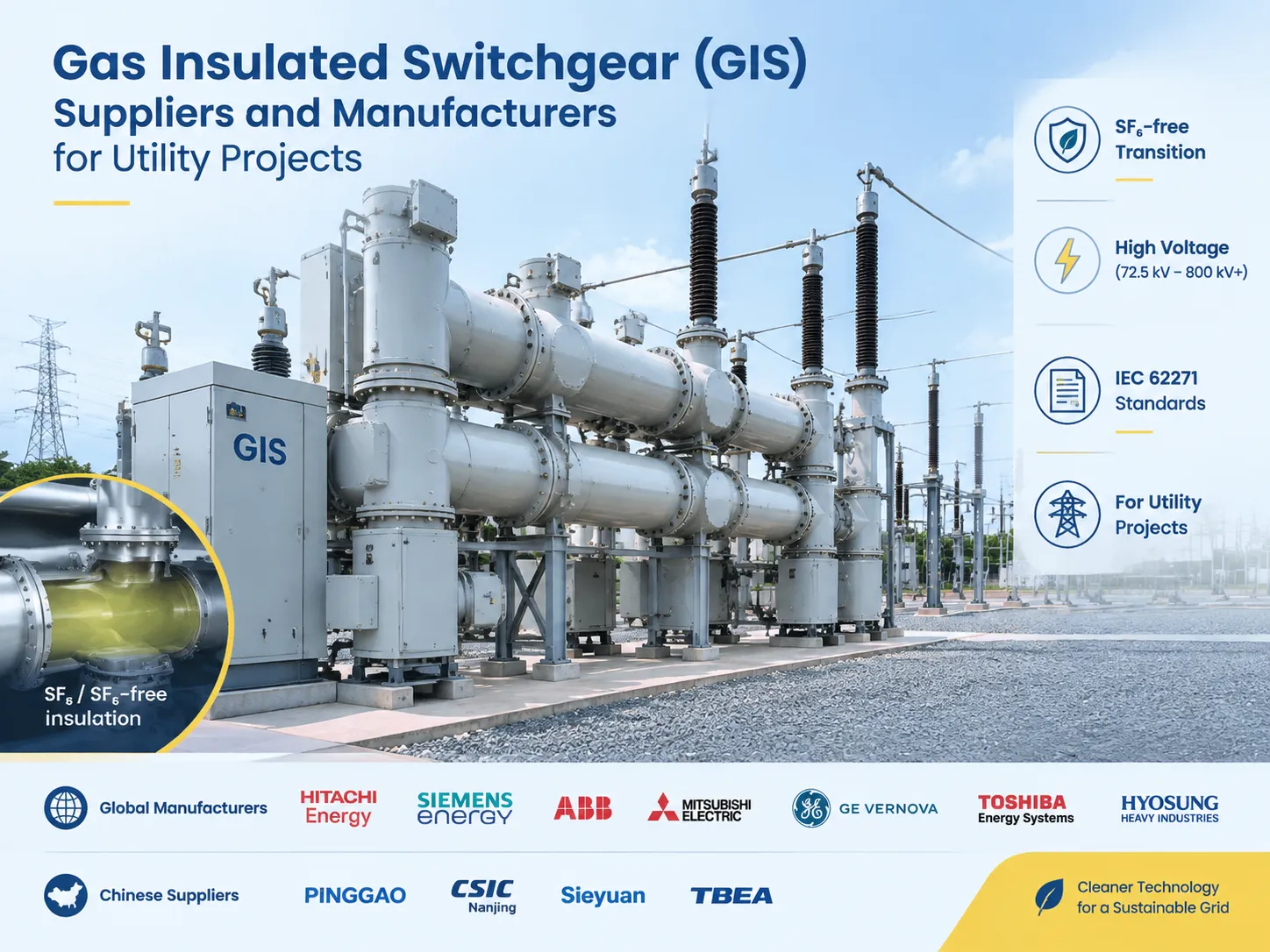
По сути, газовая изолированная распределительная установка (GIS) относится к распределительным устройствам, предназначенным для работы на высоком уровне напряжения, что обеспечивает заключение живых компонентов в герметичный металлический корпус, заполненный газовой изоляцией. Шестифтористый серо́в (SF₆) традиционно использовался в качестве газовой изоляции, но теперь также существуют системы распределительных устройств с воздушной изоляцией или газовые изолированные распределительные устройства, использующие газовую изоляцию без SF₆. Основные производители устройств GIS, работающие на мировом рынке, — это Hitachi Energy, Siemens Energy, ABB, Mitsubishi Electric, GE Vernova, Toshiba Energy Systems и Hyosung Heavy Industries. В Китае устройства GIS производятся компаниями Pinggao Group, CSIC Nanjing, Sieyuan и TBEA. В устройствах GIS существуют определенные спецификации, такие как номинальное напряжение, уровень пробивного напряжения (BIL), номинальный ток, номинальный ток короткого замыкания и количество острова. Наблюдаемая в последнее время тенденция заключается в том, что компании переходят с SF₆ на газовую изоляцию без SF₆ из-за политики ЕС, регулирующей использование SF₆ в новых распределительных устройствах среднего напряжения. В этом отношении также следует отметить, что Subian не выступает в качестве коммерческого специалиста по GIS; то есть она занимается производством трансформаторов для других устройств, размещенных на подстанциях.
Что такое GIS и почему коммунальные предприятия его используют
Традиционные подстанции зависят от воздуха и расстояния для изоляции токопроводящих проводников. Этот простой и экономичный принцип хорошо известен, но требует значительного пространства. Промежутки, необходимые для подстанций с передачей напряжения, достигают нескольких метров, что делает подстанции с воздушной изоляцией (AIS) занимающими площадь в несколько гектаров.
С другой стороны, газоизолированные распределительные устройства работают по совершенно другому принципу. Их автоматические выключатели, проводники, выключатели отключения, заземляющие выключатели и трансформаторы устанавливаются в специальные капсулы, заполненные газом под давлением. Поскольку диэлектрическая прочность газа значительно выше, чем у воздуха, расстояния также существенно уменьшаются. GIS для 245 кВ можно установить в здании, которое намного меньше, чем то, что используется для AIS.
Реализация таких систем позволяет максимально использовать пространство и быстро применяется в четырех случаях.
- Городские и ограниченные по площади районы — это места, в которых подстанция должна располагаться в городах, бизнес-комплексах или даже подземных сооружениях, где GIS является единственной жизнеспособной технологией.
- Экстремальные и загрязненные места охватывают те среды, в которых живые компоненты герметично запечатаны и, таким образом, не подвержены воздействию солевых распылений, пыли, песка, влаги или промышленного загрязнения; по этой причине технология GIS получила множество применений в прибрежных, пустынных и промышленных районах мира.
- Высокие стандарты надежности означают, что герметичная технология устраняет большинство внешних условий, вызывающих пробой в установках с воздушной изоляцией, и, таким образом, снижает частоту работ по обслуживанию.
- Возобновляемая энергия и удаленные подключения утверждают, что такие технологии, как ветер и солнечная энергия, полагаются на компактные или предварительно построенные подстанции GIS, которые минимизируют как гражданские работы, так и время, необходимое для установки, а также воздействие на площадку.
Компромисс здесь заключается в стоимости и сложности этой технологии, одна ячейка GIS требует гораздо больше средств, чем одна ячейка AIS, и подразумевает высокие требования к условиям эксплуатации, персоналу, задействованному оборудованию для управления газом, а также контролю качества производства, который не допускает недостатков в соединениях или загрязнений в установке, в то время как при отсутствии ограничений по пространству и условиям технология воздушной изоляции остается более экономически эффективной.
Классы напряжения и конфигурации
GIS определяется через свое номинальное напряжение и рейтинги, которые обычно получаются для проектов коммунальных служб и сосредоточены вокруг различных стандартов.
| Номинальное напряжение | Типичное применение | Указательный уровень импульсного напряжения (BIL) | Типичный ток короткого замыкания |
|---|---|---|---|
| 5 кВ | Подпередача, крупное промышленное снабжение | 325 кВ | 5-40 кА |
| 145 кВ | Передача и первичное распределение | 650 кВ | 40 кА |
| 170 кВ | Передача | 750 кВ | 63 кА |
| 245 / 253 кВ | Передача, возобновляемые подключения | 1050 кВ | 50-63 кА |
| 300 кВ | Передача | 1050 кВ | 63 кА |
| 420 кВ | Передача сверхвысокого напряжения | 1425 кВ | 63 кА |
| 550 кВ и выше | Массовая передача, коридоры UHV | Выше 1550 кВ | 63 кА и выше |
Данные, представленные здесь, были собраны из нескольких опубликованных данных производителей для интегрированных GIS-приложений и показывают спецификации, которые необходимо определить для их одобрения. Номинальный нормальный ток для шин и вводов находится в диапазоне от 3150 A до 5000 A при различных уровнях напряжения, а ток кратковременного сопротивления обычно указывается на продолжительность три секунды. Напряжение пробоя молнии или уровень базовой изоляции — это спецификация, важность которой необходимо полностью осознать, так как недообоснование может стать опасным и не только дорогостоящим.
Конфигурация также имеет решающее значение, помимо номинала. Самая простая схема — это конфигурация с одной шиной, которая также доступна по цене; варианты с двойной шиной обеспечивают избыточность и гибкость по более высокой цене; а секционные конфигурации позволяют изолировать часть станции для обслуживания, в то время как другая работает. Это выбор надежности, а не оборудования, и его необходимо сделать до выбора поставщика, а не просто дооснастить позже.
Переход на SF₆
Проблема изоляционного газа должна быть рассмотрена в каждом обсуждении закупок GIS в 2026 году, так как она вызывает изменения как в диапазонах, так и в процессах коммерциализации производственных систем.
Сера шестифтористая обладает уникальными диэлектрическими свойствами, что является причиной ее постоянной популярности в электрическом оборудовании. Однако у нее есть экологический фактор: SF₆ имеет потенциал глобального потепления, который многократно превышает таковой у углекислого газа и может существовать в течение многих лет. В процессе эксплуатации оборудования и его утилизации происходят потери и утечки, что превращает его в один из парниковых газов, широко используемых в электроэнергетическом секторе.
Были приняты регуляторные меры. Европейский Союз ограничил использование SF₆ в электрическом оборудовании среднего напряжения, произведенном после января 2026 года, и различные производители начали предлагать альтернативы. На рынке доступны две основные альтернативы: одна — использование сухого воздуха в качестве изолятора с вакуумным переключением, другая — это какой-то тип инновационной технологии, разработанной General Electric (например, технология g³). Прогресс был довольно быстрым, так как Hitachi Energy смогла предоставить GIS без использования SF₆ на 550 KV и получила контракт на другой аналогичный проект для японской компании, GE Vernova представила решения на 170 KV, а Siemens выходит на рынок технологий чистого воздуха, предназначенных для уровней напряжения до 420 KV.
Это может привести к трем различным последствиям для компаний, работающих в этой области. Во-первых, спецификации могут четко указывать, требуется ли оборудование, произведенное без использования SF₆, или наоборот, существуют ли какие-либо ограничения по возможным утечкам. Второе, расчеты общей стоимости должны включать не только начальную стоимость производства, но и цену на управление газом в течение его жизненного цикла, т.е. его мониторинг и восстановление при необходимости. Наконец, этот переход приносит некоторые временные риски, так как компании могут инвестировать в технологии, которые сразу устаревают, или выбирать самые новые машины, только что введенные на рынок, что означает, что у них может не быть достаточного опыта работы. Оба решения понятны.
Ландшафт поставщиков GIS
Концентрация значительна в индустрии высоковольтных GIS. Компании, которые доминируют по доходам в этой области, указаны ниже, с оговоркой, что указанные суммы представляют собой оценки, основанные на общедоступной информации, а не на проверенных сегментных данных.
| Поставщик | Штаб-квартира | Диапазон напряжения | Позиционирование |
|---|---|---|---|
| Hitachi Energy | Цюрих, Швейцария | 72,5-800 кВ, до 1200 кВ в портфеле | Лидер в области декарбонизации сетей и цифровых GIS; платформа EconiQ без SF₆; сильные отношения с коммунальными службами по всему миру |
| Siemens Energy | Мюнхен, Германия | 72.5-550 kV | Blue GIS clean-air portfolio with vacuum switching; strong European and utility base; DC GIS capability |
| ABB | Цюрих, Швейцария | 72.5-550 kV, ELK series to 1200 kV | Broad transmission and industrial footprint; compact designs and digital integration; SF₆-free medium-voltage ranges |
| Mitsubishi Electric | Tokyo, Japan | 72.5-800 kV | High-reliability transmission and HVDC projects; dry-air insulated designs; long manufacturing heritage |
| GE Vernova | Cambridge, Massachusetts, USA | 72.5-550 kV | g³ SF₆-free gas; turnkey substation capability; grid modernisation focus |
| Toshiba Energy Systems | Tokyo, Japan | 72.5-550 kV | Compact phase-segregated and three-phase encapsulated designs; strong in Japan with selective global projects |
| Hyosung Heavy Industries | Seoul, South Korea | 72.5-800 kV | Cost-competitive GIS with strong EPC partnerships; established in Asia, Middle East, and Africa |
| Nissin Electric | Tokyo, Japan | 72.5-245 kV | Compact GIS specialist for utilities and transport applications |
| Pinggao Group | Henan, China | 72.5-550 kV | Price-aggressive supplier expanding internationally, particularly in Asia, Africa, and Latin America |
| CSIC Nanjing / Sieyuan / TBEA | Китай | 72.5-550 kV | Localised manufacturing scale; competitive on large-volume programmes |
Next in the rankings and closely match the necessary competencies are regional and specialist manufacturers of the likes of Hyundai Electric in Korea, CG Power and BHEL in India, Fuji Electric and Meiden in Japan, Schneider Electric and Eaton in medium-voltage and primary distribution and ILJIN Electric in Korea. For projects in the Indian sub-continent, BHEL and CG Power are the companies of choice while for utility work in Africa and the Middle East, Hyosung has created a significant market presence owing to its pricing edge over European and Japanese companies.
Supplier Profiles
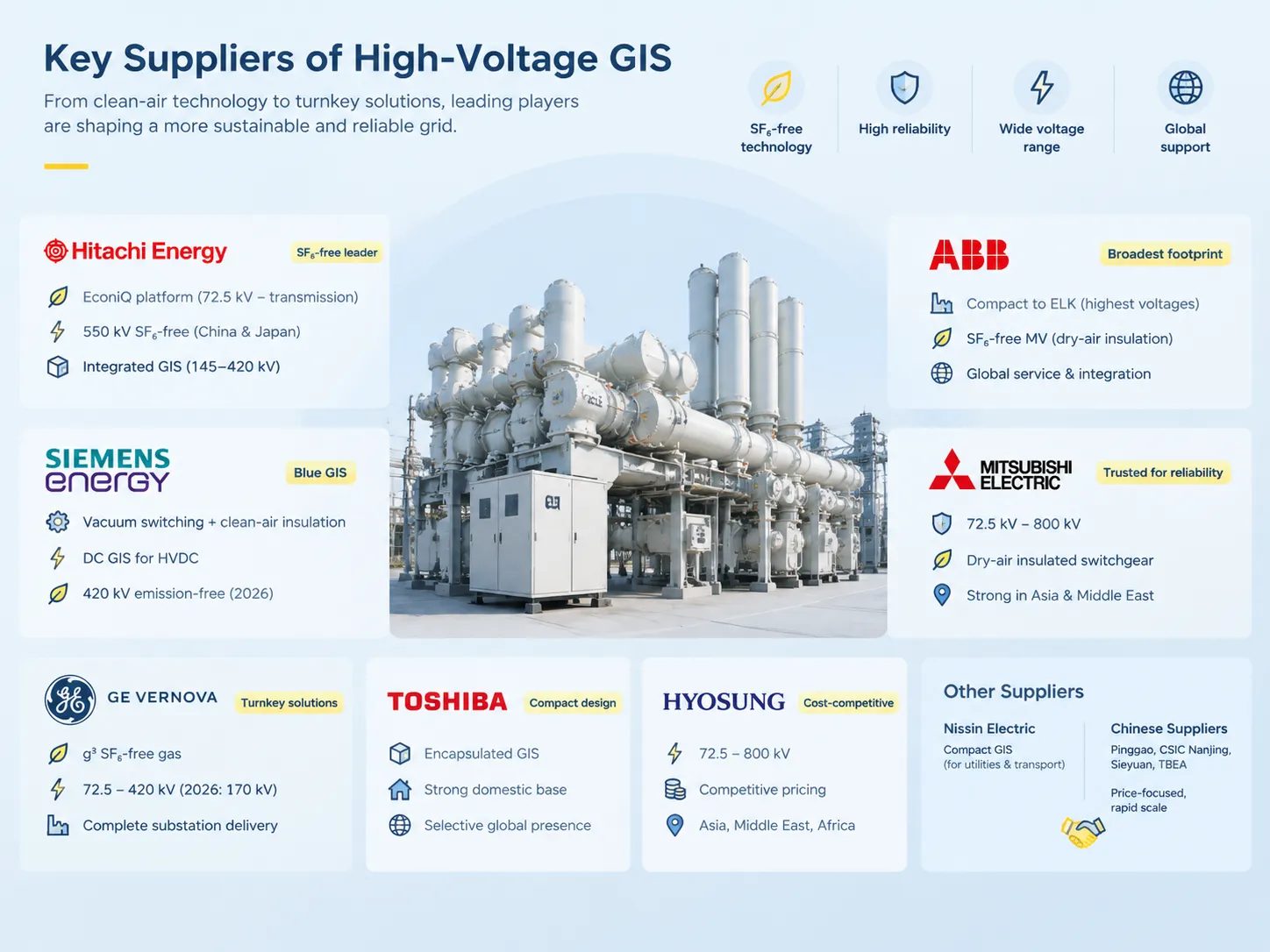
- Hitachi Energy is recognized as the top economic performer of GIS technology globally. Its EconiQ platform entering into the transmission market has been successful as the manufacturer has already started utilizing SF₆-free cavities in the skyline with deliveries of 550 kV innovative technology intended for the Shanghai transmission operator in China and its counterpart in Japan. The comprehensive GIS solutions available from the producer are particularly advantageous for various customers requiring energization such as emergency and replacement bays as well as oil, gas, and mining operations. The advantage of having all the components from one company will certainly facilitate the work of utility companies.
- Siemens Energy, benefitting from long-standing partnerships with various European electricity transmission companies, is leading its changes with the help of Blue GIS technology, which uses clean-air insulation combined with vacuum switching. The company successfully carried out Blue GIS installations at the latest Nordic transmission operator and produced DC GIS technology aimed at voltage direct current market. The 2026 initiative on creating emission-free GIS at the level of 420 kV is one of the most important initiatives in the field of clean-air technology in extra-high voltage technology.
- Among the three major manufacturers from Europe, ABB offers the greatest industrial tradition, with its transmission sector offering gas-insulated switchgear (GIS). The company’s GIS line-a complete solution from compact units in areas with spatial limitations up to ELK range for the highest voltages, points to ABB being prepared to adapt to the transformation process from SF₆ gas. Through dry-air-insulated products and a partnership with one of the most renowned German electric firms, ABB is on track to transform the industry. Its specialty in utility projects encompasses availability not only of its own equipment but also wide-ranging bundled solutions and global expertise.
- Mitsubishi Electric is regarded as the top option in cases when reliability comes first and the customers utilized Japanese transmission devices before. It provides GIS production in the range from 72.5 kV to 800 kV through dry-air insulation while also participating in the development of switching technology based on zero-global-warming-potential gases. The company is also highly active in Asia and the Middle-East securing some projects in other markets as well.
- GE Vernova makes its presence felt via g³ gas technology and the provision of full-scale substations. The launch of g-free insulated unit of 170 kV in 2026 complete the line of devices ranging from 72.5 kV to 420 kV, including the first 245 kV g-free unit installed in the USA.
- Toshiba изоляции Хиосунг provide quite different approaches and values. The first company suggests compact designs with large installed base in Japan and considerable yet not comprehensive presence abroad while the latter is able to deliver devices in the range of 72.5 kV to 800 kV at very reasonable prices.
- Nissin Electric has narrow specialization in compact GIS for utility and transport segments, while the Chinese manufacturers offer low-cost solutions, gaining momentum in manufacturing scale in such markets like Africa, Southeast Asia and Latin America.
What to Specify
Good GIS specifications spell out the above points clearly. The biggest reason for expensive change orders is poorly written specifications.
- Rated voltage and insulation level. This is the nominal voltage of the system together with voltage impulse withstand voltage (BIL) and power frequency withstand voltage.This is essential to the design of the dielectric and cannot be changed after manufacture.
- Rated normal current for busbars and feeders together with the temperature at which this is defined. Thus busbars rated for 40°C and the running at 50°C constitute different i mains.
- Rated short circuit breaking current and the short time withstand current together with the time duration of these currents. These electrical characteristics need to be matched to the fault level of the system which means current system study as opposed to antiquated methods.
- Configuration of busbars which may be single, double, double with hop or sectionalized as well as number of bays both incoming and outgoing, bus coupler, bus section bay and transformer bay.
- Gas insulated switchgear – the type of insulation gas or SF6 in case the latter is allowed and the maximum leakage of gas as well as means of gas supervision have to be defined.
- Instrument transformers ratios of current transformers and voltage transformers plus basic parameters for metering and protection of these transformers. These are essential elements of the whole system and if not defined properly will incur lot of expenditures to put the whole scheme into place.
- Protection, control and monitoring systems – the IEC 61850 compliance, communication systems as well as provision of secondary systems by suppliers.
- Physical envelope which includes width and height of the switchgear and circumstances of its building and environment.
- Testing and documentation – the certificates of type tests, reports and protocols of the completed tests.
Component-level expertise is especially important with two aspects: the short-circuit rating and specifications concerning instrumental transformers, because that sort of information is determined by the network data and metering philosophy and not by the manufacturer of the switchgear. The parameters themselves follow the same discipline as any high-voltage equipment specification, which is set out in our guide to transformer specifications explained.
How to Choose a Supplier
There are six distinguishing criteria that determine a successful GIS procurement from a costly procurement.
- Verifying the equipment already in use by similar ratings is necessary, as well as checking the installations of the equipment used on the same voltage class in the similar environment with several years of operation. For instance, a voltage class of 145 kV cannot provide enough information for a 420 kV device used in a coastal desert location, even though this is what suppliers advertise.
- Obtaining the type test certificate according to IEC 62271 for the corresponding voltage ratings needs to be ensured, as the type tests are performed based on the design and not based on the family of devices. Therefore, even having a certificate for a different voltage does not provide any data on the necessary one.
- Checking the local capabilities for the service is also important, as switchgear can last for decades and what matters during this period is whether there are properly trained service personnel and spare parts available in a reasonable distance and ability to handle the gas. Without this being in place, it cannot be imagined to use the SF₆ equipment.
- Establishing the technology roadmap is critical as well. The buyers need to ask the supplier what is being provided for the technology and what their future plans are concerning making the technology free from SF₆ gases. If the design is getting phased out, then its cost of maintenance will only increase.
- Another important point is estimating the lifecycle instead of estimating the bay, as one needs to take into account gas management, condition monitoring, availability of spare parts, training, and outage cost. Very often having the lowest price for the purchase leads to having the highest overall spending for replacement and maintenance.
- It is necessary to ensure that the schedule provided by the supplier coincides with the project as indicated. High voltage switchgear supplies imply very long delivery times that are increasing across the industry and therefore it is necessary to guarantee that the schedule being provided has been confirmed with milestones.
In case the equipment is supplied with the provision that other equipment is a part of the complete substation, the testing and commissioning procedure needs to be adhered to, the same way as it has been done for primary technologies. Our guide to transformer testing covers the equivalent regime for the transformers that share the station.
Where Subian Fits
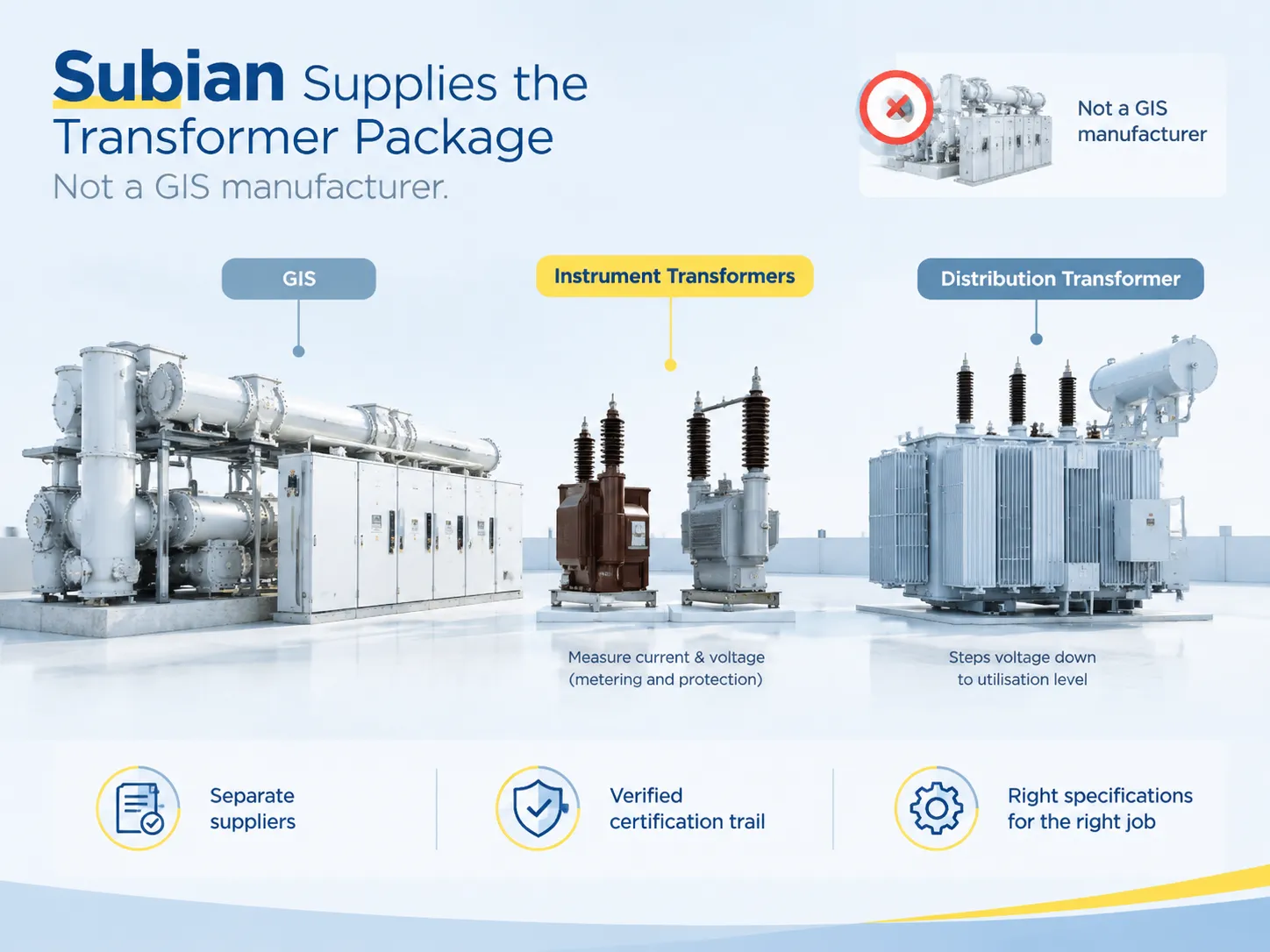
An honest guide must state this clearly so let us state it clearly. Subian is not a gas insulated switchgear manufacturer. GIS is a specialized product that requires the manufacture of enclosures, technology for sealing gas inside it, the development of arc quenching technology, and the ability to carry out type tests at insulation voltage levels which we do not manufacture. Any supplier claiming to be able to supply such equipment is misrepresenting himself.
What is supplied by Subian are appliances which complete the same substation. A GIS assembly cannot be used as a stand-alone product as it needs instrument transformers to measure current and voltage for the protection and metering systems and it also needs the distribution transformers used in distribution connected stations for transforming the voltage to a consumption level. These components are manufactured by us as well as various types of grounding and protection equipment.
Among the two instruments, the instrument transformer is more interesting from the technical point of view. Modern GIS may contain the current and voltage transformers implemented inside the sealed enclosure, and there are also stand-alone types of such transformers and retrofit projects. The specifications are the same for both cases as they include ratio, accuracy class for metering/ protection purposes, thermal rating, and burden.Our current transformer range illustrates what those specifications look like in practice, including the accuracy classes that separate a metering unit from a protection unit.
The protection side of the same installation — how the measured current is used to detect a fault, and why the transformer’s characteristics determine whether the relay operates correctly — is covered in our guide to основах защиты от земляных замыканий.
The practical implication of the GIS package and transformer package being separate procurement decisions is that they should both be specified by the utility procurement team instead of being assumed to be bundled together. Where a project needs a transformer supplier with documented test data and a verifiable certification trail, the qualification criteria are set out in our guide to choosing a transformer supplier, and the same discipline applies to the instrument transformers that interface with the switchgear.
Часто задаваемые вопросы
What is the difference between GIS and AIS switchgear?
Air insulated switchgear (AIS) relies on natural air to insulate the energized circuits, meaning the distances between the power conductors are large and require substantial space. Therefore, AIS installations are mostly placed outdoor. In contrast, GIS relies on the sealed electrical system of providing insulating gas on high pressure. That makes it possible to shorten distances considerably which makes the GIS system suitable for indoor installations. Although GIS attracts additional costs as compared to AIS, it is preferred where land is scarce, environment is aggressive or polluted, and reliability and maintenance are top priorities. On the other hand, AIS remains the optimal option when there is enough space and environment is friendly, while the capital costs dominate.
Which companies manufacture high-voltage GIS?
There are three main groups of manufacturers of high voltage GIS. The first group includes manufacturers like Hitachi Energy, Siemens Energy, ABB, Mitsubishi Electric, GE Vernova, Toshiba Energy Systems, and Hyosung Heavy Industries, covering approximately the voltage range of 72.5 kV to 800 kV. The second group mostly includes smaller manufacturers like Nissin Electric, Hyundai Electric, Fuji Electric, and CG Power. Finally, the third group includes producers from China like Pinggao Group, CSIC Nanjing, Sieyuan, and TBEA, who mainly face competition in terms of prices in the markets of Asia, Africa, and Latin America.
Why is the industry moving away from SF₆?
The reason why most companies try to substitute SF₆ is because of its extreme potency as a greenhouse gas that has a global warming potential thousands of times higher than that of carbon dioxide, as well as its very long residence time in the atmosphere. The European Union has forbidden the use of SF₆ gas in new medium-voltage switchgear with ratings of less than 24 kV since 2026. Manufacturers present alternatives in the form of dry-air and clean-air insulation combined with vacuum switching as well as proprietary gases like GE Vernova g³. Hitachi Energy issued GIS maintaining the voltage of 550 kV without using SF₆ gas, Siemens Energy is working on non-emission GIS with the ratings of 420 kV while GE Vernova released the series of GIS ranges from 72.5 kV to 420 kV.
What ratings should a GIS specification state?
The list of parameters should include the following minimum points: rated voltage, lightning impulse withstand voltage, rated normal current for busbars and feeders, rated short-circuit breaking current, busbar schema regarding the type and total number of bays, insulation gas as well as the leakage rate, ratios of current transformers and degrees of on-time operations, environmental protection means, physical dimensions of the GIS system, and the network in charge of testing and provision of data. Esoteric specifications of this type can result in expensive changes and variations during operational phase of equipment.
How do I verify a GIS supplier’s claims?
There are generally three ways for verifying the information provided by the suppliers. First of all, it can be confirmed by reference installation. It means that one can ask for information about the operation of any site with the same voltage rating and in similar environmental conditions and then check the success of such operation. Second, one can require the provision of certificates on type testing in terms of IEC 62271 standards. Finally, factory acceptance test is an option where the client can be present during the testing period of the equipment and monitor the process himself, thus providing a reliable source of information.
Ссылки
- Hitachi Energy — Gas Insulated Switchgear and EconiQ SF₆-Free Portfolio
- Siemens Energy — Blue GIS Clean Air Switchgear Technology
- International Electrotechnical Commission — IEC 62271 High-Voltage Switchgear and Controlgear
- ABB — High-Voltage Gas Insulated Switchgear
- GE Vernova — Grid Solutions GIS and g³ SF₆-Free Technology
- U.S. EPA — SF₆ Emissions Reduction Partnership for Electric Power Systems
Заключение
Gas-insulated switchgear equipment has enabled substations to adapt to modern construction, allowing them to be made more compact, completely sealed, be free from climatic impacts and serve for around 40 years. The category is represented by small group of companies selling SF₆ equipment from 72.5 kV to 800 kV with Hitachi Energy, Siemens Energy, ABB, Mitsubishi Electric, GE Vernova, Toshiba and Hyosung as the leading brands and other, mostly Chinese producers following them actively in the emerging markets. The procurement process has remained the same: pick rated voltage, insulation level, normal current, short-circuit capacity, busbar configuration and an instrument transformer interface; confirm statements with reference projects and type test certificates; and calculate the cost of the lifecycle and gas operations instead of the isolated switchgear installation.The revolutionary change took place in the insulation gas. The age of SF₆ has come to an end due to regulations, so it is important to choose carefully transition from SF₆ technology to gas insulated switchgears with completely different insulation types.