


Transformer faults are among those half a dozen failures in a power system capable of putting a facility, a substation feeder or a city block out of service in just a second. The question that follows is always the same, and it is usually asked by someone who needs an answer before the end of the phone call: how long does it take to fix a transformer? The honest answer is that it is not a single number. It is a range that runs from ninety minutes to two years, and where your particular unit lands inside that range is decided long before the fault ever happens.
The guide breaks down the specifics of repair times that a project manager or a maintenance engineer needs to know. It will help them in finding the faults as well as diagnosing the reasons, getting feedback on the repair times for attempts to repair bushings, tap changers and radiators. It would also allow them to distinguish between repairing and replacing the unit since it is known that the right owrong decision taken here may change a two-day outage into two months one.
Repairs can take anywhere between 1–6 hours depending on the case when minor faults occur such as blown fuses, loose terminations or minor oil leaks; 1–3 days for repairs of the components of the transformer itself: bushings, tap changers or cooling systems as well as severe internal faults requiring weeks of repairs for workshops. If the unit cannot be repaired cost-effectively, replacement time would depend on the product variations of the transformer itself. An off-the-shelf distribution transformer may take only 24–72 hours, while manufacturing and delivery of a power transformer could take somewhere around 12 months or even longer.
In summary, Transformer Repair Duration based on Severity
Companies and facility maintenance teams generally classify faults into the three categories – each of which represents a separate group of repair specialists and parts expeditions. Knowing which tier you are in is the fastest way to estimate how long it takes to fix a transformer.
- Tier 1: Minor external faults require only 1 to 6 hours to fix. Such faults can be blown fuses, tripped circuit breakers, corroded or loose connections, minor gasket leaks, animal interaction, etc. The fault pertains not to the transformer itself but the components surrounding it.
Tier 2: Component faults can take up to 72 hours to be repaired. It includes damaged bushings, defective tap changer contacts, broken fans/radiators, humidity penetration of oil, etc. The transformer is working but is opened for repairs.
Tier 3: Severe internal defects involve 2 weeks to several months for repair. These defects can be electric turns, core damage, complete insulation breakdown, and ruptured or burned tank. The transformer is taken out and transported to the workshop for repair.It can be concluded that most of the cases of transformer failures get resolved after tier1 or tier 2 repairs. The average downtime indicator is distorted by rare tier 3 failures. One electric failure at170 kv can take more time than repair of a hundred fuses.
-
The Reason for the Failure and the Kind of Fix
The cause of the malfunction determines what repairs should be carried out before the workers even arrive at the place where the malfunction has occurred. Most cases of failures can be ascribed to the five causes below.
Prolonged Excessive Load and Thermal Damage
Transformers are designed to withstand the increase in temperatures and not only the currents. When there was a surge in demand and the transformer was exposed to the high temperatures for extended periods — prolonged summertime loads, additional manufacturing (like production lines), unplanned loads on electric motors — the winding temperatures and oil rise, and with this decay of cellulose materials begins. For the crew, the right decision would not be to begin repairs, as they still have to wait because overheated transformers require some time to cool down before they repair the rotary transformer. In this case, not less than eight to fifteen hours will be spent on diagnosing the source of the fault. If it was discovered before the process led to the failure, the only measures to be taken would involve transferring the load to another transformer and checking the cooling system. However, it can also happen that the transformer has already faced severe overheating.
Lightning Strikes and Switching Surges
The so-called steepwave surge causes turbulence among the winding and insulation far more than any other event during its operation. Typical cases of damage caused by the surge are problems with bushings, namely, broken bushings, damaged surge arresters, and incorrect operation of insulation between turns. The difficulty of repairing such defects lies in the fact that bushing damage is a well-understood process — a comprehensive repair will take one or two days provided that there is an appropriate bushing available for installation. However, it is also known that the damage sustained by the turns is very difficult to detect. It usually requires conducting tests at several frequencies and measuring the winding ratios at the taps.
Ageing Insulation and Degraded Oil
This type of failure occurs gradually and gives some warning signs. The process is called oil oxidation that starts in a transformer and develops because of moisture content, decline in its dielectric strength, and increase in the level of gasses. While it allows for carrying out necessary repairs in a planned manner, it is also important to keep in mind that it is quite likely to face difficulties with winding repairs or replacements.
Wildlife, Vehicles and External Impact
Birds, squirrels, and other rodents go for a round trip between bushings and grounding connections causing short circuit incidents. Animal fault incidents are amongst the most widespread causes of malfunction in power distribution. Making any repairs takes much less time than in cases mentioned before.
Flooding and Moisture Ingress
Water is considered to be the most costly pollutant to a transformer. At the same time, flooded ground and pad-mounted transformers need to undergo oil sampling, oil flushing (or replacing), solid insulation drying, and dielectric testing before power supply starts. All the operations usually take longer than a week, depending on the size of the unit. In addition, being flooded serves as an obstacle for crews even before the electrical work starts, due to access difficulties, unstable soil condition, and problems with crane positioning.
Step One: How Long Diagnosis Takes
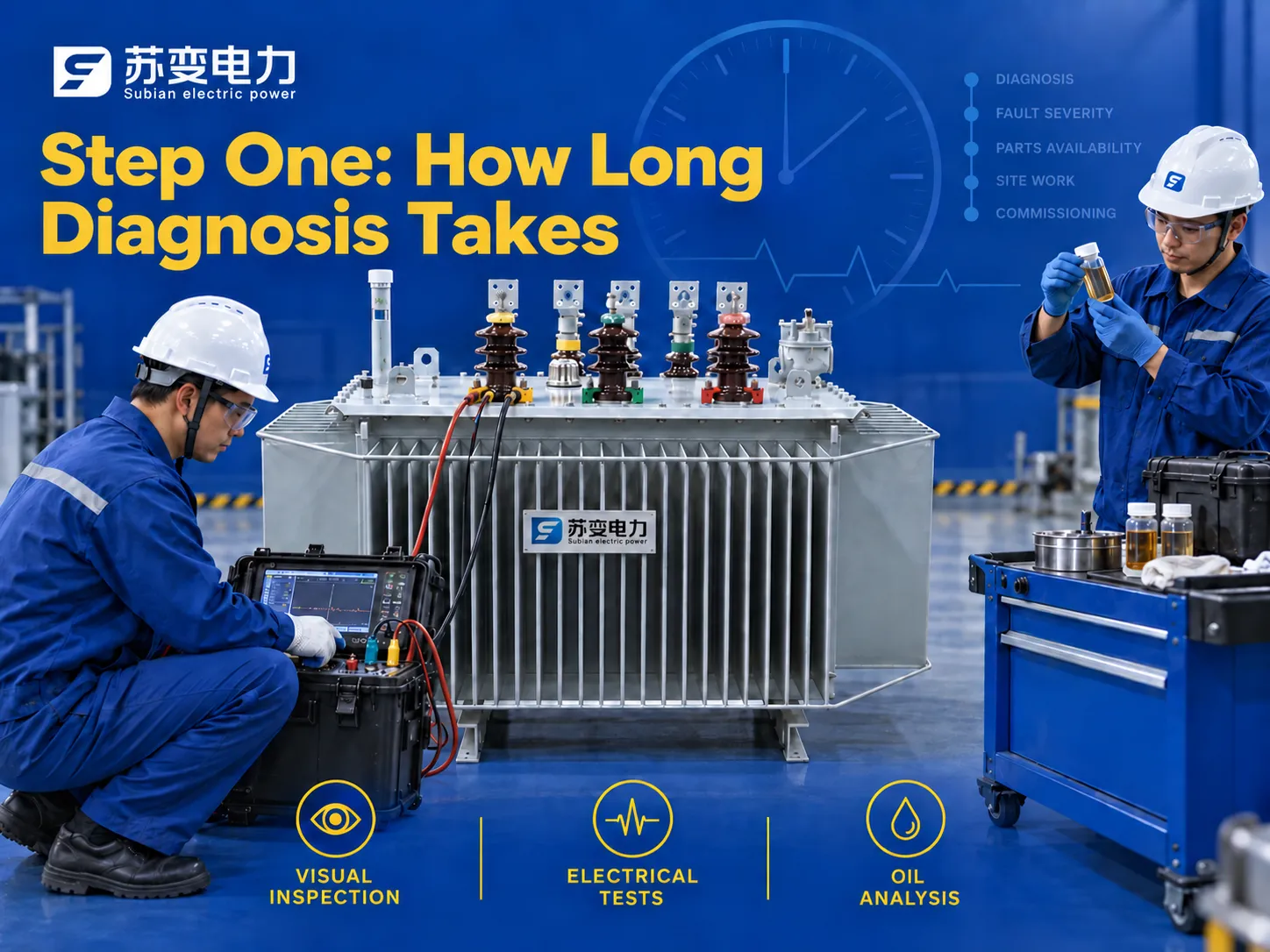
No competent crew attempts to fix a transformer they have not diagnosed. The assessment phase is a real and often underestimated part of transformer repair time, and skipping steps here is what causes re-failures on energisation.
Visual inspections can be performed in a matter of minutes, taking notice of burn and tracking marks on the bushings, oil which has accumulated below, ruptured pressure relief devices, tripped Buchholz relays, bent radiators, or fallen cables, at the same time performing the necessary safety procedures, such as putting up barriers, isolating the power supply, applying lockout and tagout, checking for dead current, and earthing. When it comes to medium- and high-voltage equipment, this will already take around 1.5-3 hours and there is no going around it.
Once visual inspections are over with, electrical tests follow. Insulation resistance and polarisation index, winding resistance, turns ratio, magnetising current as well as thermal imaging under the load are the most common tests performed. If all the necessary instruments are available, an experienced team can finish this part of the job in anywhere between 3-6 hours when it comes to a distribution transformer or much longer if it is a large power transformer with multiple taps.
The stage that usually takes longest in the schedule is DGA. Actual oil sampling does not take longer than 1 hour, after which samples have to be taken to a laboratory, which usually takes from 24 up to 96 hours depending on the workload. Interpretation is based on the IEEE C57.104 and IEC 60599 guidelines and is by far the most useful test that can be performed to establish the nature of the fault. Sites that keep a portable DGA unit on hand compress this step dramatically, which is one of the highest-return investments available for reducing transformer repair time on critical assets.
Minor Errors: Repairs Available in Same Shift
Most of the work stops here, because these jobs can be performed by a two-man team without taking the transformer out of service.
Replacing the fuse or the protection link takes 30-90 mins when the parts are easily sourced, with additional time for travelling in distant networks of additional 1-3 hour.
Retorquing or replacing oxidized terminations takes 2 to 5 hours, including cleaning, application of paste and thermographic examination after re-energizing.
Fixing minor oil leaks from gasket or valve takes 3-7 hours, as the process itself is very quick, however there is a waiting time for sealing process to be performed.
Resetting animal contact with safety installation takes an hour and a half to 4 hours depending on whether the barriers are made on site or not.
Dealing with faults of cooling fan or control circuit takes from 2 to 6 hours depending on availability of replacement fan, contactor or thermostat in stock.
The key lesson to learn from this level is that it is not technical skills but availability of spare parts that prevents the crew from being efficient. If the crew arrives with different fuse rating or end seal set, this will turn a 90-minute task into next-day assignment. Standardising fuse ratings, bushing types and gasket kits across a fleet is one of the cheapest ways to fix a transformer faster.
Moderate Faults: Component-Level Repairs
If the fault resides within the tank boundary but is located in a part that can be replaced, the expected time frame becomes approximately six to seventy-two hours.
The most common task in this range is bushing replacement. In this case, the oil must be brought down to below the level of the bushing turret, the old assembly removed, the new bushing properly mounted and secured, the oil replenished, and air from the assembly evacuated. Measurements of insulation resistance and power factor must be carried out, so that no moisture path is indicated. The average duration of works in a medium-voltage case is twenty to thirty hours.
Another major type of task falls under tap changer work. Off-circuit tap changers generally require such tasks as cleaning the contacts, checking for silver plating, as well as verifying mechanical alignment. On-load tap changers demand larger efforts: the compartment with the diverter switch must be emptied, the contacts and resistors must be either inspected or replaced, the oil must be replaced or renewed, and the timing of the driving mechanism must be confirmed. Depending on the operation location, expect eighteen to forty-eight hours for such kind of work.
Cooling system repair falls within the same range of time, but with the point that a transformer with its cooling system out of order can often continue to work with reduced load during the delivery of the necessary parts.
Partial winding repair is at the upper end of the interval. If an arc has burnt only a small and accessible section of winding, it is possible to insulate and reassemble this piece without need for rewinding the entire winding. Consequently, it is important to make dielectric tests after the completion of the repair.
Severe Faults: Workshop Overhaul and Rewinding
Once the core or the main windings are involved, the job to fix a transformer leaves the site entirely.
In the process, the following steps are involved: deactivation and isolation of the equipment, oil removal from the tank, detachment of the radiators and bushings, lifting the equipment weighing from 10 to 30 ton and more onto the special transports for transfer to the workshop, the oil tank is emptied, windings of the equipment are disassembled and rewound, the coils are wound, the body is pressed, filled with oil, and finally the equipment is tested before it goes to shipment.
The realistic timeframe for carrying out the necessary operations is the following:
For a rewind of distribution transformers (up to 2.5 MVA capacity) it would take about 2-6 weeks considering delivery of the equipment in both directions;
For a rewind of medium power transformer (35 kV) it will take 6-12 week depending on the availability of the workshop;
For an overhaul of high-voltage transformers (above 110 kV) it will take 3-6 months; this period may be extended if special materials are needed or if the special testing area is to be used.
Besides, the period may be extended if an accident has happened; oil collection and soil rehabilitation procedures can take days or weeks before the salvage work commences. Availability of the workshop is a hidden problem: sometimes it is impossible to find a workshop because all repair workshops in the region will be occupied by transformers after an accident.
Repair or Replace: Where the Decision Point Sits
The desire to repair is high as repairing things seems to take much less time. However it might not be the case. The cost of repairing something is usually evaluated in terms of the percentage; if it is more than 50/60%, it is better to buy a new one under normal circumstances. Under current conditions, however, another question must be answered: if the device has to be replaced, whether the replacement is available. Replacement usually makes sense when the core or the winding has been damaged, the repair has already been performed at least once, there have been multiple malfunctions, the insulation has reached the end of its life cycle and the machine does not have any dependable service life left, or if a new unit will have lower unproductive losses. The case for repair is stronger when defects are in components, the unit is still fairly new, the waiting time for a replacement takes too long, or when the replacement unit does not fit.
The honest framing is that the decision to fix a transformer rather than replace it is an availability decision as much as an economic one. When a like-for-like unit is twelve months away, a three-month rewind is the fast option.
How Long Does It Take to Replace a Transformer?
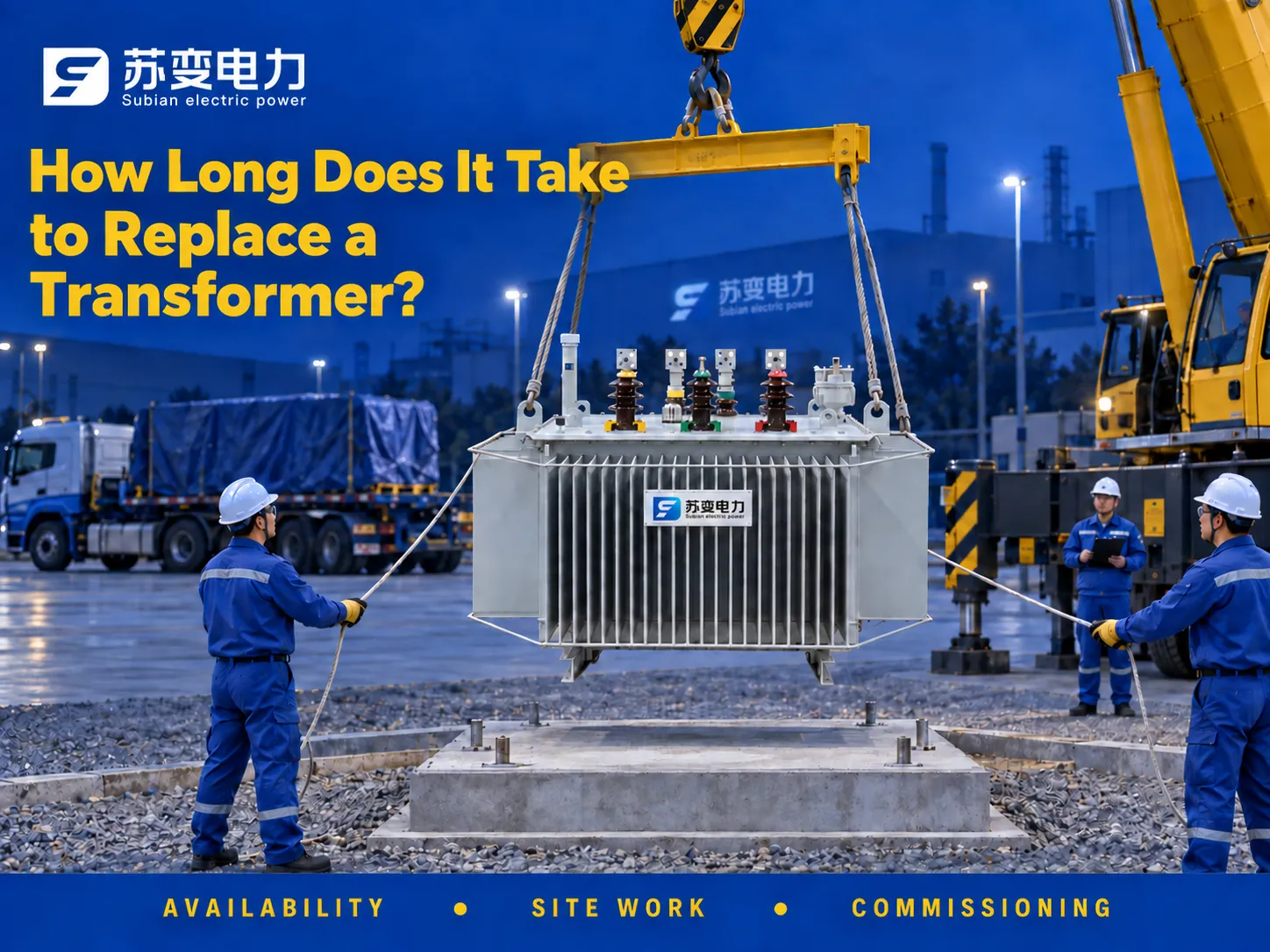
The time needed to replace a transformer depends almost entirely on stock. In case a replacement transformer is available either at a utility spares depot, a distributor warehouse or an inventory, the replacement usually proceeds quickly. For example, pole and pad-mounted transformers can be replaced and put on supply within twenty-four to seventy-two hours, which is inclusive of construction-related work and commissioning tests. As for substation transformers that have ready-made foundation and cables, they can be energized within one to three weeks.
Unfortunately, manufacturing on demand is an entirely different story. The international supply environment has changed substantially since 2021. According to the International Energy Agency estimates for 2025, in certain countries, it can take up to four years from the date of an order to the delivery date, with an average lead time being almost twice of that of 2021. These days, in comparison with 2019, the prices for transformers have grown by approximately 75 percent. It cost less to order a transformer from Asia-Pacific rather than from Europe or North America and thus, more and more buyers worldwide prefer engaging with countries from that Asia-Pacific region.
In order to perform practicable planning related to new investments in new manufacturing plants, one needs to consider:
1. Distribution transformers to 35 kV. It can take several weeks to a couple of months for a transformer making firm with the capacity to satisfy the order.
2. Prefabricated substations and pad-mounted substations. It will take similar time, but the complexity of the ordering system will influence the time needed.
3. Transformers with a rated output of 110 kV and above. In this case, the lead time goes from several months to a year. The delay is caused by problems with steel supply and test bay scheduling.
4. High voltage generator transformers and other specialized transformers. The waiting periods can amount to several years depending on the region.
The process of site preparations and installation should be taken into account as well. It may take up to three-five days for medium voltage installation (or even more for high voltage transformer) to be completed.
Seven Factors That Move the Timeline Most
- Part availability. Having parts in stock reduces a two-week job down to two days. A custom tap changer for a discontinued model can take months.
Voltage class. Every increase in voltage means there are isolation steps to be taken, larger space requirements, more heavy lifting equipment, and more tests required before starting.
Access to the site. A substation located in the city can be reached in less than an hour. However, remote sites, such as places affected by a flood, will significantly increase the time needed.
Safety regulations. Safety measures, such as switching orders, permits to work, as well as traffic management and exclusion zones cannot be avoided and take lots of time.
Weather conditions. In cold weather, oil handling and sealing will be required to wait. The rain prevents opening the tank since the insulation cannot be exposed. Wind stops hoists and aerial construction.
Crew resources. During a severe storm damage, the customers affected by the damage will prioritize repairs and wait for a crew to arrive even if there are no urgent jobs to be done at their site.
Testing and commissioning. The final step is essential. A transformer will be burnt out while trying to put it back into service without testing the repairs.
Does Transformer Type Change the Repair Time?
Yes, it does as far as planning is concerned. Dry-type transformers have no oil, which removes an entire workstream: there’s no sampling, laboratory waiting period, filling with vacuum, and so on. Thus the speed of diagnosis improves considerably as it relies almost exclusively on visual and electrical methods, with most minor problems in cast-resin units solved in one single shift. The only drawback here is that whatever happens to cast-resin windings, they’re not repairable in the same way oil-immersed systems are; mechanical failure results in removing a coil instead of rewinding it in situ.
Oil-immersed transformers are less efficient as far as diagnosis is concerned, but way more repairable. It is advantageous to apply DGA, windings can be rewound and oil regenerated instead of disposed. That’s why for high ratings and outdoors substation applications, oil-immersed systems still dominate.
Somewhere in the middle between these two types is high-voltage or packaged equipment. Pad-mounted transformers and prefabricated substations are engineered as complete units, which makes whole-unit swap the natural fast path when the site has a spare available. The associated high and low voltage switchgear also affects the timeline, because isolating and reconfiguring a feeder to bypass the faulty unit depends on how the switching arrangement was designed in the first place.
How to Cut Transformer Downtime Before the Fault Happens
The time that gets credited on a transformer repair is usually won before the repair rather than during it. Four steps will accomplish most of that timing.
Hold strategic spares. The only sound way to defend against a delay in receiving a spare is to have one on site or in a shared pool. More and more power companies use spares sharing agreements in high-voltage classes because getting the stocks by each company is unpractical.
Make specs uniform. A fleet with as many different ratios, vector groups, tap ranges, insulating bushings, and physical sizes can be covered using just a small number of specs. A unique fleet cannot be covered because every failure will be unique as well.
Monitor condition, not only alarms. A timely DGA analysis and oil testing can turn an emergency failure into planned actions. An identified trend is an opportunity to do maintenance rather than diagnose the problem.
Plan a bypass. Knowing beforehand how to reroute the load, connecting the mobile substation, or using a temporary facility will be far more useful on the day of repair than any repair facility is, which decouples service restoration from transformer repair entirely.
Plan supply in realistic timings. In the market where the orders for big transformers are taken for years in advance, the process of ordering the equipment reactively fails to work. Only water companies assessing the equipment’s service life are ready for replacement.
Frequently Asked Questions
How long does it take to fix a transformer on average?
Most jobs to fix a transformer are resolved within one to forty-eight hours. The duration for minor external faults such as blown fuses or loose connections is 1 to 6 hours, moderate component repairs like bushing, tap changers, and cooling systems will take from 6 to 72 hours, while the critical internal damage that is worked in a shop will take weeks to months. Hence, the average across the board is small since most situations belong to the minor category.
Why do some transformer outages last for weeks?
An extended failure usually means that a unit experienced one of three situations: either internal winding or core damage which leads to necessary disassembly and reconstruction of the unit, unavailability of a replacement or a unit’s part, or the necessity for a cleanup after an oil leak or a fire. An additional reason is unfolding of large storm events which creates saturation of both crews and workshop capacity across a given region.
Can a blown transformer always be repaired?
No. Component-level faults are usually repairable, but a transformer with a short-circuited winding, a damaged core, or extensive insulation carbonisation is often beyond economic repair. The conventional threshold is that repair costing more than roughly half the price of a new unit favours replacement, and an aged transformer near the end of its insulation life is usually replaced regardless of the specific fault.
How long does it take to replace a transformer?
Assuming there is a replacement unit on the shelf, the replacement of a distribution transformer takes somewhere between 1-3 days, while substation transformers may require 1-3 weeks if the foundations and the power cables are already there. In the case where a unit is to be built, the waiting period depends on the lead time which varies from several weeks of manufacturing and delivery of standard distribution units to at least 1 year of working with large transformers.
Does a dry transformer get repaired faster than an oil one?
Yes, but it only applies to minor and mid-extent damage repair. This means that repairs of dry units do not include oil sampling, laboratory examination and have no vacuum filling and containment associated with the process. But when it comes to severe faults, the situation gets reversed because the repair of oil immersed windings could be done while the burnt dry resin coil cannot be repaired and should be replaced with a new one instead.
What is the single best way to reduce transformer repair time?
Hold the right spares and standardise the fleet so that spares are interchangeable. Parts waiting, not labour, is what stretches transformer repair time. Diagnosis and labour hours vary within a narrow band; waiting for parts does not. After that, condition monitoring is the highest-value measure, because it converts unplanned failures into planned work.
Who is qualified to fix a transformer?
Only qualified personnel should fix a transformer. Field repairs on live equipment must only be performed by qualified electrical personnel who must observe a formal isolation and permit process while using adequate arc-rated protective equipment. Winder, core, and tank work must be carried out in a specialized transformer repair shop fitted for vacuum processing processes and dielectric testing. Repairs carried out without such facilities often fail when the transformer is energized and may be hazardous.
References
- IEEE Standards Association — IEEE C57.104, Guide for the Interpretation of Gases Generated in Mineral Oil-Immersed Transformers
- IEC — IEC 60076-1, Power Transformers, Part 1: General
- International Energy Agency — Building the Future Transmission Grid: Supply Chain and Lead Time Analysis
- NFPA — NFPA 70B, Standard for Electrical Equipment Maintenance
- Electrical Safety Foundation International — NFPA 70B and Electrical Maintenance Programs
Subian Electric Power manufactures power and distribution transformers up to 110 kV, prefabricated and photovoltaic step-up substations, vacuum circuit breakers and complete high and low voltage equipment from its own production base in Xuzhou, China. If long replacement lead times are a risk on your network, or you need a like-for-like unit engineered to match an existing footprint and connection arrangement, send us the voltage class, capacity, vector group and site conditions and our engineering team will define the configuration and delivery schedule. Talk to Subian engineering about transformer supply, spares strategy and project scheduling.