


Once you open up a distribution transformer, the only things that you will see inside are metals (steel, aluminium, or copper), paper, oil, porcelain, etc. You will also see a few gadgets that serve the only purpose of protecting the transformer from anything that can go wrong with it. If you consider transformers that last for thirty years and those that break down after four, it should be noted that the construction elements of both these machines do not differ, but what actually alters is the quality of their construction elements and their measuring precision. The guide you are going to read will tell you what you will find in a transformer and what functions all these elements perform. You will also get to know satisfaction factors of transformer purchases as well as how to determine whether a transformer has been poorly made or is of high quality.
Inside a transformer, there is a lamination steel core, a low-voltage winding, and a high-voltage winding as well as an insulation system composed of paper, press board, and oil (dry type uses epoxy resin instead of oil). Transformer’s tap changer shows conductors through the tank. A radiator is a tank part, there is a conservatory with a silica gel breather, there is a Buchholz relay, a pressure release system as well as thermometers. It is the core that determines no-load losses, the windings determine load losses and short-circuit strength; the insulation determines transformer lifetime and accessories show manufacturer’s condition.
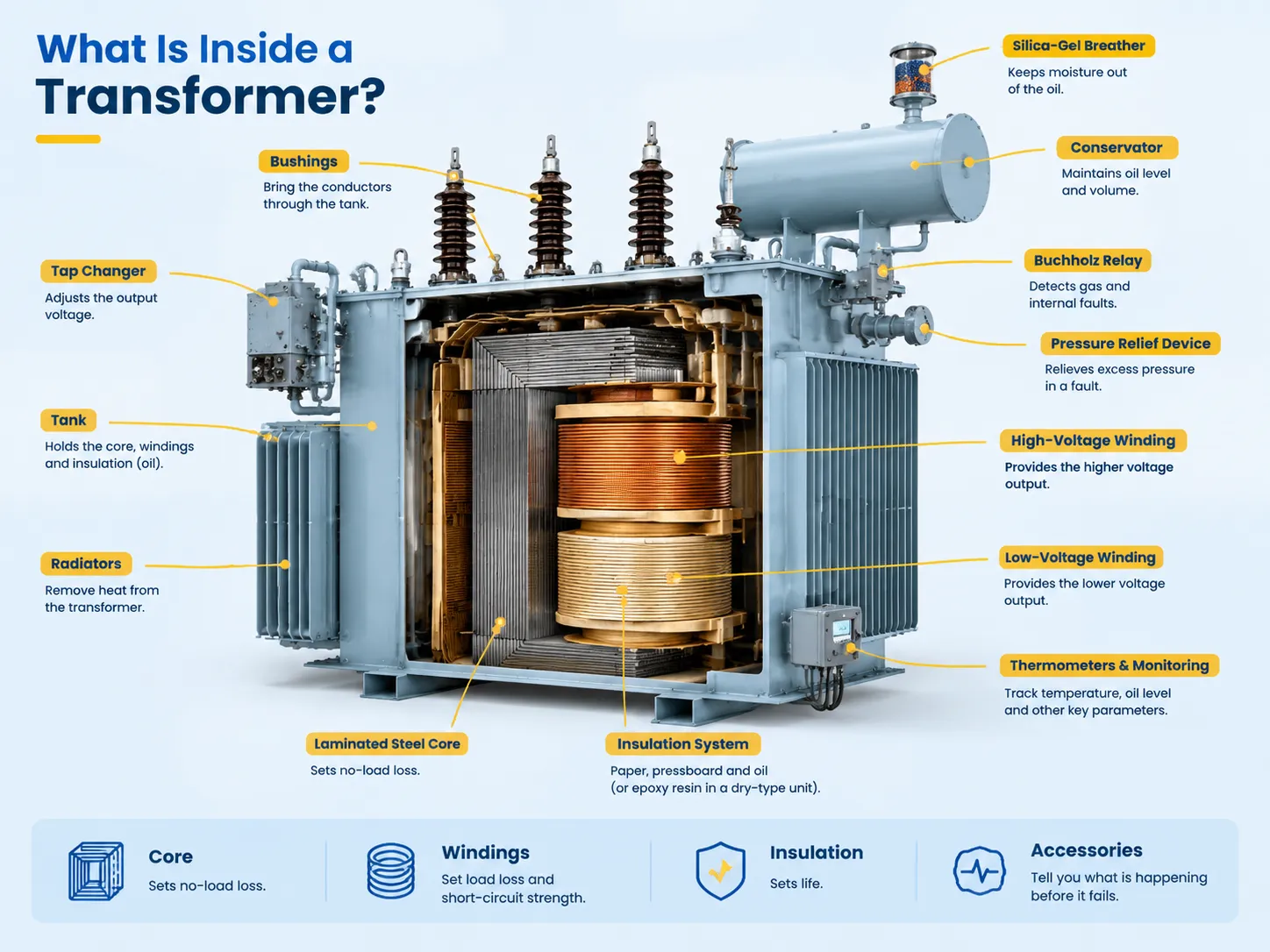
The Six Systems Inside a Transformer
Using the systems thinking approach is beneficial in understanding the rest of the article because it has a unique operation and a specific way of performing tests.
- The system of the magnet includes the laminated core, which performs the function of energy transferring and converting the voltage.
- The electrical system consists of the low and high-voltage windings, their connections, and the connections being made inside of them.
- The dielectric function is to prevent the electric current flow and maintain the dielectric properties.
- The mechanical system consists of the mechanism for pressing the core, the winding frame, and the tank with the windings.
- The heat transfer function consists of the devices for cooling, fans, the system for oil circulation, and temperature measurement devices.
- The control and protection systems consist of Buchholz relays, sensors for pressure, temperature, and gas analysis.
The Core: Where No-Load Loss Is Decided
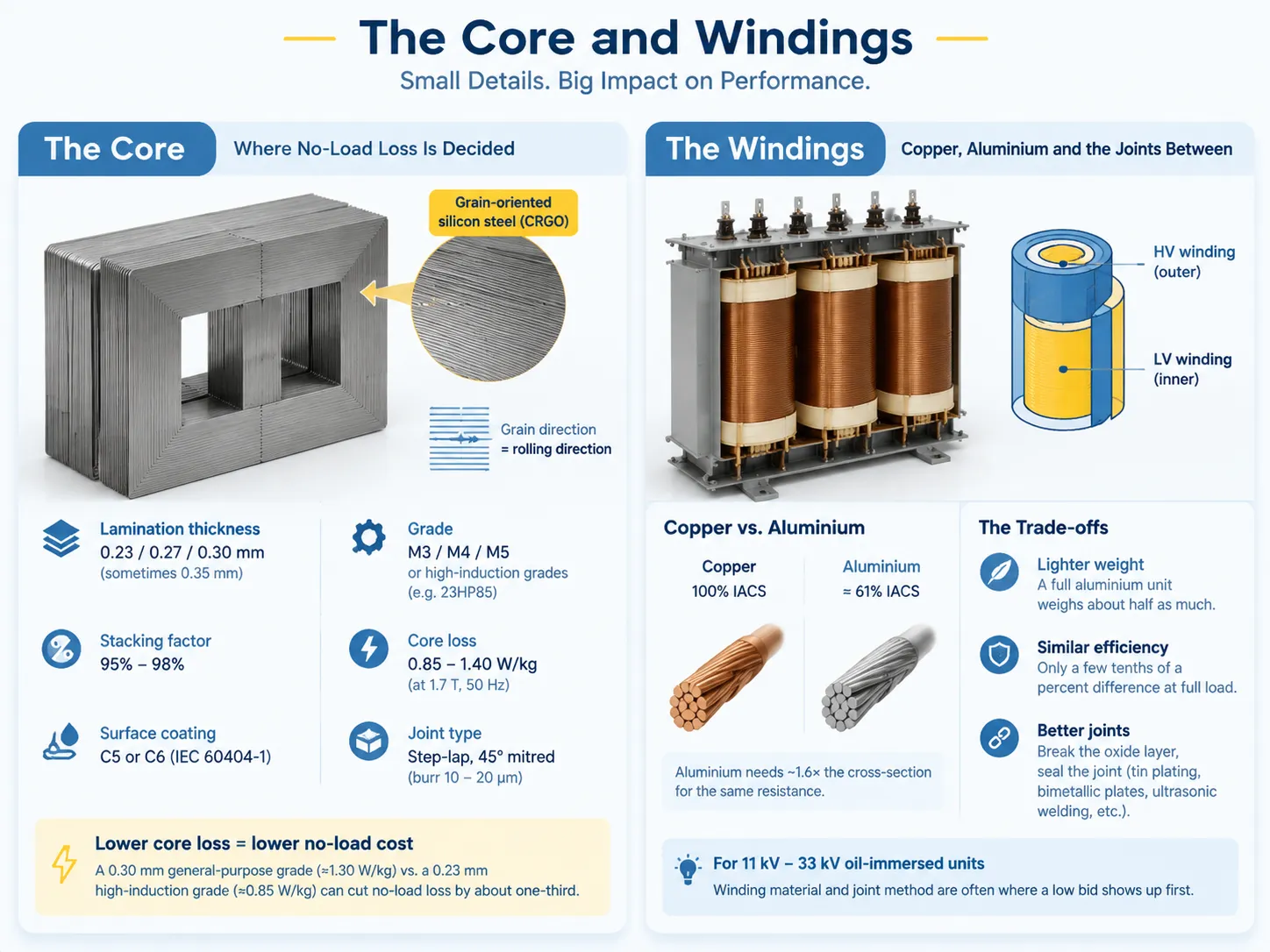
The core is made of a series of thin pieces of steel stacked on top of each other that are almost always made of cold-rolled grain-oriented silicon steel, CRGO. The grain orientation is important because the magnetic flux goes along the direction of the rolling, which corresponds to the way the core is manufactured. The silicon content, which is between 3 and 4%, increases resistivity enabling suppression of eddy currents, and the thickness of lamination does the remainder of the job.
| Property | What you will see in a specification |
|---|---|
| Lamination thickness | 0.23 mm, 0.27 mm or 0.30 mm, occasionally 0.35 mm |
| Grade | M3 / M4 / M5 conventional, or high-induction grades such as 23HP85 |
| Core loss | 0.85 to 1.40 W/kg at 1.7 T, 50 Hz, depending on grade |
| Stacking factor | 95% to 98% |
| Joint type | Step-lap, 45° mitred, with burr held to 10 to 20 µm |
| Surface coating | C5 or C6 insulation coating per IEC 60404-1 |
Two rows are of commercial importance. In terms of core losses, we can say that moving from a general-purpose core of approximately 1.30 W/kg weight for 0.30 mm thickness to a high-grade core of 0.85 W/kg weight for 0.23 mm thickness translates into a one-third reduction of the no-load loss in a transformer. A transformer functioning 8,760 hours a year benefits a lot from the difference, although it cannot be seen from outside the tank.
Another important row is related to the joint. A step-lap joint with minimized burr makes easy to reduce the gap that means lower exciting current, noise, as well as stray losses. The performance of a core made with a butt joint and rough shear, however, looks the same but is considerably worse.
The Windings: Copper, Aluminium and the Joints Between
Distribution transformers are designed in such a way that the LV winding is placed closest to the core and the HV winding is situated further away from it which serves to save insulation space between the winding and the core and to facilitate the tapping of the winding. The winding is made of copper or aluminium in form of round or flat wire.
The reason behind this substitution is rather simple though often misinterpreted. The electrical conductivity of copper is 100% IACS, aluminum conductivity is around 61% which means that in order to make an aluminum winding with the same resistance it should be approximately 1.6 times larger in cross-section. Since aluminum is also much lighter, the final winding is significantly lighter and a complete aluminum transformer weighs much less than its copper equivalent with the same specifications. This weight difference is one of the quickest field tests for buyers.
The main thing that changes is not the effectiveness of a properly constructed device, which varies by just a few tenths of a percent at full load but the joints. The joint between the aluminum and copper winding or two aluminum windings must have their oxide coating removed and sealed, otherwise they will cause heating problems. It is considered as a standard practice today to use tin plating, bimetallic transition plates, ultrasonic welding and if the budget allows to use higher insulation class in the device design to ensure thermal reliability of the device design.
For oil-immersed distribution units in the 11 kV to 33 kV range, this is the part of the design where a low bid usually shows up first, and it is worth reading a supplier’s own description of their oil-immersed distribution transformer range before comparing prices, because the wording around winding material and joint method is rarely accidental.
Insulation and Oil: The Parts That Fail Slowly
The insulating material of a transformer is the combination of kraft paper and pressboard being treated with the oil, and the life expectancy depends on temperature and moisture content. This is practically the entire story of reliability in one line.
The paper does not fail abruptly. It depolymerizes resulting in loss of mechanical strength, and the degree of polymerization decreases from 1,000 of the new paper to 200 or less at the end of the life. The products of aging include furan compounds, and for this reason furan analysis is performed as the end-of-life indicator, in addition to the water that processes.
The oil performs three tasks at the same time: insulation, heat transfer from winding to radiators, and condition reporting. New mineral oil has to have the breakdown voltage of at least 30 kV tested on the gap of 2.5 mm, and a moisture level of tens of parts per million can reduce this value twice. For this reason, oil testing is the cheapest way of diagnostics, and that is also how the transformer that has beautiful paint and wet oil still can fail.
In case of a dry-type unit, the dielectric system is different, and the mode of failure changes as well. The epoxy casting of the windings is done with the limit of partial discharge usually at 10 pC or less according to IEC 60076-11, and even a casting with voids can pass the power-frequency test but will still discharge during the operation until tracking takes place.
The Tap Changer
Distribution transformers usually utilize an off-circuit tap changer, which is a type of manual switch that modifies the treating of the high-voltage windings of the transformer in some steps, which are usually equal to about ±5% in steps of about 2.5%. The tap changer is set at the commissioning stage to correspond to the effective voltage in general terms so that it is covered and does not need any maintenance.
Transformers designed for larger and transmission-type applications are designed to use the on-load type of tap changer, which allows changing the taps of the transformer with the voltage passing through the tap changer.The difference in maintenance burden is substantial, and it is covered in this explanation of the on-load tap changer and what it does.
A practical remark: the “low voltage at the far end of the feeder” complaints are often due to a tap changer being left on the wrong tap and this should be the first check to be made before blaming the utility.
Tank, Conservator, Breather and the Buchholz Relay
Besides storing oil, the tank also holds the core-and-coil part of the transformer, protects against internal faults, provides a cooling surface, and supports bushings and accessories.
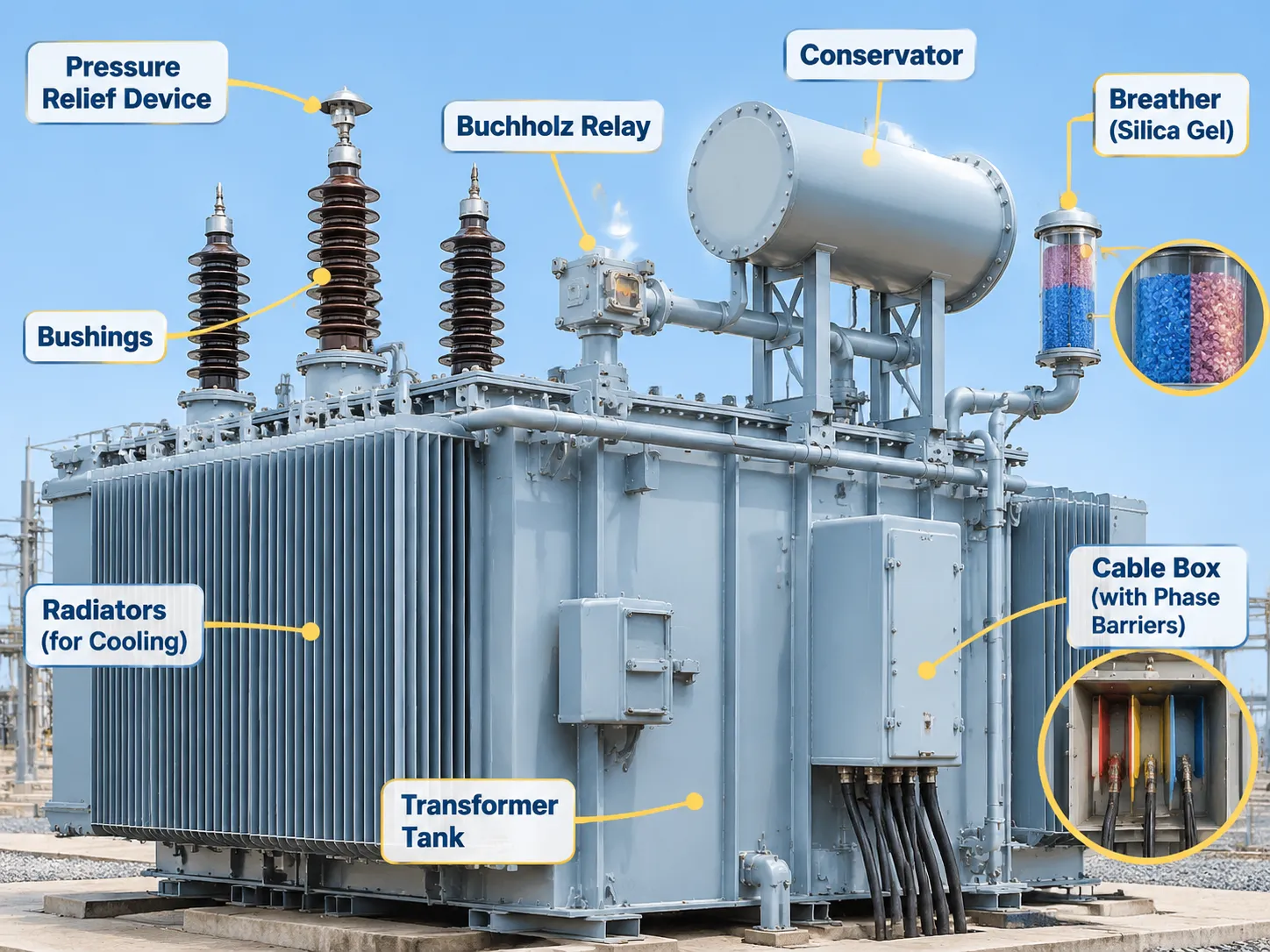
Cooling area is provided by radiators or corrugated sheets with fans installed for forced cooling in a bigger unit. Above the tank, there is a conservator which is a small tank that holds the volume of the oil expansion. The conservator makes sure that the main tank is full and that bushings and top of the winding are immerged into oil in the temperature range from -20 °C to + 50 °C.
Breather is situated at the end of the chain. It consists of silica gel that absorbs moisture from the air that fills the tank when oil cools. The change from blue to pink is probably the only sign of oil condition.
Buchholz relay is an element of pipeline between the tank and conservator. The relays have two parts: one that reacts to slow gas build-up and the second that reacts to oil surge to the conservator when the pressure wave caused by the failure is occurring. How the breather and the relay work together is set out in this note on the core functions of the breather and gas relay.
The pressure relief device is the last line. If an arc generates gas faster than the Buchholz can react, the PRD lifts and vents, ideally away from where people stand.
Bushings and Cable Boxes
The bushing serves as a part that allows the current to enter a grounded tank without causing flashover. It is a special type of insulator; it is made of oil-saturated paper in porcelain for the medium voltage and is equipped with a condenser core which equalizes the electric field between the conductor and the flange. It is made of porcelain or epoxy on the low voltage side, while a cable box with phase partitioning can also be installed.
Bushings might actually fail more frequently than one would think, and the reasons are tedious, problems such as cracked porcelain, worn-out gaskets, overtightened terminals and blocked breathing holes. Check bushing first when doing transformer inspection, as a hairline crack is easy to detect and fix while flashover is not.
What Changes in a Dry-Type Transformer
In case of a dry transformer, there will be no oil, conservator, breather, or Buchholz relay used and air as well as solid insulation will take the position of the dielectric. The windings are impregnated and encapsulated by epoxy casting, whereas CRGO stack acts as core.
It is just a matter of trade-off. You get rid of the fire load of the oil and maintenance of the oil transformer which is why such units are installed in buildings, hospitals, tunnels, and data-centers. But they come with a price of being more sensitive to moisture and dirt because air has lower dielectric strength than oil and dirty surface of the winding has the risk of becoming a leakage path. The insulation class goes up to either F or H, while the cooling system becomes either AN or AF and the partial discharge test is of the main importance.
If the application is indoor and the fire risk dominates, the specification looks quite different from an oil unit, and this overview of dry-type distribution transformers covers the classes and cooling codes in more detail.
How to Judge a Transformer from What’s Inside
You cannot see inside a sealed tank, and you do not need to. Seven checkpoints cover most of the risk.
| Checkpoint | What to ask for | What a bad answer looks like |
|---|---|---|
| Core grade | Mill test certificate naming the grade and thickness | “High quality silicon steel” with no grade |
| Winding material | Stated conductor and joint method, plus unit mass | Silence on the joint, or mass well below peers |
| Loss test | Measured no-load and load loss against guaranteed values | Only guaranteed figures, no measurement |
| Short-circuit withstand | Test report to IEC 60076-5, or a design calculation | The claim that testing is “not necessary” |
| Temperature rise | Type-test result to IEC 60076-2 | A calculated figure presented as measured |
| Oil condition | Breakdown voltage and moisture at dispatch | No oil test at all on an oil unit |
| Partial discharge | Routine PD measurement, especially on dry type | “PD is not required for this class” |
Importance of the measuring of losses is stressed. In accordance with IEC 60076-1, the maximum total losses allowed amount to +15%, meaning that the design that meets this requirement is more costly than the one that was designed on the average level of losses. Therefore, it is advisable to ask for the actual values instead of guarantees and conduct the comparison between different offers.The test methods themselves are covered in this guide to testing a transformer.
What You Cannot See, and Should Ask For
Three invisible constituents are a decisive factor for the tank life. They are the core clamping, the winding bracing and the insulation dryness at sealing.
The core clamping condition can be estimated from the noise and no-load current readings. If the laminations are not fitted tightly, the noise will progressively grow. Winding bracing can be assessed with the help of short-circuit tests. This makes the type test performed for the prototypes a more valuable piece of information than a pile of unrelated quality certificates. Insulation dryness can be observed only in few years after the tank sealing process.
You should ask for the core and coil photographs before the tanking, the core clamping pressure data and the vacuum and oil-filling information. The company performing the above-mentioned operations will get you the required information without hesitation. If the company can’t or doesn’t want to provide it, it will switch to a completely different topic.
FAQ
What are the main parts inside a transformer?
We have the following components: core, LV winding, HV winding, insulation, such as paper, pressboard and oil, or epoxy insulation in types of dry transformers, tap changer, bushings, tank, radiators, conservator, breather, Buchholz relay, pressure relief device and thermometers. In larger transformers, we have also bushing CTs and monitoring sensors.
Why is the core laminated instead of solid?
To stop the path of eddy currents. A solid steel core would permit significant circulating currents to flow through the metal, thereby heating it and wasting energy. Thin layers, insulated from one another by a layer of insulation coating, constrain those currents into small loops, thus significantly decreasing losses.
How can I tell if a transformer is copper or aluminium wound?
Investigate the unit mass with comparable units from different manufacturers, check the data plate and test report, and request written confirmation of winding material. An aluminum winding will require 1.6 times greater size of the conductor, as well as letting the unit attain a lower weight. Note that physical verification can take place only on a broken or disassembled unit.
What is the oil inside a transformer for?
There are three aspects: insulation, heat transfer from the coils to the radiators, and condition monitoring. The breakdown voltage of oil and moisture level are the two main measures that provide information on the condition of oil-immersed equipment.
References
- Rex Power Magnetics — What Is Inside a Power Transformer
- Daelim Transformer — Inside the Transformer
- High To Low Voltage — Transformer Parts Guide
- Reinhausen — On-Load Tap Changers and Transformer Monitoring
- Nynas — Transformer Oil Technology and Testing
Conclusion
Transferring power is done through the steel, conductor, paper, oil, and few protective devices which are part of the transformer. There are few types of components which are common in transformers. Difference is made by the type of steel used, accurate measurements of losses, quality of the joints, and whether the unit was dry when sealed.Send information regarding the request, process, and losses and we will send all specifications of transformers including coating grade and winding specifications, not only the price.