


Als der Exportmanager einer Transformatorenfabrik mit mittlerem Volumen das Auftragsbuch des letzten Quartals studiert, sieht er den gleichen Trend sehr deutlich. Ein Versorgungsunternehmen in Kenia hat 400 Verteilungseinheiten bestellt. Ein EPC-Unternehmen in Saudi-Arabien hat 12 Stück 31,5 MVA-Umspannungstransformatoren gekauft. Ein Bauentwickler für Rechenzentren aus dem Golf hat 35 kV estergefüllte Einheiten mit Online-Überwachung bestellt. Während diese Fabrik vor drei Jahren ihre Produkte hauptsächlich im Inland verkaufte und nur mit Preisen konkurrierte, konkurriert sie heute mit Zertifikaten, Verlusten, Lieferfristen und der Fähigkeit, Audits von Dritten zu bestehen. Die Transformatorenindustrie hat einen Übergang zur neuen Phase durchlaufen, und die Unternehmen, die den Wandel missverstanden haben, verlieren die Ausschreibungen.
Das vorliegende Papier soll untersuchen, welche Veränderungen in der ölgetauchten Transformatorenindustrie in Bezug auf die strukturellen Kräfte dahinter, die Zahlen, den Wandel in Produktion und Vertrieb sowie die Konsequenzen für potenzielle Kunden stattgefunden haben.
Zusammenfassung: Der Sektor der ölgetauchten Transformatoren hat eine neue Phase erreicht, die durch vier Elemente gekennzeichnet ist: Anstieg der Nachfrage, gefördert durch Elektrifizierung; Engpässe in den Kapazitäten, die die Lieferzeit großer Leistungstransformatoren auf 18-36 Monate erhöhten; Vorschriften zur Energieeffizienz, die Verlustquoten zu einem Kriterium für die Legalität machten; und Diversifizierung der Exportmärkte, mit wachsendem Anteil der Versorgungsprogramme von Produzenten aus China und Indien auf den Märkten in Afrika, dem Nahen Osten, Südostasien und Südamerika.
Was “Neue Phase” tatsächlich bedeutet
Alle Sektoren innerhalb einer Wirtschaft durchlaufen im Laufe der Zeit Veränderungen, und der vorherige Zeitraum der Transformatorenindustrie, der ungefähr in den 2000er Jahren und bis zur Mitte der 2010er Jahre stattfand, kann als Zeit der Kommodifizierung charakterisiert werden. Dies bedeutet, dass Standardverteilungstransformatoren basierend auf Spezifikationen entworfen wurden und der Wettbewerb hauptsächlich durch Preise und schnelle Lieferzeiten bestimmt wurde. Die neue Entwicklung unterscheidet sich in den folgenden vier grundlegenden Aspekten: Der Anstieg der Nachfrage übersteigt das Wachstum der Kapazität; Anforderungen an die Energieeffizienz und Sicherheitsvorschriften sind in die Beschaffungsrichtlinien aufgenommen worden; die Anzahl der Exportländer ist von mehreren auf Dutzende gewachsen; und eine Kaufentscheidung basiert nicht nur auf dem Preis, sondern auch auf den Testergebnissen und der Zuverlässigkeit der Lieferung.
Nichts davon ist vorübergehend. Elektrifizierung, Netzverstärkung und Integration erneuerbarer Energiequellen sind jahrzehntelange Prozesse. Die Vorschriften werden strenger. Sobald ein Kunde eine Vorlaufzeit von 24 Monaten erlebt und eine Charge fehlerhafter Prüfzeugnisse erhält, wird sich das Verhalten des Kunden für immer ändern.
Nachfragetreiber: Elektrifizierung und Netze
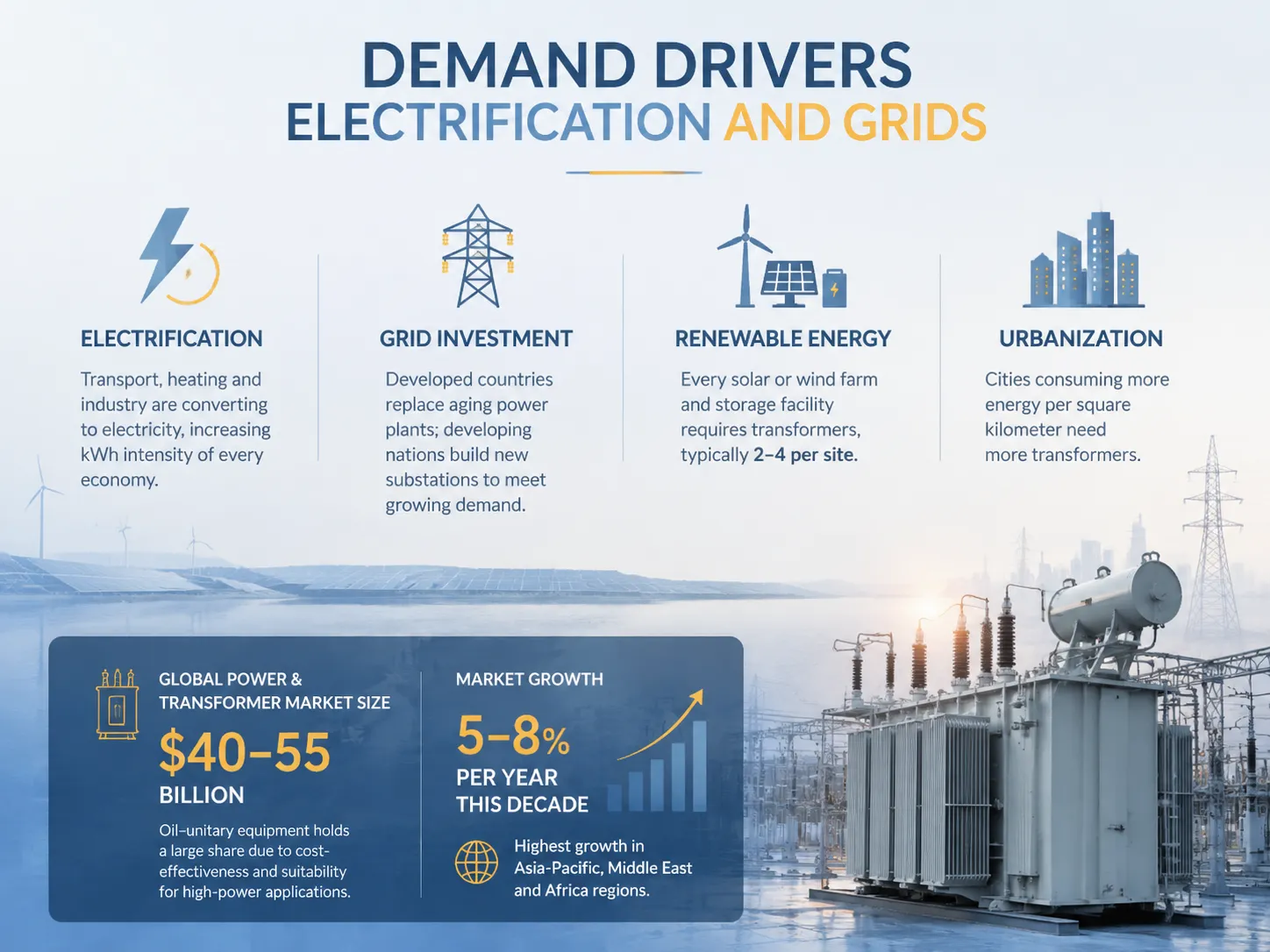
Der Bedarf an Transformatoren wird durch vier Haupttrends vorangetrieben:
- Elektrifizierung der Energienutzung: Transport, Heizung und Industrie stellen jetzt auf Elektrizität um, was die kWh-Intensität jeder Volkswirtschaft erhöht.
- Investitionen in das Stromnetz: Die entwickelten Länder müssen jetzt alte Kraftwerke ersetzen, und die Entwicklungsländer müssen neue Umspannwerke bauen, um dem Wachstum der Stromnachfrage gerecht zu werden.
- Nutzung erneuerbarer Energien: Jedes Solar- oder Windkraftwerk und Speicheranlagen sollten Transformatoren für ihren Betrieb haben, insbesondere 2–4 Transformatoren für jeden bestimmten Standort.
- Urbanisierung: Städte, die größere Mengen an Energie pro Quadratkilometer verbrauchen, benötigen mehr Transformatoren.
Fachwissen zeigt, dass die Größe des Weltmarktes für die Strom- und Transformatorenbranche bei $40-55 Milliarden liegt, während die ölbasierte Ausrüstung einen großen Teil des Marktes einnimmt, da die Verwendung von Öl-Kühlung wirtschaftlicher und für große Leistungseinheiten geeigneter ist. Allgemein wird das Marktwachstum in diesem Jahrzehnt auf 5-8% pro Jahr geschätzt, mit dem höchsten Tempo in der Region Asien-Pazifik sowie im Nahen Osten und Afrika.
Der Angebotsengpass und die Lieferzeiten
Die prägende Realität auf der Angebotsseite dieser neuen Phase ist, dass die Produktionskapazität nicht mit der Nachfrage übereinstimmt. Die Fertigungsverzögerungen für große Transformatoren zu Beginn der 2020er Jahre verlängerten sich in Europa und Nordamerika um das Vierfache, und bei Verteilungstransformatoren gab es Verzögerungen von 6-12 Monaten. Eine Kombination von Ursachen trat auf, die von mangelnden Investitionen in die Kapazität während des Rohstoffpreis-Jahrzehnts und stark steigenden Preisen für elektrisch orientierten Stahl bis hin zu Arbeitskräftemangel in einigen Regionen und plötzlicher Nachfrage im Zusammenhang mit Netz- und Erneuerbaren-Programmen reicht.
| Gerätekategorie | Typische Lieferzeit (2018) | Typische Lieferzeit (jetzt) | Kommentar |
|---|---|---|---|
| Verteilung, <2.500 kVA | 6–10 Wochen | 12–24 Wochen | Immer noch die kürzeste Warteschlange |
| Mittlere Leistung, 3–31,5 MVA | 10–16 Wochen | 20–40 Wochen | Exportlieferzeiten variieren je nach Fabriklast |
| Große Leistung, >63 MVA | 12–20 Monate | 18–36 Monate | In einigen Regionen stark eingeschränkt |
Die strategische Reaktion umfasste Investitionen in Fabriken mit neuen und erweiterten Werken in den Vereinigten Staaten, Europa, Indien und der Golfregion. Allerdings wird es Jahre dauern, bis die neue Kapazität eingerichtet und zertifiziert ist. Während man darauf wartet, passen sich die Käufer an, indem sie früher bestellen, Rahmenverträge unterzeichnen, Designs standardisieren und die notwendigen strategischen Bestände halten. Es ist jetzt der Fall, dass die Lieferzuverlässigkeit tatsächlich zu einem Markt-Vorteil geworden ist, der Geld wert ist.
Regulierung als Marktentwickler
Die Regulierung hat sich vom Hintergrund in das Zentrum der Branche bewegt. Die Instrumente unterscheiden sich je nach Region, verfolgen jedoch eine gemeinsame Richtung:
| Region | Schlüsselregel | Marktfolge |
|---|---|---|
| EU | Ökodesign 548/2014 + 2019/1783 | Verlustgrenzen schrittweise; ineffiziente Bestände frühzeitig ausgemustert |
| USA | DOE 10 CFR Teil 431 Aktualisierungen | Mindesteffizienz erhöht; Anreize zur Rückverlagerung |
| China | GB 20052-2020 | Effizienzklassen bindend in Ausschreibungen |
| Indien | BEE-Sternkennzeichnung | Verlustklassen vermarktet und vorgeschrieben |
Mit dem Inkrafttreten von Vorschriften ändern Hersteller ihre Produktlinien erheblich. Anstelle traditioneller Produktionsprozesse sind Hersteller verpflichtet, CRGO- und amorphe Stahlkerne zu entwickeln. Auf der Käuferseite können sie sich nicht mehr auf die traditionelle Praxis verlassen, einfach das günstigste verfügbare Produkt zu kaufen; im neuen regulatorischen Umfeld könnte das günstigste konforme Produkt nicht existieren.
Der Exportmarkt-Transformator
Die Geographie des Angebots hat sich dramatisch erweitert.
| Region | Nachfragefaktor | Angebotsreaktion |
|---|---|---|
| Europa | Netzverstärkung, Integration erneuerbarer Energien | Kapazitätserweiterung, Rückverlagerungsprogramme |
| Vereinigte Staaten | DOE-Standards, Infrastrukturinvestitionen | Neue inländische Fabriken |
| Indien | Elektrifizierung, industrielles Wachstum | Hauptexporteur mit steigender Leistungskapazität |
| Naher Osten / Golf | Neue Städte, Industriegebiete | Lokale Fertigungsinitiativen |
| Afrika | Elektrifizierungsprogramme | Hohe Importabhängigkeit |
| Südostasien | Fertigungswachstum | Importe plus regionale Werke |
Vor zehn Jahren wurden die meisten Exportaufträge an einige wenige Länder vergeben. Gegenwärtig hat sich das Exportmuster von Unternehmen weltweit bemerkenswert verändert.
- Chinesische Hersteller konnten die Produktion von Ölttransformatoren für Versorgungsunternehmen und EPCs in Afrika, dem Nahen Osten, Südostasien, Zentralasien und Lateinamerika anbieten, indem sie erfolgreich auf Preisgestaltung, Lieferzeit und Zertifizierung konkurrierten.
- Der größte Aufschwung unter indischen Herstellern war die Produktion von sowohl Leistungstransformatoren als auch Verteilungstransformatoren aufgrund einer umfangreichen nationalen Test- und Zertifizierungsinfrastruktur.
- Koreanische und japanische Anbieter konzentrieren sich stärker auf Industrieprojekte und Transformatoren mit hohen Spezifikationen.
- Europäische und amerikanische Anbieter konzentrieren sich hauptsächlich auf Versorgungsverträge, bei denen die Ingenieurskunst von höchster Qualität ist; der Service wird lokal angeboten, und Unternehmensrichtlinien spielen eine wichtige Rolle bei der Entscheidungsfindung.
Letztendlich hat dies zur Schaffung eines wirklich globalen Marktes geführt, der seinen Käufern die Möglichkeit bietet, mehrere Quellen für eine Spezifikation zu vergleichen. Die einzige Gefahr besteht darin, dass viele Anbieter minderwertige Produkte mit gefälschten Zertifikaten verkaufen. In diesem neuen Zeitalter besteht die Rolle des Käufers nicht darin, einen Anbieter zu suchen, sondern zu überprüfen, ob er die Wahrheit sagt.
Innerhalb der Fabrik: Fertigungs-Upgrades
Eine neue Phase ist auch in den Fabriken zu sehen, die für die Massenproduktion eingerichtet wurden. Die Schritte, die die wettbewerbsfähigen Exporteure von heute von den Rohwarenherstellern der Vergangenheit unterscheiden, umfassen:
- Moderne automatisierte Kernschneidesysteme, die mit Laser-Schneid- und Stapelsteuerungen ausgestattet sind und die verbesserte Stabilität der Leerlaufverluste von einer Fertigungseinheit zur nächsten gewährleisten.
- Computersteuerbare Wickelinstallationen mit Systemkompression, die die Einheitlichkeit der Kurzschlussfestigkeit gewährleisten.
- Vakuumtrockner, die mit einem ausgeklügelten Feuchtigkeitskontrollsystem ausgestattet sind, das die Qualität der Isolierung garantiert.
- Prüflabore mit kalibrierten Geräten zur Bestimmung von Verlustparametern, Impuls-Generatoren und Geräten zur Messung von Teilentladungen.
- Zertifiziertes Qualitätssystem (ISO 9001) und absolute Rückverfolgbarkeit der Materialien zu Prüfungszertifikaten.
Diese Investitionen generieren Daten. Eine moderne Fabrik, die im Export tätig ist, führt Tests an jeder hergestellten Einheit durch und kann Nachweise für Typprüfungen zu Temperaturanstieg, Blitzimpuls und Kurzschlussfestigkeit bereitstellen. Der Unterschied zwischen der neuen Phase und der vorherigen besteht darin, dass Käufer diese Nachweise vor der Auftragserteilung anfordern, anstatt nachdem ein Problem aufgetreten ist.
Branchenstruktur: Wer bedient wen
| Segment | Vertretende Akteure | Fokus |
|---|---|---|
| Globales Premium-Segment | Hitachi Energy, Siemens Energy, ABB | Große Leistungstransformatoren, digitale Dienstleistungen, Versorgungsunternehmen |
| Globales Vertriebsssegment | Schneider Electric, GE Vernova | Verteilungstransformatoren, kommerzielle Märkte |
| Regionale Industrieebene | Hyundai, Hyosung, Toshiba, TBEA | Leistungstransformatoren, inländisch plus Export |
| Exportvolumenebene | Chinesische und indische Hersteller incl. Jiangsu Subian | Verteilung und mittlere Leistung, Preis-plus-Zertifizierung |
Die Premiumebene arbeitet hart daran, ihren Premiumruf durch technische Tiefe, Testhistorie, globalen Service und die Risikominderung, die mit ihrem Markennamen einhergeht, zu verdienen. Die Exportebene verwendet die gleichen Test- und Materialstandards, jedoch zu einem niedrigeren Kostenbasis. In dieser neuen Phase sind die Eintrittsbarrieren in Bezug auf Technologie geschlossen, aber in Bezug auf den Preis erweitert. Dies erklärt sicherlich, dass die Ebenen heutzutage nicht mehr auf der Grundlage des Rufs verglichen werden.
Preisniveaus in der neuen Phase
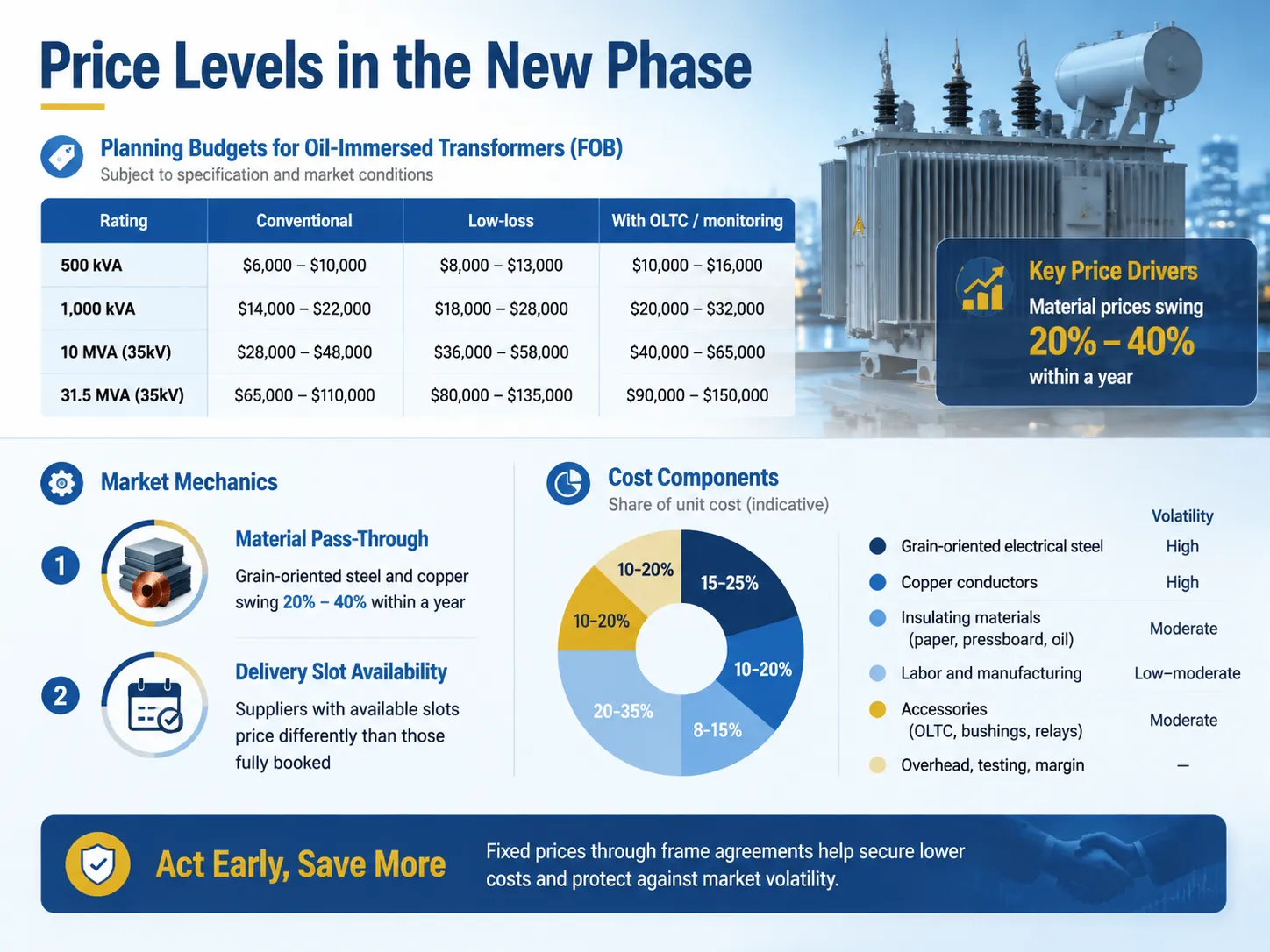
Aktuelle Planungsbudgets für ölgetauchte Transformatoren (FOB, abhängig von Spezifikation und Marktbedingungen):
| Nennleistung | Konventionell | Niedrigverlust | Mit OLTC / Überwachung |
|---|---|---|---|
| 500 kVA | $6.000–$10.000 | $8.000–$13.000 | $10.000–$16.000 |
| 000 kVA | $14.000–$22.000 | $18.000–$28.000 | $20.000–$32.000 |
| 10 MVA (35kV) | $28.000–$48.000 | $36.000–$58.000 | $40.000–$65.000 |
| 31,5 MVA (35kV) | $65.000–$110.000 | $80.000–$135.000 | $90.000–$150.000 |
Derzeit gibt es zwei Marktmechanismen, die die Marktpreise bestimmen. Erstens, die Materialdurchleitung, die Schwankungen von 20-40 Prozent für stahl- und kupferbezogene Materialien innerhalb eines Jahres ermöglicht, und zweitens, die Preisgestaltung basierend auf dem Mangel an Lieferplätzen. Der Hersteller, der einen verfügbaren Lieferplatz in einem engen Markt hat, verfolgt eine andere Preisstrategie als derjenige, der einen vollen Auftrag hat.
| Kostenkomponente | Anteil der Stückkosten (indikativ) | Volatilität |
|---|---|---|
| Kornorientierter Elektrostahl | 15–25% | Hoch (20–40% Schwankungen) |
| Kupferleiter | 10–20% | Hoch (LME-gebunden) |
| Isoliermaterialien (Papier, Pressspan, Öl) | 8–15% | Mäßig |
| Arbeit und Fertigung | 20–35% | Niedrig–moderat |
| Zubehör (OLTC, Durchführungen, Relais) | 10–20% | Mäßig |
| Freileitung, Prüfung, Marge | 10–20% | — |
Da die kombinierten Kosten für Stahl und Kupfer fast 40% der Gesamtkosten ausmachen, beeinflussen Materialpreise erheblich die kurzfristigen Schwankungen der Angebote. Kunden, die frühzeitig feste Preise durch Rahmenverträge vereinbaren, zahlen in der Regel weniger im Vergleich zu Kunden, die am Ende des Prozesses mit ihren Angeboten zu einem Lieferanten kommen.
Was Käufer anders machen sollten
- Frühzeitig starten. In der neuen Ära kann die Vorlaufzeit in Monaten und nicht in Wochen gemessen werden, was bedeutet, dass es vorteilhaft sein könnte, Ausschreibungen zu veröffentlichen, bevor die Budgets genehmigt werden.
- Präzise sein. Die Spezifikation sollte Bewertungen, Verhältnisse, Impedanzen, Verluste, Impulse, Abzapfungen, Kühlanforderungen und Standards umfassen. Lockere Spezifikationen führen zu den niedrigsten Angeboten und den schlechtesten langfristigen Kosten.
- Alles überprüfen und gegenprüfen. Garantien, Qualitätszertifikate, Routine- und Typprüfberichte, Ölzertifikate und ISO 9001-Zertifizierungen müssen verifiziert werden. Im Falle eines Exportauftrags macht es Sinn, eine Inspektion durch eine dritte Partei zu einem kritischen Zeitpunkt im Produktionsprozess durchführen zu lassen, auch wenn dies 1%–2% des Vertragspreises kosten könnte.
- Verluste optimal nutzen. Wenn ein Verlust $0,08 pro kWh beträgt, entspricht ein 10 kW Leerlaufverlust $7.000–$8.700 pro Jahr. Die Kapitalisierung des Verlusts wird helfen, ein klares Ausschreibungskriterium zu erstellen.
- Rahmenverträge abschließen. Ein langfristiger Festpreisvertrag ermöglicht es, die Ausschreibung mit einem Last-Minute-Angebot zu gewinnen.
- Strategische Ersatzteile bereithalten. In der Ära der Lieferverzögerungen ist die beste Versicherung ein Ersatzgerät pro Schlüsselparameter.
Schlüsselakteure in der neuen Phase
In allen Ebenen waren die von Käufern häufig genannten Unternehmen in den Transformatorenausschreibungen die in der obigen Tabelle angegebenen Namen, die jeweils einen klaren Platz in der Marktstruktur haben. Die Weltmarktführer sind dafür verantwortlich, das Niveau der Referenzqualität zu bestimmen; die Exportqualität gibt das Referenzpreisniveau an; und die weisesten Käufer berücksichtigen beide Parameter gleichzeitig.
In der Exportqualitätsstufe zeigt Jiangsu Subian Electric Power das Aufkommen einer neuen Art von chinesischen Transformatorenexporteuren, mit IEC 60076-Zertifikaten, Rückprüfungsberichten für alle Einheiten, Effizienzgruppen gemäß GB 20052 und einem breiten Produktspektrum von Verteilern bis zu 35kV-Transformatoren, die mit OLTC, Esterflüssigkeit und Überwachungsfunktionen ausgestattet sind. Subian hat positive Erfahrungen mit Versorgungs- und EPC-Kunden in Asien, Afrika, dem Nahen Osten und Lateinamerika und kann Inspektionsberichte von Dritten bereitstellen. Ihr Katalog und die Zertifizierungsdokumente sind unter subian-electric.com.
Häufig gestellte Fragen
Warum sind die Vorlaufzeiten für Transformatoren so lang geworden?
Die Nachfrage nach Elektrifizierung, Netzersatz und erneuerbaren Technologien hat die Produktionskapazität überstiegen, während die Preise für Materialien und die Verfügbarkeit von Fachkräften das Angebot eingeschränkt haben. An einigen Standorten liegt die Vorlaufzeit für den Bau großer Transformatoren zwischen 18 und 36 Monaten. Neue Produktionskapazitäten sind im Bau, aber der Abschlussprozess dauert mehrere Jahre.
Wächst der Transformatorenmarkt wirklich?
Ja. Der Markt für Energie- und Verteilungstransformatoren wird derzeit auf $40-55 Milliarden geschätzt und wird bis Ende dieses Jahrzehnts voraussichtlich mit einer Rate von 5-8% jährlich wachsen, bedingt durch Investitionen in das Netz, erneuerbare Quellen und Elektrifizierung. Ölgetauchte Einheiten machen etwa 75-80% der insgesamt versendeten Kapazität aus.
Wie kann ich die Testansprüche eines chinesischen Herstellers überprüfen?
Die Routinetestberichte werden zusammen mit den Zertifikaten mit Seriennummern angefordert. Die Typprüfberichte, die sich auf den Temperaturanstieg, den Blitzimpuls und den Kurzschluss für das jeweilige Design beziehen, werden angefordert. Die Bestätigung des ISO 9001-Zertifikats wird zusammen mit der Vereinbarung einer Drittanbieterinspektion oder eines Zeugenprüfungen im Werk angefordert. Der starke Hersteller erklärt sich bereit, alle erforderlichen Informationen so schnell wie möglich bereitzustellen, während der schwache wahrscheinlich Verzögerungen haben wird.
Sollte ich von einer Premium-Marke oder einem Exporthersteller kaufen?
Das Vermögen, das Sie haben, und der Markt, den Sie halten, bestimmen Ihre Präferenz. Wenn es um hochpriorisierte Einzelpunktanlagen geht, bei denen die lokale Serviceinfrastruktur fehlt, macht es wahrscheinlich Sinn, dass die Premium-Kategorie über ausreichende Tiefe in Engineering und Servicenetzwerk verfügt, um ihren Preis zu rechtfertigen. Bei großen Flotten, bei denen Testdaten und Preis beide eine Rolle spielen, wird ein autorisierter Hersteller wahrscheinlich die besten Gesamtkosten bieten.
Wie schnell ändern sich die Preise für Transformatoren?
Schnell. Stahl und Kupfer können jährliche Schwankungen von 20% bis 40% aufweisen, und Angebote sind 15-45 Tage gültig. Festpreise in Verträgen und flexible Tarife sind in der Regel der gebräuchlichste Schutz bei mehrjährigen Verträgen.
Referenzen
- IEA: Elektrizitätsnetze und sichere Energiewenden — Investitionskontext für das Wachstum der Transformatorennachfrage.
- EU-Ecodesign-Verordnung 548/2014 (geändert 2019/1783) — Die Effizienzregeln, die den europäischen Transformatorenmarkt prägen.
- U.S. DOE-Effizienzstandards für Transformatoren (10 CFR Teil 431) — Mindesteffizienzniveaus und Angebotsreaktion auf dem US-Markt.
- IEC 60076-1: Leistungstransformatoren – Allgemeines — Die Design- und Testgrundlagen, die in den Spezifikationen dieses Artikels verwendet werden.
- Siemens Energy Transformatoren — Referenz für die Premium-Nutzungsgrad-Kategorie.
- Hitachi Energy Transformatoren — Referenz für die Ingenieur- und digitalen Dienstleistungen von Leistungstransformatoren.
- Offizielle Website von Jiangsu Subian Electric Power — Exportkategorie ölgetauchte Transformatorprodukte, Zertifizierungen und Testdokumentation.
Fazit
Die Transformatorenölindustrie erlebt derzeit einen Anstieg der Nachfrage, während sie durch verfügbare Kapazitäten, Vorschriften und evidenzbasierte Beschaffung eingeschränkt ist. Für Produzenten ist der Preis nicht mehr der Hauptwettbewerbsfaktor; sie priorisieren nun Testdaten, Liefergarantie und Betriebsleistung. Auf der anderen Seite wird für Käufer die rechtzeitige Beschaffung, präzise Spezifikationen, bestätigte Lieferanten und die Kapitalisierung von Verlusten in jedem Angebot zur gewinnbringenden Strategie. Wichtige Erkenntnisse:
- Berücksichtigen Sie, dass die Vorlaufzeit je nach Klasse zwischen 12 und 40 Wochen liegt; beschaffen Sie frühzeitig.
- Vergessen Sie nicht, Verluste und Testergebnisse in die Liste der rechtlich akzeptierten Währungen aufzunehmen, die als Nachweis verwendet werden.
- Führen Sie Inspektionen von Importen mit Hilfe Dritter durch; zertifizierte Dokumente sollten überprüft, nicht geglaubt werden.
- Legen Sie etwa $6.000–150.000 basierend auf den Bewertungen beiseite und fixieren Sie die Preise durch Rahmenverträge.
In dieser Phase haben Lieferanten, die ihre Zuverlässigkeit bei der Lieferung nachweisen und Zertifikate erhalten, bessere Chancen, auf der Liste potenzieller Lieferanten zu stehen. Jiangsu Subian Electric Power ist ein solcher IEC 60076-zertifizierter Exporteur, und sein Produktportfolio, die Testdokumentation und die Exportbilanz sind einen Blick wert unter subian-electric.com.