


Sie befinden sich um 7 Uhr morgens im Kontrollraum eines 110-kV-Umspannwerks an einem warmen Julimorgen. Die Nachfrage nach Klimaanlagen steigt in der Stadt und der Dispatcher möchte wissen, warum die Busbar-Spannung auf der 10-kV-Ebene auf 9,8 kV gefallen ist, anstatt bei der Zielspannung von 10,5 kV zu bleiben. In einem herkömmlichen Transformator, der über kein Lastwechselgerät verfügt, bedeutet diese Situation eine Unterbrechung des Dienstes oder eine Nacht, die mit der Wiederverbindung der Schaltungen verbracht wird. Wenn Sie jedoch einen SZ11-31500kVA 35/10,5kV ölgetauchten Transformator mit Lastwechselgerät haben, wird alles automatisiert gelöst und die Busbar-Spannung kehrt in wenigen Sekunden auf die erforderlichen 10,5 kV zurück.
Das ist der Grund, warum Versorgungsunternehmen, Fertigungsunternehmen und unabhängige Stromerzeuger weiterhin die Hersteller von ölgetauchten Transformatoren mit Lastwechselgeräten kontaktieren und nicht die viel günstigeren Modelle, die Off-Circuit-Abgriffe nutzen. Der vorliegende Artikel untersucht, wie der SZ11-31500kVA 35/10,5kV Transformator funktioniert, wie hoch der Preis für den ölgetauchten Transformator ist und wie man ihn ohne Überraschungen erwerben kann.
Der SZ11-31500kVA 35/10,5kV Transformator ist ein dreiphasiges, ölgetauchtes Gerät mit einer Leistung von 31.500 kVA. Er hat eine 35-kV-Hochspannungswicklung und eine 10,5-kV-Niederspannungswicklung. Diese Einheit verwendet ein Lastwechselgerät (OLTC), was bedeutet, dass sie die Spannung während des Betriebs anpassen kann. Der Leerlaufverlust liegt typischerweise bei etwa 20-25 kW und der Lastverlust beträgt etwa 130-150 kW. Er hat eine Standardimpedanz von 8% und gehört normalerweise zur Vektorgemeinschaft YNd11.
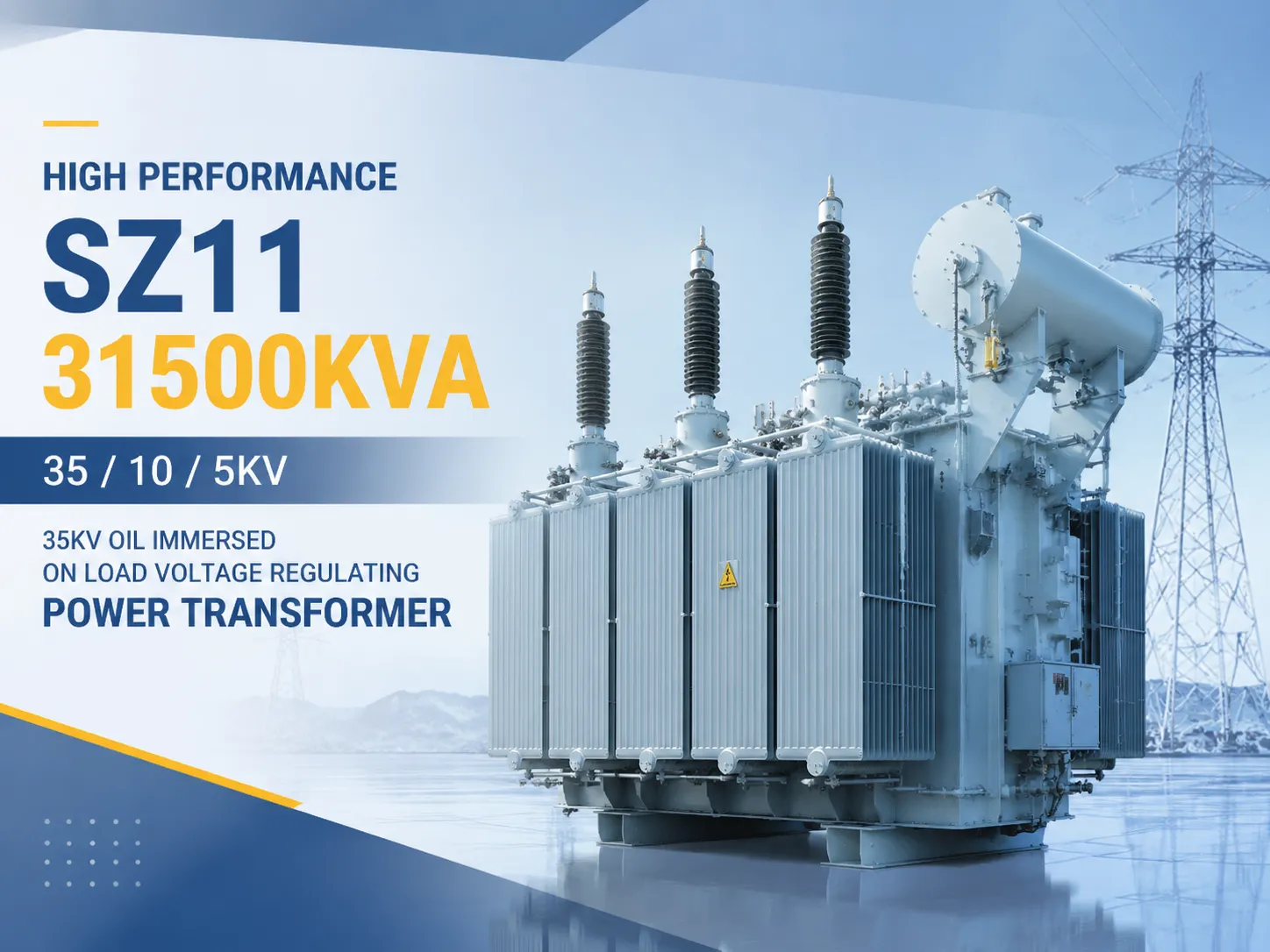
Was ist der SZ11-31500kVA 35/10,5kV Transformator?
Die Bezeichnung der SZ11-Serie folgt dem nationalen Klassifizierungssystem Chinas für Leistungstransformatoren. Der Buchstabe “S” bezieht sich auf dreiphasige Transformatoren, “Z” zeigt Transformatoren mit Lastwechselgeräten an, und die Zahl “11” bezeichnet die Serie von Transformator-Designs mit Leerlaufverlusten, die 30% niedriger sind als die Verluste der vorherigen S9-Serie gemäß GB/T 6451 und GB 20052. Der 31500 kVA Transformator ermöglicht den Anschluss des 35-kV-Mittelspannungsnetzes an die 10,5-kV-Verteilungsschiene und wird häufig in 110/35/10-kV-Umspannwerken, großen Industrieparks und erneuerbaren Energieanlagen eingesetzt.
Der Hauptgrund für die Verwendung des SZ11-31500kVA Transformators anstelle eines festen Transformators ist die Verbesserung der Spannungsqualität. Die Spannung in Verteilungsnetzen variiert ständig, was es notwendig macht, dass die 10,5-kV-Busbar von 9,5 kV auf 11 kV umschaltet. Das Lastwechselgerät ermöglicht die Anpassung der Spannung im Bus zu jeder Zeit während des Betriebs. Der geschätzte Abgriffbereich für solche Transformatoren beträgt (gemäß IEC 60076-1) ±8 x 1.25%, was einen Gesamtbereich von ±10% ergibt. Dennoch arbeiten die SZ11-Transformatoren, die für 35-kV-Netze vorgesehen sind, normalerweise im Bereich von 35 ± 3 x 2.5% oder 35 ± 8 x 1.25%, abhängig von den spezifischen Anforderungen des Projekts.
Im Falle eines Transformators mit 31,5 MVA gibt es zwei Seiten: Eine kann die Bedürfnisse des gesamten Stadtgebiets oder eines mittelgroßen Industrieunternehmens decken, ist aber auch als komplette Einheit transportierbar. Das Gewicht von 45-55 Tonnen ermöglicht einen einfachen Transport des Geräts durch viele Regionen.
Wie die Spannungsregelung unter Last funktioniert
Die Verwendung eines Lastwechsel-Schalters bedeutet, dass ein Transformator sein Übersetzungsverhältnis anpassen kann, während er aktiv Strom führt. Dies unterscheidet sich von allen Offline-Umschaltungen, da der Transformator bei einer Offline-Umschaltung oder De-energisierung keinen Strom führen darf. Beide Arten von Änderungen beinhalten die gleichen Schaltelemente und Übergangssysteme, die auf entweder Widerständen oder Reaktoren basieren und den Umschaltprozess erleichtern, ohne Lichtbogen-Schäden am zu ändernden System oder Unterbrechungen eines Stromkreises während der Umschaltsequenz zu verursachen.
Im Falle von Widerstands-OLTCs wird eine Abfolge von Schaltvorgängen durchgeführt. Für den OLTC eines Transformators, der bei 35 kV arbeitet und eine der Haupttypen in der Praxis darstellt, sind die Schritte im Umschaltprozess wie folgt:
- Der Umgehungsschalter fungiert als Schaltelement, indem er sowohl eingehende als auch ausgehende Leiter mit einem Übergangswiderstand verbindet.
- Die Einführung des Widerstands in den Stromkreis ermöglicht es, den zirkulierenden Strom zu begrenzen, in dem Moment, in dem der Transformator mit dem energisierten System verbunden wird.
- Der Umschaltprozess wird innerhalb von ein paar Millisekunden nach der Initiierung der Spannungsänderung am Abgriff abgeschlossen.
Abgesehen von dem praktischen Aspekt des OLTC hat der Betrieb des Geräts viel mit der Funktionsweise des Apparats zu tun, der als automatischer Spannungsregler (AVR) bekannt ist. Das Gerät kann den OLTC-Prozess aus der Ferne steuern, indem es die tatsächlichen Spannungsniveaus überwacht. Die Aufgabe des AVR-Controllers besteht darin, die sekundären Spannungswerte mithilfe des Spannungstransformators als Messgerät zu steuern. Er sendet einen Änderungsbefehl, wenn die Zeit, die in einer Spannungszone verbracht wird, überschritten wird, was oft während der Umschaltvorgänge geschieht.
Die Wartung des OLTC ist entscheidend in Bezug auf die Kosten, die bei der Nutzung eines der Transformator-Typen anfallen. In dieser Hinsicht sind die Plug-in-Bäder von ölgetauchten OLTCs der zeitaufwändigste Teil des Prozesses, da diese OLTCs, wie der MR-Typ VACUTAP oder ABB UZ-Serie Schalter, regelmäßig überwacht werden müssen, um die Leistung des Öls in ihrem Tank sicherzustellen.
| Abgriffwechseltyp | Typischer Bereich | Wartungsintervall | Kostenimpact |
|---|---|---|---|
| Off-Kreis (DETC) | ±2 × 2.5% | Nur inspizieren | Basislinie |
| Ölgetauchter Widerstands-OLTC | ±8 × 1.25% | 000–100.000 Operationen | +$6.000–$12.000 |
| Vakuum-OLTC | ±8 × 1.25% | 000–200.000 Operationen | +$10.000–$18.000 |
Für eine 31,5 MVA-Umspannwerkeinheit, die mehrmals täglich Abgriffe wechselt, rechtfertigt das längere Wartungsintervall des Vakuumtyps oft seinen Aufpreis.
Design- und Konstruktionsmerkmale
Der SZ11-31500kVA 35/10.5kV Transformator bezieht sich auf einen Konservator-Öl-Transformator, was bedeutet, dass er einen versiegelten Ausdehnungstank enthält, der mit Silikagel gefüllt ist, anstelle eines vollständig gasdichten Tanks. Die Hauptbaukomponenten umfassen Folgendes:
- Kern: Der Kern besteht aus kaltgewalztem, kornorientiertem (CRGO) Siliziumstahl des Typs 30ZH120 oder 27ZH110 und kann einen dreiläufigen oder fünfläufigen Stufenkern haben. Der Einsatz von Stufenüberlappungen ermöglicht es, die Verluste im Leerlauf und das Geräuschniveau zu verringern.
- Wicklungen: Die Wicklungen bestehen aus Kupferleiter, während die 35 kV HV-Wicklung als kontinuierliche Scheibenwicklung konstruiert ist und die 10,5 kV LV-Wicklung in spiralförmiger oder helikaler Weise ausgeführt ist, sodass sie die hohen Kräfte während eines Kurzschlusses gemäß IEC 60076-5 Norm aushalten kann.
- Isolierung: Die Isolierung besteht hier aus Transformator-Qualitäts-Isolierpapier und ölgetränktem Pressspan mit Isolierung der Klasse A für einen durchschnittlichen Temperaturanstieg der Wicklung von 65K und einem Temperaturanstieg des Hot Spots von 78 K bei 40°C.
- Lastwechsel-Schalter: Der Lastwechsel-Schalter befindet sich im Inneren des Tanks oder in einer separaten Kammer und funktioniert mit einem Motormechanismus und hat einen Positionsanzeiger sowie eine Fernüberwachungsoberfläche.
- Angehängte Geräte: Buchholz (Gas) Relais, Ölstandsanzeiger, Druckentlastungsgerät, Öltemperaturanzeiger, Wicklungstemperaturanzeiger und zwei oder mehr Silikagel-Atmer.
- Kühlung: Der Betriebsmodus ist ONAN (Öl natürlich, Luft natürlich) für diese Leistungsstufen, aber es ist möglich, auf die ONAF-Option umzuschalten, um die Leistung um 20-30% bei kurzzeitiger Überlast zu erhöhen.
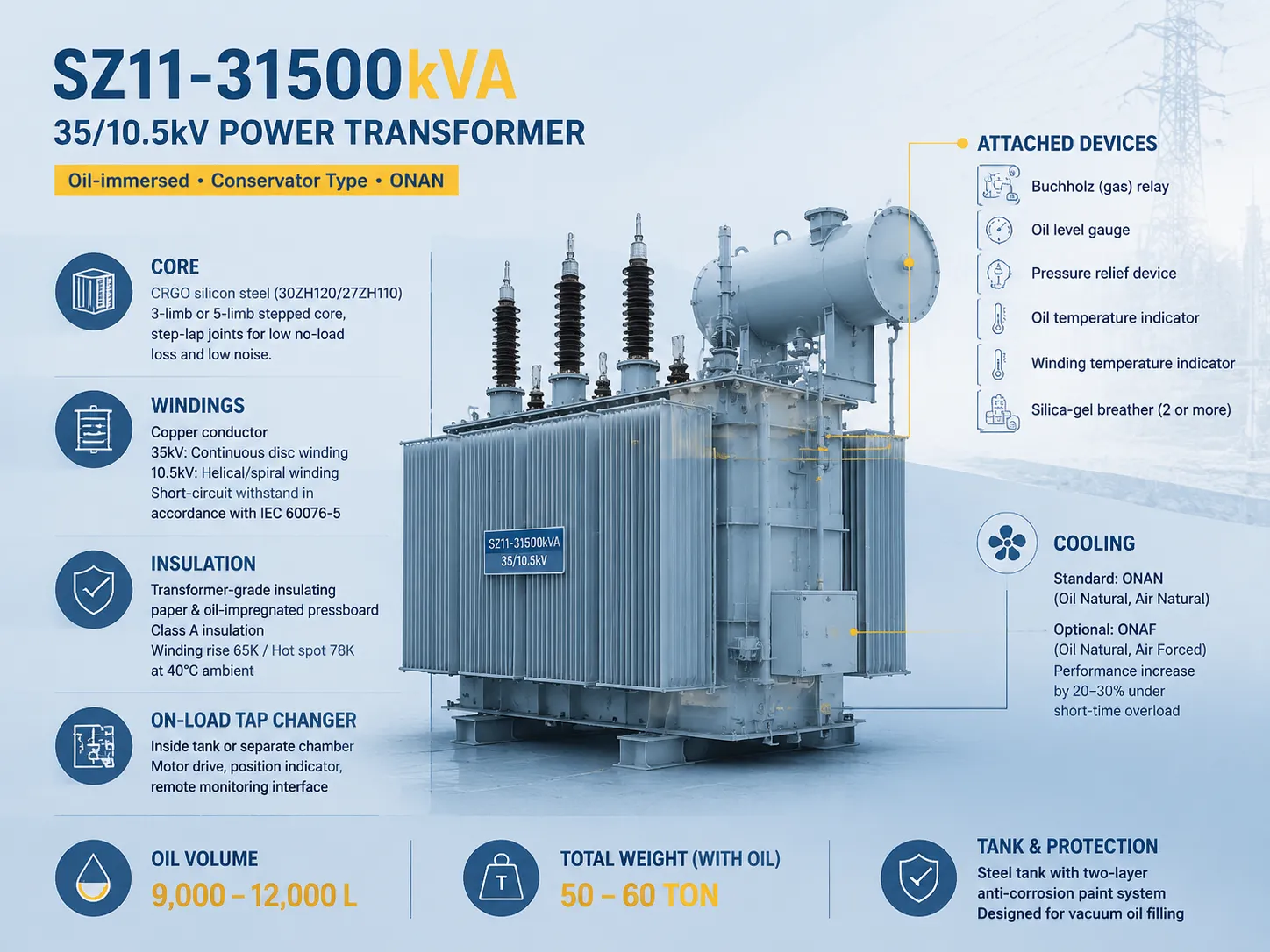
Der Tank selbst besteht aus Stahlblech und ist mit einem zweilagigen Farbsystem beschichtet, das ihn vor Korrosion schützt. Der Tank ist für das Vakuumfüllverfahren ausgelegt. Das Volumen des Öls für einen 31,5 MVA Transformator beträgt etwa 9.000-12.000 Liter und das Gesamtgewicht des Geräts mit Öl beträgt ungefähr 50-60 Tonnen, was für die Fundamentplanung und den Transport lange bevor der Transformator an seinen Arbeitsort geliefert wird, wichtig ist.
Wichtige technische Spezifikationen
| Parameter | Typischer Wert (IEC 60076) | Anmerkungen |
|---|---|---|
| Nennleistung | 500 kVA | ONAN / ONAF Bewertungen unterscheiden sich |
| Übersetzungsverhältnis | 35 ± 8 × 1.25% / 10,5 kV | Bereich hängt von den Spezifikationen ab |
| Häufigkeit | 50 Hz | 60 Hz Optionen verfügbar |
| Vektorguppe | YNd11 | Delta LV, geerdeter Stern HV |
| Kurzschlussimpedanz | 8% (±7.5% Toleranz gemäß IEC) | Nach IEC 60076-5 |
| Leerlaufverlust | ~20–25 kW | GB/T 6451 Serienwert |
| Lastverlust | ~130–150 kW | Bei 75°C Referenz |
| Leerlaufstrom | ~0,6–0,8% | Gemessen bei Nennspannung |
| Effizienz bei Volllast | > 99,5% | Leistungsfaktor 1,0 |
| Kühlmethode | ONAN / ONAF | IEC 60076-2 Bezeichnung |
| Temperaturanstieg | 65K durchschnittliche Wicklung | 40°C Umgebungstemperaturbasis |
| Gesamtgewicht | ~50–60 metrische Tonnen | Einschließlich Öl |
| Norm | IEC 60076 Reihe | Auch GB/T 6451 |
Wir sollten besondere Aufmerksamkeit auf die Effizienz legen. Bei voller Kapazität und einem Leistungsfaktor von 1,0 erreicht ein Transformator mit einer Kapazität von 31,5 MVA, einem Leerlaufverlust von 20 kW und einem Lastverlust von 140 kW eine Effizienz von etwa 99,49%. Obwohl 0,5% klein erscheinen mag, kann dies nach 25 Jahren Betrieb und einer durchschnittlichen Last von 60% zu kumulierten Verlusten von etwa 14–18 GWh führen, die rund $1,1–$1,7 Millionen bei einem typischen industriellen Strompreis von $0,08–$0,10 pro kWh kosten. Deshalb ist die Verlustkapitalisierung ein wesentlicher Bestandteil von Transformator-Ausschreibungen in den meisten Energieunternehmen, und deshalb ist auch der TCO des Transformators in der Regel weit höher als der ursprüngliche Kaufpreis.
| Kostenelement | 20 kW Leerlauf / 140 kW Lastverlust | 25-Jahres-Wert bei $0,08/kWh |
|---|---|---|
| Leerlaufverluste (P0) | 20 kW × 8.760 h | $350,000 |
| Lastverluste (Pk) bei 60% Last | 140 kW × 0,36 × 8.760 h | $882,000 |
| Gesamtkosten der Verluste | — | $1,232,000 |
| Typischer Kaufpreis | FOB, chinesischer Export | $65.000–$110.000 |
Verluste übersteigen den Transformator mehrere Male über seine Lebensdauer — der Hauptgrund, warum die Verlustkapitalisierung in jede Ausschreibung gehört.
SZ11 vs. S11 vs. Andere 35kV Typen
| Typ | Leerlaufverlust | Abgriffschalter | Beste Passform | Relativer Preis |
|---|---|---|---|---|
| S9 (Legacy) | Referenzbasis | Abgeschaltet | Budget-Nachrüstung | Niedrigste |
| S11 | ~30% niedriger als S9 | Abgeschaltet | Festverhältnis-Verteilung | +10–15% gegen S9 |
| SZ11 | ~30% niedriger als S9 | Unter Last (OLTC) | Spannungs-kritische Netze | +20–35% gegen S11 |
| S13 | ~50% niedriger als S9 | Abgeschaltet | Ultra-niedrigverlust Projekte | +25–40% gegen S9 |
| Amorph (SBH15) | ~70% niedriger als S9 | Variiert | Hochlastfaktor-Umspannwerke | +40–60% gegen S9 |
Der Hauptunterschied zwischen SZ11 und einem Transformator mit festem Verhältnis wird normalerweise die Spannungsfluktuation sein. Wenn Sie beispielsweise ein 35kV-Netz haben, das stabil ist, bleiben die Spannungspegel der Einspeisungen innerhalb von ±2,5%, wenn Laständerungen sehr langsam auftreten, dann würde ein abgekoppelter S11 oder S13 mit einem manuellen Abgriffschalter, der auf ±2 x 2,5% arbeitet, die Aufgabe zu einem viel geringeren Anfangskapitalaufwand erledigen. Wenn Sie jedoch eine schwankende industrielle Fertigungstätigkeit oder eine lange Reihe von Einspeisungen, die zu einer erneuerbaren Erzeugungsanlage gehören, versorgen, wird sich der Einsatz eines OLTC-Transformators in Bezug auf die Vermeidung von Unterspannungsabschaltungen und Überspannungsschäden auszahlen.
Typische Anwendungen
- 110/35/10kV Netz-Umspannwerke: SZ11 bietet eine Transformatorbewertung von 31,5 MVA und dient als Transformationsstufe von 35 kV auf 10,5 kV für sekundäre Umspannwerke, die die Busspannung für die gesamte Region steuern.
- Industrieanlagen: Große Anlagen zur Stahlproduktion, Zementverarbeitung, chemischen Anwendung oder Mineralgewinnung mit Motoren oder Bögen führen zu Spannungsabfällen, die eine kontinuierliche Regelung vorteilhaft machen.
- Erneuerbare Energieerzeugung: Solaranlagen oder Windparks, die sehr große Schwankungen im Erzeugungsprozess aufweisen; OLTC wird verwendet, um den Sammelbus legal arbeiten zu lassen.
- Urbane Verteilung: Gemischte Zuleitungen, die sowohl gewerbliche als auch private Verbraucher bedienen und abends Spitzenlasten aufweisen, benötigen eine regulatorische Wartung der Spannung auf dem Niveau von 95% des nominalen Wertes.
- Elektrifizierte Infrastruktur: Rechenzentren, Verkehrsnetze und medizinische Campus, wo die Qualität der Energie Vertragsgegenstand ist.
Für viele der oben genannten Projekte kann der Transformator bei hohen Spannungsregelungsniveaus gemäß dem ONAN-Kühlmodus und bis zu einer Nennlast von 100% betrieben werden und Überlastungen bis zu 130% für zwei Stunden mit Hilfe von Lüftern akzeptieren, gemäß den Empfehlungen der IEC 60076-7. Einer der Gründe, warum der 31,5 MVA Transformator bei Entwicklern und Ingenieuren so beliebt ist, ist die große Flexibilität im Betrieb.
Top-Marken und Preisspannen
Die 31,5 MVA-Klasse ist ein wirklich globaler Markt. Nachfolgend finden Sie einen indikativen Preisvergleich; die tatsächlichen Zahlen variieren je nach Kupferpreis, Verlustniveau, OLTC-Marke und Zielort.
| Marke | Herkunft | Typischer Preis (USD, FOB) | Anmerkungen |
|---|---|---|---|
| ABB | Schweiz/Weltweit | $130.000–$190.000 | Premium, globales Servicenetzwerk |
| Siemens Energie | Deutschland/Weltweit | $125.000–$185.000 | Stark bei Versorgungsangeboten |
| Hitachi Energie | Japan/Weltweit | $130.000–$200.000 | Hochspezifiziert, lange Lieferzeiten |
| Hyundai / Toshiba | Korea/Japan | $110.000–$170.000 | Industriequalität |
| Schneider Electric | Frankreich/Weltweit | $120.000–$175.000 | Verteilungsfokus |
| Indische Hersteller (TBEA, EMCO) | Indien | $80.000–$120.000 | Wettbewerbsfähig für regionale Projekte |
| Jiangsu Subian Electric Power | China | $65.000–$110.000 | IEC 60076 zertifiziert, exportorientiert |
Internationale Organisationen wie ABB, Siemens Energy und Hitachi Energy haben die Führung in Ingenieurexpertise und After-Sales-Service übernommen, sodass ihre Preise ihren Status widerspiegeln. Ihre Hauptkonkurrenten in Bezug auf Technologie sind chinesische und indische Hersteller, die die meisten technologischen Anforderungen zu deutlich niedrigeren Preisen erfüllen können, da sie vollständig etablierte Lieferketten für kornorientierten Stahl, Kupfer und Isoliermaterialien haben.
Als Beispiel für ein Unternehmen, das zuverlässige ölgetauchte Leistungstransformatoren bis zu 110kV produziert, arbeitet Jiangsu Guomai Electric Co. in Übereinstimmung mit den IEC 60076-Standards. Die tägliche Produktion von Jiangsu Guomai umfasst moderne 35/10,5kV SZ11-31500kVA Transformatoren, die ein Standardprodukt des Unternehmens sind und gemäß den IEC 60076-Richtlinien für die Prüfung von Materialien einschließlich Verlusten, Widerstand und Temperatur gebaut und getestet werden. Die Produktpalette der Fabrik umfasst Transformatoren verschiedener Ausführungen sowohl für Energieversorger als auch für Elektroinstallationsunternehmen in Asien, Afrika und Südamerika, einschließlich maßgeschneiderter Transformatoren. Besuchen Sie subian-electric.com für Produktpaletten und Testdokumentation.
Wie man diesen Transformator auswählt
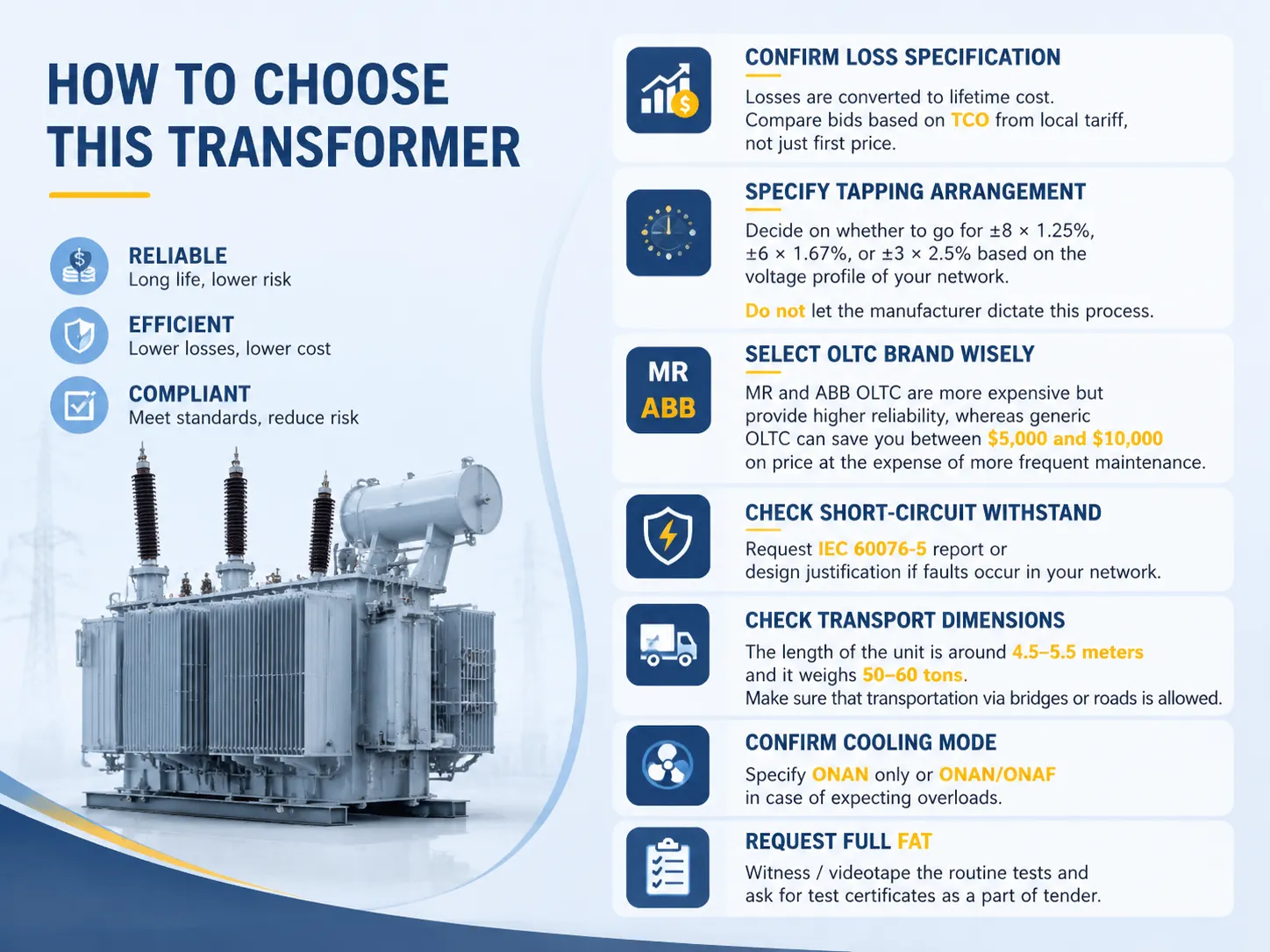
- Bestätigen Sie die Verlustspezifikation. Verluste werden in Lebenszykluskosten umgerechnet. Vergleichen Sie Angebote basierend auf TCO aus dem lokalen Tarif und nicht nur auf dem Erstpreis.
- Geben Sie die Abgriffanordnung an. Entscheiden Sie, ob Sie ±8 × 1.25%, ±6 × 1.67% oder ±3 × 2.5% basierend auf dem Spannungsprofil Ihres Netzes wählen möchten. Lassen Sie den Hersteller diesen Prozess nicht für Sie diktieren.
- Wählen Sie die OLTC-Marke weise. MR und ABB OLTC sind teurer, bieten jedoch höhere Zuverlässigkeit, während generische OLTC Ihnen zwischen $5.000 und $10.000 beim Preis sparen können, jedoch auf Kosten häufigerer Wartung.
- Stellen Sie sicher, dass Sie die Kurzschlussfestigkeit überprüfen. Fordern Sie den IEC 60076-5 Bericht oder eine Entwurfsbegründung an, falls Fehler in Ihrem Netzwerk auftreten.
- Überprüfen Sie die Transportabmessungen. Die Länge der Einheit beträgt etwa 4,5–5,5 Meter und sie wiegt 50–60 Tonnen. Stellen Sie sicher, dass der Transport über Brücken oder Straßen erlaubt ist.
- Bestätigen Sie den Kühlmodus. Geben Sie nur ONAN oder ONAN/ONAF an, falls Überlastungen erwartet werden.
- Fordern Sie einen vollständigen FAT an. Zeugen/filmen Sie die Routineprüfungen und verlangen Sie Testzertifikate als Teil der Ausschreibung.
Installation, Prüfung und Wartung
Der Installationsprozess für Öltrafos mit Konservator umfasst ein Standardverfahren. Das Gerät wurde mit Stickstoffgas für den trockenen Transport oder mit Öl geliefert, auf einem Fundament von 300 mm oder höher für Entwässerungszwecke platziert und mit dem Durchführungsstutzen und den Kabelkästen verbunden. Die folgenden Maßnahmen sollten vom Baustellenpersonal getroffen werden, bevor das Gerät eingeschaltet wird:
- Bestimmen Sie den Isolationswiderstand an allen Wicklungen mit einem Megger. Für das Gerät, das für 35kV ausgelegt ist, liegt der akzeptable Wert des Isolationswiderstands bei über 1000MΩ bei 20°C.
- Testen Sie die dielektrische Festigkeit des Öls des Transformators. Das Öl muss die Mindestdielektrizitätsfestigkeit von 50kV/2,5mm erfüllen.
- Bestätigen Sie über das Buchholz-Relais und das Druckentlastungssystem, dass Alarm- und Auslöseschaltungen ordnungsgemäß funktionieren.
- Führen Sie den OLTC-Betrieb im vollen Bereich ohne Last durch.
- Halten Sie das Gerät 168 Stunden ohne Last, während Sie DGA-Proben entnehmen.
Routineprüfungen für die SZ11-31500-Einheit können vierteljährliche Überprüfungen eines Atmungsgeräts umfassen, ob das Silikagel im rosa Zustand ist, sowie jährliche Ölprobenentnahmen für DGA und Überprüfungen des Arbeitsölzustands des OLTC gemäß den Systemanforderungen des Herstellers.
| Aktivität | Häufigkeit | Schlüsselprüfung |
|---|---|---|
| Sichtprüfung | Vierteljährlich | Atmungsgerät Silikagel, Ölstand, Lecks, Korrosion |
| Ölprobenentnahme und DGA | Jährlich | Schlüsselgasverhältnisse gemäß IEC 60599 |
| OLTC-Service | Pro Betriebsanzahl | Kontakte, Ölzustand, Motormechanismus |
| Prüfung des Schutzgeräts | Jährlich | Buchholz-Gas-/Überspannungs-Auslösungen, PRD, Alarme |
| Isolationswiderstand | Alle 2–3 Jahre | Megger-Messwerte im Trend im Vergleich zur Basislinie |
Das Ignorieren von DGA-Trends ist die häufigste Ursache für vorzeitigen Ausfall, daher budgetieren Sie einen DGA-Laborvertrag, auch wenn der Transformator selbst günstig war.
Häufig gestellte Fragen
Wie viel kostet ein SZ11-31500kVA 35/10,5kV Transformator?
Eine grobe Schätzung zeigt, dass man mit einem Preis für einen in China hergestellten Transformator von etwa $65.000–$110.000 FOB rechnen kann, während europäische oder japanische Hersteller irgendwo im Bereich von $120.000–$190.000 verlangen, ohne die Kosten für Transport, Versicherung oder Baustellenarbeiten. Der geschätzte Preis hängt letztendlich vom Verlustniveau, der OLTC-Marke, zusätzlicher Ausrüstung und den aktuellen Kupferpreisen ab. Der Transport eines Geräts mit einem Gewicht von 50–60 Tonnen kostet zusätzlich $8.000–$25.000, wobei die Gesamtkosten von der Entfernung zwischen den Herkunfts- und Zielhäfen abhängen.
Was bedeutet die Bezeichnung “SZ11” tatsächlich?
Hier steht S für die dreiphasige Bezeichnung und Z für den Lastabgriff, bekannt als “有载调压” auf Chinesisch. Die Zahl 11 zeigt an, dass dies ein verlustreduzierendes Design ist (dies hat ungefähr 30% geringere Leerlaufverluste als die S9-Serie). Daher zeigt die Bezeichnung SZ11 einen dreiphasigen Transformator mit einem Lastabgriff auf den modernen Verlustniveaus der 11-Serie gemäß der Spezifikation GB/T 6451 an.
Kann dieser Transformator in 60 Hz-Systemen betrieben werden?
Die Antwort ist ja, aufgrund der neu gestalteten Kern- und Wicklungsspezifikationen. Die Auswahl der Frequenz zwischen 50/60Hz beeinflusst die Flussdichte und somit sollten die Kernabmessungen immer die Betriebsfrequenz in der Anfrage zur Neuberechnung der Motorenbewertungen angeben, da die 50Hz nicht direkt auf die 60Hz übertragen werden können, ohne die Leerlaufverluste und Sättigungsgrenzen zu überprüfen.
Wie oft muss der Lastabgriff (OLTC) gewartet werden?
Ein widerstandsartiger, ölgetauchter Lastabgriff (OLTC) sollte nach jeweils 50.000 bis 100.000 Betätigungen oder nach 5 bis 7 Jahren, je nachdem, was zuerst eintritt, inspiziert werden. Vakuum-OLTCs können etwa 150.000 bis 200.000 Betätigungen erreichen, bevor eine Inspektion erforderlich ist. Verfolgen Sie die Anzahl der Betätigungen mit dem Zähler des Motormechanismus und folgen Sie dem Wartungsplan des OLTC-Herstellers, da dieser wahrscheinlich häufiger sein wird als der des Transformators.
Warum 10,5kV anstelle von 10kV oder 11kV auf der Niederspannungsseite wählen?
10,5kV ist die festgelegte Entwurfs-Spannung für die chinesischen Verteilungssysteme der 10kV-Klasse, bei denen die Nennspannung 10kV mit einer Toleranz von 5% beträgt. Die Implementierung einer Entwurfs-Spannung von 10,5kV berücksichtigt den Impedanzabfall des Transformators während des Lastprozesses, wobei die Spannung im Leerlaufzustand auf etwa 10,5kV einstellbar ist und die belastete Sammelschiene eine Spannung von 10kV liefert. In den Bereichen, in denen 11kV-Netze angewendet werden, die in asiatischen und nahöstlichen Ländern weit verbreitet sind, sollte stattdessen 11kV erwähnt werden.
Referenzen
- IEC 60076-1: Leistungstransformatoren – Teil 1: Allgemeines — Definiert die Anforderungen an Bewertungen, Abgriffe und Temperaturanstieg für Leistungstransformatoren.
- IEC 60076-5: Fähigkeit, Kurzschluss zu widerstehen — Gibt die Anforderungen an die Kurzschlussfestigkeit und Prüfverfahren an.
- IEC 60296: Flüssigkeiten für elektrotechnische Anwendungen – Mineralische Isolieröle — Legt die Qualitätsanforderungen für Transformator-Isolieröl fest.
- IEEE C57.12.00: Standard für flüssigkeitsgetauchte Verteilungs- und Leistungstransformatoren — Das nordamerikanische Pendant zu IEC 60076, nützlich für den Vergleich.
- Maschinenfabrik Reinhausen (MR) Lastabgriffe — Herstellerdokumentation zu OLTC-Betrieb und Wartungsintervallen.
- Hitachi Energy Transformatoren — Referenzproduktinformationen für große Leistungstransformatoren und OLTC-Systeme.
- Offizielle Website von Jiangsu Subian Electric Power — Produktpaletten, Zertifizierungen und Kontaktdaten des Herstellers.
Fazit
Der SZ11-31500kVA 35/10,5kV ölgekühlte Lastspannungsreglertransformator ist für den Einsatz in Mittelspannungsnetzen mit stabiler Spannung unter den Lastschwankungen konzipiert. Er erreicht eine bemerkenswerte Effizienz durch die Verwendung der Art der Öl-Kühlung, die einen Konservator umfasst, und die Möglichkeit, die Abgriffe jederzeit mit über 99,5% Effizienz zu ändern. Wesentliche Dinge, die zu beachten sind:
- Bereiten Sie ein Budget von $65.000-$110.000 FOB für ein Gerät aus China vor; europäische und japanische Marken werden teurer sein.
- Berechnen Sie die Verluste im Rahmen des Lebenszykluskostenkonzepts, da diese die Kosten der Ausrüstung in 25 Jahren übersteigen werden.
- Wählen Sie die OLTC-Marke und den Abgriffbereich bewusst aus, da diese die Betriebskosten aus langfristiger Perspektive bestimmen.
- Planen Sie den Transport, die Installation, die Tests und die routinemäßige DGA-Wartung ab Tag 1.
Falls Sie nach den Herstellern suchen, wird Jiangsu Subian Electric Power Ihnen die IEC 60076-konformen SZ11-Geräte zu Exportpreisen liefern, indem sie auf Anfrage die Werksprüfdokumentation bereitstellen. Überprüfen Sie deren Sortiment unter subian-electric.com bevor Sie Ihre Ausschreibungsliste abschließen.