


Der Beginn einer neuen Ära in der Transformatorentechnologie entspricht der Schaffung einer dreischichtigen Plattform für die technologische Modernisierung der Produktion. Erstens ermöglicht die Komponenteninnovation, wie die Entwicklung von amorphen Kernen, Esterölen und hochreinen Wickelmaterialien, eine Reduzierung der Verluste und eine Erweiterung der Installationsmöglichkeiten. Zweitens transformiert die Systeminnovation, d.h. Monitoring, digitale Zwillinge und prädiktive Analytik, Vermögenswerte in Datenquellen und verringert erzwungene Ausfälle um 30 bis 50 %. Drittens ermöglicht die Innovation des Geschäftsmodells, wie Leistungsbeschaffung und Transformator-als-Service, eine Veränderung des Eigentums an Risiko und Kapital. Die laufende dreifache Revolution verwandelt die Beschaffung von Transformatoren von einem einfachen Kauf in einen datengestützten strategischen Entscheidungsprozess.
Die Effizienzsteigerung auf IEC 60076-20 Klasse 1 ermöglicht eine Reduzierung der Verluste um 30 bis 50%, was zu einer Amortisation in 4 bis 9 Jahren führt.
Investitionen in Monitoring gewährleisten die schnellste Amortisation für kritische Vermögenswerte und bieten oft bereits nach dem ersten verhinderten Vorfall eine Rendite.
Servicemodelle ermöglichen die Freisetzung von Kapital und den Risikoübergang, was insbesondere für die Liquidität wichtig ist.
Sie sollten Transformatoren mit Zuverlässigkeitsgarantien, digitaler Dokumentation und Tests unter Aufsicht erwerben.
Jiangsu Subian Electric Power ist der Hersteller moderner Transformatoren und Transformatoren, die bereit für die Aufrüstung von Monitoring-Lösungen zu erschwinglichen Preisen sind.
Was ist ein Transformator-Abgriffwechselgerät?
A Abgriffwechselgerät ist ein Schaltgerät, das an einer Transformatorwicklung an verschiedenen Abgriffpunkten angebracht ist. Mit Hilfe des Geräts ist es möglich, die Verbindung zwischen verschiedenen Abgriffen zu wechseln, was zu Änderungen der Windungsanzahl und damit zu Spannungsvariationen auf der Sekundärseite führt. Somit ist der Abgriffwechseler tatsächlich der Mechanismus zur Spannungsanpassung, der entweder im Tank des Transformators integriert oder auf der Wicklung montiert ist.
Die Spannung, die von verschiedenen Netzen erfahren wird, unterliegt ständigen Reduzierungen und Erhöhungen aufgrund von Lasten, die sich im Laufe des Tages ändern, Durchhängern der Stromleitung und Änderungen der vom Netz bereitgestellten Spannung. Der feste Spannungsoutput eines Transformators bei einem während der Produktion gewonnenen Verhältnis kann zu Problemen mit der Spannungsversorgung führen, und der Abgriffwechseler bietet ein zuverlässiges Mittel zur Korrektur.
Es gibt drei kritische Aspekte, die zur Charakterisierung aller Arten von Abgriffwechselgeräten verwendet werden: ihre Spannungsstufe (ausgedrückt als Prozentsatz der Nennspannung), ihre Anzahl an Positionen und der Bereich der geregelten Spannung. Zum Beispiel könnte es einen Verteilungstransformator geben, der in der Lage ist, über einen Bereich von ±2×2.5% zu funktionieren, da er 4 Abgriffpositionen hat, während größere Transformatoren mit fortschrittlicheren Abgriffwechselgeräten ausgestattet sind.
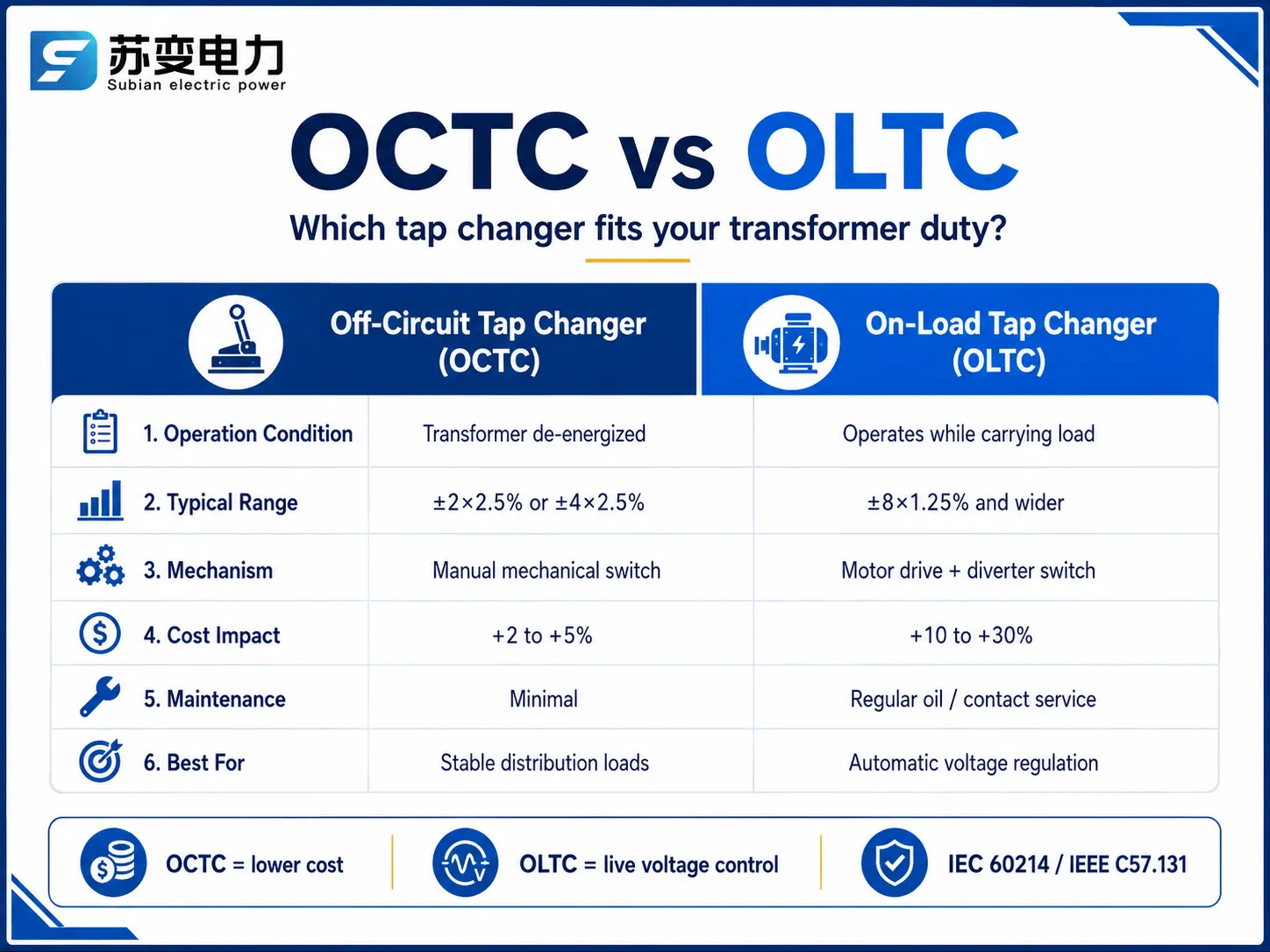
Off-Circuit vs. On-Load Abgriffwechselgeräte
| Charakteristik | Off-Circuit Abgriffwechselgerät (OCTC) | On-Load Abgriffwechselgerät (OLTC) |
|---|---|---|
| Betriebszustand | Transformator spannungsfrei | Transformator unter Last |
| Typischer Bereich | ±2×2.5% (5 Positionen), ±4×2.5% (9) | ±8×1.25% (17 Positionen) und breiter |
| Mechanismus | Manuell, einfacher mechanischer Schalter | Motorantrieb, federbelasteter Umleiter, Vakuum- oder Widerstandsübergang |
| Kostenimpact auf den Transformator | +2 bis +5% | +10 bis +30% |
| Wartung | Minimal | Regelmäßig; Ölfiltration und Kontaktinspektion |
| Am besten für | Verteilung, stabile Last, saisonale Anpassung | Leistungstransformatoren, schwankende Last, automatische Spannungsregelung |
Die Wahl zwischen den beiden Optionen basiert auf einem entscheidenden Aspekt: Muss die Spannung, die der Transformator erzeugt, während des Betriebs angepasst werden? Verteilungstransformatoren, die stabile Lasten bedienen, können saisonal mit einem OCTC angepasst werden und verursachen daher nahezu keine Kosten. Leistungstransformatoren, die schwankende Lasten versorgen, müssen jedoch mit einem OLTC ausgestattet sein, um die Qualität der gelieferten Spannung sicherzustellen, und müssen daher zusätzliche Kosten von 10-30% für die Einhaltung der Anforderungen an die Spannungsqualität tragen.
Wie ein On-Load Abgriffwechselgerät funktioniert
Es ist nicht einfach, unter Last zwischen den Abgriffen zu wechseln. Man kann den Stromkreis am Abgriffspunkt nicht einfach öffnen, da dies den Laststrom unterbrechen und einen Lichtbogen erzeugen würde, der die Kontakte beschädigt. Der OLTC bietet eine zweistufige Lösung, die einen Selektor umfasst, mit dem die neue Abgriffposition gewählt werden kann, ohne dass der Strom eingeschaltet wird, und einen Umgehungsschalter, der die aktuelle Last am aktuellen Abgriff zur neuen Position verschiebt. Der Übergang wird durch die Übergangsimpedanz bereitgestellt. Dies kann ein resistives Element oder ein Vakuumunterbrecher sein. So fließt der Strom kontinuierlich und wird sofort gelöscht.
Im Widerstands-OLTC lässt der Umgehungsschalter
die aktuelle Last durch ein oder zwei resistive Elemente fließen, wenn zwischen den Abgriffen gewechselt wird. Im Falle eines Vakuumtyps ist es der Vakuumunterbrecher, der für die Lichtbogenlöschung sorgt und somit das Öl sauberer hält und die Zeit zwischen den Wartungen verlängert. Beide Typen basieren auf den Leistungsanforderungen der IEC 60214-1 und den Anwendungsspezifikationen der IEC 60214-2, und die Wahl zwischen ihnen wird hauptsächlich durch die Lebenszykluskostenberechnungen bestimmt, da Vakuum-OLTCs teurer in der Installation sind, aber weniger Wartung erfordern.
Typen von Abgriffwechseln
| Typ | Betriebsprinzip | Typischer Nennbereich | Preisspanne |
|---|---|---|---|
| Abgriffwechsel unter Spannung (manuell) | Mechanischer Schalter, keine Last | Bis zu 10 MVA typisch | $200-$1,500 |
| Widerstands-OLTC (Tank- oder Kopftyp) | Umgehungsschalter mit Übergangswiderständen | Bis zu ~60 MVA | $3,000-$18,000 |
| Vakuum-OLTC | Vakuumunterbrecher im Umgehungsschalter | Bis zu 200+ MVA | $5,000-$30,000 |
| Reaktor-OLTC | Reaktorübergang, ältere Designs | Große Leistungstransformatoren | Selten; ersetzt durch Widerstands/Vakuum |
| Motorantriebseinheit (Zubehör) | Fern-/Automatikbetrieb eines beliebigen OLTC | — | $2,000-$10,000 |
Für die meisten Anwendungen, mit denen wir heute zu tun haben, reduziert sich die Frage darauf, ob man einen Widerstands- oder einen Vakuum-OLTC wählt, obwohl letzterer in letzter Zeit beliebter geworden ist und normalerweise in neuen Leistungstransformatoren eingesetzt wird, aufgrund der längeren Wartungsintervalle. Abgriffwechsel unter Spannung hingegen sind eine völlig andere Produktart, einfacher und recht kostengünstig ($200-$1500), die sich innerhalb von Verteilungstanks befinden und ein paar Mal im Jahr geregelt werden, wenn ein Transformator abgeschaltet wird.
Wichtige Nennwerte und Spezifikationen
| Parameter | Bedeutung | Typische Werte |
|---|---|---|
| Nenn-Durchgangsstrom | Maximale kontinuierliche Laststromstärke, die der OLTC tragen kann | 250-1.250 A |
| Nennstufenspannung | Spannung über den Abgriffbereich | Bis zu 3.300 V pro Schritt in großen Einheiten |
| Nennfrequenz | Muss mit dem System übereinstimmen (50 oder 60 Hz) | 50 Hz / 60 Hz |
| Anzahl der Positionen | Insgesamt wählbare Abgriffe | 5, 9, 17, 33 |
| Schrittspannung (%) | Spannungsänderung pro Schritt als % des Nennwerts | 1.25%, 2.5%, 5% |
| Norm | Entwurfs- und Testbasis | IEC 60214-1/-2, IEEE C57.131 |
Es gibt zwei Zahlen, die typischerweise in Bestellungen durcheinander geraten. Dies sind der Nenn-Durchlassstrom, der größer sein muss als die maximale kontinuierliche Strombewertung des Transformators (einschließlich Überlastbewertungen), und die Schrittspannung — die hohe Schrittspannung für einen bestimmten Strom stellt ganz andere Anforderungen an den Abzweiger als das Tragen desselben Stroms bei niedriger Schrittspannung, und daher kombiniert die OLTC-Bewertung diese beiden Zahlen.
Um das Thema zu veranschaulichen, bringen wir einige Richtlinien zu den Abgriffwechselparametern für die traditionellen Transformatorarten — die Zahlen, die Sie in Ihrem RFQ erwähnen sollten:
| Transformator-Klasse | Abgriffwechseltyp | Typischer Bereich | Durchlassstrom | Ungefährer Preis-Einfluss auf den Transformator |
|---|---|---|---|---|
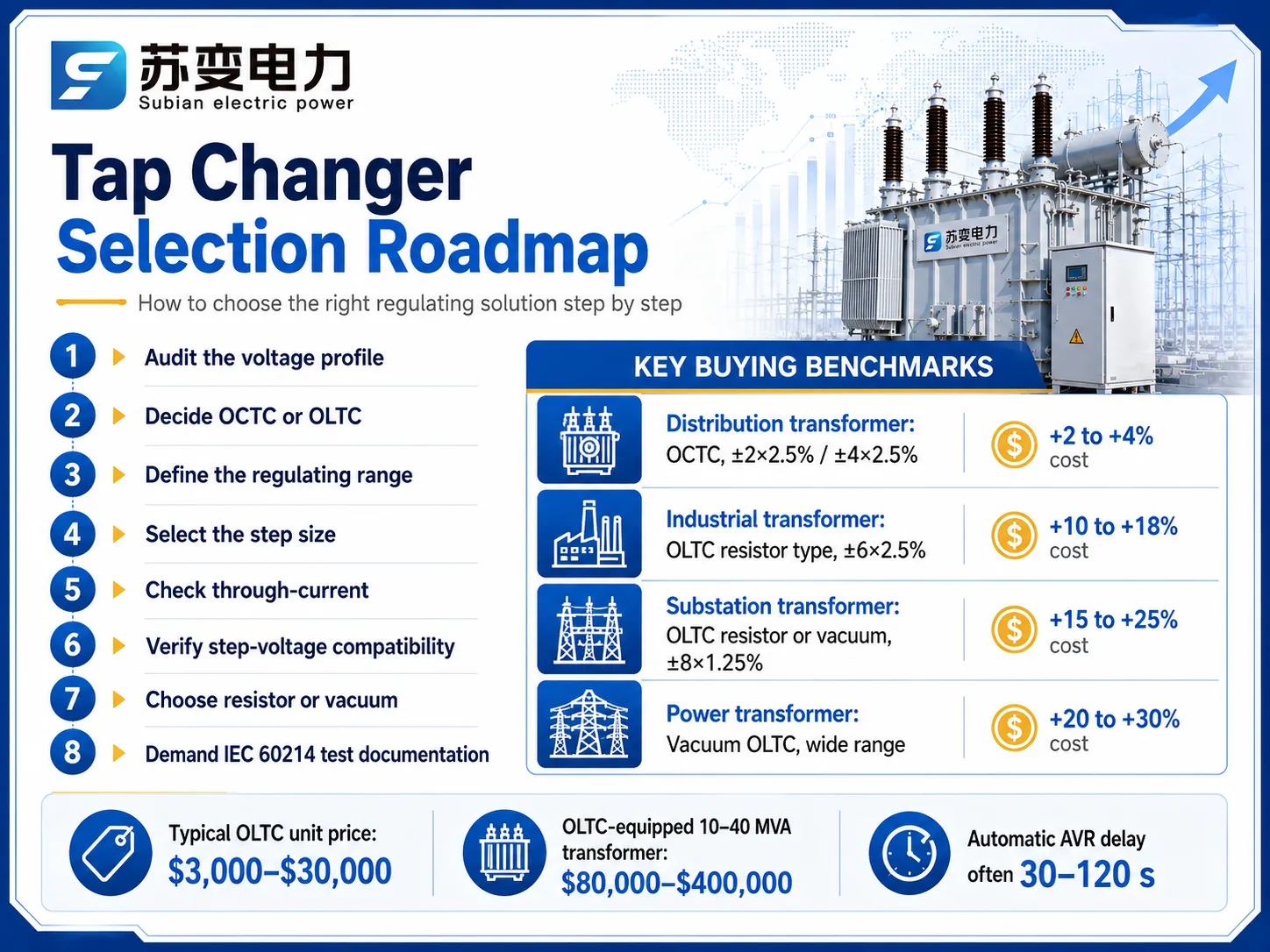
| 100-1.000 kVA Verteilung | Abgeschaltet (OCTC) | ±2×2.5% / ±4×2.5% | Bis zu 1.500 A | +2 bis +4% |
| 1-10 MVA Industrie | OLTC, Widerstandstyp | ±6×2.5% | 300-700 A | +10 bis +18% |
| 10-60 MVA Umspannwerk | OLTC, Widerstands- oder Vakuumtyp | ±8×1.25% | 400-1.250 A | +12 bis +25% |
| Über 60 MVA Leistung | OLTC, Vakuumtyp | ±8×1.25% oder breiter | 250-2.500 A | +15 bis +30% |
Abgriffbereich, Schritte und Positionsauswahl
Die Auswahl des Abgriffbereichs ist eine Bestimmung der Spannungsregelung, im Gegensatz zu einer fundierten Schätzung. Der Prozess verläuft im Allgemeinen wie folgt:
Der erste Schritt besteht darin, die Spannungsvariation zu messen, indem die Primärseitenspannung während eines vollständigen Lastzyklus aufgezeichnet wird. Die Primärspannung ändert sich um ±5-10% von leichten Lasten zu schweren Lasten.
Der zweite Schritt besteht darin, den erforderlichen Regelungsbereich zu berechnen. Es ist wichtig, den Impedanzabfall im Transformator zusammenzuzählen, der typischerweise 4-8% bei voller Last beträgt, und die Spannungsvariation auf der Primärseite, um den Regelungsbereich zu ermitteln.
Der nächste Schritt besteht darin, die verwendete Schrittgröße in den Einrichtungen herauszufinden. Die Standardverteilungsschrittgröße variiert je nach verwendetem Transformator, die von 2.5% bis 1.25% für Leistungstransformatoren reicht, die mehr Präzision benötigen.
Der vierte Schritt besteht darin, den Mittelpunkt des Bereichs auszuwählen, der um ein nominales Verhältnis von ±8×1.25% zentriert sein sollte, was einen Bereich der Spannungsregelung durch Abgriffe von 10% für 33/11kV-Anwendungen erzeugt.
Der letzte Schritt besteht darin, sich mit dem AVR zu synchronisieren. Im Automatikmodus verfolgt das Relais die Spannung auf der Sammelschiene und sendet das Kommando an den Motorantrieb, um jeden Schritt im Verzögerungsmodus zu ändern, was ungefähr 30-120 Sekunden dauert.
Wo jeder Typ gehört
- Verteilungstransformatoren (50-2.500 kVA): Abgeschaltete Abgriffwechsel, ±2×2.5% oder ±4×2.5%, bei der Inbetriebnahme und saisonal eingestellt;
Umspannungsleistungstransformatoren (5-60 MVA): Widerstandstyp OLTC mit ±8×1.25% oder ±6×2.5% Anpassungen mit der Möglichkeit, die Spannung automatisch zu regeln;
Große Leistungs- und Generatortransformatoren (>60 MVA): Vakuum-OLTC, der über weite Bereiche arbeitet, manchmal an sowohl HV- als auch LV-Wicklungen (zwei OLTCs);
Industrieofen- und Lichtbogenlasten: OLTCs, die für schnelle Operationen und hohe Schaltfrequenzen ausgelegt sind;
Transformatoren für erneuerbare Energieanschlüsse: OLTC zur Unterstützung variabler Erzeugung und zur Stabilisierung der Spannung im Netz.
Marken- und Preisvergleich
| Marke | Herkunft | Stärke | Ungefährer Preisbereich (OLTC, eigenständig) |
|---|---|---|---|
| MR (Reinhausen) | Deutschland | Der globale OLTC-Standard; Vakuum- und Widerstandstypen | $6,000-$35,000 |
| ABB | Schweiz/Schweden | Komplettpaket Transformator + OLTC | $5,000-$30,000 |
| Siemens | Deutschland | OLTC für große Leistungstransformatoren | $6,000-$32,000 |
| Hitachi Energie | Schweiz | Lastabgriffänderung bei Leistungstransformatoren | $7,000-$35,000 |
| Schneider Electric | Optimierungsmaßnahmen in der Praxis | Verteilungs-Klasse Lastabgreifer | $3,000-$15,000 |
| Jiangsu Subian Electric Power | China | OCTC- und OLTC-ausgestattete Transformatoren, IEC 60214-Koordination | $2,000-$12,000 |
Im Bereich der Lastwechsel-Schalter gilt MR Reinhausen als der Maßstab, da die Mehrheit der großen Transformatoren weltweit von MR oder seiner lizenzierten Version hergestellt wird; ABB, Siemens und Hitachi Energy bieten umfassende Lösungen rund um diese Maschinen oder die OLTC-Technologie ihrer Partner an. Die Geräte bestehen alle notwendigen Tests gemäß IEC 60214 und IEEE C57.131 und verfügen über alle erforderlichen Aufzeichnungen über ihre Lebensdauer und Wartung. Für diejenigen, die dasselbe Ergebnis, jedoch zu einem attraktiveren Preis wünschen, Subian Elektrizitätswerk stellt Jiangsu Geräte mit demselben OLTC her, die als Einheit fungieren können. Jiangsu Subian Electric Power liefert Geräte, die erfolgreich für IEC 60214 betrieben werden und weltweit mit allen gängigen Testaufzeichnungen versendet werden, zu einem Preis, der 40-60% unter den Kosten europäischer Transformatoren liegt. Wenn Sie sich für MR-Geräte entscheiden oder ein kosteneffizientes Pendant finden, stellen Sie sicher, dass Sie den Namen des OLTC in Ihrem Kauf erwähnen und sich verpflichten, die genaue Einheit zu erwerben, anstatt nur allgemein darauf zu verweisen.
Schritt-für-Schritt-Auswahlhilfe
Wählen Sie zunächst zwischen einem OCTC oder einem OLTC. Wenn Sie den Transformator außer Betrieb nehmen können, während Sie die Abgriffe wechseln, und wenn die Last allmählich wechselt, dann ist ein OCTC der richtige Weg. Wenn Sie jedoch die Spannung konstant halten möchten, während die Last sich ständig ändert, sollten Sie sich für einen OLTC entscheiden.
Definieren Sie als Nächstes den Regelbereich. Notieren Sie die tatsächliche Spannungsvariation und finden Sie den erforderlichen Bereich, wobei Sie beachten sollten, dass +8×1.25% ausreicht, um die meisten Situationen beim Einsatz von Elektrizität abzudecken.
Wählen Sie als Nächstes die Schrittgröße; verwenden Sie 2.5% aus wirtschaftlichen Gründen und 1.25% für eine genauere Regelung.
Überprüfen Sie dann den Durchgangsstrom. Der OLTC muss eine Kapazität haben, die größer ist als der maximale Dauerstrom des Transformators, einschließlich aller Überlastverpflichtungen.
Stellen Sie außerdem sicher, dass die Spannungen kompatibel sind. Bestätigen Sie, dass der OLTC die Schrittspannung Ihres Transformators verarbeitet, da das Produkt aus dem Abgriffstrom und der Schrittspannung Stress auf den Umleiter verursacht.
Entscheiden Sie, ob Sie einen Widerstand oder ein Vakuum verwenden möchten. Ein Widerstand wäre die bessere Option, da er günstiger ist und schon lange verwendet wird, während ein Vakuum niedrigere Wartungskosten hätte.
Vergessen Sie schließlich nicht, automatische Steuerungen einzubeziehen. Ein Motorantrieb, AVR-Relais und Positionsanzeiger sind nicht nur notwendig für Ihren OLTC, sondern Sie sollten auch die benötigte Steuerungsspannung angeben, damit er funktioniert.
Installation und Wartung
Der wartungsintensivste Aspekt eines modernen Transformators ist die Verwendung von Lastschaltern, da sie die einzigen Transformatorbauteile sind, die mechanische Arbeit unter Lastbedingungen verrichten. Das Schaltöl, das in typischen Widerstands-OLTC-Geräten verwendet wird, muss gemäß dem Zeitplan des Herstellers gefiltert oder ersetzt werden, normalerweise nach einer Periode von 100.000 Schaltungen oder 5-7 Jahren, je nachdem, was zuerst eintritt, während vakuumbetriebene OLTCs die Betriebszeit erheblich verlängern.
Wartungsverfahren
Messen und erstellen Sie ein monatliches Diagramm der Betriebszählerstände.
Nehmen Sie OLTC-Ölproben separat vom Haupttanköl. Das Öl des Abzweigers karbonisiert beim Schalten und verschlechtert sich viel schneller.
Überprüfen Sie die Kontakte auf Erosion während der allgemeinen Überholungen und nehmen Sie Übergangswiderstandsmessungen gemäß den Anforderungen des Handbuchs vor.
Testen Sie die Drehmomentmerkmale des Motorantriebs und der AVR-Relais-Einstellungen einmal im Jahr.
Stellen Sie sicher, dass der Abgriffpositionsanzeiger mit der aktuellen Wicklungsposition übereinstimmt, bevor Sie manuelle Operationen durchführen.
Häufig gestellte Fragen
Wie viel kostet ein Abgriffschalter zusätzlich zum Transformator?
Ein Abgriffschalter im Freischaltbetrieb erhöht den Preis des Transformators um etwa 2-5%. Ein Lastabgriffschalter erhöht ihn um 10-30%, da der OLTC selbst $3.000-$30.000 (nach Nennleistung) kostet, zuzüglich des Motorantriebs und des Steuerungssystems. Für einen 10 MVA Transformator sollten Sie $10.000-$25.000 für die OLTC-Erhöhung einplanen.
Was ist der Unterschied zwischen einem Abgriffschalter im Freischaltbetrieb und einem Lastabgriffschalter?
Ein Abgriffschalter im Freischaltbetrieb (OCTC) kann nur betrieben werden, wenn der Transformator spannungslos ist; es handelt sich um einen einfachen, kostengünstigen Schalter, der verwendet wird, um den Transformator an das durchschnittliche Spannungsprofil seines Zuleitungsnetzes anzupassen. Ein Lastabgriffschalter (OLTC) schaltet Abgriffe, während der Transformator Last trägt, und verwendet einen Abzweiger und Übergangsimpedanz, um einen Stromunterbruch zu vermeiden, was ihn für die automatische Spannungsregelung unter variierender Last geeignet macht.
Welchen Abgriffbereich benötige ich für meinen Transformator?
Für Verteilungstransformatoren decken ±2×2.5% (5 Positionen) oder ±4×2.5% (9 Positionen) die meisten Fälle ab. Für Leistungstransformatoren, die schwankende Lasten speisen, ist ±8×1.25% (17 Positionen) die gängige Wahl, was einen Gesamtbereich von ±10% ergibt. Der richtige Wert ergibt sich aus der Messung Ihrer Spannungsvariation und des Impedanzabfalls des Transformators — wählen Sie keinen Bereich aus einem Katalog.
Wie oft sollte ein Lastabgriffschalter gewartet werden?
Widerstands-OLTCs müssen typischerweise alle 100.000 Schaltungen oder 5-7 Jahre, je nachdem, was zuerst eintritt, einer Ölfiltration oder einem Austausch unterzogen werden. Vakuumtypische Konstruktionen verlängern dies auf etwa 300.000 Schaltungen. Überwachen Sie den Betriebszähler, entnehmen Sie die OLTC-Ölproben separat vom Hauptöl und überprüfen Sie die Kontakte bei jeder größeren Überholung.
Kann ich einen OLTC an einen für den Freischaltbetrieb ausgelegten Transformator nachrüsten?
Selten und typischerweise nicht günstig. Die Wicklung sollte die richtige Abgriffkonfiguration haben, der Tank sollte eine Montageturm haben, und die Kühlung sowie die Abstände müssen für den Umleiter funktionieren. Es ist fast immer günstiger, den OLTC in der Entwurfsphase zu spezifizieren oder einen neuen Transformator zu kaufen. Wenn der Bedarf an Spannungsregelung für eine bereits installierte Festabgriff-Einheit besteht, sollte man stattdessen über einen separaten spannungsregelnden Transformator nachdenken.
Referenzen
- IEC 60214-1 — Lastwechselrichter, Leistungsanforderungen und Prüfmethoden — Der Kernstandard für das Design und die Prüfung von Abgriffwechseln.
- IEC 60214-2 — Abgriffwechsel, Anwendungsleitfaden — Leitfaden zur Auswahl von Bereichen, Stufen und Nennwerten.
- IEEE C57.131 — Anforderungen an Lastabgriffwechsel — Nordamerikanischer OLTC-Standard.
- MR Reinhausen — Abgriffwechsel-Portal — Die Produkt- und Anwendungsdokumentation des führenden OLTC-Herstellers.
- IEC 60076-1 — Leistungstransformatoren, Allgemeine Anforderungen — Transformator-spezifische Standards, die der Abgriffwechsel als Teil der Einheit erfüllen muss.
- ABB Transformatoren — Referenz für die Integration von Transformator und Abgriffwechsel.
Fazit
Die Abgriffwechselgerät Die Auswahl kann als Lösung zur Spannungsregelung betrachtet werden, die sich als Auswahl von Komponenten tarnt. Es ist notwendig, die Testergebnisse in Bezug auf Spannungsvariation und Abnahme der Transformatorimpedanz im Voraus zu bewerten. Der nächste Schritt besteht darin, den Abgriffwechsel gemäß dem richtigen Spannungsbereich und der Abgriffgröße auszuwählen und dann ein entsprechendes Modell auszuwählen, um die Anforderungen und Spezifikationen zu erfüllen, einschließlich der Auswahl eines Lastabgriffwechsels, falls zutreffend.
Ein OCTC erhöht die Kosten des Transformators nur um etwa 2% bis 5%, während ein OLTC die Kosten um etwa 10% bis 30% erhöht. Der Strom und die Spannung sollten entsprechend den Betriebsbedingungen abgestimmt werden, anstatt die Marke der Ausrüstung zu benennen.
Für Transformatoren mit Abgriffwechseln, die nach IEC 60214 und IEC 60076 gebaut sind, kontaktieren Sie Jiangsu Subian Electric Power entscheiden www.subian-electric.com uns mit Ihrem Spannungsprofil und Ihren Lastdaten für eine Spezifikation und ein Angebot.