


A criação de uma nova era na tecnologia de transformadores corresponde à criação de uma plataforma de três camadas para a modernização tecnológica da produção. Primeiramente, a inovação de componentes, como o desenvolvimento de núcleos amorfos, óleos ester e materiais de enrolamento de alta pureza, permite a redução de perdas e amplia as opções de instalação. Em segundo lugar, a inovação de sistemas, ou seja, monitoramento, gêmeos digitais e análises preditivas, transforma ativos em fontes de dados e diminui as interrupções forçadas em 30 a 50 %. Por último, a inovação de modelos de negócios, como aquisição de desempenho e transformador como serviço, permite a mudança da propriedade de risco e capital. A contínua revolução tripla transforma a aquisição de transformadores de uma simples compra em um processo de tomada de decisão estratégica orientado por dados.
A atualização da eficiência para a classe 1 da IEC 60076-20 permite a redução de perdas de 30 a 50%, resultando em retorno sobre o investimento em 4 a 9 anos.
O investimento em monitoramento garante o retorno mais rápido sobre o investimento para ativos críticos, muitas vezes proporcionando um retorno já após o primeiro incidente evitado.
Modelos de serviço permitem a liberação de capital e a transferência de risco, o que é especialmente importante para fins de fluxo de caixa.
Você deve adquirir transformadores com garantias de confiabilidade, documentação digital e testes sob supervisão.
Jiangsu Subian Electric Power é o produtor de transformadores modernos e transformadores prontos para soluções de monitoramento de atualização a preços acessíveis.
O que é um Mudador de Tap do Transformador?
A mudador de tap é um dispositivo de comutação anexado a um enrolamento de transformador em vários pontos de derivação. Com a ajuda do dispositivo, é possível alternar a conexão entre diferentes taps que resultam em mudanças na quantidade de voltas do enrolamento e, assim, variações na tensão do lado secundário. Assim, o mudador de tap é, de fato, o mecanismo de ajuste de tensão incorporado dentro do tanque do transformador ou montado sobre o enrolamento.
A tensão experimentada por várias redes sofre constantes reduções e aumentos devido a cargas que variam durante o dia, queda da linha de energia, mudanças na tensão fornecida pela rede. A saída de tensão fixa de um transformador em uma razão obtida durante a produção pode levar a problemas com o fornecimento de tensão e o mudador de tap fornece os meios confiáveis de correção.
Existem três aspectos críticos usados para caracterizar qualquer tipo de mudadores de tap: seu passo de tensão (expresso como porcentagem da tensão nominal), seu número de posições e a faixa da tensão regulada. Por exemplo, pode haver um transformador de distribuição que tem a capacidade de funcionar em uma faixa de ±2×2.5%, pois possui 4 posições de tap, enquanto transformadores maiores são fornecidos com mudadores de tap mais avançados.
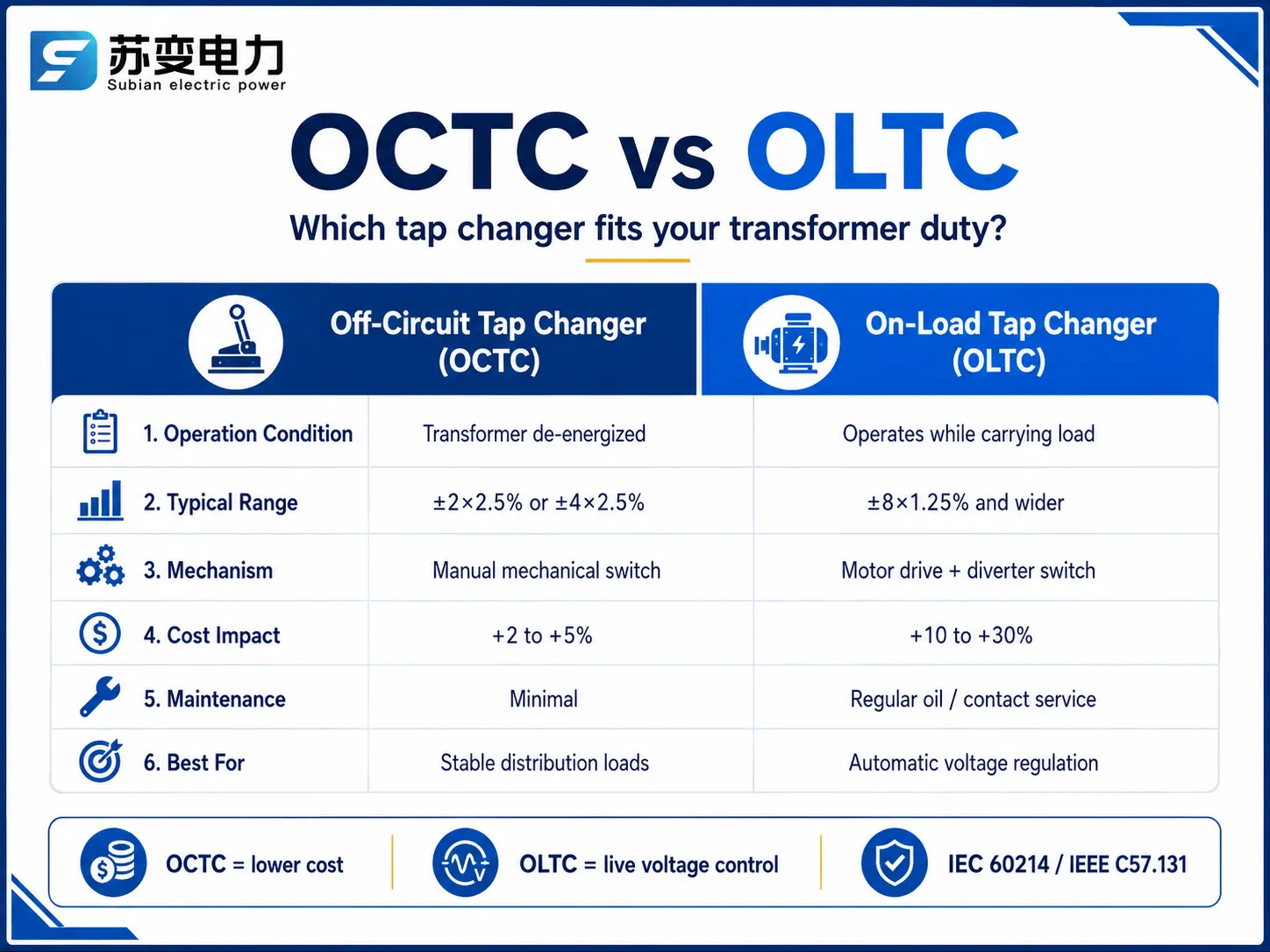
Mudadores de Tap Off-Circuito vs. On-Load
| Característica | Mudador de Tap Off-Circuito (OCTC) | Mudador de Tap On-Load (OLTC) |
|---|---|---|
| Condição de operação | Transformador desenergizado | Transformador carregando carga |
| Faixa típica | ±2×2.5% (5 posições), ±4×2.5% (9) | ±8×1.25% (17 posições) e mais amplo |
| Mecanismo | Manual, interruptor mecânico simples | Acionamento por motor, desvio com mola, transição a vácuo ou resistor |
| Impacto de custo no transformador | +2 a +5% | +10 a +30% |
| Manutenção | Mínima | Regular; filtração de óleo e inspeção de contatos |
| Melhor para | Distribuição, carga estável, ajuste sazonal | Transformadores de potência, carga flutuante, controle automático de tensão |
A escolha entre as duas opções é baseada em um aspecto chave: é necessário fazer algum ajuste na tensão produzida pelo transformador quando está em operação? Transformadores de distribuição que atendem cargas estáveis podem ser ajustados sazonalmente usando um OCTC e, portanto, não incorrer em quase nenhum custo. No entanto, transformadores de potência que fornecem cargas flutuantes devem ser equipados com um OLTC para garantir a qualidade da tensão fornecida e, portanto, suportar um custo adicional de 10-30% para conformidade com os requisitos relativos à qualidade da tensão.
Como funciona um Mudador de Tap sob Carga
Não é fácil mudar taps sob carga. Você não pode simplesmente abrir o circuito no ponto de tap porque isso interromperia a corrente de carga e resultaria em um arco que danificaria os contatos. O OLTC oferece uma solução em duas etapas envolvendo um seletor que permite escolher a nova posição do tap sem que a corrente seja ligada e um interruptor de desvio que move a carga de corrente no tap atual para a nova posição. A transição é fornecida pela impedância de transição. Isso pode ser um elemento resistivo ou um interruptor a vácuo. Assim, a corrente flui continuamente e é extinta imediatamente.
No OLTC do tipo resistor, o desvio faz
a carga de corrente passar por um elemento resistivo ou dois ao mudar os taps. No caso de um design do tipo vácuo, é o interruptor a vácuo que cuida da extinção do arco, mantendo assim o óleo mais limpo e estendendo o tempo entre manutenções. Ambos os tipos são baseados nos requisitos de desempenho da IEC 60214-1 e nas especificações de aplicação da IEC 60214-2, e a escolha entre eles é determinada principalmente pelos cálculos de custo do ciclo de vida, uma vez que os OLTCs a vácuo são mais caros para instalar, mas requerem menos manutenção.
Tipos de Mudadores de Tap
| Tipo | Princípio de Operação | Faixa Típica de Classificação | Faixa de Preço |
|---|---|---|---|
| Mudador de tap fora de circuito (manual) | Interruptor mecânico, sem carga | Até 10 MVA típico | $200-$1,500 |
| OLTC do tipo resistor (tipo tanque ou cabeça) | Desvio com resistores de transição | Até ~60 MVA | $3,000-$18,000 |
| OLTC do tipo vácuo | Interruptor a vácuo no desvio | Até 200+ MVA | $5,000-$30,000 |
| OLTC do tipo reator | Transição de reator, designs mais antigos | Transformadores de potência grandes | Raro; substituído por resistor/vácuo |
| Unidade de acionamento de motor (acessório) | Operação remota/automática de qualquer OLTC | — | $2,000-$10,000 |
Para a maioria das aplicações com as quais lidamos hoje, a questão se resume a escolher um resistor ou um OLTC a vácuo, embora recentemente, este último tenha se tornado mais popular e seja geralmente empregado em novos transformadores de potência devido aos períodos mais longos de manutenção. Mudadores fora de circuito, por outro lado, são um tipo de produto completamente diferente, mais simples e bastante barato ($200-$1500), localizados dentro de tanques de distribuição e regulados poucas vezes por ano quando um transformador é desligado.
Classificações e Especificações Principais
| Parâmetro | Significado | Valores Típicos |
|---|---|---|
| Corrente nominal | Corrente de carga contínua máxima que o OLTC pode suportar | 250-1.250 A |
| Tensão de passo nominal | Tensão na faixa de derivação | Até 3.300 V por passo em grandes unidades |
| Frequência nominal | Deve corresponder ao sistema (50 ou 60 Hz) | 50 Hz / 60 Hz |
| Número de posições | Total de derivação selecionável | 5, 9, 17, 33 |
| Tensão do passo (%) | Variação de tensão por passo como % do nominal | 1.25%, 2.5%, 5% |
| Padrão | Base de projeto e teste | IEC 60214-1/-2, IEEE C57.131 |
Existem dois números que geralmente estão fora de ordem em pedidos de compra. Estes são a corrente nominal de passagem, que deve ser maior do que a classificação máxima de corrente contínua do transformador (incluindo classificações de sobrecarga), e a tensão do passo — a alta tensão do passo para uma corrente dada impõe demandas bastante diferentes ao desviador do que carregar a mesma corrente em uma baixa tensão do passo e, portanto, a classificação do OLTC combina esses dois números.
Para ilustrar o assunto, vamos trazer algumas diretrizes sobre os parâmetros do mudador de derivação para os tipos tradicionais de transformadores — os números que você deve mencionar em seu RFQ:
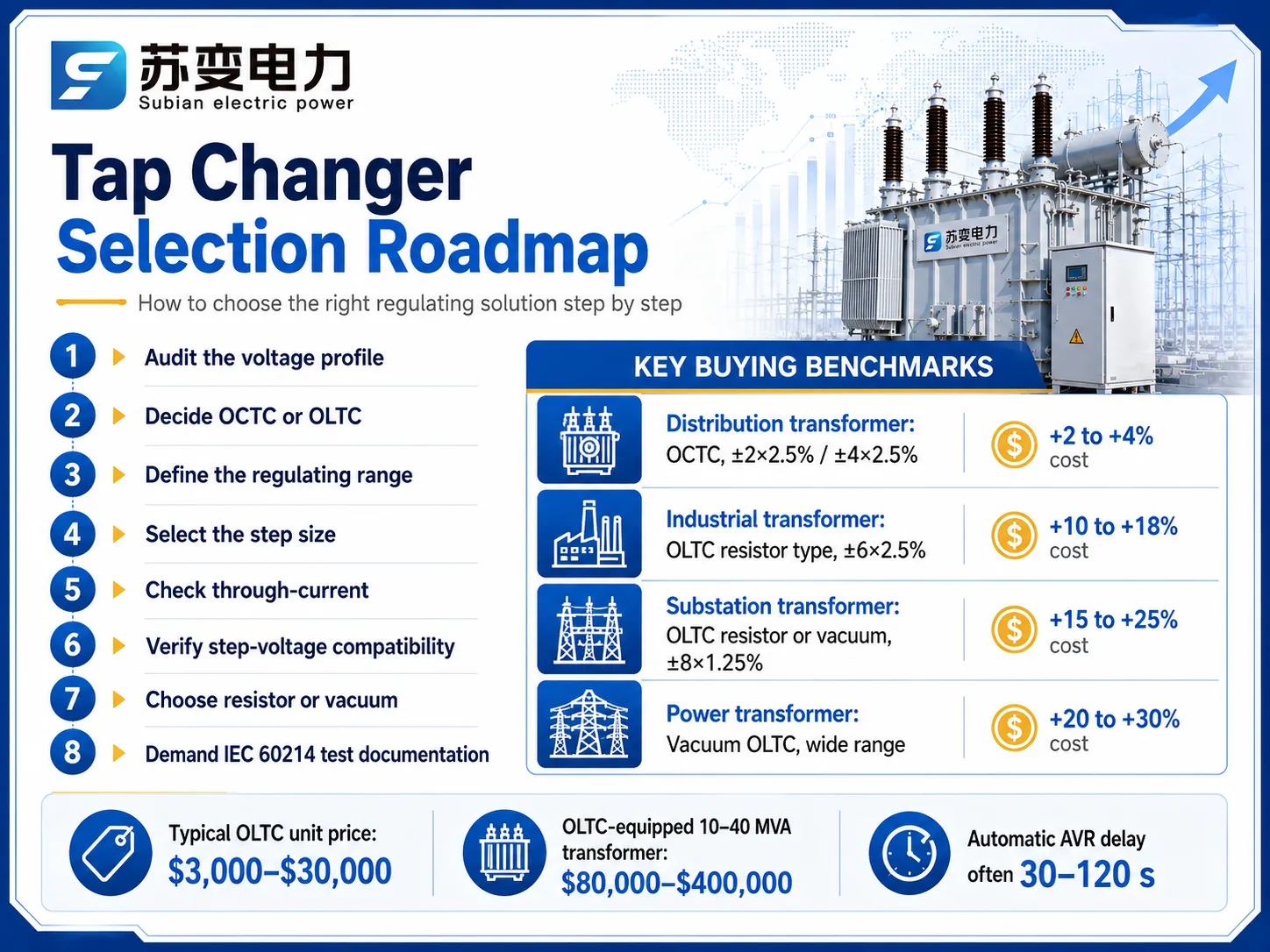
| Classe de Transformador | Tipo de Mudador de Derivação | Faixa Típica | Corrente de Passagem | Aproximadamente Impacto no Preço do Transformador |
|---|---|---|---|---|
| Distribuição de 100-1.000 kVA | Fora de circuito (OCTC) | ±2×2.5% / ±4×2.5% | Até 1.500 A | +2 a +4% |
| Industrial de 1-10 MVA | OLTC, tipo resistor | ±6×2.5% | 300-700 A | +10 a +18% |
| Subestação de 10-60 MVA | OLTC, resistor ou vácuo | ±8×1.25% | 400-1.250 A | +12 a +25% |
| Acima de 60 MVA de potência | OLTC, tipo vácuo | ±8×1.25% ou mais amplo | 250-2.500 A | +15 a +30% |
Faixa de Derivação, Passos e Seleção de Posição
Selecionar a faixa de derivação é uma determinação de regulação de tensão, ao invés de ser um palpite educado. O processo geralmente ocorre da seguinte forma:
O primeiro passo é medir a variação de tensão, registrando a tensão do lado primário durante um ciclo de carga total. A tensão primária varia de ±5-10% de cargas leves a cargas pesadas.
O segundo passo é calcular a faixa de regulação necessária. É essencial somar a queda de impedância no transformador, que é tipicamente de 4-8% quando em carga total, e a variação de tensão no lado primário para conhecer a faixa de regulação.
O próximo passo é descobrir o tamanho do passo utilizado nas instalações. O tamanho do passo de distribuição padrão varia de acordo com cada transformador utilizado, que varia de 2.5% a 1.25% para transformadores de potência que necessitam de mais precisão.
O quarto passo é escolher o ponto médio da faixa, que deve estar centrado em uma razão nominal de ±8×1.25%, produzindo uma faixa de regulação de tensão com um toque de 10% para aplicações de 33/11kV.
O passo final é sincronizar com o AVR. Ao trabalhar no modo automático, o relé monitora a tensão no barramento e envia o comando para o acionamento do motor para mudar cada passo em modo de atraso, que é aproximadamente 30-120 segundos.
Onde Cada Tipo Pertence
- Transformadores de distribuição (50-2.500 kVA): Chaves de derivação fora de circuito, ±2×2.5% ou ±4×2.5%, ajustadas na comissionamento e sazonalmente;
Transformadores de potência de subestação (5-60 MVA): OLTC do tipo resistor com ajustes de ±8×1.25% ou ±6×2.5% com a possibilidade de regular automaticamente a tensão;
Transformadores de grande potência e geradores (>60 MVA): OLTC do tipo vácuo operando em amplas faixas, às vezes em ambos os enrolamentos HV e LV (dois OLTCs);
Cargas de forno industrial e arco: OLTCs feitos para operações rápidas e altas taxas de comutação;
Transformadores de ligação de energia renovável: OLTC para ajudar com geração variável e manter a tensão na rede.
Comparação de Marcas e Preços
| Marca | Origem | Força | Faixa de Preço Aproximada (OLTC, autônomo) |
|---|---|---|---|
| MR (Reinhausen) | Alemanha | O padrão global de OLTC; tipos de vácuo e resistor | $6,000-$35,000 |
| ABB | Suíça/Suécia | Pacotes completos de transformadores + OLTC | $5,000-$30,000 |
| Siemens | Alemanha | OLTC para grandes transformadores de potência | $6,000-$32,000 |
| Hitachi Energy | Suíça | Mudança de tap do transformador de potência | $7,000-$35,000 |
| Schneider Electric | França | Mudadores de tap de classe de distribuição | $3,000-$15,000 |
| Jiangsu Subian Electric Power | China | Transformadores equipados com OCTC e OLTC, coordenação IEC 60214 | $2,000-$12,000 |
No campo de chaves de derivação sob carga, a MR Reinhausen é considerada o padrão, uma vez que a maioria dos grandes transformadores globalmente é fabricada pela MR ou sua versão licenciada; ABB, Siemens e Hitachi Energy fornecendo soluções completas em torno dessas máquinas ou da tecnologia OLTC de seus parceiros. O equipamento passa por todos os testes necessários de acordo com IEC 60214 e IEEE C57.131, possuindo todos os registros exigidos de sua vida útil e manutenção. Para aqueles que desejam o mesmo resultado, mas a um preço mais atraente, Jiangsu Subian Energia Elétrica cria equipamentos com o mesmo OLTC capaz de fazer dispositivos como um só. A Jiangsu Subian Electric Power fornece equipamentos que operam com sucesso para IEC 60214 e enviando mundialmente com todos os registros comuns de testes a um preço 40-60% menor do que o custo de transformadores europeus. Se você optar por equipamentos MR ou encontrar um análogo econômico, certifique-se de mencionar o nome do OLTC em sua compra, concordando em adquirir a unidade exata em vez de apenas se referir a ela de forma geral.
Guia de Seleção Passo a Passo
Primeiro, escolha entre um OCTC ou um OLTC. Se você puder retirar o transformador de serviço enquanto muda as derivação e se a carga mudar gradualmente, então um OCTC é o caminho a seguir. Se, no entanto, você quiser manter a tensão constante enquanto a carga está em um estado de mudança constante, então você deve escolher um OLTC.
Em seguida, defina a faixa de regulação. Anote a variação de tensão real e encontre a faixa necessária, lembrando que +8×1.25% é suficiente para cobrir a maioria das situações ao usar eletricidade.
Em seguida, escolha o tamanho do passo; use 2.5% para fins econômicos e 1.25% para uma regulação mais precisa.
Então, verifique a corrente de passagem. O OLTC deve ter uma capacidade maior do que a corrente contínua máxima do transformador, que também inclui quaisquer compromissos de sobrecarga.
Além disso, certifique-se de que as tensões são compatíveis. Confirme que o OLTC suporta a tensão de passo do seu transformador, pois o produto da corrente do tap pelo passo de tensão causará estresse no desviador.
Decida se deseja usar um resistor ou um vácuo. Um resistor seria uma opção melhor, pois é mais barato e tem sido usado há muito tempo, enquanto um vácuo teria custos de manutenção mais baixos.
Finalmente, não se esqueça de incluir controles automáticos. Um acionamento por motor, relé AVR e indicador de posição não são apenas necessários para o seu OLTC, mas você também deve especificar a tensão de controle necessária para seu funcionamento.
Instalação e Manutenção
O aspecto que mais exige manutenção em um transformador moderno é o uso de comutadores de tap sob carga, pois são os únicos componentes do transformador que realizam trabalho mecânico sob condições de carga. O óleo de comutação usado em dispositivos OLTC do tipo resistor típico precisa ser filtrado ou substituído conforme o cronograma do fabricante, geralmente após um período de 100.000 operações ou 5-7 anos, o que ocorrer primeiro, enquanto os OLTCs operados a vácuo prolongam consideravelmente o tempo de operação.
Procedimentos de manutenção
Meça e elabore um gráfico mensal das leituras do contador de operação.
Tire amostras do óleo do OLTC separadamente do óleo do tanque principal. O óleo do desviador carboniza durante a comutação e se deteriora muito mais rápido.
Inspecione os contatos quanto à erosão durante revisões gerais e faça leituras do resistor de transição conforme os requisitos do manual.
Teste as características de torque do acionamento por motor e as configurações do relé AVR uma vez por ano.
Certifique-se de que o indicador de posição do tap corresponde à posição atual do enrolamento antes de qualquer operação manual.
Perguntas Frequentes
Quanto um comutador de tap adiciona ao custo do transformador?
Um comutador de tap fora de circuito adiciona aproximadamente 2-5% ao preço do transformador. Um comutador de tap sob carga adiciona 10-30%, porque o próprio OLTC custa $3.000-$30.000 (por classificação) mais o acionamento por motor e o sistema de controle. Para um transformador de 10 MVA, orce $10.000-$25.000 para o incremento do OLTC.
Qual é a diferença entre um comutador de tap fora de circuito e um sob carga?
Um comutador de tap fora de circuito (OCTC) só pode ser operado quando o transformador está desenergizado; é um interruptor simples e barato usado para ajustar o transformador ao perfil médio de tensão do seu alimentador. Um comutador de tap sob carga (OLTC) comuta taps enquanto o transformador está carregado, usando um desviador e impedância de transição para evitar a interrupção da corrente, o que o torna adequado para regulação automática de tensão sob carga variável.
Qual faixa de tap eu preciso para meu transformador?
Para transformadores de distribuição, ±2×2.5% (5 posições) ou ±4×2.5% (9 posições) cobre a maioria dos casos. Para transformadores de potência alimentando cargas flutuantes, ±8×1.25% (17 posições) é a escolha comum, oferecendo ±10% de faixa total. O valor correto vem da medição da variação de tensão e da queda de impedância do transformador — não escolha uma faixa de um catálogo.
Com que frequência um cambiador de tomadas sob carga deve ser mantido?
Os OLTCs do tipo resistor geralmente precisam de filtração ou substituição de óleo a cada 100.000 operações ou 5-7 anos, o que ocorrer primeiro. Os designs do tipo vácuo estendem isso para cerca de 300.000 operações. Monitore o contador de operações, amostre o óleo do OLTC separadamente do óleo principal e inspecione os contatos em cada grande revisão.
Posso adaptar um OLTC em um transformador projetado para operação fora de circuito?
Raramente, e tipicamente não é barato. O enrolamento deve ter a configuração de tomadas adequada, o tanque deve ter uma torre de montagem, e o resfriamento e os espaços livres devem funcionar para o desviador. Quase sempre é mais barato especificar o OLTC na fase de projeto ou comprar um novo transformador. Se a necessidade de regulação de tensão existir para uma unidade de tomada fixa já instalada, deve-se considerar um transformador regulador de tensão separado.
Referências
- IEC 60214-1 — Cambiadores de Tomadas, Requisitos de Desempenho e Métodos de Teste — O padrão básico para o design e teste de cambiadores de tomadas.
- IEC 60214-2 — Cambiadores de Tomadas, Guia de Aplicação — Orientação sobre seleção de faixas, etapas e classificações.
- IEEE C57.131 — Requisitos para Cambiadores de Tomadas Sob Carga — Padrão OLTC da América do Norte.
- MR Reinhausen — Portal de Cambiadores de Tomadas — A documentação de produtos e aplicações do principal fabricante de OLTC.
- IEC 60076-1 — Transformadores de Potência, Requisitos Gerais — Padrões em nível de transformador que o cambiador de tomadas deve satisfazer como parte da unidade.
- Transformadores ABB — Referência para integração de transformador e trocador de tomadas.
Conclusão
enrolamento mudador de tap a seleção pode ser considerada uma solução de regulação de tensão disfarçada como uma seleção de componentes. É necessário avaliar os resultados dos testes em relação à variação de tensão e à diminuição da impedância do transformador previamente. O próximo passo é selecionar o trocador de tomadas de acordo com a faixa de tensão adequada e o tamanho da tomada, em seguida, selecionar um modelo correspondente para atender aos seus requisitos e especificações, incluindo a seleção de um trocador de tomadas fora de carga, se aplicável.
Um OCTC adiciona ao custo do transformador apenas aproximadamente 2% a 5%, enquanto um OLTC aumenta o custo em uma quantia de aproximadamente 10% a 30%. A corrente e a tensão devem ser ajustadas de acordo com as condições de operação, em vez de nomear a marca do equipamento.
Para transformadores equipados com trocadores de tomadas fora de circuito e sob carga construídos de acordo com a IEC 60214 e IEC 60076, entre em contato Jiangsu Subian Electric Power decidem www.subian-electric.com com seu perfil de tensão e dados de carga para uma especificação e orçamento.