


Un gerente de adquisiciones que trabajaba en una empresa embotelladora de bebidas en Kenia enfrentó el desafío de encontrar dos nuevos transformadores de 1,000 kVA para una línea de llenado en solo tres semanas. Mientras que la sede proporcionó un presupuesto estricto, la sucursal local no contaba con un ingeniero eléctrico en el lugar. Después de investigar, el gerente de adquisiciones encontró cotizaciones sorprendentemente bajas para unidades cercanas. Tras la llegada de las especificaciones, notó que un voltaje primario estaba establecido en 11 kV en el alimentador de 33 kV, un grupo vectorial en Yyn0 en lugar de Dyn11, y una clasificación IP de IP21 para la instalación de producción húmeda y polvorienta. Afortunadamente, el pedido se detuvo justo a tiempo. Lamentablemente, esto refleja las realidades de elegir transformadores en países en desarrollo: los requisitos no pueden limitarse solo al precio y la capacidad; podrían ser una combinación de aspectos eléctricos, mecánicos y comerciales, una parte desconsiderada de la cual podría poner en peligro todo el proyecto.
Esta guía profesional le proporcionará una serie de pasos que se pueden utilizar para seleccionar el transformador óptimo, desde la clarificación de la solicitud inicial hasta la creación de una especificación técnica y una lista de las unidades requeridas. La lista de verificación se puede utilizar para cualquier tipo de aplicación: utilidad, industria o aplicación comercial.
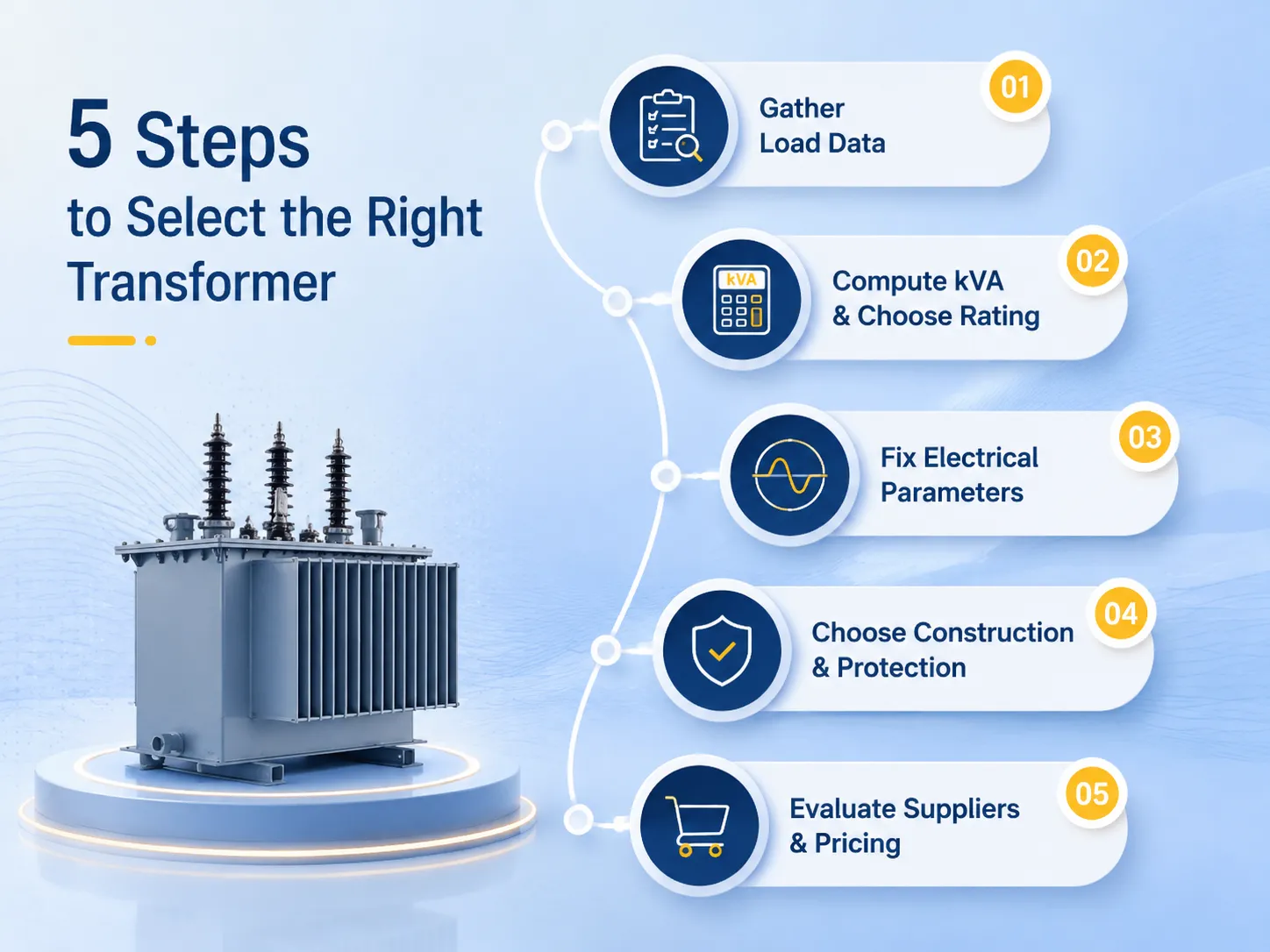
En resumen: El proceso de determinar el mejor transformador para sus propósitos consta de cinco pasos: (1) Se deben recopilar datos de carga, incluyendo kW, factor de potencia, corriente de arranque y contenido armónico; (2) Se debe realizar el cálculo de kVA con un factor de diversidad que varía de 0.7 a 0.85, sin mencionar el factor de crecimiento de 10% a 20%; (3) Todos los parámetros eléctricos deben establecerse, es decir, voltaje primario y secundario, grupo vectorial, impedancia y rango de tomas; (4) Se debe determinar el tipo de construcción. En este caso, es tipo sumergido en aceite o tipo seco, pero la clasificación IP debe coincidir con las condiciones; (5) Se deben comparar los proveedores principales según su historial de rendimiento, garantía y costos totales.
Traduciendo Requisitos en una Especificación
La distancia entre “necesitamos un transformador” y un pedido efectivo para él radica en una especificación técnica escrita (spec). Una buena especificación incluye posiblemente las siguientes secciones: información general (tipo, modelo, capacidad), datos eléctricos (voltaje, grupo vectorial, impedancia, pérdidas, nivel de aislamiento), parámetros mecánicos (peso, dimensiones, procesos) e información comercial (pruebas, documentación, garantía, entrega). Cada uno de sus requisitos debe corresponder a alguna restricción física; si no puede decir por qué necesita ese parámetro, es probable que lo haya copiado de algún proyecto anterior y probablemente sea incorrecto.
Algunos errores comunes en la traducción de los requisitos incluyen usar el voltaje nominal en lugar del voltaje de trabajo, ignorar el sistema de puesta a tierra neutra (TN, TT, IT), así como mencionar IP54, cuando en realidad se requiere IP23 y un dosel a prueba de intemperie. Redactar una especificación real mejora tu comprensión de lo que significan los requisitos antes de que se pague el dinero por el transformador.
Paso 1: Reúne Datos de Carga Precisos
Ninguna selección de transformador sobrevive al contacto con datos de carga deficientes. Recoge, para cada alimentador y máquina significativa:
- Potencia aparente en kVA o MVA (no solo kW — el factor de potencia importa).
- Voltaje requerido en los terminales de carga.
- Ciclo de trabajo — continuo, intermitente o cíclico, y horas esperadas por día.
- Corriente de arranque para motores y cualquier carga de inrush.
- Contenido armónico de VFDs, rectificadores y equipos de UPS.
- Adiciones futuras — el plan que el gerente de planta suele olvidar mencionar.
Si el sitio ya está en funcionamiento, utiliza un analizador de calidad de energía durante dos semanas para capturar la curva de demanda real, el factor de potencia y el espectro armónico. Una medición de dos semanas cuesta $300–$1,000 con un registrador alquilado — una fracción de los $8,000–$60,000 que estás a punto de gastar, y elimina la mayor fuente de error de selección: la demanda estimada.
Paso 2: Calcula kVA y Elige la Clasificación
Con los datos de carga en mano, calcula la clasificación del transformador:
- Suma los kVA de todas las cargas que pueden operar juntas de manera realista.
- Multiplica por el factor de diversidad para tu industria — 0.6–0.7 comercial, 0.7–0.85 industrial, 0.9–1.0 proceso continuo.
- Añade un margen de crecimiento de 10–20%.
- Redondea al siguiente valor estándar según IEC 60076-1: 25, 50, 100, 160, 250, 400, 500, 630, 800, 1000, 1250, 1600, 2000, 2500 kVA.
- Verifica la condición máxima: ¿puede la unidad soportar el máximo de corta duración (arranque del motor) sin disparar la protección o exceder los límites de caída de voltaje?
Para una carga trifásica, la demanda en kVA es kVA = (√3 × V × I) ÷ 1000. Una carga de proceso de 480 V, 300 A resulta en 1.732 × 480 × 300 ÷ 1000 = 249.4 kVA, por lo que una unidad de 250 kVA se encuentra en un 99.8% de carga — demasiado ajustada. Con una diversidad de 0.85 y un crecimiento de 15%, el objetivo de diseño es de aproximadamente 326 kVA, lo que se traduce en una unidad de 400 kVA. Esa es la diferencia entre un transformador que se enfría durante 25 años y uno que falla en cinco.
| Carga Conectada (kVA) | Factor de Diversidad | Margen de Crecimiento | kVA de Diseño | Clasificación Recomendada |
|---|---|---|---|---|
| 150 | 0.85 | 15% | 147 | 160 |
| 300 | 0.80 | 15% | 276 | 315 |
| 500 | 0.80 | 20% | 480 | 500 |
| 900 | 0.75 | 15% | 776 | 800 |
| 1,400 | 0.75 | 15% | 1,207 | 1,250 |
| 2,200 | 0.80 | 15% | 2,024 | 2,500 |
Paso 3: Fija los Parámetros Eléctricos
Ahora bloquea el esqueleto eléctrico de la especificación. El voltaje primario debe coincidir con el alimentador aguas arriba — verifica el voltaje real del sistema, no el de papel, porque muchas redes se desvían 5–8% de lo nominal. El voltaje secundario debe satisfacer las cargas más grandes con regulación aceptable. El rango de derivación (típicamente ±2×2.5% fuera de circuito, o en carga para redes volátiles) compensa la variación de la fuente.
La selección del grupo vectorial sigue el sistema de puesta a tierra y el requisito de neutro. Dyn11 es el caballo de batalla de la distribución de baja tensión (delta de HV, estrella aterrizada de LV con un desplazamiento de 0°–30°). Para aplicaciones de elevación, Yd11 o Yd1 es estándar. La impedancia (uk%) es un compromiso: 4% para unidades pequeñas proporciona una buena regulación de voltaje; 6–8% para unidades más grandes limita la corriente de falla. Si la unidad debe funcionar en paralelo con transformadores existentes, la impedancia debe coincidir dentro de aproximadamente 10% y el grupo vectorial y la relación deben ser idénticos.
| Parámetro | Valor Típico | Consideración de Diseño |
|---|---|---|
| Voltaje primario | 11 / 22 / 33 / 35 kV | Coincidir con el alimentador, incluir rango de toma |
| Voltaje secundario | 4 / 0.42 / 0.48 kV | Coincidir con el voltaje de utilización de carga |
| Grupo vectorial | Dyn11, Yyn0, Yd11 | Sistema de puesta a tierra, neutro, paralelo |
| Impedancia (uk%) | 4–8% | Nivel de falla vs. regulación de voltaje |
| Rango de toma | ±2×2.5% / OLTC | Volatilidad de voltaje de fuente |
| Nivel de aislamiento | LI 75/28 kV para clase de 33 kV | Sobretensiones por rayos y conmutación |
| Nivel de ruido | ≤ 55–65 dB(A) a 1 m | Sitios residenciales y hospitales |
Paso 4: Elegir Construcción y Protección
El tipo de construcción y la envoltura dependen del entorno físico. Las unidades sumergidas en aceite son el estándar para subestaciones al aire libre, parques solares y redes de servicios públicos; las unidades de tipo seco o de resina fundida se utilizan en interiores donde rigen el fuego y el espacio. La clasificación IP de la envoltura (según IEC 60529) se elige según la exposición al polvo y al agua: IP21–IP23 para interiores limpios, IP44 para interiores polvorientos, IP54 para exteriores con salpicaduras, IP56 para áreas costeras y de lavado.
También especifique la clase de refrigeración: ONAN para unidades de aceite autoventiladas, ONAN/ONAF si la capacidad de sobrecarga asistida por ventilador (típicamente +20–30%) vale la pena por los ventiladores y controles adicionales, y las condiciones ambientales para la reducción de potencia: por encima de 40°C de ambiente o 1,000 m de altitud, la clasificación en kVA debe ser reducida según IEC 60076-1. Hacer estas elecciones correctamente en la etapa de especificación evita costosas modificaciones: un kit de ventilador de $300 pedido más tarde se convierte en una modificación de sitio de $2,500 si el tanque no fue construido para ello.
Paso 5: Evaluar Proveedores y Precios
Con una especificación completa, invite al menos a tres proveedores y evalúelos en una matriz ponderada. Pondere fuertemente el rendimiento probado y la documentación: una oferta baja en una especificación incompleta no es un ahorro, es una trampa. Pregunte a cada candidato por:
- El informe de prueba de rutina de fábrica IEC 60076 (relación, pérdidas, impedancia, aumento de temperatura).
- Certificados ISO 9001 / ISO 14001 y acreditación de laboratorio de pruebas.
- Referencias de clientes en su industria o región, idealmente visitables.
- Valores de pérdida garantizados con tolerancias, no cifras “típicas”.
- Términos de garantía (18–24 meses es el estándar del mercado) y política de repuestos por 10 años.
- Tiempo de entrega y términos de flete (FOB, CIF, DAP).
Compare el costo total de propiedad, no el precio de etiqueta: las pérdidas durante 25 años a $0.10/kWh pueden exceder el precio de compra de una unidad de 1,000 kVA, por lo que un transformador ligeramente más caro pero de menor pérdida suele ser la mejor compra. Y para cualquier pedido superior a $30,000–$50,000, una auditoría de fábrica o una prueba presenciada es dinero bien gastado.
Estructura de Hoja de Especificación de Muestra
| Sección | Contenidos | Valor de Ejemplo |
|---|---|---|
| General | Tipo, estándar, clasificación | Sumergido en aceite, IEC 60076, 1,000 kVA |
| Eléctrico | Voltaje, grupo vectorial, impedancia | 33/0.4 kV, Dyn11, uk=6% |
| Rendimiento | Pérdida en vacío/carga, aumento de temperatura | 1,200 W / 11,000 W, 65 K |
| Mecánico | Peso, dimensiones, tanque | 3,200 kg, 2.2 × 1.5 × 2.4 m, acero |
| Recinto | Clasificación IP, clase de refrigeración | IP54, ONAN |
| Accesorios | Cambiador de tomas, medidor de aceite, relé | ±2×2.5% DETC, relé Buchholz |
| Pruebas y documentos | Informe de prueba de rutina, certificados | Pruebas de rutina + tipo IEC 60076-1 |
| Comercial | Garantía, entrega, pago | 24 meses, 60 días, 30/70 L/C |
Una hoja como esta convierte sus requisitos en algo que una fábrica puede cotizar de manera inequívoca. Si la cotización de un proveedor se desvía de ella — grupo vectorial diferente “por conveniencia” o pérdidas “mejoradas por 5%” sin un informe de prueba — márcalo de inmediato. Las desviaciones de las especificaciones son donde se recortan esquinas.
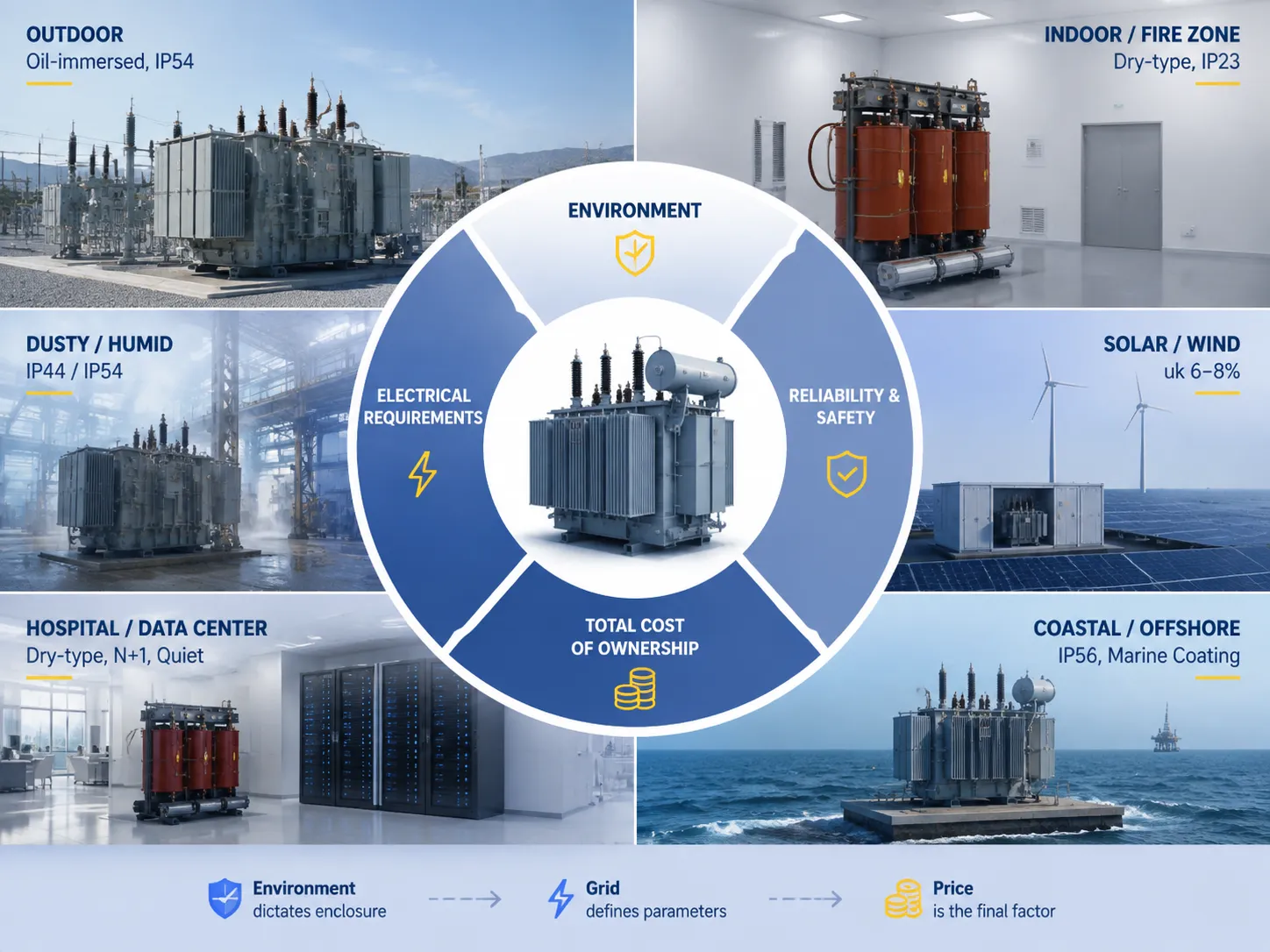
Tipos de Requisitos vs. Soluciones Preferidas
| Requisito | Solución Preferida | Por qué |
|---|---|---|
| Subestación de utilidad al aire libre | Sumergido en aceite, ONAN, IP54 | Mejor costo/kVA, vida útil comprobada de 30 años |
| Sótano del edificio, zona de incendio | Tipo seco de resina fundida, IP23 | Autoextinguible, sin pozo de aceite |
| Sala industrial polvorienta / húmeda | Tipo seco IP44 o sumergido en aceite IP54 | Sellos contra polvo y humedad |
| Estación colectora solar/eólica | Sumergido en aceite, uk 6–8%, grupo de código de red | Maneja cargas cíclicas y límites de fallas |
| Hospital, centro de datos | Tipo seco, redundancia N+1, silencioso | Seguridad contra incendios, continuidad, bajo ruido |
| Costero / en alta mar | Sumergido en aceite IP56, recubrimiento marino | Resistencia a la corrosión por sal |
Estas asignaciones son puntos de partida, no reglas. El punto es que los requisitos son físicos antes de ser comerciales: el entorno dicta el recinto, la red dicta los parámetros eléctricos, y solo después de que ambos estén fijos, el precio se convierte en la variable decisiva.
Principales marcas y referencias de precios
Para la mayoría de los compradores, la decisión real es entre una marca internacional con servicio global y un fabricante chino certificado por la IEC a aproximadamente la mitad del precio. Ambos pueden entregar un transformador que cumpla con la IEC 60076; las diferencias se reflejan en la calidad de la documentación, el tiempo de entrega y la profundidad del servicio postventa.
| Marca | Región de origen | Posición | Precio indicativo (1,000 kVA) |
|---|---|---|---|
| ABB | Suiza/Suecia | Portafolio completo, red de servicio global | $25,000–$42,000 |
| Siemens | Alemania | Monitoreo digital, unidades de alta eficiencia | $25,000–$45,000 |
| Schneider Electric | Francia | Tipo seco y fortaleza de integración de LV | $22,000–$38,000 |
| Hitachi Energy | Suiza | Fortaleza de red y grandes unidades de potencia | $24,000–$42,000 |
| Eaton | EE. UU. | Cumplimiento norteamericano, montajes en base | $20,000–$36,000 |
| CG Power / TBEA | India / China | Alto volumen, precios agresivos | $14,000–$24,000 |
| Jiangsu Subian Electric Power | China | Certificado IEC 60076, informes de prueba completos, bobinados de cobre | $12,000–$22,000 |
Los precios son indicativos FOB China o ex-works para una unidad sumergida en aceite de 1,000 kVA y varían según la especificación, marca y región. Los líderes globales ganan sus primas con décadas de datos de confiabilidad y cobertura de servicio — para activos de red críticos, eso a menudo vale la pena. Pero para unidades de clase de distribución en proyectos comerciales, industriales y renovables, la ecuación de valor cambia. Jiangsu Subian Electric Power suministra transformadores de 10 kVA a 100 MVA bajo certificación IEC 60076, envía unidades con bobinados de cobre como estándar y proporciona el informe de prueba de fábrica completo con cada pedido — por lo que los valores de pérdida e impedancia de su especificación están verificados, no asumidos. En un mercado donde una diferencia de $8,000–$15,000 por unidad financia toda una pequeña subestación, los compradores que insisten en un rendimiento probado documentado obtienen los mismos estándares por menos. La decisión profesional es poner ambas opciones sobre la mesa y dejar que la matriz ponderada decida.
Preguntas Frecuentes
¿Qué información necesito antes de seleccionar un transformador?
Como mínimo: carga conectada en kVA (con factor de potencia), voltajes primario y secundario, sistema de puesta a tierra y requisitos de neutro, entorno de instalación (interior/exterior, polvo, humedad), temperatura ambiente y altitud, y planes de crecimiento futuros. Si alguno de estos es desconocido, mida o consulte antes de especificar — un estudio de calidad de energía de dos semanas cuesta $300–$1,000 y previene un error de selección que vale $10,000–$60,000.
¿Cómo elijo entre transformadores sumergidos en aceite y de tipo seco?
La ubicación lo decide. Al aire libre y del lado de la utilidad: sumergidos en aceite (más baratos por kVA, mejor tolerancia a sobrecargas, IP54–IP56). En interiores, sensibles al fuego o con espacio limitado: de tipo seco o resina fundida (autoextinguibles, sin contención de aceite, más silenciosos). Para una unidad de 500 kVA, el sumergido en aceite cuesta entre $8,000 y $16,000 frente a $12,000 y $24,000 de tipo seco, pero los códigos de incendios locales y el seguro pueden hacer que el tipo seco sea obligatorio independientemente del precio.
¿Cuánto cuesta que un profesional seleccione un transformador?
Un consultor eléctrico cobra entre $500 y $2,000 por un estudio de selección de transformadores en un proyecto típico de distribución, o entre $2,000 y $6,000 por un diseño completo de subestación que incluye coordinación de protección. Para proyectos superiores a $30,000, el estudio se paga solo al prevenir el sobredimensionamiento (capital desperdiciado y pérdidas) o el subdimensionamiento (fallas y tiempo de inactividad). Muchos fabricantes, incluyendo Subian, revisarán sus datos de carga y recomendarán una clasificación sin costo.
¿Cuál es la diferencia entre kVA y kW al dimensionar un transformador?
kVA es potencia aparente (voltios × amperios), kW es potencia real (trabajo real), y difieren por el factor de potencia. Una carga de 100 kW a 0.8 PF consume 125 kVA. Los devanados del transformador se calientan por la corriente independientemente del ángulo de fase, por lo que la clasificación siempre está en kVA. Dimensionar solo a partir de kW subdimensiona la unidad a menos que la carga sea puramente resistiva, lo cual casi nunca es cierto en aplicaciones industriales.
¿Debería comprar a una marca global o a un fabricante chino?
Alinee la elección con la criticidad del proyecto y su red de servicios. Las marcas globales (ABB, Siemens, Schneider, Hitachi) justifican precios de 2 a 3 veces con soporte global y décadas de datos de campo — adecuados para activos críticos de la red. Los fabricantes chinos certificados por IEC como Jiangsu Subian Electric Power ofrecen los mismos estándares de prueba a aproximadamente la mitad del precio, ideales para proyectos de distribución, industriales y renovables. El filtro es la documentación: si el informe de prueba de fábrica, los certificados ISO y las referencias son válidos, la unidad cumplirá con las especificaciones independientemente de su origen.
Referencias
- IEC 60076-1: Transformadores de Potencia — General — el estándar rector para clasificaciones, tolerancias y pruebas.
- IEC 60076-7: Guía de Carga para Transformadores de Potencia Sumergidos en Aceite — límites de temperatura por sobrecarga y carga cíclica.
- IEC 60529: Grados de Protección Proporcionados por Enclosures (Código IP) — la referencia para definiciones de clasificación IP y métodos de prueba.
- IEEE C57.12.00: Requisitos Generales para Transformadores Sumergidos en Líquido — marco de clasificación y pruebas equivalente en América del Norte.
- Electrical4U — Transformador — explicaciones claras de los principios del transformador, grupos vectoriales y pérdidas.
- Eaton — Herramientas de Selección de Transformadores — orientación de ingeniería y utilidades de dimensionamiento para aplicaciones industriales.
- Siemens Energy — Transformadores de Potencia — referencia del fabricante sobre especificaciones y tecnologías de transformadores.
Conclusión
Seleccionar un transformador para requisitos específicos es un proceso profesional de cinco pasos: recopilar datos de carga reales, calcular el kVA con márgenes de diversidad y crecimiento, fijar los parámetros eléctricos al sistema, elegir la construcción y protección para el entorno, y evaluar a los proveedores según el rendimiento probado documentado. Siga este proceso, y el transformador se convierte en un activo aburrido y confiable. Salte un paso, y se convierte en el componente más costoso de su instalación.
- Convierta los requisitos en una especificación técnica escrita antes de contactar a los proveedores.
- Base el kVA en datos de carga medidos, no en suposiciones, con un margen de crecimiento de 10–20%.
- Verifique el grupo vectorial, la impedancia y el nivel de aislamiento contra la red y el sistema de puesta a tierra.
- Exija el informe de prueba de fábrica IEC 60076 — rendimiento probado, no afirmaciones de folleto.
¿Listo para especificar? Jiangsu Subian Electric Power construye transformadores certificados por IEC 60076 desde 10 kVA hasta 100 MVA y proporciona informes completos de pruebas de fábrica, certificados ISO y referencias de proyectos — la documentación que necesita para seleccionar con confianza.