


A las 2:47 a.m. en punto, la alarma en la sala de control sonó: el análisis de gas disuelto (DGA) para el transformador de potencia de 10 MVA, 33/11 kV había saltado de un normal 60 ppm de gas combustible a 340 ppm en seis horas. El operador de la planta tiene tres opciones: limpiar toda la unidad y terminar el turno con una pérdida en la producción, continuar la operación normal con la esperanza de no activar el relé Buchholz, o comenzar a realizar diagnósticos. El diagnóstico de fallas en transformadores de potencia es exactamente el campo de estudio que lleva a diferenciar entre los tiempos de inactividad programados para mantenimiento y las interrupciones forzadas que le quitan a la empresa $50,000 o más en ingresos perdidos, costos de transporte y compra de electricidad de emergencia. En este artículo, se puede encontrar información sobre los tipos de fallas más comunes, sus métodos de detección y las instrucciones paso a paso para realizar diagnósticos de fallas en la práctica.
Explicamos la causa física de cada tipo de falla, los dispositivos de diagnóstico responsables de detectarlas, los fondos aproximados necesarios para equipos de prueba y diagnósticos de terceros, y el trabajo de mantenimiento que permite evitar la mayoría de las fallas mucho antes de que lleguen al interruptor automático.
En términos simples, solucionar una falla en un transformador de potencia significa seguir un procedimiento claramente definido basado en el conocimiento, destinado a identificar, medir y rectificar fallas en transformadores de más de aproximadamente 1 MVA, mediante pruebas como DGA (análisis de gas disuelto), pruebas de resistencia de aislamiento, pruebas de resistencia de devanados y pruebas de aceite de transformador. Se estima que 80% de los transformadores defectuosos fallan debido a fallas eléctricas causadas por ruptura del aislamiento, descarga parcial o impacto de sobretensión, siendo las fallas térmicas y relacionadas con la máquina la gran mayoría del resto. Lo que debemos tener en cuenta es que no debemos quitar la tapa de un transformador hasta que los resultados de DGA y las pruebas eléctricas hayan mostrado cuál es el subsistema que falla.
¿Cuáles son las fallas más comunes en transformadores de potencia?
Los transformadores son equipos maduros que se conocen por ser muy fiables y pueden durar entre 30 y 40 años si se construyen correctamente y se enfrían adecuadamente. La falla de los transformadores generalmente se clasifica en una de cinco categorías, siendo la primera la ruptura del aislamiento de los devanados, que causa alrededor del 35-40% de las fallas de dicho equipo. Esto está relacionado con cortocircuitos entre vueltas, cortocircuitos entre diferentes capas, así como fallas a tierra que ocurren debido a la deterioración del aislamiento de papel. Además, las debilidades en los terminales también son responsables del 10-15% de las fallas, y esto es particularmente peligroso debido a la posibilidad de que aceite caliente altamente inflamable sea rociado desde los terminales cuando ocurre una falla. Las fallas de los cambiadores de tomas bajo carga se comparan con los terminales, ya que representan un porcentaje similar de las fallas, siendo los problemas de forja una de las principales razones, ya sea por desgaste de contacto, contaminación del aceite en el compartimento del cambiador de tomas, o fallas en el motor. Los defectos del núcleo y del circuito magnético pueden presentarse en forma de pernos sueltos o circulación de corriente causada por daños en el aislamiento entre las laminaciones, lo que lleva a un sobrecalentamiento local y pérdidas excesivas en vacío. Además, los problemas relacionados con el aceite del sistema de enfriamiento, como radiadores obstruidos, bombas y ventiladores que no funcionan, bajo nivel de aceite o altos niveles de humedad, conducen a una degradación térmica que inicia la destrucción de partes dentro del transformador.
Cómo se desarrollan las fallas en los transformadores: Modos y mecanismos de falla
La existencia de fallas requiere un largo proceso de degradación que ocurre con el tiempo para que aparezca una falla. La mayoría de las fallas en devanados y aislamiento resultan de tensiones térmicas. Según la regla de envejecimiento aplicada en la industria, la vida útil del aislamiento se reduce a la mitad cuando su temperatura supera entre 6°C y 10°C por encima de su temperatura nominal de 98 °C al utilizar papel térmicamente mejorado. Por ejemplo, operar un transformador de 10 MVA bajo una carga de al menos 20% durante el verano consumirá años de vida útil del aislamiento, incluso si el transformador no se desconecta.
Las tensiones eléctricas conducen a su propio proceso de fallo. Las descargas parciales que aparecen como micro-descargas a través de burbujas, vacíos y material de aislamiento dañado pueden llevar a una degradación lenta del aislamiento. En el caso de un devanado de 33 kV, se debe tener en cuenta que una actividad de descarga parcial de 100 pC ya es una señal de advertencia. Y si hay descargas parciales en el transformador de 1000 pC, el transformador experimentará un fallo que podríamos observar en un par de semanas. La presencia de humedad puede empeorar ambos procesos. En el caso de un transformador que tiene un nivel de humedad de 2 % en su aislamiento de papel, el papel puede envejecer aproximadamente el doble de rápido que en un transformador sin influencia de humedad, lo que lleva a la destrucción del aislamiento. Debido a la presencia de humedad en el aceite, la resistencia dieléctrica puede disminuir de 40 kV (calificación mínima según IEC 60156) a menos de 20 kV, lo que es suficiente para provocar un fallo. La fuerza mecánica conectada a las corrientes de cortocircuito en el devanado puede cambiar y aflojarlo, por lo que incluso si el transformador sobrevive al primer caso, el segundo fallo a través puede finalmente dañar si ocurre en seis meses entre los fallos. Tenga en cuenta que reconocer esos mecanismos proporciona una base muy buena para el diagnóstico de fallos en transformadores.
Tipos de fallos, señales de advertencia y causas raíz
| Tipo de fallo | Participación típica de fallos | Señales de advertencia tempranas | Causas raíz más comunes |
|---|---|---|---|
| Fallo de devanado / aislamiento | 35–40% | Aumento de DGA acetileno/etileno, desviación de relación, aceite caliente | Sobrecalentamiento, humedad, PD, daño por sobretensión, sujeción suelta |
| Fallo de bushing | 10–15% | Grietas visibles, fugas de aceite, cambio de capacitancia, PD en el bushing | Daño en porcelana, entrada de humedad, contaminación |
| Fallo de OLTC / cambiador de tomas | 10–15% | Ruido inusual al cambiar de toma, aumento de resistencia de contacto, oscurecimiento del aceite | Desgaste de contacto, aceite carbonizado, desgaste mecánico |
| Fallo de núcleo | 8–12% | Aumento de pérdida en vacío, puntos calientes locales, zumbido inusual | Laminaciones sueltas, aislamiento de núcleo dañado, corrientes circulantes |
| Fallo del sistema de enfriamiento / aceite | 10–15% | Alta temperatura del aceite superior, bajo nivel de aceite, paradas de bomba/ventilador | Radiadores bloqueados, bombas fallidas, fugas, entrada de humedad |
| Sobrecarga / evento del sistema externo | 5–10% | Carga alta sostenida, calentamiento armónico, disparo de protección | Sobrecarga sostenida, armónicos, desequilibrio de voltaje |
La tabla contiene dos piezas importantes de información sobre el proceso de solución de problemas. Una que vale la pena mencionar es que los datos que muestran la “participación de fallos” se recopilan de investigaciones combinadas sobre diferentes fallos en la industria realizadas por CIGRÉ e IEEE, que han identificado las variaciones en estas cifras según la clase de voltaje de los transformadores. Por ejemplo, los transformadores de clase de distribución sufren de muchos más fallos por sobrecarga que los transformadores que transmiten más de 110 kV sufren de fallos dieléctricos y de OLTC. Además, el aceite aislante de un transformador es un mensaje oculto, ya que indica el tipo de fallo que está ocurriendo.
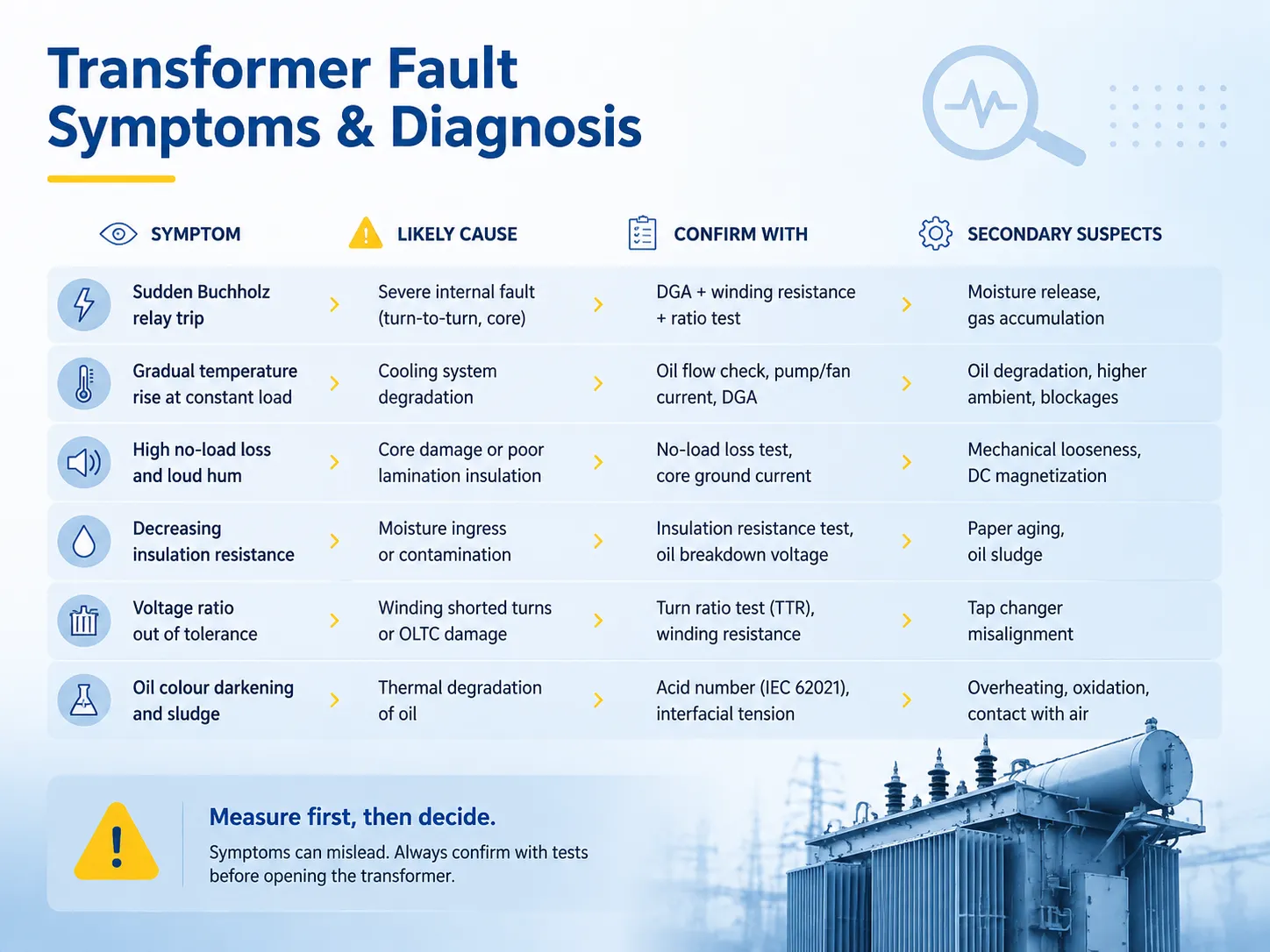
Síntomas de fallo vs. causas probables
| Síntoma observado | Fallo más probable | Confirmar con | Sospechosos secundarios |
|---|---|---|---|
| Disparo repentino del relé Buchholz | Fallo interno severo (de vuelta a vuelta, núcleo) | DGA + resistencia de devanado + prueba de relación | Liberación rápida de humedad, acumulación de gas |
| Aumento gradual de temperatura a carga constante | Degradación del sistema de refrigeración | Verificación del flujo de aceite, corriente de bomba/ventilador, DGA | Degradación del aceite, mayor temperatura ambiente, obstrucciones |
| Alta pérdida en vacío y zumbido fuerte | Daño en el núcleo o mala aislamiento de laminación | Prueba de pérdida en vacío, corriente de tierra del núcleo | Holgura mecánica, magnetización DC |
| Disminución de la resistencia de aislamiento | Ingreso de humedad o contaminación | Prueba de resistencia de aislamiento, voltaje de ruptura del aceite | Envejecimiento del papel, lodo de aceite |
| Relación de voltaje fuera de tolerancia | Vueltas cortocircuitadas del devanado o daño en el OLTC | Prueba de relación de vueltas (TTR), resistencia del devanado | Desalineación del cambiador de tomas |
| Oscurecimiento del color del aceite y lodo | Degradación térmica del aceite | Número de ácido (IEC 62021), tensión interfacial | Sobrecalentamiento, oxidación, contacto con aire |
Esta tabla de síntomas es deliberadamente conservadora: cada síntoma indica un sospechoso clave, pero los solucionadores de problemas experimentados no saltarían a conclusiones sobre nada. Por ejemplo, un disparo de Buchholz podría surgir tan fácilmente de una tubería de enfriamiento rota que introduce aire en el contenedor pero no implica ninguna falla eléctrica en absoluto. Por lo tanto, la siguiente secuencia de diagnóstico siempre debe confirmarse con medidas de antemano, antes de tomar cualquier decisión sobre abrir el contenedor.
Pruebas de diagnóstico clave y límites aceptables
| Prueba | Referencia estándar | Rango aceptable típico | Cuándo realizar |
|---|---|---|---|
| Análisis de gases disueltos (DGA) | IEC 60599 / IEEE C57.104 | Gas combustible total < 720 ppm; relaciones de gas clave normales | Anual; inmediatamente después de cualquier disparo o evento anormal |
| Resistencia de aislamiento (IR) / PI | IEEE 43 | Índice de polarización ≥ 2.0 para papel seco; IR por clasificación de kV | Anual; antes de energizar después del mantenimiento |
| Resistencia del devanado | IEC 60076-1 | Desbalance de fase ≤ 2% entre fases | Después de disparos, inspecciones de OLTC, vueltas cortocircuitadas sospechosas |
| Prueba de relación de vueltas (TTR) | IEC 60076-1 | Desviación ≤ 0.5% del nombre de placa | Anual; después de reconexión o trabajo en OLTC |
| Voltaje de ruptura del aceite (BDV) | IEC 60156 | ≥ 40 kV para aceite nuevo; ≥ 30 kV aceptable en servicio | Cada muestra de aceite; antes de la recuperación del aceite |
| Humedad en aceite / papel | IEC 60814 / Karl Fischer | < 2% humedad en papel; < 10 ppm de agua en aceite (típico) | Anual; después de sospecha de ingreso de humedad |
| Medición de descarga parcial | IEC 60270 | Nivel de PD por debajo de la aceptación del fabricante (a menudo < 100 pC en HV) | Pruebas de fábrica; después de una gran perturbación de aislamiento |
| Respuesta en frecuencia (SFRA) | IEC 60076-18 | Bajo índice de desviación a través de barrido de frecuencia | Después de fallas a través o transporte; comparación de línea base |
Estos límites son números de trabajo, en lugar de inevitables, ya que un transformador que siempre funcionó bajo indicadores equivalentes de humedad de 5% podría seguir funcionando correctamente; sin embargo, la tendencia importa más que cualquier número separado. Por lo tanto, necesita mantener todos los resultados de las pruebas disponibles para una comparación año tras año, porque un aumento de 40% en el contenido de hidrógeno en dos instancias es mucho más importante que un valor absoluto normal.
Donde los fallos golpean más fuerte: aplicaciones y activos críticos
Las prioridades en la resolución de problemas varían según las aplicaciones, ya que los costos de las fallas difieren de una aplicación a otra. En la generación y transmisión de electricidad, un transformador con una clasificación de 110 kV/50 MVA podría costar hasta $ 400,000 e incluso un millón de dólares, y podría tardar hasta 1 temporada en reemplazarlo. En un entorno industrial, el mismo dispositivo de 10 MVA generalmente tendría una unidad de respaldo en su lugar, y el objetivo, por lo tanto, sería clasificar la falla, averiguando si se puede reparar en el sitio o necesita ser atendida fuera del sitio. Para dispositivos de energía renovable, similares a los parques eólicos, los transformadores están expuestos a ciclos de calle y enfrentan diferentes problemas relacionados con daños en el OLTC, sobrevoltajes y fallas de aislamiento, no causadas por accidentes individuales. Lugares como centros de datos y hospitales se centrarán en hacer de los problemas de disponibilidad la prioridad, y es por eso que recurrirán a pagar mucho más de lo habitual por las reparaciones.
En cuanto a las redes, las empresas que operan en ellas elegirán la estrategia de gestión de riesgos y lidiarán con fallas de alto riesgo cada 6-12 meses y fallas de bajo riesgo cada 2-3 años. Así, el mismo transformador o la misma falla pueden recibir un tratamiento completamente diferente, dependiendo del contexto de uso de la tecnología.
Herramientas de diagnóstico, marcas y rangos de precios
| Herramienta / Servicio | Marcas representativas | Rango de precios típico | Notas |
|---|---|---|---|
| Kit de muestreo DGA y prueba de laboratorio (por muestra) | Doble, SGS, laboratorios de servicios públicos locales | $80–$250 por muestra | Panel completo de cromatografía de gases |
| Monitor DGA portátil (en línea) | Kelman (GE), Serveron, Qualitrol | $15,000–$45,000 | Monitoreo continuo de gases clave |
| Probador de resistencia de aislamiento (5–10 kV) | Megger, Fluke, Doble | $1,500–$6,000 | Para mediciones de IR, PI, DAR |
| Medidor de resistencia de devanado (micro-ohmiómetro) | Megger, Vanguard, DV Power | $4,000–$12,000 | Medición de baja resistencia hasta 0.1 µΩ |
| Probador de relación de transformación (TTR) | Megger, Vanguard, Doble | $5,000–$15,000 | TTR trifásico completo con prueba de OLTC |
| Conjunto de prueba SFRA | Doble, OMICRON, Megger | $20,000–$60,000 | Análisis de deformación de devanados |
| Servicio de diagnóstico de terceros (batería completa en el sitio) | Doble, Intertek, laboratorios certificados locales | $5,000–$25,000 por visita | DGA + pruebas eléctricas + pruebas de aceite en una unidad |
Dependiendo de factores como la ubicación, el fabricante y la singularidad, los precios pueden diferir, por lo que puede ser más seguro considerarlos como valores de planificación en lugar de precios reales. Por ejemplo, una de las ideas válidas para presupuestar una pequeña flota industrial es comprar primero un medidor de resistencia de aislamiento de gama media y un medidor de resistencia de devanados, que cuesta entre $6,000 y $18,000 juntos; las muestras de DGA pueden enviarse a un laboratorio y la inspección de terceros para SFRA y PD solo se puede realizar cuando aparece alguna disfunción. Hay muchos actores globales en el mercado como Doble, OMICRON, Megger, Fluke y Qualitrol, por lo que es posible estar seguro de que pueden servir como un punto de referencia. Sin embargo, debe señalarse que Jiangsu Subian Electric Power y otras empresas chinas ya han comenzado a producir los transformadores que estos dispositivos de diagnóstico evalúan, introduciendo así transformadores de distribución y potencia relacionados con IEC 60076 de 10 kVA a 100 MVA en el mercado a precios y plazos razonables. Para comparar la metodología de diagnóstico utilizada por varias empresas, es necesario decir que una empresa que produce transformadores también puede proporcionar a sus clientes la interpretación de los resultados de las pruebas.
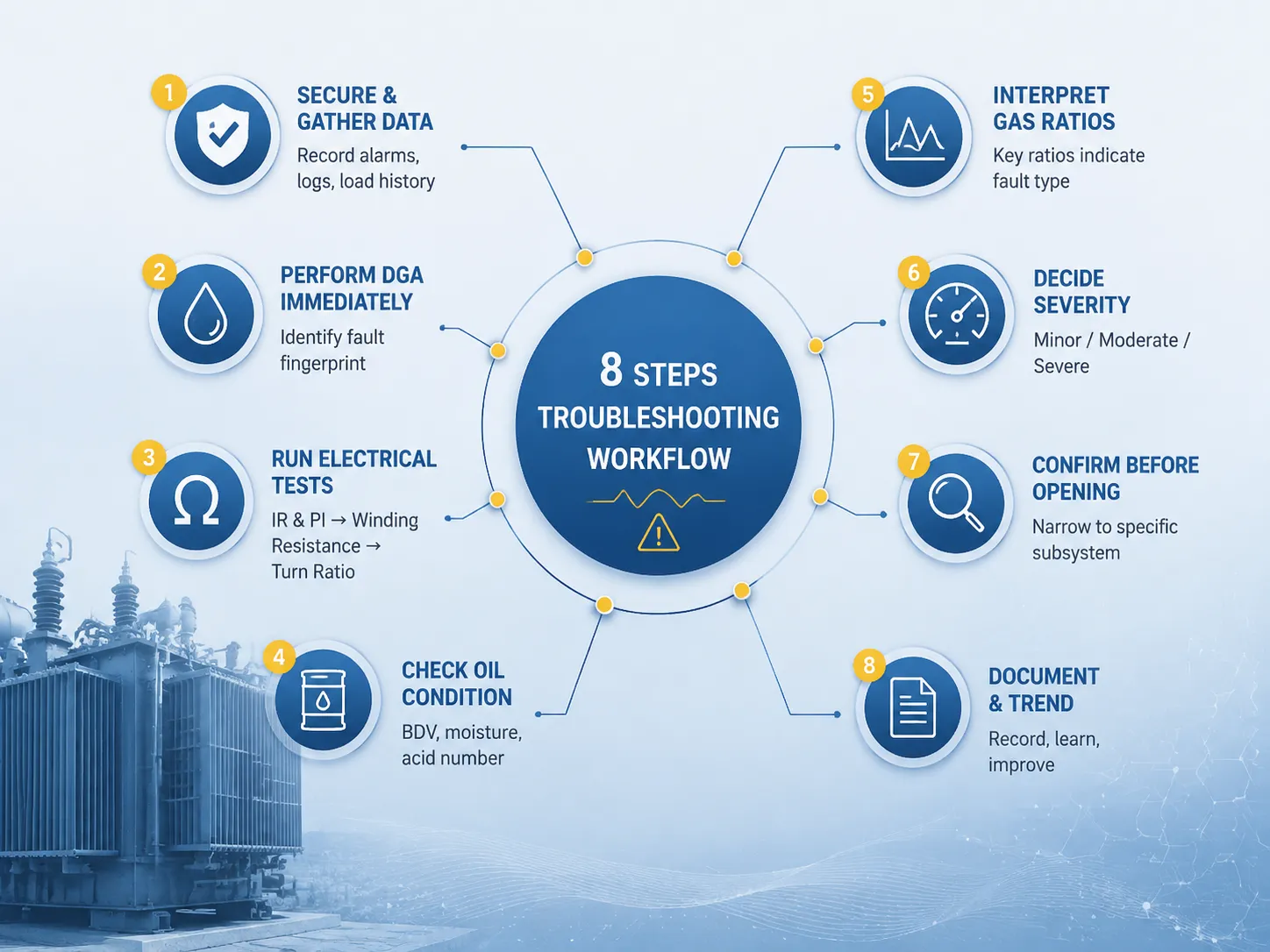
Construyendo un Flujo de Trabajo de Solución de Problemas: 8 Pasos
Cualquier actividad seria de solución de problemas debe adherirse a la misma secuencia estructurada, ya que así es como los técnicos experimentados se meten en problemas.
- Establecer el sitio y obtener datos; validar el viaje o la alarma, aislar el transformador y tomar nota de cualquier objetivo de relé, registros de SCADA, historial de carga y temperatura ambiente de los últimos dos días, antes de realizar cualquier reinicio de protección.
- Realizar un DGA de inmediato; si hay aceite disponible, tomar una muestra para pruebas de gas disuelto; la huella digital (IEC 60599) tiende a indicar sobrecalentamiento, PD o arco, antes de realizar cualquier prueba eléctrica.
- Realizar inspecciones eléctricas en un orden específico: resistencia de aislamiento e índices de polarización primero (sencillo y rápido); seguido de resistencia de devanados, luego relación de vueltas; comparar todas las lecturas con la línea base o los valores de la placa de identificación.
- Evaluar la condición del aceite; el voltaje de ruptura, la humedad, la acidez y la resistencia dieléctrica te dirán si el aceite mismo es el culpable o la víctima.
- Analizar los gases en función de las relaciones clave; el hidrógeno indica PD, el etileno y el metano señalan fallas térmicas, el acetileno en exceso de 5 ppm indica arco o sobrecalentamiento.
- Tomar una decisión sobre si es menor, moderado o severo; haciendo referencia a IEEE C57.104 o IEC 60599.
- Verificar primero antes de abrir; solo realizar la apertura del tanque después de haber determinado dónde está la falla mediante una inspección física — la entrada al tanque cuesta entre $5,000 y $20,000.
- Asegurarse de que todo esté documentado; en cada archivo de historial de activos registrar cada resultado, cada decisión tomada así como cada acción realizada con reparaciones.
Prácticas de Mantenimiento Preventivo y Predictivo
La solución de problemas que no tiene que hacerse es la mejor solución de problemas. Hay cuatro capas que hacen que el mantenimiento del transformador sea efectivo. La primera capa es la inspección rutinaria del transformador, que incluye la inspección visual, la lectura del indicador de temperatura, la verificación del nivel de aceite y la detección de fugas, así como el monitoreo de la funcionalidad auditiva de forma mensual o trimestral. La segunda capa es la prueba periódica que incluye DGA anual, pruebas de resistencia de aislamiento, pruebas de resistencia de devanados y pruebas de voltaje de ruptura del aceite (BDV), que deben realizarse dos veces al año para transformadores de más de 20 años o que han sufrido sobrecargas. La tercera capa es el monitoreo predictivo, que incluye la instalación de monitores DGA, la instalación de sensores de temperatura de devanados y la instalación de algunos sensores de humedad para los transformadores muy costosos que pueden costar alrededor de $15000-$50000, pero el dinero se recupera rápidamente. La última capa es el mantenimiento del aceite que permite mantener el voltaje de ruptura (BDV) por encima de 30 kV y el número de ácido por debajo, lo que resulta en un aumento del tiempo de servicio del aceite.
También es importante mencionar dos reglas de mantenimiento que deben ser memorizadas y seguidas. La primera es que se deben tomar notas, ya que las tendencias de desarrollo importan más que los umbrales al tomar decisiones. La segunda es que el DGA dirigido debe realizarse para los transformadores con el evento de emergencia, incluso si el transformador es funcional, ya que puede haber algún daño que no esté definido por la señal de alarma.
| Actividad de Mantenimiento | Frecuencia Típica | Verificaciones Clave | Costo Típico por Visita |
|---|---|---|---|
| Inspección visual de rutina | Mensual / trimestral | Fugas de aceite, nivel de aceite, medidores de temperatura, sonido, color del deshidratador | $100–$300 (interno) |
| DGA anual + muestreo de aceite | Anualmente (6 meses para unidades envejecidas) | Relaciones clave de gas, BDV, humedad, número de ácido | $80–$250 por muestra |
| Prueba eléctrica anual de batería | Anualmente | IR/PI, resistencia de devanado, relación de transformación, pérdida en vacío/carga si es necesario | $1,000–$4,000 interno |
| Servicio del sistema de refrigeración | Cada 6–12 meses | Operación del ventilador/bomba, limpieza del radiador, aletas bloqueadas | $500–$2,000 |
| Servicio de respiradero / deshidratador | Cada 6 meses | Condición del gel de sílice, nivel del sello de aceite | $100–$500 |
| Inspección de OLTC (compartimento lleno de aceite) | Cada 2–5 años o por conteo de cambios de toma | Desgaste de contactos, carbonización del aceite, sincronización del mecanismo | $1,500–$5,000 |
Preguntas Frecuentes
¿Con qué frecuencia debo realizar DGA en un transformador de potencia?
Para un transformador saludable, se debe utilizar DGA al menos una vez al año, como se indica en IEEE C57.104. Sin embargo, esta frecuencia debe cambiar a cada 6 meses en caso de unidades que tengan más de 20 años, unidades que han sido sobrecargadas o unidades que ya tienen gases presentes en niveles moderados. En caso de activos que son muy valiosos, se debe considerar la instalación del sistema de monitoreo DGA que muestrea gases constantemente (este equipo cuesta entre 15,000-$45,000). Es bastante probable que este tipo de instalación valga la pena si se puede detectar al menos una falla a tiempo.
¿Qué indica el acetileno en DGA y cuánto es demasiado?
El acetileno (C₂H₂) se produce solo en condiciones extremas asociadas con arcos eléctricos y temperaturas muy altas (superiores a 700 °C). IEEE C57.104 establece que el contenido de acetileno en el líquido no debe superar el nivel de 5 ppm, de lo contrario, debe ser tratado como una condición moderada a alta y ser investigado. Tomar mediciones por encima del límite de 20 ppm puede llevar al apagado del transformador para pruebas eléctricas adicionales, ya que pueden ocurrir daños graves como la ruptura del tanque tras cualquier tipo de falla de arco que se desarrolle durante unos días.
¿Puedo diagnosticar un transformador sin abrir el tanque?
Sí. Normalmente, DGA, medición de resistencia de aislamiento, medición de resistencia de devanado, mediciones de relación de transformación y pruebas de aceite identifican correctamente la ubicación del problema en la unidad sin entrar en el tanque. Abrir un transformador para una inspección interna cuesta entre $5,000-20,000. Por lo tanto, es necesario realizar todas las pruebas de acceso antes de verificar el tanque.
¿Cuál es la diferencia entre un índice de polarización de 1.5 y 3.0?
El índice de polarización (PI) muestra la relación entre las lecturas de resistencia de aislamiento que se tomaron 10 minutos y 1 minuto después de la aplicación inicial de voltaje. Un valor inferior a 1.5 sugiere que el aislamiento está húmedo o sucio y requiere un secado adicional. El rango de PI de 1.5-2.0 es marginal, mientras que el rango de 2.0-3.0 es aceptable. Cualquier valor por encima de 3.0 indica que el aislamiento está seco y limpio.
¿Cuánto cuesta típicamente una investigación de falla de transformador?
Si se realiza una investigación de diagnóstico de terceros, el DGA más pruebas eléctricas más análisis de aceite más SFRA costaría entre 5,000-25,000 por transformador, dependiendo de su potencia, accesibilidad del sitio y alcance del trabajo. Es más barato realizar las pruebas con los propios aparatos, ya que en este caso la única inversión sería la experiencia y no el dinero.
Referencias
- IEC 60076-1: Transformadores de potencia – Parte 1: General — la norma internacional fundamental para la clasificación, prueba y rendimiento de transformadores de potencia.
- IEC 60599: Equipos eléctricos llenos de aceite mineral en servicio – Interpretación del análisis de gases disueltos y libres — la referencia para interpretar las relaciones de gases DGA y tipos de fallas.
- IEEE C57.104: Guía para la Interpretación de Gases Generados en Transformadores Sumergidos en Aceite — el marco de categoría de condición estándar utilizado en la interpretación de gases.
- IEEE 43: Práctica Recomendada para la Prueba de Resistencia de Aislamiento de Máquinas Rotativas — ampliamente referenciado para límites de resistencia de aislamiento e índice de polarización.
- CIGRÉ — consejo internacional cuyas encuestas de confiabilidad proporcionan la base estadística para los datos de distribución de fallas de transformadores.
- Electrical4U – Análisis de Gases Disueltos en Aceite de Transformador — una referencia introductoria práctica sobre la interpretación del DGA.
- Jiangsu Subian Electric Power – Fabricante de Transformadores de Potencia — fabricante de transformadores conforme a IEC 60076 que ofrece datos de diseño y apoyo para la investigación de fallas.
Conclusión
No es solo suerte o la edad de un profesional, sino la secuencia correcta de acciones la que ayudará a eliminar fallas en transformadores de potencia. Comience con el proceso de DGA seguido de pruebas de resistencia de aislamiento y devanado, y totalice los resultados en comparación con las normas establecidas para tomar decisiones acertadas sobre sus acciones futuras respecto al problema. De hecho, muchas fallas pueden repararse en una etapa temprana, ahorrando así mucho tiempo y fondos a largo plazo.
- Realice DGA regularmente; al menos una vez al año; si la unidad es antigua o está estresada, al menos cada seis meses.
- Asegúrese de mantener un registro de los resultados de las pruebas, ya que la dinámica del proceso es el indicador más importante en lugar del número absoluto.
- Nunca comience a inspeccionar el transformador hasta que se conozca bien la causa del problema.
- Asigne de $1500 a $6000 para la prueba de un transformador, ya que un accidente evitado cubrirá esta suma durante el período de tiempo.
- Colabore con un fabricante que pueda ayudarle con los datos que obtenga sobre los problemas; por ejemplo, Jiangsu Subian Electric Power, que produce transformadores que cumplen con las normas IEC 60076.