


Situado en un vecindario recién desarrollado cerca de Austin, Texas, trescientos residencias reciben electricidad a través de un sofisticado sistema de recintos verdes silenciosos instalados en las áreas ajardinadas entre las aceras y las cercas, donde se encuentran los transformadores montados en base — un transformador por cada doce a quince hogares. No hay cableado aéreo ni postes de servicios públicos ni transformadores colgando sobre el estacionamiento. El año pasado, por ejemplo, cuando la tormenta de verano pasó y la unidad de alimentación fue dañada, el sistema subterráneo pudo mantener todo el vecindario en línea mientras las áreas vecinas con electricidad aérea se sumieron en la oscuridad.
El documento describe por qué los transformadores montados en base son el principal medio de suministro de electricidad, cómo funcionan y se construyen, cuál es su precio, cómo se utilizan y mantienen, mientras proporciona pistas sobre la selección de estos dispositivos para servicios públicos, desarrolladores y comunidades.
Un transformador montado en base: es un transformador de distribución ubicado en el suelo y a prueba de manipulaciones; los cables están ubicados bajo tierra. Debido a que es seguro, resistente a tormentas y tiene una larga vida útil (de hasta 25 a 40 años), es el tipo predominante de transformador para instalaciones residenciales y comerciales subterráneas.
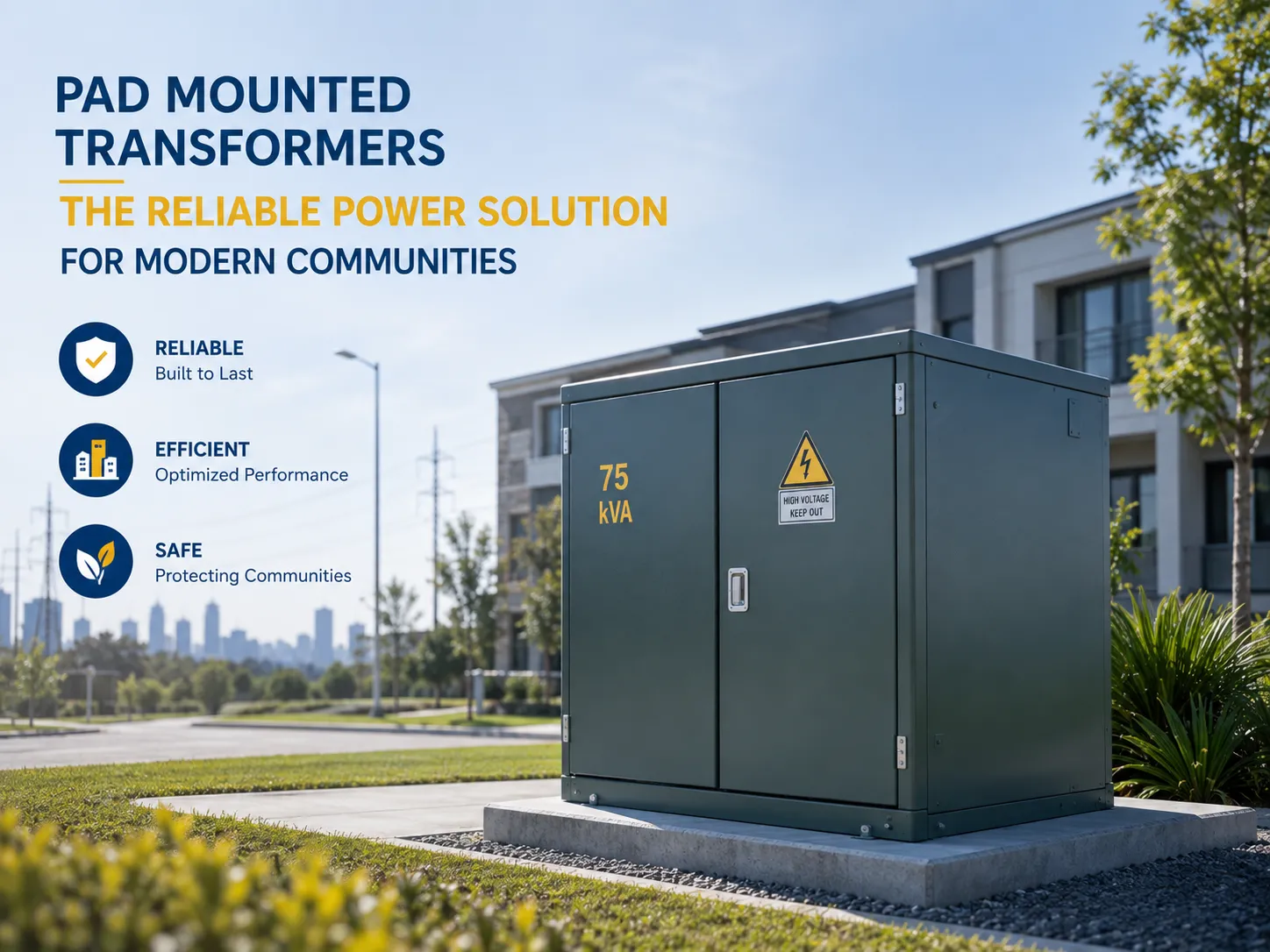
¿Qué es un transformador montado en base?
Un transformador montado en base es un transformador para distribución encerrado dentro de un recinto de acero a tierra que puede ser cerrado con llave y está instalado sobre una base de concreto. El transformador está diseñado de tal manera que todo el cableado de potencia que entra y sale de él se realiza bajo tierra, con todas las conexiones siendo conexiones de frente muerto para que no se puedan ver conexiones vivas durante la operación. Este tipo de transformador se utiliza ampliamente en la distribución subterránea en América del Norte y se vuelve más popular en todo el mundo.
Hay dos características de diseño que determinan el diseño del producto. Una es la construcción de frente muerto. Esto significa que todas las conexiones vivas están ocultas en conectores aislados, cumpliendo con el estándar IEEE 386, lo que permite que el gabinete se abra de manera segura incluso cuando está energizado. La otra es la resistencia a manipulaciones; el gabinete puede estar equipado con un candado y cumple con IEEE C57.12.27. Estas dos características de construcción permiten que los transformadores montados en base se instalen de manera segura en lugares públicos como parques, patios traseros o estacionamientos.
Las instalaciones típicas en comunidades utilizan de 75 a 160 kVA en modo monofásico para bucles residenciales y de 300 a 2,500 kVA en modo trifásico cuando se trata de cargas comerciales, institucionales y de uso mixto. Las tensiones primarias son de 15, 25 o 35 kV; las tensiones secundarias son de 240/120 V o 480Y/277 V.
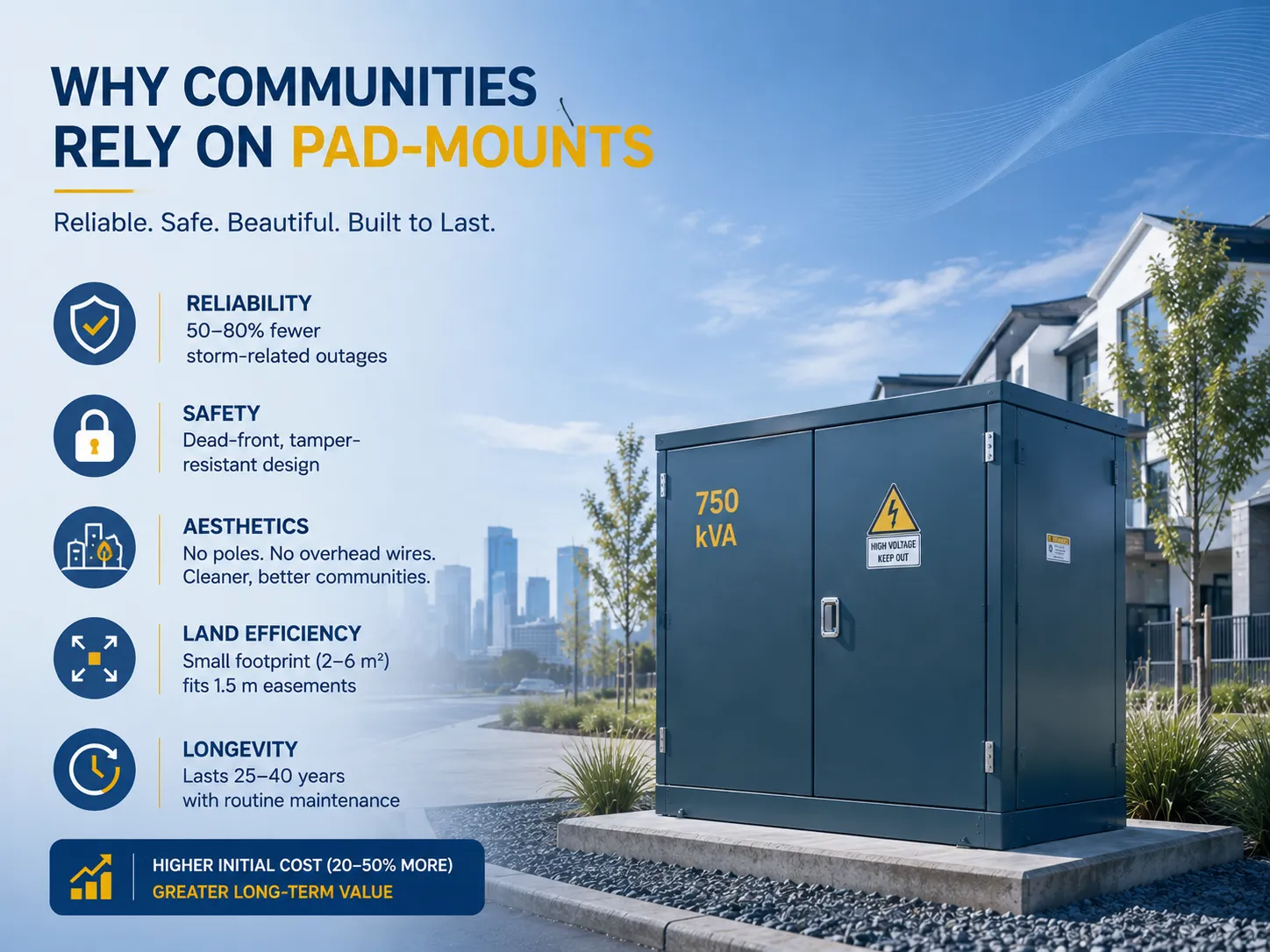
Por qué las comunidades confían en los transformadores montados en base
- El funcionalismo es el principio subyacente detrás de las características operativas de los transformadores montados en base que son ampliamente aceptadas por desarrolladores, administradores de edificios y compañías eléctricas.
- La fiabilidad implica la ausencia de cortes debido a tormentas, viento y vehículos que impactan líneas aéreas. Como resultado, las compañías de servicios públicos informan una disminución de entre 50 y 80% en cortes asociados con tormentas en áreas servidas subterráneamente.
- La seguridad se relaciona con la tecnología de frente muerto a prueba de manipulaciones que garantiza la falta de partes vivas expuestas que podrían dañar a las personas.
- El atractivo estético radica en la ausencia de postes y cables, ya que los gabinetes están diseñados de manera que se integren en el paisaje.
- La eficiencia del terreno demuestra cómo gabinetes menores proporcionan la capacidad que requiere grandes terrenos alrededor de postes.
- La longevidad se expresa en el hecho de que los robustos transformadores montados en base duran entre 25 y 40 años, lo que corresponde a la vida útil de los edificios modernos.
Cómo Funciona
Similar a cualquier transformador de distribución, el transformador montado en base funciona. El cable primario de la red subterránea se conecta a través de un codo de frente muerto en el buje primario. El núcleo del transformador reduce la tensión entrante de 15–35 kV a los niveles de tensión de uso, como 480Y/277 V o 240/120 V, mientras que los cables de baja tensión se conectan en la parte inferior del transformador al panel de medición y servicio.
La envoltura proporciona seguridad estructural al ofrecer terminaciones, un gabinete cerrable y a prueba de manipulaciones, y protección del equipo eléctrico contra el clima y los animales. El transformador en sí es del tipo sumergido en aceite, con devanados enfriados por convección de aceite mineral o aceite vegetal FR3 que pasa a través de radiadores o un tanque corrugado. En condiciones de operación normales, el transformador es silencioso, excepto por un bajo zumbido, pero en caso de carga pesada, la temperatura aumenta pero se mantiene dentro de los límites de IEEE C57.12.00.
El sistema incluye una característica de protección incorporada, ya que los fusibles primarios dentro del transformador eliminan las fallas antes de que ocurra algún daño al equipo y el lado de carga está protegido por interruptores o fusibles secundarios. El gabinete está conectado a tierra de manera de baja resistencia para que cualquier falla interna se elimine de manera segura a tierra.
Clasificaciones y Tipos para Uso Comunitario
| Aplicación | Tipo | Clasificación típica | Hogares / Carga Servida |
|---|---|---|---|
| Bucle residencial | Montaje en base monofásico | 75–167 kVA | 10–25 hogares por unidad |
| Pequeño comercial / escuela | Montaje en base trifásico | 300–500 kVA | Pequeñas tiendas, escuelas, oficinas |
| Uso mixto / centro comercial | Montaje en base trifásico | 750–1,000 kVA | Agrupaciones comerciales, edificios de apartamentos |
| Hospital / gran campus | Montaje en base trifásico | 1,500–2,500 kVA | Hospitales, universidades, centros de datos |
La planificación comunitaria procede de la demanda: el uso máximo típico para un hogar en EE. UU. es de aproximadamente 10-15 kVA, lo que significa que 167 kVA sirven alrededor de 12-18 hogares, mientras que un sistema trifásico de 500 kVA proporciona energía para una manzana típica de edificios comerciales de tamaño mediano. Los desarrolladores deben reservar espacio de servidumbre para una residencia por cada 12-25 hogares, más la potencia comercial relacionada con su superficie y ocupación.
Instalación y Despejes
El proceso de instalación no es complicado.
- Selección del lugar: Coloque la unidad a una distancia de 1.5 m de las paredes o cualquier otro obstáculo.
- Construcción y preparación de la base: Vierta concreto con una longitud igual al tamaño del gabinete y hágalo por encima del nivel del suelo.
- Instalación de los cables: Coloque los cables bajo tierra asegurándose de que tengan suficiente profundidad y marcación.
- Instalación de la unidad: Mueva todo el equipo al soporte con un mecanismo de elevación universal según el nivel adecuado; conecte todo.
- Establecimiento de la conexión a tierra: Asegúrese de que el sistema de conexión a tierra se haya instalado correctamente y que todo esté en orden.
- Verificaciones finales: Verifique si los voltajes y las cargas fueron correctos al final.
El equipo no requiere un espacio libre significativo a su alrededor, ya que es una zona segura y puede colocarse cerca de otros edificios a una distancia de 3 m debido a cuestiones de seguridad y consideración de las leyes locales (1.5–3m para la cara frontal).
Normas y Seguridad
| Estándar | Alcance | Requisito Clave |
|---|---|---|
| IEEE C57.12.00 | Requisitos generales, transformadores de distribución sumergidos en líquido | Clasificaciones, impedancia, accesorios, placa de identificación |
| IEEE C57.12.27 | Integridad del enclosure de equipo montado en base | Frente muerto, resistencia a manipulaciones, bloqueo |
| IEEE C57.12.90 | Procedimientos de prueba | Pérdidas, pruebas dieléctricas, pruebas de impulso |
| IEEE 386 | Sistemas de conectores separables | Requisitos del conector de codo de frente muerto |
| NFPA 70 (NEC) | Instalaciones eléctricas | Espacios libres, conexión a tierra, reglas de instalación |
| Eficiencia DOE 2016 | Eficiencia del transformador de distribución | Niveles mínimos de eficiencia obligatorios (EE. UU.) |
Los aspectos fundamentales de seguridad de este equipo para las comunidades son bastante sencillos. En primer lugar, la carcasa está diseñada de tal manera que los niños y miembros del público no pueden alcanzar las partes energizadas. En segundo lugar, el personal calificado puede utilizar técnicas normales para realizar el servicio en el equipo mientras está energizado. Y finalmente, el sistema de conexión a tierra es una garantía contra fallos dentro del equipo. El equipo se ha revisado una vez cada 1-3 años y las muestras de aceite se toman una vez cada 2-5 años.
Costos y rangos de precios
Una cifra aproximada confiable para un transformador de tres fases montado en soporte de calidad aceptable sería la siguiente: el transformador sería del tipo de frente muerto, operaría con un voltaje primario de 15–35 kV, y con una salida de 480Y/277V, con bobinas de cobre.
| Clasificación | Clase de Voltaje | Precio típico (USD) | Tiempo de Entrega |
|---|---|---|---|
| 75–150 kVA (monofásico) | 15–25 kV | $1,800–$3,500 | 8–16 semanas |
| 300–500 kVA | 15–25 kV | $4,500–$9,000 | 10–20 semanas |
| 750–1,000 kVA | 25–35 kV | $8,500–$16,000 | 12–22 semanas |
| 1,500–2,500 kVA | 25–35 kV | $12,000–$30,000 | 14–28 semanas |
Se puede añadir aproximadamente un 5-10 por ciento al precio de un transformador con una salida primaria de 35 kV, aproximadamente un 5-8 por ciento para un transformador con acero de núcleo más eficiente, y alrededor de $300-$1,500 por el equipo adicional como pararrayos, codos de ruptura de carga, o aceite vegetal FR3. Los precios son indicativos, FOB, y están sujetos a cambios, dependiendo de la marca, especificación y región de fabricación. Los plazos de entrega para transformadores de distribución siguen siendo largos en todo el mundo, por lo que es mejor ordenarlos antes de aprobar los planes de construcción.
Principales Marcas y Comparación de Precios
| Marca | País | Fuerza | Precio Indicativo — 500 kVA (USD) |
|---|---|---|---|
| Prolec GE | EE. UU./México | Líder del mercado norteamericano, referencias de servicios públicos | $6,500–$12,000 |
| Hitachi Energy (ABB) | Suiza | Ingeniería global, amplio portafolio de transformadores | $7,000–$13,000 |
| Siemens | Alemania | Opciones digitales, cobertura internacional | $7,000–$12,500 |
| Schneider Electric | Francia | Soluciones de distribución, red de servicio global | $6,800–$12,000 |
| Eaton | EE. UU. | Amplia gama de montajes en base para comercial y utilidades | $6,500–$11,500 |
| Jiangsu Subian Electric Power | China | Montajes de pad conforme a IEEE, bobinas de cobre, OEM | $4,500–$9,000 |
Los grandes fabricantes en América del Norte tienden a tener una profunda experiencia, inventario local y un servicio rápido para cubrir proyectos liderados por servicios públicos de manera segura. Jiangsu Subian Electric Power produce transformadores montados en base que cumplen con los requisitos de IEEE C57.12. Utilizan bobinados de cobre, terminaciones de frente muerto y certificados de pérdidas respectivos, entregando unidades a aproximadamente 30–45% menos que los fabricantes occidentales. También ofrecen opciones de paquete OEM/ODM y empaquetan las unidades para exportación para servir a proyectos de servicios públicos en diferentes regiones. Para el desarrollo de proyectos que requieren consistencia en transformadores montados en base, el fabricante ofrece mucha prueba y una sólida posición de precios frente a marcas establecidas.
Mantenimiento y Esperanza de Vida
Los transformadores montados en base requieren solo mantenimiento ocasional, pero aún así, regular para que su vida útil total alcance de 25 a 40 años:
| Actividad | Frecuencia | Qué Verificar |
|---|---|---|
| Inspección visual | Cada 1–3 años | Condición del gabinete, bloqueo, despeje de vegetación, fugas de aceite, signos de sobrecalentamiento |
| Muestreo de aceite / DGA | Cada 2–5 años | Humedad, gases disueltos, resistencia dieléctrica (≥40 kV/2.5 mm) |
| Termografía | Cada 2–5 años | Puntos calientes en las terminaciones y aletas de enfriamiento |
| Monitoreo de carga | Continuo donde sea posible | Carga máxima dentro de la placa de identificación; equilibrio entre fases |
| Verificación de conexión a tierra | Cada 5 años | Resistencia a tierra, integridad de la conexión |
Las fallas comunes no ocurren debido al diseño técnico de los transformadores, sino por el impacto ambiental, como la penetración de humedad debido a juntas envejecidas, vegetación que restringe el flujo de aire, vandalismo de cerraduras y sobrecargas. Por lo tanto, las comunidades que mantienen los gabinetes limpios y tienen sus cerraduras funcionando y muestras de aceite tomadas a intervalos regulares pueden disfrutar de toda la vida útil del equipo.
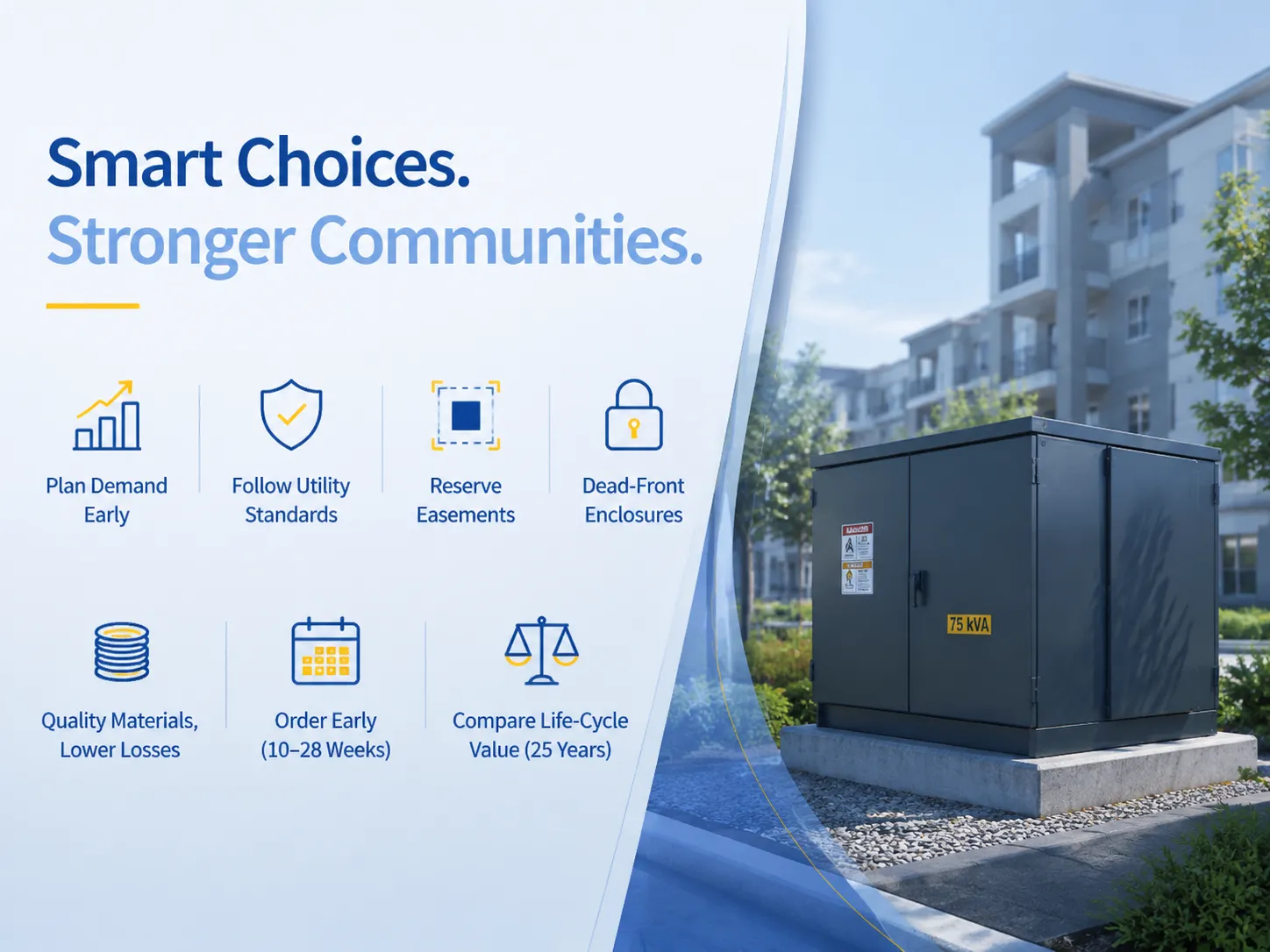
Cómo Deben Elegir las Comunidades
- Prever demandas con anticipación, optimizando los tamaños de los módulos para asegurar que los niveles de demanda máxima estén entre 60 y 80% del tamaño de la placa de identificación, permitiendo cualquier crecimiento asociado con la carga de vehículos eléctricos.
- Verificar el punto de referencia del servicio público respecto al tipo de voltaje, estilo de terminación y estipulaciones de la vivienda.
- Reservar servidumbres como parte del plan del sitio: 1.5 m de acceso público en frente y una distancia de 60 cm alrededor de los módulos; un módulo sirve de 12 a 25 hogares.
- Utilizar frentes muertos y carcasas a prueba de manipulaciones según IEEE C57.12.27.
- Optar por bobinados de cobre y acero de alta calidad para la eficiencia operativa.
- OBSERVAR TIEMPOS DE ADQUISICIÓN DE 10-28 semanas como estándar. Siempre adquirir solo cuando el plan del sitio esté aprobado y no durante el trabajo de construcción.
Preguntas Frecuentes
¿Cuánto cuesta un transformador montado en base para un desarrollo residencial?
Un dispositivo transformador monofásico de 75-167 kVA tiene un precio entre $1,800 y $3,500 (la instalación no está incluida). Por lo general, 8-12 dispositivos son suficientes para servir a 150 casas. Los precios oscilan para transformadores comerciales trifásicos de 300-1,000 kVA y son de $4,500-$16,000. Los precios dados son indicativos y pueden variar según las especificaciones del dispositivo, la marca y la región.
¿Son seguros los transformadores montados en base para hogares y espacios públicos?
Definitivamente. El diseño dead-front significa que ninguna de las partes queda expuesta incluso con el gabinete abierto, mientras que el diseño a prueba de manipulaciones garantiza que no se obtenga acceso no autorizado. Los dispositivos pueden instalarse fácilmente a lo largo de la acera, cerca de parques y en las entradas de los edificios sin necesidad de cercado.
¿Cuántas viviendas puede atender un transformador montado en pedestal?
Para un cliente residencial promedio en EE. UU., se necesitan 10-15 kVA por hogar. Por lo tanto, una unidad monofásica de 167 kVA puede usarse para atender entre 12 y 18 hogares. Sin embargo, las compañías de servicios públicos generalmente pronostican un transformador para atender entre 12 y 25 viviendas, dependiendo del tamaño de la casa, el uso de aire acondicionado y la carga de vehículos eléctricos.
¿Cuánto tiempo duran los transformadores montados en pedestal?
La vida útil es de 25 a 40 años, y se requiere mantenimiento del dispositivo cada 1-3 años. En particular, se debe realizar una inspección visual cada 2-5 años junto con un muestreo de aceite. La vida útil real está determinada por el historial de carga, la condición del aceite y la protección del dispositivo contra la entrada de humedad a través de juntas.
¿Por qué los tiempos de entrega de los transformadores montados en pedestal son tan largos?
Desde principios de la década de 2020, la demanda de transformadores ha sido mayor que su capacidad de producción debido a la modernización de las redes eléctricas, la electrificación y el desarrollo de energías renovables. Los transformadores normales pueden enviarse en un plazo de 20 semanas, los grandes tardan de 16 a 28 semanas. Algunos pedidos pueden tardar 30 semanas. Las mejores recomendaciones incluyen ordenar justo en el momento de la aprobación del plan de construcción del desarrollo habitacional.
Referencias
- IEEE C57.12.00 — Requisitos generales para transformadores de distribución sumergidos en líquido — el diseño base y la norma de clasificación.
- IEEE C57.12.27 — Integridad del recinto de equipos montados en pedestal — requisitos dead-front y de resistencia a manipulaciones para la seguridad comunitaria.
- IEEE C57.12.90 — Procedimientos de prueba para transformadores de distribución — la base de pruebas para pérdidas y rendimiento dieléctrico.
- IEEE 386 — Sistemas de conectores aislados separables — requisitos de conectores dead-front tipo codo.
- U.S. DOE — Normas de eficiencia de transformadores de distribución — niveles mínimos obligatorios de eficiencia para el mercado estadounidense.
- NFPA 70 — Código Eléctrico Nacional — reglas de instalación, despeje y puesta a tierra.
- Jiangsu Subian Electric Power — sitio oficial — fabricante y exportador de transformadores montados en pedestal que cumplen con IEEE.
Conclusión
Utilizar transformadores montados en pedestal proporciona a las comunidades modernas transformadores seguros, confiables y visualmente agradables. Al establecer este transformador en una caja dead-front, libre de manipulaciones, conectada a tierra y con cables conectados bajo tierra, las compañías de servicios públicos y desarrolladores eliminan las interrupciones más comunes debido a fallas en las líneas eléctricas, además de aumentar la seguridad en sistemas eléctricos aéreos por costos iniciales relativamente bajos que las comunidades consideran razonables.
- Dimensione transformadores para capacidades de carga de 60 a 80 kVA anticipando un aumento en la proporción de vehículos eléctricos en el futuro; programe un transformador por cada 12 a 20 viviendas.
- Elija transformadores que cumplan con las normas IEEE C57.12.27.
- Ordene transformadores con anticipación, ya que los tiempos de espera hoy pueden ser de hasta 28 semanas.
- Realice inspecciones de mantenimiento con pruebas de aceite del transformador y despeje de dos tercios de la vegetación.
- Elija proveedores líderes como Prolec GE y Eaton, pero también revise empresas revolucionarias como Jiangsu Subian Electric Power.