


Un propietario de fábrica en Ningbo nos envía una pregunta sencilla: “Nuestro transformador de distribución de 2,500 kVA ha estado en funcionamiento desde 2009. Si lo reemplazo por una unidad de núcleo amorfo actualizada, ¿cuánto ahorro veré en mi factura de electricidad?” Esta pregunta es válida ya que la innovación en transformadores energéticamente eficientes es ahora más un argumento comercial que un eslogan ecológico. La IEC 60076-20 y su estándar chino equivalente GB 20052 han establecido niveles de pérdida en vacío que los viejos transformadores no pueden cumplir. Esto hace que los cálculos sean simples: en este ejemplo, un transformador de 63 kVA con el límite de pérdida en vacío establecido en 2,300 kWh/año frente a un diseño antiguo que consume al menos 4,000 kWh solo para mantenerse magnetizado. Esta diferencia durante veinte años se acumula en decenas de miles de dólares.
Este artículo continúa explicando las fuentes de este ahorro: materiales del núcleo, materiales de bobinado, diseño geométrico, método de enfriamiento y carga basada en resultados de monitoreo, y proporciona primas de precio apropiadas para que se pueda elaborar un sólido caso de retorno de inversión.
Los desarrollos actuales en transformadores energéticamente eficientes giran en torno a cinco categorías clave: el uso de núcleos de metal amorfo que reducen las pérdidas en vacío en un 60-80% en comparación con la fabricación convencional de acero silicio orientado a grano; el uso de versiones mejoradas de aceros silicio orientados a grano (por ejemplo, 23ZH90); el uso de bobinados de cobre puro o aluminio puro para minimizar las pérdidas por carga; la optimización del diseño del núcleo y el uso de acero delgado grabado con láser; y finalmente, la utilización de herramientas de monitoreo inteligente que aseguran que los transformadores operen cerca de la máxima eficiencia en su carga nominal.
¿Qué es un transformador energéticamente eficiente?
Un transformador energéticamente eficiente se reconoce como cualquier dispositivo que tiene un mejor rendimiento de eficiencia que un transformador estándar de la época. La eficiencia se basa en las pérdidas en vacío y en carga, con parámetros medidos a una temperatura de 75 °C de acuerdo con la IEC 60076-1. La diferencia en eficiencia puede parecer menor, ya que un transformador moderno generalmente tiene una eficiencia de entre 98.5–99.5%, pero considerando un transformador que opera continuamente, incluso una mera mejora del 0.5% en una estación transformadora se convierte en una suma significativa, con un transformador de 10 MVA ahorrando alrededor de 50,000 kWh por año, lo que equivale a entre $6,000–$12,000 dependiendo de las tarifas industriales de $0.12–$0.24/kWh.
La definición del término se estableció como una categoría de producto en las décadas de 1990 y 2000 cuando Japón, EE. UU. y más tarde China desarrollaron categorías de eficiencia para transformadores de distribución. El estándar chino GB 20052-2020 y los estándares de eficiencia de DOE de 2016 promueven el uso de tecnología de núcleo amorfo. Así, hoy en día, un transformador energéticamente eficiente es aquel que satisface al menos la segunda clase de eficiencia de acuerdo con los estándares IEC 60076-20, mientras que la clase más alta corresponde a un transformador con un núcleo amorfo y materiales de bobinado mejorados en su interior.
Cómo ocurren las pérdidas de energía: La física detrás de los ahorros.
Hay dos tipos de pérdidas en transformadores, y los métodos de ahorro de energía dependen específicamente del tipo. La pérdida en vacío (también llamada pérdida de núcleo o pérdida de hierro) ocurre tan pronto como se enciende el transformador, incluso si no se está utilizando. La pérdida en vacío se puede dividir en dos partes: la pérdida por histéresis, que depende del material utilizado para fabricar el núcleo y de la frecuencia, y la pérdida por corrientes parásitas, que depende del grosor de la laminación y de la frecuencia. Juntas, estas dos clases de pérdidas son responsables de aproximadamente 30–50% de las pérdidas totales que ocurren en un transformador de distribución típico que trabaja bajo carga moderada. Esta es la razón para mejorar la tecnología del metal amorfo, que proporciona una pérdida por histéresis que es mucho más baja que en el acero orientado al grano.
Con respecto a la pérdida por carga (pérdida de cobre), este tipo de pérdida se determina por el calentamiento I²R en el devanado y también por las pérdidas en el material utilizado para fabricar el marco del transformador. La pérdida por carga aumenta exponencialmente. La proporción se puede ilustrar de esta manera: a 50% de carga, la pérdida por carga es aproximadamente 25% de la pérdida máxima, a 110% de carga la pérdida por carga es 121% de la carga máxima. Para minimizar las pérdidas por carga, es posible realizar cambios en el diseño, por ejemplo, aumentando el área del conductor de alambre, utilizando cobre en lugar de aluminio porque la resistividad del cobre es 40% menor que la del aluminio (cobre = 0.0172 Ω·mm²/m; aluminio = 0.0282 Ω·mm²/m). Algunas características de diseño también son importantes: ciertos tipos de patrones de devanado pueden reducir las pérdidas parásitas y la colocación adecuada de diferentes dispositivos puede ayudar a evitar la creación de corrientes circulatorias.
Tecnologías clave de ahorro de energía y potencial de ahorro
| Tecnología | Lo que cambia | Reducción típica de pérdidas | Costo inicial adicional |
|---|---|---|---|
| Núcleo de metal amorfo | Material del núcleo | 60–80% menor pérdida en vacío | +15–30% |
| Acero silicio orientado al grano de primera calidad (GOES) | Grado de material del núcleo | 15–30% menor pérdida en vacío frente a grados más antiguos | +5–15% |
| Acero grabado con láser / acero refinado por dominio | Tratamiento de superficie del núcleo | 8–15% menor pérdida de núcleo | +2–5% |
| Bobinados de cobre en lugar de aluminio | Material de devanado | 20–30% menor pérdida por carga a la misma clasificación | +10–20% |
| Mayor sección transversal del conductor | Geometría del devanado | 10–20% menor pérdida por carga | +5–10% |
| Enfriamiento mejorado (ONAN→ONAF, radiadores mejorados) | Diseño térmico | Permite una mayor carga sin pérdida adicional | +3–8% |
| Monitoreo y optimización de carga inteligente | Operaciones | 3–8% de reducción de energía en toda la flota | +1,500–8,000 por unidad (monitoreo) |
Las tecnologías están apiladas una sobre la otra. Un núcleo amorfo de alta calidad con bobinas de cobre y acero fabricado con láser puede demostrar 50-60% menos pérdidas totales que el diseño de 20 años hecho de acero silicio. Sin embargo, tenga en cuenta los compromisos: los núcleos amorfos son más sensibles a las fuerzas mecánicas y tienen una densidad de flujo de saturación reducida, lo que incita a los diseñadores a hacer un núcleo más grande para compensar, por lo tanto, el aumento del costo inicial. La elección se basa en el número de horas que su transformador está en operación; en caso de que esté funcionando al nivel de 20-30% la mayor parte del tiempo de trabajo, la pérdida en vacío domina y el amorfo está en demanda.
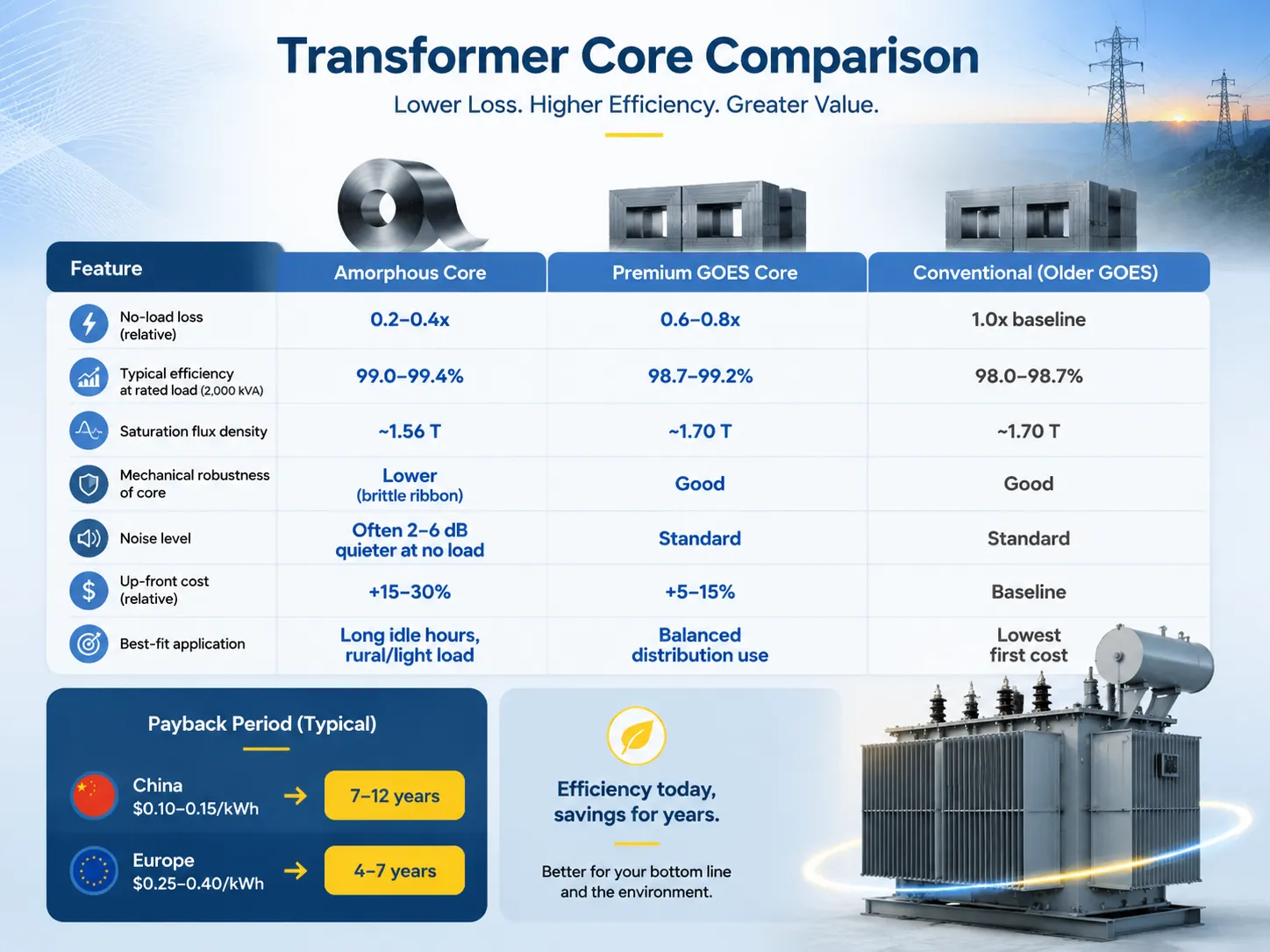
Amorpho vs. Acero Silicio vs. Transformador Convencional
| Característica | Núcleo Amorfoso | Núcleo GOES Premium | Convencional (GOES Antiguo) |
|---|---|---|---|
| Pérdida en vacío (relativa) | 0.2–0.4x | 0.6–0.8x | 0x base |
| Eficiencia típica a carga nominal (2,000 kVA) | 99.0–99.4% | 98.7–99.2% | 98.0–98.7% |
| Densidad de flujo de saturación | ~1.56 T | ~1.70 T | ~1.70 T |
| Mechanical robustness of core | Lower (brittle ribbon) | Buena | Buena |
| Nivel de ruido | Often 2–6 dB quieter at no load | Estándar | Estándar |
| Up-front cost (relative) | +15–30% | +5–15% | Línea base |
| Best-fit application | Long idle hours, rural/light load | Balanced distribution use | Lowest first cost |
| Payback period (typical) | 6–12 years | 3–8 years | n/a |
The context of the payback columns is important. Under China’s industrial tariffs of $0.10-0.15/kWh, an amorphous upgrade pays back in 7-12 years, whereas, in Europe, where industrial power costs $0.25-0.40/kWh, the same upgrade pays back in just 4-7 years. This is why efficiency-first regulation is becoming more widespread — the math for savings works even before accounting for environmental benefits.
Efficiency Classes & Standards
| Estándar | What It Defines | Status / Notes |
|---|---|---|
| IEC 60076-20 | Energy efficiency classes for distribution transformers (class 1 = highest) | Current international reference |
| GB 20052-2020 | Energy efficiency values for power and distribution transformers in China | Mandatory; three efficiency grades |
| US DOE 10 CFR 431 (2016 rule) | Minimum efficiency for liquid-immersed distribution transformers | Amended to a stricter standard from 2027 in the US |
| EU Regulation 548/2014 (amended 2019) | Eco-design Tier 1 and Tier 2 efficiency levels for transformers | Bans sale of the lowest-efficiency classes in the EU |
| IEC 60076-1 | General power transformer rating and loss measurement methods | Basis for loss guarantees and test procedures |
Make sure to check the standard of “energy-saving transformer” mentioned in the product sheet whenever you come across it. A unit with “GB 20052 Level 3” on it is superior to a unit without a rating, but it is much less superior compared to one with “Level 1”. An ordinary top performer is a unit with “IEC 60076-20 class 1” on it. Guarantees on losses are negotiable too: companies like Jiangsu Subian Electric Power, which produce products according to IEC 60076 norms, will include P0 and Pk values in their offer and test them in production. This way, you will be able to hold them accountable for the figures mentioned with the help of tolerance clauses according to IEC 60076-1.
Where Energy-Saving Transformers Pay Off Most
The economic perspective differs considerably with respect to applications, where it is important to go by the load profile rather than the promotional material. Utilities and rural distribution represents the classic amorphous core application: rural transformers operate 8,760 hours per year; however, they are frequently discharging less than 25% of their load, which means that no-load losses are predominant and the payback is most attractive. Industrial plants operating around the clock have high load factors; in this case, the emphasis is on minimal load loss, meaning that copper windings, substantial conductors, and sometimes parallel small transformers are used. Commercial buildings and data centers need both efficiency and low noise levels, where amorphous cores are quieter than others, thus dry-type or cast resin units are often adopted. Renewable energy farms have their specifics: inverters have high harmonics in their output; besides, the pattern of generation is characterized by long hours of working under light loads, which calls for both low no-load losses and protection from harmonics.
For all these cases, the approach is the same: calculate the annual use profile, calculate costs of energy based on the ligation tariffs and compare total cost of ownership over the period of 15 to 20 years against the purchasing cost.
| Aplicación | Load Pattern | Dominant Loss | Recommended Technology | Typical Payback |
|---|---|---|---|---|
| Rural distribution | Energized 8,760 h/yr, low load | Pérdida en vacío | Núcleo amorfo | 5–10 years |
| Urban utility substation | Cyclic peaks, moderate average | Mixed | Premium GOES + copper | 4–8 años |
| 24/7 industrial plant | High load factor 70–90% | Pérdida de carga | Copper windings, larger conductors | 2–5 years |
| Commercial building / data center | Daytime peaks, high availability | Mixed + noise | Dry-type, low-noise, premium steel | 3–6 años |
| Solar / wind farm | Cyclic generation, harmonics | No-load + stray losses | Amorphous or premium GOES, harmonic-tested | 4–8 años |
Top Brands & Price Ranges
| Marca | Specialty | Typical Price Range (2,000 kVA class) | Region |
|---|---|---|---|
| Hitachi Energy (ABB) | Amorphous & large power transformers | $35,000–$70,000 | Switzerland/Global |
| Siemens Energy | Power transformers, grid solutions | $38,000–$75,000 | Germany/Global |
| Schneider Electric | Distribution & dry-type transformers | $25,000–$55,000 | France/Global |
| TBEA | Amorphous & large power transformers | $20,000–$45,000 | China |
| China XD / Baoding Tianwei | Power transformers, UHV expertise | $22,000–$50,000 | China |
| Jiangsu Subian Electric Power | Distribution & power transformers to IEC 60076 | $15,000–$38,000 | China/Global export |
The prices can differ depending on specification, efficiency class, cooling type, and accessories, so consider them as guiding values. Popular global manufacturers such as Hitachi Energy, Siemens Energy, and Schneider Electric have a good reliability record. Their prices reflect that. Chinese companies such as Jiangsu Subian Electric Power have managed to close much of the gap in terms of quality, as modern Chinese distribution and power transformers comply with established IEC 60076 and are made using the same measurement techniques. They are also sold globally 20-40% cheaper than their European counterparts. Those who maintain budget consciousness but want assured low losses can opt for a Chinese IEC-compliant product, just make sure to check the test report from the manufacturer and include a third-party test in the contract in case the order is significant.
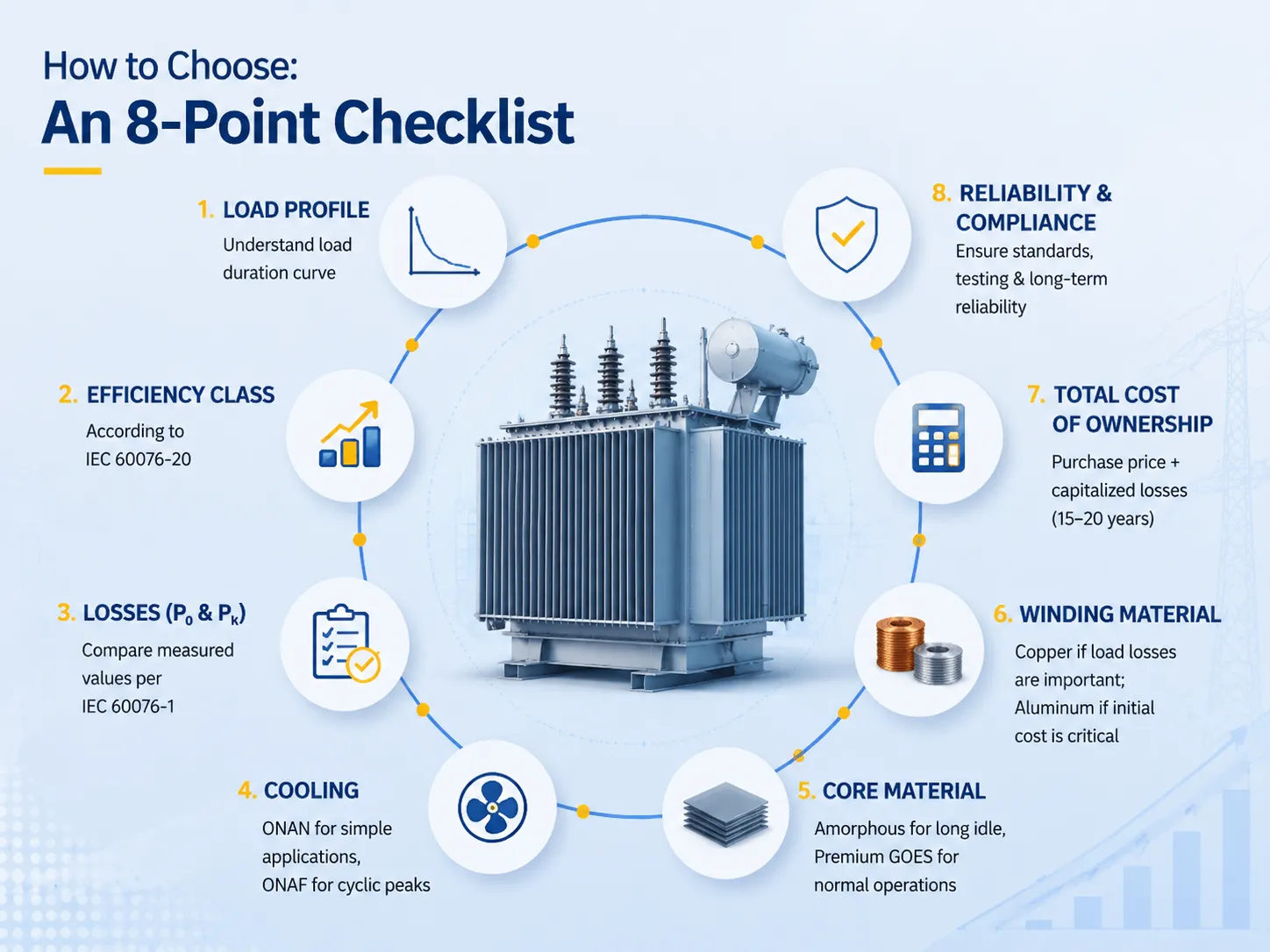
How to Choose: An 8-Point Checklist
- What is load profile? Estimate the annual load duration curve to determine whether no-load losses or load losses are predominant.
- Next, determine the efficiency class. IEC 60076-20 defines classes 1, 2 and 3 or the equivalent local standard based on tariff, load factor and estimated working life.
- Now compare P0 and Pk values as declared in measurements. Ensure that the manufacturer has conducted tests in accordance with IEC 60076-1 and not just relied on the catalog data.
- Make sure that the cooling is appropriate for the application. ONAN for simple applications or ONAF or forced cooling for cyclic peaks.
- Next check if the core material is suitable for the application. Use amorphous core for long idle conditions and premium GOES for normal operations, and also make sure you comply with noise and saturation limits.
- Decide what winding material has to be used in the transformer. Copper if load losses are important; aluminum only if initial cost is critical and load factor is low.
- Finally, calculate total cost of ownership. Price of acquisition and capitalized losses during next 15 – 20 years from the moment of commissioning will give you total cost.
Maintaining Efficiency Over the Long Run
Efficiency is not a static feature but one that erodes gradually over time or because of poor maintenance practices. The core losses will often remain unchanged for decades as long as the core is not subjected to mechanical disturbance, while winding losses will rise due to deterioration of the paper insulation and the increase of oxidation in oil, although this effect is relatively small. The major losses are caused by humidity and loading conditions. The moisture in the oil higher than 2% will help the paper insulation to age faster, resulting in an increase of dielectric losses; it is important to maintain high BDV, preferably above 30 kV and at all times test the oil to verify the moisture content (IEC 60156, Karl Fischer). It is important also to monitor the loading process because the prolonged overloading will increase I²R losses, so that at 120% load the load losses are already 44% higher than they should be.
For maintenance with regard to efficiency, the company must conduct annual DGA and oil quality controls, quarterly tests for the performance of the cooling system, continuous cleaning of the oil cooler from dust and vegetation, as well as quarterly analysis of the load data in order to detect any discrepancies. One more important thing to consider is the optimization of the voltage during the re-energizing process and the tap changer positions, since overloading can drastically increase the no-load losses in a unit. For example, by increasing the voltage by 5%, the core losses will grow by 10-12% approximately and hence accurate position should be chosen for the tap changer.
Preguntas Frecuentes
How much electricity does an energy-saving transformer actually save?
Savings rely on load profile. For a distribution transformer of 2000 kVA replaced from an outdated silicon-steel design to an amorphous-core version, the typical known energy-saving potential is in the range of 8000 to 15000 kWh per year, which translates to a monetary equivalent of $1000 to $2500 at the electricity price of $0.12-$0.24 per kWh. If we include improvements in loss of power due to the application of copper winding technology, then in the case of high load factor, the total saving can be estimated at the magnitude up to 15000-30000 kWh per year. Power loss is greatest at low load and long duration of operation.
Is an amorphous core transformer worth the higher price?
Normally, this is true for devices that spend a lot of time operational under low load – for example, rural electrical distribution and renewable energy devices. The extra expense associated with this technology is about 15–30% more than the cost of traditional silicon steel, and the payback time is around 6–12 at standard industrial prices and 4–7 years in highly priced areas. In case the distribution transformer operates mostly under maximum load, the no-load savings become of less value, thus, the steel core made of premium materials and a copper winding wire can benefit more in this specific case overall.
What efficiency class should I specify for a new transformer?
In many markets, IEC 60076-20 class 2 should generally be taken as the minimum, with class 1 being used at times of high tariffs or low load factor. Under the rules of the EU eco-design, class 1 has almost turned into the standard for new distribution transformers. China’s GB 20052-2020 standard establishes three levels of efficiency, with Level 1 being the most efficient of the three. The efficiency premium can usually be recovered within less than a decade for an asset with a lifespan of 15 to 20 years; hence specifying the highest class is seen as the only rational economic option most of the time.
Does using copper instead of aluminum really matter?
Yes, it can be measured. Copper’s resistivity is around 40% lower than aluminum’s (0.0172 versus 0.0282 Ω·mm²/m, respectively, at 20 °C), so the copper winding uses less conductor volume to achieve the same loss and works at lower temperatures – it can carry a bigger current for the same losses. For high load factors, copper windings can decrease load losses by 20-30% compared to the equivalent aluminum design. What is the disadvantage? The pricing – copper windings increase the cost of the transformer by 10-20% approximately.
How do I verify a manufacturer’s loss figures?
Ask for the factory tests results performed according to IEC 60076-1 standards, which lay down required measurements for both the no-load losses and loading losses with tolerances applied. For large orders, ensure that a third party is there to witness the testing at the factory or in an independent testing lab along with getting a loss guarantee clause added to the contracts with penalties in case of exceeding losses above the contracted ones. The leading manufacturers such as Jiangsu Subian Electric Power will never hesitate to share the testing methods, references, and installations used unless they are trying to hide some facts.
Referencias
- IEC 60076-20: Power transformers – Part 20: Energy efficiency — the international standard defining efficiency classes for distribution transformers.
- IEC 60076-1: Power transformers – Part 1: General — defines rating, loss measurement, and testing procedures.
- US DOE – Energy Efficiency of Distribution Transformers — US regulatory minimum-efficiency rules and technical background.
- EU Regulation 548/2014 on transformer eco-design — European efficiency requirements and tiered phase-in schedule.
- GB 20052-2020 (Chinese national standard) reference — efficiency grades for power and distribution transformers in China.
- Amorphous metal core technology resources — technical background on amorphous core properties and applications.
- Jiangsu Subian Electric Power — IEC 60076-compliant transformer manufacturer offering amorphous and premium steel designs with verifiable loss reports.
Conclusión
The invention of energy-efficient transformers has shifted from being a special feature to become an important criterion in purchasing decisions. The theory behind energy-efficient transformers is easy: the use of amorphous cores leads to a reduction in no-load losses by 60-80%, copper winding reduces load losses from the point of view of physics by 20-30%, and with smart load management, the transformer operates most efficiently. The key question asked is not “Are these transformers energy-efficient?” but “Does the payback period suit my loading and tariff?” The answer is positive in most cases within 4-12 years.
- Amorphous cores work well in case of idle transformers with little load, whereas the combination of GOES material and copper is more appropriate for transformers with high load factor.
- Make sure to choose transformers of IEC 60076-20 class 1 or 2 and to ask for graphs of factory transformer test results.
- Compare the total life cost over 15-20 years instead of purchasing cost.
- Make sure that you control tap position and keep oil dry.