


Un energy storage compact substation serves as a connection between a battery energy storage system (BESS) and a medium voltage distribution network. The electric equipment associated with the conversion and protection of energy remains compact and engineered on the site. Each of these projects includes a bidirectional conversion system, a step up transformer, medium voltage electronic devices, and the auxiliary equipment for monitoring and control of the system. The different construction approaches in these constructions include the integration of the PCS to be located on the same skid or in a separate box or to locate it near the transformer.
Respuesta rápida: An energy storage compact substation represents an interface between the BESS and medium voltage distribution grid at 11, 20, 22, 33 or 35 kV. The compact substation with integrated PCS is a design which brings together the converter and all electronic equipment into a single construction. Purchasing the compact substations depends on various factors, which include specification of the PCS, transformer power, ability to work in a bi-directional regime, etc.
This guide provides detailed information concerning the electrical structure of the system and the difference between compact substation designs with integrated and separate conversion systems, specifications needed by EPC contractors, and the evaluation of the suppliers of the compact subsystems. The guide also provides information concerning transformer constructors and the manufacturers of the assemblies.
What Is an Energy Storage Compact Substation?
In an AC coupled BESS system, direct current is delivered by the batteries, whereas the PCS changes it into alternating current so that it can be fed into the grid. When charging, energy flows in the reverse direction. The transformer modifies the ACS current to that of the energy collection grid. All the other MV equipment connects the block and operates the isolation of the unit. The bidirectional circulation of electricity becomes something that differentiates a BESS from an ordinary substation.
One must keep in mind that marketing terminology covers/overlaps compact substation, MV skid, PCS transformer station and power conversion station, but their meaning is different. The buyer can be offered either a MV transformer and switch gear unit, or a skid with preinstalled PCS or a complete BESS block.
A standard electrical line and parts limits
Battery racks (DC) → DC safety and fence protection → bi-direction PCS → low voltage AC safety → step-up transformers → MV switchboard and safety → MV collection lines → point of connection to the grid.
This is a synonymous AC-connected configuration. The process for controlling the battery system (BMS), energy system (EMS), plant controller, communications, emergency system and auxiliary equipment is not a part of the electrical line. The approach for DC-connected PV systems can be dissimilar; therefore, the same scheme cannot be used for every configuration.
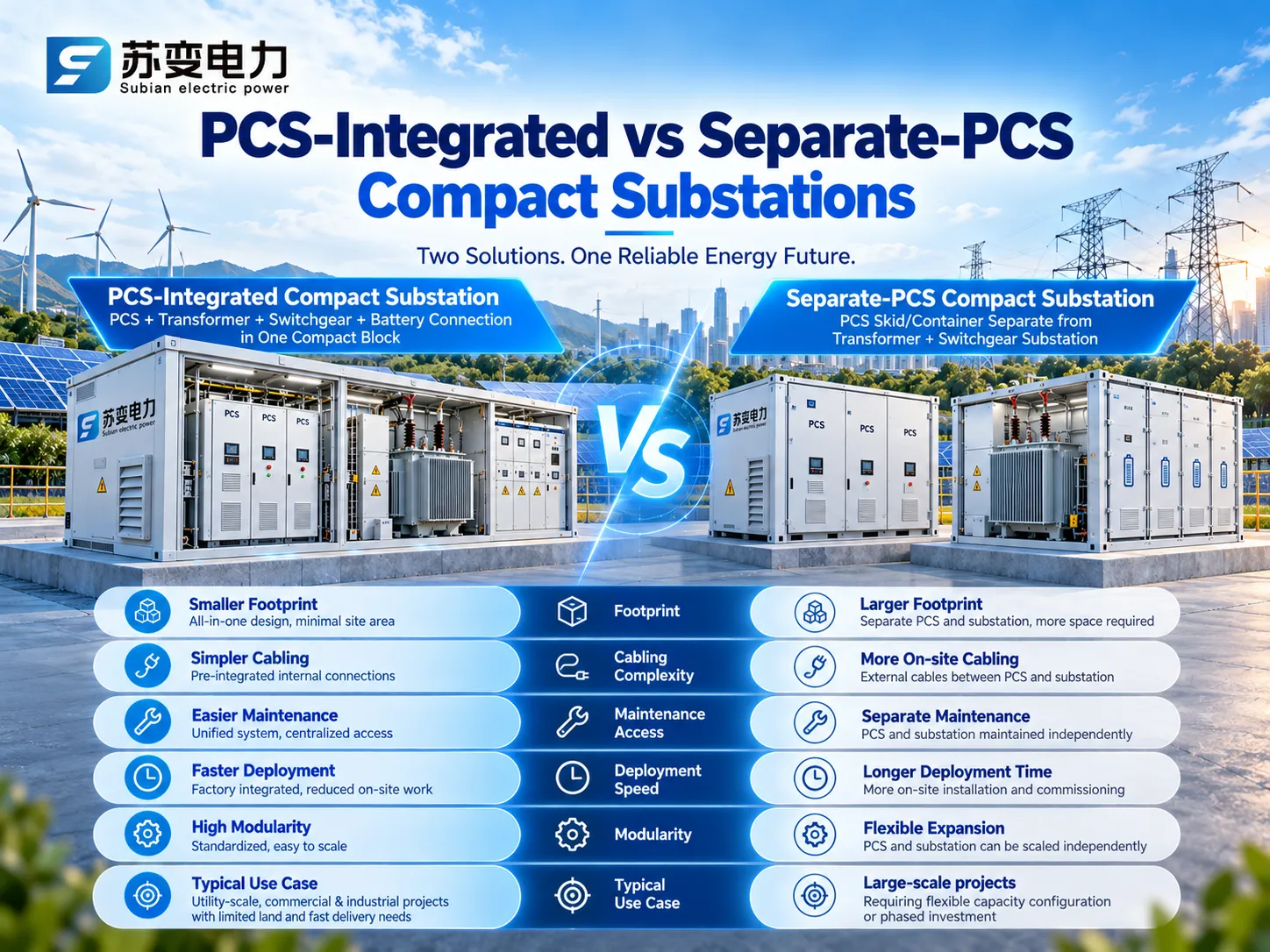
PCS-Integrated vs Separate-PCS Compact Substations
Implementation of PCS systems may reduce the need for cabling and interface installation in the field; however, the choice of an integrated solution should not be viewed as a guaranteed success. The specifics of the layout design depend on the provider of the PCS system, thermal regulation, provision of necessary access, dimensions of the site and transport restrictions.
| Diseño | Typical arrangement | Advantages | Trade-offs |
|---|---|---|---|
| PCS-integrated MV skid or enclosure | PCS, transformer, MV switching and interconnections supplied as one coordinated block or set of closely integrated modules | More factory assembly; fewer on-site interfaces; repeatable modular layout | Concentrated heat, access and transport constraints; component-specific testing still required |
| Separate PCS + compact transformer substation | PCS in independent outdoor cabinets or container; transformer and MV switchgear in adjacent substation | Flexible vendor choice, clear service zones and easier equipment replacement | More LV AC cabling and field coordination; site installation scope may be larger |
| Central PCS vs distributed/string PCS | One or a few large conversion units versus multiple smaller converters feeding one or more transformers | Can be optimized for redundancy, capacity and plant controls | Protection, cable losses, harmonics and maintenance arrangements differ |
A supplier offering the enclosure, transformer and MV switchgear is not necessarily offering the PCS, EMS, BMS or a complete certified BESS. Ask for the supply-boundary matrix and a single-line diagram (SLD) at the start of the RFQ.
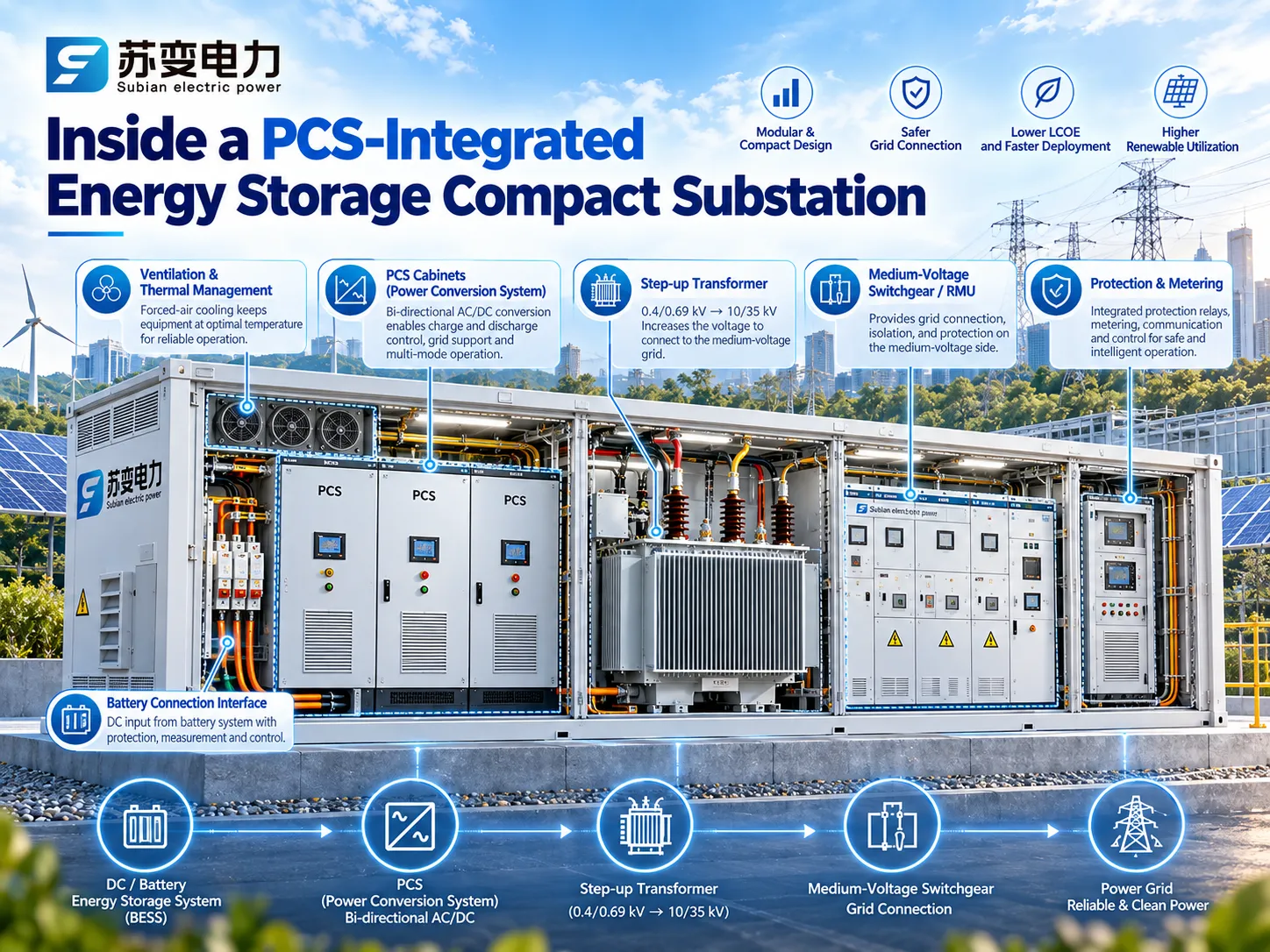
The main parts of a PCS-based energy-storage substation
Bidirectional power conversion device (PCS)
It is essential to choose the right for the battery DC operation voltage range and low-voltage transformer. It is necessary to check the continuous MW and MVA performance and find out the requirements for charge/discharge modes of operation, reactive power delivery (if applicable), emissions of harmonics and required working temperature. Just having a 2 MW PCS doesn’t mean that it is capable of providing necessary reactive power requirements.
BESS booster transformer
It is responsible for frequent charging and discharging, changing load profiles and big amount of harmonics coming from converters. A right MVA needs to be selected basing on factors such as PCS characteristics, losses, surrounding conditions, cooling and overloads specifications. Design of winding material, impedance, vector group, tap range, earthing system and guaranteed no-load/load losses must be defined. Both oil immersed transformers and dry transformers may be used here depending on the conditions and project safety regulations.
Medium voltage switch gear, RMU and protection relays
Medium voltage RMU or circuit breaker switchgear ensures the operation of disconnecting and fault clearing. There must be sufficient fault current, short time withstand current, making/breaking duty and feeder configuration, besides, protective relays, measuring devices must be evaluated as well. Usually, load break switch or fuse combination cannot substitute a breaker as there are specific protection requirements.
Auxiliaries, cooling and information technology interfaces
Designing must be based on auxiliary transformers, UPS, ventilation or air conditioning system, its installation must guarantee the heat removed during operation.
Energy Storage Compact Substation Specifications: What Buyers Should Request
For international projects, an engineering specification is more useful than a generic claim of “11–35 kV” or “PCS ready.” The items below belong on the quotation and approved drawings.
| Especificación | What to confirm | Por qué es importante |
|---|---|---|
| Grid nominal voltage / equipment rated voltage | For example, 11 kV network with suitable 12 kV class equipment, or 33 kV with suitable 36 kV class equipment, subject to network rules | Insulation coordination and correct MV apparatus |
| PCS AC voltage and rated MW/MVA | Exact converter datasheet and continuous charge/discharge operating envelope | Transformer winding compatibility and thermal sizing |
| Transformer rating and type | kVA/MVA, ratio, impedance, cooling, loss guarantees, vector group, taps | Reliability, loss cost and grid compliance |
| MV short-circuit duty | Short-time withstand, peak withstand, breaking duties and duration | Equipment and personnel safety |
| Protección y control | Protection study, relay functions, SCADA/EMS protocol and interlocks | Safe bidirectional operation |
| Site / enclosure conditions | Ambient range, altitude, corrosion category, ventilation and required IP degree | Derating and maintenance access |
| Standards and proof | Applicable IEC / local rules, type-test coverage, routine test reports and FAT scope | Approvals and contractual acceptance |
Example: sizing the step-up transformer for a 2.5 MW PCS
Assuming that the PCS has to deliver a load of 2.5 MW with a power factor of 0.95 from its AC terminals means that the apparent power will be about 2.5/0.95 ≈ 2.63 MVA. This is not a fixed transformer specification, but rather a first step in the calculations – reactive power needs to be calculated at different operating points, overload and harmonics of the converter, the influence of temperature on the site and some other details of engineering calculations.
Also keep in mind that MW and MWh are different figures. A 2.5 MW / 5 MWh BESS has a nominal two-hour energy-to-power ratio, while the real energy supply duration will depend on the battery operation constraints.
11kV, 22kV and 33/35kV Grid Connections for BESS
Compact storage substations could be connected to networks which operate at 11, 20/22, 33 or 35 kV lines, based on the local utility practices and studies regarding the size of the plant, as well as point of inter-connection. The project designer is responsible for determining the nature of the connection made to the technical network and the required protection. The manufacturer is therefore tasked with choosing the suitable ratings of the transformer and switchgear.
For a number of BESS blocks, the individual PCS transformer stations can feed a medium voltage collector in order to connect to the high voltage grid substation. In a smaller commercial facility, a single transformer station can connect the local battery facility with the MV distribution network.
IEC Standards and Safety Requirements for BESS Substations
Different standards apply to different parts of the installation. Avoid accepting a single blanket statement that a complete PCS-integrated substation is “IEC certified” without identifying the assembly, equipment and actual test evidence.
| Estándar | Primary relevance |
|---|---|
| IEC 62271-202:2022 | Requirements and tests for applicable AC prefabricated substations above 1 kV and up to 52 kV |
| IEC 62271-200 | Applicable medium-voltage metal-enclosed switchgear and controlgear |
| Serie IEC 60076 | Power transformer design, ratings and tests; the applicable parts depend on transformer construction |
| IEC 62477-1:2022 | General safety requirements for power electronic converter systems within its defined voltage scope |
| IEC 62933-5-2:2025 | Safety requirements for grid-integrated electrochemical energy storage systems |
| Local interconnection / fire / utility rules | Project-specific protection, grid-support functions, battery safety, commissioning and permissions |
IEC 62271-202 deals with prefabricated assembly substation where it applies and does not imply a general certificate for batteries or PCS. IEC 62933-5-2 specifies the safety of electrochemical BESS systems in operation. A PCS needs to conform to its specific safety requirements. In addition, local laws or grid operators impose additional requirements. If the manufacturer has changed transformer or converter or switchgear arrangement or casing compared with the previous design that was already verified, it is better to get clarified how this change influences on the validity of the test results.
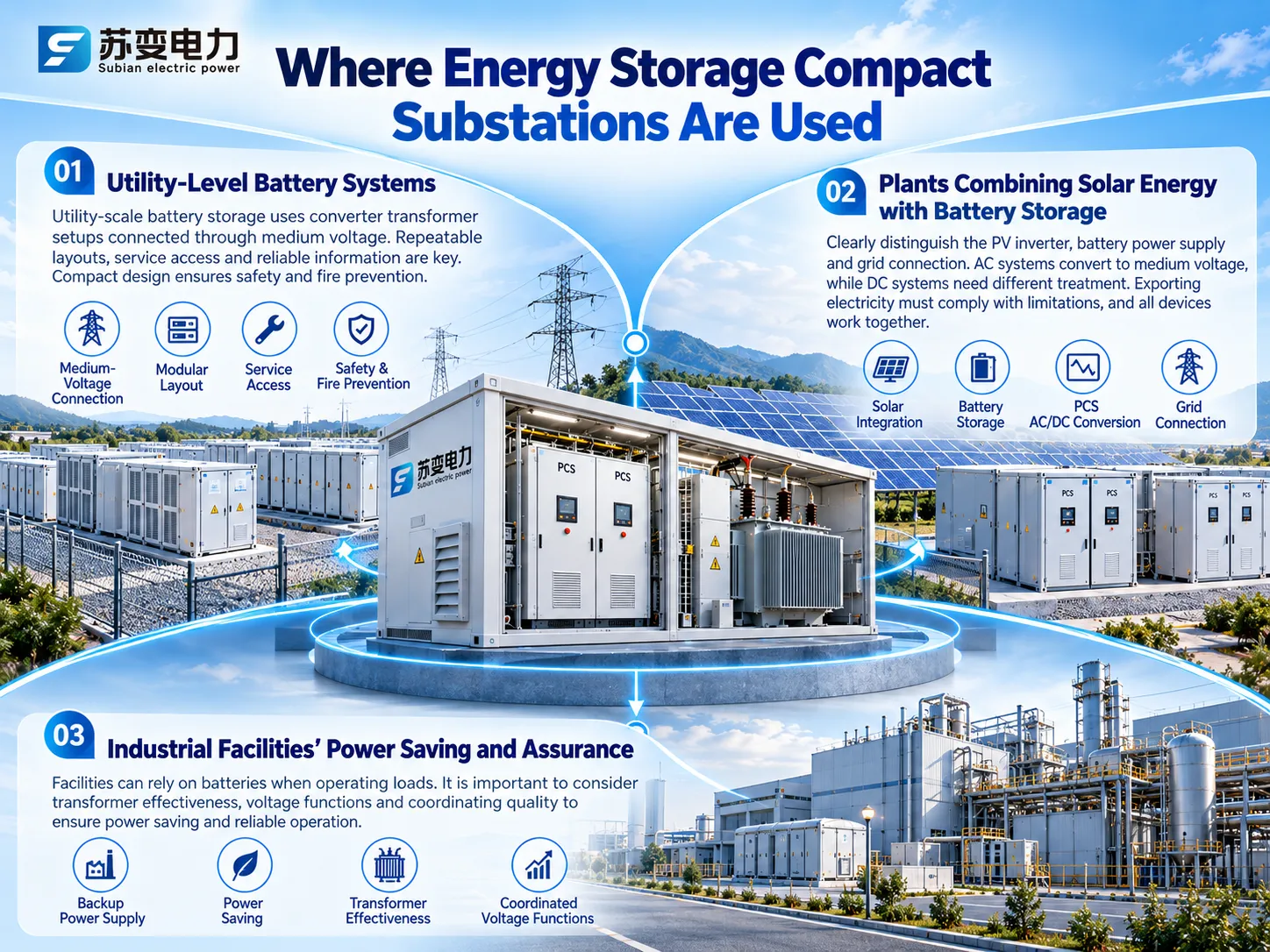
Where Energy Storage Compact Substations Are Used
Utility level battery systems
Utility scale battery storage systems use many converter transformer setups that are connected through the medium voltage electrical connection. Repeatable layouts, service access and reliable information are very important. The compact design should ensure safety and fire prevention access.
Plants combining solar energy with battery storage
It is important to make a clear difference between the PV inverter, battery power supply and shared network connection. AC systems usually use different sources of energy converted into medium voltage electricity, while DC systems need to be treated in a different way. Exporting electricity must comply with the limitations, all processes or devices must work at the same time.
Industrial facilities’ power saving and assurance
Facilities can rely on the batteries when operating loads. In this case, it is more important to consider how effective the transformer is, what voltage functions it performs and its coordinating quality.
What Leading Brands Illustrate About PCS and Modular Substation Design
Different manufacturers showcase various stages of the supply chain process. For example, Sungrow provides bidirectional power conditioning systems (PCS) along with large-scale battery storage systems that can both serve as reference points for inquiries into their capacity ratings and grid-support capabilities. Similarly, Hitachi Energy shares information on container-shaped, ready-made modular substations, demonstrating factory assembly and grid-connection interfaces. These examples serve as references and do not claim that these two manufacturers share the same product description or that any particular Subian device is the same as theirs.
When assessing the supplier, it is important to compare the set of equipment being provided: whether it includes batteries, PCS, transformers, switchgear, burning systems, grid management systems or testing. After that, the supplier’s footprint, quality guarantees, lead times and price can be compared.
How do you select the most appropriate Supplier of a compact substation with an integrated BESS-PCS?
An EPC customer should ask all bidders to submit similar project inputs. At a minimum, you will have to submit a single-line diagram, the BESS MW/MWh, the PCS make/model, the specifications for the direct current voltage, the nominal voltage, grid voltage and frequency, fault characteristics, point of connection to the grid and its requirements, and ambient conditions of the delivery destination.
Confirm at which location you will be receiving the equipment and check out who will be the supplier of the equipment of the PCS and transformer, the RMU/MV circuit breaker, relay protection, the control panel, and connecting wires.
Make sure that the PCS and transformer will be compatible with each other; thus, identify the voltage and maximum apparent power (MVA) range of the PCS and the transformer.Rest on the converters, grounding and leakage currents. Also check what demands for the interface between the converter and the device the manufacturer will have.
Examine documented safety principles like detailed assembly design reports and reports on the results of equipment testing.
Carry out the investigation of the physical integration of the system; thus, analyze the weight of the equipment,its dimensions, and how the cables will be fed.
Subian Electric: Transformer and MV Substation Support for BESS Projects
Subian Electric manufactures transformers, medium-voltage switchgear and prefabricated substation products. Its subestación prefabricada serie YB integrates a transformer with HV/MV switching and LV distribution; its YBM 35 kV photovoltaic step-up substation offers relevant renewable-energy step-up experience. These product families provide a basis for reviewing transformer and MV substation packages for a storage project.
Important supply clarification: Subian’s public product information does not by itself establish that a complete PCS-integrated BESS substation—including a particular PCS, battery system and all system-level certificates—is a standard, tested Subian product. Any PCS-inclusive offer, integration responsibility, compatibility and project-specific certification must be confirmed in the quotation and approved drawings. Subian is an independent manufacturer and is not affiliated with or endorsed by the brands referenced in this guide.
For an engineering review, provide your battery/PCS technical datasheets, single-line diagram, grid voltage, transformer rating, protection requirements, installation conditions and project location. Contacte a Subian Electric to discuss a project-specific transformer, switchgear or compact substation quotation, and any separately confirmed PCS integration scope.
Preguntas Frecuentes
What is an energy storage compact substation?
The BESS Grid Interface Station is a compact electric grid connection facility featuring a step-up transformer, high voltage switchgear gear and equipment for complete protection and other auxiliary functions. The power conditioning system can be a part of an integrated skid or installed in proximity to the BESS Grid Interface Station.
What does PCS mean in an energy storage substation?
PCS means power conversion system: the bidirectional converter that changes DC battery power into AC for export and converts AC to DC when charging. PCS operation is coordinated with the battery controls and plant controller.
Is a PCS-integrated compact substation the same as a battery container?
No. A battery container houses battery modules and associated safety and thermal systems. A PCS-integrated MV station focuses on conversion and grid-interface equipment; some projects use adjacent, interconnected modules rather than one enclosure.
Can a BESS compact substation connect to an 11 kV or 33 kV grid?
Yes, when engineered for the project’s nominal voltage, insulation level, grid fault current and interconnection rules. Transformer and MV switchgear ratings must match the actual network.
How do you size a BESS step-up transformer?
Begin with the PCS apparent-power operation envelope to undertake the assessment of the power factor/reactive requirements and such things as converter overload, harmonics, losses, ambient conditions, cooling, and site-specific safety margin. Just the battery MWh value is insufficient.
What is the difference between an MV skid and a compact substation?
An MV skid means a portable platform that bears transformation and/or MV apparatus. A compact substation usually means a contained transformer and switchgear unit. Suppliers in the marketplace have varied uses of the terms so it is wise to check the bill of materials and coverage.
Which IEC standards apply to a PCS-integrated energy storage substation?
The standards that can be applicable depending on the configuration and market. For example, IEC 62271-202 can be used with the assembly of prefabricated substations; IEC 60076 can be applicable to the transformers; IEC 62477-1 may be used with the relevant converters which are covered under this scope; and IEC 62933-5-2 could be applied to safety aspects of the BESS system integrated with the grid. Also, there might be additional requirements arising from local rules for the grid and the fire regulations.
Does PCS integration automatically reduce total project cost?
No. Factory assembly can reduce field cabling and commissioning interfaces, but enclosure cooling, transport, serviceability and vendor coordination may change the total cost. Compare complete project scope and operating cost.
Can I buy an energy storage PCS-integrated compact substation from China?
Yes, there are suppliers from China which can deliver MV solution through PCS. Always ask manufacturer to provide project-specific BOF, refer to the names of PCS supplier, providing drawings, compatibility studies and tests. Make sure that the quoted unit has all the required safety and grid approval certification.
Referencias
- IEC 62271-202:2022 — AC Prefabricated Substations
- IEC 60076-1:2011 — Power Transformers, General
- IEC 62477-1:2022 — Safety Requirements for Power Electronic Converter Systems
- IEC 62933-5-2:2025 — Grid-Integrated Electrochemical Energy Storage Safety
- Sungrow — Utility-Scale MV Power Conversion System
- Hitachi Energy — Containerized and Prefabricated Substations
Conclusion: Specify the BESS Electrical Interface Before Choosing the Enclosure
The best energy storage compact substation is not necessarily the smallest package or the one described with the most integration buzzwords. It is the one whose PCS voltage, transformer capacity, MV protection, heat management and safety documentation match the exact BESS duty. Define the interface, decide whether a PCS-integrated skid or separate-PCS layout is more practical, and evaluate every supplier using the same evidence-based RFQ. Share your technical requirements with Subian Electric for an assessment of the transformer and MV substation scope.