


Cuando la empresa de servicios públicos o el contratista EPC te proporciona una hoja de especificaciones que especifica el uso de un transformador de estilo americano, tu primera pregunta es si tu proyecto realmente requiere tal transformador o si podría estar utilizando un transformador IEC más barato. Para ilustrar, piensa en subdivisiones alrededor de Houston, campamentos mineros en América del Sur o complejos hoteleros en el Caribe: todos obtienen su suministro eléctrico de una red de 60Hz y, por lo tanto, utilizan transformadores que cumplen con ANSI/IEEE, que difieren de los transformadores diseñados para el estándar europeo o asiático. Este artículo discute qué son los transformadores americanos, además de sus pros y contras, junto con cuánto puedes esperar pagar por uno de estos transformadores en 2026 y cuáles son los dos errores que la mayoría de los compradores cometen sobre los transformadores americanos: usar transformadores ANSI en operaciones IEC o adquirir características innecesariamente costosas.
Respuesta corta: Un transformador de estilo americano se refiere a un transformador de distribución fabricado de acuerdo con los estándares norteamericanos, principalmente los objetivos establecidos por IEEE C57.12.20, la serie ANSI C57.12 y NEMA, que operan a una frecuencia de 60 Hz y tienen la forma de un transformador monofásico o trifásico que varía de 5 kVA a aproximadamente 2,500 kVA. Los transformadores montados en postes y en bases son más comunes con un diseño de frente muerto, difícil de manipular, que se utilizan para reducir voltajes de 7.2–24.9 kV a 120/240 V o 277/480 V.
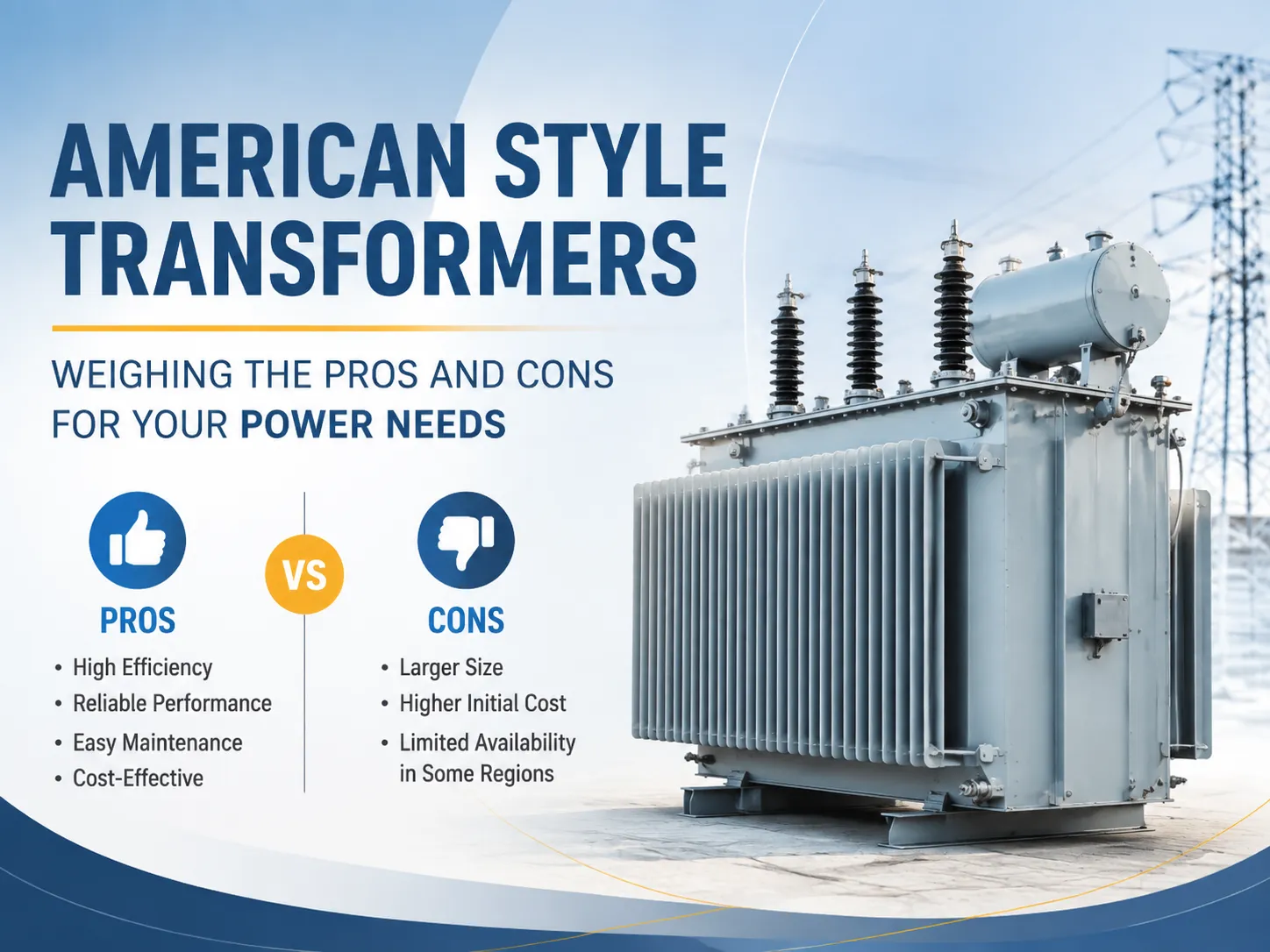
¿Qué son los transformadores de estilo americano?
Los transformadores de estilo americano son un tipo de transformadores de distribución que están diseñados para seguir los principios eléctricos; frecuencia de 60 Hz, especificaciones ANSI/IEEE y diseños prescritos por las compañías eléctricas norteamericanas. Este término puede referirse a transformadores montados en postes monofásicos, transformadores montados en bases monofásicos y trifásicos, transformadores secos utilizados en edificios y transformadores de aceite utilizados por las empresas de servicios públicos. Los transformadores de estilo americano se crean de acuerdo con sus propios estándares, a diferencia de los transformadores de estilo IEC; por esa razón, los nombres de los transformadores, tipo de refrigeración, impedancia, rango de tomas y forma del tanque no pueden ser los mismos que los del equipo que cumple con IEC 60076.
Para un comprador industrial, la diferencia práctica con otros tipos de transformadores es más significativa en el punto de salida. De hecho, el transformador americano debería adaptarse bastante fácilmente a una línea de potencia de 12.47 o 24.9 kV, por lo que proporciona una salida de 120/240 V o 277/480 V y funciona de acuerdo con los requisitos locales. Los productores y distribuidores con sede en EE. UU. prefieren usar transformadores americanos, ya que el resto del equipo para los proyectos de operación a 60 Hz se desarrolla de acuerdo con este esquema.
Los estándares que los definen: IEEE C57, ANSI, NEMA
En contraste con el equipo IEC que está regulado principalmente por la serie de especificaciones IEC 60076, los transformadores americanos están regulados por un conjunto de documentos norteamericanos. Entre estos documentos de importancia se encuentran:
- IEEE C57.12.20, que especifica las pautas para transformadores de distribución montados en la parte superior y en la base, tratando específicamente el diseño de transformadores monofásicos y trifásicos con niveles de rendimiento que oscilan entre 5 kVA y 500 kVA.
- IEEE C57.12.00 describe las especificaciones para transformadores llenos de líquido, como el transformador de distribución, el transformador regulador y el transformador de potencia.
- La publicación IEEE C57.12.90 especifica los estándares de prueba de transformadores desde pruebas de diseño hasta pruebas de rutina.
- NEMA TP-1 establece los estándares para medir el nivel de eficiencia de transformadores de distribución secos y llenos de líquido en América del Norte.
- UL 1561 / UL 1562 son los estándares de seguridad que se mencionan en el caso de transformadores secos y líquidos en los EE. UU. y Canadá.
Estos documentos no son solo documentos, ya que conducen a decisiones de ingeniería. Por ejemplo, establecen que la temperatura para los devanados no debe ser superior a 65 grados, los tomas fuera de circuito deben estar al nivel de +/-2*2.5%, el nivel de impulso básico necesita ser diseñado para cada clase de voltaje, y los transformadores líquidos deben pasar pruebas dieléctricas y de cortocircuito, de acuerdo con los estándares ANSI. Si compras transformadores americanos de cualquier empresa, cumplirán con estas prácticas.
Cómo Funcionan los Transformadores de Estilo Americano
El principio fundamental involucrado es el mismo que el de cualquier transformador: la ley de Faraday se aplica entre el devanado primario y el secundario en un núcleo de acero silicio laminado. Lo que distingue a los transformadores de tipo americano es la disposición del sistema en sí. A 60 Hz, una cierta combinación del núcleo y su devanado tiene diferentes pérdidas de inducción y características de vacío que a 50 Hz, lo que significa que está optimizado para la red norteamericana. Los transformadores monofásicos son probablemente los más utilizados porque el método de distribución en los EE. UU. es monofásico, lo que significa que el voltaje es igual a 120/240 V en sus tomas secundarias. Los transformadores trifásicos se utilizan en la industria, reduciendo voltajes de 12.47, 13.8 o 24.9 kV a 120/208 V o 277/480 V.
La mayoría de los dispositivos contienen cambiadores de tomas bajo carga, generalmente ±2 × 2.5%, lo que asegura que una empresa de servicios públicos pueda hacer un ajuste al voltaje en el momento de la instalación del dispositivo. Sin embargo, los transformadores montados en la base están equipados con una construcción de frente muerto, lo que significa que todas las partes vivas del dispositivo están ocultas dentro del tanque o en codos aislados, de modo que es fácil para el personal de la empresa de servicios operar los interruptores con un palo aislante, garantizando la seguridad del público en general.
Tipos Principales y Clasificaciones
| Tipo | Rango de clasificación | Primario / secundario típico | Donde se utiliza |
|---|---|---|---|
| Montado en poste monofásico | 5–167 kVA | 2–14.4 kV / 120-240 V | Subdivisiones residenciales, alimentadores rurales |
| Montado en base monofásico | 25–167 kVA | 47 kV / 120-240 V | Distribución residencial subterránea |
| Montado en base trifásico | 75–2,500 kVA | 47–24.9 kV / 208 V, 480 V | Parques comerciales, pequeña industria, solar |
| Tipo subestación trifásica | 500–5,000 kVA | 47–34.5 kV / 480 V-4.16 kV | Plantas industriales, subestaciones de servicios públicos |
| Tipo seco (ventilado / encapsulado) | 15–1,000 kVA | 480 V / 208 V, 240 V, 600 V | Edificios comerciales e institucionales interiores |
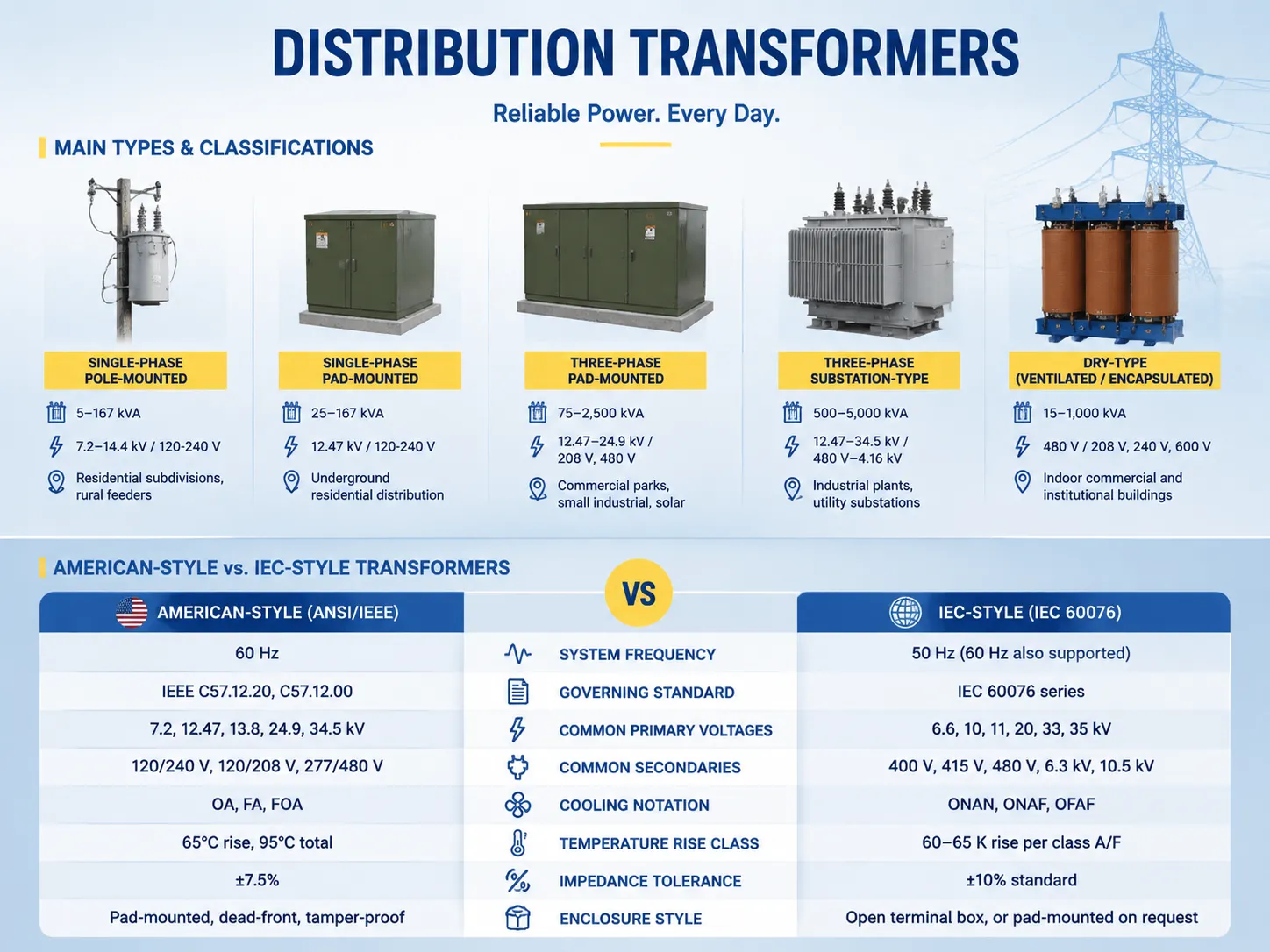
Transformadores de estilo americano vs. transformadores de estilo IEC
| Aspecto | Estilo americano (ANSI/IEEE) | Estilo IEC (IEC 60076) |
|---|---|---|
| Frecuencia del sistema | 60 Hz | 50 Hz (60 Hz también soportado) |
| Norma reguladora | IEEE C57.12.20, C57.12.00 | Serie IEC 60076 |
| Voltajes primarios comunes | 2, 12.47, 13.8, 24.9, 34.5 kV | 6, 10, 11, 20, 33, 35 kV |
| Secundarias comunes | 120/240 V, 120/208 V, 277/480 V | 400 V, 415 V, 480 V, 6.3 kV, 10.5 kV |
| Notación de enfriamiento | OA, FA, FOA | ONAN, ONAF, OFAF |
| Clase de aumento de temperatura | Aumento de 65°C, total de 95°C | Aumento de 60–65 K por clase A/F |
| Tolerancia de impedancia | ±7.5% | ±10% estándar |
| Estilo de envolvente | Montado en base, frente muerto, a prueba de manipulaciones | Caja de terminales abierta, o montada en base a solicitud |
El hecho es que una familia no puede ser simplemente intercambiada por otra. Un ANSI de 12.47 kV no encajaría en un sistema IEC de 10 kV y una salida de 120/240 V no puede conectarse a un tablero europeo de 230/400 V. Las diferencias de frecuencia también marcan la diferencia: un transformador de 60 Hz funcionando en 50 Hz se sobrecalentará porque el núcleo se saturará. Un transformador de 50 Hz funcionando con energía de 60 Hz generalmente funciona con pérdida pero con algún cambio en la impedancia. Asegúrese de comprar una familia que sea compatible con su red.
Los Pros y los Contras: Lo que Ganas, Lo que Pagas
En el lado positivo del balance, las unidades de estilo americano están diseñadas para la red que sirven y para las normas de seguridad de los mercados en los que operan:
| Ventaja | Lo que significa en la práctica |
|---|---|
| Compatibilidad directa con la red | Se integra en redes de 60 Hz, clase de 12.47 kV sin necesidad de reingeniería de alimentadores, equipos de conmutación o protección. |
| Normas probadas y maduras | IEEE C57.12.20 y C57.12.00 tienen décadas de datos de campo detrás de ellas; las expectativas de diseño y prueba son inequívocas. |
| Seguridad pública | Las envolventes montadas en base, a prueba de manipulaciones y de frente muerto cumplen con las normas de seguridad de las utilidades en áreas residenciales. |
| Intercambiabilidad | Las clasificaciones y dimensiones estándar significan que los reemplazos y repuestos de diferentes marcas se ajustan al stock existente de la utilidad. |
| Accesorios fácilmente disponibles | Aisladores, terminadores en codo, pararrayos, manijas de toma y paquetes de monitoreo están estandarizados en el mercado. |
En el lado negativo, vemos muchos inconvenientes que también deben ser considerados en el proceso de toma de decisiones.
- Gasto por kVA. La presencia de un tanque, envolvente de frente muerto, configuración de aislador ANSI y la necesidad de seguir un proceso de prueba específico generalmente conduce a un aumento de precio del 15–40% en comparación con un transformador IEC del mismo tipo.
- Diseño solo para 60Hz. Un transformador americano no puede ser utilizado en una configuración de 50Hz, lo cual es importante tener en cuenta si la planta está ubicada en un país de uso de 50Hz.
- La carga de certificación. Muchos proyectos en EE. UU. requerirán certificación UL o CSA o una inspección de terceros por parte de la compañía de servicios públicos, lo que requerirá gastos adicionales y tomará una cantidad considerable de tiempo.
- Sesgo de fase única. El hecho de que el suministro residencial sea de fase única pone a los compradores con un requerimiento de tres fases en peligro de ordenar una unidad de 3 fases en lugar del modelo en alta demanda.
- Tiempo de entrega de proveedores nacionales. En los últimos años, los tiempos de entrega para las unidades montadas en base en América del Norte han estado entre 20 y 50 semanas.
Especificaciones y tabla de clasificación típicas
| Clasificación (kVA) | Clase de voltaje | Pérdida típica en vacío (W) | Pérdida típica en carga (W) | Impedancia | Peso típico (kg) |
|---|---|---|---|---|---|
| 25 (1-fase) | 47 kV / 240 V | ~80–110 | ~350–500 | 1.8–2.5% | 180–260 |
| 75 (3-fase) | 47 kV / 480 V | ~180–250 | ~900–1,200 | 1.7–3.5% | 450–600 |
| 300 (3-fases) | 9 kV / 480 V | ~450–600 | ~2,800–3,600 | 4–5% | 1,200–1,600 |
| 1,000 (3-fases) | 9 kV / 480 V | ~1,100–1,500 | ~8,000–10,500 | 5–5.75% | 3,200–4,200 |
| 2,500 (3-fases) | 5 kV / 480 V | ~2,300–3,000 | ~18,000–24,000 | 5.75–6.5% | 6,500–8,500 |
Los valores de pérdida sirven como rangos representativos para equipos llenos de aceite mineral; los diseños que cumplen con la eficiencia premium NEMA TP-1 tienen pérdidas más bajas, mientras que los diseños personalizados pueden diferir. Siempre solicite la garantía de pérdida en vacío y en carga según lo especificado en un informe de prueba antes de comparar las cotizaciones disponibles.
Aplicaciones Comunes
Los transformadores americanos se utilizan en toda la jerarquía del sistema de distribución de 60 Hz. Las compañías de servicios públicos implementaron transformadores en postes para proporcionar energía a casas y pequeñas granjas, y la distribución residencial subterránea (URD) se suministró con transformadores montados en base de fase única periódicamente a lo largo de la calle. En parques empresariales y zonas industriales, el uso de transformadores montados en base de tres fases es común, mientras que las fábricas eligen transformadores para convertir voltaje a 480 V. Estados Unidos y Canadá ampliaron el alcance de los transformadores cuidadosamente diseñados y comenzaron a exportarlos a los países de América Latina, México, el Caribe, el Medio Oriente y las Islas del Pacífico. La tecnología también se aplica ampliamente en plantas fotovoltaicas construidas de acuerdo con los estándares ANSI. Si su proyecto sigue las normas IEEE C57 o asume los voltajes de 12.47 kV / 277-480 V, se deben considerar los transformadores americanos en la especificación.
Principales marcas y rangos de precios
| Marca | País | Enfoque típico del producto | Rango de precios indicativo (FOB, US$) |
|---|---|---|---|
| ABB | Suiza/Suecia | Rango completo, unidades montadas en base y de subestación | $3,000–$60,000 |
| Hitachi Energy | Suiza | Transformadores de distribución de grado utilitario | $3,500–$70,000 |
| Siemens | Alemania | Unidades comerciales de tipo seco y llenas de líquido | $2,500–$50,000 |
| Schneider Electric | Francia | Rangos de tipo seco y montados en base | $2,000–$45,000 |
| Eaton | EE. UU. | Líneas de tipo seco, montadas en base, energéticamente eficientes | $1,500–$40,000 |
| Prolec GE | EE. UU./México | Transformadores de distribución para servicios públicos de EE. UU. | $2,000–$55,000 |
| Transformador de Virginia | EE. UU. | Unidades personalizadas de tipo seco y llenas de líquido | $2,800–$48,000 |
| Jiangsu Subian Electric Power | China | Transformadores de distribución ANSI/IEEE e IEC | $1,200–$38,000 |
Los transformadores americanos se despliegan a lo largo de todo el nivel del sistema de distribución de 60 Hz. Las compañías de servicios públicos implementaron transformadores en postes para proporcionar energía a casas y pequeñas granjas, y la distribución residencial subterránea (URD) se suministró con transformadores montados en base de fase única periódicamente a lo largo de la calle. En parques empresariales y zonas industriales, el uso de transformadores montados en base de tres fases es común, mientras que las fábricas cLos siguientes son los precios indicativos para FOB para configuraciones estándar para el año 2026 con algunas variaciones debido a las clasificaciones, clase de voltaje, arreglos de tomas, método de enfriamiento y el tipo de certificación otorgada a ellos. Hay muchos fabricantes de transformadores como ABB, Hitachi Energy, Siemens, Schneider, Eaton y Prolec GE que producen excepcionales transformadores americanos y sus documentos de ingeniería que establecen estándares de calidad. Para aquellos compradores que desean buscar transformadores similares que cumplan con IEEE C57.12.20 y sean más beneficiosos en términos de precio, Jiangsu Subian Electric Power Co., Ltd es una buena opción. La empresa produce los transformadores estándar de 60 Hz para cumplir con las especificaciones ANSI e IEEE, proporcionando transformadores de frente muerto e inspección de terceros. La empresa exportó sus transformadores a más de países receptores como EE. UU., México, el Caribe y Medio Oriente.
Elija transformadores para convertir el voltaje a 480 V. Estados Unidos y Canadá ampliaron el alcance de los transformadores cuidadosamente diseñados y comenzaron a exportarlos a los países de América Latina, México, el Caribe, Medio Oriente y las Islas del Pacífico. La tecnología también se aplica ampliamente en plantas fotovoltaicas construidas de acuerdo con los estándares ANSI. Si su proyecto sigue las normas IEEE C57 o asume los voltajes de 12.47 kV / 277-480 V, se deben considerar los transformadores americanos en la especificación. Puede revisar la capacidad de fabricación de la empresa en el sitio web de Jiangsu Subian Electric Power.
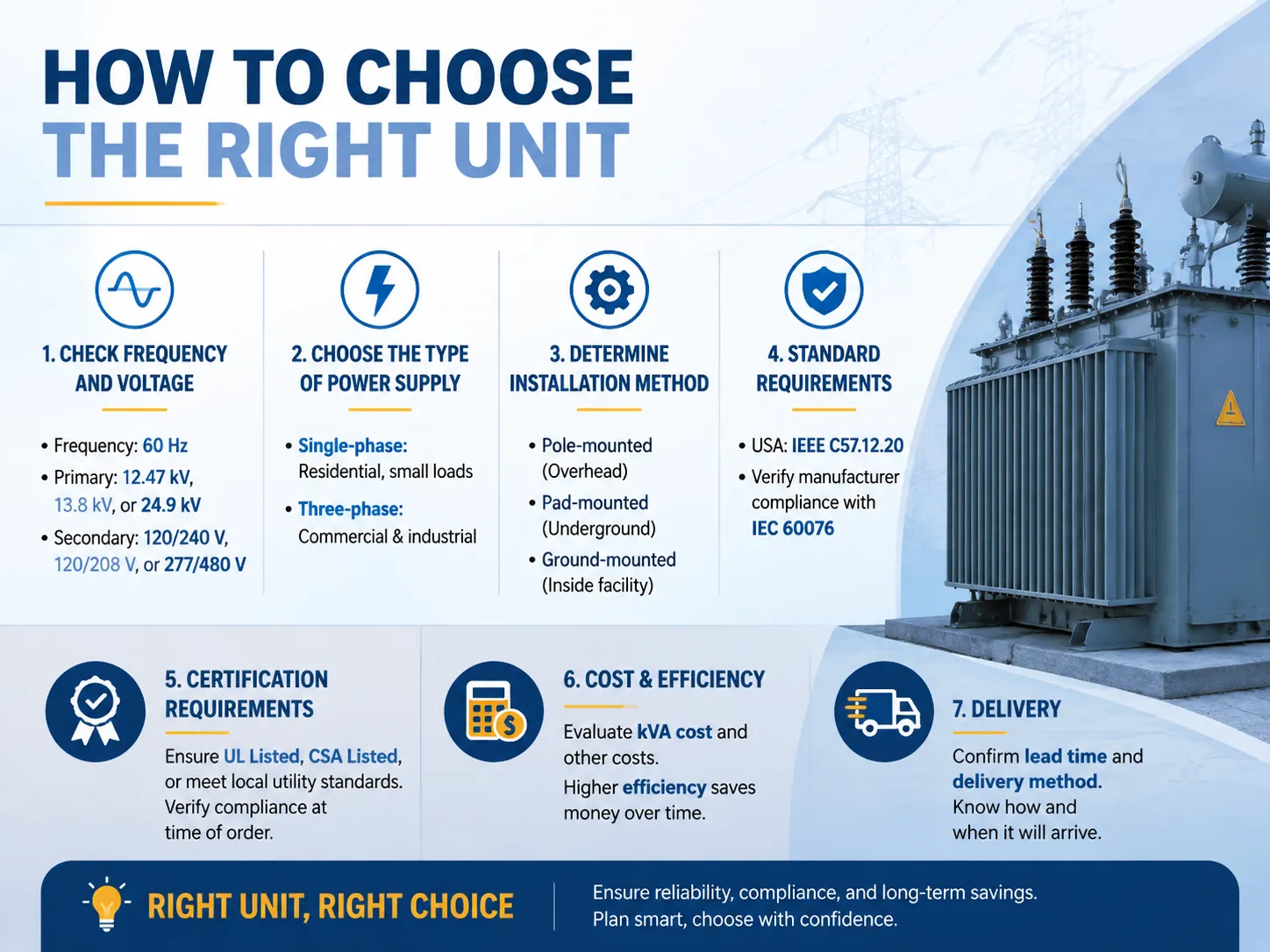
Cómo Elegir la Unidad Correcta
- Verifique la frecuencia y el voltaje del sistema para confirmar. La frecuencia correcta para un sistema que opera en América es de 60 Hz; verifique tanto el voltaje primario (12.47 kV, 13.8 kV o 24.9 kV) como el voltaje secundario (120/240 V, 120/208 V o 277/480 V).
- Elija el tipo de suministro de energía. Un suministro de energía monofásico es adecuado para áreas residenciales con pequeñas necesidades de energía, mientras que se necesita uno trifásico para aplicaciones comerciales e industriales.
- Determine cómo se instalará el sistema, ya sea en un poste para instalación aérea, en una base para instalación subterránea o en el suelo dentro de la instalación.
- Determine las opciones estándar requeridas. Para EE. UU., se necesita la norma IEEE C57.12.20; verifique si el fabricante podrá cumplir con IEC 60076.
- Asegúrese de verificar los requisitos de certificación. El sistema puede necesitar estar listado por UL, listado por CSA o cumplir con los estándares de la empresa eléctrica local; verifique que habrá cumplimiento en el momento de realizar el pedido.
- Determine el costo de kVA y otros costos involucrados; considere la eficiencia del sistema también, ya que una unidad costosa y eficiente en energía ahorrará dinero con el tiempo.
- Asegúrese de saber cuánto tiempo tomará la entrega y cómo se entregarán las libras.
Preguntas Frecuentes
¿Puede un transformador de estilo americano funcionar en una red de 50 Hz?
No, no de manera segura. Un transformador diseñado para 60 Hz tiene el núcleo y los devanados configurados para esa frecuencia; usar ese transformador a 50 Hz aumenta la densidad de flujo del núcleo en aproximadamente 20%, requiriendo corriente de magnetización adicional que puede causar sobrecalentamiento y falla prematura del aislamiento. Si su sistema de energía opera a 50 Hz, obtenga un transformador IEC 60076 diseñado para 50 Hz. Un transformador de 50 Hz generalmente puede trabajar con 60 Hz con resultados satisfactorios (menos pérdidas y una impedancia ligeramente diferente), sin embargo, la operación inversa no se recomienda.
¿Cuál es el tiempo de entrega típico para un transformador montado en base en 2026?
Dependiendo del fabricante, los proveedores nacionales en los Estados Unidos han informado tiempos de entrega de 20-50 semanas para unidades montadas en base. Para unidades importadas de fabricantes que vienen con configuraciones estándar, como Jiangsu Subian Electric Power, los tiempos de entrega generalmente oscilarán entre 4-10 semanas, además de tiempos de flete de 2-6 semanas, dependiendo del puerto de entrega.
¿Cuánto cuesta un transformador de estilo americano?
Como referencia, una unidad monofásica de 25 kVA montada en poste cuesta aproximadamente $1,200, una unidad trifásica de 75 kVA montada en base cuesta aproximadamente $3,500 a $7,500, una unidad de 300 kVA montada en base cuesta aproximadamente $8,000 a $16,000, y una unidad de 1,000 kVA cuesta aproximadamente $15,000 a $35,000. Estos precios pueden variar según la marca, impedancia, esquema de tomas y certificación, por lo tanto, siempre solicite una cotización que coincida con las especificaciones.
¿Necesito la certificación UL para un transformador de estilo americano importado?
Depende del comprador y de la jurisdicción. Algunas utilidades y códigos de construcción de EE. UU. requieren la certificación UL 1561/UL 1562 o una certificación de terceros equivalente, mientras que otras dan crédito por el cumplimiento de IEEE C57.12.20 junto con una prueba presenciada o un informe de inspector. Antes de comprometerse, siempre verifique con su ingeniero de servicios públicos y confirme qué opciones de certificación puede ofrecer el fabricante.
¿Son aceptados los transformadores de estilo americano construidos en China por las utilidades de EE. UU.?
Cuando se cumplen las especificaciones, es preciso decir que las utilidades aceptarán equipos importados. Los proveedores de electricidad aceptan equipos que cumplen con los requisitos de IEEE C57.12.20, han sido sometidos a una prueba de fábrica observada por la utilidad o un tercero y tienen la documentación necesaria. Subtrans ha vendido transformadores compatibles con ANSI de 60 hertz a compradores en Canadá y EE. UU. bajo esas condiciones. Por lo tanto, la aceptación depende de la documentación y las pruebas y no del lugar de producción.
Referencias
- IEEE C57.12.20 — Norma para Transformadores de Distribución Aéreos y Montados en Base — la especificación principal para transformadores de distribución de estilo americano.
- IEEE C57.12.00 — Requisitos Generales para Transformadores de Distribución, Potencia y Regulación Sumergidos en Líquido — define la clasificación, pérdidas y base de pruebas para la práctica en EE. UU.
- NEMA TP-1 — Guía para Determinar la Eficiencia Energética de Transformadores de Distribución — el punto de referencia de eficiencia en América del Norte mencionado en las adquisiciones de EE. UU.
- UL 1561 — Norma para Transformadores de Potencia de Tipo Seco de Uso General — listado de seguridad comúnmente requerido para instalaciones comerciales.
- IEC 60076-1 — Transformadores de Potencia, General — la base de referencia de la IEC utilizada para comparación y para proyectos de exportación que operan a 50 Hz.
- Eaton — Información del Producto de Transformadores — documentación representativa de fabricantes de América del Norte para comparación.
Conclusión
La respuesta a su necesidad de transformadores que sean compatibles con su red eléctrica que opera a 60 Hz y estándares ANSI/IEEE, utilizando servicios de 120/240 V o 277/480 V radica en el uso de transformadores de estilo americano. Los transformadores de estilo americano aseguran que sus proyectos cumplan con las precauciones y estándares de seguridad pública requeridos en los Estados Unidos, América Latina y el Caribe. Sin embargo, hay desventajas en este tipo de transformadores, como el hecho de que son más costosos en términos de kVA y la necesidad de someterse a procesos de certificación complejos. Para evitar las desventajas de los transformadores de estilo americano, aquellos que buscan comprarlos deben determinar su voltaje, frecuencia, configuración de montaje y requisitos de certificación antes de hacer comparaciones entre las ofertas que reciben. Jiangsu Subian Electric Power fabrica transformadores de estilo americano que cumplen con las normas IEEE C57.12.20, lo que asegura que los clientes solo paguen precios razonables directos de fábrica mientras obtienen resultados de pruebas completamente documentados. Para obtener una cotización ajustada a la especificación para su próximo proyecto de 60 Hz, comuníquese con la empresa a través del página web oficial.